


Questions
8 questionsShowing 1–8 of 8 questions
-
- (A) A, B and D Only
- (B) C and E Only
- (C) A, C and E Only
- (D) B, C and D Only
Show answer and solution
Correct Answer: (C)
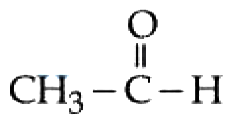
Name of Reaction Acetaldehyde Acetone A. Iodoform reaction ✓ ✓ B. Cannizaro reaction × × C. Aldol reaction ✓ ✓ D. Tollen's test ✓ × E. Clemmensen reduction ✓ ✓ -
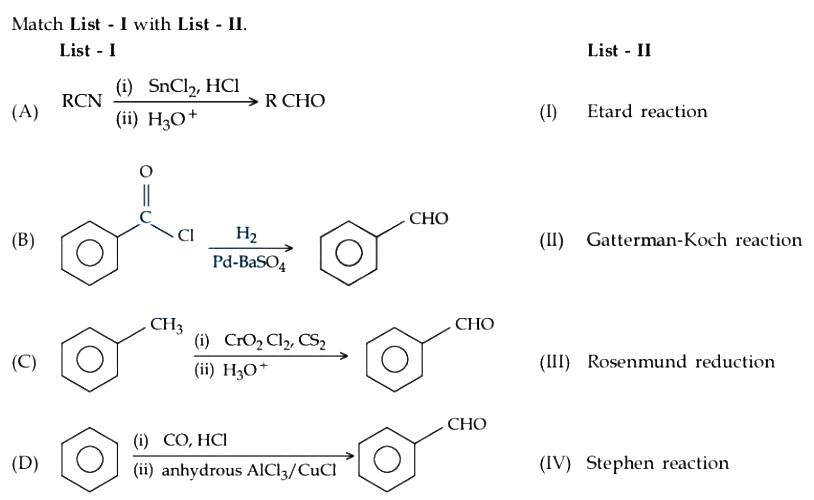
- (A) (A)-(III), (B)-(IV), (C)-(II), (D)-(I)
- (B) (A)-(I), (B)-(III), (C)-(II), (D)-(IV)
- (C) (A)-(III), (B)-(IV), (C)-(I), (D)-(II)
- (D) (A)-(IV), (B)-(III), (C)-(I), (D)-(II)
Show answer and solution
Correct Answer: (D)
(A) \(\mathrm{RCN} \xrightarrow[\text { (i) } \mathrm{H}_3 \mathrm{O}^{+}]{\text {(i) } \mathrm{SnCl}_2, \mathrm{HCl}} \mathrm{RCHO}\)
Stephen reaction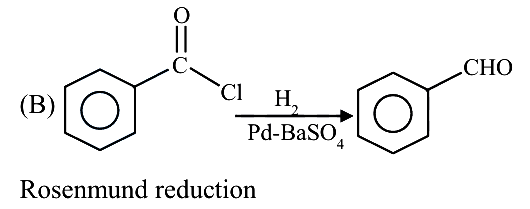
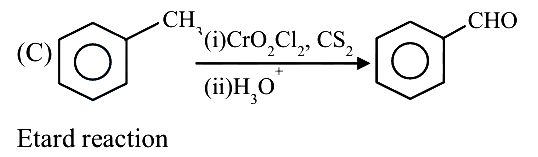
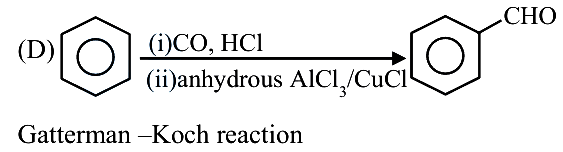
-
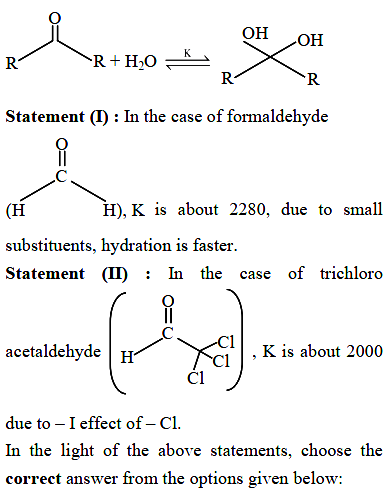
- (A) Both Statement I and Statement II are false
- (B) Statement I is true but Statement II is false
- (C) Statement I is false but Statement II is true
- (D) Both Statement I and Statement II are true
Show answer and solution
Correct Answer: (D)
\(\mathrm{k}_{\mathrm{eq}}=2280\) is for HCHO
\(\mathrm{k}_{\text {eq }}=2000\) is for chloral
Both data is given in clayden and warren book.
\(\mathrm{k}_{\mathrm{eq}}>1\) because HCHO and chloral are more electrophilic. -
- (A) Statement I is incorrect but Statement II is correct
- (B) Statement I is correct but Statement II is incorrect
- (C) Both Statement I and Statement II are incorrect
- (D) Both Statement I and Statement II are correct
Show answer and solution
Correct Answer: (B)
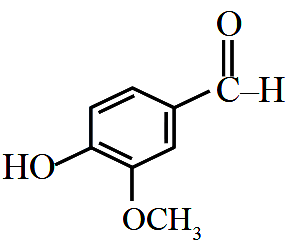
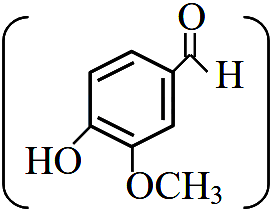
Phenolic group soluble in NaOH
Benzaldehyde derivative react with Tollen's reagent.
Vanillin does not give self-aldol reaction due to lack of acidic H for condensation. -
- (A) 5
- (B) 6
- (C) 7
- (D) 8
Show answer and solution
Correct Answer: (C)
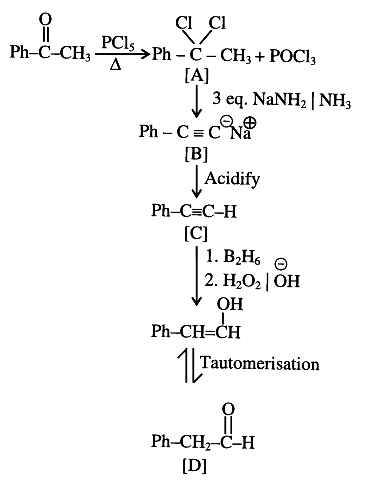
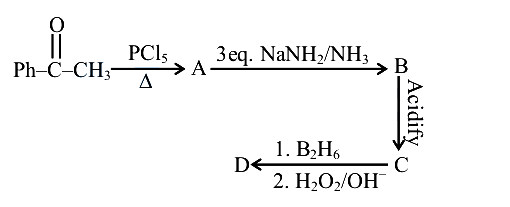
\(\Rightarrow\) Number of \(\mathrm{sp}^2 \mathrm{C}\)-atoms in product \(\mathrm{D}=7\)
NTA Ans. \(=7\)
ALLEN Ans. \(=7\) -
- (A) 5
- (B) 4
- (C) 3
- (D) 2
Show answer and solution
Correct Answer: (B)
Following will not give iodoform reaction/test.
(1) Butanal
(2) 3-Pentanone
(3) Pentanal
(4) 3-Pentanol -
- (A) (A), (D) and (E) Only
- (B) (C), (D) and (E) Only
- (C) (A), (C) and (D) Only
- (D) (A), (B) and (C) Only
Show answer and solution
Correct Answer: (B)
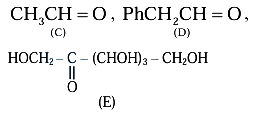
All gives positive Fehling test - 8. Which of the following arrangements with respect to their reactivity in nucleophilic addition reaction is correct? 2025 Easy
- (A) acetophenone \( \lt \) benzaldehyde \( \lt \) p-tolualdehyde \( \lt \) p- nitrobenzaldehyde
- (B) benzaldehyde \( \lt \) acetophenone \( \lt \) p- nitrobenzaldehyde \( \lt \) p-tolualdehyde
- (C) p- nitrobenzaldehyde \( \lt \) benzaldehyde \( \lt \) p-tolualdehyde \( \lt \) acetophenone
- (D) acetophenone \( \lt \) p-tolualdehyde \( \lt \) benzaldehyde \( \lt \) p- nitrobenzaldehyde
Show answer and solution
Correct Answer: (D)
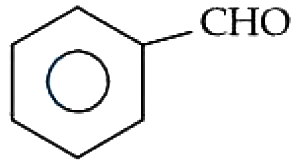
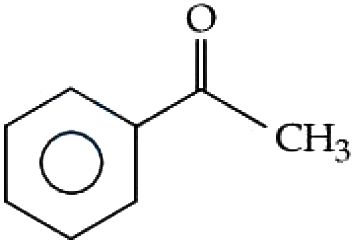
Reactivity \(\propto+\mathrm{ve}\) charge on electrophilic carbon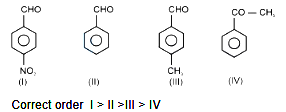
No questions on this page match these filters.