


Chapters asked in 2022
26 chapters- 18Qs STD 11 Organic chemistry purification and characterization
- 27Qs STD 12 D and f- block elements Most asked
- 6Qs STD 11 Redox reactions
- 12Qs STD 12 Biomolecules
- 16Qs STD 11 Equilibrium - II (icon Equilibrium)
- 22Qs STD 12 Chemical kinetics
- 4Qs STD 11 Organic chemistry reaction mechanism
- 9Qs STD 12 Amines
- 6Qs STD 12 Carboxylic acids and their derivative
- 1Qs STD 12 Aldehydes and ketones
- 5Qs STD 12 Alcohol, phenol and ethers
- 3Qs STD 12 Haloalkanes and Haloarenes
- 1Qs STD 11 Organic chemistry isomerism
- 27Qs STD 12 Co-ordination chemistry Most asked
- 26Qs STD 12 P -Block elements - ll
- 19Qs STD 12 Electrochemistry
- 18Qs STD 12 Solution and colligative properties
- 27Qs STD 11 Some basic concept of chemistry Most asked
- 6Qs STD 11 Hydricarbon
- 3Qs STD 11 Organic chemistry Nomenclature of organic compounds
- 17Qs STD 11 Chemical bonding and molecular structure
- 18Qs STD 11 Classification of elements and periodicity in properties
- 7Qs STD 11 Equilibrium - 1 (chemical Equilibrium)
- 23Qs STD 11 Thermodynamics and thermochemistry
- 8Qs STD 11 P-Block elements - I
- 22Qs STD 11 Structure of atom
All JEE Mains 2022 Chemistry questions
26 chaptersShowing 1–50 of 351 questions
-
- (A) \(14\)
- (B) \(21\)
- (C) \(18\)
- (D) \(56\)
Show answer and solution
Correct Answer: (A)
weight of organic compound \(=0.2\, g\)\(\text { mass of } N _{2}( g ) \text { evolved }=\frac{22.4 \times 10^{-3}}{22.4} \times 28\)
\(=28 \times 10^{-3} \,g\)
\(\% \text { of } N =\frac{28 \times 10^{-3}}{0.2} \times 100=14\)
-
- (A) \(40\)
- (B) \(140\)
- (C) \(80\)
- (D) \(143\)
Show answer and solution
Correct Answer: (A)
wt. of organic compound \(=0.25 \,g\)mass of \(Cl =\frac{35.5}{143.5} \times 0.4\, g\)
mass \(\%\) of \(Cl\) in the organic compound
\(=\frac{35.5 \times 0.4}{143.5 \times 0.25} \times 100\)
\(=39.58 \,\%\)
-
- (A) \(22\)
- (B) \(23\)
- (C) \(21\)
- (D) \(20\)
Show answer and solution
Correct Answer: (A)
\(V =22.78\,ml , T =280\,K\)\(P _{\text {total }}=759\,mmHg\)
\(P _{ N _{2}}=759-14.2=744.8\,mmHg\)
\(n _{ N _{2}}=\frac{744.8 \times 22.78}{760 \times 1000 \times 0.082 \times 280}=0.00097\)
\(W _{\text {Nitrogen }}=0.02716\)
\(\% N =\frac{0.02716}{0.125} \times 1000=21.728\)
-
- (A) Dimethylglyoxime and \(Ni ^{2+}\)
- (B) Dimethylglyoxime and \(Co ^{2+}\)
- (C) Nessler's reagent and \(Hg ^{2+}\)
- (D) Nessler's reagent and \(Ni ^{2+}\)
Show answer and solution
Correct Answer: (A)
\(Ni ^{2+}+ DMG ^{-} \rightarrow\left[ Ni ( DMG )_{2}\right] \downarrow\)(Bright red precipitate)
-
- (A) \(\left[ Fe \left( H _{2} O \right)_{6}\right]_{2}\left[ Fe ( CN )_{6}\right]\)
- (B) \(Fe _{2}\left[ Fe ( CN )_{6}\right]_{2}\)
- (C) \(Fe _{3}\left[ Fe ( OH )_{2}( CN )_{4}\right]_{2}\)
- (D) \(Fe _{4}\left[ Fe ( CN )_{6}\right]_{3}\)
Show answer and solution
Correct Answer: (D)
\(4 Fe ^{3+}+3\left[ Fe ( CN )_{6}\right]^{-4} \underset{\text { Prussian Blue }}{\longrightarrow} Fe _{4}\left[ Fe ( CN )_{6}\right]_{3}\) -
- (A) Both \(A\) and \(R\) are true and \(R\) is the correct explanation of \(A.\)
- (B) Both \(A\) and \(R\) are true but \(R\) is \(NOT\) the correct explanation of \(A\)
- (C) \(A\) is true but \(R\) is false
- (D) \(A\) is false but \(R\) is true
Show answer and solution
Correct Answer: (A)
Theory basedThin layer chromoatography \((TLC)\) is another type of adsorption chromatography, which involve sepration of substance of a mixture ovel a thin layer of an adsorbent coated on glass plate. A thin layer (about \(0.2\,mm\) thick) of an adsorbent (silica gel) or (Alumina) in spread overa glass plate of suitable size. Hence Assertion \((A)\) is correct and Reason \((R)\) is correct explanation of \((A)\)
-
- (A) Both Statement \(I\) and Statement \(II\) are correct.
- (B) Both Statement \(I\) and Statement \(II\) are incorrect.
- (C) Statement \(I\) is correct but Statement \(II\) is incorrect.
- (D) Statement \(I\) is incorrect but Statement \(II\) is correct.
Show answer and solution
Correct Answer: (A)
Both statement \(I\) and statement \(II\) are correct. -
- (A) \(34.04 \%\)
- (B) \(40.04 \%\)
- (C) \(36.03 \%\)
- (D) \(38.04 \%\)
Show answer and solution
Correct Answer: (A)
Mass of organic compound \(=0.45\,gm\)Mass of \(AgBr\) obtained \(=0.36\,gm\)
\(\therefore\) Moles of \(AgBr =\frac{0.36}{188}\)
\(\therefore\) Mass of Bromine \(=\frac{0.36}{188} \times 80=0.1532\,gm\)
\(\therefore \% Br\) in compound \(=\frac{0.1532}{0.45} \times 100=34.04 \%\)
-
- (A) \(340\)
- (B) \(90\)
- (C) \(188\)
- (D) \(34\)
Show answer and solution
Correct Answer: (D)
\(O . C \longrightarrow AgBr\)\(0.5\, g \quad 0.4\, g\)
\(mol\) of \(Br = mol\) of \(AgBr =\frac{0.4}{188}\)
\(\%\, Br =\%\, Br =\frac{\frac{0.4}{188} \times 80}{0.5} \times 100\)
\(=34.04\, \%\)
-
- (A) \(1\)
- (B) \(84\)
- (C) \(32\)
- (D) \(64\)
Show answer and solution
Correct Answer: (D)
Meq of \(H _{2} SO _{4}\) used by \(NH _{3}=12.5 \times 1 \times 2=25\)\(\%\) of \(N\) in the compound \(=\frac{25 \times 10^{-3} \times 14 \times 100}{0.55}=63.6\)
-
- (A) \((A)-(IV), (B)-(III), (C)-(I), (D)-(II)\)
- (B) \((A)-(III), (B)-(I), (C)-(IV), (D)-(II)\)
- (C) \((A)-(III), (B)-(IV), (C)-(II), (D)-(I)\)
- (D) \((A)-(III), (B)-(IV), (C)-(I), (D)-(II)\)
Show answer and solution
Correct Answer: (D)
\((A)\) Chloroform + Aniline \(\rightarrow\) \((III)\) Distillation\((B)\) Benzoic acid + Napthalene \(\rightarrow\) \((IV)\) Crystallisation
\((C)\) Water + Aniline \(\rightarrow\) \((I)\) Steam distillation
\((D)\) Napthalene + Sodium chloride \(\rightarrow\) \((II)\) Sublimation
-
- (A) \(18\)
- (B) \(180\)
- (C) \(65\)
- (D) \(74\)
Show answer and solution
Correct Answer: (A)
\(C _{ x } HyOz +\left( x +\frac{ y }{4}-\frac{ z }{2}\right) O _{2} \rightarrow xCO _{2}+\frac{ y }{2} H _{2} O\)\(0.3g\quad\quad\quad\quad\quad\quad\quad\quad0.2g\quad\quad\quad0.1g\)
\(\frac{ n _{ CO _{2}}}{ n _{ H _{2} O }}=\frac{ x }{ y / 2}=\frac{0.2 / 44}{.1 / 18}\)
\(\frac{2 x }{ y }=\frac{36}{44}=\frac{9}{11}\)
\(x =\frac{9 y }{22}\)
\(\frac{ n _{ C _{ x } H _{ y } O_{ z } }}{ nCO _{ 2 } }=\frac{1}{ x }\)
\(\frac{0.3 }{12 x + y +16 z } \times \frac{44}{0.2}=\frac{1}{ x }\)
\(66 x =12 x + y +16 z\)
\(54 x = y +16 z\)
\(\frac{54 \times 9 y }{22}- y =16 z\)
\(\frac{464 y }{22}=16 z\)
\(z =\frac{29 y }{22}\)
\(C _{ x } H _{ y } O _{z}= C _{ x } H _{ y } O _{z}\)
\(C _{\frac{9 y}{22}} H _{ y } O _{\frac{29 y}{22}}^{22}\)
\(C _{9} H _{22} O _{29}\)
\(\,\%\) of \(C =\frac{12 \times 9}{(12 \times 9+22+29 \times 16)} \times 100=\frac{108}{594} \times 100\)
\(18.18 \,\%\)
-
- (A) \(46\)
- (B) \(44\)
- (C) \(43\)
- (D) \(42\)
Show answer and solution
Correct Answer: (A)
\(0.492\,g\) of \(C _{ x } H _{ y } O _{z}\)Gives \(0.7938\,g\,CO _{2}=0.018\) moles
\(0.4428\,g\,H _{2} O =0.0246\) moles
So moles of \(C =0.018 \Rightarrow 0.216\,g\)
Moles of \(H =0.049 \Rightarrow 0.049\,g\)
\(\therefore\) wt. of Oxygen \(=0.492-0.216-0.049\)
\(\%\) of Oxygen \(=\frac{0.227}{0.492} \times 10046\) (approx.)
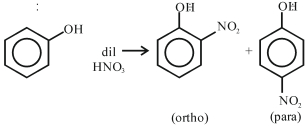
- 14. Phenol on reaction with dilute nitric acid, gives two products. Which method will be most effective for large scale separation ? 2022 Medium
- (A) Chromatographic separation
- (B) Fractional Crystallisation
- (C) Steam distillation
- (D) Sublimation
Show answer and solution
Correct Answer: (C)
Para product has higher boiling point than ortho as intermolecular \(H\)-bond is possible in former, where as intramolecular \(H\)-bond is possible in ortho product.Steam distillation can separate them as ortho product is steam volatile.
-
- (A) \(64\)
- (B) \(92\)
- (C) \(50\)
- (D) \(46\)
Show answer and solution
Correct Answer: (D)
Mole of \(CO _{2}=\) Moles of \(C =\frac{0.793}{44}\)Weight of ' \(C\) ' \(=\frac{0.793}{44} \times 12=0.216 \,gm\)
Moles of ' \(H ^{\prime}=\frac{0.442}{18} \times 2\)
Weight of ' \(H ^{\prime}=\frac{0.442}{18} \times 2 \times 1=0.049 \,gm\)
\(\therefore\) Weight of ' \(O\) ' \(=0.492-0.216-0.049=0.227\, gm\) \(\,\%\) of ' \({ }^{\prime}{ }^{\prime}=\frac{0.227}{0.492} \times 100=46.13\, \%\)
- 16. The formula of the purple colour formed in Laissaigne's test for sulphur using sodium nitroprusside is ...... 2022 Medium
- (A) \(NaFe \left[ Fe ( CN )_{6}\right]\)
- (B) \(Na \left[ Cr \left( NH _{3}\right)_{2}\left( NCS _{4}\right]\right.\)
- (C) \(Na _{2}\left[ Fe ( CN )_{5}( NO )\right]\)
- (D) \(Na _{4}\left[ Fe ( CN )_{5}( NOS )\right]\)
Show answer and solution
Correct Answer: (D)
\(Na _{2} S + Na _{2}\left[ Fe ( CN )_{5} NO \right] \rightarrow Na _{4}\left[ Fe ( CN )_{5} NO _{5}\right]\) -
- (A) \(5\)
- (B) \(3\)
- (C) \(8\)
- (D) \(2\)
Show answer and solution
Correct Answer: (D)
\(\frac{ R _{ F _{ A }}}{ R _{ F _{ B }}}=\frac{\frac{2.08}{3.25}}{\frac{1.05}{3.25}}=\frac{2.08}{1.05} \simeq 2\) -
- (A) \(55\)
- (B) \(56\)
- (C) \(54\)
- (D) \(53\)
Show answer and solution
Correct Answer: (B)
\(\% N =\frac{1.4\left( N _{1} V _{1}\right)}{\text { mass of organic compound }}\)\(\% N =\frac{1.4(2.5 \times 2 \times 2)}{0.25}=56\)
-
- (A) \(9\)
- (B) \(8\)
- (C) \(4\)
- (D) \(6\)
Show answer and solution
Correct Answer: (D)
\(2 KMnO _{4}+5 H _{2} C _{2} O _{4}+3 H _{2} SO _{4} \rightarrow K _{2} SO _{4} + 2 MnSO _{4}+10 CO _{2}+8 H _{2} O\)\(Mn ^{2+}\) has \(5\) unpaired electrons therefore the magnetic moment is \(\sqrt{35}\, BM\)
-
- (A) \(6\)
- (B) \(5\)
- (C) \(3\)
- (D) \(4\)
Show answer and solution
Correct Answer: (B)
\(Co ^{3+}\) can't liberate \(H _{2}\).It has \(d ^{6}\) configuration,
Number of unpaired electrons \(=4\)
\(\mu=\sqrt{4 \times 6}=4.92\) \(B.M.\)
-
- (A) \(Mn ^{3+}\)
- (B) \(Fe ^{3+}\)
- (C) \(Ti ^{3}\)
- (D) \(Cr ^{3+}\)
Show answer and solution
Correct Answer: (A)
Strongest oxidising agent have highest reduction potential value\(E _{ Mn ^{+3} / Mn ^{+2}}^{0}=1.51 \,V\) (highest)
-
- (A) \(2\)
- (B) \(56\)
- (C) \(10\)
- (D) \(0\)
Show answer and solution
Correct Answer: (D)
\(3 MnO _{4}^{2-}+4 H ^{+} \longrightarrow 2 MnO _{4}^{-}+ MnO _{2}^{+7}+2 H _{2} O\)\(Mn ^{+7}=\) no. of unpaired electrons is \(' 0 '\)
\(\mu=0\, \text { B.M. }\)
- 23. Cerium \((IV)\) has a noble gas configuration. Which of the following is correct statement about it? 2022 Medium
- (A) It will not prefer to undergo redox reactions.
- (B) It will prefer to gain electron and act as an oxidizing agent
- (C) It will prefer to give away an electron and behave as reducing agent
- (D) It acts as both, oxidizing and reducing agent.
Show answer and solution
Correct Answer: (B)
Cerium exists in two different oxidation state \(+3\), \(+4\)\(Ce ^{+4}+ e ^{-} \rightarrow Ce ^{3+} \,\quad\quad\,\,\, E ^{0}=+1.61 \,V\)
\(Ce ^{+3}+3 e ^{-} \rightarrow Ce \quad\quad\,\,\, E ^{0}=-2.336 \,V\)
It shows \(Ce ^{+4}\) acts as a strong oxidising agent \(\&\) accepts electron.
-
- (A) Both statement \(I\) and Statement \(II\) are ture
- (B) Both statement \(I\) and Statement \(II\) are false
- (C) Statement \(I\) is true but Statement \(II\) is false
- (D) Statement \(I\) is false but Statement \(II\) is true
Show answer and solution
Correct Answer: (B)
Neutral \(KMnO _{4}\) oxidises \(I ^{-}\)to \(IO _{3}^{-}\)Manganate ion has \(d \pi- p \pi\) bonding.
- 25. In \(3 d\) series, the metal having the highest \(M ^{2+} / M\) standard electrode potential is .... . 2022 Easy
- (A) \(Cr\)
- (B) \(Fe\)
- (C) \(Cu\)
- (D) \(Zn\)
Show answer and solution
Correct Answer: (C)
\(Cr ^{-2} / Cr \rightarrow-0.90 \,V\)\(Fe ^{-2} / Fe \rightarrow-0.44\, V\)
\(Cu ^{+2} / Cu \rightarrow+0.34\, V\)
\(Zn ^{+2} / Zn \rightarrow-0.76 \,V\)
-
- (A) \(Sc ^{3+}, Zn ^{2+}\)
- (B) \(Ti ^{4+}, Cu ^{2+}\)
- (C) \(V ^{2+}, Ti ^{3+}\)
- (D) \(Zn ^{2+}, Mn ^{2+}\)
Show answer and solution
Correct Answer: (A)
(A) \(Sc ^{3+}, Zn ^{2+}\)\(3 d ^{0} \quad 3 d ^{10}\)
(B) \(Ti ^{4+}, Cu ^{2+}\)
\(3 d ^{0} \quad 3 d ^{9}\)
(C) \(V ^{2+}, Ti ^{3+}\)
\(3 d^{3} \quad 3 d^{1}\)
(D) \(Zn ^{2+}, Mn ^{2+}\)
\(3 d^{10} 3 d^{5}\)
No \(d-d\) transitions in ions with \(d^{0}\) and \(d^{10}\) configuration. Therefore they are colourless.
-
- (A) \(S _{2} O _{7}^{2-}\)
- (B) \(S _{2} O _{8}^{2-}\)
- (C) \(SO _{3}^{2-}\)
- (D) \(SO _{4}^{2-}\)
Show answer and solution
Correct Answer: (D)
\(8 MnO _{4}^{-}+3 S _{2} O _{3}^{2-}+ H _{2} O \frac{\text { neutral or }}{\text { alk. solution }} 88 MnO _{2}+6 SO _{4}^{2-}+2 OH ^{-}\) -
- (A) \(5\)
- (B) \(1\)
- (C) \(0\)
- (D) \(3\)
Show answer and solution
Correct Answer: (D)
\(8 MnO _{4}{ }^{+7}+3 S _{2} O _{3}{ }^{2-}+ H _{2} O \rightarrow 8 MnO _{2}+6 SO _{4}{ }^{2-}+2 OH ^{-}\)Change in oxidation state of \(Mn\) is from \(+7\) to \(+4\) which is \(3 .\)
-
- (A) \(3\)
- (B) \(2\)
- (C) \(1\)
- (D) \(4\)
Show answer and solution
Correct Answer: (A)
\(MnO _{4}^{2-}\) disproportionates in a neutral or acidic solution to give \(MnO _{4}^{-}\)and \(Mn ^{+4}\)\(3 MnO _{4}^{2-}+3 H ^{+} \longrightarrow 2 MnO _{4}^{-}+ MnO _{2}+2 H _{2} O\)
O.S. of \(Mn\) in \(MnO _{4}^{-}=+7\)
O.S. of \(Mn\) in \(MnO _{2}=+4\)
\(\text { difference }=3\)
-
- (A) \(Hg\)
- (B) \(Ag\)
- (C) \(Ga\)
- (D) \(Cs\)
Show answer and solution
Correct Answer: (B)
\(Hg , Ga , Cs\) are liquid near room temperature But \(Ag\) (silver) is solid. - 31. Spin only magnetic moment of \(\left[ MnBr _{6}\right]^{4-}\) is \(.....\,B.M.\) (round off to the closest integer) 2022 Medium
- (A) \(65\)
- (B) \(6\)
- (C) \(12\)
- (D) \(81\)
Show answer and solution
Correct Answer: (B)
\(Mn ^{2+} \rightarrow t _{2 g ^{ 111 }} e _{ g ^{11}}\)\(\mu_{s}=\sqrt{35}\)
\(=5.91\)
\(=6\)
-
- (A) \(Eu ^{2+}\) and \(Tm ^{2+}\)
- (B) \(Sm ^{2+}\) and \(Tm ^{3+}\)
- (C) \(Tb ^{4+}\) and \(Yb ^{2+}\)
- (D) \(Dy ^{3+}\) and \(Yb ^{3+}\)
Show answer and solution
Correct Answer: (C)
\(Tb \rightarrow 4 f ^{9} 6 s ^{2}\)\(Tb ^{+4} \rightarrow 4 f ^{7}\)
\(Yb \rightarrow 4 f ^{14} 6 s ^{2}\)
\(Yb ^{+2} \rightarrow 4 f ^{14}\)
-
- (A) \(3\)
- (B) \(4\)
- (C) \(5\)
- (D) \(6\)
Show answer and solution
Correct Answer: (B)
\(MnO _{4}^{2-} \stackrel{ H ^{+}}{\longrightarrow} MnO _{4}^{-}+ MnO _{2}\)No. of unpaired \(\overline{ e }=3\)
\(\therefore \mu=\sqrt{15}=3.877\) Nearest Integer \(=4\)
-
- (A) \([ Xe ]\,4 f ^{14} \,5 d ^{9}\, 6 s ^{1}\)
- (B) \([ Kr ]\, 4 f ^{14} \,5 d ^{10}\)
- (C) \([ Xe ] \,4 f ^{14}\, 5 d ^{10}\)
- (D) \([ Xe ] \,4 f ^{14}\, 5 d ^{8} \,6 s ^{2}\)
Show answer and solution
Correct Answer: (A)
\({ }_{78} Pt =[ Xe ] \,4 f ^{14} \,5 d ^{9}\, 6 s ^{1}\) (Exceptional electronic configuration) -
- (A) \(Ce\) (At. No. \(58\))
- (B) \(La\) (At. No. \(57\))
- (C) \(Lu\) (At. No. \(71\))
- (D) \(Gd\) (At. No. \(64\))
Show answer and solution
Correct Answer: (A)
\(Ce =[ Xe ] 4 f ^{1} 5 d ^{1} 6 s ^{2}\)\(Ce ^{3+}=[ Xe ] 4 f ^{1} 5 d ^{0}\)
\(Ce ^{+4}=[ Xe ] 4 f ^{0} 5 d ^{0}\) (Noble gas configuration)
-
- (A) \(6\)
- (B) \(54\)
- (C) \(9\)
- (D) \(81\)
Show answer and solution
Correct Answer: (A)
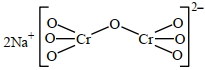
\(4 FeCr _{2} O _{4}+8 Na _{2} CO _{3}+7 O _{2} \rightarrow 8 Na _{2} CrO _{4}+2 Fe _{2} O _{3}\)\(+8 CO _{2}\)
\(2 Na _{2} CrO _{4}+2 H ^{+} \rightarrow \underbrace{ Na _{2} Cr _{2} O _{7}}_{ B }+2 Na ^{+}+ H _{2} O\)
- 37. The products obtained from a reaction of hydrogen peroxide and acidified potassium permanganate are 2022 Medium
- (A) \(Mn ^{4+}, H _{2} O\) only
- (B) \(Mn ^{2+}, H _{2} O\) only
- (C) \(Mn ^{4+}, H _{2} O , O _{2}\) only
- (D) \(Mn ^{2+}, H _{2} O , O _{2}\) only
Show answer and solution
Correct Answer: (D)
\(6 H ^{+}+2 MnO _{4}^{-}+5 H _{2} O _{2} \longrightarrow 2 Mn ^{+2}+8 H _{2} O +5 O _{2}\) - 38. The reaction of \(H _{2} O _{2}\) with potassium permanganate in acidic medium leads to the formation of mainly. 2022 Medium
- (A) \(Mn ^{2+}\)
- (B) \(Mn ^{4+}\)
- (C) \(Mn ^{3+}\)
- (D) \(Mn ^{6+}\)
Show answer and solution
Correct Answer: (A)
\(H _{2} O _{2}+ MnO _{4}^{-} \rightarrow Mn ^{2+}+ O _{2}\) \((unbalanced)\) - 39. The spin only magnetic moment of the complex present in Fehling's reagent is \(B.M.\)(Nearest integer). 2022 Medium
- (A) \(3\)
- (B) \(0\)
- (C) \(1\)
- (D) \(2\)
Show answer and solution
Correct Answer: (D)
Fehling solution is a complex of \(Cu ^{++}\)\(Cu ^{++}=3 d ^{9}\)
No. of unpaired \(e ^{-}=1\)
\(M \cdot M=\sqrt{1(1+2)}=\sqrt{3}=1.73\,BM\)
-
- (A) \(4\)
- (B) \(2\)
- (C) \(3\)
- (D) \(1\)
Show answer and solution
Correct Answer: (A)
\(\left. E _{ Cr ^{+3}}^{0}\right|_{ Cr ^{+2}}=-0.41\,V\)\({\left[ Cr ^{+3}\right]=4 s ^{0} 3 d ^{3} }\)
\(\mu=\sqrt{ n ( n +2)}\,B.M\)
\(=\sqrt{15}\) B.M \(\sim 4\,B.M\)
-
- (A) \(4\)
- (B) \(3\)
- (C) \(2\)
- (D) \(5\)
Show answer and solution
Correct Answer: (D)
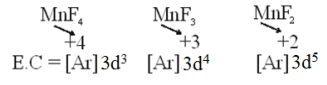
Hence \(MnF _{3} \Rightarrow\) strongest O.A\(\mu=\sqrt{4(4+2)}=\sqrt{24}=4.89=5\)
-
- (A) \(3\)
- (B) \(30\)
- (C) \(0.3\)
- (D) \(56\)
Show answer and solution
Correct Answer: (A)
Most basic oxide is \(V _{2} O _{3}\)\(V ^{+3} \rightarrow\left[A_{ r }\right] 3 d ^{2}\)
\(\mu=\sqrt{2(2+2)}=2.84\, BM\)
\(\approx 3\)
- 43. Which of the following \(3 d -m e t a l\) ion will give the lowest enthalpy of hydration \((\Delta_{ hyd } H )\) when dissolved in water? 2022 Medium
- (A) \(Cr ^{2+}\)
- (B) \(Mn ^{2+}\)
- (C) \(Fe ^{2+}\)
- (D) \(Co ^{2+}\)
Show answer and solution
Correct Answer: (B)
Enthalpy of hydration increases with increase in charge density. \(Mn ^{+2}\) has least charge density (as \(Mn\) has highest size among the given options) so it will have least enthalpy of hydration. -
- (A) \((A), (C)\) and \((D)\) only
- (B) \((A)\) and \((B)\) only
- (C) \((A)\) and \((C)\) only
- (D) \((A), (B)\) and \((C)\) only
Show answer and solution
Correct Answer: (D)
\((A)\) \(Cr =[ Ar ] 3 d ^{5} 4 s ^{1}\)\((B)\) \(m =-\ell\) to \(+\ell\)
\((C)\) According to Aufbau principle, orbitals are filled in order of their increasing energies.
\((D)\) Total nodes \(=n-1\)
-
- (A) \(Ce\) (Atomic Number \(58\))
- (B) \(Sm\) (Atomic Number \(62\))
- (C) \(Eu\) (Atomic Number \(63\))
- (D) \(Yb\) (Atomic Number \(70\))
Show answer and solution
Correct Answer: (C)
\(E _{ M ^{3+} / M ^{2+}}^{0} \Rightarrow Eu(-0.35) Yb(-1.05\)Hence, due to more reduction potential in \(Eu\) as compared to \(Yb\), it can concluded that \(Eu ^{2+}\) is more stable than \(Yb ^{2+}\).
-
- (A) \(3\)
- (B) \(4\)
- (C) \(5\)
- (D) \(6\)
Show answer and solution
Correct Answer: (B)
\(n _{\text {eq. }}\) of \(I _{2}= n _{ eq }\) of \(Na _{2} S _{2} O _{3}=20 \times 0.002 \times 1\)\(2 \times n _{ mol }\) of \(I _{2}=0.4\)
\(n _{ mol }\) of \(I _{2}=0.2 m mol\)
\(n _{ mol }\) of \(Cu ^{+2}=0.2 \times 2 \times 10^{-3}\)
\(\left[ Cu ^{+2}\right]=\frac{0.4 \times 10^{-3}}{10 \times 10^{-3}}=0.04=4 \times 10^{-2}\)
-
- (A) \(22\)
- (B) \(23\)
- (C) \(24\)
- (D) \(25\)
Show answer and solution
Correct Answer: (C)
Eq. of \(K _{2} Cr _{2} O _{7}=\) Eq. of \(Fe ^{2+}\)\((Molarity\) \(\times\) \(volume\) \(\times\) \(n.f)\) of \(K _{2} Cr _{2} O _{7}=\) (molarity \(\times\) volume \(\times\) n.f ) of \(Fe ^{2+}\)
\(0.02 \times 20 \times 6= M \times 10 \times 1\)
\(M =0.24\)
Molarity \(=24 \times 10^{-2}\)
-
- (A) \(13\)
- (B) \(130\)
- (C) \(65\)
- (D) \(70\)
Show answer and solution
Correct Answer: (A)
\(MnO _{2}+ HCl \longrightarrow Cl _{2}+ Mn ^{+2}\)\(6\, meq\quad\quad\quad\quad\quad\quad\quad 6\, meq\)
\(=3 m mol\)
\(Cl _{2}+ KI \longrightarrow Cl ^{-}+ I _{2}\)
\(6\, meq\quad\quad\quad\quad\quad\quad\quad6\, meq\)
\(I _{2}+ Na _{2} S _{2} O _{3} \longrightarrow I ^{-}+ Na _{2} S _{4} O _{6}\)
\(6\, meq\quad\quad\quad\quad\quad\quad\quad 6\, m\,mol\)
\(\quad=6 meq\)
\(\% \,MnO _{2}=\frac{3 \times 10^{-3} \times 87}{2} \times 100\)
\(=13.05\, \%\)
- 49. In the titration of \(KMnO _{4}\) and oxalic acid in acidic medium, the change in oxidation number of carbon at the end point is 2022 Medium
- (A) \(1\)
- (B) \(0\)
- (C) \(2\)
- (D) \(3\)
Show answer and solution
Correct Answer: (A)
Oxidation state of carbon changes from \(+3\) to \(+4\).\(2 KMnO _{4}+5 H _{2} C _{2} O _{4}+3 H _{2} SO _{4}(\text { dil. }) \)\(\rightarrow K _{2} SO _{4}+2 MnSO _{4}+10 CO _{2}+8 H _{2} O\)
- 50. The difference in oxidation state of chromium in chromate and dichromate salts is .... . 2022 Easy
- (A) \(1\)
- (B) \(0\)
- (C) \(2\)
- (D) \(3\)
Show answer and solution
Correct Answer: (B)
\(Cr=+6\)\(Cr O_{4}^{2-}, Cr _{2} O _{7}^{2-}\) difference is zero.
No questions on this page match these filters.
Other years
Frequently asked
How many JEE Mains 2022 Chemistry questions are on ExamBro?
351 questions, each with the correct answer and a full solution.
Which JEE Mains 2022 Chemistry chapter is asked the most?
D and f- block elements, with 27 questions, followed by Co-ordination chemistry with 27.
How difficult are JEE Mains 2022 Chemistry questions?
20% are easy, 65% medium and 15% hard.