


All JEE Mains 2025 Chemistry questions
26 chaptersShowing 301–350 of 381 questions
-
- (A) \(\mathrm{PF}_5\)
- (B) \(\mathrm{XeF}_4\)
- (C) \(\mathrm{SF}_4\)
- (D) \(\mathrm{XeF}_2\)
Show answer and solution
Correct Answer: (C)
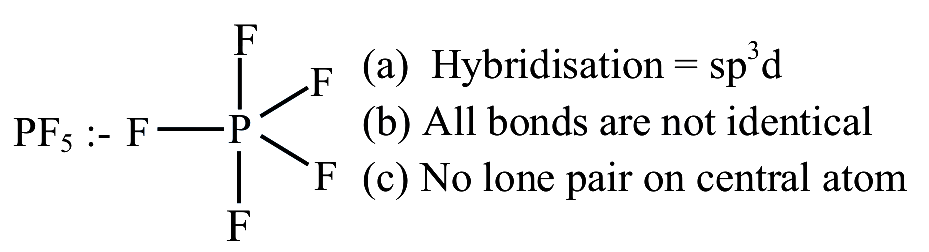
\(\mathrm{XeF}_4:-\mathrm{sp}^3 \mathrm{~d}^2\) Hybridisation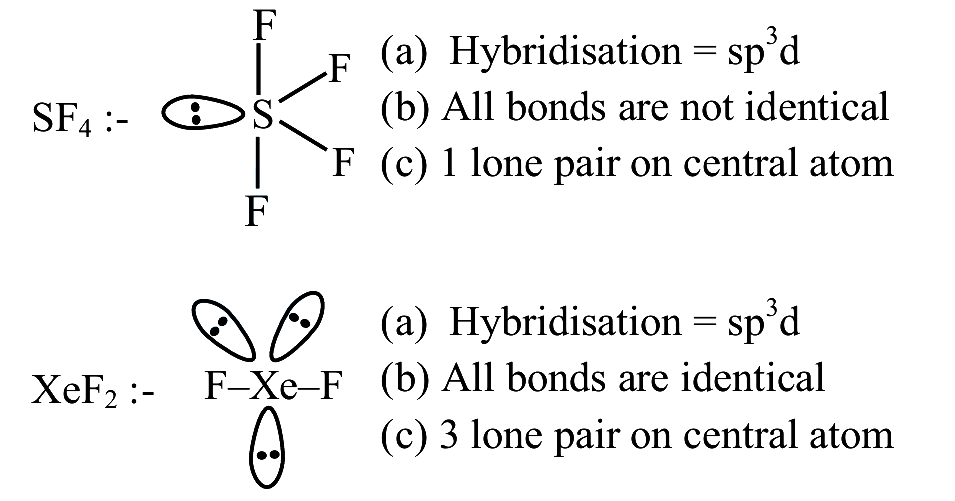
-
- (A) B only
- (B) A & C only
- (C) A & E only
- (D) A & D only
Show answer and solution
Correct Answer: (D)
\(\begin{array}{lcc}
& & \text { No. of unpaired } \mathrm{e}^{-} \\
\text {(A) } & \mathrm{O}_2 & 2 \\
\text { (B) } & \mathrm{N}_2 & 0 \\
\text { (C) } & \mathrm{F}_2 & 0 \\
\text { (D) } & \mathrm{S}_2 & 2 \\
\text { (E) } & \mathrm{Cl}_2 & 0
\end{array}\)
If species contain unpaired electron than it is paramagnetic.
So A \& D are paramagnetic. -
- (A) A, B and C Only
- (B) A, D and E Only
- (C) C, D and E Only
- (D) A, B, C and E Only
Show answer and solution
Correct Answer: (A)
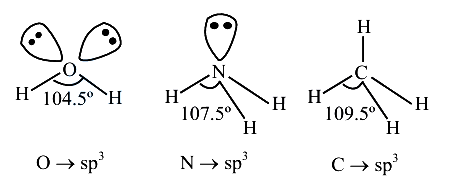
Dipole moment \(\quad \mathrm{H}_2 \mathrm{O}>\mathrm{NH}_3>\mathrm{CH}_4\)
\(\mathrm{H}_2 \mathrm{O} \& \mathrm{NH}_3\) are Lewis Bases
\(\mathrm{NH}_3\) act as Lowry- Bronsted base
Hence, A, B & C are correct -
- (A) \(\mathrm{r}_{\mathrm{Br}} \lt \mathrm{r}_{\mathrm{K}}\)
- (B) \(\mathrm{r}_{\mathrm{Mg}} \lt \mathrm{r}_{\mathrm{Al}}\)
- (C) \(\mathrm{r}_{\mathrm{Rb}} \lt \mathrm{r}_{\mathrm{Cs}}\)
- (D) \(\mathrm{r}_{\mathrm{At}} \lt \mathrm{r}_{\mathrm{Cs}}\)
Show answer and solution
Correct Answer: (B)
In a period from left to right atomic size decreases. -
- (A) A < D < B < C
- (B) A < C < B < D
- (C) A < B < C < D
- (D) D < A < B < C
Show answer and solution
Correct Answer: (D)
\(\mathrm{N}:-1 \mathrm{~s}^2 2 \mathrm{~s}^2 2 \mathrm{p}^3\) (Electronegativity \(\left.=3\right)\)
\(\mathrm{O}:-1 \mathrm{~s}^2 2 \mathrm{~s}^2 2 \mathrm{p}^4\) (Electronegativity \(=3.5\))
\(\mathrm{F}:-1 \mathrm{~s}^2 2 \mathrm{~s}^2 2 \mathrm{p}^5\) (Electronegativity \(=4\))
\(\mathrm{C}:-1 \mathrm{~s}^2 2 \mathrm{~s}^2 2 \mathrm{p}^2\) (Electronegativity \(=2.55\))
Correct order \(=\mathrm{C} \gt \mathrm{B} \gt \mathrm{A} \gt \mathrm{D}\) -
- (A) \(1402 \mathrm{~kJ} \mathrm{~mol}^{-1}\)
- (B) \(834 \mathrm{~kJ} \mathrm{~mol}^{-1}\)
- (C) \(1012 \mathrm{~kJ} \mathrm{~mol}^{-1}\)
- (D) \(947 \mathrm{~kJ} \mathrm{~mol}^{-1}\)
Show answer and solution
Correct Answer: (C)
The main component of apatite family is phosphorus.
Order of \(\mathrm{IE}_1\) of group 15 elements \(\mathrm{N}>\mathrm{P}>\mathrm{As}>\mathrm{Sb}\) IE of phosphorus \(=1012 \mathrm{~kJ} \mathrm{~mol}^{-1}\). -
- (A) Both Statement I and Statement II are true
- (B) Statement I is false but Statement II is true
- (C) Both Statement I and Statement II are false
- (D) Statement I is true but Statement II is false
Show answer and solution
Correct Answer: (C)
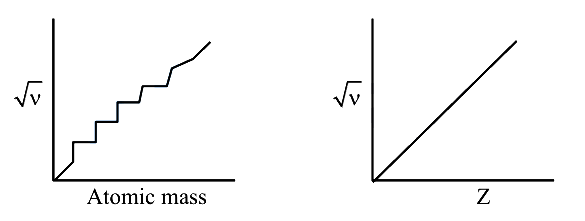
Explanation:
According to Moseley's Law for characteristic X-ray spectra, the relationship between frequency and atomic number is expressed as:
\( \sqrt{\nu} = a(Z - b) \)
Where \( \nu \) represents the frequency of the emitted X-rays, \( Z \) represents the atomic number, and \( a \) and \( b \) are constants.
1. Analysis of Statement (I): The graph plotted between \( \sqrt{\nu} \) and atomic mass is not a straight line; instead, it forms a jagged, irregular curve. This discovery led Henry Moseley to conclude that the atomic number is a far more fundamental property of an element than its atomic mass. Therefore, Statement I is false.
2. Analysis of Statement (II): Moseley's law specifies that the square root of the frequency (\( \sqrt{\nu} \)) is directly proportional to the atomic number, which means a plot of \( \sqrt{\nu} \) versus \( Z \) yields a straight line. Conversely, a plot of frequency (\( \nu \)) versus atomic number (\( Z \)) will yield a parabola (\( \nu \propto Z^2 \)), not a straight line. Therefore, Statement II is also false.
Since both statements are entirely false, Option C is the correct choice. -
- (A) Both Statement (I) and Statement (II) are false.
- (B) Both Statement (I) and Statement (II) are true.
- (C) Statement (I) is false but Statement (II) is true.
- (D) Statement (I) is true but Statement (II) is false.
Show answer and solution
Correct Answer: (A)
Law of octaves was arranged in the increasing order of their atomic weight.
Lothar Meyer plotted the physical properties such as atomic volume, melting point and boiling point against atomic weight. -
- (A) Statement I is true but Statement II is false
- (B) Both Statement I and Statement II are true
- (C) Both Statement I and Statement II are false
- (D) Statement I is false but Statement II is true
Show answer and solution
Correct Answer: (D)
Statement-I : False but Statement-II is true.
On moving left to right in periodic table nonmetallic character increases and we know that nonmetal oxides are acidc in nature.
Non metallic character \(\uparrow\) Acidic strength of oxide \(\uparrow\) -
- (A) Both Statement I and Statement II are incorrect
- (B) Statement I is incorrect but Statement II is correct
- (C) Statement I is correct but Statement II is incorrect
- (D) Both Statement I and Statement II are correct
Show answer and solution
Correct Answer: (B)
\(\Rightarrow\) The metallic radius order of \(\mathrm{Al} ~\&~ \mathrm{Ga}\) is
\(\mathrm{B} \lt \underbrace{\mathrm{Ga} \lt \mathrm{Al}}_{\downarrow} \lt \mathrm{In} \lt \mathrm{T} \ell\)
(due to poor shielding of d-subshell electrons)
\(\Rightarrow\) The ionic radius order of \(\mathrm{Al}^{+3} ~\&~ \mathrm{Ga}^{+3}\) is \(\mathrm{B}^{+3} \lt \mathrm{Al}^{+3} \lt \mathrm{Ga}^{+3} \lt \mathrm{In}^{+3} \lt \mathrm{T} \ell^{+3}\) -
- (A) Statement I is false but Statement II is true
- (B) Statement I is true but Statement II is false
- (C) Both Statement I and Statement II are true
- (D) Both Statement I and Statement II are false
Show answer and solution
Correct Answer: (B)
First ionization energy of Lead \(=715 \mathrm{~kJ} \mathrm{~mol}^{-1}\)
First ionization energy of Tin \(=708 \mathrm{~kJ} \mathrm{~mol}^{-1}\)
\(\left(\mathrm{IE}_1\right)\) of Lead is greater than that of Tin due to ineffective shielding of d - and f -electrons.
Therefore Statement-I is true.
First ionization energy of Germanium \(=761 \mathrm{~kJ} \mathrm{~mol}^{-1}\)
First ionization energy of Silicon \(=786 \mathrm{~kJ} \mathrm{~mol}^{-1}\)
\(\left(\mathrm{IE}_1\right)\) of Germanium is lower than that of Silicon as the effect of higher atomic radius of Ge outweighs the increase in nuclear charge from Si to Ge and effective shielding of inner electrons.
Therefore Statement-II is false. -
- (A) Statement I is incorrect but Statement II is correct
- (B) Statement I is correct but Statement II is incorrect
- (C) Both Statement I and Statement II are incorrect
- (D) Both Statement I and Statement II are correct
Show answer and solution
Correct Answer: (D)
\(\mathrm{r} \propto \mathrm{q}^{-}\)(for isoelectronic species)
\(\propto \frac{1}{q^{+}}\)
\(\therefore\) Statement I is correct
Magnitude of electron gain enthalpy
\(\mathrm{Cl}>\mathrm{F}>\mathrm{Br}>\mathrm{I}\) -
- (A) (A)-(IV), (B)-(I), (C)-(II), (D)-(III)
- (B) (A)-(IV), (B)-(I), (C)- (III), (D)-(II)
- (C) (A)-(III), (B)-(IV), (C)- (II), (D)-(I)
- (D) (A)-(II), (B)-(III), (C)-(IV), (D)-(I)
Show answer and solution
Correct Answer: (A)
Ionic radii \(-\mathrm{Al}^{3+} < \mathrm{Mg}^{2+} < \mathrm{Na}^{+} < \mathrm{F}^{-}\)
Ionisation energy - \(\mathrm{B} < \mathrm{C} < \mathrm{O} < \mathrm{N}\)
Metallic character \(-\mathrm{B} < \mathrm{Al} < \mathrm{Mg} < \mathrm{K}\)
Electron negativity \(-\mathrm{Si} < \mathrm{P} < \mathrm{S} < \mathrm{Cl}\) - 314. The element that does not belong to the same period of the remaining elements (modern periodic table) is _______. 2025 Easy
- (A) Iridium
- (B) Platinum
- (C) Osmium
- (D) Palladium
Show answer and solution
Correct Answer: (D)
Palladium \(\Rightarrow 5^{\text {th }}\) period
Iridium, Osmium, Platinum \(\Rightarrow 6^{\text {th }}\) Period - 315. The elements of Group 13 with highest and lowest first ionisation enthalpies are respectively: 2025 Medium
- (A) \(\mathrm{B} ~\&~ \mathrm{Ga}\)
- (B) B & Tl
- (C) \(\mathrm{Tl} ~\&~ \mathrm{~B}\)
- (D) B & In
Show answer and solution
Correct Answer: (D)
IE order
\(\mathrm{B} \gt \mathrm{T} \ell \gt \mathrm{Ga} \gt \mathrm{Al} \gt \mathrm{In}\) -
- (A) \(\mathrm{Si}\gt\mathrm{P}\gt\mathrm{Cl}\gt\mathrm{F}\)
- (B) \(\mathrm{Be}\gt\mathrm{Mg}\gt\mathrm{Al}\gt\mathrm{Si}\)
- (C) \(\mathrm{Al}\gt\mathrm{B}\gt\mathrm{N}\gt\mathrm{F}\)
- (D) \(\mathrm{Mg}\gt\mathrm{Al}\gt\mathrm{C}\gt\mathrm{O}\)
Show answer and solution
Correct Answer: (B)
Correct order of atomic radius : \(\mathrm{Be} < \mathrm{Mg}>\mathrm{Al}>\mathrm{Si}\) -
- (A) Group 13
- (B) Group 14
- (C) Group 2
- (D) Group 4
Show answer and solution
Correct Answer: (A)
The successive 5 ionisation energies of an element are \(800,2427,3658,25024\) and \(32824 \mathrm{~kJ} / \mathrm{mol}\), respectively.
\(\begin{aligned}
& \frac{\mathrm{IE}_2}{\mathrm{IE}_1}=\frac{2427}{800}=3.03 \\
& \frac{\mathrm{IE}}{\mathrm{IE}_2}=\frac{3658}{2427}=1.51 \\
& \frac{\mathrm{IE}}{\mathrm{IE}_3}=\frac{25024}{3658}=6.84
\end{aligned}\)
\(\frac{\mathrm{IE}_5}{\mathrm{IE}_4}=\frac{32824}{25024}=1.31\)
Since ( \(\mathrm{IE}_4 / \mathrm{IE}_3\) ) value is maximum, the element belongs to group 13. -
- (A) \(\mathrm{A}_2 \mathrm{O}\)
- (B) \(\mathrm{A}_2 \mathrm{O}_3\)
- (C) \(\mathrm{AO}_2\)
- (D) \(\mathrm{AO}\)
Show answer and solution
Correct Answer: (B)
Among given atoms, Boron has least atomic radius oxide of Boron \(=\mathrm{B}_2 \mathrm{O}_3\) -
- (A) B & C only
- (B) A, C and d only
- (C) B and D only
- (D) B,C and E only
Show answer and solution
Correct Answer: (A)
(A) The process of adding an \(\mathrm{e}^{-}\)to a neutral gaseous atom is not always exothermic it may be exothermic or endothermic.
(C) \(\mathrm{Be} \quad \mathrm{B}\)
\(1 s^2 2 s^2 \quad 1 s^2 2 s^2 2 p^1\)
In Be 2 s subshell in fully filled
So, need high energy to remove \(\mathrm{e}^{-}\)as compared to B.
(D)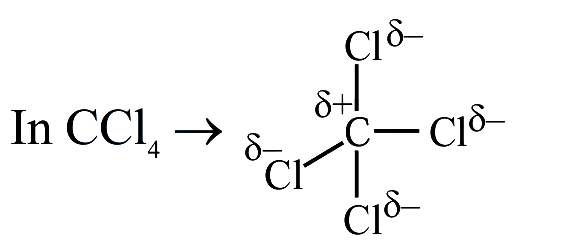
due to partially positive charge \(z_{\text {eff }} \uparrow, \mathrm{EN} \uparrow\)
So, EN of \(\mathrm{C} \Rightarrow \mathrm{CCl}_4 \gt \mathrm{CH}_4\)
(E) Cs is most electropositive. -
- (A) \(\mathrm{A}, \mathrm{C}\) and E Only
- (B) A and E Only
- (C) \(\mathrm{B}, \mathrm{C}\) and E Only
- (D) D and E Only
Show answer and solution
Correct Answer: (A)
Properties of elements are function of atomic numbers.
Elements having similar outer electronic configuration are arranged in same group.
Number of elements in a period is double of number of atomic orbitals available in energy level that is being filled. -
- (A) 900
- (B) 950
- (C) 962
- (D) 942
Show answer and solution
Correct Answer: (C)
Initial pressure of \(\mathrm{N}_2 \mathrm{O}_5\)
\(\begin{aligned}
& =\frac{\frac{37.8}{108} \times 0.082 \times 500}{1}=14.35 \text { bar } \\
& 2 \mathrm{~N}_2 \mathrm{O}_5 \rightleftharpoons 2 \mathrm{~N}_2 \mathrm{O}_4+\mathrm{O}_2
\end{aligned}\)
\(\begin{array}{lll}\mathrm{t}=0 & 14.35 \\ \mathrm{t}=\mathrm{eq} & 14.35-2 \mathrm{P} & 2 \mathrm{P}\end{array}\)
\(\begin{aligned} & \mathrm{P}_{\text {Total }} \text { at eqb }=14.35+\mathrm{P}=18.65 \\ & \mathrm{P}=4.3 \\ & \mathrm{P}_{\mathrm{N}_2 \mathrm{O}_5}=5.75 \text { bar } \\ & \mathrm{P}_{\mathrm{N}_2 \mathrm{O}_4}=8.6 \mathrm{bar} \\ & \mathrm{P}_{\mathrm{O}_2}=4.3 \text { bar } \\ & \mathrm{k}_{\mathrm{p}}=\frac{(8.6)^2 \times(4.3)}{(5.75)^2}=9.619=\mathrm{x} \times 10^{-2} \\ & \mathrm{x}=961.9 \approx 962\end{aligned}\) -
- (A) 1.8 atm
- (B) 0.3 atm
- (C) 3 atm
- (D) 0.18 atm
Show answer and solution
Correct Answer: (A)
\(\begin{array}{lc}\mathrm{CO}_2(\mathrm{~g})+\mathrm{C}(\mathrm{s}) \rightleftharpoons & 2 \mathrm{CO}(\mathrm{g}) \\ 0.5 & - \\ 0.5-\mathrm{x} & 2 \mathrm{x}\end{array}\)
\(\begin{aligned}\mathrm{P}_{\text {total }}=0.5+\mathrm{x}=0.8 \\ \mathrm{x}=0.3 \\ \mathrm{~K}_{\mathrm{P}}=\frac{(0.6)^2}{0.2}=1.8\end{aligned}\) -
- (A) \(\sqrt[4]{\frac{2 K_p}{p}}\)
- (B) \(\sqrt[3]{\frac{2 K_{\mathrm{p}}}{\mathrm{p}}}\)
- (C) \(\sqrt[3]{\frac{2 \mathrm{~K}_{\mathrm{p}}^2}{\mathrm{p}}}\)
- (D) \(\sqrt{K_p}\)
Show answer and solution
Correct Answer: (C)
\(\begin{array}{lcc}
& \mathrm{AB}_2(\mathrm{g}) & \rightleftharpoons & \mathrm{AB}(\mathrm{g}) & + & \frac{1}{2} \mathrm{~B}_2(\mathrm{g}) \\
t=0 & p_0 & \\
t=t_{\text {eq }} & p_0(1-x) & & p_0 x & & \frac{p_0 x}{2}
\end{array}\)
\(\mathrm{p}=\mathrm{p}_0 \mathrm{x}-\mathrm{p}_0 \mathrm{x}+\mathrm{p}_0 \mathrm{x}+\frac{\mathrm{p}_0 \mathrm{x}}{2}\)
\(\begin{gathered}p=p_0\left(1+\frac{x}{2}\right) \\ p_0=\frac{p}{\left(1+\frac{x}{2}\right)} \\ K_p=\frac{\left(p_{A B}\right)\left(p_{B_2}\right)^{1 / 2}}{\left(p_{\mathrm{AB}_2}\right)} \\ K_p=\frac{\left(p_0 x\right)\left(\frac{p_0 x}{2}\right)^{1 / 2}}{p_0(1-x)}\end{gathered}\)
\(\mathrm{K}_{\mathrm{p}}=\frac{\frac{\mathrm{px}}{\left(1+\frac{x}{2}\right)}\left(\frac{\mathrm{p}}{1+\frac{x}{2}} \times \frac{\mathrm{x}}{2}\right)^{1 / 2}}{\frac{\mathrm{p}(1-\mathrm{x})}{\left(1+\frac{x}{2}\right)}}\)
Since \(x \ll 1\)
\(\begin{aligned}
& K_p=\frac{\mathrm{p}^{1 / 2} \mathrm{x}^{3 / 2}}{2^{1 / 2}} \\
& \mathrm{x}=\sqrt[3]{\frac{2 \mathrm{~K}_{\mathrm{p}}^2}{\mathrm{p}}}
\end{aligned}\) -
- (A) (A), (B) and (C) only
- (B) (A) and (B) only
- (C) (A), (B) and (D) only
- (D) (B) and (C) only
Show answer and solution
Correct Answer: (B)
\(\begin{aligned} & \mathrm{CO}(\mathrm{g})+3 \mathrm{H}_2 \rightleftharpoons \mathrm{CH}_4(\mathrm{~g})+\mathrm{H}_2 \mathrm{O}(\mathrm{g}) \\ & \Delta \mathrm{n}_{\mathrm{g}}=-2\end{aligned}\)
If pressure of system increases then according to Le-Chatelier's principle reaction will move in forward direction.
Concentration of reactant and products both increases but concentration of product increases more. -
- (A) If p value is extremely high compared to \(\mathrm{K}_{\mathrm{p}}, \alpha \approx 1\)
- (B) When \(p\) increases \(\alpha\) decreases
- (C) If \(k_p\) value is extremely high compared to \(p, \alpha\) becomes much less than unity
- (D) When \(p\) increases \(\alpha\) increases
Show answer and solution
Correct Answer: (B)
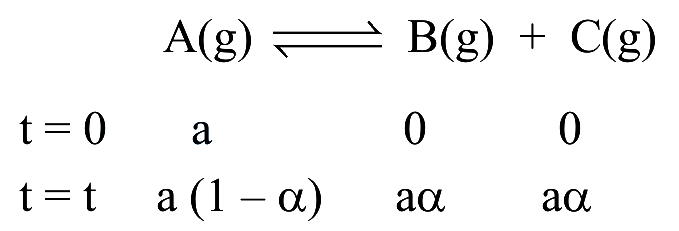
a moles of \(A(g)\) taken initially and at time Now moles fraction of \(\mathrm{A}(\mathrm{g}), \mathrm{B}(\mathrm{g})\) and \(\mathrm{C}(\mathrm{g})\) are
\(\begin{aligned}
& X_A=\frac{a-a \alpha}{a+a \alpha}=\frac{1-\alpha}{1+\alpha} \\
& X_B=\frac{a \alpha}{a+a \alpha}=\frac{\alpha}{1+\alpha} \\
& X_C=\frac{a \alpha}{a+a \alpha}=\frac{\alpha}{1+\alpha}
\end{aligned}\)
Now if \(P\) is total pressure then partial pressure o \(\mathrm{A}(\mathrm{g}), \mathrm{B}(\mathrm{g})\) and \(\mathrm{C}(\mathrm{g})\) are
\(\begin{aligned}
& \mathrm{P}_{\mathrm{A}}=\left(\frac{1-\alpha}{1+\alpha}\right) \mathrm{P} \\
& \mathrm{P}_{\mathrm{B}}=\left(\frac{\alpha}{1+\alpha}\right) \mathrm{P} \\
& \mathrm{P}_{\mathrm{C}}=\left(\frac{\alpha}{1+\alpha}\right) \mathrm{P} \\
& \mathrm{~K}_{\mathrm{P}}=\frac{\left(\frac{\alpha}{1+\alpha}\right) \mathrm{P}\left(\frac{\alpha}{1+\alpha}\right) \mathrm{P}}{\left(\frac{1-\alpha}{1+\alpha}\right) \mathrm{P}} \\
& \mathrm{~K}_{\mathrm{P}}=\frac{\alpha^2 \mathrm{P}}{1-\alpha^2}
\end{aligned}\)
As \(K_P\) is only function of temperature.
So as P \(\uparrow \quad \alpha \downarrow\) -
- (A) 70
- (B) 74
- (C) 76
- (D) 78
Show answer and solution
Correct Answer: (B)
\(\begin{array}{llll}
& \mathrm{CO}(\mathrm{g}) & + & 2 \mathrm{H}_2(\mathrm{g}) & \rightleftharpoons & \mathrm{CH}_3 \mathrm{OH}(\mathrm{g}) \\
\mathrm{t}=0 & 0.1 \mathrm{~mol} & & \mathrm{a} \mathrm{~mol} & & - \\
\mathrm{t}_{\text {eq }} & 0.1-\mathrm{x} & & \mathrm{a}-2 \mathrm{x} & & \mathrm{x}=0.04 \\
& =0.06 & & =\mathrm{a}-0.08 & \\
& & & =0.23-0.08 \\
& & & =0.15 \mathrm{~mole}
\end{array}\)
\(\begin{aligned} & \mathrm{V}=2 \mathrm{~L} \\ & \mathrm{~T}=500 \mathrm{~K} \\ & \mathrm{P}_{\text {total }}=5 \mathrm{bar} \\ & \mathrm{n}_{\text {Total }}=0.25=\frac{1}{4} \mathrm{~mol} \\ & \mathrm{P}_{\text {total }}=\mathrm{n}_{\text {total }} \times \frac{\mathrm{RT}}{\mathrm{V}} \\ & \Rightarrow 5=(0.06+\mathrm{a}-0.08+0.04) \times \frac{0.08 \times 500}{2} \\ & \Rightarrow 10=(0.02+\mathrm{a}) \times 0.08 \times 500\end{aligned}\)
\(\Rightarrow \mathrm{a}=0.25-0.02=0.23 \mathrm{~mol}.\)
\(\begin{aligned}
& \mathrm{K}_{\mathrm{P}}=\frac{\mathrm{X}_{\mathrm{CH}_3 \mathrm{OH}}}{\mathrm{X}_{\mathrm{CO}} \times \mathrm{X}_{\mathrm{H}_2}^2} \times \frac{1}{\left(\mathrm{P}_{\mathrm{T}}\right)^2}=\frac{0.04}{0.06 \times(0.15)^2} \times\left[\frac{1 / 4}{5}\right]^2 \\
& =\frac{4}{6 \times(0.15)^2 \times 16} \times \frac{1}{25} \\
& =\frac{100 \times 100}{24 \times 225 \times 25}=\frac{100 \times 100}{135000} \\
& =0.074=74 \times 10^{-3}
\end{aligned}\) -
- (A) \(x=\sqrt[3]{\frac{2 \mathrm{Kp}}{\mathrm{p}}}\)
- (B) \(x=\sqrt[3]{\frac{2 \mathrm{Kp}^2}{\mathrm{p}}}\)
- (C) \(x=\sqrt[3]{\frac{\mathrm{Kp}}{\mathrm{p}}}\)
- (D) \(x=\sqrt[3]{\frac{K \mathrm{p}}{2 \mathrm{p}}}\)
Show answer and solution
Correct Answer: (B)
\(\begin{aligned} & 1 \mathrm{~mol} \\ & \mathrm{X}_2 \mathrm{Y}(\mathrm{g}) \rightarrow \underset{\mathrm{x}}{\mathrm{X}} \mathrm{X}_2(\mathrm{~g})+\frac{1}{2} \mathrm{Y}_2(\mathrm{~g}) \\ & \frac{\mathrm{x}}{2} \\ & \therefore \quad P_{\mathrm{x}_2 \mathrm{y}} \\ & =\frac{1-\mathrm{x}}{1+\frac{x}{2}} \times \mathrm{p} \\ & P_{x_2}=\frac{x}{1+\frac{x}{2}} \times p\end{aligned}\)
\(\begin{aligned}
& P_{y_2}=\frac{x / 2}{1+\frac{x}{2}} \times p \\
\therefore \quad K_p= & \frac{\left(\frac{x}{1+\frac{x}{2}} p\right)\left(\frac{x}{2\left(1+\frac{x}{2}\right)} p\right)^{1 / 2}}{\left(\frac{1-x}{1+\frac{x}{2}}\right) \times p} \\
\therefore \quad & K_p=\left(\frac{x}{1-x}\right)\left(\frac{x}{2\left(1+\frac{x}{2}\right)}\right)^{1 / 2} \times p^{1 / 2}
\end{aligned}\)
\(\therefore \quad \mathrm{x}\) to be very small
\(\begin{aligned}
\therefore & K_p=\frac{x^{3 / 2}}{2^{(1 / 2)}} \times p^{1 / 2} \\
\therefore & x^{3 / 2}=\frac{K_p \times 2^{1 / 2}}{p^{1 / 2}} \\
& x^3=\frac{K_p^2 \times 2}{p} \\
& x=\left(\frac{K_p^2 \times 2}{p}\right)^{1 / 3}
\end{aligned}\) -
- (A) 5 times of initial pressure
- (B) \(5 / 2\) times of initial pressure
- (C) \(7 / 2\) times of initial pressure
- (D) \(7 / 4\) times of initial pressure
Show answer and solution
Correct Answer: (D)
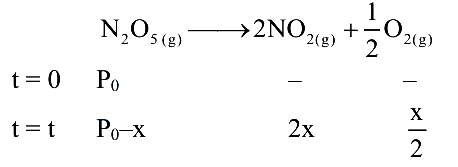
\(\begin{gathered}x=\frac{P_0}{2} \\ P_{\text {total }}=P_0-\frac{P_0}{2}+P_0+\frac{P_0}{4}=\frac{7}{4} P_0\end{gathered}\) -
- (A) Statement I is false but Statement II is true
- (B) Both Statement I and Statement II are true
- (C) Both Statement I and Statement II is false
- (D) Statement I is true but Statement II is false
Show answer and solution
Correct Answer: (B)
A catalyst can change equilibrium composition if it is added at constant pressure, but it can not change equilibrium constant. -
- (A) \(\mathrm{PCl}_5\) will increase
- (B) \(\mathrm{Cl}_2\) will decrease
- (C) \(\mathrm{PCl}_5, \mathrm{PCl}_3 \& \mathrm{Cl}_2\) remain constant
- (D) \(\mathrm{PCl}_3\) will increase
Show answer and solution
Correct Answer: (D)
On addition of inert gas at constant P & T, reaction moves in the direction of greater no. of moles so it will shift in forward direction, so \(\left[\mathrm{PCl}_5\right]\) decrease and \(\left[\mathrm{PCl}_3\right] \&\left[\mathrm{Cl}_2\right]\) will increase. -
- (A) 10
- (B) 15
- (C) 5
- (D) 20
Show answer and solution
Correct Answer: (C)
\(\begin{aligned} & \mathrm{H}_2 \mathrm{O}(\mathrm{g}) \rightleftharpoons \mathrm{H}_{2(\mathrm{~g})}+\frac{1}{2} \mathrm{O}_{2(\mathrm{~g})} \\ & \mathrm{t}=0 \quad 1 \mathrm{~mole} \\ & \mathrm{t}=\mathrm{t}_{\mathrm{eq}} \quad 1-\alpha \quad \alpha \quad \frac{\alpha}{2} \\ & \mathrm{n}_{\mathrm{T}}=1+\frac{\alpha}{2} \simeq 1(\alpha \ll 1) \\ & \mathrm{k}_{\mathrm{P}}=\frac{\mathrm{P}_{\mathrm{H}_2} \cdot \mathrm{P}_{\mathrm{O}_2}^{1 / 2}}{\mathrm{P}_{\mathrm{H}_2 \mathrm{O}}}=\frac{(\alpha \cdot \mathrm{P})\left(\frac{\alpha}{2} \mathrm{P}\right)^{\frac{1}{2}}}{(1-\alpha) \mathrm{P}} \\ & 8 \times 10^{-3}=\frac{\alpha^{3 / 2}}{\sqrt{2}} \\ & \alpha^{3 / 2}=8 \sqrt{2} \times 10^{-3} \\ & \alpha^3=128 \times 10^{-6} \\ & \alpha=\sqrt[3]{128} \times 10^{-2} \\ & =5.03 \times 10^{-2}\end{aligned}\) -
- (A) 20
- (B) 25
- (C) 30
- (D) 35
Show answer and solution
Correct Answer: (B)
\(\begin{aligned}
& \quad \mathrm{HX}_{(\mathrm{aq)}} \rightleftharpoons \mathrm{H}_{(\mathrm{aq})}^{+}+\mathrm{X}_{(\mathrm{aq})}^{-} \quad \mathrm{K}_{\mathrm{a}}=4 \times 10^{-10} \\
& 0.01(1-\alpha) \quad 0.01 \alpha \quad 0.01 \alpha \quad \text { Not justified } \\
& \Rightarrow 0.01 \alpha=10^{-5} \Rightarrow \alpha=10^{-3} \\
& \mathrm{~K}_{\mathrm{a}}=0.01 \alpha^2=10^{-8}
\end{aligned}\)
On dilution let final concentration of \(\mathrm{HX}=\mathrm{c} \mathrm{M}\)
\(\begin{aligned}
& \mathrm{Hx}_{(\mathrm{an})} \rightleftharpoons \mathrm{H}_{(\mathrm{aq})}^{+}+\mathrm{X}_{(\mathrm{an})}^{-} \\
& \mathrm{C}(1-\alpha) \quad \mathrm{C} \alpha \quad \mathrm{C} \alpha \\
& \Rightarrow \mathrm{C} \alpha=10^{-6}...(1) \\
& \quad \frac{\mathrm{C} \alpha^{2}}{1-\alpha}=\mathrm{K}_{\mathrm{a}}=10^{-8}...(2) \\
& \Rightarrow \frac{10^{-6} \alpha}{1-\alpha}=10^{-8}
\end{aligned}\)
Data given is inconsistent \& contradictory. This should be bonus. -
- (A) 378 K and 500 J
- (B) 368 K and 500 J
- (C) 348 K and 300 J
- (D) 378 K and 300 J
Show answer and solution
Correct Answer: (C)
\(\begin{aligned} & \mathrm{q}_{\mathrm{p}}=\mathrm{n} \times \mathrm{c}_{\mathrm{p}} \times \Delta \mathrm{T} \\ & \Rightarrow 500=0.5 \times \frac{5}{2} \times 8.3\left(\mathrm{~T}_{\mathrm{f}}-298\right) \\ & \Rightarrow \mathrm{T}_{\mathrm{f}} \simeq 346.2 \mathrm{~K} \\ & \frac{\Delta \mathrm{H}}{\Delta \mathrm{U}}=\frac{\mathrm{C}_{\mathrm{p}}}{\mathrm{C}_{\mathrm{v}}}=\left(\frac{5}{3}\right) \\ & \Rightarrow \Delta \mathrm{U}=\frac{3}{5} \times 500=300 \mathrm{~J}\end{aligned}\) -
- (A) \(\Delta \mathrm{U} \lt 0, \mathrm{q}=0, \mathrm{w}\gt0\)
- (B) \(\Delta \mathrm{U}=0, \mathrm{q}=0, \mathrm{w}=0\)
- (C) \(\Delta \mathrm{U}\gt0, \mathrm{q}=0, \mathrm{w}\gt0\)
- (D) \(\Delta \mathrm{U}=0, \mathrm{q} \lt 0, \mathrm{w}\gt0\)
Show answer and solution
Correct Answer: (C)
Thermally insulated \(\Rightarrow q=0\) from \(\mathrm{I}^{\text {st }}\) law
\(\begin{aligned}
& \Delta \mathrm{U}=\mathrm{q}+\mathrm{w} \\
& \Delta \mathrm{U}=\mathrm{w} \\
& \mathrm{w}>0, \Delta \mathrm{U}>0
\end{aligned}\) -
- (A) 304
- (B) 305
- (C) 306
- (D) 307
Show answer and solution
Correct Answer: (A)
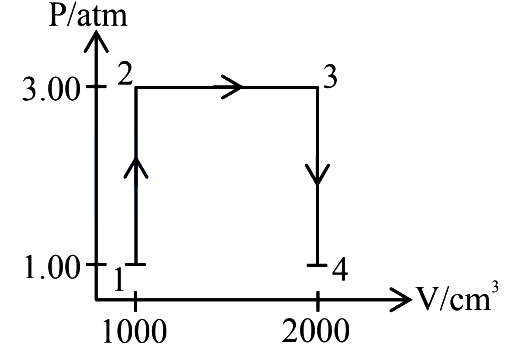
\(\begin{aligned}
& \mathrm{W}_{1 \rightarrow 2}=0 \\
& \mathrm{~W}_{2 \rightarrow 3}=-\mathrm{P} \Delta \mathrm{~V} \\
& =-3[2-1] \\
& =-3 \mathrm{~atm}-\ell
\end{aligned}\)
\(\mathrm{W}_{3 \rightarrow 4}=0\)
Total work done
\(\begin{aligned}
& =-3 \mathrm{~atm}-\ell \\
& =-3 \times 101.3 \text { Joule } \\
& =-304 \text { Joule }
\end{aligned}\) -
- (A) 3000
- (B) 2500
- (C) 200
- (D) 3500
Show answer and solution
Correct Answer: (B)
\(\text { Mole of octane }=\frac{1.14}{114}=0.01 \mathrm{~mole}\)
Heat evolved \(=\mathrm{C} \times \Delta \mathrm{T}\)
\(\begin{aligned}
& =5 \times 5 \mathrm{~kJ} \\
& =25 \mathrm{~kJ}
\end{aligned}\)
\(\therefore\) Magnitude of Heat of combustion \(=\frac{25}{0.01}=2500\) \(\mathrm{kJ} /\) mole -
- (A) \(x+y \mathrm{kcal}\)
- (B) \(y-2 x \mathrm{kcal}\)
- (C) \(\frac{2 x}{y} \mathrm{kcal}\)
- (D) \(2 x+y \mathrm{kcal}\)
Show answer and solution
Correct Answer: (B)
(i) \(\mathrm{S}(\mathrm{g})+\frac{3}{2} \mathrm{O}_2(\mathrm{~g}) \rightarrow \mathrm{SO}_3(\mathrm{~g})+2 x\) kcal \(\Delta \mathrm{H}_1\)
(ii) \(\mathrm{SO}_2(\mathrm{~g})+\frac{1}{2} \mathrm{O}_2(\mathrm{~g}) \rightarrow \mathrm{SO}_3(\mathrm{~g})+y\) kcal \(\Delta \mathrm{H}_2\)
(i) - (ii)
\(\begin{aligned}
& \mathrm{S}(\mathrm{~g})+\mathrm{O}_2(\mathrm{~g}) \rightarrow \mathrm{SO}_2(\mathrm{~g}) \Delta \mathrm{H} \\
& \Delta \mathrm{H}=\Delta \mathrm{H}_1-\Delta \mathrm{H}_2 \\
& =-2 x-(-y)=(y-2 x) \mathrm{kcal}
\end{aligned}\) -
- (A) \(\mathrm{ED}\gt\mathrm{EC}\gt\mathrm{EB}\gt\mathrm{EA}\)
- (B) \(\mathrm{EA}\gt\mathrm{EB}\gt\mathrm{EC}\gt\mathrm{ED}\)
- (C) \(\mathrm{EB}\gt\mathrm{EA}\gt\mathrm{EC}\gt\mathrm{ED}\)
- (D) \(\mathrm{ED}\gt\mathrm{EC}\gt\mathrm{EA}\gt\mathrm{EB}\)
Show answer and solution
Correct Answer: (C)
The element having high value of Electron gain enthalpy (magnitude) will form a compound having higher ionic character so order of ionic character
\(E B>E A>E C>E D\) -
- (A) \(\Delta \mathrm{U}(\) Case-I \()=\Delta \mathrm{U}(\) Case-II \()=\Delta \mathrm{U}(\) Case-III \()\)
- (B) \(\Delta \mathrm{U}(\) Case-I \()\gt\Delta \mathrm{U}(\) Case-III \()\gt\Delta \mathrm{U}(\) Case-II \()\)
- (C) \(\Delta \mathrm{U}(\) Case-III \()\gt\Delta \mathrm{U}(\) Case-II \()\gt\Delta \mathrm{U}(\) Case-I \()\)
- (D) \(\Delta \mathrm{U}(\) Case-I \()\gt\Delta \mathrm{U}(\) Case-II \()\gt\Delta \mathrm{U}(\) Case-III \()\)
Show answer and solution
Correct Answer: (A)
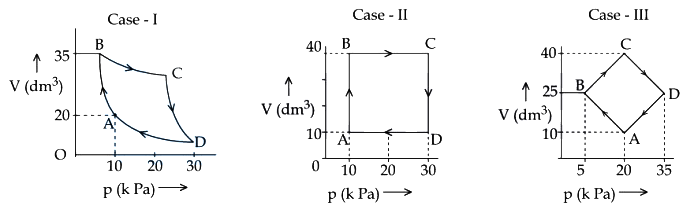
As internal energy ' \(U\) ' is a state function, its cyclic integral must be zero in a cyclic process
\(\therefore \Delta U \text { case }(I)=\Delta U \text { case }(\text { II })=\Delta U \text { case }(\text { III })\) -
- (A) \(a \gt b \gt c \gt d\)
- (B) \(d \gt c=a \gt b\)
- (C) \(c=a \gt d \gt b\)
- (D) \(a \gt c \gt b \gt d\)
Show answer and solution
Correct Answer: (B)
For isothermal process
\(\begin{aligned}
& \left|\mathrm{W}_{\text {reversible }}\right|_{\text {expansion }}=\left|\mathrm{W}_{\text {reversible }}\right|_{\text {compression }} \\
& =-\mathrm{nRT} \ln \frac{\mathrm{~V}_{\mathrm{f}}}{\mathrm{~V}_{\mathrm{i}}} \\
& \left|\mathrm{~W}_{\text {irreversible }}\right|_{\text {expansion }} \lt \left|\mathrm{W}_{\text {irreversible }}\right|_{\text {compression }} \\
& \mathrm{d} \gt \mathrm{c}=\mathrm{a} \gt \mathrm{b} \\
& \left|\mathrm{~W}_{\text {irreversible }}\right|_{\text {expansion }}=-\mathrm{P}_{\text {ext }}\left(\mathrm{V}_{\mathrm{f}}-\mathrm{V}_{\mathrm{i}}\right)
\end{aligned}\)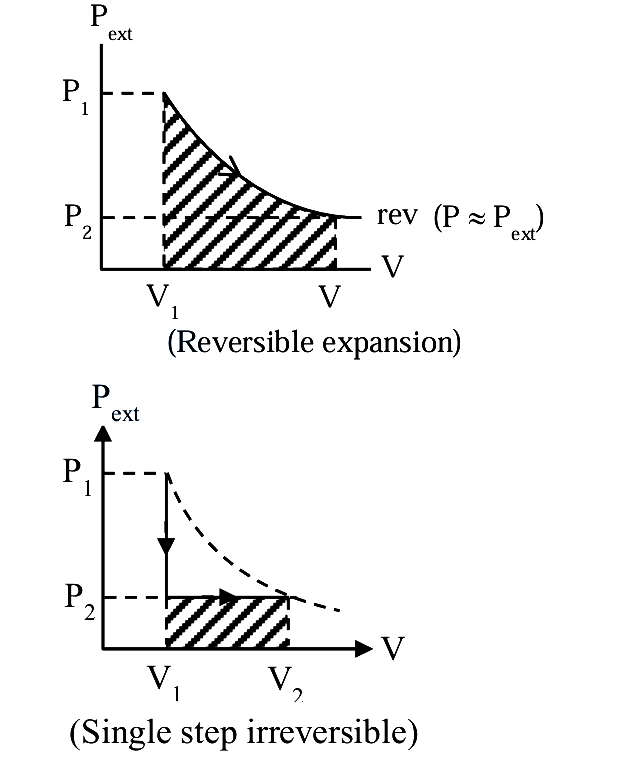
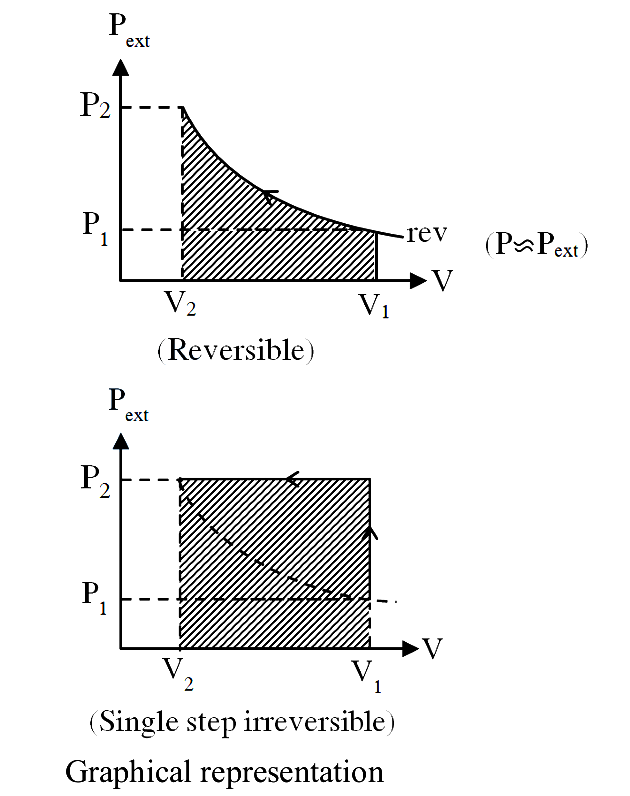
We can compare work by area of PV graph -
- (A) 140
- (B) 147
- (C) 138
- (D) 146
Show answer and solution
Correct Answer: (C)
\(\begin{aligned}
& \mathrm{C}_4 \mathrm{H}_{10}+\frac{13}{2} \mathrm{O}_2 \rightarrow 4 \mathrm{CO}_2+5 \mathrm{H}_2 \mathrm{O} \\
& 3 \times 10^3 \quad 10 \times 10^3
\end{aligned}\)
Moles of \(\mathrm{H}_2 \mathrm{O}\) formed \(=\mathrm{n}_{\mathrm{H}_2 \mathrm{O}}=5 \times \frac{2}{13} \times 10 \times 10^3\)
Then \(\mathrm{w}_{\mathrm{H}_2 \mathrm{O}}=\frac{10^5}{13} \times 18\)
\(=1.3846 \times 10^5 \mathrm{~g}\)
Volume of \(\mathrm{H}_2 \mathrm{O}\) will be \(=138.46\) litre.
Ans. 138 -
- (A) 90
- (B) 100
- (C) 95
- (D) 97
Show answer and solution
Correct Answer: (C)
\(\begin{aligned} & 2 \mathrm{C}_{\text {(graphite) }}+3 \mathrm{H}_2(\mathrm{~g}) \rightarrow \mathrm{C}_2 \mathrm{H}_6(\mathrm{~g}) \quad \Delta \mathrm{H}_{\mathrm{f}}=? \\ & \mathrm{C}_2 \mathrm{H}_6(\mathrm{~g})+\frac{7}{2} \mathrm{O}_2(\mathrm{~g}) \rightarrow 2 \mathrm{CO}_2(\mathrm{~g})+3 \mathrm{H}_2 \mathrm{O}(l) \\ & \quad \Delta \mathrm{H}_1=-1550 \\ & \mathrm{C}_{\text {(graphite) }}+\mathrm{O}_2(\mathrm{~g}) \rightarrow \mathrm{CO}_2(\mathrm{~g}) \Delta \mathrm{H}_2=-393.5 \\ & \mathrm{H}_2(\mathrm{~g})+\frac{1}{2} \mathrm{O}_2(\mathrm{~g}) \rightarrow \mathrm{H}_2 \mathrm{O}(/) \Delta \mathrm{H}_3=-286 \\ & \Delta \mathrm{H}_{\mathrm{f}}=2 \Delta \mathrm{H}_2+3 \Delta \mathrm{H}_3-\Delta \mathrm{H}_1 \\ & \quad=95 \mathrm{~kJ} / \mathrm{mole}^2\end{aligned}\) -
- (A) 46
- (B) 47
- (C) 48
- (D) 49
Show answer and solution
Correct Answer: (C)
\(\begin{aligned} & \Delta \mathrm{H}_{\mathrm{f}}\left[\mathrm{CO}_2(\mathrm{~g})\right]=-393.5 \mathrm{~kJ} / \mathrm{mole} \\ & \Delta \mathrm{H}_{\mathrm{f}}\left[\mathrm{H}_2 \mathrm{O}(\ell)\right]=-286.0 \mathrm{~kJ} / \mathrm{mole} \\ & \Delta \mathrm{H}_{\mathrm{c}}\left[\mathrm{C}_6 \mathrm{H}_6\right]=-3267.0 \mathrm{~kJ} / \mathrm{mole} \\ & \Delta \mathrm{H}_{\mathrm{f}} \mathrm{C}_6 \mathrm{H}_6=(?) \\ & \mathrm{C}_6 \mathrm{H}_6+\frac{15}{2} \mathrm{O}_2(\mathrm{~g}) \longrightarrow 6 \mathrm{CO}_2(\mathrm{~g})+3 \mathrm{H}_2 \mathrm{O}(\ell) \\ & \Delta \mathrm{H}_{\mathrm{R}}=\Delta \mathrm{H}_{\mathrm{C}}=\Sigma \Delta \mathrm{H}_{\mathrm{f}}(\mathrm{P})-\Sigma \Delta \mathrm{H}_{\mathrm{f}}(\mathrm{R}) \\ & -3267=6 \times(-393.5)+3(-286)-\Delta \mathrm{H}_{\mathrm{f}}\left(\mathrm{C}_6 \mathrm{H}_6\right) \\ & \Delta \mathrm{H}_{\mathrm{f}}\left(\mathrm{C}_6 \mathrm{H}_6\right)=48 \mathrm{~kJ} / \mathrm{mole}\end{aligned}\) -
- (A) Dissolution of gas in water is an endothermic process
- (B) The heat of solution depends on the amount of solvent.
- (C) The heat of dilution for the \(\mathrm{HCl}\left(\mathrm{HCl} \cdot 10 \mathrm{H}_2 \mathrm{O}\right.\) to \(\left.\mathrm{HCl}.40 \mathrm{H}_2 \mathrm{O}\right)\) is \(3.78 \mathrm{~kJ} \mathrm{~mol}^{-1}\).
- (D) The heat of formation of HCl solution is represented by both (a) and (b)
Show answer and solution
Correct Answer: (B)
From the given information
\(\Delta \mathrm{H}\) is negative so it means dissolution of gas \(\mathrm{HCl}(\mathrm{g})\) is exothermic.
\(\mathrm{HCl}(\mathrm{g})+10 \mathrm{H}_2 \mathrm{O}(\mathrm{l}) \rightarrow \mathrm{HCl}.10 \mathrm{H}_2 \mathrm{O}\) ...(1)
\(\Delta \mathrm{H}_1=-69.01 \frac{\mathrm{~kJ}}{\mathrm{~mol}}\)
\(\mathrm{HCl}(\mathrm{g})+40 \mathrm{H}_2 \mathrm{O}(\mathrm{l}) \rightarrow \mathrm{HCl}.40 \mathrm{H}_2 \mathrm{O}\) ...(2)
\(\Delta \mathrm{H}_2=-72.79 \frac{\mathrm{~kJ}}{\mathrm{~mol}}\)
Hence heat of solution depends upon amount of solvent
By equation..(2) - equation
\(\mathrm{HCl}.10 \mathrm{H}_2 \mathrm{O}+30 \mathrm{H}_2 \mathrm{O}(\ell) \rightarrow \mathrm{HCl} \cdot 40 \mathrm{H}_2 \mathrm{O}\)
So Heat of dilution \(=-72.79-(-69.01)\)
\(=-3.78 \frac{\mathrm{~kJ}}{\mathrm{~mol}}\)
Hence option (3) is incorrect.
For heat of formation reactant should be in elemental form hence option (4) is incorrect -
- (A) 30
- (B) 35
- (C) 20
- (D) 25
Show answer and solution
Correct Answer: (D)
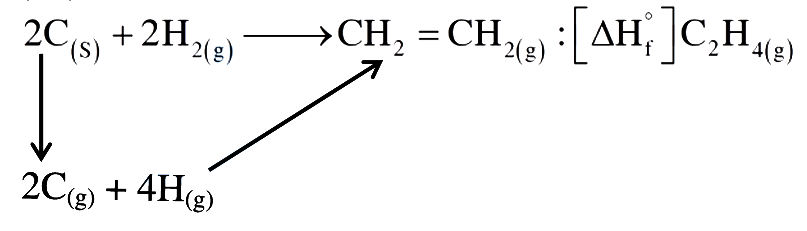
\(\left[\Delta H _{ f }^{ o }\right]_{ C _2 H _{(4)}}=2 \times\left[\Delta H _{ sub }^{ o }\right]_{ C _{( s )}}+2 \times \Delta H _{ H - H }^{ o }\) \(-1 \times \Delta H _{ C = C }^{ o }-4 \times \Delta H _{ CH }^{ o }\)
\(\Rightarrow\left[\Delta H _{ f }^{ o }\right]_{ C _2 H _{4(g)}}=(2 \times 710)+(2 \times 436)\) \(-611-4 \times 414\)
\(\Rightarrow {\left[\Delta \mathrm{H}_{\mathrm{f}}^{\mathrm{o}}\right]_{\mathrm{C}_2 \mathrm{H}_{4(\mathrm{~g})}}=25 \mathrm{~kJ} / \mathrm{mol} }\) -
- (A) \(\mathrm{T}=\mathrm{Te}\)
- (B) \(\mathrm{Te} \gt \mathrm{T}\)
- (C) \(\mathrm{T} \gt \mathrm{Te}\)
- (D) \(\mathrm{Te}=5 \mathrm{~T}\)
Show answer and solution
Correct Answer: (C)
For reaction to be spontaneous according to \(2^{\text {nd }}\) law:
\(\begin{aligned}
& \Delta \mathrm{G} \lt 0 \\
& \Rightarrow \Delta \mathrm{H}-\mathrm{T} \Delta \mathrm{~S} \lt 0 \\
& \Rightarrow \mathrm{~T} \gt \left(\frac{\Delta \mathrm{H}}{\Delta \mathrm{~S}}\right)=\mathrm{T}_{\mathrm{e}} \\
& \Rightarrow \mathrm{~T} \gt \mathrm{T}_{\mathrm{e}}
\end{aligned}\) -
- (A) Both \(\Delta \mathrm{H}\) and \(\Delta \mathrm{S}\) are (-ve)
- (B) \(\Delta \mathrm{H}\) is (-ve) but \(\Delta \mathrm{S}\) is (+ve)
- (C) \(\Delta \mathrm{H}\) is \((+\mathrm{ve})\) but \(\Delta \mathrm{S}\) is \((-\mathrm{ve})\)
- (D) Both \(\Delta \mathrm{H}\) and \(\Delta \mathrm{S}\) are (+ve)
Show answer and solution
Correct Answer: (D)
On increasing temperature, the given endothermic reaction becomes spontaneous.
\(\Delta G=\Delta H-T \Delta S\)
For spontaneity,
\(\Delta \mathrm{G} < 0\)
Given,
\(\Delta \mathrm{H}>0\)
So, \(\Delta \mathrm{S}\) should be +ve. -
- (A) (A)-(II), (B)-(I), (C)-(III), (D)-(IV)
- (B) (A)-(I), (B)-(II), (C)-(IV), (D)-(III)
- (C) (A)-(II), (B)-(I), (C)-(IV), (D)-(III)
- (D) (A)-(II), (B)-(III), (C)-(I), (D)-(IV)
Show answer and solution
Correct Answer: (C)
\(\begin{aligned} & \because \mathrm{dH}=\mathrm{dq} \text { (at } \mathrm{P}=\text { constant) } \\ & \mathrm{dH}=\mathrm{CpdT}^{\mathrm{dT}} \\ & \left(\frac{\mathrm{dH}}{\mathrm{dT}}\right)_{\mathrm{P}}=\mathrm{C}_{\mathrm{P}} \\ & \mathrm{dU}=\mathrm{dq} \quad \text { (at } \mathrm{V}=\text { constant) } \\ & \mathrm{dU}=\mathrm{C}_{\mathrm{V}} \mathrm{dT} \\ & \left(\frac{\mathrm{dU}}{\mathrm{dT}}\right)_{\mathrm{V}}=\mathrm{C}_{\mathrm{V}} \\ & \because \mathrm{dG}=\mathrm{VdP}-\mathrm{SdT} \\ & \text { at } \mathrm{P}=\text { constant, } \mathrm{dP}=0\end{aligned}\)
\(\left(\frac{d G}{d T}\right)_P=-S\)
at \(\mathrm{T}=\) constant
\(\left(\frac{\mathrm{dG}}{\mathrm{dP}}\right)_{\mathrm{T}}=\mathrm{V}\) -
- (A) \(0,21.84 \mathrm{~kJ},-1.26 \mathrm{~kJ}\)
- (B) \(0,-17.18 \mathrm{~kJ}, 1.718 \mathrm{~J}\)
- (C) \(0,21.84 \mathrm{~kJ}, 21,84 \mathrm{~kJ}\)
- (D) \(0,1.78 \mathrm{~kJ},-1.718 \mathrm{~kJ}\)
Show answer and solution
Correct Answer: (D)
\(\begin{aligned} & (10 \mathrm{~L}, 300 \mathrm{~K}) \xrightarrow{\mathrm{n}=1}(20 \mathrm{~L}, 300 \mathrm{~K}) \\ & -\mathrm{q}=\mathrm{w}=-\mathrm{nRT} \ln \frac{\mathrm{V}_2}{\mathrm{~V}_1} \\ & =-8.3 \times 300 \times \ln \left(\frac{20}{10}\right) \\ & =-1.718 \mathrm{~kJ} \\ & \Rightarrow \mathrm{q}=1.718 \mathrm{~kJ} \\ & \mathrm{w}=-1.718 \mathrm{~kJ} \\ & \Delta \mathrm{U}=0(\because \Delta \mathrm{~T}=0)\end{aligned}\) -
- (A) 800
- (B) 900
- (C) 1000
- (D) 700
Show answer and solution
Correct Answer: (D)
\(\begin{aligned} & \frac{1}{2} \mathrm{X}_2+\frac{5}{2} \mathrm{Y}_2 \rightleftharpoons \mathrm{XY}_5 \\ & \Delta \mathrm{~S}_{\mathrm{Rxn}}^0=110-\left[\left(\frac{1}{2} \times 70\right)+\left(\frac{5}{2} \times 50\right)\right] \\ & =110-160=-50 \mathrm{JK}^{-1} \mathrm{~mol}^{-1} \\ & \Delta \mathrm{G}^0=0 \text { at eqb } \\ & \Delta \mathrm{G}^0=\Delta \mathrm{H}^0-\mathrm{T} \Delta \mathrm{S}^0 \\ & 0=-35000-\mathrm{T}(-50) \\ & \mathrm{T}=700 \mathrm{Kelvin}\end{aligned}\)
No questions on this page match these filters.