


All JEE Mains 2022 Physics questions
32 chaptersShowing 401–450 of 597 questions
-
- (A) \(249\)
- (B) \(415\)
- (C) \(498\)
- (D) \(830\)
Show answer and solution
Correct Answer: (C)
No of moles \(=\frac{44.8}{22.4}=2\)Gas is mono atomic so \(C _{ V }=\frac{3}{2} R\)
\(\Delta Q = nC _{ v } \Delta T\)
\(=2 \times \frac{3}{2} R (20)\)
\(=60 R\)
\(=60 \times 8.3\)
\(=498 \,J\)
-
- (A) \(3: 2\)
- (B) \(9: 4\)
- (C) \(2: 3\)
- (D) \(3:5\)
Show answer and solution
Correct Answer: (D)
Average \(K.E./molecule=\frac{f}{2} k T\)So, \(\frac{K_{A r}}{K_{O_{2}}}=\frac{\frac{3}{2} k T}{\frac{5}{2} k T}=\frac{3}{5}\)
- 403. A gas has \(n\) degrees of freedom. The ratio of specific heat of gas at constant volume to the specific heat of gas at constant pressure will be. 2022 Medium
- (A) \(\frac{n}{n+2}\)
- (B) \(\frac{ n +2}{ n }\)
- (C) \(\frac{n}{2 n+2}\)
- (D) \(\frac{ n }{ n -2}\)
Show answer and solution
Correct Answer: (A)
\(C _{ v }=\frac{ nR }{2} \quad C _{ p }=\frac{( n +2) R }{2}\)\(\frac{ C _{v}}{ C _{ p }}=\frac{ n }{ n +2}\)
-
- (A) \(\frac{1}{3}\)
- (B) \(\frac{3}{1}\)
- (C) \(\frac{1}{16}\)
- (D) \(\frac{16}{1}\)
Show answer and solution
Correct Answer: (B)
\(PV = nRT\)\(n=\frac{100 \times 10^{3} \times 2000 \times 10^{-6}}{\frac{25}{3} \times 300}\)
\(n=80 \times 10^{-3}\)
\(n_{1}+n_{2}=0.08\)
\(n_{1} \times 2+n_{2} \times 32=0.76\)
\(\left(0.08-n_{2}\right) 2+n_{2}(32)=0.76\)
\(n_{2}=0.02\)
\(n_{1}=0.06\)
\(\frac{n_{1}}{n_{2}}=\frac{3}{1}\)
-
- (A) \(\frac{ Mv ^{2}}{7 R }\)
- (B) \(\frac{ Mv ^{2}}{5 R }\)
- (C) \(2 \frac{ Mv ^{2}}{7 R }\)
- (D) \(7 \frac{ Mv ^{2}}{5 R }\)
Show answer and solution
Correct Answer: (B)
\(\frac{ C _{ P }}{ C _{ v }}=1+\frac{2}{ F }=1.4 \Rightarrow F =5\)By conservation of energy
\(\frac{ F }{2} nR \Delta T =\frac{1}{2}[ nm ] v ^{2}\)
\(\Delta T =\frac{ mv ^{2}}{ FR }=\frac{ Mv ^{2}}{5 R }\)
-
- (A) \(2229\)
- (B) \(5616\)
- (C) \(9360\)
- (D) \(13104\)
Show answer and solution
Correct Answer: (C)
\(v _{ rms } \propto \sqrt{ T }\)\(v _{ rms } \propto \sqrt{300\,K }, v _{ rms _{ f }}=2 v _{ rms _{ i }}\)
\(v _{ rms _{ f }} \propto \sqrt{1200\,K }\)
\(T _{ f }=1200\,K , T _{ i }=300 K , n =\frac{14}{28}=\frac{1}{2}\)
\(Q = nC _{ v } \Delta T =\frac{1}{2} \times \frac{5 R }{2} \times 900\)
\(Q =9360\,J\)
- 407. A vessel contains \(16 \,g\) of hydrogen and \(128 \,g\) of oxygen at standard temperature and pressure. The volume of the vessel in \(cm ^{3}\) is 2022 Medium
- (A) \(72 \times 10^{5}\)
- (B) \(32 \times 10^{5}\)
- (C) \(27 \times 10^{4}\)
- (D) \(54 \times 10^{4}\)
Show answer and solution
Correct Answer: (C)
No of \(moles\) of \(H _{2}=8 \,moles\)No of \(moles\) of \(O _{2}=4 \,moles\)
Total \(moles\) \(=12 \,moles\)
At \(STP \,1 \,mole\) occupy \(=22.4 \ell=22.4 \times 10^{3} \,cm ^{3}\)
\(12 \,moles\) will occupy \(=12 \times 22.4 \times 10^{3} cm ^{3}\) \(\approx 26.8 \times 10^{4} \,cm ^{3}\)
-
- (A) \(A\) and \(C\) only
- (B) \(B\) and \(C\) only
- (C) \(A\) and \(B\) only
- (D) \(C\) and \(D\) only
Show answer and solution
Correct Answer: (B)
\(\lambda=\frac{ kT }{\sqrt{2} \pi d ^{2} P }\) -
- (A) \((1)\) and \((4)\) only
- (B) \((1)\),\((2)\) and \((4)\) only
- (C) \((2)\) and \((4)\) only
- (D) \((1),(2)\) and \((5)\) only
Show answer and solution
Correct Answer: (A)
\(KE _{\text {avg }}=\frac{3}{2} KT\)\(P =\frac{1}{3} \rho V _{\text {rus }}^{2}\)
Note : Statement \((4)\) is correct only if we consider it at constant volume and not constant pressure. Ideally, this question must be bonus but most appropriate answer is option \((A)\).
-
- (A) \(2\)
- (B) \(5\)
- (C) \(8\)
- (D) \(3\)
Show answer and solution
Correct Answer: (D)
\(C _{ V_{mix }} =\frac{ n _{1} Cv _{1}+ n _{2} Cv _{2}}{ n _{1}+ n _{2}}\)\(=\frac{1 \cdot \frac{3 R }{2}+3 \cdot \frac{5 R }{2}}{1+3}\)
\(=\frac{9 R }{4}=\frac{\alpha^{2}}{4} R\)
\(\alpha=3\)
-
- (A) \(A\) and \(C\) only
- (B) \(B\) and \(D\) only
- (C) \(A\) and \(B\) only
- (D) \(C\) and \(D\) only
Show answer and solution
Correct Answer: (C)
\(KTG\)A. \(V_{R m s}=\sqrt{\frac{3 R T}{M_{m}}} \Rightarrow V_{R m s}\) is same
B. \(\frac{ P _{1}}{ P _{2}}=\frac{ N _{1}}{ N _{2}} \Rightarrow B\) is correct
Ans \([A \& B\) only are correct]
-
- (A) \(1\)
- (B) \(2\)
- (C) \(3\)
- (D) \(4\)
Show answer and solution
Correct Answer: (B)
\(v _{ s }=\sqrt{\frac{\gamma RT }{ M }}\)\(v _{ mms }=\sqrt{\frac{3 RT }{ M }}\)
\(\frac{ v _{ s }}{ v _{ rms }}=\sqrt{\frac{\gamma}{3}}=\frac{1}{\sqrt{2}} \Rightarrow \frac{\gamma}{3}=\frac{1}{2} \Rightarrow \gamma=\frac{3}{2}\)
\(\gamma=1+\frac{2}{ f _{\operatorname{mix}}}\)
\(f _{\operatorname{mix}}=\frac{2 \times 3+ n \times 5}{ n +2}=\frac{6+ n \times 5}{( n +2)}\)
\(\gamma=1+\frac{2( n +2)}{6+ n \times 5}=\frac{6+5 n +2 n +4}{6+5 n }\)
\(\gamma=\frac{7 n +10}{6+5 n }=\frac{3}{2}\)
\(14 n +20=18+15 n\)
\(n =2\)
-
- (A) \(v _{ rms }=\sqrt{\frac{2}{3}} v _{ p }\)
- (B) \(v _{ rms }=\sqrt{\frac{3}{2}} v _{ p }\)
- (C) \(v _{ rms }= v _{ p }\)
- (D) \(v _{ rms }=\sqrt{\frac{1}{3}} v _{ p }\)
Show answer and solution
Correct Answer: (B)
\(v _{ rms }=\sqrt{\frac{3 RT }{ M }} \text { and } v _{ mp }=\sqrt{\frac{2 RT }{ M }}\)Thus \(v _{ rms }=\sqrt{\frac{3}{2}} v _{ mp }\)
-
- (A) \(60\)
- (B) \(12\)
- (C) \(15\)
- (D) \(36\)
Show answer and solution
Correct Answer: (C)
\(V _{\text {rms}}=\sqrt{\frac{3 kT }{ m }}=\sqrt{\frac{3 \times 1.38 \times 10^{-23} \times 293}{5 \times 10^{-17}}}\)\(\approx 15\,mm / s\)
-
- (A) \(7567\)
- (B) \(7771\)
- (C) \(7479\)
- (D) \(8976\)
Show answer and solution
Correct Answer: (C)
\(U = nC _{ v } T\)\(=2 \times \frac{3}{2} R \times 300\)
\(=900 R =900 \times 8 \cdot 31=7479\,J\)
-
- (A) The velocity of atomic oxygen remains same
- (B) The velocity of atomic oxygen doubles
- (C) The velocity of atomic oxygen becomes half
- (D) The velocity of atomic oxygen becomes four times
Show answer and solution
Correct Answer: (B)
\(V _{ mms }=\sqrt{\frac{3 RT }{ M }}\)\(T \rightarrow 2 T\)
\(M \rightarrow \frac{ M }{2}\)
\(V _{ rms } \propto \sqrt{\frac{ T }{ M }}\)
\(\Rightarrow\left(V_{\text {rms }}\right)_{\text {atomic }}=\left(V_{\text {rms }}\right)_{\text {molecular }} \times \sqrt{\frac{2}{1 / 2}}=2\left(V_{\text {ms }}\right)_{\text {molecular }}\)
-
- (A) \(270\)
- (B) \(258\)
- (C) \(250\)
- (D) \(290\)
Show answer and solution
Correct Answer: (C)
\(pV = nRT\)\(\Delta P . V = nR \Delta T\)
\(\Rightarrow \frac{\Delta P }{ P }=\frac{\Delta T }{ T }=\frac{0.4}{100}\)
\(\Rightarrow T =\frac{100 \times 1}{0.4}=250 K\)
-
- (A) \(B\) and \(C\) only
- (B) \(B\) and \(D\) only
- (C) \(A\) and \(B\) only
- (D) \(C\) and \(D\) only
Show answer and solution
Correct Answer: (B)
Methane molecule is tetrahedronDegree of freedom due to rotation \(=3\)
Degree of freedom due to translation \(=3\)
-
- (A) \(107\)
- (B) \(99\)
- (C) \(100\)
- (D) \(102\)
Show answer and solution
Correct Answer: (D)
\(1-\frac{Q_{2}}{Q_{1}}=1-\frac{T_{2}}{T_{1}}\)\(\frac{ Q _{2}}{ Q _{1}}=\frac{ T _{2}}{ T _{1}}\)
\(\frac{225}{300}=\frac{ T _{2}}{500}\)
\(\frac{500 \times 225}{300}= T _{2}\)
\(375= T _{2}\)
\(102^{\circ} C = T _{2}\)
-
- (A) \(166.7\)
- (B) \(255.1\)
- (C) \(266.7\)
- (D) \(367.7\)
Show answer and solution
Correct Answer: (C)
\(\eta=1-\frac{ T _{ L }}{ T _{ H }}\)\(\frac{1}{2}=1-\frac{ T _{ L }}{ T _{ H }}\)
\(\frac{1}{2}(1.3)=1-\left(\frac{ T _{ L }-40}{ T _{ H }}\right)\)
\(\frac{1}{2}(1.3)=\frac{1}{2}+\frac{40}{ T _{ H }} \quad T _{ H }=266.7\,K\)
-
- (A) \(3\)
- (B) \(0\)
- (C) \(12.6\)
- (D) \(8.4\)
Show answer and solution
Correct Answer: (C)
\(L=\frac{W D}{Q_{H}}\)\(\Rightarrow WD = Q _{ H }\left(1-\frac{ T _{ L }}{ T _{ H }}\right)\)
\(=5 \times 10^{3}\left(1-\frac{400}{1000}\right)\)
\(=3000\, kcal\)
\(=12.6 \times 10^{6} J\)
-
- (A) Increases by \(18\,^{\circ} C\)
- (B) Increase by \(200\,^{\circ} C\)
- (C) Increase by \(120\,^{\circ} C\)
- (D) Increase by \(73\,^{\circ}\)
Show answer and solution
Correct Answer: (B)
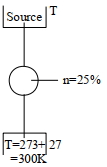
\(1-\frac{300}{ T }=0\)\(\frac{300}{ T }=0.75\)
\(1-\frac{300}{ T }=0\)
\(\frac{300}{ T }=0.75\)
\(T =400 K\)
If efficiency increased by \(\,100 \%\) then new efficiency \(\Rightarrow n ^{\prime}=50 \%\)
\(1-\frac{300}{T^{\prime}}=0.5\)
\(T^{\prime}=600 \,K\)
Increase in temp \(=600-400\)
\(=200\, K \text { or } 200^{\circ} C\)
\(T =400\, K\)
If efficiency increased by \(100 \%\,\) then new efficiency \(\Rightarrow n ^{\prime}=50 \%\)
\(1-\frac{300}{T^{\prime}}=0.5\)
\(T^{\prime}=600\,K\)
Increase in temp \(=600-400\)
\(=200 K \text { or } 200\,^{\circ} C\)
-
- (A) \(3.536 \times 10^{5}\,Pa\)
- (B) \(3.536 \times 10^{6}\,Pa\)
- (C) \(1.25 \times 10^{6}\,Pa\)
- (D) \(1.25 \times 10^{5}\,Pa\)
Show answer and solution
Correct Answer: (B)
\(P _{1}=2 \times 10^{7} Pa\)\(P _{1} V _{1}= P _{2} V _{2}\)
Since \(V_{2}=2 V_{1}\) Hence \(P_{2}=P_{1} / 2\) (isothermal expansion)
\(P _{2}=1 \times 10^{7} Pa\)
\(P _{2}\left( V _{2}\right)^{\gamma}= P _{3}\left(2 V _{2}\right)^{\gamma}\)
\(P _{3}=\frac{1 \times 10^{7}}{2^{1.5}}=3.536 \times 10^{6}\)
- 424. A diatomic gas \((\gamma=1.4)\) does \(400 J\) of work when it is expanded isobarically. The heat given to the gas in the process is ............ \(J\) 2022 Medium
- (A) \(1100\)
- (B) \(1200\)
- (C) \(1300\)
- (D) \(1400\)
Show answer and solution
Correct Answer: (D)
\(Q = nC _{ p } \Delta T =\frac{ n\gamma }{ \gamma -1} R \Delta T\)\(Q =\frac{ \gamma }{\gamma -1}\Delta T =\frac{1.4}{0.4} \times 400=1400 \,J\)
-
- (A) \(530\)
- (B) \(540\)
- (C) \(550\)
- (D) \(560\)
Show answer and solution
Correct Answer: (B)
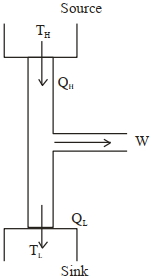
\(T _{ c }=324 \; k\)\(T _{ H }= ?\)
\(Q _{ H }=300 \; J\)
\(Q _{ L }=180 \; J\)
\(1-\frac{ Q _{ L }}{ Q _{ H }}=1-\frac{ T _{ L }}{ T _{ H }}\)
\(\frac{ Q _{ L }}{ Q _{ H }}=\frac{ T _{ L }}{ T _{ H }}\)
\(T _{ H }=\frac{ Q _{ H }}{ Q _{ L }} \times T _{ L }=\frac{300}{180} \times 324=540 K\)
-
- (A) \(1\)
- (B) \(8\)
- (C) \(32\)
- (D) \(64\)
Show answer and solution
Correct Answer: (C)
Constant entropy means process is adiabatic\(PV ^{\gamma}=\) constant
\(V _{2}=\frac{ V _{1}}{8}\)
\(P _{1} V _{1}^{\gamma}= P _{2} V _{2}^{\gamma}\)
\(P _{1} V _{1}^{\gamma}= P _{2}\left(\frac{ V _{1}}{8}\right)^{5 / 3}\)
\(P _{1} V _{1}^{5 / 3}=\frac{ P _{2} V _{1}^{5 / 3}}{32}\)
\(P _{2}=32 P _{1}\)
-
- (A) \(20\)
- (B) \(30\)
- (C) \(-30\)
- (D) \(-60\)
Show answer and solution
Correct Answer: (B)
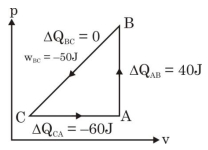
\(\Delta Q_{\text {cycle }}=40-60=\Delta W\)\(\Rightarrow \Delta W =-20 J = W _{ BC }+ W _{ CA }\)
\(\Rightarrow W _{ CA }=-20 J - W _{ BC }\)
\(=-20-(-50)\)
\(=30\,J\)
-
- (A) \(-450\)
- (B) \(450\)
- (C) \(900\)
- (D) \(1350\)
Show answer and solution
Correct Answer: (B)
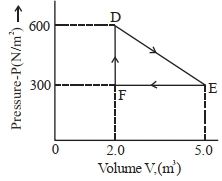
\(W _{ DE }=\frac{1}{2}(600+300) 3\,J\)\(=1350\,J\)
\(W _{ EF }=-300 \times 3=-900\,J\)
\(W _{ DEF }=450\,J\)
-
- (A) Dimensions of \(\beta\) is same as that of force.
- (B) Dimensions of \(\alpha^{-1} x\) is same as that of energy.
- (C) Dimensions of \(\eta^{-1} \sin \theta\) is same as that of \(\alpha \beta\)
- (D) Dimensions of \(\alpha\) is same as that of \(\beta\)
Show answer and solution
Correct Answer: (D)
\([\alpha \beta]=[\eta]=[\sin \theta]=\) Dimensionless\(\left[\eta^{-1} \sin \theta\right]=[\alpha \beta]=\text { D.L. }\)
-
- (A) Both statement \(-I\) and statement \(-II\) are true.
- (B) Both statement \(-I\) and statement \(-II\) are false.
- (C) Statement \(-I\) is true but statement \(-II\) is false.
- (D) Statement \(-I\) is false but statement \(-II\) is true.
Show answer and solution
Correct Answer: (A)
\(W _{\text {adiabatic }}=\frac{ NR \left( T _{f}- T _{ i }\right)}{1-\gamma} \rightarrow\) statment \(1\)\(Q=W+\Delta U\)
\(0= W +\Delta U\)
\(\Delta U =- W\)
If work is done on the gas, i.e. work is negative
\(\therefore \Delta U\) is positive.
\(\therefore\) Temperature will increase.
-
- (A) same as the \(1^{\text {st }}\) case
- (B) always greater than the \(1^{\text {st }}\) case
- (C) always less than the \(1^{\text {st }}\) case
- (D) may increase or decrease with respect to the \(1^{\text {st }}\) case
Show answer and solution
Correct Answer: (A)
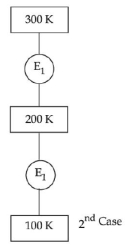
First case : \(\eta=1-\frac{100}{300}=\frac{2}{3}\)Second case : \(\eta_{\text {net }}=\eta_{1}+\eta_{2}-\eta_{1} \eta_{2}\)
\(\eta_{1}=1-\frac{200}{300}=\frac{1}{3}\)
\(\eta_{2}=1-\frac{100}{200}=\frac{1}{2}\)
\(\eta_{\text {net }}=\frac{1}{3}+\frac{1}{2}-\frac{1}{6}=\frac{2}{3}\)
\(\eta\) (first case) \(=\eta\) (second case)
-
- (A) \(16\)
- (B) \(26\)
- (C) \(36\)
- (D) \(46\)
Show answer and solution
Correct Answer: (A)
\(\left(T_{2}\right) T_{\sin k}=200 \; K\)\(\left(T_{1}\right) T_{\text {Reservoir }}=527+273=800 \; K\)
\(W=12000 K J=12 \times 10^{6} \; J\)
\(Q_{1}=\) ?
\(\eta=1-\frac{T_{2}}{T_{1}}=\frac{W}{Q_{1}}=1-\frac{200}{800}=\frac{12 \times 10^{6}}{Q_{1}}\)
\(\frac{3}{4}=\frac{12 \times 10^{6}}{Q_{1}}=Q_{1}=16 \times 10^{6} J\)
-
- (A) \(0.41\)
- (B) \(0.56\)
- (C) \(0.73\)
- (D) \(0.70\)
Show answer and solution
Correct Answer: (B)
Efficiency \(\eta=1-\frac{ T _{ L }}{ T _{ H }}\)\(\eta_{1}=1-\frac{147+273}{447+273}=1-\frac{420}{720}\)
\(\eta_{1}=\frac{300}{720}\)
\(\eta_{2}=1-\frac{47+273}{947+273}=1-\frac{320}{1220}\)
\(\eta_{2}=\frac{900}{1220}\)
\(\frac{\eta_{1}}{\eta_{2}}=\frac{300}{720} \times \frac{1220}{900}=\frac{122}{72 \times 3}\)
\(\frac{\eta_{1}}{\eta_{2}}=0.56\)
-
- (A) \(W _{1} < W _{2} < W _{3}\)
- (B) \(W _{2} < W _{3} < W _{1}\)
- (C) \(W _{3} < W _{1} < W _{2}\)
- (D) \(W _{2} < W _{1} < W _{3}\)
Show answer and solution
Correct Answer: (D)
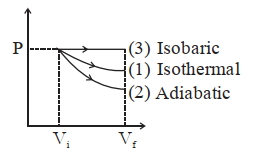
Area under curve is work\(W _{2} < W _{1} < W _{3}\)
- 435. The efficiency of an ideal heat engine working between the freezing point and boiling point of water, is ........ \(\%\) 2022 Medium
- (A) \(26.8\)
- (B) \(20 \)
- (C) \(12.5\)
- (D) \(6.25\)
Show answer and solution
Correct Answer: (A)
Efficiency of an ideal heat engine,\(\eta = \left( {1 - \frac{{{T_2}}}{{{T_1}}}} \right)\)
Freezing point of water \( = {0^ \circ }C = 273\,K\)
Boiling point of water\( = {100^ \circ }C = \left( {100 + 273} \right)K\)
\( = 373\,K\)
\(T_2\) Sink temperature\(=273 K\)
\(T_1\) Source temperature \(=373 K\)
\(\% \eta = \left( {1 - \frac{{{T_2}}}{{{T_1}}}} \right) \times 100 = \left( {1 - \frac{{273}}{{373}}} \right) \times 100\)
\( = \left( {\frac{{100}}{{373}}} \right) \times 100 = 26.8\% \)
-
- (A) \(5\)
- (B) \(2\)
- (C) \(4\)
- (D) \(0\)
Show answer and solution
Correct Answer: (C)
\(PV ^{\gamma}=\) const \(\quad d =\frac{ m }{ v }\)\(p \left(\frac{ m }{ d }\right)^{\gamma}=\) const
\(\frac{ p }{ d ^{\gamma}}=\) const \(\quad \frac{ d _{2}}{ d _{1}}=32\)
\(\frac{ p _{1}}{ p _{2}}=\left(\frac{ d _{1}}{ d _{2}}\right)^{\gamma}=\left(\frac{1}{32}\right)^{7 / 5}=\frac{1}{128}\)
\(\frac{ T _{1}}{ T _{2}}=\frac{ P _{1} V _{1}}{ P _{2} V _{2}}=\frac{1}{128} 32=\frac{1}{4}\)
-
- (A) \(675\)
- (B) \(1600\)
- (C) \(16.07\)
- (D) \(6.75\)
Show answer and solution
Correct Answer: (C)
\(\frac{1}{2} \times 1.5 \times 60^{2} \times \frac{1}{4}=0.1 \times 420 \times \Delta T\) -
- (A) \(90\)
- (B) \(89\)
- (C) \(95\)
- (D) \(100\)
Show answer and solution
Correct Answer: (A)
Energy released by water\(=0.3 \times 2.5 \times 4200=31500\,J\)
let \(m \ kg\) ice melts
\(m \times 3.5 \times 10^{5}=31.500\)
\(m =\frac{31500 \times 10^{-5}}{3.5}=9000 \times 10^{-5}\)
\(m =0.09\,kg =90\,gm\)
\(x =90\)
-
- (A) \(1.5\)
- (B) \(5.8\)
- (C) \(2.9\)
- (D) \(3.8\)
Show answer and solution
Correct Answer: (C)
Heat given by block to get \(0\,^{\circ} C\) temperature\(\Delta Q _{1}=5 \times\left(0.39 \times 10^{3}\right) \times(500-0)\)
\(=975 \times 10^{3} J\)
Heat absorbed by ice to melt \(m\) mass
\(\Delta Q _{2}= m \times\left(335 \times 10^{3}\right) J\)
\(\Delta Q _{1}=\Delta Q _{2}\)
\(m \times\left(335 \times 10^{3}\right)=975 \times 10^{3}\)
\(m =\frac{975}{335}=2.910\, kg\)
-
- (A) \(32\)
- (B) \(42\)
- (C) \(52\)
- (D) \(62\)
Show answer and solution
Correct Answer: (B)
\(m =2000 \; gm / min\)Heat required by \(water / min = mS \Delta T\)
\(=(2000) \times 4.2 \times 40 \; J / min\)
\(=336000 \; J / min\)
The rate of combustion \(=\left(\frac{ dm }{ dt } L \right)=336000 \; J / min\)
\(\frac{ dm }{ dt }=\frac{336000}{8 \times 10^{3}} \; g / min\)
\(=42 \; gm / min\)
-
- (A) \(125\)
- (B) \(500\)
- (C) \(250\)
- (D) \(600\)
Show answer and solution
Correct Answer: (B)
\(m \times 125 \times 200+ m \times 2.5 \times 10^{4}=\frac{1}{2} mv ^{2} \times \frac{40}{100}\)\(V =500 \,m / s\)
-
- (A) \(2.4 \times 10^{6} cm ^{3}\)
- (B) \(1.2 \times 10^{5} cm ^{3}\)
- (C) \(6.0 \times 10^{4} cm ^{3}\)
- (D) \(4.8 \times 10^{5} cm ^{3}\)
Show answer and solution
Correct Answer: (B)
Increase in volume \(\Delta V =\gamma V _{0} \Delta T\)\(\gamma=3 \alpha\)
So \(\Delta V =(3 \alpha) V _{0} \Delta T\)
Total surface area \(=6 a ^{2}\), where \(a\) is side length \(24=6 a ^{2} \quad a =2 m\)
\(Volume \,V _{0}=(2)^{3}=8 m ^{3}\)
\(\Delta V =\left(3 \times 5 \times 10^{-4}\right)(8) \times 10\)
\(=1.2 \times 10^{5} cm ^{3}\)
-
- (A) \(91\)
- (B) \(71\)
- (C) \(31\)
- (D) \(39\)
Show answer and solution
Correct Answer: (C)
Heat rejected \(= mL _{ f }+ mS \Delta T\)\(=(50 \times 540)+50(1)(100-20)\)
\(=31000 Cal\)
\(=31 \times 10^{3} Cal\)
-
- (A) \(59\)
- (B) \(6\)
- (C) \(60\)
- (D) \(600\)
Show answer and solution
Correct Answer: (C)
\(\ell_{ B }\left(1+\alpha_{ B } \Delta T \right)-\ell_{ i }\left(1+\alpha_{ i } \Delta T \right)=\ell_{ B }-\ell_{ i }\)\(\alpha_{ B } \ell_{ B }=\ell_{ i } \alpha_{ i }\)
\(1.8 \times 10^{-5} \times 40=\ell_{ i } \times 1.2 \times 10^{-5}\)
\(\ell_{ i }=\frac{1.8 \times 10^{-5} \times 40}{1.2 \times 10^{-5}}=\frac{3 \times 40}{2}=60\) \(\ell_{ i }=60\,cm\)
-
- (A) \(125.7\)
- (B) \(91.7\)
- (C) \(425.7\)
- (D) \(152.7\)
Show answer and solution
Correct Answer: (D)
\(\Delta \ell=6.241-6.230=0.011 \,cm\)\(\Delta \ell=\ell \alpha \Delta \theta\)
\(0.011=6.230 \times 1.4 \times 10^{-5}(\theta-27)\)
\(\theta-27=\frac{0.011 \times 10^{5}}{6.230 \times 1.4}\)
\(\theta \approx 153.11\) nearest is \(152.7^{\circ} C\)
-
- (A) \(49\)
- (B) \(48\)
- (C) \(46\)
- (D) \(50\)
Show answer and solution
Correct Answer: (D)
\(T =\frac{ mv ^{2}}{\ell}=\frac{10 \times v ^{2}}{0.5}=20\,v ^{2}\)\(T _{\max }=\) Breaking stress \(\times\) Area
\(=5 \times 10^{8} \times 10^{-4}=5 \times 10^{4}\)
\(20\,V ^{2}=5 \times 10^{4}\)
\(V=\sqrt{\frac{1}{4} 10^{4}}=50\,m / s\)
-
- (A) \(24\)
- (B) \(12\)
- (C) \(48\)
- (D) \(96\)
Show answer and solution
Correct Answer: (C)
\(\frac{ F }{ A }=\eta \frac{ x }{\ell} \Rightarrow \frac{ F \ell}{ An }= x\)\(x =\frac{18 \times 10^{4} \times 60 \times 10^{-2}}{60 \times 10^{-2} \times 15 \times 10^{-2} \times 25 \times 10^{9}}\)
\(=48 \times 10^{-6}\,m =48\,\mu m\)
-
- (A) \(360\)
- (B) \(180\)
- (C) \(1080\)
- (D) \(154\)
Show answer and solution
Correct Answer: (D)
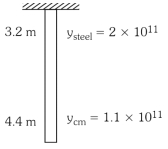
\(\Delta \ell_{1}+\Delta \ell_{2}=\Delta \ell\)\(\frac{ F \ell_{1}}{ A _{1} y _{1}}+\frac{ F \ell_{2}}{ A _{2} y _{2}}=\Delta \ell\)
\(F =\frac{\Delta \ell}{\frac{\ell_{1}}{ A _{1} y _{1}}+\frac{\ell_{2}}{ A _{2} y _{2}}}=1.54 \times 10^{2}=154\)
-
- (A) \(29\)
- (B) \(300\)
- (C) \(30\)
- (D) \(303\)
Show answer and solution
Correct Answer: (C)
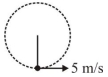
Strain \(=\) F/AY\(=\frac{ mg +\frac{ mv ^{2}}{ R }}{ AY }\)
\(=\frac{20+\frac{2(5)^{2}}{0.5}}{3 \times 10^{-6} \times 10^{11}}=30 \times 10^{-5}\)
-
- (A) \(28\)
- (B) \(25\)
- (C) \(24\)
- (D) \(23\)
Show answer and solution
Correct Answer: (B)
\(Y =\frac{ T }{ A } \frac{ dx }{ dy }\)\(m =20\,kg\)
\(A =0.4\,m^{2}\)
\(1=20\,m\)
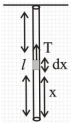
let extension is \(dy\) in length \(dx\)
\(Y =\frac{\text { stress }}{\text { strain }}\)
\(Y =\frac{\frac{ T }{ A }}{\frac{ d }{ dx }}=\frac{ T }{ A } \cdot \frac{ dx }{ dy }\)
\(dy =\frac{ Tdx }{ AY }\)
Tension at a distance \(x\) from lower end \(=\frac{ mg }{\ell} x\)
So. \(\int_{0}^{\Delta l} dy =\int_{0}^{\ell} \frac{ mg }{\ell} x \frac{ dx }{ AY }\)
\(\Delta \ell=\frac{ mg }{\ell AY }\left[\frac{ x ^{2}}{2}\right]_{0}^{\ell}\)
\(\Delta \ell=\frac{ mg \ell}{2\,AY }\)
\(\Delta \ell=\frac{20 \times 10 \times 20}{2 \times 0.4 \times 2 \times 10^{11}}\)
\(2500 \times 10^{-11}\)
\(\Delta \ell=25 \times 10^{-9}\)
\(= x \times 10^{-9}\)
No questions on this page match these filters.