


All JEE Mains 2022 Physics questions
32 chaptersShowing 101–150 of 597 questions
-
- (A) \(\frac{ hc }{ E \lambda- hc }\)
- (B) \(\frac{ hc \lambda}{ E \lambda+ hc }\)
- (C) \(\frac{ h \lambda}{ E \lambda+ hc }\)
- (D) \(\frac{ hc \lambda}{ E \lambda- hc }\)
Show answer and solution
Correct Answer: (B)
\(E =\frac{ hc }{\lambda}-\phi-\text { (i) }\)\(2 E =\frac{ hc }{\lambda^{\prime}}-\phi-\) (ii)
(ii) \(-\) (i)
\(E = hc \left(\frac{1}{\lambda^{\prime}}-\frac{1}{\lambda}\right)\)
\(\Rightarrow \lambda^{\prime}=\frac{ hc \lambda}{ E \lambda+ hc }\)
-
- (A) \(1: 1\)
- (B) \(2: 1\)
- (C) \(4: 1\)
- (D) \(1: 4\)
Show answer and solution
Correct Answer: (B)
\(\sqrt{\frac{3.8-0.6}{1.4-0.6}}=\sqrt{\frac{3.2}{0.8}}=2\) -
- (A) \(1: 1\)
- (B) \(\sqrt{2}: 1\)
- (C) \(2: 1\)
- (D) \(4: 1\)
Show answer and solution
Correct Answer: (D)
Kinetic energy gained by a charged particle accelerated by a potential \(V\) is \(qV\) \(KE = qV\)\(\frac{ p ^{2}}{2 m }= qV \Rightarrow p =\sqrt{2 mqV }\)
\(p =\frac{ h }{\lambda}, \text { thus } \lambda=\frac{ h }{\sqrt{2 mqV }}\)
now \(\frac{\lambda_{ p }}{\lambda_{ d }}=\sqrt{\frac{ m _{ d } V _{ d }}{ m _{ p } V _{ p }}}\)
\(\Rightarrow \frac{1}{\sqrt{2}}=\sqrt{\frac{2 V_{d}}{V_{p}}} \Rightarrow \frac{V_{p}}{V_{d}}=4\)
-
- (A) \(32\)
- (B) \(33\)
- (C) \(34\)
- (D) \(35\)
Show answer and solution
Correct Answer: (D)
Stopping potential \(V _{0}=0.42 \; V\)\(\lambda=6630 \; \mathring A\)
\(E =\phi+ eV _{0}\)
\(E\) : energy of incident photon
\(V_{0}:\) Stopping potential
\(\phi= E - eV _{0}\)
\(E =\frac{12400}{6630} eV =1.87 \; eV\)
\(\phi=(1.87-0.42)=1.45 \; eV\)
\(\phi= hv _{0} ; v _{0}\) : threshold frequency
\(1.45 \times 1.6 \times 10^{-19}=6.63 \times 10^{-34} \times v _{0}\)
\(v _{0}=0.35 \times 10^{15}\)
\(=35 \times 10^{13} sec ^{-1}\)
\(=35\)
-
- (A) \(1: 2\)
- (B) \(1: 3\)
- (C) \(2: 3\)
- (D) \(3: 2\)
Show answer and solution
Correct Answer: (C)
\(\frac{1}{2} m v_{1}^{2}=4 \phi\)\(\frac{1}{2} mv _{2}^{2}=9 \phi\)
\(\frac{ v _{1}}{ v _{2}}=\frac{2}{3}\)
-
- (A) \(8\)
- (B) \(7\)
- (C) \(2\)
- (D) \(55\)
Show answer and solution
Correct Answer: (C)
\(hv =h v _{\text {th }}+\frac{1}{2} mv ^{2}\)\(v =2 v _{\text {th }}\)
\(2 hv _{\text {th }}=h v _{\text {th }}+\frac{1}{2} mv _{1}^{2} \ldots \ldots(1)\)
\(v =5 v _{\text {th }}\)
\(5 hv _{\text {th }}=h v _{\text {th }}+\frac{1}{2} mv _{2}^{2} \ldots(2)\)
\(\frac{\frac{1}{2} m v_{1}^{2}}{\frac{1}{2} m v_{2}^{2}}=\frac{h v_{t h}}{4 h v_{\text {th }}}\)
\(\left(\frac{ v _{1}}{ v _{2}}\right)^{2}=\frac{1}{4} \Rightarrow v _{2}=2 v _{1}\)
-
- (A) \(A\) and \(B\) only
- (B) \(A\) and \(E\) only
- (C) \(C\) and \(E\) only
- (D) \(D\) and \(E\) only
Show answer and solution
Correct Answer: (B)
\(\frac{1}{2} mV _{\max }^{2}= hf -\phi\)Photoelectric effect can be explained by particle nature of light. Threshold \(\lambda\) is max wavelength at which emission takes place.
-
- (A) \(1: 1\)
- (B) \(1: 10\)
- (C) \(10: 1\)
- (D) \(1: 2\)
Show answer and solution
Correct Answer: (C)
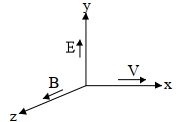
\(E _{ y }=900 \sin \left(\omega t -\frac{\omega x }{ c }\right)\)\(E _{0}=900\)
\(F _{ E }= q E _{0}\)
\(F _{ B }= qvB _{0}\)
\(\frac{ F _{ E }}{ F _{ B }}=\frac{ E _{0}}{ vB }=\frac{ c }{ v }=\frac{3 \times 10^{8}}{3 \times 10^{7}}=10: 1\)
-
- (A) \(16.96\; Vm ^{-1}\)
- (B) \(2.25 \times 10^{-2}\; Vm ^{-1}\)
- (C) \(8.48\; Vm ^{-1}\)
- (D) \(6.75 \times 10^{6} \;Vm ^{-1}\)
Show answer and solution
Correct Answer: (C)
\(\mu_{ I }=1.61 \quad \epsilon_{ I }=6.44\)\(B =4.5 \times 10^{-2}\)
\(E =\) \(?\)
\(C =\frac{1}{\sqrt{\mu_{0} \epsilon_{0}}} V =\frac{1}{\sqrt{\mu \epsilon}}\)
\(\frac{ C }{ V }=\sqrt{\mu_{ r } \epsilon_{ r }}=\sqrt{1.61 \times 6.44}\)
\(\frac{E}{B}=V=\frac{3 \times 10^{8}}{\sqrt{1.61 \times 6.44}}=9.32 \times 10^{7} m / s\)
\(E =4.5 \times 10^{-2} \times 9.32 \times 10^{7}\)
\(=4.2 \times 10^{6}\)
-
- (A) \(2\)
- (B) \(4\)
- (C) \(1\)
- (D) \(8\)
Show answer and solution
Correct Answer: (B)
\(C =\frac{ E _{0}}{ B _{0}}=\frac{2.25}{1.5 \times 10^{- s }}=1.5 \times 10^{8}\,ms ^{-1}\)\(t =\frac{6 \times 10^{3}}{1.5 \times 10^{8}}=4 \times 10^{-5}\,s\)
-
- (A) \(192\, k\,Vm ^{-1}\)
- (B) \(192\, m\, Vm ^{-1}\)
- (C) \(9600\, k\,Vm ^{-1}\)
- (D) \(16 \,k\,Vm ^{-1}\)
Show answer and solution
Correct Answer: (A)
\(\overrightarrow{ E }= E \hat{ k } B =12 mT\)\(\overrightarrow{ B }= B \hat{ j } \text { Energy }=728\,eV\)
Energy \(=\frac{1}{2} mv ^{2}\)
\(728\,eV =\frac{1}{2} \times 9.1 \times 10^{-31} \times v ^{2}\)
\(728 \times 1.6 \times 10^{-19}=\frac{1}{2} \times 9.1 \times 10^{-31} \times v ^{2}\)
\(v =16 \times 10^{6} m / s\)
\(E=v B\)
\(E =16 \times 10^{6} \times 12 \times 10^{-3}\)
\(E =192 \times 10^{3}\,V / m\)
-
- (A) \(60\)
- (B) \(6\)
- (C) \(9\)
- (D) \(3\)
Show answer and solution
Correct Answer: (B)
\(C^{\prime}=\frac{C}{\sqrt{\mu_{r} \varepsilon_{r}}}=\frac{3 \times 10^{8}}{\sqrt{6.25}}=\frac{3 \times 10^{8}}{2.5}\)\(f \lambda=1.25 \times 10^{8} s\)
\(\Rightarrow f \left(5 \times 10^{-3} \times 4\right)=1.25 \times 10^{8}\)
\(f =6.25 \,GHz\)
So \(f \approx 6\)
-
- (A) \(1.19\)
- (B) \(1.71\)
- (C) \(0.84\)
- (D) \(3.36\)
Show answer and solution
Correct Answer: (B)
\(\frac{\eta P }{4 \pi r ^{2}}=\frac{ cB _{0}^{2}}{2 \mu_{0}}\)\(B _{0}=\sqrt{\frac{\mu_{0}}{4 \pi} \frac{\eta P }{ c } \frac{1}{ r }}\)
\(\Rightarrow B _{0}=\frac{1}{4} \sqrt{\frac{10^{-7} \times 4 \times 3.5}{3 \times 10^{8}}}=1.71 \times 10^{-8} \,T\)
-
- (A) \(E_{y}=60 \sin \left[\frac{\pi}{4} \times 10^{3}\left( x -3 \times 10^{8} t \right)\right] \hat{ j }\,Vm ^{-1}\) \(B _{z}=2 \sin \left[\frac{\pi}{4} \times 10^{3}\left( x -3 \times 10^{8} t \right)\right] \hat{ k }\,T\)
- (B) \(E_{y}=60 \sin \left[\frac{\pi}{4} \times 10^{3}\left( x -3 \times 10^{8} t \right)\right] \hat{ j }\,Vm ^{-1}\) \(B _{z}=2 \times 10^{-7} \sin \left[\frac{\pi}{4} \times 10^{3}\left( x -3 \times 10^{8} t \right)\right] \hat{ k }\,T\)
- (C) \(E _{y}=2 \times 10^{-7} \sin \left[\frac{\pi}{4} \times 10^{3}\left( x -3 \times 10^{8} t \right)\right] \hat{ j }\,Vm ^{-1}\) \(B _{z}=60 \sin \left[\frac{\pi}{4} \times 10^{3}\left( x -3 \times 10^{8} t \right)\right] \hat{ k }\, T\)
- (D) \(E _{ y }=2 \times 10^{-7} \sin \left[\frac{\pi}{4} \times 10^{4}\left( x -4 \times 10^{8} t \right)\right] \hat{ j }\,Vm ^{-1}\) \(B _{z}=60 \sin \left[\frac{\pi}{4} \times 10^{4}\left( x -4 \times 10^{8} t \right)\right] \hat{ k } \,T\)
Show answer and solution
Correct Answer: (B)
\(B _{0}=\frac{ E _{0}}{ c }=\frac{60}{3 \times 10^{8}}=2 \times 10^{-7}\,T\)\(\widehat{ E } \times \widehat{ B }\) must be direction of propagation
So, \(\widehat{B} \rightarrow z\)-axis
\(k =\frac{2 \pi}{\lambda}=\frac{\pi}{4} \times 10^{3}\,m ^{-1}\)
\(E _{ y }=60 \sin \left[\frac{\pi}{4} \times 10^{3}\left( x -3 \times 10^{8} t \right)\right] \hat{ j } Vm ^{-1}\)
\(B _{z}=2 \times 10^{-7} \sin \left[\frac{\pi}{4} \times 10^{3}\left( x -3 \times 10^{8} t \right)\right] \hat{ k } T\)
-
- (A) Both statement \(I\) and statement \(II\) are true
- (B) Both statement \(I\) and statement \(II\) are false
- (C) Statement \(I\) is correct but statement \(II\) is false
- (D) Statement \(I\) is incorrect but statement \(II\) is true
Show answer and solution
Correct Answer: (C)
The statement \(II\) is wrong as the velocity of \(sm\) wave in a medium is \(\frac{1}{\sqrt{\mu \varepsilon}}=\frac{1}{\sqrt{\mu_{0} \mu_{ r } \varepsilon_{0} \varepsilon_{ r }}}\). -
- (A) \(D\) only
- (B) \(B\) and \(D\) only
- (C) \(B , C\) and \(E\) only
- (D) \(A, B\) and \(E\) only
Show answer and solution
Correct Answer: (B)
Second and fourth statements are correct. -
- (A) \(+0.8 \sin ( kz -\omega t ) \hat{ a }_{ y }+0.8 \sin ( kz -\omega t ) \hat{ a }_{ x }\)
- (B) \(+1.0 \times 10^{-6} \sin ( kz -\omega t ) \hat{ a }_{ y }+1.5 \times 10^{-6}( kz -\omega t ) \hat{ a }_{ x }\)
- (C) \(-0.8 \sin ( kz -\omega t ) \hat{ a }_{ y }-1.2 \sin ( kz -\omega t ) \hat{ a }_{ x }\)
- (D) \(-1.0 \times 10^{-6} \sin ( kz -\omega t ) \hat{ a }_{ y }-1.5 \times 10^{-6} \sin ( kz -\omega t ) \hat{ a }_{ x }\)
Show answer and solution
Correct Answer: (C)
\(\overrightarrow{ E }=301.6 \sin ( kz -\omega t )\left(-\hat{ a }_{ x }\right)+452.4 \sin ( kz -\omega t ) \hat{ a }_{ y }\)\(\overrightarrow{ B }=\frac{301.6}{ C } \sin ( kz -\omega t )\left(-\hat{a}_{ y }\right)+\frac{452.4}{ C } \sin ( kz -\omega t )\left(-\hat{ a }_{ x }\right)\)
\(\overrightarrow{ H }=\frac{\overrightarrow{ B }}{\mu_{0}}=\frac{301.6}{\mu C } \sin ( kz -\omega t )\left(-\hat{ a }_{ y }\right)+\frac{452.4}{\mu C } \sin ( kz -\omega t )\left(-\hat{ a }_{ x }\right)\)
\(\overrightarrow{ H }=-0.8 \sin ( kz -\omega t ) \hat{ a }_{ y }-1.2 \sin ( kz -\omega t ) \hat{ a }_{ x }\)
For direction
\(\overrightarrow{ E } \times \overrightarrow{ B }\) is direction of \(\overrightarrow{ C }\)
For first part \(\hat{ E }=-\hat{ i }, \hat{ B }= ?\)
\(\hat{ E } \times \hat{ B }=\hat{ k } \Rightarrow \hat{ B }=-\hat{ j }\)
Similarly for second
\(\hat{ E }=\hat{ j }, \hat{ B }=?\)
\(\hat{ E } \times \hat{ B }=\hat{ k } \Rightarrow \hat{ B }=-\hat{ i }\)
-
- (A) \(18\)
- (B) \(54\)
- (C) \(5.4\)
- (D) \(1.8\)
Show answer and solution
Correct Answer: (A)
\(E _{ y }=540 \sin \pi \times 10^{4}( x - ct ) Vm ^{-1}\)\(E _{0}=540\,Vm ^{-1}\)
\(B _{0}=\frac{ E _{0}}{ C }=\frac{540}{3 \times 10^{8}}=18 \times 10^{-7}\,T\)
-
- (A) \((a)-(iii), (b)-(ii), (c)-(i), (d)-(iv)\)
- (B) \((a)-(ii), (b)-(i), (c)-(iii), (d)-(iv)\)
- (C) \((a)-(ii), (b)-(iv), (c)-(iii), (d)-(i)\)
- (D) \((a)-(iii), (b)-(i), (c)-(ii), (d)-(iv)\)
Show answer and solution
Correct Answer: (B)
\(uv\) rays - used for water purification\(X-\)rays used for diagnosing fracture
Microwaves are used for mobile and radar communication
Infrared waves show less scattering therefore used in foggy days
-
- (A) \((a) - (iii), (b) - (iv), (c) - (ii), (d) - (i)\)
- (B) \((a) - (iii), (b) - (i), (c) - (ii), (d) - (iv)\)
- (C) \((a) - (iv), (b) - (iii), (c) - (ii), (d) - (i)\)
- (D) \((a) - (iii), (b) - (iv), (c) - (i), (d) - (ii)\)
Show answer and solution
Correct Answer: (A)
(Fact) -
- (A) \(80\)
- (B) \(29\)
- (C) \(54\)
- (D) \(84\)
Show answer and solution
Correct Answer: (D)
\(P ^{\prime}=10 \%\) of \(110\,W\)\(=\frac{10}{100} \times 110\,W\)
\(=11\,W\)
\(I _{1}- I _{2}=\frac{ P ^{\prime}}{4 \pi r _{1}^{2}}-\frac{ P ^{\prime}}{4 \pi r _{2}^{2}}\)
\(=\frac{11}{4 \pi}\left[\frac{1}{1}-\frac{1}{25}\right]\)
\(=\frac{11}{4 \pi} \times \frac{24}{25}\)
\(=\frac{264}{\pi} \times 10^{-2}=84 \times 10^{-2}\,W / m ^{2}\)
-
- (A) \(25.92 \times 10^{2}\,W / cm ^{2}\)
- (B) \(8.64 \times 10^{-6}\,W / cm ^{2}\)
- (C) \(6.0\,W / cm ^{2}\)
- (D) \(0.06\,W / cm ^{2}\)
Show answer and solution
Correct Answer: (D)
\(\frac{I}{C} \times\) area \(=\) force\(\frac{I}{C} \times 36 \times 10^{-4}=7.2 \times 10^{-9}\)
\(I =\frac{7.2 \times 10^{-9} \times 3 \times 10^{8}}{36 \times 10^{-9} \times 10}\)
\(=\frac{6 \times 10^{-1}}{10^{-3}}\)
\(I =6 \times 10^{2} \frac{ w }{ m ^{2}}\)
\(=0.06 \frac{ w }{ cm ^{2}}\)
-
- (A) \(2\)
- (B) \(7\)
- (C) \(8\)
- (D) \(9\)
Show answer and solution
Correct Answer: (C)
\(I _{ d }=\frac{ dq }{ dt }\)\(I _{ d }=\frac{\epsilon_{0} A }{ d } \frac{ dV }{ dt }\)
\(d =\frac{8.85 \times 10^{-12} \times 4 \times 10^{-3} \times 10^{6}}{4.425 \times 10^{-6}}\)
\(=8 \,mm\)
\(X =8\)
-
- (A) \(5.65 \;Wm ^{-2}\)
- (B) \(4.24 \;Wm ^{-2}\)
- (C) \(1.9 \times 10^{-7} \;Wm ^{-2}\)
- (D) \(56.5 \;Wm ^{-2}\)
Show answer and solution
Correct Answer: (B)
\(I =\frac{1}{2} \varepsilon_{0} E _{0}^{2} c\)\(I =\frac{1}{2} \times\left(8.85 \times 10^{-12}\right)(56.5)^{2} \times\left(3 \times 10^{8}\right)\)
\(=4.24 Wm ^{-2} .\)
-
- (A) \(2.25\)
- (B) \(4.25\)
- (C) \(6.25\)
- (D) \(8.25\)
Show answer and solution
Correct Answer: (A)
\(V =2 \times 10^{8} m / s\)\(C =3 \times 10^{8} m / s\)
\(\frac{ C }{ V }=\sqrt{\mu_{ r } \in_{ I }}\)
\(\frac{9}{4}=1 \times \epsilon_{ r }\)
\(\epsilon_{ I }=\frac{9}{4}=2.25\)
-
- (A) \(34\)
- (B) \(43\)
- (C) \(40\)
- (D) \(56\)
Show answer and solution
Correct Answer: (B)
\(I =\left(\frac{1}{2} \varepsilon_{0} E _{0}^{2}\right) C\)\(\Rightarrow E _{0} \Rightarrow \sqrt{\frac{2 I }{\varepsilon_{0} C }} \Rightarrow \sqrt{\frac{2 \times 0.22}{8.85 \times 10^{-12} \times 3 \times 10^{8}}}=12.873\)
\(B \Rightarrow \frac{ E _{0}}{ C } \Rightarrow \frac{12.873}{3 \times 10^{8}}=4.291 \times 10^{-8}=43 \times 10^{-9}\)
-
- (A) \(6 Vm ^{-1}\) along \(x\)-axis
- (B) \(3 Vm ^{-1}\) along \(z\)-axis
- (C) \(6 Vm ^{-1}\) along \(z\)-axis
- (D) \(2 \times 10^{-8} Vm ^{-1}\) along \(z\)-axis
Show answer and solution
Correct Answer: (C)
\(c =\frac{ E _{0}}{ B _{0}} \Rightarrow E _{0}= cB _{0}\)\(E _{0}=\left(3 \times 10^{8}\right)\left(2 \times 10^{-8}\right)\)
\(E _{0}=6 Vm ^{-1}\)
As, \(\overrightarrow{ B }=\) along \(y\)-axis
\(\overrightarrow{ v }\) =along negative \(x\)-axis
hence \(\quad \overrightarrow{ E }_{0}=\) along \(z\)-axis
-
- (A) \(15 \times 10^{2} \,Vm ^{-1}\)
- (B) \(5 \times 10^{-6} \,Vm ^{-1}\)
- (C) \(16 \times 10^{12} \,Vm ^{-1}\)
- (D) \(4 \times 10^{2} \,Vm ^{-1}\)
Show answer and solution
Correct Answer: (D)
\(B _{0}=5 \times 10^{-6}\)\(v =\) Speed of wave \(=\frac{4 \times 10^{8}}{5}=8 \times 10^{7}\left[\therefore v =\frac{ w }{ k }\right]\)
\(E _{0}= vB B _{0}=40 \times 10^{1}\)
\(=4 \times 10^{2} V / m\)
-
- (A) \(\lambda_{\text {visible }}<\lambda_{ X \text {-ray }}<\lambda_{\text {gamma-ray }}<\lambda_{\text {microwave }}\)
- (B) \(\lambda_{\text {gamma-ray }}<\lambda_{ X \text {-ray }}<\lambda_{\text {visible }}<\lambda_{\text {microwave }}\)
- (C) \(\lambda_{\text {X-ray }}<\lambda_{\text {gamma-ray }}<\lambda_{\text {visisible }}<\lambda_{\text {microwave }}\)
- (D) \(\lambda_{\text {microwave }}<\lambda_{\text {visible }}<\lambda_{\text {gamma-ray }}<\lambda_{\text {X-ray }}\)
Show answer and solution
Correct Answer: (B)
From electromagnetic wave spectrum.\(\lambda\) increases \(\longrightarrow\)
\(\gamma\)-ray \(x\)-rays ultra violet visible infrared microwave Radio wave \(\lambda_{\text {ganma-ray }}<\lambda_{ X \text {-ray }}<\lambda_{\text {visible }}<\lambda_{\text {microwave }}\)
-
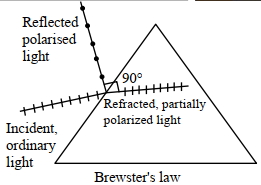
- (A) Reflected and refracted rays will be perpendicular to each other
- (B) Wave will propagate along the surface of prism
- (C) No refraction, and there will be total reflection of light.
- (D) No reflection and there will be total transmission of light
Show answer and solution
Correct Answer: (D)
But as the incident light electric field vectors are completely removed so there will be no reflection and there will be total transmission of light, explained by an experiment in \(NCERT.\)[Reference \(NCERT\) Part\(-2\) \(Pg\) \(-380,\) (A special case of total transmission)]
Note : Since direction of polarization is not mentioned hence most suitable option \((D)\) corresponding to case in which electric field is absent perpendicular to plane consisting incident and normal.
-
- (A) Resolving power will be \(\frac{1}{4}\) in the oil than it was in the air
- (B) Resolving power will be twice in the oil than it was in the air.
- (C) Resolving power will be four times in the oil than it was in the air.
- (D) Resolving power will be \(\frac{1}{2}\) in the oil than it was in the air.
Show answer and solution
Correct Answer: (B)
\((\text { R.P })_{\text {air }}=\frac{2 \sin \theta}{1.22 \lambda}\)\((\text { R.P })_{\text {oil }}=\frac{2 \sin \theta}{1.22 \lambda_{\text {oil }}}=\frac{2 \sin \theta \times \mu}{1.22 \lambda}\)
\((\text { R.P })_{\text {oil }}=(\text { R.P })_{\text {oir }} \times 2\)
-
- (A) \(\frac{I_{0}}{4}\)
- (B) \(\frac{I_{0}}{2}\)
- (C) \(\frac{3 I_{0}}{4}\)
- (D) \(\frac{3 I_{0}}{2}\)
Show answer and solution
Correct Answer: (C)
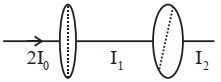
\(I _{1}=\frac{1}{2}\left(2 I _{0}\right)= I _{0}\)\(I _{2}= I _{1} \cos ^{2} 30^{\circ}\)
\(= I _{0} \cdot \frac{3}{4}=\frac{3 I _{0}}{4}\)
-
- (A) \(3 \times 10^{8} \; ms ^{-1}\)
- (B) \(3 \times 10^{10} \; ms ^{-1}\)
- (C) \(3.13 \times 10^{5} \; ms ^{-1}\)
- (D) \(4.48 \times 10^{5} \; ms ^{-1}\)
Show answer and solution
Correct Answer: (C)
\(\lambda_{\text {emitted }}=670 \; nm\)\(\lambda_{\text {obs }}=670.7 \; nm\)
\(v =?\)
\(c =3 \times 10^{8} \; m / s\)
If \(v << c\)
\(\frac{\lambda_{\text {obs }}-\lambda_{\text {emitted }}}{\lambda_{\text {emiited }}}=\frac{ v }{ c }\)
\(\frac{670.7-670}{670}=\frac{ v }{ c }\)
\(V =3.13 \times 10^{5} \; m / s\)
-
- (A) \(500\)
- (B) \(600\)
- (C) \(700\)
- (D) \(900\)
Show answer and solution
Correct Answer: (B)
\(\beta=\frac{\lambda D}{d}\)
\(\Delta \beta=\frac{\lambda}{ d } \Delta D\)
\(\lambda=\frac{\Delta \beta \cdot d}{\Delta D }\)
\(=\frac{3 \times 10^{-5} \times 1 \times 10^{-3}}{5 \times 10^{-2}}\)
\(=60 \times 10^{-8}=600 \times 10^{-9} \,m\)
\(=600 \,nm\) -
- (A) \(600\)
- (B) \(620\)
- (C) \(630\)
- (D) \(645\)
Show answer and solution
Correct Answer: (C)
\(\beta \propto \lambda\)\(\lambda_{2}=\frac{9}{8} \lambda_{1}\)
\(\therefore \beta_{2}=\frac{9}{8} \beta_{1}=\frac{9}{8} \times 560=630\,nm\)
-
- (A) \(1\)
- (B) \(4\)
- (C) \(5\)
- (D) \(0\)
Show answer and solution
Correct Answer: (B)
\(\beta=\frac{0.35 \times 5}{7}=0.25\)\(\frac{1}{\alpha}=\frac{2.5}{100}\)
\(\alpha=4\)
-
- (A) \(3\)
- (B) \(2\)
- (C) \(1.5\)
- (D) \(0.5\)
Show answer and solution
Correct Answer: (B)
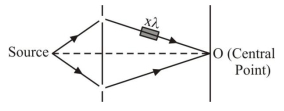
Path difference at \(O =(\mu-1) t\).If the intensity at \(O\) remains (maximum) unchanged, path difference must be \(n \lambda\).
\(\Rightarrow(\mu-1) t = n \lambda\)
\((1.5-1) x \lambda= n \lambda\)
\(\Rightarrow x =2 n\)
For \(n =1, x =2\)
-
- (A) \(16\)
- (B) \(9\)
- (C) \(48\)
- (D) \(12\)
Show answer and solution
Correct Answer: (B)
For a given light wavelength corresponding a medium of refractive index \(\mu\)\(\lambda_{\text {med }}=\frac{\lambda_{\text {vacuum }}}{\mu}\)
and we know that fringe width \(\beta=\frac{\lambda D}{ d }\)
Therefore, \(\beta_{\text {med }}=\frac{\beta_{\text {vacuum }}}{\mu}=\frac{12}{\frac{4}{3}}=9\,mm\)
-
- (A) \(450\)
- (B) \(550\)
- (C) \(650\)
- (D) \(750\)
Show answer and solution
Correct Answer: (A)
\(d=0.6 \times 10^{-3}\)\(D=80 \times 10^{-2}\)
\(1st\) Dark fringe \(=\frac{D \lambda}{2 d}=\frac{d}{2}, \quad \lambda=\frac{d^{2}}{D}\)
\(=450 \times 10^{-9} \; m\)
-
- (A) \(9\)
- (B) \(31\)
- (C) \(3\)
- (D) \(5\)
Show answer and solution
Correct Answer: (C)
\(\operatorname{asin} \theta=\frac{3 \lambda}{2}\)\(\frac{ y }{ L }=\theta=\frac{3 \lambda}{2 a } \quad L =2 m\)
\(y _{1}=\frac{3 \lambda_{1} L }{2 a } \quad \lambda_{2}=655\, nm\)
\(y _{2}=\frac{3 \lambda_{2} L }{2 a } \quad \lambda_{1}=650\, nm\)
\(a=0.5 \,nm\)
\(\Delta y = y _{2}- y _{1}=\frac{3\left(\lambda_{2}-\lambda_{1}\right)}{2 a } L\)
\(=\frac{3(655-650)}{2 \times 0.5 \times 10^{-3}} \times 2 \times 10^{-9}\)
\(=\frac{3 \times 5 \times 2}{1 \times 10^{-3}} \times 10^{-9}\)
\(=3 \times 10^{-5}\)
-
- (A) \(8.1 \times 10^{6}\)
- (B) \(10.0 \times 10^{7}\)
- (C) \(8.2 \times 10^{5}\)
- (D) \(1.0 \times 10^{-8}\)
Show answer and solution
Correct Answer: (C)
\(R.P =\frac{ d }{1.22 \lambda}=\frac{24.4 \times 10^{-2}}{1.22 \times 2440 \times 10^{-10}}=8.2 \times 10^{5}\) -
- (A) \(2\)
- (B) \(6\)
- (C) \(5\)
- (D) \(7\)
Show answer and solution
Correct Answer: (B)
\(I _{ P }= I +9 I +2 \sqrt{ I \times 9 I } \cos \frac{\pi}{2}\)\(I _{ P }=10\, I\)
\(I _{ Q }= I +9 I +2 \sqrt{ I \times 9 I } \cos \pi\)
\(=10 I -6 I =4 I\)
\(\therefore I _{ P }- I _{ Q }=10 I -4 I =6 I\)
-
- (A) \(1\)
- (B) \(3\)
- (C) \(4\)
- (D) \(2\)
Show answer and solution
Correct Answer: (D)
\(\phi_{ A }=\frac{\pi}{2}\)\(\phi_{ B }=\frac{\pi}{3}\)
\(I _{ A }= I +4 I +2 \sqrt{ I } \sqrt{4 I } \cos \left(\frac{\pi}{2}\right)\)
\(=5 I +4 I (0)=5 I\)
\(I _{ B }= I +4 I +2 \sqrt{ I } \sqrt{4 I } \cos \left(60^{\circ}\right)\)
\(=5 I +4 I \times \frac{1}{2}=7 I\)
\(I _{ B }- I _{ A }=7 I -5 I =2 I ,( x =2)\)
-
- (A) \(1.5\)
- (B) \(2\)
- (C) \(0.5\)
- (D) \(1\)
Show answer and solution
Correct Answer: (B)
\(\frac{ I _{1}}{ I _{2}}=\frac{1}{4}\)\(I _{2}=4 I _{1}\)
\(I _{\max }= I _{1}+4 I _{1}+2 \sqrt{ I _{1} 4 I _{1}}=9 I _{1}\)
\(I_{\min }=I_{1}+4 I_{1}-2 \sqrt{I_{1} 4 I_{1}}=I_{1}\)
\(\therefore \frac{9 I _{1}+ I _{1}}{9 I _{1}- I _{1}}=\frac{10}{8}=\frac{5}{4}=\frac{2 \alpha+1}{\beta+1}\)
\(\alpha=2 \beta=1\)
\(\therefore \frac{\alpha}{\beta}=\frac{2}{1}=2\)
-
- (A) \(24\)
- (B) \(12\)
- (C) \(6\)
- (D) \(3\)
Show answer and solution
Correct Answer: (A)
\(I _{\text {met }}=I_{1}+I_{2}+2 \sqrt{I_{1}} \sqrt{I_{2}} \cos \phi\)\(I_{\max }\) for \(\phi=0 \& I_{\min }\) for \(\phi=\pi\)
\(I_{\max }=\left(\sqrt{I_{1}}+\sqrt{I_{2}}\right)^{2}=(\sqrt{9 I}+\sqrt{4 I})^{2}=25\,I\)
\(I_{\min }=\left(\sqrt{I_{1}}-\sqrt{I_{2}}\right)^{2}=(\sqrt{9 I}-\sqrt{4 I})^{2}=I\)
\(I_{\max }-I_{\min }=25 I - I =24\,I\)
- 146. Two light beams of intensities in the ratio of \(9: 4\) are allowed to interfere. The ratio of the intensity of maxima and minima will be 2022 Medium
- (A) \(2: 3\)
- (B) \(16: 81\)
- (C) \(25: 169\)
- (D) \(25: 1\)
Show answer and solution
Correct Answer: (D)
\(\sqrt{\frac{I_{1}}{I_{2}}}=\sqrt{\frac{9}{4}}=\frac{3}{2}\)\(\left(\frac{\sqrt{ I _{1}}+\sqrt{ I _{2}}}{\sqrt{ I _{1}}-\sqrt{ I _{2}}}\right)^{2}=5^{2}=25\)
-
- (A) \(0.5\)
- (B) \(1.0\)
- (C) \(0.6\)
- (D) \(0.3\)
Show answer and solution
Correct Answer: (D)
Fringe width \(\beta=\frac{ D \lambda}{ d }\)\(\lambda_{1}=5000 \,\mathring A\)
\(\beta_{1}=\frac{ D }{ d }\left(5000 \times 10^{-10}\right)=5 \times 10^{-4} \,m\)......\((I)\)
\(\beta_{2}=\frac{ D }{(2 d )}\left(6000 \times 10^{-10}\right)= x \text { (let) }\).....\((II)\)
Divide \((II)\) and \((I)\)
\(\frac{\beta_{2}}{\beta_{1}}=\frac{3000 \times 10^{-10}}{5000 \times 10^{-10}}=\frac{x}{5 \times 10^{-4}}\)
\(x=3 \times 10^{-4} m \text { or } 0.3 \,mm\)
-
- (A) \(11\)
- (B) \(9\)
- (C) \(8\)
- (D) \(10\)
Show answer and solution
Correct Answer: (D)
For lens\(\frac{1}{ v }-\frac{1}{ u }=\frac{1}{ f }\)
\(\Rightarrow \frac{1}{ v }-\frac{1}{(-60)}=\frac{1}{20} \Rightarrow \frac{1}{ v }+\frac{1}{60}=\frac{1}{20}\)
\(v =30\,cm\)
For final image to be formed on the objectitself, after refraction from lens the ray should meet the mirror perpendicularly and the image by lens should be on the centre of curvature of mirror
\(R =30-10=20\,cm\)
Focal length of mirror \(= R / 2=10\,cm\)
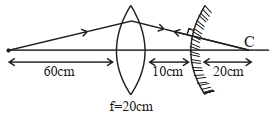
-
- (A) \(-110\)
- (B) \(110\)
- (C) \(-20\)
- (D) \(210\)
Show answer and solution
Correct Answer: (D)
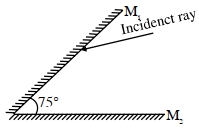
\(\delta_{total } = 360^o - 2\theta\)\(=360^o - 2 \times 75^o\)
\(\theta_{total} = 210^o\)
\(\theta_1 = 45^o\)
\(\delta=120^{\circ}+90^{\circ}=210^{\circ}\)
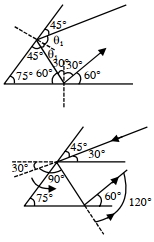
-
- (A) \(10\)
- (B) \(20\)
- (C) \(30\)
- (D) \(60\)
Show answer and solution
Correct Answer: (D)
For total internal reflection, i \(>\theta_{ C }\)\(\Rightarrow \sin i>\sin \theta_{C}\)
\(\Rightarrow \sin i>\frac{\mu_{R}}{\mu_{D}}\)............\((1)\)
Also \(\mu=\sqrt{\mu_{ r } \epsilon_{ T }}\)
\(\frac{\mu_{ R }}{\mu_{ D }}=\frac{\sqrt{1 \times 1}}{\sqrt{4 \times 1}}=\frac{1}{2}\)
From (1), \(\sin i>\frac{1}{2} \Rightarrow i>30^{\circ}, i =60^{\circ}\)
No questions on this page match these filters.