


All JEE Mains 2022 Physics questions
32 chaptersShowing 451–500 of 597 questions
-
- (A) \(2\)
- (B) \(3\)
- (C) \(4\)
- (D) \(5\)
Show answer and solution
Correct Answer: (D)
\(\Delta \ell_{1}=\frac{ F \ell}{ AY }=\frac{ F \ell}{\pi r ^{2} Y }=5\,cm\)\(\Delta \ell_{2}=\frac{4 F 4 \ell}{\pi 16 r ^{2} Y }=\frac{ F \ell}{\pi r ^{2} Y }=5\,cm\)
-
- (A) \(\sqrt{ L _{1} L _{2}}\)
- (B) \(\frac{ L _{1}+ L _{2}}{2}\)
- (C) \(2 L _{1}- L _{2}\)
- (D) \(3 L_{1}-2 L_{2}\)
Show answer and solution
Correct Answer: (C)
By Hooke's Lawso \(F \alpha \Delta L\)
\(\frac{ F _{1}}{ F _{2}}=\frac{\Delta L _{1}}{\Delta L _{2}}\)
\(\frac{10}{20}=\frac{\left(L_{1}-L\right)}{\left(L_{2}-L\right)}\)
\(L =2 L _{1}- L _{2}\)
-
- (A) Remains same
- (B) Become \(8\) times its initial value
- (C) Become \(\frac{1^{\text {th }}}{4}\) of its initial value
- (D) Become \(4\) times its initial value
Show answer and solution
Correct Answer: (A)
\(Y\) depends on material of wire -
- (A) \(20\)
- (B) \(2\)
- (C) \(23\)
- (D) \(21\)
Show answer and solution
Correct Answer: (B)
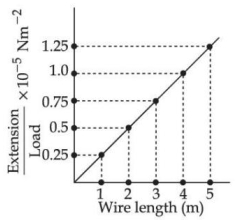
Slope \(=\frac{\Delta l / W }{ L }=\frac{\Delta l / L }{ w }=\frac{1}{ YA }\)\(Y =\frac{1}{\text { (slope) A }}\)
\(Y =\frac{1}{2 \times 10^{-6}\left(0.25 \times 10^{-5}\right)}\)
\(Y =2 \times 10^{11} N / m ^{2}\)
-
- (A) \(6.25\)
- (B) \(10\)
- (C) \(1\)
- (D) \(1.67\)
Show answer and solution
Correct Answer: (A)
Since breaking stress (Maximum lifting capacity) is the property of material so it will remain same. breaking stress \(=\frac{\text { Maximum lifting capacity }}{\text { Area of cross section of rope }}\) \(\frac{10}{2.5 \times 10^{-4}}=\frac{25}{ A }\)\(A =625 \times 10^{-6}\)
\(=6.25 \times 10^{-4} m ^{2}\)
-
- (A) \(35\)
- (B) \(-35\)
- (C) \(25\)
- (D) \(-25\)
Show answer and solution
Correct Answer: (C)
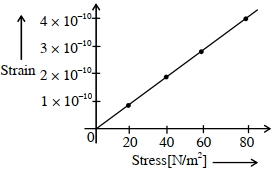
\(y =\frac{\text { stress }}{\text { strain }}=2.0 \times 10^{10}\)Energy density \(=\frac{1}{2} \; stress \; \times \; strain\)
\(=\frac{1}{2}(\text { strain })^{2} y =\frac{1}{2}\left(5 \times 10^{-4}\right)^{2} \times 20 \times 10^{10}\)
\(=25 \times 10^{2} \times 10=25 \frac{ kJ }{ m ^{3}}\)
Ans. \(25\)
-
- (A) \(0\)
- (B) \(2\)
- (C) \(4\)
- (D) \(6\)
Show answer and solution
Correct Answer: (D)
\(\Delta \ell \propto g\)\(\frac{\Delta \ell_{\text {earth }}}{\Delta \ell_{\text {planet }}}=\frac{g_{\text {earth }}}{g_{\text {planet }}}=\frac{10^{-4}}{6 \times 10^{-5}}\)
\(g_{planet} = 6 \; m / s ^{-2}\)
Ans. \(6.00\)
-
- (A) \(1\)
- (B) \(1.5\)
- (C) \(2\)
- (D) \(2.5\)
Show answer and solution
Correct Answer: (C)
\(F =Y A \frac{\Delta l}{l}\)\(=2 \times 10^{11} \times 10^{-4}\left(\frac{2 l-l}{l}\right)\)
\(=2 \times 10^{7}\,N\)
-
- (A) \(\frac{15}{\sqrt{2 \rho-\sigma}}\)
- (B) \(\frac{15}{\sqrt{\rho-\sigma}}\)
- (C) \(\frac{3}{2 \sqrt{\rho-\sigma}}\)
- (D) \(\frac{3}{20 \sqrt{2 \rho-\sigma}}\)
Show answer and solution
Correct Answer: (A)
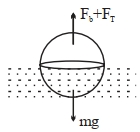
Boyant force \(+\) surace tension \(= mg\)\(\sigma \frac{ V }{2} g+2 \pi R T=\rho Vg\)
\(2 \pi RT =\frac{(2 \rho-\sigma)}{2} \frac{4}{3} \pi R ^{3} g ; \quad\left[ V =\frac{4}{3} \pi R ^{3}\right]\)
\(R ^{3}=\frac{3 T }{(2 \rho-\sigma) g} \Rightarrow R =\sqrt{\frac{3 \times 7.5 \times 10^{-2} N - m ^{-1}}{(2 \rho-\sigma) \times 10}}\)
\(R=\frac{3}{20 \sqrt{(2 \rho-\sigma)}} m =\frac{15}{\sqrt{2 \rho-\sigma}}\,\,cm\)
-
- (A) \(4\)
- (B) \(6\)
- (C) \(8\)
- (D) \(2\)
Show answer and solution
Correct Answer: (D)
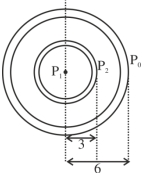
\(P_{2}-P_{0}=\frac{4 T}{6}\,and\,P_{1}-P_{2}=\frac{4 T}{3}\)\(\Rightarrow P_{1}-P_{0}=\frac{4 T}{2}=2\)
-
- (A) \(2.8 \times 10^{-4}\)
- (B) \(1.5 \times 10^{-3}\)
- (C) \(1.9 \times 10^{-4}\)
- (D) \(9.4 \times 10^{-5}\)
Show answer and solution
Correct Answer: (A)
\(d =2\,cm ; \quad r =1\,cm ; \quad T =0.075\)\(\Delta SE = T \Delta A\)
\(=0.075\left( A _{ f }- A _{1}\right)\)
\(A _{ i }=4 \pi r ^{2}\)
\(A _{ t }=4 \pi r _{0}^{2} \times 64\)
By volume conservation
\(\frac{4}{3} \pi r ^{3}=64 \cdot \frac{4}{3} \pi r_{0}^{3}\)
\(I _{0}=\frac{ r }{4}\)
\(A _{ f }=4 \pi\left(\frac{ r }{4}\right)^{2} \cdot 64=16 \pi r ^{2}\)
\(\Delta SE =0.075\left(16 \pi r ^{2}-4 \pi r ^{2}\right)\)
\(=0.075\left(12 \pi(0.01)^{2}\right)\)
\(=2.8 \times 10^{-4}\,J\)
-
- (A) \(8.5\)
- (B) \(8.2\)
- (C) \(7.5\)
- (D) \(5.3\)
Show answer and solution
Correct Answer: (C)
Initial surface energy \(= TA\)Where \(T\) is surface tension and \(A\) is surface area
\(U _{ i }=\left(\frac{75 \times 10^{-5}}{10^{-2}} \frac{ N }{ m }\right) \times\left[4 \pi\left(1 \times 10^{-2}\right)^{2}\right]\)
\(=75 \times 10^{-3} \times 4 \pi \times 10^{-4}=942 \times 10^{-7}\,J\)
To get final radius of drops by volume conservation
\(\frac{4}{3} \pi R^{3}=729\left(\frac{4}{3} \pi r^{3}\right)\)
\(R=\text { Initial radius }\)
\(r=\text { final radius }\)
\(r=\frac{R}{(729)^{1 / 3}}=\frac{R}{9}=\frac{1}{9}\,cm\)
Final surface energy
\(U _{ f }=729[ TA ]\)
\(=729\left[\frac{75 \times 10^{-5}}{10^{-2}} \frac{ N }{ m }\right] \times\left[4 \pi\left(\frac{1}{9} \times 10^{-2}\right)^{2}\right]\)
\(=729\left[75 \times 10^{-3} \times \frac{4 \pi \times 10^{-4}}{81}\right]\)
\(=9\left[942 \times 10^{-7} J \right]\)
Gain in surface energy
\(\Delta U =9 \times 942 \times 10^{-7}-942 \times 10^{-7}\)
\(=8 \times 942 \times 10^{-7} J =7536 \times 10^{-7}\,J\)
\(=7.5 \times 10^{-4}\,J\)
-
- (A) \(20\)
- (B) \(23\)
- (C) \(24\)
- (D) \(29\)
Show answer and solution
Correct Answer: (C)
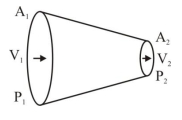
\(A _{2}=\frac{ A _{1}}{2}\)\(P _{1}- P _{2}=4500\,Pa\)
\(P _{1}+\frac{1}{2} \rho V _{1}^{2}+\rho gh = P _{2}+\frac{1}{2} \rho V _{2}^{2}+\rho gh\)
\(P _{1}- P _{2}=\frac{1}{2} \rho\left( V _{2}^{2}- V _{1}^{2}\right)\)
And \(A _{1} V _{1}= A _{2} V _{2}\)
\(\Rightarrow \quad V _{2}=2 V _{1}\)
\(4500=\frac{1}{2} \times 750 \times 3 V _{1}^{2}\)
\(V _{1}=2\,m / s\)
Volume flow rate \(= A _{1} V _{1}=24 \times 10^{-3}\,m ^{3} s ^{-1}\)
-
- (A) \(300\)
- (B) \(500\)
- (C) \(250\)
- (D) \(400\)
Show answer and solution
Correct Answer: (D)
\(F =\rho av { }^{2}=10^{3} \times 10 \times 10^{-4} \times 20 \times 20\)\(F =400\)
-
- (A) \(10\)
- (B) \(9\)
- (C) \(30\)
- (D) \(20\)
Show answer and solution
Correct Answer: (D)
Speed after falling through height \(h\) Should be equal to terminal velocity\(\sqrt{2 gh }=\frac{2}{9} \frac{ r ^{2}( d -\rho) g }{\eta}\)
\(\sqrt{2 gh }=\frac{2}{9} \frac{10^{-8}(10000-1000) \times 10}{10^{-5}}\)
\(=\frac{2}{9} \times 10^{-8} \frac{9 \times 10^{4}}{10^{-5}}=20\)
\(2 \times 10 \times h =400\)
\(h =20 \,m\)
-
- (A) \(145.4\)
- (B) \(118.0\)
- (C) \(132.6\)
- (D) \(123.4\)
Show answer and solution
Correct Answer: (D)
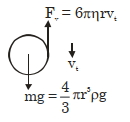
\(6 \pi \eta r v _{ t }=\frac{4}{3} \pi r ^{3} \rho g\)\(v _{ t }=\frac{4}{3} \times \frac{\pi r^{3} \rho g }{6 \pi \eta r}\)
\(v _{ t }=\frac{4}{3} \times \frac{\pi r ^{3} \rho g }{6 \pi \eta r}=\frac{2 \times 10^{-12} \times 10^{3} \times 10}{9 \times 1.8 \times 10^{-5}}\)
\(=123.4 \times 10^{-6}\,m / s\)
-
- (A) \(363\)
- (B) \(373\)
- (C) \(383\)
- (D) \(393\)
Show answer and solution
Correct Answer: (A)
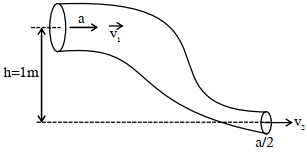
From continuity equation\(a v _{1}=\frac{ a }{2} v _{2}\)
\(v _{2}=2 v _{1}\)
From Bernoulli's theorem,
\(P _{1}+\rho g h_{1}+\frac{1}{2} \rho v _{1}^{2}= P _{2}+\rho g h_{2}+\frac{1}{2} \rho v _{2}^{2}\)
\(P _{1}- P _{2}=\rho\left[\left(\frac{ v _{2}^{2}- v _{1}^{2}}{2}\right)+ g \left( h _{2}- h _{1}\right)\right]\)
\(4100=800\left[\left(\frac{4 v _{1}^{2}- v _{1}^{2}}{2}\right)+10 \times(0-1)\right]\)
\(\frac{41}{8}+10=\frac{3 v _{1}^{2}}{2}\)
\(\frac{121}{8} \times \frac{2}{3}= v _{1}^{2}\)
\(v _{1}=\sqrt{\frac{ I 21}{4 \times 3} \times \frac{3}{3}}\)
\(v _{1}=\frac{\sqrt{363}}{6} \; m / s\)
\(X =363\)
-
- (A) \(11.6\)
- (B) \(10.8\)
- (C) \(17.8\)
- (D) \(14.4\)
Show answer and solution
Correct Answer: (C)
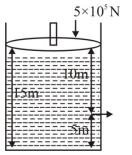
Apply Bernoulli's theorem between Piston and hole \(P_{A}+\rho g h=P_{0}+\frac{1}{2} \rho v_{e}^{2}\)Assuming there is no atmospheric pressure on piston
\(\frac{5 \times 10^{5}}{\pi}+10^{3} \times 10 \times 10=1.01 \times 10^{5}+\frac{1}{2} \times 10^{3} \times v_{e}^{2}\)
\(v_{e}=17.8\,m / s\)
-
- (A) \(R _{ e }=\frac{\eta d}{\rho v}\)
- (B) \(R_{e}=\frac{\rho v}{\eta d}\)
- (C) \(R _{ e }=\frac{\rho vd }{\eta}\)
- (D) \(R _{ e }=\frac{\eta}{\rho vd }\)
Show answer and solution
Correct Answer: (C)
Reynold's number is given by \(\frac{\rho v d}{\eta}\) -
- (A) \(100\)
- (B) \(200\)
- (C) \(300\)
- (D) \(400\)
Show answer and solution
Correct Answer: (C)
\(P_{0}+\frac{250}{0.5}+\rho g\left(40 \times 10^{-2}\right)=P_{0}+\frac{1}{2} \rho v^{2}\)\(500+\frac{1000 \times 10 \times 40}{100}=\frac{1}{2} \times 1000 \times v^{2}\)
\(V =3 \; m / s\)
\(V =300 \; cm / s\)

-
- (A) \(3\)
- (B) \(9\)
- (C) \(6\)
- (D) \(12\)
Show answer and solution
Correct Answer: (C)
\(B =3 \times 10^{10}\)\(-\frac{\Delta V }{ V }=0.02\)
\(B =\frac{\Delta P }{-\frac{\Delta V }{ V }} \Rightarrow \Delta P =- B \left(\frac{\Delta V }{ V }\right)\)
\(=\left(3 \times 10^{10}\right)(0.02)\)
\(=6 \times 10^{8} N / m ^{2}\)
-
- (A) \(12\)
- (B) \(11\)
- (C) \(10\)
- (D) \(8\)
Show answer and solution
Correct Answer: (B)
As the bubble is rising steadily the net force acting on it will be zero(Because of density of air the value of mg can be neglected)
So \(B = F \Rightarrow \frac{4 \pi}{3} R ^{3} \rho g =6 \pi \eta Rv\)
Putting \(R =1\,mm =10^{-3}\,m\)
\(\rho=1.75 \times 10^{3}\,kg / m ^{3}\)
\(g =10\,m / s ^{2}\)
\(v =0.35 \times 10^{-2}\,m / s\)
\(\eta=\frac{10}{9}=1.11\) SI unit \(=11\) poise \(( CGS )\)
-
- (A) \(r^{1 / 2}\)
- (B) \(r\)
- (C) \(r^{2}\)
- (D) \(r ^{3}\)
Show answer and solution
Correct Answer: (C)
\(v _{ t }=\frac{2}{9} \frac{ gr ^{2}\left(\rho_{ p }-\rho_{1}\right)}{\eta} ; \quad v _{ t } \propto r ^{2}\) -
- (A) \(24.125\)
- (B) \(23.125\)
- (C) \(25.125\)
- (D) \(22.125\)
Show answer and solution
Correct Answer: (C)
\(F _{ V }+ F _{ B }= mg ( v =\) constant \()\)\(F _{ V }= mg - F _{ B }\)
\(=\rho_{ B } Vg -\rho_{ L } Vg\)
\(=\left(\rho_{ B }-\rho_{ L }\right) Vg\)
\(=(8-1.3) \times 10^{+3} \times \frac{0.3 \times 10^{-3}}{8 \times 10^{3}} \times 10\)
\(=\frac{6.7 \times 0.3}{8} \times 10^{-2} \quad(g=10)\)
\(=\frac{67 \times 3}{8} \times 10^{-4}=25.125 \times 10^{-4}\)
Ans. \(25.125\)
-
- (A) \(m g\left(1-\frac{d_{1}}{d_{2}}\right)\)
- (B) \(m g\left(1-\frac{d_{2}}{d_{1}}\right)\)
- (C) \(m g\left(\frac{d_{1}}{d_{2}}-1\right)\)
- (D) \(m g\left(\frac{d_{2}}{d_{1}}-1\right)\)
Show answer and solution
Correct Answer: (B)
\(F_{V}=m g-F_{B}\)\(=m g-\left(\frac{m}{d_{1}} \times d_{2}\right) g\)
\(=m g\left(1-\frac{d_{2}}{d_{1}}\right)\)
-
- (A) \(500\)
- (B) \(107\)
- (C) \(700\)
- (D) \(100\)
Show answer and solution
Correct Answer: (D)
\(F =\eta A \frac{\Delta v _{ x }}{\Delta y }\)\(\frac{ F }{ A }=\eta \frac{\Delta v _{ x }}{\Delta y }\)
\(\Rightarrow 10^{-3}=10^{-2} \times \frac{36 \times 1000}{ h \times 3600}\)
\(\Rightarrow h =10^{-2} \times \frac{36 \times 1000}{10^{-3} \times 3600}=100 \,m\)
-
- (A) \(0.25\)
- (B) \(1\)
- (C) \(8\)
- (D) \(12\)
Show answer and solution
Correct Answer: (B)
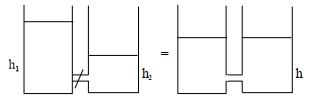
\(h =\frac{ h _{1}+ h _{2}}{2}\)Now,
\(W = U _{1}- U _{f}\)
\(W =\left(\rho A h_{1}\right) g \frac{h_{1}}{2}+\left(\rho A h_{2}\right) g \frac{h_{2}}{2}-\rho A \left( h _{1}+h_{2}\right) g\)
\(\left(\frac{h_{1}+h_{2}}{4}\right)\)
\(W =\frac{\rho Ag }{2}\left[ h _{1}^{2}+ h _{2}^{2}-\frac{\left( h _{1}+ h _{2}\right)^{2}}{2}\right]\)
\(W =1\,J\)
-
- (A) \(3\)
- (B) \(9\)
- (C) \(12\)
- (D) \(18\)
Show answer and solution
Correct Answer: (B)
\(F =\frac{ dm }{ dt } v\)\(=\frac{10 g }{5 s }\left(4.5 \frac{ cm }{ s }\right)=9 \frac{ gcm }{ s ^{2}}=9\,dyne\)
-
- (A) \(12\)
- (B) \(22\)
- (C) \(32\)
- (D) \(42\)
Show answer and solution
Correct Answer: (A)
Impulse \(=\) change in momentum\(= m [ v -(- v )]=2 \; mv\)
\(=2 \times 0.4 \times 15=12 \; Ns\)
-
- (A) \(2.66\)
- (B) \(0.83\)
- (C) \(1.68\)
- (D) \(0.70\)
Show answer and solution
Correct Answer: (C)
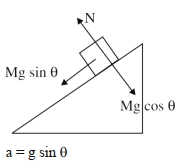
\(a = g \sin \theta\)\(\ell=\frac{1}{2} g \sin 30^{\circ}(2)^{2}\)
\(\ell=\frac{1}{2} g \sin 45^{\circ} t ^{2}\)
\(\left(\frac{1}{2}\right)(4)=\frac{1}{\sqrt{2}} t ^{2} \Rightarrow t =\sqrt{2 \sqrt{2}}=1.68\)
-
- (A) \(12\)
- (B) \(82\)
- (C) \(128\)
- (D) \(19\)
Show answer and solution
Correct Answer: (A)
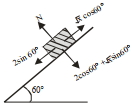
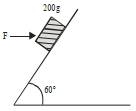
\(mg =2 N\)\(\sqrt{ x } \frac{1}{2}=\frac{2 \sqrt{3}}{2}\)
\(x =12\)
-
- (A) \(\frac{g}{4}\)
- (B) \(\frac{g}{2}\)
- (C) \(\frac{3 g }{4}\)
- (D) \(g\)
Show answer and solution
Correct Answer: (C)
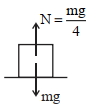
\(m g-N=m a\)\(a=g-\frac{g}{4}\)
\(a=\frac{3 g}{4}\)
-
- (A) \(3\)
- (B) \(6\)
- (C) \(5\)
- (D) \(4\)
Show answer and solution
Correct Answer: (C)
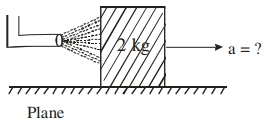
\(F =\frac{ dp }{ dt }= v \frac{ dm }{ dt }\)\(\Rightarrow Ma =10 \times 1\)
\(\Rightarrow 2 a =10\)
\(a =5 \,m / sec ^{2}\)
-
- (A) \(100 \hat{ i }+(100 \sqrt{2}-200) \hat{ j }\)
- (B) \(100 \sqrt{2} \hat{i}+(100-200 \sqrt{2}) \hat{j}\)
- (C) \(100 \hat{ i }+(100-200 \sqrt{2}) \hat{ j }\)
- (D) \(100 \sqrt{2} \hat{i}+(100 \sqrt{2}-200) \hat{j}\)
Show answer and solution
Correct Answer: (D)
\(y = x -\frac{10 x ^{2}}{2 u ^{2}\left(\frac{1}{2}\right)} \Rightarrow 10=20-\frac{(10)(100)}{ u ^{2}}\)\(u=20\)
\(T=\frac{(2)(20)}{\sqrt{2}(10)}=2 \sqrt{2}\)
\(\overrightarrow{ v }=10 \sqrt{2} \hat{ i }+(10 \sqrt{2}-10(2)] \hat{ j }\)
Momentum \(\vec{p}=M \vec{v}=100 \sqrt{2} \hat{i}+(100 \sqrt{2}-200) \hat{j}\)
-
- (A) \(15\)
- (B) \(25\)
- (C) \(35\)
- (D) \(50\)
Show answer and solution
Correct Answer: (B)
Mass of pieces by \(\frac{ M }{4}, \frac{ M }{4}, \frac{ M }{2}\)conserving momentum
\(\overrightarrow{ P }_{1}+\overrightarrow{ P }_{2}+\overrightarrow{ P }_{3}=0\)
\(\overline{ P }_{3}=-\left(\overline{ P }_{1}+\overline{ P }_{2}\right)\)
As \(\overline{ P }_{1} \,and \,\overline{ P }_{2}\) are perpendicular
so \(P _{3}=\sqrt{ P _{1}^{2}+ P _{2}^{2}}\)
\(P _{3}=(50) \frac{ M }{4}\)
\( and \,P _{3}=\frac{ M }{2} v\)
so \(v =25\)
-
- (A) \(2\)
- (B) \(99\)
- (C) \(20\)
- (D) \(60\)
Show answer and solution
Correct Answer: (A)
\(\overrightarrow{ F }=10 \hat{ i }+5 \hat{ j }\)\(m =100 \,g =0.1 \,kg\)
\(\vec{a}=\frac{\overrightarrow{ F }}{ m }=100 \hat{ i }+50 \hat{ j }\)
\(\overrightarrow{ S }=\overrightarrow{ u t}+\frac{1}{2} \overrightarrow{ a }{ }^{2}=\frac{1}{2} \overrightarrow{ a } t ^{2}(\) as \(\overrightarrow{ u }=0)\)
\(=\frac{1}{2}(100 \hat{ i }+50 \hat{ j }) 2^{2}\)
\(=200 \hat{i}+100 \hat{j}\)
\(=a \hat{i}+b \hat{j}\)
\(a=200, b=100\)
\(\therefore \frac{a}{b}=2\)
-
- (A) \(2\)
- (B) \(7\)
- (C) \(6\)
- (D) \(8\)
Show answer and solution
Correct Answer: (C)
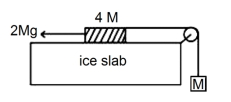
Using \(\overrightarrow{ F }_{\text {net }}=\mu \vec{a}\)\(2 Mg - T =4 Ma\)
\(T - Mg = Ma\)
_______________
\(\Rightarrow a =\frac{ g }{5}\)
\(T = Mg + Ma = Mg +\frac{ Mg }{5}=\frac{6}{5}\,Mg\)
-
- (A) \(5\)
- (B) \(6\)
- (C) \(2\)
- (D) \(1\)
Show answer and solution
Correct Answer: (B)
Taking the system as man and trolley and using conservation of linear momentum.
\(60 \times v =(60+120) \times 2\)
\(\Rightarrow v =6 \,m / s\) -
- (A) \(2\)
- (B) \(5\)
- (C) \(4\)
- (D) \(3\)
Show answer and solution
Correct Answer: (D)
\( T \sin \theta=30 \)\( T \cos \theta=100 \)
\( \Rightarrow \quad \tan \theta=0.3 \)
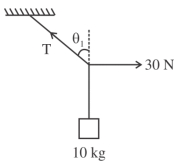
-
- (A) \(T =700\,N\) while climbing upward
- (B) \(T =350\,N\) while going downward
- (C) Rope will break while climbing upward
- (D) Rope will break while going downward
Show answer and solution
Correct Answer: (C)
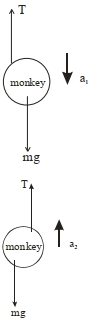
F.B.D of monkey while moving downwardUsing Newton's second law
\(mg - T = ma _{1}\)
\(500- T =50 \times 4 \Rightarrow T =300\,N\)
F.B.D of monkey while moving up
Using Newton's second law of motion
\(T - mg = ma _{2}\)
\(T -500=50 \times 5\)
\(T =750\,N\)
Breaking strength of string \(=350\,N\)
String will break while monkey is moving upward
- 491. A person is standing in an elevator. In which situation, he experiences weight loss? 2022 Medium
- (A) When the elevator moves upward with constant acceleration
- (B) When the elevator moves downward with constant acceleration
- (C) When the elevator moves upward with uniform velocity
- (D) When the elevator moves downward with uniform velocity
Show answer and solution
Correct Answer: (B)
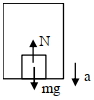
\(mg - N = ma\)\(\Rightarrow N = m ( g - a )\)
\(\therefore\) Person experiences weightloss, when acceleration of lift is downward.
-
- (A) \(6\)
- (B) \(2\)
- (C) \(1.5\)
- (D) \(4\)
Show answer and solution
Correct Answer: (D)
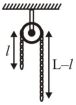
\(a =\frac{\left( m _{2}- m _{1}\right)}{\left( m _{2}+ m _{1}\right)} g\)\(\frac{ g }{2}=\frac{(\lambda( L -\ell)-\lambda \ell) g }{\lambda L } \Rightarrow L =\frac{ L }{4}=\frac{ L }{ x }\)
\(x =4\)

- 493. An object is thrown vertically upwards. At its maximum height, which of the following quantity becomes zero? 2022 Medium
- (A) Momentum
- (B) Potential energy
- (C) Acceleration
- (D) Force
Show answer and solution
Correct Answer: (A)
At maximum height, \(V =0\)\(\therefore\) Momentum of object is zero.
-
- (A) \(1: 1\)
- (B) \(\sqrt{2}: \sqrt{3}\)
- (C) \(\sqrt{3}: \sqrt{2}\)
- (D) \(2: 3\)
Show answer and solution
Correct Answer: (B)
\(6\, t_{1}^{2}=4\, t_{2}^{2}\)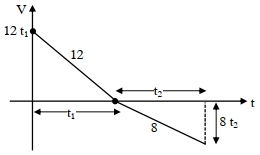
-
- (A) \(\sqrt{2} N , 45^{\circ}\)
- (B) \(\sqrt{2} N , 135^{\circ}\)
- (C) \(\frac{2}{\sqrt{3}} N , 30^{\circ}\)
- (D) \(2 N , 45^{\circ}\)
Show answer and solution
Correct Answer: (A)
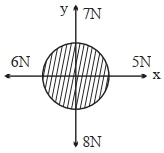
Let addition force required is \(=\overrightarrow{ F }\)\(\overrightarrow{ F }+5 \hat{ i }-6 \hat{ i }+7 \hat{ j }-8 \hat{ j }=0\)
\(\overrightarrow{ F }=\hat{ i }+\hat{ j },|\overrightarrow{ F }|=\sqrt{2}\)
Angle with X-axis: \(\tan \theta=\frac{ y \text { component }}{ x \text { component }}=\frac{1}{1}\)
\(\theta=45^{\circ}\)
-
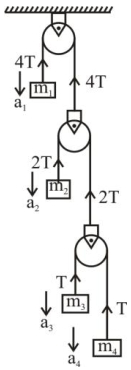
- (A) \(4 a_{1}+2 a_{2}+a_{3}+a_{4}=0\)
- (B) \(a_{1}+4 a_{2}+3 a_{3}+a_{4}=0\)
- (C) \(a_{1}+4 a_{2}+3 a_{3}+2 a_{4}=0\)
- (D) \(2 a_{1}+2 a_{2}+3 a_{3}+a_{4}=0\)
Show answer and solution
Correct Answer: (A)
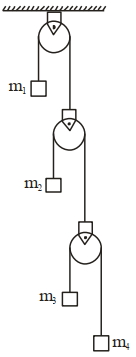
Using costraint\(\sum \overrightarrow{ T } \cdot \overrightarrow{ a }=0\)
\(-4 T a _{1}-2 T a _{2}- T a _{3}- T a _{4}=0\)
\(4 a _{1}+2 a _{2}+ a _{3}+ a _{4}=0\)
-
- (A) Impulse and average force acting on the object will be same for both the cases.
- (B) Impulse will be same for both the cases but the average force will be different.
- (C) Average force will be same for both the cases but the impulse will be different.
- (D) Average force and impulse will be different for both the cases.
Show answer and solution
Correct Answer: (B)
Impulse = change in momentum\(I=\Delta P\)
\(F _{\text {aug }}=\frac{\Delta P }{\Delta t }\)
\(\Delta t _{1}=3 \quad \Delta t _{2}=5\)
\(\Delta P _{1}=\Delta P _{2}\)
\(I _{1}= I _{2}\)
\(F _{\text {avg }}\) in case \((i)\) is more than \((ii)\)
-
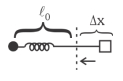
- (A) \(\frac{ k - m \omega^{2} l_{0}}{ m \omega^{2}}\)
- (B) \(\frac{ m \omega^{2} l_{0}}{ k + m \omega^{2}}\)
- (C) \(\frac{ m \omega^{2} I_{0}}{ k - m \omega^{2}}\)
- (D) \(\frac{ k + m \omega^{2} l_{0}}{m \omega^{2}}\)
Show answer and solution
Correct Answer: (C)
\(K \Delta x = m \left(\ell_{0}+\Delta x \right) w ^{2}\)\(K \Delta x = m \ell_{0} w ^{2}+ mw ^{2} \Delta x\)
\(\Delta x =\frac{ m \ell_{0} w ^{2}}{ k - mw ^{2}}\)
-
- (A) \(3360\)
- (B) \(3380\)
- (C) \(3120\)
- (D) \(3240\)
Show answer and solution
Correct Answer: (A)
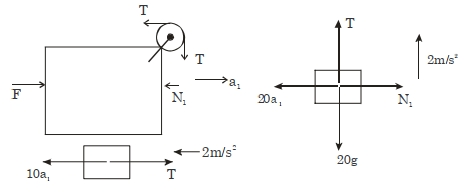
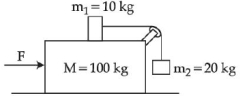
Let acceleration of \(100 kg\) block \(=a_{1}\) FBD of \(100\,kg\) block w.r.t ground\(F - T - N _{1}=100 a _{1} \ldots \ldots . .( i )\)
\(FBD\) of \(20\) block wrt \(100\,kg\)
\(T -20\,g =20(2)\)
\(T =240\)
\(N _{1}=20 a _{1}\)
FBD of \(10\,kg\) block wrt \(100\,kg\)
\(10 a _{1}-240=10(2)\)
\(a _{1}=26 m / s ^{2}\)
\(F -240-20(26)=100 \times 26\)
\(\Rightarrow F =3360\,N\)
-
- (A) \(100\)
- (B) \(200\)
- (C) \(300\)
- (D) \(400\)
Show answer and solution
Correct Answer: (B)
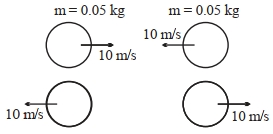
Change in momentum of any one ball\(|\Delta \overrightarrow{ P }|=2 \times 0.05 \times 10\)
\(|\Delta \overrightarrow{ P }|=1\)
\(\left|\overrightarrow{ F }_{x r}\right|=\frac{|\Delta \overrightarrow{ P }|}{\Delta t }\)
\(F _{ av }=200\,N\)
No questions on this page match these filters.