


Questions
24 questionsShowing 1–24 of 24 questions
-
- (A) \(11\)
- (B) \(9\)
- (C) \(8\)
- (D) \(10\)
Show answer and solution
Correct Answer: (D)
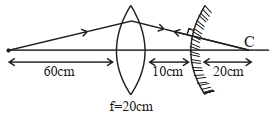
For lens\(\frac{1}{ v }-\frac{1}{ u }=\frac{1}{ f }\)
\(\Rightarrow \frac{1}{ v }-\frac{1}{(-60)}=\frac{1}{20} \Rightarrow \frac{1}{ v }+\frac{1}{60}=\frac{1}{20}\)
\(v =30\,cm\)
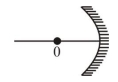
For final image to be formed on the objectitself, after refraction from lens the ray should meet the mirror perpendicularly and the image by lens should be on the centre of curvature of mirror
\(R =30-10=20\,cm\)
Focal length of mirror \(= R / 2=10\,cm\)
-
- (A) \(-110\)
- (B) \(110\)
- (C) \(-20\)
- (D) \(210\)
Show answer and solution
Correct Answer: (D)
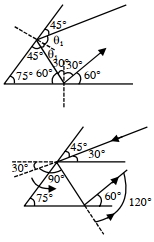
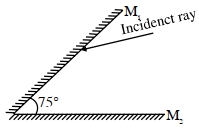
\(\delta_{total } = 360^o - 2\theta\)\(=360^o - 2 \times 75^o\)
\(\theta_{total} = 210^o\)
\(\theta_1 = 45^o\)
\(\delta=120^{\circ}+90^{\circ}=210^{\circ}\)
-
- (A) \(10\)
- (B) \(20\)
- (C) \(30\)
- (D) \(60\)
Show answer and solution
Correct Answer: (D)
For total internal reflection, i \(>\theta_{ C }\)\(\Rightarrow \sin i>\sin \theta_{C}\)
\(\Rightarrow \sin i>\frac{\mu_{R}}{\mu_{D}}\)............\((1)\)
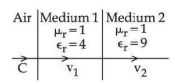
Also \(\mu=\sqrt{\mu_{ r } \epsilon_{ T }}\)
\(\frac{\mu_{ R }}{\mu_{ D }}=\frac{\sqrt{1 \times 1}}{\sqrt{4 \times 1}}=\frac{1}{2}\)
From (1), \(\sin i>\frac{1}{2} \Rightarrow i>30^{\circ}, i =60^{\circ}\)
-
- (A) \(223\)
- (B) \(220\)
- (C) \(225\)
- (D) \(234\)
Show answer and solution
Correct Answer: (C)
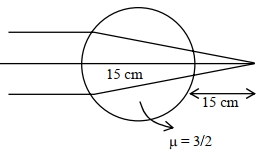
\(\frac{\frac{3}{2}}{ V }-\frac{1}{\infty}=\frac{\frac{3}{2}-1}{15}\)\(\frac{3}{2 V }=\frac{1}{30}\)
\(V =45 \,cm\)
\(\frac{1}{ V }-\frac{3}{\frac{2}{15}}=\frac{1-\frac{3}{2}}{\frac{2}{-15}}\)
\(\frac{1}{ V }-\frac{1}{10}=\frac{1}{30}\)
\(\frac{1}{ V }=\frac{1}{10}+\frac{1}{30}=\frac{4}{30}\)
\(V =7.5\)
\(V =22.5\)
\(v =225 \,mm\)
-
- (A) \(82\)
- (B) \(120\)
- (C) \(12\)
- (D) \(16\)
Show answer and solution
Correct Answer: (C)
\(\ell= t \sin i \left[1-\frac{\operatorname{cosi}}{\sqrt{\mu^{2}-\sin ^{2} i}}\right]\)\(\Rightarrow 4 \sqrt{3}= t \sin 60^{\circ}\left[1-\frac{\cos 60^{\circ}}{\sqrt{3-\frac{3}{4}}}\right]\)
-
- (A) \(5\)
- (B) \(7\)
- (C) \(9\)
- (D) \(11\)
Show answer and solution
Correct Answer: (C)
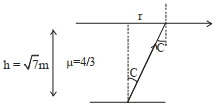
\(C\) : Criticle angle\(\tan C=\frac{r}{h}\)
\(r=h \tan C\)
\(\sin C =\frac{1}{\mu}=\frac{3}{4}\)
\(\tan C =\frac{3}{\sqrt{7}}\)
\(r =\sqrt{7} \times \frac{3}{\sqrt{7}}=3\)
Area of surface \(=\pi r^{2}=9 \; \pi m ^{2}\)
-
- (A) \(0.4\)
- (B) \(4\)
- (C) \(40\)
- (D) \(8\)
Show answer and solution
Correct Answer: (B)
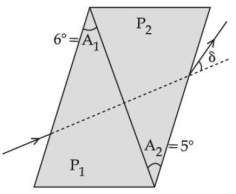
\(\delta= A \left(\mu_{ y }-1\right)- A ^{\prime}\left(\mu_{ y }^{\prime}-1\right)\)\(=6(1.5-1)-5(1.55-1)\)
\(=\frac{1}{4}\)
-
- (A) \(40\)
- (B) \(405\)
- (C) \(402\)
- (D) \(400\)
Show answer and solution
Correct Answer: (D)
After \(10\,sec\).\(u =-80\,cm\)
\(f =-100\,cm\)
\(\frac{1}{ v }+\frac{1}{ u }=\frac{1}{ f }\)
\(v =400\,cm\)
-
- (A) \(1.0\)
- (B) \(0.5\)
- (C) \(1.5\)
- (D) \(3.0\)
Show answer and solution
Correct Answer: (A)
\(\frac{\mu_{2}}{\mu_{ air }}=\frac{ C }{ V _{2}}\)\(\therefore \frac{\sqrt{\mu_{ r _{2}} \varepsilon_{ r _{2}}}}{(1)}=\frac{ C }{ V _{2}}\)
\(\therefore \sqrt{(1)(9)}=\frac{C}{v_{2}}\)
\(\therefore v _{2}=\frac{ C }{3}\)
-
- (A) \(\sin ^{-1}(\sqrt{n})\)
- (B) \(\cos ^{-1}\left(\sqrt{\frac{n}{2}}\right)\)
- (C) \(\sin ^{-1}(\sqrt{2 n})\)
- (D) \(2 \cos ^{-1}\left(\sqrt{\frac{n}{2}}\right)\)
Show answer and solution
Correct Answer: (D)
\(i=2 r\)\(\sin i \times n_{1}=\sin r \times n_{2}\)
\(\sin i \times 1=\sin \frac{i}{2} \times \sqrt{2 n}\)
\(\frac{\sin i}{\sin \frac{i}{2}}=\sqrt{2 n}\)
\(\frac{\sin \frac{i}{2} \cos \frac{i}{2}}{\sin \frac{i}{2}} \sqrt{2 n}\)
\(\cos \frac{i}{2}=\sqrt{\frac{n}{2}}\)
\(\frac{i}{2}=\cos ^{-1}\left(\sqrt{\frac{n}{2}}\right)\)
\(i=2 \cos ^{-1}\left(\sqrt{\frac{n}{2}}\right)\)
-
- (A) \(0.8\)
- (B) \(3.2\)
- (C) \(1.2\)
- (D) \(5.6\)
Show answer and solution
Correct Answer: (B)
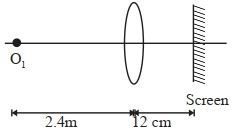
Applying lens formula\(\frac{1}{0.12}+\frac{1}{2.4}=\frac{1}{f} \Rightarrow \frac{1}{f}=\frac{210}{24}\)
Upon putting the glass slab, shift of image is
\(\Delta x = t \left(1-\frac{1}{\mu}\right)=\frac{1}{3}\,cm\)
Now \(v =12-\frac{1}{3}=\frac{35}{3}\,cm\)
Again apply lens formula
\(\frac{1}{0.12}+\frac{1}{ u }=\frac{1}{ f }=\frac{210}{24}\)
Solving \(u =-5.6\,m\)
Thus shift of object is
\(5.6-2.4=3.2\,m\)
-
- (A) wavelength speed and frequency decreases
- (B) wavelength increases, speed decreases and frequency remains constant
- (C) wavelength and speed decreases but frequency remains constant
- (D) wavelength, speed and frequency increases
Show answer and solution
Correct Answer: (C)
No change in frequency but speed and wave-length decreases.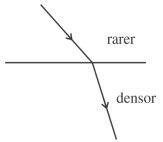
-
- (A) \(14\)
- (B) \(15\)
- (C) \(18\)
- (D) \(19\)
Show answer and solution
Correct Answer: (B)
\(vu = f ^{2}\) (by Newton's formula)\(f ^{\prime}=225\)
\(f =15\,cm\)
-
- (A) Reflection
- (B) Refraction
- (C) Diffraction
- (D) Scattering
Show answer and solution
Correct Answer: (D)
\(\frac{ a }{\lambda}=\frac{1}{100}\)For reflection size of obstacle must be much larger than wavelength, for diffraction size should be order of wavelength.
Since the object is of size \(\frac{\lambda}{100}\), much smaller than wavelength, so scattering will occur.
-
- (A) \(20\)
- (B) \(30\)
- (C) \(10\)
- (D) \(15\)
Show answer and solution
Correct Answer: (A)
\(f _{0}+ f _{ e }=30\)\(m =\frac{ f _{0}}{ f _{ e }}\)
\(2=\frac{ f _{0}}{ f _{ e }} \Rightarrow f _{0}=2 f _{ e }\)
So \(f _{0}+\frac{ f _{0}}{2}=30\)
\(f _{0}=20\,cm\)
-
- (A) \(27\)
- (B) \(270\)
- (C) \(22\)
- (D) \(30\)
Show answer and solution
Correct Answer: (A)
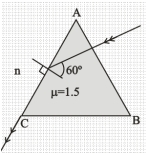
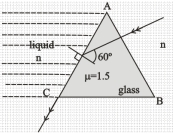
Using snell's law at face \(AC\)\(1.5 \sin 60^{\circ}=n \times \sin 90^{\circ}\)
\(1.5 \times \frac{\sqrt{3}}{2}=n=\frac{\sqrt{x}}{4}\)
\(3 \sqrt{3}=\sqrt{x}\)
\(x =27\)
-
- (A) \(1.732\)
- (B) \(1.333\)
- (C) \(1.414\)
- (D) \(2.732\)
Show answer and solution
Correct Answer: (C)
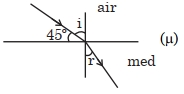
\(i=45^{\circ}\)\(D=i-r\)
\(15^{\circ}=45-r \Rightarrow r=30^{\circ}\)
\(n_{1} \sin i=n_{2} \sin r\)
\(1 \sin 45^{\circ}=\mu \sin 30^{\circ}\)
\(\frac{1}{\sqrt{2}}=\mu \frac{1}{2}\)
\(\mu=\sqrt{2}=1.414\)
-
- (A) \(\tan ^{-1}\left(\frac{3}{\sqrt{7}}\right)\)
- (B) \(\tan ^{-1}\left(\frac{2}{3}\right)\)
- (C) \(\cos ^{-1}\left(\frac{3}{4}\right)\)
- (D) \(\sin ^{-1}\left(\frac{2}{3}\right)\)
Show answer and solution
Correct Answer: (A)
\(V =\frac{ C }{ n }\)\(n_{d} \sin i_{c}=n_{r} \sin 90^{\circ}\)
\(\sin i_{ C }=\frac{ n _{ r }}{ n _{ d }}=\frac{ V _{ d }}{ V _{ I }}\)
\(\sin i_{c}=\frac{1.5 \times 10^{8}}{2 \times 10^{8}}=\frac{1.5}{2}\)
\(\sin i_{c}=\frac{3}{4}\)
\(\tan i_{c}=\frac{3}{\sqrt{4^{2}-3^{2}}} \Rightarrow \frac{3}{\sqrt{7}}\)
\(i_{c}=\tan ^{-1}\left(\frac{3}{\sqrt{7}}\right)\)
-
- (A) \(1.303\)
- (B) \(1.318\)
- (C) \(1.13\)
- (D) \(0.12\)
Show answer and solution
Correct Answer: (C)
\(v =\frac{ c }{\mu}\)\(\Rightarrow v _{ B }=\frac{3 \times 10^{8}}{1.47}=2.04 \times 10^{8}=20.4 \times 10^{7} m / s\)
\(\because v _{ A }- v _{ B }=2.6 \times 10^{7} m / s\)
\(\therefore v _{ A }=(20.4+2.6) \times 10^{7}=23 \times 10^{7} m / s\)
\(\therefore \frac{\mu_{ B }}{\mu_{A}}=\frac{ v _{ A }}{ v _{ B }}=\frac{23 \times 10^{7}}{20.4 \times 10^{7}}=1.13\)
-
- (A) \(\theta=\sin ^{-1}\left(\frac{3}{4}\right)\)
- (B) \(\theta > \sin ^{-1}\left(\frac{2}{3}\right)\)
- (C) \(\theta < \sin ^{-1}\left(\frac{3}{4}\right)\)
- (D) \(\theta > \sin ^{-1}\left(\frac{3}{4}\right)\)
Show answer and solution
Correct Answer: (D)
\(\sin i _{ c }=\frac{ n _{ r }}{ n _{ d }}=\frac{ C _{ d }}{ C _{ r }}=\frac{1.5 \times 10^{10}}{2 \times 10^{10}}\)\(\sin i _{ c }=\frac{3}{4}\)
\(i _{ c }=\sin ^{-1}\left(\frac{3}{4}\right)\)
for T I R \(\quad \theta> i _{ c }\)
\(\quad \theta>\sin ^{-1}\left(\frac{3}{4}\right)\)
-
- (A) \(7\)
- (B) \(15\)
- (C) \(254\)
- (D) \(225\)
Show answer and solution
Correct Answer: (B)
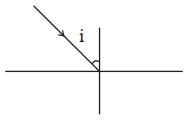
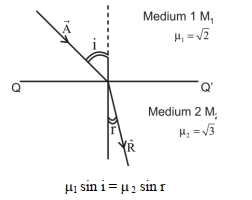
\(\overrightarrow{ A }=4 \sqrt{3 \hat{i}}-3 \sqrt{3 \hat{j}}-5 \hat{ k }\)As incident vector \(A\) makes \(i\) angle with normal \(z-\)axis refracted vector \(R\) makes \(r\) angle with normal \(z\) - axis with help of direction cosine
\(i=\cos ^{-1}\left(\frac{A_{z}}{A}\right)=\cos ^{-1}\left(\frac{5}{\sqrt{(4 \sqrt{3})^{2}+(3 \sqrt{3})^{2}+5^{2}}}\right)\)
\(=\cos ^{-1}\left(\frac{5}{10}\right) \Rightarrow i=60^{\circ}\)
\(\sqrt{2} \sin 60=\sqrt{3} \times \sin r\)
\(r=45^{\circ}\)
Difference between \(i \) & \(r =60-45=15\)
-
- (A) \(5 \times 10^{-10}\,v _{ a } m\)
- (B) \(5 \times 10^{-10}\,m\)
- (C) \(1.5 \times 10^{10}\,m\)
- (D) \(5 \times 10^{-10} v _{ B }\,m\)
Show answer and solution
Correct Answer: (A)
\(\frac{\mu_{ A }}{\mu_{ B }}=\frac{ c / V _{ A }}{ c / V _{ B }}=\frac{ V _{ B }}{ V _{ A }}=\frac{1}{2}\)Let the thickness is \(d\)
\(\frac{d}{v_{B}}-\frac{d}{v_{A}}=5 \times 10^{-10}\)
\(d =\frac{5 \times 10^{-10} \times v _{ A } v _{ B }}{ v _{ A }- v _{ B }}\)
As \(v _{ A }=2 v _{ B } \Rightarrow d =5 \times 10^{-10} \times 2 v _{ B }\)
Or \(d =5 \times 10^{-10} \times v_{ A }\)
-
- (A) \(10\)
- (B) \(101\)
- (C) \(18\)
- (D) \(11\)
Show answer and solution
Correct Answer: (A)
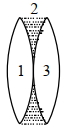
\(\frac{1}{ f _{1}}=\frac{1}{15}=\left(\frac{3}{2}-1\right)\left[\frac{2}{ R }\right]\)\(\frac{1}{ R }=\frac{1}{15}\)
\(\frac{1}{ f _{\text {eq }}}=\frac{1}{ f _{1}}+\frac{1}{ f _{2}}+\frac{1}{ f _{3}}\)
\(=\frac{1}{15}+\left(\frac{5}{4}-1\right)\left[\frac{-2}{ R }\right]+\frac{1}{15}\)
\(=\frac{1}{15}-\frac{1}{30}+\frac{1}{15}\)
\(=\frac{2-1+2}{30}\)
\(=\frac{3}{30}=\frac{1}{10}\)
\(=10\)
-
- (A) In primary rainbow, observer sees red colour on the top and violet on the bottom
- (B) In primary rainbow, observer sees violet colour on the top and red on the bottom
- (C) In primary rainbow, light wave suffers total internal reflection twice before coming out of water drops
- (D) Primary rainbow is less bright than secondary rainbow.
Show answer and solution
Correct Answer: (A)
In primary rainbow, red colour is at top and violet is at bottom.Intensity of secondary rainbow is less in comparison to primary rainbow.
No questions on this page match these filters.