


All JEE Mains 2022 Physics questions
32 chaptersShowing 51–100 of 597 questions
-
- (A) \(3\)
- (B) \(4\)
- (C) \(5\)
- (D) \(6\)
Show answer and solution
Correct Answer: (B)
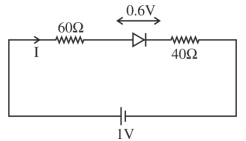
\(1- I (60)-0.6- I (40)=0\)\(\frac{0.4}{100}= I\)
\(I =4 \,mA\)
-
- (A) \(3\)
- (B) \(2\)
- (C) \(4\)
- (D) \(1\)
Show answer and solution
Correct Answer: (A)
\(E _{ g }=\frac{ hc }{\lambda}=\frac{1242}{\lambda( nm )}=\frac{1242}{400}=3.105\)Answer rounded to \(3\,eV\)
-
- (A) \(1: 2\)
- (B) \(5: 1\)
- (C) \(1: 40\)
- (D) \(20: 1\)
Show answer and solution
Correct Answer: (B)
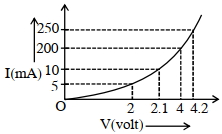
\(R =\frac{\Delta V }{\Delta i }\)\(\frac{ R _{1}}{ R _{2}}=\frac{\Delta v _{1}}{\Delta v _{2}} \frac{\Delta i _{2}}{\Delta i _{1}}=\frac{0.1}{0.2} \times \frac{50}{5}=5\)
- 54. The photodiode is used to detect the optiocal signals. These diodes are preferably operated in reverse biased mode because. 2022 Medium
- (A) fractional change in majority carriers produce higher forward bias current
- (B) fractional change in majority carriers produce higher reverse bias current
- (C) fractional change in minority carriers produce higher forward bias current
- (D) fractional change in minority carriers produce higher reverse bias current
Show answer and solution
Correct Answer: (D)
Very small change in minority charge carriers produces high value of reverse bias current. - 55. The positive feedback is required by an amplifier to act an oscillator. The feedback here means ........... 2022 Medium
- (A) External input is necessary to sustain ac signal in output.
- (B) A portion of the output power is returned back to the input.
- (C) Feedback can be achieved by \(LR\) network.
- (D) The base-collector junction must be forward biased.
Show answer and solution
Correct Answer: (B)
When the amplifier connects with positive feedback, it acts as the oscillator the feedback here is positive feedback which means some amount of voltage is given to the input. -
- (A) \(100\)
- (B) \(200\)
- (C) \(20\)
- (D) \(2000\)
Show answer and solution
Correct Answer: (B)
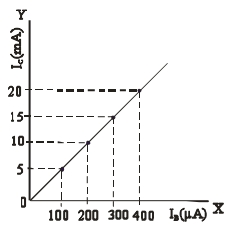
Current gain in C-E configuration\(\Rightarrow \beta=\frac{\Delta I _{ C }}{\Delta I _{ B }}\)
\(R _{ C }=2 k \Omega, R _{ B }=0.50 k \Omega\)
\(\text { Voltage gain }=\frac{\Delta I _{ C } R _{ C }}{\Delta I _{ B } R _{ B }}=\frac{5 \times 10^{-3}}{100 \times 10^{-6}} \times \frac{2}{0.5}\)
\(=\frac{10^{-2}}{5 \times 10^{-5}}=\frac{1000}{5}=200\)
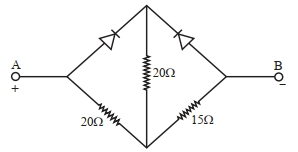
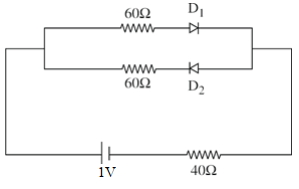
- 57. Two ideal diodes are connected in the network as shown in figure. The equivalent resistance between \(A\) and \(B\) is \(.......\Omega\).
 2022 Medium
- (A) \(24\)
- (B) \(25\)
- (C) \(23\)
- (D) \(22\)
Show answer and solution
Correct Answer: (B)
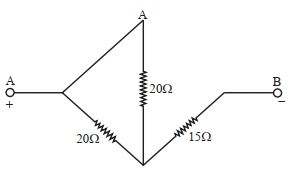
The forward biased diode will conduct while the reverse biased will not\(\therefore\) Equivalent resistance \(=10+15=25\,\Omega\)
-
- (A) \(14\)
- (B) \(18\)
- (C) \(15\)
- (D) \(75\)
Show answer and solution
Correct Answer: (C)
\(A = A _{0} \times 2^{- t / T }\)\(\frac{ A _{0}}{64}= A _{0} \times 2^{- t / T }\)
\(\therefore t =6\,T =6 \times 2.5=15\,hours\)
-
- (A) \(3.75\)
- (B) \(0.56\)
- (C) \(0.26\)
- (D) \(1.80\)
Show answer and solution
Correct Answer: (D)
\(\lambda_{\text {eq }}=\lambda_{1}+\lambda_{2}\)\(\frac{\ln 2}{\left( t _{1 / 2}\right)_{ eq }}=\frac{\ln 2}{\left( t _{1 / 2}\right)_{1}}+\frac{\ln 2}{\left( t _{1 / 2}\right)_{2}}\)
\(\left( t _{1 / 2}\right)_{ eq }=\frac{\left( t _{1 / 2}\right)_{1} \times\left( t _{1 / 2}\right)_{2}}{\left( t _{1 / 2}\right)_{1}+\left( t _{1 / 2}\right)_{2}}\)
\(=\frac{3 \times 4.5}{3+4.5}=\frac{3 \times 4.5}{7.5}=\frac{3 \times 3}{5}=1.8 \; hr\)
- 60. A radioactive sample decays \(\frac{7}{8}\) times its original quantity in \(15\) minutes. The half-life of the sample is \(......min\) 2022 Medium
- (A) \(5\)
- (B) \(7.5\)
- (C) \(15\)
- (D) \(30\)
Show answer and solution
Correct Answer: (A)
Remaining \(=\frac{1}{8}\)\(3 t _{1 / / 2}=15\,min\)
\(t _{1 / 2}=5\,min\)
-
- (A) \(55\)
- (B) \(50\)
- (C) \(90\)
- (D) \(150\)
Show answer and solution
Correct Answer: (B)
\(N_{t}=N_{0}(0.5)^{\frac{t}{t_{1 / 2}}}\)\(=\frac{ m }{ M } \times N _{ A }(0.5)^{\frac{ t }{ t _{/ 2}}}\)
\(\frac{N_{1}}{N_{2}}=\frac{M_{2}}{M_{1}}(0.5)^{t}\left[\frac{1}{T_{ A }}-\frac{1}{T_{B}}\right]\)
\(=2(0.5)^{16 \times \frac{1}{8}}=\frac{2}{4}=\frac{1}{2}=\frac{ x }{100}\)
- 62. How many alpha and beta particles are emitted when Uranium \({ }_{92} U ^{238}\) decays to lead \({ }_{82} Pb ^{206}\) ? 2022 Medium
- (A) \(3\) alpha particles and \(5\) beta particles
- (B) \(6\) alpha particles and \(4\) beta particles
- (C) \(4\) alpha particles and \(5\) beta particles
- (D) \(8\) alpha particles and \(6\) beta particles
Show answer and solution
Correct Answer: (D)
\({ }_{92}^{238} U \rightarrow{ }_{2}^{4} He +6_{-1}^{0} e +{ }_{82}^{206} Pb\)\(8 \alpha\) particles and \(6 \beta\) particles are emitted.
-
- (A) \(174\) and \(71\)
- (B) \(174\) and \(69\)
- (C) \(172\) and \(69\)
- (D) \(172\) and \(71\)
Show answer and solution
Correct Answer: (A)
Say for \(D _{4}\) Atomic No \(=Z\)Mass Number \(= A\)
\(A=182-4-4=174\)
\(Z=74-2+1-2=71\)
- 64. Mass numbers of two nuclei are in the ratio of \(4: 3\). Their nuclear densities will be in the ratio of 2022 Medium
- (A) \(4: 3\)
- (B) \(\left(\frac{3}{4}\right)^{\frac{1}{3}}\)
- (C) \(1: 1\)
- (D) \(\left(\frac{4}{3}\right)^{\frac{1}{3}}\)
Show answer and solution
Correct Answer: (C)
Radius of nucleus \(R=R_{0} A^{\frac{1}{3}}\)Density of nucleus \(=\frac{\text { Mass of nucleus }}{\text { volume of nucleus }}\)
\(\rho=\frac{ m \times A }{\frac{4}{3} \pi R ^{3}}\) Where \(m :\) mass of proton or neutron
\(\rho=\frac{ m \times A }{\frac{4}{3} \pi R _{0}{ }^{3} A }\)
\(\rho \propto A^{0}\)
Hence density of nucleus is independent of mass number
-
- (A) \(0.8\)
- (B) \(275\)
- (C) \(220\)
- (D) \(176\)
Show answer and solution
Correct Answer: (D)
\(Q=(B \cdot E)_{p}-(B . E)_{R}\)\(=(105+115)(6.4)-(220)(5.6)\)
\(=176 \,MeV\)
-
- (A) \((A)\) and \((D)\) only.
- (B) \((A)\) and \((E)\) only.
- (C) \((B)\) and \((E)\) only.
- (D) \((A)\) and \((C)\) only
Show answer and solution
Correct Answer: (B)
\(R \propto A ^{1 / 3}\)\(V =\frac{4}{3} \pi R ^{3} \propto A\)
Mass \(\propto\) A
So density is independent of \(A\).
-
- (A) \(30\)
- (B) \(35\)
- (C) \(40\)
- (D) \(25\)
Show answer and solution
Correct Answer: (B)
\(\frac{ A }{ A _{0}}=\frac{ N }{ N _{0}}\)\(\frac{2 \times 10^{-5}}{2.56 \times 10^{-3}}=\frac{ N }{ N _{0}}\)
\(\frac{ N }{ N _{0}}=\frac{1}{128} \Rightarrow N =\frac{ N _{0}}{128}\)
After \(7\) half life activity comes down to given value \(T =7 \times 5\) \(=35\) days
-
- (A) \(7\)
- (B) \(15\)
- (C) \(25\)
- (D) \(35\)
Show answer and solution
Correct Answer: (D)
\(A_{0}=6.4 \times 10^{-4}\) Curie\(T _{1 / 2}=5 \text { days }=\frac{\ln 2}{\lambda}\)
\(A = A _{0} e ^{-\lambda t }\)
\(5 \times 10^{-6}=6.4 \times 10^{-4} e ^{-\lambda t }\)
\(\frac{5}{6.4} \times 10^{-2}=e^{-\lambda t}\)
\(7.8 \times 10^{-3}= e ^{-\lambda t}\)
\(\log \left(7.8 \times 10^{-3}\right)=-\lambda t \ln e\)
\(\ln \left(7.8 \times 10^{-3}\right)=-\frac{\lambda n 2}{5} \cdot t\)
\(\therefore \frac{5 \times 4.853}{0.693}= t =35 \text { days }\)
-
- (A) \(0.02\)
- (B) \(2.7\)
- (C) \(0.063\)
- (D) \(6.3\)
Show answer and solution
Correct Answer: (C)
At \(t=0\) disintegration rate \(=4250\,dpm\)At \(t=10\) disintegration rate \(=2250\,dpm\)
\(A=A_{0} e^{-\lambda t}\)
\(2250=4250\,e ^{-\lambda .(10)}\)
\(\Rightarrow \lambda(10)=\ln \left(\frac{4250}{2250}\right)\)
\(\Rightarrow \lambda=0.063 min ^{-1}\)
-
- (A) \(20\)
- (B) \(19\)
- (C) \(21\)
- (D) \(22\)
Show answer and solution
Correct Answer: (A)
\(T 1 / 2=5\) year\(N = N _{0}\left(\frac{1}{2}\right)^{\text {No of half lives }}\)
\(\frac{ N }{ N _{0}}=\frac{1}{16}=\left(\frac{1}{2}\right)^{4}\)
Time \(=4\) half lives \(=20\) years
-
- (A) \(120\)
- (B) \(130\)
- (C) \(180\)
- (D) \(20\)
Show answer and solution
Correct Answer: (C)
\(7 / 8\) disintegrates means \(1 / 8\) remains\(\operatorname{Or}\left(\frac{1}{2}\right)^{3}\)
\(\therefore 3\) half lives
\(=180\) days
- 72. The \(Q\)-value of a nuclear reaction and kinetic energy of the projectile particle, \(K _{ p }\) are related as 2022 Medium
- (A) \(Q=K_{p}\)
- (B) \(\left( K _{ p }+ Q \right) < O\)
- (C) \(Q < K_{p}\)
- (D) \(\left( K _{ p }+ Q \right) > 0\)
Show answer and solution
Correct Answer: (D)
\(x + p \rightarrow \gamma+ b\)\(Q = k _{ r }+ k _{ b }- k _{ p }\)
\(Q + k _{ p }= k _{ f }+ k _{ b }\)
\(Q + k _{ p } > 0\)
-
- (A) \(25\)
- (B) \(26\)
- (C) \(23\)
- (D) \(22\)
Show answer and solution
Correct Answer: (B)
Energy released in the given process \(=\) Binding energy of product \(-\) Binding energy of reactants\(=7.6 \times 4-(1.1 \times 2) \times 2\)
\(=30.4-4.4\)
\(=26\,MeV\)
-
- (A) \(9\)
- (B) \(8\)
- (C) \(5\)
- (D) \(6\)
Show answer and solution
Correct Answer: (A)
\(N = N _{0} e ^{-\lambda t }\)\(\frac{ N _{ B }}{ N _{ A }}=\frac{ e ^{-\lambda_{2} t }}{ e ^{-\lambda_{1} t }}= e ^{-\lambda_{2} t } \cdot e ^{\lambda_{1} t }\)
\(e ^{1}= e ^{\left(\lambda_{1}-\lambda_{2}\right) t }\)
\(\left(\lambda_{1}-\lambda_{2}\right) t =1\)
\(t =\frac{1}{\lambda_{1}-\lambda_{2}}=\frac{1}{25 \lambda-16 \lambda}=\frac{1}{9 \lambda}\)
-
- (A) \(9.5\)
- (B) \(8.5\)
- (C) \(7.5\)
- (D) \(10.5\)
Show answer and solution
Correct Answer: (C)
\(A=A_{0} e^{-\lambda t}\)\(-\lambda t =\ln \left(\frac{ A }{ A _{0}}\right)\)
\(-\frac{\ln 2}{ t _{1 / 2}} \times 30=\ln \left(\frac{1}{16}\right)\)
\(-\frac{\ln 2}{t_{1 / 2}} \times 30=-4 \ln 2\)
\(t _{1 / 2}=\frac{30}{4}=7.5\,yrs\)
-
- (A) \(113\)
- (B) \(114\)
- (C) \(115\)
- (D) \(116\)
Show answer and solution
Correct Answer: (B)
\(Z =3\)\(\frac{1}{\lambda}=R Z^{2}\left(\frac{1}{n_{1}^{2}}-\frac{1}{n_{2}^{2}}\right)\)
\(n_{1}=1, \quad n_{2}=3,\)
\(\frac{1}{\lambda}=R(9)\left(\frac{1}{1}-\frac{1}{9}\right)=8 \; R\)
\(\lambda=\frac{1}{8 R}=114 \times 10^{-10} \; m\)
-
- (A) \(2.10\)
- (B) \(1.05\)
- (C) \(3.15\)
- (D) \(4.2\)
Show answer and solution
Correct Answer: (B)
\(13.6\left(\frac{1}{1^{2}}-\frac{1}{n^{2}}\right)=10.2\)\(n=2\)
\(L_{i}=\frac{h}{2 \pi} \times 1\)
\(L_{F}=\frac{2 h}{2 \pi}\)
\(\Delta L=L_{F}-L_{i}=\frac{h}{2 \pi}=\frac{6.6 \times 10^{-34}}{2 \times \frac{22}{7}}\)
\(=1.05 \times 10^{-34} \; J-s\)
-
- (A) \(1.05 \times {10^{ - 34}} J-sec\)
- (B) \(3.16 \times {10^{ - 34}} J-sec\)
- (C) \(2.11 \times {10^{ - 34}} J-sec\)
- (D) \(4.22 \times {10^{ - 34}}J-sec\)
Show answer and solution
Correct Answer: (A)
(a) Electron after absorbing \(10.2\ eV\) energy goes to its first excited state \((n=2)\) from ground state \((n = 1)\).\(\therefore \) Increase in momentum \( = \frac{h}{{2\pi }}\)\( = \frac{{6.6 \times {{10}^{ - 34}}}}{{6.28}} = 1.05 \times {10^{ - 34}}J{\rm{ - }}s\).
-
- (A) In the ground state of Rutherford's model electrons are in stable equilibrium. While in Thomson's model electrons always experience a net-force.
- (B) An atom has a nearly continuous mass distribution in a Rutherford's model but has a highly non-uniform mass distribution in Thomson's model
- (C) A classical atom based on Rutherford's model is doomed to collapse.
- (D) The positively charged part of the atom possesses most of the mass in Rutherford's model but not in Thomson's model.
Show answer and solution
Correct Answer: (C)
According to Rutherford, \(e ^{-}\)revolves around nucleus in circular orbit. Thus \(e ^{-}\)is always accelerating (centripetal acceleration). An accelerating change emits \(EM\) radiation and thus \(e ^{-}\) should loose energy and finally should collapse in the nucleus. -
- (A) \(3\)
- (B) \(4\)
- (C) \(5\)
- (D) \(7\)
Show answer and solution
Correct Answer: (A)
\(\sqrt{d} \propto \cot \frac{\theta}{2}\)\(\cot ^{2} 30^{\circ}=x \cot ^{2} 45^{\circ}\)
\(3=x\)
-
- (A) \(3: 4\)
- (B) \(4: 3\)
- (C) \(1: 4\)
- (D) \(4: 1\)
Show answer and solution
Correct Answer: (A)
\(E _{ n }=\frac{-13.6}{ n ^{2}}\,ev\)\(\Rightarrow \frac{ E _{2}- E _{1}}{ E _{\infty}- E _{1}}=\frac{13.6\left(1-\frac{1}{4}\right)}{13.6}=\frac{3}{4}\)
-
- (A) Both statement \(I\) and statement \(II\) are true
- (B) Both statement \(I\) and statement \(II\) are false
- (C) Statement \(I\) is correct but statement \(II\) is false
- (D) Statement \(I\) is incorrect but statement \(II\) is true
Show answer and solution
Correct Answer: (D)
When electron jump from lower to higher energy level, energy absorbed so statement - \(I\) incorrect. When electron jump from higher to lower energy level, energy of emitted photon\(E = E _{2}- E _{1}\)
\(hf = E _{2}- E _{1} \Rightarrow f =\frac{ E _{2}- E _{1}}{ h }\)
so statement - \(II\) is correct.
-
- (A) \(\sqrt{\frac{\lambda R}{\lambda-1}}\)
- (B) \(\sqrt{\frac{\lambda R}{\lambda R-1}}\)
- (C) \(\sqrt{\frac{\lambda}{\lambda R-1}}\)
- (D) \(\sqrt{\frac{\lambda R^{2}}{\lambda R-1}}\)
Show answer and solution
Correct Answer: (B)
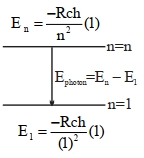
\(\frac{- Rch }{( n )^{2}}+\frac{ Rch }{1}=\frac{ hc }{\lambda}\)\(\frac{- R }{ n ^{2}}+ R =\frac{1}{\lambda}\)
\(R -\frac{1}{\lambda}=\frac{ R }{ n ^{2}}\)
\(\frac{\lambda R -1}{\lambda}=\frac{ R }{ n ^{2}}\)
\(n ^{2}=\frac{\lambda R }{\lambda R -1} \Rightarrow n =\sqrt{\frac{\lambda R }{\lambda R -1}}\)
-
- (A) \(5\)
- (B) \(50\)
- (C) \(25\)
- (D) \(4\)
Show answer and solution
Correct Answer: (A)
For first line of Lyman\(\frac{1}{\lambda}= R \left(1-\frac{1}{4}\right)= R \left(\frac{3}{4}\right)\)
\(\quad \lambda =\frac{4}{3 R } \ldots(1)\)
\(3^{\text {rd }} \text { line(Paschen) }\)
\(\frac{1}{\lambda_{3}}= R \left(\frac{1}{3^{2}}-\frac{1}{6^{2}}\right)=\frac{ R }{9} \times \frac{3}{4}\)
\(2^{nd}\) line(Balmer)
\(\frac{1}{\lambda_{2}}= R \left(\frac{1}{2^{2}}-\frac{1}{4^{2}}\right)=\frac{ R }{4} \times \frac{3}{4}\)
Thus a \(\lambda=\lambda_{3}-\lambda_{2}=\frac{12}{R}-\frac{16}{3 R}=\frac{20}{3 R}\) putting
\(a\left(\frac{4}{3 R}\right)=\frac{20}{3 R} \Rightarrow a=5\)
- 85. The momentum of an electron revolving in \(n ^{\text {th }}\) orbit is given by: (Symbols have their usual meanings) 2022 Easy
- (A) \(\frac{ nh }{2 \pi r }\)
- (B) \(\frac{ nh }{2 r }\)
- (C) \(\frac{ nh }{2 \pi}\)
- (D) \(\frac{2 \pi r }{ nh }\)
Show answer and solution
Correct Answer: (A)
Angular momentum \(mrV =\frac{ nh }{2 \pi}\)So momentum \(mv =\frac{ nh }{2 \pi r }\)
-
- (A) \(1: 1\)
- (B) \(1: 2\)
- (C) \(4: 1\)
- (D) \(2: 1\)
Show answer and solution
Correct Answer: (D)
\(v \propto \frac{Z}{ n } \propto Z ( n = constant )\)\(\Rightarrow \frac{ V _{ He ^{+}}}{ v _{ H }}=\frac{ Z _{ He ^{+}}}{ Z _{ H }}=\frac{2}{1}\)
-
- (A) \(6\)
- (B) \(5\)
- (C) \(4\)
- (D) \(3\)
Show answer and solution
Correct Answer: (B)
\(\frac{13.6\left(\frac{1}{2^{2}}-\frac{1}{3^{2}}\right)}{13.6\left(\frac{1}{2^{2}}-0\right)}=\frac{x}{x+4} ; \frac{\frac{1}{4}-\frac{1}{9}}{\frac{1}{4}}=\frac{x}{x+4}\)\(\frac{5}{9}=\frac{x}{x+4}\)
\(5 x+20=9 x\)
\(4 x=20\)
\(x=5\)
-
- (A) \(1.537\)
- (B) \(2.46\)
- (C) \(0.615\)
- (D) \(1.23\)
Show answer and solution
Correct Answer: (C)
\(k _{1}=\frac{1230}{800}-\phi\)\(k _{2}=2 k _{1}=\frac{1230}{500}-\phi\)
Eliminating \(k_{1}\) from \((1)\) and \((2)\) we get \(0=\frac{1230}{500}-\frac{1230}{400}+\phi\)
\(\phi=0.615\,eV\)
-
- (A) \(1.36\)
- (B) \(1.69\)
- (C) \(2.78\)
- (D) \(2.23\)
Show answer and solution
Correct Answer: (A)
\(\lambda=4500 \; \mathring A\)\(B =2 \; mT , R =2 \; mm\)
\(R =\frac{\sqrt{2 \; Km }}{ qB }\)
\(\frac{(q B R)^{2}}{2 \; m}=K\)
\(\frac{\left(1.6 \times 10^{-19} \times 2 \times 10^{-3} \times 2 \times 10^{-3}\right)^{2}}{2 \times 9.1 \times 10^{-31}}= K\)
\(\frac{(6.4)^{2}}{2 \times 9.1} \times \frac{10^{-50}}{10^{-31}}= K\)
\(K =2.25 \times 10^{-19} \; J\)
\(=\frac{2.25 \times 10^{-19}}{1.6 \times 10^{-19}} eV =1.40 \; eV\)
\(E =\frac{12400}{4500}=2.76 \; eV\)
\(\phi= E - K =(2.76-1.40) eV =1.36 \; eV\)
-
- (A) \(1:2\)
- (B) \(2:1\)
- (C) \(1:1\)
- (D) \(2:3\)
Show answer and solution
Correct Answer: (C)
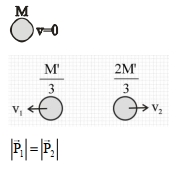
\(\left|\overrightarrow{ P }_{1}\right|=\left|\overrightarrow{ P }_{2}\right|\)Here \(\overrightarrow{ P }\) is momentum
So \(\lambda=\frac{ h }{ P }\)
Hence both will have same de broglie wavelength.
-
- (A) \(3 \times 10^{16}\)
- (B) \(4.5 \times 10^{16}\)
- (C) \(4.5 \times 10^{17}\)
- (D) \(4.5 \times 10^{20}\)
Show answer and solution
Correct Answer: (B)
Wavelength of incident beam \(\lambda=900 \times 10^{-9}\,m\)Intensity of incident beam \(= I =100\,W / m ^{2}\)
No. of photons crossing per unit sec
\(= n =\frac{ E _{\text {net }}}{ E _{\text {sim gle photon }}}=\frac{ IA \lambda}{ hc }\)
\(=\frac{(100)\left(1 \times 10^{-4}\right)\left(900 \times 10^{-9}\right)}{6.62 \times 10^{-34} \times 3 \times 10^{8}}=4.5 \times 10^{16}\)
-
- (A) \(\lambda_{ p }=\lambda_{ n }>\lambda_{ e }>\lambda_{\alpha}\)
- (B) \(\lambda_{\alpha}<\lambda_{ n }<\lambda_{ p }<\lambda_{ e }\)
- (C) \(\lambda_{ e }<\lambda_{ p }=\lambda_{ n }>\lambda_{\alpha}\)
- (D) \(\lambda_{ e }=\lambda_{ p }=\lambda_{ n }=\lambda_{\alpha}\)
Show answer and solution
Correct Answer: (B)
\(\lambda=\frac{ h }{\sqrt{2 Em }}\)\(\lambda \propto \frac{1}{\sqrt{ m }}\)
\(\therefore\lambda_{ e }>\lambda_{ p }>\lambda_{ n }>\lambda_{\alpha}\)
-
- (A) \(\frac{{{\lambda _0}}}{{\left( {1 + \frac{{e{E_0}}}{{m{V_0}}}t} \right)}}\)
- (B) \({\lambda _0}\;\left( {1 + \frac{{e{E_0}}}{{m{V_0}}}t} \right)\)
- (C) \({\lambda _0}\)
- (D) \({\lambda _0}t\)
Show answer and solution
Correct Answer: (A)
Here, \(\vec{E}=-E_{0} \hat{i} ;\) initial velocity \(\vec{v}=v_{0} \hat{i}\) Force action on electron due to electric field\(\bar{F}=(-e)\left(-E_{0} \hat{i}\right)=e E_{0} \hat{i}\)
Acceleration produced in the electron, \(\vec{a}=\frac{\vec{F}}{m}=\frac{e E_{0}}{m} \hat{i}\)
Now, velocity of electron after time \(t\)
\(\vec{v}_{t}=\vec{v}+\vec{a} t=\left(v_{0}+\frac{e E_{0} t}{m}\right) \hat{i}\)
or \(\left|\vec{v}_{t}\right|=v_{0}+\frac{e E_{0} t}{m}\)
Now, \(\lambda_{t}=\frac{h}{m v_{t}}=\frac{h}{m\left(v_{0}+\frac{e E_{0} t}{m}\right)}=\frac{h}{m v_{0}\left(1+\frac{e E_{0} t}{m v_{0}}\right)}\)
\(=\frac{\lambda_{0}}{\left(1+\frac{e E_{0} t}{m v_{0}}\right)} \quad \quad \quad\left(\because \lambda_{0}=\frac{h}{m v_{0}}\right)\)
-
- (A) \(\frac{E_{e}}{E_{p h}}=\frac{2 c}{v}\)
- (B) \(\frac{E_{e}}{E_{p h}}=\frac{v}{2 c}\)
- (C) \(\frac{p_{e}}{p_{p h}}=\frac{2 c}{v}\)
- (D) \(\frac{ p _{ e }}{ p _{ ph }}=\frac{ v }{2 c }\)
Show answer and solution
Correct Answer: (B)
\(\lambda_{ e }=\lambda_{\text {photon }}\)\(\frac{ h }{ mv }=\frac{ h }{ P _{\text {photon}}} \Rightarrow P _{\text {photon }}= mv\)
\(\frac{ E _{ e }}{ E _{ ph }}=\frac{\frac{1}{2} mv ^{2}}{\frac{ hc }{\lambda}}=\frac{1}{2} \frac{ mv }{ P _{ Ph } C } \times v =\frac{ v }{2 C }\)
-
- (A) \(1: \sqrt{3}\)
- (B) \(\sqrt{3}: 1\)
- (C) \(3: 1\)
- (D) \(2: \sqrt{3}\)
Show answer and solution
Correct Answer: (B)
\(k=\frac{P^{2}}{2 m} \Rightarrow P \alpha \sqrt{m}\)Now \(\lambda=\frac{h}{p}\)
So, \(\lambda \alpha \frac{1}{p} \Rightarrow \lambda \alpha \frac{1}{\sqrt{m}}\)
\(\frac{\lambda_{\alpha}}{\lambda_{C 12}}=\frac{\sqrt{3}}{1}\)
-
- (A) Both \(A\) and \(R\) are correct and \(R\) is the correct explanation of \(A\)
- (B) Both \(A\) and \(R\) are correct but \(R\) is not the correct explanation of \(A\)
- (C) \(A\) is correct but \(R\) is not correct
- (D) \(A\) is not correct but \(R\) is correct
Show answer and solution
Correct Answer: (B)
To free the electron from metal surface minimum energy required, is equal to the work function of that metal.So Assertion \(A\), is correct.
\(h v = w _{0}+ K. E. _{\max }\)
if \(h v = w _{0}\)
\(\Rightarrow\) \(K.E.\) \(_{\text {max }}=0\)
Hence reason \(R\), is correct, But \(R\) is not the correct explanation of \(A\).
-
- (A) Both Statement \(I\) and Statement \(II\) are true
- (B) Both Statement \(I\) and Statement \(II\) are false
- (C) Statement \(I\) is true but Statement \(II\) is false
- (D) Statement \(I\) is false but Statement \(II\) is true
Show answer and solution
Correct Answer: (A)
In Davisson\(-\)Germer experiment the electrons exhibit diffraction there by proving that electrons have wave nature. Hence both statement are correct.Both the options are correct by concept
-
- (A) \(K_{1} > \frac{K_{2}}{3}\)
- (B) \(K _{1} < \frac{ K _{2}}{3}\)
- (C) \(K_{1}=\frac{K_{2}}{3}\)
- (D) \(K _{2}=\frac{ K _{1}}{3}\)
Show answer and solution
Correct Answer: (B)
\(\frac{ hc }{\lambda_{1}}-\phi= K _{1}\)\(\frac{ hc }{\lambda_{2}}-\phi= K _{2}\)
\(\lambda_{1}=3 \lambda_{2}\)
\(3 K _{1}=\frac{3 hc }{\lambda_{1}}-3 \phi\)
\(3 K _{1}=\frac{h c }{\lambda_{2}}-3 \phi\)
\(3 K _{1}= K _{2}-2 \phi\)
\(3 K _{1}< K _{2}\)
\(K _{1}<\frac{ K _{2}}{3}\)
-
- (A) \(1.90\)
- (B) \(3.27\)
- (C) \(3.60\)
- (D) \(3.42\)
Show answer and solution
Correct Answer: (D)
For maximum \(KE\) we will take higher frequency \(\left(f=\frac{9 \times 10^{15}}{2 \pi} Hz \right)\)\(K_{\max }=h f-\phi\)
\(=\frac{9 \times 10^{15} \times 4.14 \times 10^{-15}}{2 \pi}-2.50\)
\(3.43 \,eV\)
nearest is \(3.42 \,eV\)
-
- (A) \(\sqrt{ mK }\)
- (B) \(\sqrt{ P }\)
- (C) \(\sqrt{ K }\)
- (D) \(\sqrt{ V }\)
Show answer and solution
Correct Answer: (D)
\(\lambda=\frac{ h }{ m v}\) (de-Broglie's wavelength)\(\lambda \frac{ h }{\sqrt{2 m ( K \cdot E )}}\)
\(h =\frac{ h }{\sqrt{2 mqV }}\)
Putting the values of \(m ; q\)
We get \(\lambda=\frac{1 \cdot 22}{\sqrt{V}}\,nm\)
No questions on this page match these filters.