


Questions
20 questionsShowing 1–20 of 20 questions
-
- (A) \(1.537\)
- (B) \(2.46\)
- (C) \(0.615\)
- (D) \(1.23\)
Show answer and solution
Correct Answer: (C)
\(k _{1}=\frac{1230}{800}-\phi\)\(k _{2}=2 k _{1}=\frac{1230}{500}-\phi\)
Eliminating \(k_{1}\) from \((1)\) and \((2)\) we get \(0=\frac{1230}{500}-\frac{1230}{400}+\phi\)
\(\phi=0.615\,eV\)
-
- (A) \(1.36\)
- (B) \(1.69\)
- (C) \(2.78\)
- (D) \(2.23\)
Show answer and solution
Correct Answer: (A)
\(\lambda=4500 \; \mathring A\)\(B =2 \; mT , R =2 \; mm\)
\(R =\frac{\sqrt{2 \; Km }}{ qB }\)
\(\frac{(q B R)^{2}}{2 \; m}=K\)
\(\frac{\left(1.6 \times 10^{-19} \times 2 \times 10^{-3} \times 2 \times 10^{-3}\right)^{2}}{2 \times 9.1 \times 10^{-31}}= K\)
\(\frac{(6.4)^{2}}{2 \times 9.1} \times \frac{10^{-50}}{10^{-31}}= K\)
\(K =2.25 \times 10^{-19} \; J\)
\(=\frac{2.25 \times 10^{-19}}{1.6 \times 10^{-19}} eV =1.40 \; eV\)
\(E =\frac{12400}{4500}=2.76 \; eV\)
\(\phi= E - K =(2.76-1.40) eV =1.36 \; eV\)
-
- (A) \(1:2\)
- (B) \(2:1\)
- (C) \(1:1\)
- (D) \(2:3\)
Show answer and solution
Correct Answer: (C)
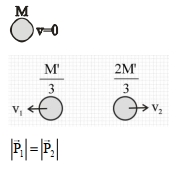
\(\left|\overrightarrow{ P }_{1}\right|=\left|\overrightarrow{ P }_{2}\right|\)Here \(\overrightarrow{ P }\) is momentum
So \(\lambda=\frac{ h }{ P }\)
Hence both will have same de broglie wavelength.
-
- (A) \(3 \times 10^{16}\)
- (B) \(4.5 \times 10^{16}\)
- (C) \(4.5 \times 10^{17}\)
- (D) \(4.5 \times 10^{20}\)
Show answer and solution
Correct Answer: (B)
Wavelength of incident beam \(\lambda=900 \times 10^{-9}\,m\)Intensity of incident beam \(= I =100\,W / m ^{2}\)
No. of photons crossing per unit sec
\(= n =\frac{ E _{\text {net }}}{ E _{\text {sim gle photon }}}=\frac{ IA \lambda}{ hc }\)
\(=\frac{(100)\left(1 \times 10^{-4}\right)\left(900 \times 10^{-9}\right)}{6.62 \times 10^{-34} \times 3 \times 10^{8}}=4.5 \times 10^{16}\)
-
- (A) \(\lambda_{ p }=\lambda_{ n }>\lambda_{ e }>\lambda_{\alpha}\)
- (B) \(\lambda_{\alpha}<\lambda_{ n }<\lambda_{ p }<\lambda_{ e }\)
- (C) \(\lambda_{ e }<\lambda_{ p }=\lambda_{ n }>\lambda_{\alpha}\)
- (D) \(\lambda_{ e }=\lambda_{ p }=\lambda_{ n }=\lambda_{\alpha}\)
Show answer and solution
Correct Answer: (B)
\(\lambda=\frac{ h }{\sqrt{2 Em }}\)\(\lambda \propto \frac{1}{\sqrt{ m }}\)
\(\therefore\lambda_{ e }>\lambda_{ p }>\lambda_{ n }>\lambda_{\alpha}\)
-
- (A) \(\frac{{{\lambda _0}}}{{\left( {1 + \frac{{e{E_0}}}{{m{V_0}}}t} \right)}}\)
- (B) \({\lambda _0}\;\left( {1 + \frac{{e{E_0}}}{{m{V_0}}}t} \right)\)
- (C) \({\lambda _0}\)
- (D) \({\lambda _0}t\)
Show answer and solution
Correct Answer: (A)
Here, \(\vec{E}=-E_{0} \hat{i} ;\) initial velocity \(\vec{v}=v_{0} \hat{i}\) Force action on electron due to electric field\(\bar{F}=(-e)\left(-E_{0} \hat{i}\right)=e E_{0} \hat{i}\)
Acceleration produced in the electron, \(\vec{a}=\frac{\vec{F}}{m}=\frac{e E_{0}}{m} \hat{i}\)
Now, velocity of electron after time \(t\)
\(\vec{v}_{t}=\vec{v}+\vec{a} t=\left(v_{0}+\frac{e E_{0} t}{m}\right) \hat{i}\)
or \(\left|\vec{v}_{t}\right|=v_{0}+\frac{e E_{0} t}{m}\)
Now, \(\lambda_{t}=\frac{h}{m v_{t}}=\frac{h}{m\left(v_{0}+\frac{e E_{0} t}{m}\right)}=\frac{h}{m v_{0}\left(1+\frac{e E_{0} t}{m v_{0}}\right)}\)
\(=\frac{\lambda_{0}}{\left(1+\frac{e E_{0} t}{m v_{0}}\right)} \quad \quad \quad\left(\because \lambda_{0}=\frac{h}{m v_{0}}\right)\)
-
- (A) \(\frac{E_{e}}{E_{p h}}=\frac{2 c}{v}\)
- (B) \(\frac{E_{e}}{E_{p h}}=\frac{v}{2 c}\)
- (C) \(\frac{p_{e}}{p_{p h}}=\frac{2 c}{v}\)
- (D) \(\frac{ p _{ e }}{ p _{ ph }}=\frac{ v }{2 c }\)
Show answer and solution
Correct Answer: (B)
\(\lambda_{ e }=\lambda_{\text {photon }}\)\(\frac{ h }{ mv }=\frac{ h }{ P _{\text {photon}}} \Rightarrow P _{\text {photon }}= mv\)
\(\frac{ E _{ e }}{ E _{ ph }}=\frac{\frac{1}{2} mv ^{2}}{\frac{ hc }{\lambda}}=\frac{1}{2} \frac{ mv }{ P _{ Ph } C } \times v =\frac{ v }{2 C }\)
-
- (A) \(1: \sqrt{3}\)
- (B) \(\sqrt{3}: 1\)
- (C) \(3: 1\)
- (D) \(2: \sqrt{3}\)
Show answer and solution
Correct Answer: (B)
\(k=\frac{P^{2}}{2 m} \Rightarrow P \alpha \sqrt{m}\)Now \(\lambda=\frac{h}{p}\)
So, \(\lambda \alpha \frac{1}{p} \Rightarrow \lambda \alpha \frac{1}{\sqrt{m}}\)
\(\frac{\lambda_{\alpha}}{\lambda_{C 12}}=\frac{\sqrt{3}}{1}\)
-
- (A) Both \(A\) and \(R\) are correct and \(R\) is the correct explanation of \(A\)
- (B) Both \(A\) and \(R\) are correct but \(R\) is not the correct explanation of \(A\)
- (C) \(A\) is correct but \(R\) is not correct
- (D) \(A\) is not correct but \(R\) is correct
Show answer and solution
Correct Answer: (B)
To free the electron from metal surface minimum energy required, is equal to the work function of that metal.So Assertion \(A\), is correct.
\(h v = w _{0}+ K. E. _{\max }\)
if \(h v = w _{0}\)
\(\Rightarrow\) \(K.E.\) \(_{\text {max }}=0\)
Hence reason \(R\), is correct, But \(R\) is not the correct explanation of \(A\).
-
- (A) Both Statement \(I\) and Statement \(II\) are true
- (B) Both Statement \(I\) and Statement \(II\) are false
- (C) Statement \(I\) is true but Statement \(II\) is false
- (D) Statement \(I\) is false but Statement \(II\) is true
Show answer and solution
Correct Answer: (A)
In Davisson\(-\)Germer experiment the electrons exhibit diffraction there by proving that electrons have wave nature. Hence both statement are correct.Both the options are correct by concept
-
- (A) \(K_{1} > \frac{K_{2}}{3}\)
- (B) \(K _{1} < \frac{ K _{2}}{3}\)
- (C) \(K_{1}=\frac{K_{2}}{3}\)
- (D) \(K _{2}=\frac{ K _{1}}{3}\)
Show answer and solution
Correct Answer: (B)
\(\frac{ hc }{\lambda_{1}}-\phi= K _{1}\)\(\frac{ hc }{\lambda_{2}}-\phi= K _{2}\)
\(\lambda_{1}=3 \lambda_{2}\)
\(3 K _{1}=\frac{3 hc }{\lambda_{1}}-3 \phi\)
\(3 K _{1}=\frac{h c }{\lambda_{2}}-3 \phi\)
\(3 K _{1}= K _{2}-2 \phi\)
\(3 K _{1}< K _{2}\)
\(K _{1}<\frac{ K _{2}}{3}\)
-
- (A) \(1.90\)
- (B) \(3.27\)
- (C) \(3.60\)
- (D) \(3.42\)
Show answer and solution
Correct Answer: (D)
For maximum \(KE\) we will take higher frequency \(\left(f=\frac{9 \times 10^{15}}{2 \pi} Hz \right)\)\(K_{\max }=h f-\phi\)
\(=\frac{9 \times 10^{15} \times 4.14 \times 10^{-15}}{2 \pi}-2.50\)
\(3.43 \,eV\)
nearest is \(3.42 \,eV\)
-
- (A) \(\sqrt{ mK }\)
- (B) \(\sqrt{ P }\)
- (C) \(\sqrt{ K }\)
- (D) \(\sqrt{ V }\)
Show answer and solution
Correct Answer: (D)
\(\lambda=\frac{ h }{ m v}\) (de-Broglie's wavelength)\(\lambda \frac{ h }{\sqrt{2 m ( K \cdot E )}}\)
\(h =\frac{ h }{\sqrt{2 mqV }}\)
Putting the values of \(m ; q\)
We get \(\lambda=\frac{1 \cdot 22}{\sqrt{V}}\,nm\)
-
- (A) \(\frac{ hc }{ E \lambda- hc }\)
- (B) \(\frac{ hc \lambda}{ E \lambda+ hc }\)
- (C) \(\frac{ h \lambda}{ E \lambda+ hc }\)
- (D) \(\frac{ hc \lambda}{ E \lambda- hc }\)
Show answer and solution
Correct Answer: (B)
\(E =\frac{ hc }{\lambda}-\phi-\text { (i) }\)\(2 E =\frac{ hc }{\lambda^{\prime}}-\phi-\) (ii)
(ii) \(-\) (i)
\(E = hc \left(\frac{1}{\lambda^{\prime}}-\frac{1}{\lambda}\right)\)
\(\Rightarrow \lambda^{\prime}=\frac{ hc \lambda}{ E \lambda+ hc }\)
-
- (A) \(1: 1\)
- (B) \(2: 1\)
- (C) \(4: 1\)
- (D) \(1: 4\)
Show answer and solution
Correct Answer: (B)
\(\sqrt{\frac{3.8-0.6}{1.4-0.6}}=\sqrt{\frac{3.2}{0.8}}=2\) -
- (A) \(1: 1\)
- (B) \(\sqrt{2}: 1\)
- (C) \(2: 1\)
- (D) \(4: 1\)
Show answer and solution
Correct Answer: (D)
Kinetic energy gained by a charged particle accelerated by a potential \(V\) is \(qV\) \(KE = qV\)\(\frac{ p ^{2}}{2 m }= qV \Rightarrow p =\sqrt{2 mqV }\)
\(p =\frac{ h }{\lambda}, \text { thus } \lambda=\frac{ h }{\sqrt{2 mqV }}\)
now \(\frac{\lambda_{ p }}{\lambda_{ d }}=\sqrt{\frac{ m _{ d } V _{ d }}{ m _{ p } V _{ p }}}\)
\(\Rightarrow \frac{1}{\sqrt{2}}=\sqrt{\frac{2 V_{d}}{V_{p}}} \Rightarrow \frac{V_{p}}{V_{d}}=4\)
-
- (A) \(32\)
- (B) \(33\)
- (C) \(34\)
- (D) \(35\)
Show answer and solution
Correct Answer: (D)
Stopping potential \(V _{0}=0.42 \; V\)\(\lambda=6630 \; \mathring A\)
\(E =\phi+ eV _{0}\)
\(E\) : energy of incident photon
\(V_{0}:\) Stopping potential
\(\phi= E - eV _{0}\)
\(E =\frac{12400}{6630} eV =1.87 \; eV\)
\(\phi=(1.87-0.42)=1.45 \; eV\)
\(\phi= hv _{0} ; v _{0}\) : threshold frequency
\(1.45 \times 1.6 \times 10^{-19}=6.63 \times 10^{-34} \times v _{0}\)
\(v _{0}=0.35 \times 10^{15}\)
\(=35 \times 10^{13} sec ^{-1}\)
\(=35\)
-
- (A) \(1: 2\)
- (B) \(1: 3\)
- (C) \(2: 3\)
- (D) \(3: 2\)
Show answer and solution
Correct Answer: (C)
\(\frac{1}{2} m v_{1}^{2}=4 \phi\)\(\frac{1}{2} mv _{2}^{2}=9 \phi\)
\(\frac{ v _{1}}{ v _{2}}=\frac{2}{3}\)
-
- (A) \(8\)
- (B) \(7\)
- (C) \(2\)
- (D) \(55\)
Show answer and solution
Correct Answer: (C)
\(hv =h v _{\text {th }}+\frac{1}{2} mv ^{2}\)\(v =2 v _{\text {th }}\)
\(2 hv _{\text {th }}=h v _{\text {th }}+\frac{1}{2} mv _{1}^{2} \ldots \ldots(1)\)
\(v =5 v _{\text {th }}\)
\(5 hv _{\text {th }}=h v _{\text {th }}+\frac{1}{2} mv _{2}^{2} \ldots(2)\)
\(\frac{\frac{1}{2} m v_{1}^{2}}{\frac{1}{2} m v_{2}^{2}}=\frac{h v_{t h}}{4 h v_{\text {th }}}\)
\(\left(\frac{ v _{1}}{ v _{2}}\right)^{2}=\frac{1}{4} \Rightarrow v _{2}=2 v _{1}\)
-
- (A) \(A\) and \(B\) only
- (B) \(A\) and \(E\) only
- (C) \(C\) and \(E\) only
- (D) \(D\) and \(E\) only
Show answer and solution
Correct Answer: (B)
\(\frac{1}{2} mV _{\max }^{2}= hf -\phi\)Photoelectric effect can be explained by particle nature of light. Threshold \(\lambda\) is max wavelength at which emission takes place.
No questions on this page match these filters.