


Questions
12 questionsShowing 1–12 of 12 questions
-
- (A) \(113\)
- (B) \(114\)
- (C) \(115\)
- (D) \(116\)
Show answer and solution
Correct Answer: (B)
\(Z =3\)\(\frac{1}{\lambda}=R Z^{2}\left(\frac{1}{n_{1}^{2}}-\frac{1}{n_{2}^{2}}\right)\)
\(n_{1}=1, \quad n_{2}=3,\)
\(\frac{1}{\lambda}=R(9)\left(\frac{1}{1}-\frac{1}{9}\right)=8 \; R\)
\(\lambda=\frac{1}{8 R}=114 \times 10^{-10} \; m\)
-
- (A) \(2.10\)
- (B) \(1.05\)
- (C) \(3.15\)
- (D) \(4.2\)
Show answer and solution
Correct Answer: (B)
\(13.6\left(\frac{1}{1^{2}}-\frac{1}{n^{2}}\right)=10.2\)\(n=2\)
\(L_{i}=\frac{h}{2 \pi} \times 1\)
\(L_{F}=\frac{2 h}{2 \pi}\)
\(\Delta L=L_{F}-L_{i}=\frac{h}{2 \pi}=\frac{6.6 \times 10^{-34}}{2 \times \frac{22}{7}}\)
\(=1.05 \times 10^{-34} \; J-s\)
-
- (A) \(1.05 \times {10^{ - 34}} J-sec\)
- (B) \(3.16 \times {10^{ - 34}} J-sec\)
- (C) \(2.11 \times {10^{ - 34}} J-sec\)
- (D) \(4.22 \times {10^{ - 34}}J-sec\)
Show answer and solution
Correct Answer: (A)
(a) Electron after absorbing \(10.2\ eV\) energy goes to its first excited state \((n=2)\) from ground state \((n = 1)\).\(\therefore \) Increase in momentum \( = \frac{h}{{2\pi }}\)\( = \frac{{6.6 \times {{10}^{ - 34}}}}{{6.28}} = 1.05 \times {10^{ - 34}}J{\rm{ - }}s\).
-
- (A) In the ground state of Rutherford's model electrons are in stable equilibrium. While in Thomson's model electrons always experience a net-force.
- (B) An atom has a nearly continuous mass distribution in a Rutherford's model but has a highly non-uniform mass distribution in Thomson's model
- (C) A classical atom based on Rutherford's model is doomed to collapse.
- (D) The positively charged part of the atom possesses most of the mass in Rutherford's model but not in Thomson's model.
Show answer and solution
Correct Answer: (C)
According to Rutherford, \(e ^{-}\)revolves around nucleus in circular orbit. Thus \(e ^{-}\)is always accelerating (centripetal acceleration). An accelerating change emits \(EM\) radiation and thus \(e ^{-}\) should loose energy and finally should collapse in the nucleus. -
- (A) \(3\)
- (B) \(4\)
- (C) \(5\)
- (D) \(7\)
Show answer and solution
Correct Answer: (A)
\(\sqrt{d} \propto \cot \frac{\theta}{2}\)\(\cot ^{2} 30^{\circ}=x \cot ^{2} 45^{\circ}\)
\(3=x\)
-
- (A) \(3: 4\)
- (B) \(4: 3\)
- (C) \(1: 4\)
- (D) \(4: 1\)
Show answer and solution
Correct Answer: (A)
\(E _{ n }=\frac{-13.6}{ n ^{2}}\,ev\)\(\Rightarrow \frac{ E _{2}- E _{1}}{ E _{\infty}- E _{1}}=\frac{13.6\left(1-\frac{1}{4}\right)}{13.6}=\frac{3}{4}\)
-
- (A) Both statement \(I\) and statement \(II\) are true
- (B) Both statement \(I\) and statement \(II\) are false
- (C) Statement \(I\) is correct but statement \(II\) is false
- (D) Statement \(I\) is incorrect but statement \(II\) is true
Show answer and solution
Correct Answer: (D)
When electron jump from lower to higher energy level, energy absorbed so statement - \(I\) incorrect. When electron jump from higher to lower energy level, energy of emitted photon\(E = E _{2}- E _{1}\)
\(hf = E _{2}- E _{1} \Rightarrow f =\frac{ E _{2}- E _{1}}{ h }\)
so statement - \(II\) is correct.
-
- (A) \(\sqrt{\frac{\lambda R}{\lambda-1}}\)
- (B) \(\sqrt{\frac{\lambda R}{\lambda R-1}}\)
- (C) \(\sqrt{\frac{\lambda}{\lambda R-1}}\)
- (D) \(\sqrt{\frac{\lambda R^{2}}{\lambda R-1}}\)
Show answer and solution
Correct Answer: (B)
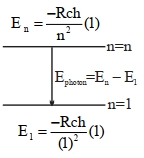
\(\frac{- Rch }{( n )^{2}}+\frac{ Rch }{1}=\frac{ hc }{\lambda}\)\(\frac{- R }{ n ^{2}}+ R =\frac{1}{\lambda}\)
\(R -\frac{1}{\lambda}=\frac{ R }{ n ^{2}}\)
\(\frac{\lambda R -1}{\lambda}=\frac{ R }{ n ^{2}}\)
\(n ^{2}=\frac{\lambda R }{\lambda R -1} \Rightarrow n =\sqrt{\frac{\lambda R }{\lambda R -1}}\)
-
- (A) \(5\)
- (B) \(50\)
- (C) \(25\)
- (D) \(4\)
Show answer and solution
Correct Answer: (A)
For first line of Lyman\(\frac{1}{\lambda}= R \left(1-\frac{1}{4}\right)= R \left(\frac{3}{4}\right)\)
\(\quad \lambda =\frac{4}{3 R } \ldots(1)\)
\(3^{\text {rd }} \text { line(Paschen) }\)
\(\frac{1}{\lambda_{3}}= R \left(\frac{1}{3^{2}}-\frac{1}{6^{2}}\right)=\frac{ R }{9} \times \frac{3}{4}\)
\(2^{nd}\) line(Balmer)
\(\frac{1}{\lambda_{2}}= R \left(\frac{1}{2^{2}}-\frac{1}{4^{2}}\right)=\frac{ R }{4} \times \frac{3}{4}\)
Thus a \(\lambda=\lambda_{3}-\lambda_{2}=\frac{12}{R}-\frac{16}{3 R}=\frac{20}{3 R}\) putting
\(a\left(\frac{4}{3 R}\right)=\frac{20}{3 R} \Rightarrow a=5\)
- 10. The momentum of an electron revolving in \(n ^{\text {th }}\) orbit is given by: (Symbols have their usual meanings) 2022 Easy
- (A) \(\frac{ nh }{2 \pi r }\)
- (B) \(\frac{ nh }{2 r }\)
- (C) \(\frac{ nh }{2 \pi}\)
- (D) \(\frac{2 \pi r }{ nh }\)
Show answer and solution
Correct Answer: (A)
Angular momentum \(mrV =\frac{ nh }{2 \pi}\)So momentum \(mv =\frac{ nh }{2 \pi r }\)
-
- (A) \(1: 1\)
- (B) \(1: 2\)
- (C) \(4: 1\)
- (D) \(2: 1\)
Show answer and solution
Correct Answer: (D)
\(v \propto \frac{Z}{ n } \propto Z ( n = constant )\)\(\Rightarrow \frac{ V _{ He ^{+}}}{ v _{ H }}=\frac{ Z _{ He ^{+}}}{ Z _{ H }}=\frac{2}{1}\)
-
- (A) \(6\)
- (B) \(5\)
- (C) \(4\)
- (D) \(3\)
Show answer and solution
Correct Answer: (B)
\(\frac{13.6\left(\frac{1}{2^{2}}-\frac{1}{3^{2}}\right)}{13.6\left(\frac{1}{2^{2}}-0\right)}=\frac{x}{x+4} ; \frac{\frac{1}{4}-\frac{1}{9}}{\frac{1}{4}}=\frac{x}{x+4}\)\(\frac{5}{9}=\frac{x}{x+4}\)
\(5 x+20=9 x\)
\(4 x=20\)
\(x=5\)
No questions on this page match these filters.