


All JEE Mains 2022 Physics questions
32 chaptersShowing 151–200 of 597 questions
-
- (A) \(223\)
- (B) \(220\)
- (C) \(225\)
- (D) \(234\)
Show answer and solution
Correct Answer: (C)
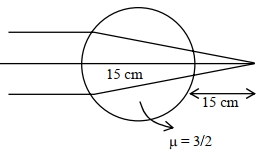
\(\frac{\frac{3}{2}}{ V }-\frac{1}{\infty}=\frac{\frac{3}{2}-1}{15}\)\(\frac{3}{2 V }=\frac{1}{30}\)
\(V =45 \,cm\)
\(\frac{1}{ V }-\frac{3}{\frac{2}{15}}=\frac{1-\frac{3}{2}}{\frac{2}{-15}}\)
\(\frac{1}{ V }-\frac{1}{10}=\frac{1}{30}\)
\(\frac{1}{ V }=\frac{1}{10}+\frac{1}{30}=\frac{4}{30}\)
\(V =7.5\)
\(V =22.5\)
\(v =225 \,mm\)
-
- (A) \(82\)
- (B) \(120\)
- (C) \(12\)
- (D) \(16\)
Show answer and solution
Correct Answer: (C)
\(\ell= t \sin i \left[1-\frac{\operatorname{cosi}}{\sqrt{\mu^{2}-\sin ^{2} i}}\right]\)\(\Rightarrow 4 \sqrt{3}= t \sin 60^{\circ}\left[1-\frac{\cos 60^{\circ}}{\sqrt{3-\frac{3}{4}}}\right]\)
-
- (A) \(5\)
- (B) \(7\)
- (C) \(9\)
- (D) \(11\)
Show answer and solution
Correct Answer: (C)
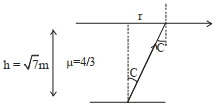
\(C\) : Criticle angle\(\tan C=\frac{r}{h}\)
\(r=h \tan C\)
\(\sin C =\frac{1}{\mu}=\frac{3}{4}\)
\(\tan C =\frac{3}{\sqrt{7}}\)
\(r =\sqrt{7} \times \frac{3}{\sqrt{7}}=3\)
Area of surface \(=\pi r^{2}=9 \; \pi m ^{2}\)
-
- (A) \(0.4\)
- (B) \(4\)
- (C) \(40\)
- (D) \(8\)
Show answer and solution
Correct Answer: (B)
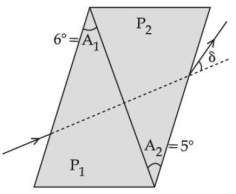
\(\delta= A \left(\mu_{ y }-1\right)- A ^{\prime}\left(\mu_{ y }^{\prime}-1\right)\)\(=6(1.5-1)-5(1.55-1)\)
\(=\frac{1}{4}\)
-
- (A) \(40\)
- (B) \(405\)
- (C) \(402\)
- (D) \(400\)
Show answer and solution
Correct Answer: (D)
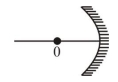
After \(10\,sec\).\(u =-80\,cm\)
\(f =-100\,cm\)
\(\frac{1}{ v }+\frac{1}{ u }=\frac{1}{ f }\)
\(v =400\,cm\)
-
- (A) \(1.0\)
- (B) \(0.5\)
- (C) \(1.5\)
- (D) \(3.0\)
Show answer and solution
Correct Answer: (A)
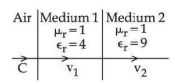
\(\frac{\mu_{2}}{\mu_{ air }}=\frac{ C }{ V _{2}}\)\(\therefore \frac{\sqrt{\mu_{ r _{2}} \varepsilon_{ r _{2}}}}{(1)}=\frac{ C }{ V _{2}}\)
\(\therefore \sqrt{(1)(9)}=\frac{C}{v_{2}}\)
\(\therefore v _{2}=\frac{ C }{3}\)
-
- (A) \(\sin ^{-1}(\sqrt{n})\)
- (B) \(\cos ^{-1}\left(\sqrt{\frac{n}{2}}\right)\)
- (C) \(\sin ^{-1}(\sqrt{2 n})\)
- (D) \(2 \cos ^{-1}\left(\sqrt{\frac{n}{2}}\right)\)
Show answer and solution
Correct Answer: (D)
\(i=2 r\)\(\sin i \times n_{1}=\sin r \times n_{2}\)
\(\sin i \times 1=\sin \frac{i}{2} \times \sqrt{2 n}\)
\(\frac{\sin i}{\sin \frac{i}{2}}=\sqrt{2 n}\)
\(\frac{\sin \frac{i}{2} \cos \frac{i}{2}}{\sin \frac{i}{2}} \sqrt{2 n}\)
\(\cos \frac{i}{2}=\sqrt{\frac{n}{2}}\)
\(\frac{i}{2}=\cos ^{-1}\left(\sqrt{\frac{n}{2}}\right)\)
\(i=2 \cos ^{-1}\left(\sqrt{\frac{n}{2}}\right)\)
-
- (A) \(0.8\)
- (B) \(3.2\)
- (C) \(1.2\)
- (D) \(5.6\)
Show answer and solution
Correct Answer: (B)
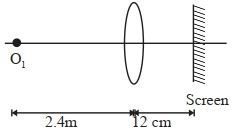
Applying lens formula\(\frac{1}{0.12}+\frac{1}{2.4}=\frac{1}{f} \Rightarrow \frac{1}{f}=\frac{210}{24}\)
Upon putting the glass slab, shift of image is
\(\Delta x = t \left(1-\frac{1}{\mu}\right)=\frac{1}{3}\,cm\)
Now \(v =12-\frac{1}{3}=\frac{35}{3}\,cm\)
Again apply lens formula
\(\frac{1}{0.12}+\frac{1}{ u }=\frac{1}{ f }=\frac{210}{24}\)
Solving \(u =-5.6\,m\)
Thus shift of object is
\(5.6-2.4=3.2\,m\)
- 159. If a wave gets refracted into a denser medium, then which of the following is true? 2022 Medium
- (A) wavelength speed and frequency decreases
- (B) wavelength increases, speed decreases and frequency remains constant
- (C) wavelength and speed decreases but frequency remains constant
- (D) wavelength, speed and frequency increases
Show answer and solution
Correct Answer: (C)
No change in frequency but speed and wave-length decreases.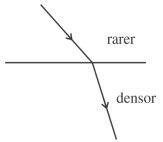
-
- (A) \(14\)
- (B) \(15\)
- (C) \(18\)
- (D) \(19\)
Show answer and solution
Correct Answer: (B)
\(vu = f ^{2}\) (by Newton's formula)\(f ^{\prime}=225\)
\(f =15\,cm\)
-
- (A) Reflection
- (B) Refraction
- (C) Diffraction
- (D) Scattering
Show answer and solution
Correct Answer: (D)
\(\frac{ a }{\lambda}=\frac{1}{100}\)For reflection size of obstacle must be much larger than wavelength, for diffraction size should be order of wavelength.
Since the object is of size \(\frac{\lambda}{100}\), much smaller than wavelength, so scattering will occur.
-
- (A) \(20\)
- (B) \(30\)
- (C) \(10\)
- (D) \(15\)
Show answer and solution
Correct Answer: (A)
\(f _{0}+ f _{ e }=30\)\(m =\frac{ f _{0}}{ f _{ e }}\)
\(2=\frac{ f _{0}}{ f _{ e }} \Rightarrow f _{0}=2 f _{ e }\)
So \(f _{0}+\frac{ f _{0}}{2}=30\)
\(f _{0}=20\,cm\)
-
- (A) \(27\)
- (B) \(270\)
- (C) \(22\)
- (D) \(30\)
Show answer and solution
Correct Answer: (A)
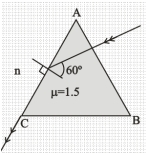
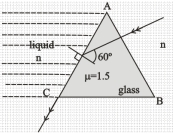
Using snell's law at face \(AC\)\(1.5 \sin 60^{\circ}=n \times \sin 90^{\circ}\)
\(1.5 \times \frac{\sqrt{3}}{2}=n=\frac{\sqrt{x}}{4}\)
\(3 \sqrt{3}=\sqrt{x}\)
\(x =27\)
-
- (A) \(1.732\)
- (B) \(1.333\)
- (C) \(1.414\)
- (D) \(2.732\)
Show answer and solution
Correct Answer: (C)
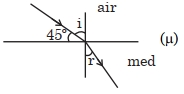
\(i=45^{\circ}\)\(D=i-r\)
\(15^{\circ}=45-r \Rightarrow r=30^{\circ}\)
\(n_{1} \sin i=n_{2} \sin r\)
\(1 \sin 45^{\circ}=\mu \sin 30^{\circ}\)
\(\frac{1}{\sqrt{2}}=\mu \frac{1}{2}\)
\(\mu=\sqrt{2}=1.414\)
-
- (A) \(\tan ^{-1}\left(\frac{3}{\sqrt{7}}\right)\)
- (B) \(\tan ^{-1}\left(\frac{2}{3}\right)\)
- (C) \(\cos ^{-1}\left(\frac{3}{4}\right)\)
- (D) \(\sin ^{-1}\left(\frac{2}{3}\right)\)
Show answer and solution
Correct Answer: (A)
\(V =\frac{ C }{ n }\)\(n_{d} \sin i_{c}=n_{r} \sin 90^{\circ}\)
\(\sin i_{ C }=\frac{ n _{ r }}{ n _{ d }}=\frac{ V _{ d }}{ V _{ I }}\)
\(\sin i_{c}=\frac{1.5 \times 10^{8}}{2 \times 10^{8}}=\frac{1.5}{2}\)
\(\sin i_{c}=\frac{3}{4}\)
\(\tan i_{c}=\frac{3}{\sqrt{4^{2}-3^{2}}} \Rightarrow \frac{3}{\sqrt{7}}\)
\(i_{c}=\tan ^{-1}\left(\frac{3}{\sqrt{7}}\right)\)
-
- (A) \(1.303\)
- (B) \(1.318\)
- (C) \(1.13\)
- (D) \(0.12\)
Show answer and solution
Correct Answer: (C)
\(v =\frac{ c }{\mu}\)\(\Rightarrow v _{ B }=\frac{3 \times 10^{8}}{1.47}=2.04 \times 10^{8}=20.4 \times 10^{7} m / s\)
\(\because v _{ A }- v _{ B }=2.6 \times 10^{7} m / s\)
\(\therefore v _{ A }=(20.4+2.6) \times 10^{7}=23 \times 10^{7} m / s\)
\(\therefore \frac{\mu_{ B }}{\mu_{A}}=\frac{ v _{ A }}{ v _{ B }}=\frac{23 \times 10^{7}}{20.4 \times 10^{7}}=1.13\)
-
- (A) \(\theta=\sin ^{-1}\left(\frac{3}{4}\right)\)
- (B) \(\theta > \sin ^{-1}\left(\frac{2}{3}\right)\)
- (C) \(\theta < \sin ^{-1}\left(\frac{3}{4}\right)\)
- (D) \(\theta > \sin ^{-1}\left(\frac{3}{4}\right)\)
Show answer and solution
Correct Answer: (D)
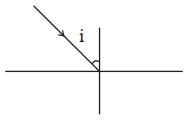
\(\sin i _{ c }=\frac{ n _{ r }}{ n _{ d }}=\frac{ C _{ d }}{ C _{ r }}=\frac{1.5 \times 10^{10}}{2 \times 10^{10}}\)\(\sin i _{ c }=\frac{3}{4}\)
\(i _{ c }=\sin ^{-1}\left(\frac{3}{4}\right)\)
for T I R \(\quad \theta> i _{ c }\)
\(\quad \theta>\sin ^{-1}\left(\frac{3}{4}\right)\)
-
- (A) \(7\)
- (B) \(15\)
- (C) \(254\)
- (D) \(225\)
Show answer and solution
Correct Answer: (B)
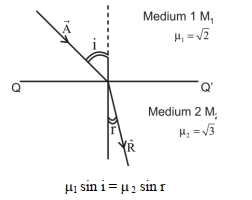
\(\overrightarrow{ A }=4 \sqrt{3 \hat{i}}-3 \sqrt{3 \hat{j}}-5 \hat{ k }\)As incident vector \(A\) makes \(i\) angle with normal \(z-\)axis refracted vector \(R\) makes \(r\) angle with normal \(z\) - axis with help of direction cosine
\(i=\cos ^{-1}\left(\frac{A_{z}}{A}\right)=\cos ^{-1}\left(\frac{5}{\sqrt{(4 \sqrt{3})^{2}+(3 \sqrt{3})^{2}+5^{2}}}\right)\)
\(=\cos ^{-1}\left(\frac{5}{10}\right) \Rightarrow i=60^{\circ}\)
\(\sqrt{2} \sin 60=\sqrt{3} \times \sin r\)
\(r=45^{\circ}\)
Difference between \(i \) & \(r =60-45=15\)
-
- (A) \(5 \times 10^{-10}\,v _{ a } m\)
- (B) \(5 \times 10^{-10}\,m\)
- (C) \(1.5 \times 10^{10}\,m\)
- (D) \(5 \times 10^{-10} v _{ B }\,m\)
Show answer and solution
Correct Answer: (A)
\(\frac{\mu_{ A }}{\mu_{ B }}=\frac{ c / V _{ A }}{ c / V _{ B }}=\frac{ V _{ B }}{ V _{ A }}=\frac{1}{2}\)Let the thickness is \(d\)
\(\frac{d}{v_{B}}-\frac{d}{v_{A}}=5 \times 10^{-10}\)
\(d =\frac{5 \times 10^{-10} \times v _{ A } v _{ B }}{ v _{ A }- v _{ B }}\)
As \(v _{ A }=2 v _{ B } \Rightarrow d =5 \times 10^{-10} \times 2 v _{ B }\)
Or \(d =5 \times 10^{-10} \times v_{ A }\)
-
- (A) \(10\)
- (B) \(101\)
- (C) \(18\)
- (D) \(11\)
Show answer and solution
Correct Answer: (A)
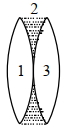
\(\frac{1}{ f _{1}}=\frac{1}{15}=\left(\frac{3}{2}-1\right)\left[\frac{2}{ R }\right]\)\(\frac{1}{ R }=\frac{1}{15}\)
\(\frac{1}{ f _{\text {eq }}}=\frac{1}{ f _{1}}+\frac{1}{ f _{2}}+\frac{1}{ f _{3}}\)
\(=\frac{1}{15}+\left(\frac{5}{4}-1\right)\left[\frac{-2}{ R }\right]+\frac{1}{15}\)
\(=\frac{1}{15}-\frac{1}{30}+\frac{1}{15}\)
\(=\frac{2-1+2}{30}\)
\(=\frac{3}{30}=\frac{1}{10}\)
\(=10\)
-
- (A) In primary rainbow, observer sees red colour on the top and violet on the bottom
- (B) In primary rainbow, observer sees violet colour on the top and red on the bottom
- (C) In primary rainbow, light wave suffers total internal reflection twice before coming out of water drops
- (D) Primary rainbow is less bright than secondary rainbow.
Show answer and solution
Correct Answer: (A)
In primary rainbow, red colour is at top and violet is at bottom.Intensity of secondary rainbow is less in comparison to primary rainbow.
-
- (A) \(0\)
- (B) \(1\)
- (C) \(2\)
- (D) \(3\)
Show answer and solution
Correct Answer: (A)
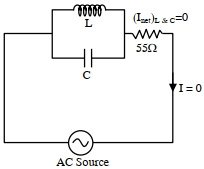
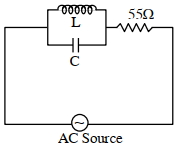
At resonance \(I _{ L }= I _{ C }\)Alternatively,
\(\frac{1}{Z}=\sqrt{\left(\frac{1}{X_{L}}-\frac{1}{X_{C}}\right)^{2}}\)
At resonance, \(X _{ L }= X _{ C }\) and \(Z \rightarrow \infty\)
\(\therefore Z_{\text {total circuit }} \rightarrow \infty\) i.e, \(I=0\)
Ans. \(0\)
-
- (A) \(10\)
- (B) \(1\)
- (C) \(0\)
- (D) \(100\)
Show answer and solution
Correct Answer: (A)
Energy stored in capacitor\(=\frac{1}{2} CV ^{2}=\frac{1}{2} 500 \times 10^{-6} \times 10^{4}\)
\(=\frac{5}{2}\,J\)
Current will be maximum when whole energy of capacitor becomes energy of inductor.
\(\frac{1}{2} LI ^{2}=\frac{5}{2}\)
\(I =\sqrt{\frac{5}{ L }}=\sqrt{\frac{5}{50 \times 10^{-3}}}=10\,A\)
-
- (A) \(\frac{10}{\sqrt{2}}\)
- (B) \(\frac{5}{\sqrt{2}}\)
- (C) \(5 \sqrt{2}\)
- (D) \(\frac{5}{2}\)
Show answer and solution
Correct Answer: (D)
Element \(X\) should be resistive with \(R =20 \Omega\)Element \(Y\) should be inductive with \(X _{ L }=20 \Omega\)
When \(X\) and \(Y\) are connector in series
\(Z =\sqrt{ X _{ L }^{2}+ R ^{2}}=20 \sqrt{2}\)
\(I _{0}=\frac{ E _{0}}{ Z }=\frac{100}{20 \sqrt{2}}=\frac{5}{\sqrt{2}} A\)
\(I _{ rms }=\frac{ I _{0}}{\sqrt{2}}=\frac{5}{2}\,A\)
-
- (A) \(3: 2\)
- (B) \(3: 1\)
- (C) \(3: 4\)
- (D) \(4: 3\)
Show answer and solution
Correct Answer: (B)
\(\begin{array}{ll} H _{1}=i^{2} R _{1} t & H _{2}=i_{1 ms }^{2} R _{2} t \left\{ i _{1 ms }=\frac{ i _{0}}{\sqrt{2}}\right\} \\ H _{1}=16(3) t \quad H _{2}=\frac{ i _{0}^{2}}{2} R _{2} t \\ H _{2}=16 t \\ H _{1}: H _{2}=3: 1\end{array}\)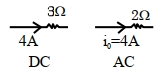
-
- (A) \(2.5\, ms\)
- (B) \(1.25\, ms\)
- (C) \(2.5 \,s\)
- (D) \(0.25 \,s\)
Show answer and solution
Correct Answer: (A)
Considering sinusoidal \(AC\).Phase at maximum value \(=\frac{\pi}{2}\)
Phase at rms value \(=\frac{3 \pi}{4}\)
Thus phase change \(=\frac{3 \pi}{4}-\frac{\pi}{2}=\frac{\pi}{4}\)
\(Now \,\omega=2 \pi f\)
\(=2 \pi \times 50\)
\(=100 \pi\)
time taken \(t =\frac{\theta}{\omega}=\frac{\pi / 4}{100 \pi}=\frac{1}{400} s\) \(t =2.5 \times 10^{-3}=2.5\, ms\)
-
- (A) \(466\)
- (B) \(312\)
- (C) \(238\)
- (D) \(196\)
Show answer and solution
Correct Answer: (C)
Resonant frequency, \(\omega_{0}=\frac{1}{\sqrt{ LC }}=10^{4} rad / sec\)\(\omega^{\prime}=.4 \times 10^{4}=4000 rad / sec\)
\(i_{0}=\frac{ V _{0}}{\sqrt{ R ^{2}+\left( X _{ C }^{\prime}- X _{ L }^{\prime}\right)^{2}}}=238\,mA\)
-
- (A) \(\tan ^{-1}(0.17)\)
- (B) \(\tan ^{-1}(9.46)\)
- (C) \(\tan ^{-1}(0.30)\)
- (D) \(\tan ^{-1}(13.33)\)
Show answer and solution
Correct Answer: (A)
\(X _{ L }=10^{-2} \times 3000=30 \Omega\)\(X _{ C }=\frac{1}{3000 \times 25 \times 10^{-6}}=\frac{40}{3} \Omega\)
\(X = X _{ L }- X _{ C }\)
\(=30-\frac{40}{3}=\frac{50}{3}\)
\(\tan \delta=\frac{ X }{ R }=\frac{50}{3 \times 100}=\frac{1}{6}\)
\(\delta=\tan ^{-1}\left(\frac{1}{6}\right)=\tan ^{-1}(0.17)\)
-
- (A) \(99\)
- (B) \(101\)
- (C) \(105\)
- (D) \(100\)
Show answer and solution
Correct Answer: (D)
For minimum impedance\(X _{ L }= X _{ C }\)
\(\Rightarrow \omega L =\frac{1}{\omega C } \Rightarrow L =\frac{1}{\omega^{2} C }=10^{-1} H =100\,mH\)
-
- (A) \(14\)
- (B) \(15\)
- (C) \(10\)
- (D) \(13\)
Show answer and solution
Correct Answer: (B)
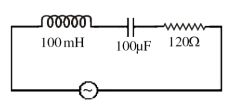
\(\left|\left( X _{ L }- X _{ C }\right)\right|=\left|10-10^{2}\right|=90\,\Omega\)\(Z =\) Impendance
\(=\sqrt{\left( X _{ L }- X _{ C }\right)^{2}+ R ^{2}}=\sqrt{(90)^{2}+(20)^{2}}=150\,\Omega\)
\(i _{ ms }=\frac{ V _{\text {mas }}}{ z }=\left(\frac{2}{15}\right) A\)
Now \(i _{ mms }^{2} R \Delta t = ms (\Delta T )\)
\(\Rightarrow \Delta t =15\,sec\)
-
- (A) \(4.4\)
- (B) \(1.55\)
- (C) \(2.2\)
- (D) \(3.1\)
Show answer and solution
Correct Answer: (C)
\(E =440 \sin 100 \pi t , L =-\frac{\sqrt{2}}{\pi} H\)\(X _{ L }=\omega L =100 \pi \frac{\sqrt{2}}{\pi}=100 \sqrt{2} \Omega\)
Peak current \(I _{0}=\frac{ E _{0}}{ X _{ L }}=\frac{440}{100 \sqrt{2}}=2.2 \sqrt{2} A\)
\(AC\) ammeter reads RMS value therefore reading will be \(I_{\text {ms }}\)
\(I_{\text {mus }}=\frac{I_{0}}{\sqrt{2}}=2.2\,A\)
-
- (A) \(6\)
- (B) \(5\)
- (C) \(4\)
- (D) \(3\)
Show answer and solution
Correct Answer: (B)
If Current is in phase with emf then the frequency of source \(=\frac{1}{2 \pi \sqrt{L C}}\) (Resonant frequency)
\(\frac{1}{2 \pi \sqrt{\frac{1}{2} \times 10^{-3} \times 2 \times 10^{-4}}}\)
\(=\frac{1}{2 \pi} \times \sqrt{10} \times 1000=500 \,Hz\) -
- (A) \(282\)
- (B) \(242\)
- (C) \(247\)
- (D) \(867\)
Show answer and solution
Correct Answer: (B)
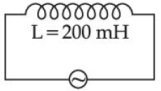
\(f =50 Hz\)\(X _{ L }=2 \pi fL\)
\(=2 \pi(50)\left(200 \times 10^{-3}\right)\)
\(=20 \pi \Omega\)
\(i _{0}=\frac{ V _{0}}{ X _{ L }} \Rightarrow \frac{ V _{ rms } \sqrt{2}}{ X _{ L }}\)
\(=\frac{(220) \sqrt{2}}{20 \pi}=\frac{11 \sqrt{2}}{\pi}\)
\(i _{ o }=\frac{\sqrt{242}}{\pi}\)
-
- (A) \((a)\) and \((d)\) only
- (B) \((b)\) and \((d)\) only
- (C) \((a)\) and \((c)\) only
- (D) \((b)\) and \((c)\) only
Show answer and solution
Correct Answer: (C)
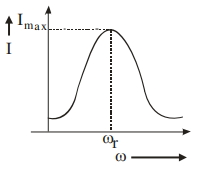
\(\text { at } \omega_{r}, X_{C}=X_{L}\)\(\Rightarrow \frac{1}{\omega_{r} C}=\omega_{r} L\)
So if \(\omega < \omega_{r}\) then \(X_{C}\) will increase and \(X_{L}\) will decrease.
Hence to left of \(\omega_{t}\) circuit is capacitive
\(Z=\sqrt{R^{2}+\left(X_{C}-X_{L}\right)^{2}}\)
at \(\omega_{r}, Z =\sqrt{ R ^{2}+ O ^{2}}= R ( C )\)
-
- (A) Both Statement \(I\) and Statement \(II\) are true.
- (B) Both Statement \(I\) and Statement \(II\) are false.
- (C) Statement \(I\) is true but Statement \(I\) in false.
- (D) Statement \(I\) is false but Statement \(II\) is true.
Show answer and solution
Correct Answer: (C)
if \(R =0, P =0\) -
- (A) Purely Resistive circuit
- (B) Purely Inductive circuit
- (C) \(LCR\) series circuit
- (D) \(RC\) series circuit only
Show answer and solution
Correct Answer: (B)
Purely Inductive circuit\(\theta=\frac{\pi}{2}\)
\(\cos \frac{\pi}{2}=0\)
Average power \(=0\)
-
- (A) \(\frac{1}{2}\)
- (B) \(\frac{1}{\sqrt{2}}\)
- (C) \(\frac{\sqrt{3}}{\sqrt{2}}\)
- (D) \(2: 1\)
Show answer and solution
Correct Answer: (B)
In case of \(L-R\) circuit\(Z=\sqrt{ X _{ L }^{2}+ R ^{2}} \&\) power factor
\(P _{1}=\cos \phi=\frac{ R }{ Z }\)
\(\text { As } X _{ L }= R\)
\(\Rightarrow Z =\sqrt{2} R\)
\(\Rightarrow P _{1}=\frac{ R }{\sqrt{2} R } \Rightarrow P _{1}=\frac{1}{\sqrt{2}}\)
In case of \(L-C-R\) circuit
\(Z=\sqrt{R^{2}+\left(X_{L}-X_{C}\right)^{2}}\)
As \(X_{L}=X_{C}\)
\(\Rightarrow Z=R\)
\(\Rightarrow P _{2}=\cos \phi=\frac{ R }{ R }=1\)
\(\Rightarrow \frac{ P _{1}}{ P _{2}}=\frac{1}{\sqrt{2}}\)
-
- (A) \(27\)
- (B) \(89\)
- (C) \(55\)
- (D) \(22\)
Show answer and solution
Correct Answer: (D)
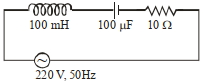
\(X _{ L }=\omega L =2 \pi \times 50 \times 10^{-1}=10 \pi\)\(X _{ X }=\frac{1}{\omega C }=\frac{1}{2 \pi \times 50} \times 10^{4}=\frac{100}{\pi}\)
\(R =10 \Omega\)
\(Z =\sqrt{\left(10 \pi-\frac{100}{\pi}\right)^{2}+10^{2}} \simeq 10 \Omega\)
\(i =\frac{ E }{2} \simeq \frac{220}{10} \simeq 22 Amp\)
-
- (A) \(0\)
- (B) \(1\)
- (C) \(2\)
- (D) \(7\)
Show answer and solution
Correct Answer: (A)
\(V _{ L }= V _{ C }=2 V _{ R }\)\(X _{ L }= X _{ C }=2 R\)
\(X _{ L }=10\,\Omega\)
\(\omega L =10\)
\(2 \pi f =10\)
\(L =\frac{10}{2 \pi f }=\frac{1}{10 \pi}\,H =\frac{1000}{10 \pi}\,mH\)
\(L =\frac{1}{\frac{1}{100} \pi} ; \quad K =\frac{1}{100}=0.01 \approx 0\)
-
- (A) \((A)-(II), B-(I), (C)-(IV), (D)-(III)\)
- (B) \((A)-(II), B-(I), (C)-(III), (D)-(IV)\)
- (C) \((A)-(III), B-(IV), (C)-(II), (D)-(I)\)
- (D) \((A)-(III), B-(I), (C)-(II), (D) -(IV)\)
Show answer and solution
Correct Answer: (A)
\(AC\) generator converts mechanical energy into electrical energy. Galvanometer shows deflection when current passes through it so it is used to show presence of current in any wire.Transformer is used to step up or step down the voltage. Metals detectors contain inductor coils and use principle of induction and resonance in \(AC\) circuit.
-
- (A) \(\frac{1}{60} \; s\)
- (B) \(60 \; s\)
- (C) \(\frac{1}{120} \; s\)
- (D) \(\frac{1}{240} \; s\)
Show answer and solution
Correct Answer: (D)
\(\omega=120 \pi=\frac{2 \pi}{T} \Rightarrow T=\frac{1}{60} sec\)time taken to reach peak value \(=\frac{T}{4}=\frac{1}{240} s\)
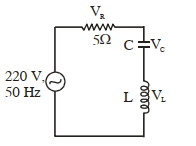
- 192. The effective current \(I\) in the given circuit at very high frequencies will be \(.......A\)
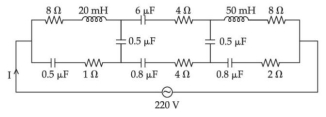 2022 Hard
- (A) \(4\)
- (B) \(44\)
- (C) \(42\)
- (D) \(46\)
Show answer and solution
Correct Answer: (B)
At very high frequencies,\(X _{ C }=\frac{1}{\omega C } \approx 0\)
Also \(X _{ L }=\omega L \approx \infty\)
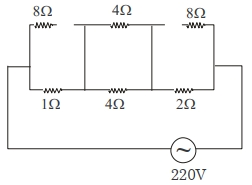
Thus, equivalent circuit can be redrawn as
\(Z =1+2+2=5 \Omega\)
\(I =\frac{220 V }{5 \Omega}=44 A\)
-
- (A) \(1.47 \sin \left(49 \pi t -30^{\circ}\right)\)
- (B) \(1.47 \sin \left(49 \pi t+60^{\circ}\right)\)
- (C) \(23.1 \sin \left(49 \pi t -30^{\circ}\right)\)
- (D) \(23.1 \sin \left(49 \pi t+60^{\circ}\right)\)
Show answer and solution
Correct Answer: (D)
\(v _{0}= i _{0} x _{ L }\)\(= i _{0}( wL )\)
\(=(5)(49 \pi)\left(30 \times 10^{-3}\right)\)
\(=23.1\)
Voltage will lead current by \(90^{\circ}\).
\(\therefore V =23.1 \sin \left(49 \pi t +60^{\circ}\right)\)
-
- (A) \(250\)
- (B) \(2489\)
- (C) \(254\)
- (D) \(552\)
Show answer and solution
Correct Answer: (A)
Band width \(=232-212=\frac{ R }{ L }\)\(\therefore L =\frac{5}{20}=250\,mH\)
-
- (A) \(5\)
- (B) \(50\)
- (C) \(100\)
- (D) \(200\)
Show answer and solution
Correct Answer: (B)
Current in capacitor \(I =\frac{ V }{ X _{ C }}\)\(I =( V ) \times(\omega C )\)
\(C =\frac{ I }{ V \omega}=\frac{6.9 \times 10^{-6}}{230 \times 600}=50 pF\)
-
- (A) Source frequency should be increased
- (B) Another resistance should be added in series with the first resistance.
- (C) Another capacitor should be added in series with the first capacitor
- (D) Another capacitor should be added in series with the first capacitor
Show answer and solution
Correct Answer: (C)
\(f =\frac{1}{2 \pi \sqrt{ LC }}\)To increase the resonating frequency product of \(L\) and \(C\) should decrease.
By joining capacitor in series, capacitor will decrease
-
- (A) \(2\)
- (B) \(3\)
- (C) \(1\)
- (D) \(8\)
Show answer and solution
Correct Answer: (B)
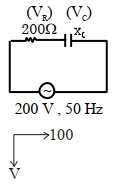
\(P =\frac{ V ^{2}}{ R } \Rightarrow R =\frac{ V ^{2}}{ P }\)\(R =\frac{100 \times 10^{2}}{50}= R =200 \Omega\)
\(V _{ R }^{2}+ V _{ C }^{2}= V ^{2}\)
\((100)^{2}+ V _{ C }^{2}=(200)^{2}\)
\(i =\frac{100}{200}=\frac{1}{2} ;\)
\(V = I \times X _{ C }\)
\(V _{ C }=100 \sqrt{3}\)
\(X C _{ C }=200 \sqrt{3}\)
\(200 \sqrt{3}=\frac{1}{\omega C }\)
\(C =\frac{ V ^{2}=40000}{20 \times 50 \times 20 \sqrt{3}}=\frac{ V _{ C }^{2}=30000}{\sqrt{ x }}\)
\(\sqrt{ x }=50 \times 10^{-6} \times 100 \times 200 \sqrt{3}\)
\(X =3\)
- 198. When you walk through a metal detector carrying a metal object in your pocket, it raises an alarm. This phenomenon works on 2022 Medium
- (A) Electromagnetic induction
- (B) Resonance in \(ac\) circuits
- (C) Mutual induction in \(ac\) circuits
- (D) interference of electromagnetic waves
Show answer and solution
Correct Answer: (B)
Metal detector works on the principle of transmitting an electromagnetic signal and analyses a return signal from the target. So it works on the principle of resonance in \(AC\) circuit. -
- (A) \(\frac{6}{\sqrt{110}}\)
- (B) \(\frac{3}{\sqrt{113}}\)
- (C) \(\frac{3}{\sqrt{109}}\)
- (D) \(\frac{2}{\sqrt{109}}\)
Show answer and solution
Correct Answer: (C)
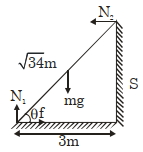
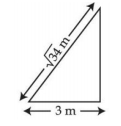
\(f = N _{2}\)\(N_{1}=m g\)
\(N _{2} \times \ell \sin \theta= mg \frac{\ell}{2} \cos \theta\)
\(N _{2}=\frac{ mg }{2} \cot \theta\)
\(\frac{ F _{w}}{ F _{i}}=\frac{\frac{ mg }{2} \cot \theta}{\sqrt{( mg )^{2}+\left(\frac{ mg }{2} \cot \theta\right)^{2}}}\)
\(=\frac{1}{\sqrt{1+\frac{4}{\cot ^{2} \theta}}}\)
\(=\frac{3}{\sqrt{109}}\)
-
- (A) \(\frac{3}{2} t^{4}-t^{2}+10 t\)
- (B) \(\frac{t^{4}}{2}-\frac{t^{3}}{3}+10 t+4\)
- (C) \(\frac{2 t ^{4}}{3}-\frac{ t ^{3}}{6}+10 t +12\)
- (D) \(2 t^{4}-\frac{t^{3}}{2}+5 t+4\)
Show answer and solution
Correct Answer: (B)
\(\frac{d \omega}{d t}=6 t^{2}-2 t\)\(\int \limits_{10}^{m} d \omega=2 t^{5}-t^{2}\)
\(\omega=10+2 t^{5}-t^{2}\)
\(\frac{d \theta}{d t}=10+2 t^{5}-t^{2}\)
\(\int \limits_{4}^{\theta} d \theta=10+2 t^{3}-t^{2}\)
\(\int \limits_{4}^{\theta} d \theta=10 t+\frac{t^{4}}{2}-\frac{t^{3}}{3}\)
\(\theta=4+10 t+\frac{t^{4}}{2}-\frac{t^{5}}{3}\)
No questions on this page match these filters.