


Questions
27 questionsShowing 1–27 of 27 questions
-
- (A) \(0\)
- (B) \(1\)
- (C) \(2\)
- (D) \(3\)
Show answer and solution
Correct Answer: (A)
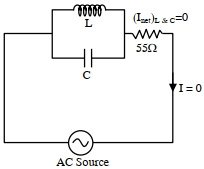
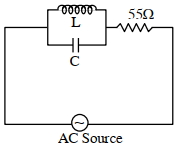
At resonance \(I _{ L }= I _{ C }\)Alternatively,
\(\frac{1}{Z}=\sqrt{\left(\frac{1}{X_{L}}-\frac{1}{X_{C}}\right)^{2}}\)
At resonance, \(X _{ L }= X _{ C }\) and \(Z \rightarrow \infty\)
\(\therefore Z_{\text {total circuit }} \rightarrow \infty\) i.e, \(I=0\)
Ans. \(0\)
-
- (A) \(10\)
- (B) \(1\)
- (C) \(0\)
- (D) \(100\)
Show answer and solution
Correct Answer: (A)
Energy stored in capacitor\(=\frac{1}{2} CV ^{2}=\frac{1}{2} 500 \times 10^{-6} \times 10^{4}\)
\(=\frac{5}{2}\,J\)
Current will be maximum when whole energy of capacitor becomes energy of inductor.
\(\frac{1}{2} LI ^{2}=\frac{5}{2}\)
\(I =\sqrt{\frac{5}{ L }}=\sqrt{\frac{5}{50 \times 10^{-3}}}=10\,A\)
-
- (A) \(\frac{10}{\sqrt{2}}\)
- (B) \(\frac{5}{\sqrt{2}}\)
- (C) \(5 \sqrt{2}\)
- (D) \(\frac{5}{2}\)
Show answer and solution
Correct Answer: (D)
Element \(X\) should be resistive with \(R =20 \Omega\)Element \(Y\) should be inductive with \(X _{ L }=20 \Omega\)
When \(X\) and \(Y\) are connector in series
\(Z =\sqrt{ X _{ L }^{2}+ R ^{2}}=20 \sqrt{2}\)
\(I _{0}=\frac{ E _{0}}{ Z }=\frac{100}{20 \sqrt{2}}=\frac{5}{\sqrt{2}} A\)
\(I _{ rms }=\frac{ I _{0}}{\sqrt{2}}=\frac{5}{2}\,A\)
-
- (A) \(3: 2\)
- (B) \(3: 1\)
- (C) \(3: 4\)
- (D) \(4: 3\)
Show answer and solution
Correct Answer: (B)
\(\begin{array}{ll} H _{1}=i^{2} R _{1} t & H _{2}=i_{1 ms }^{2} R _{2} t \left\{ i _{1 ms }=\frac{ i _{0}}{\sqrt{2}}\right\} \\ H _{1}=16(3) t \quad H _{2}=\frac{ i _{0}^{2}}{2} R _{2} t \\ H _{2}=16 t \\ H _{1}: H _{2}=3: 1\end{array}\)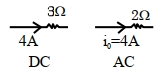
-
- (A) \(2.5\, ms\)
- (B) \(1.25\, ms\)
- (C) \(2.5 \,s\)
- (D) \(0.25 \,s\)
Show answer and solution
Correct Answer: (A)
Considering sinusoidal \(AC\).Phase at maximum value \(=\frac{\pi}{2}\)
Phase at rms value \(=\frac{3 \pi}{4}\)
Thus phase change \(=\frac{3 \pi}{4}-\frac{\pi}{2}=\frac{\pi}{4}\)
\(Now \,\omega=2 \pi f\)
\(=2 \pi \times 50\)
\(=100 \pi\)
time taken \(t =\frac{\theta}{\omega}=\frac{\pi / 4}{100 \pi}=\frac{1}{400} s\) \(t =2.5 \times 10^{-3}=2.5\, ms\)
-
- (A) \(466\)
- (B) \(312\)
- (C) \(238\)
- (D) \(196\)
Show answer and solution
Correct Answer: (C)
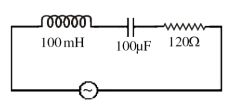
Resonant frequency, \(\omega_{0}=\frac{1}{\sqrt{ LC }}=10^{4} rad / sec\)\(\omega^{\prime}=.4 \times 10^{4}=4000 rad / sec\)
\(i_{0}=\frac{ V _{0}}{\sqrt{ R ^{2}+\left( X _{ C }^{\prime}- X _{ L }^{\prime}\right)^{2}}}=238\,mA\)
-
- (A) \(\tan ^{-1}(0.17)\)
- (B) \(\tan ^{-1}(9.46)\)
- (C) \(\tan ^{-1}(0.30)\)
- (D) \(\tan ^{-1}(13.33)\)
Show answer and solution
Correct Answer: (A)
\(X _{ L }=10^{-2} \times 3000=30 \Omega\)\(X _{ C }=\frac{1}{3000 \times 25 \times 10^{-6}}=\frac{40}{3} \Omega\)
\(X = X _{ L }- X _{ C }\)
\(=30-\frac{40}{3}=\frac{50}{3}\)
\(\tan \delta=\frac{ X }{ R }=\frac{50}{3 \times 100}=\frac{1}{6}\)
\(\delta=\tan ^{-1}\left(\frac{1}{6}\right)=\tan ^{-1}(0.17)\)
-
- (A) \(99\)
- (B) \(101\)
- (C) \(105\)
- (D) \(100\)
Show answer and solution
Correct Answer: (D)
For minimum impedance\(X _{ L }= X _{ C }\)
\(\Rightarrow \omega L =\frac{1}{\omega C } \Rightarrow L =\frac{1}{\omega^{2} C }=10^{-1} H =100\,mH\)
-
- (A) \(14\)
- (B) \(15\)
- (C) \(10\)
- (D) \(13\)
Show answer and solution
Correct Answer: (B)
\(\left|\left( X _{ L }- X _{ C }\right)\right|=\left|10-10^{2}\right|=90\,\Omega\)\(Z =\) Impendance
\(=\sqrt{\left( X _{ L }- X _{ C }\right)^{2}+ R ^{2}}=\sqrt{(90)^{2}+(20)^{2}}=150\,\Omega\)
\(i _{ ms }=\frac{ V _{\text {mas }}}{ z }=\left(\frac{2}{15}\right) A\)
Now \(i _{ mms }^{2} R \Delta t = ms (\Delta T )\)
\(\Rightarrow \Delta t =15\,sec\)
-
- (A) \(4.4\)
- (B) \(1.55\)
- (C) \(2.2\)
- (D) \(3.1\)
Show answer and solution
Correct Answer: (C)
\(E =440 \sin 100 \pi t , L =-\frac{\sqrt{2}}{\pi} H\)\(X _{ L }=\omega L =100 \pi \frac{\sqrt{2}}{\pi}=100 \sqrt{2} \Omega\)
Peak current \(I _{0}=\frac{ E _{0}}{ X _{ L }}=\frac{440}{100 \sqrt{2}}=2.2 \sqrt{2} A\)
\(AC\) ammeter reads RMS value therefore reading will be \(I_{\text {ms }}\)
\(I_{\text {mus }}=\frac{I_{0}}{\sqrt{2}}=2.2\,A\)
-
- (A) \(6\)
- (B) \(5\)
- (C) \(4\)
- (D) \(3\)
Show answer and solution
Correct Answer: (B)
If Current is in phase with emf then the frequency of source \(=\frac{1}{2 \pi \sqrt{L C}}\) (Resonant frequency)
\(\frac{1}{2 \pi \sqrt{\frac{1}{2} \times 10^{-3} \times 2 \times 10^{-4}}}\)
\(=\frac{1}{2 \pi} \times \sqrt{10} \times 1000=500 \,Hz\) -
- (A) \(282\)
- (B) \(242\)
- (C) \(247\)
- (D) \(867\)
Show answer and solution
Correct Answer: (B)
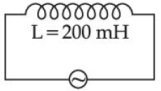
\(f =50 Hz\)\(X _{ L }=2 \pi fL\)
\(=2 \pi(50)\left(200 \times 10^{-3}\right)\)
\(=20 \pi \Omega\)
\(i _{0}=\frac{ V _{0}}{ X _{ L }} \Rightarrow \frac{ V _{ rms } \sqrt{2}}{ X _{ L }}\)
\(=\frac{(220) \sqrt{2}}{20 \pi}=\frac{11 \sqrt{2}}{\pi}\)
\(i _{ o }=\frac{\sqrt{242}}{\pi}\)
-
- (A) \((a)\) and \((d)\) only
- (B) \((b)\) and \((d)\) only
- (C) \((a)\) and \((c)\) only
- (D) \((b)\) and \((c)\) only
Show answer and solution
Correct Answer: (C)
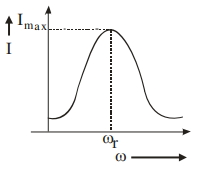
\(\text { at } \omega_{r}, X_{C}=X_{L}\)\(\Rightarrow \frac{1}{\omega_{r} C}=\omega_{r} L\)
So if \(\omega < \omega_{r}\) then \(X_{C}\) will increase and \(X_{L}\) will decrease.
Hence to left of \(\omega_{t}\) circuit is capacitive
\(Z=\sqrt{R^{2}+\left(X_{C}-X_{L}\right)^{2}}\)
at \(\omega_{r}, Z =\sqrt{ R ^{2}+ O ^{2}}= R ( C )\)
-
- (A) Both Statement \(I\) and Statement \(II\) are true.
- (B) Both Statement \(I\) and Statement \(II\) are false.
- (C) Statement \(I\) is true but Statement \(I\) in false.
- (D) Statement \(I\) is false but Statement \(II\) is true.
Show answer and solution
Correct Answer: (C)
if \(R =0, P =0\) -
- (A) Purely Resistive circuit
- (B) Purely Inductive circuit
- (C) \(LCR\) series circuit
- (D) \(RC\) series circuit only
Show answer and solution
Correct Answer: (B)
Purely Inductive circuit\(\theta=\frac{\pi}{2}\)
\(\cos \frac{\pi}{2}=0\)
Average power \(=0\)
-
- (A) \(\frac{1}{2}\)
- (B) \(\frac{1}{\sqrt{2}}\)
- (C) \(\frac{\sqrt{3}}{\sqrt{2}}\)
- (D) \(2: 1\)
Show answer and solution
Correct Answer: (B)
In case of \(L-R\) circuit\(Z=\sqrt{ X _{ L }^{2}+ R ^{2}} \&\) power factor
\(P _{1}=\cos \phi=\frac{ R }{ Z }\)
\(\text { As } X _{ L }= R\)
\(\Rightarrow Z =\sqrt{2} R\)
\(\Rightarrow P _{1}=\frac{ R }{\sqrt{2} R } \Rightarrow P _{1}=\frac{1}{\sqrt{2}}\)
In case of \(L-C-R\) circuit
\(Z=\sqrt{R^{2}+\left(X_{L}-X_{C}\right)^{2}}\)
As \(X_{L}=X_{C}\)
\(\Rightarrow Z=R\)
\(\Rightarrow P _{2}=\cos \phi=\frac{ R }{ R }=1\)
\(\Rightarrow \frac{ P _{1}}{ P _{2}}=\frac{1}{\sqrt{2}}\)
-
- (A) \(27\)
- (B) \(89\)
- (C) \(55\)
- (D) \(22\)
Show answer and solution
Correct Answer: (D)
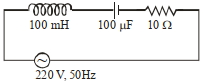
\(X _{ L }=\omega L =2 \pi \times 50 \times 10^{-1}=10 \pi\)\(X _{ X }=\frac{1}{\omega C }=\frac{1}{2 \pi \times 50} \times 10^{4}=\frac{100}{\pi}\)
\(R =10 \Omega\)
\(Z =\sqrt{\left(10 \pi-\frac{100}{\pi}\right)^{2}+10^{2}} \simeq 10 \Omega\)
\(i =\frac{ E }{2} \simeq \frac{220}{10} \simeq 22 Amp\)
-
- (A) \(0\)
- (B) \(1\)
- (C) \(2\)
- (D) \(7\)
Show answer and solution
Correct Answer: (A)
\(V _{ L }= V _{ C }=2 V _{ R }\)\(X _{ L }= X _{ C }=2 R\)
\(X _{ L }=10\,\Omega\)
\(\omega L =10\)
\(2 \pi f =10\)
\(L =\frac{10}{2 \pi f }=\frac{1}{10 \pi}\,H =\frac{1000}{10 \pi}\,mH\)
\(L =\frac{1}{\frac{1}{100} \pi} ; \quad K =\frac{1}{100}=0.01 \approx 0\)
-
- (A) \((A)-(II), B-(I), (C)-(IV), (D)-(III)\)
- (B) \((A)-(II), B-(I), (C)-(III), (D)-(IV)\)
- (C) \((A)-(III), B-(IV), (C)-(II), (D)-(I)\)
- (D) \((A)-(III), B-(I), (C)-(II), (D) -(IV)\)
Show answer and solution
Correct Answer: (A)
\(AC\) generator converts mechanical energy into electrical energy. Galvanometer shows deflection when current passes through it so it is used to show presence of current in any wire.Transformer is used to step up or step down the voltage. Metals detectors contain inductor coils and use principle of induction and resonance in \(AC\) circuit.
-
- (A) \(\frac{1}{60} \; s\)
- (B) \(60 \; s\)
- (C) \(\frac{1}{120} \; s\)
- (D) \(\frac{1}{240} \; s\)
Show answer and solution
Correct Answer: (D)
\(\omega=120 \pi=\frac{2 \pi}{T} \Rightarrow T=\frac{1}{60} sec\)time taken to reach peak value \(=\frac{T}{4}=\frac{1}{240} s\)
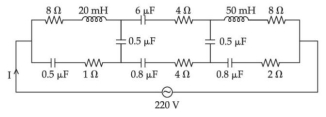
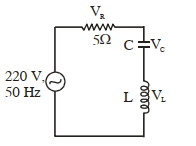
- 21. The effective current \(I\) in the given circuit at very high frequencies will be \(.......A\)
 2022 Hard
- (A) \(4\)
- (B) \(44\)
- (C) \(42\)
- (D) \(46\)
Show answer and solution
Correct Answer: (B)
At very high frequencies,\(X _{ C }=\frac{1}{\omega C } \approx 0\)
Also \(X _{ L }=\omega L \approx \infty\)
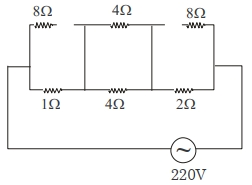
Thus, equivalent circuit can be redrawn as
\(Z =1+2+2=5 \Omega\)
\(I =\frac{220 V }{5 \Omega}=44 A\)
-
- (A) \(1.47 \sin \left(49 \pi t -30^{\circ}\right)\)
- (B) \(1.47 \sin \left(49 \pi t+60^{\circ}\right)\)
- (C) \(23.1 \sin \left(49 \pi t -30^{\circ}\right)\)
- (D) \(23.1 \sin \left(49 \pi t+60^{\circ}\right)\)
Show answer and solution
Correct Answer: (D)
\(v _{0}= i _{0} x _{ L }\)\(= i _{0}( wL )\)
\(=(5)(49 \pi)\left(30 \times 10^{-3}\right)\)
\(=23.1\)
Voltage will lead current by \(90^{\circ}\).
\(\therefore V =23.1 \sin \left(49 \pi t +60^{\circ}\right)\)
-
- (A) \(250\)
- (B) \(2489\)
- (C) \(254\)
- (D) \(552\)
Show answer and solution
Correct Answer: (A)
Band width \(=232-212=\frac{ R }{ L }\)\(\therefore L =\frac{5}{20}=250\,mH\)
-
- (A) \(5\)
- (B) \(50\)
- (C) \(100\)
- (D) \(200\)
Show answer and solution
Correct Answer: (B)
Current in capacitor \(I =\frac{ V }{ X _{ C }}\)\(I =( V ) \times(\omega C )\)
\(C =\frac{ I }{ V \omega}=\frac{6.9 \times 10^{-6}}{230 \times 600}=50 pF\)
-
- (A) Source frequency should be increased
- (B) Another resistance should be added in series with the first resistance.
- (C) Another capacitor should be added in series with the first capacitor
- (D) Another capacitor should be added in series with the first capacitor
Show answer and solution
Correct Answer: (C)
\(f =\frac{1}{2 \pi \sqrt{ LC }}\)To increase the resonating frequency product of \(L\) and \(C\) should decrease.
By joining capacitor in series, capacitor will decrease
-
- (A) \(2\)
- (B) \(3\)
- (C) \(1\)
- (D) \(8\)
Show answer and solution
Correct Answer: (B)
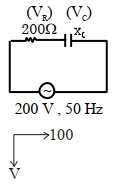
\(P =\frac{ V ^{2}}{ R } \Rightarrow R =\frac{ V ^{2}}{ P }\)\(R =\frac{100 \times 10^{2}}{50}= R =200 \Omega\)
\(V _{ R }^{2}+ V _{ C }^{2}= V ^{2}\)
\((100)^{2}+ V _{ C }^{2}=(200)^{2}\)
\(i =\frac{100}{200}=\frac{1}{2} ;\)
\(V = I \times X _{ C }\)
\(V _{ C }=100 \sqrt{3}\)
\(X C _{ C }=200 \sqrt{3}\)
\(200 \sqrt{3}=\frac{1}{\omega C }\)
\(C =\frac{ V ^{2}=40000}{20 \times 50 \times 20 \sqrt{3}}=\frac{ V _{ C }^{2}=30000}{\sqrt{ x }}\)
\(\sqrt{ x }=50 \times 10^{-6} \times 100 \times 200 \sqrt{3}\)
\(X =3\)
- 27. When you walk through a metal detector carrying a metal object in your pocket, it raises an alarm. This phenomenon works on 2022 Medium
- (A) Electromagnetic induction
- (B) Resonance in \(ac\) circuits
- (C) Mutual induction in \(ac\) circuits
- (D) interference of electromagnetic waves
Show answer and solution
Correct Answer: (B)
Metal detector works on the principle of transmitting an electromagnetic signal and analyses a return signal from the target. So it works on the principle of resonance in \(AC\) circuit.
No questions on this page match these filters.