


All JEE Mains 2022 Physics questions
32 chaptersShowing 351–400 of 597 questions
-
- (A) \(1\)
- (B) \(5\)
- (C) \(10\)
- (D) \(0.5\)
Show answer and solution
Correct Answer: (D)
Distance travelled by particle before stopping\(\frac{ V ^{2}}{2 a }= S \Rightarrow \frac{ v ^{2} m }{2 qE }\)
\(\Rightarrow \frac{(200)^{2} \times 100 \times 10^{-6}}{2 \times 40 \times 10^{-6} \times 10^{5}}=0.5 \,m\)
-
- (A) \(\frac{\rho_{0} r}{4 \varepsilon_{0}}\left(\frac{3}{4}-\frac{r}{R}\right)\)
- (B) \(\frac{\rho_{0} r}{3 \varepsilon_{0}}\left(\frac{3}{4}-\frac{r}{R}\right)\)
- (C) \(\frac{\rho_{0} r}{4 \varepsilon_{0}}\left(1-\frac{r}{R}\right)\)
- (D) \(\frac{\rho_{0} r}{5 \varepsilon_{0}}\left(1-\frac{r}{R}\right)\)
Show answer and solution
Correct Answer: (C)
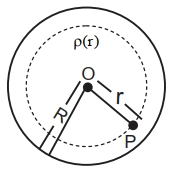
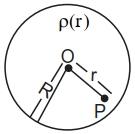
\(\oint \overrightarrow{ E } \cdot d \overrightarrow{ s }=\frac{ Q _{\text {in }}}{\varepsilon_{ o }}\)\(E .4 \pi r ^{2}=\frac{\int_{0}^{ r } \rho_{ o }\left(\frac{3}{4}-\frac{ r }{ R }\right) 4 \pi r ^{2} dr }{\varepsilon_{0}}\)
\(E 4 \pi r ^{2}=\frac{\rho_{ o } 4 \pi}{\varepsilon_{ o }}\left(\frac{3}{4} \frac{ r ^{3}}{3}-\frac{ r ^{4}}{4 R }\right)\)
\(Er { }^{2}=\frac{\rho_{ o } r ^{3}}{4 \varepsilon_{ o }}\left\{1-\frac{ r }{ R }\right\}\)
\(E =\frac{\rho_{0} r }{4 \varepsilon_{ o }}\left\{1-\frac{ r }{ R }\right\}\)
-
- (A) \(\tan ^{-1} (4)\)
- (B) \(\tan ^{-1}(2)\)
- (C) \(\tan ^{-1}\left(\frac{1}{3}\right)\)
- (D) \(\tan ^{-1} (3)\)
Show answer and solution
Correct Answer: (B)
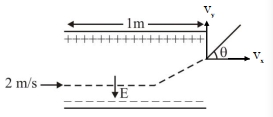
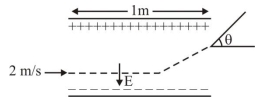
\(a _{ y }=\frac{ F _{ y }}{ m }=\frac{ e ( E )}{ m }=\frac{ e \left(\frac{8\,m }{ e }\right)}{ m }=8\,m / s ^{2}\)\(s _{ x }= u _{ x } t\)
\(1=2 \times t\)
\(t =\frac{1}{2} sec\)
\(v _{ y }= u _{ y }+ a _{ y } t\)
\(v _{ y }=0+8 \times \frac{1}{2}\)
\(v _{ y }=4\,m / s\)
\(\tan \theta=\frac{ v _{ y }}{ v _{ x }}=\frac{4}{2}=2 \Rightarrow \theta=\tan ^{-1}(2)\)
-
- (A) \(1.6 \times 10^{-9} C\)
- (B) \(2.0 \times 10^{-9} C\)
- (C) \(3.2 \times 10^{-9} C\)
- (D) \(0.5 \times 10^{-9} C\)
Show answer and solution
Correct Answer: (B)
\(Mg = qE\)\(\left(0.1 \times 10^{-3}\right)(9.8)=4.9 \times 10^{5} q\)
\(\frac{2 \times 10^{-4}}{10^{5}}= q\)
\(q=2 \times 10^{-9} C\)
-
- (A) Both statement \(-I\) and statement \(-I\) are true.
- (B) Both statement \(-I\) and statement \(-I\) are false.
- (C) Statement \(-I\) is true but statement \(-I\) is false.
- (D) Statement \(-I\) is false but statement \(-II\) is true.
Show answer and solution
Correct Answer: (C)
If the electric field is in the positive direction and the positive charge is to the left of that point then the electric field will increase. But to the left of the positive charge the electric field would decrease.If the dipole is kept at the point where the electric field is maximum then the force on it will be zero.
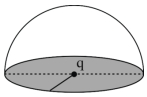
- 356. If a charge \(q\) is placed at the centre of a closed hemispherical non-conducting surface, the total flux passing through the flat surface would be
 2022 Medium
- (A) \(\frac{q}{\varepsilon_{0}}\)
- (B) \(\frac{q}{2 \varepsilon_{0}}\)
- (C) \(\frac{q}{4 \varepsilon_{0}}\)
- (D) \(\frac{ q }{2 \pi \varepsilon_{0}}\)
Show answer and solution
Correct Answer: (B)
Total flux through complete spherical surface is \(\frac{ q }{\varepsilon_{0}}\)So the flux through curved surface will be \(\frac{q}{2 \varepsilon_{0}}\). The flux through flat surface will be zero.
Remark : Electric flux through flat surface is zero but no option is given, option is available for electric flux passing through curved surface.
-
- (A) \(E _{1}=\sigma / \varepsilon_{0}, E _{2}=\sigma / 2 \varepsilon_{0}\)
- (B) \(E _{1}=2 \sigma / \varepsilon_{0}, E _{2}=\sigma / \varepsilon_{0}\)
- (C) \(E _{1}= E _{2}=\sigma / 2 \varepsilon_{0}\)
- (D) \(E _{1}= E _{2}=\sigma / \varepsilon_{0}\)
Show answer and solution
Correct Answer: (C)
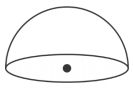
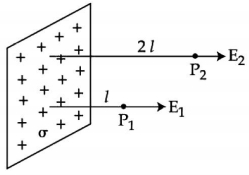
As the sheet is very large \(\overrightarrow{ E }\) is independent of distance from it.Thus \(E _{1}= E _{2}=\frac{\sigma}{2 \varepsilon_{0}}\)
-
- (A) \(\frac{ q }{4 \pi \epsilon_{0} a ^{2}}\left(\frac{1}{\sqrt{2}}+\frac{1}{2}\right)\)
- (B) \(\frac{ q }{4 \pi \in_{0} a ^{2}}\left(1+\frac{1}{\sqrt{2}}\right)\)
- (C) \(\frac{ q }{4 \pi \epsilon_{0} a ^{2}}\left(1-\frac{1}{\sqrt{2}}\right)\)
- (D) \(\frac{ q }{4 \pi \in_{0} a ^{2}}\left(\frac{1}{\sqrt{2}}-\frac{1}{2}\right)\)
Show answer and solution
Correct Answer: (A)
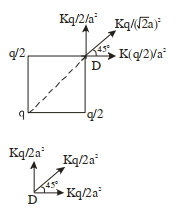
\(\left( E _{\text {ner }}\right)_{D}=\frac{ kq }{2 a ^{2}}+\frac{\sqrt{2 kq }}{2 a ^{2}}\)\(\left( E _{\text {ner }}\right)_{ D }=\frac{ kq }{ a ^{2}}\left(\frac{1}{2}+\frac{1}{\sqrt{2}}\right)\)
\(\left( E _{\text {net }}\right)_{ D }=\frac{ q }{4 \pi \epsilon_{0} a ^{2}}\left(\frac{1}{2}+\frac{1}{\sqrt{2}}\right)\)
-
- (A) \(44\)
- (B) \(43\)
- (C) \(45\)
- (D) \(42\)
Show answer and solution
Correct Answer: (C)
No. of electric field lines per unit area \(=\) electric field.\(E =\frac{\rho r}{3 \epsilon_{0}}, \text { for } r=R\)
\(E=\frac{\rho R}{3 \epsilon_{0}}=\frac{2 \times 6}{3 \times 8.85 \times 10^{-12}}=0.45 \times 10^{12}\,NC ^{-1}\)
\(=45 \times 10^{10}\,N / C\)
-
- (A) \(1: 1\)
- (B) \(1: 4\)
- (C) \(\sqrt{3}: 2\)
- (D) \(\sqrt{3}: 1\)
Show answer and solution
Correct Answer: (D)
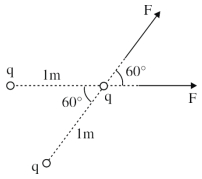
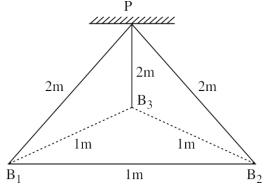
\(F=\frac{k(2)(2)}{(1)^{2}}\)( \(F=\) Force between two charges).
\(F =4 k\)
\(F_{\text {net }}=2 F \cos 30^{\circ}=2 \cdot F \cdot \frac{\sqrt{3}}{2}=F \sqrt{3}\)
\(\left(F_{\text {net }}=\right.\) Net electrostatic force on one charged ball)
\(\frac{F_{\text {net }}}{F}=\frac{\sqrt{3} F}{F}=(\sqrt{3})\)
Remark : Net force on any one of the ball is zero. But no option given in options.
-
- (A) \(177\)
- (B) \(12\)
- (C) \(17\)
- (D) \(29\)
Show answer and solution
Correct Answer: (C)
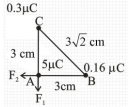
\(F _{1}=\frac{ k \times 5 \times 0.3 \times 10^{-12}}{9 \times 10^{-4}}\)\(=\frac{9 \times 10^{9} \times 5 \times 0.3 \times 10^{-12}}{9 \times 10^{-4}}\)
\(=1.5 \times 10=15\,N\)
\(F _{2}=\frac{9 \times 10^{9} \times 5 \times 0.16 \times 10^{-12}}{9 \times 10^{-4}}=8\,N\)
force experienced by charge at \(A =\sqrt{ F _{1}^{2}+ F _{2}^{2}}\)
\(=\sqrt{15^{2}+8^{2}}\)
\(=\sqrt{289}=17\,N\)
-
- (A) \(6\)
- (B) \(9\)
- (C) \(61\)
- (D) \(3\)
Show answer and solution
Correct Answer: (A)
\(|\tau|_{\max }= PE\)\(\frac{\tau_{1}}{\tau_{2}}=\frac{ P _{1} E _{1}}{ P _{2} E _{2}}=\frac{1 \cdot 2 \times 10^{-30} \times 5 \times 10^{4}}{2 \cdot 4 \times 10^{-30} \times 15 \times 10^{4}}\)
\(=\frac{1}{6}\)
Hence \(x=6\)
-
- (A) \(12\)
- (B) \(10\)
- (C) \(8\)
- (D) \(5\)
Show answer and solution
Correct Answer: (A)
\(\frac{ kq ^{2}}{ L ^{2}}=\mu mg \Rightarrow L =\sqrt{\frac{ k }{\mu mg } q }\) -
- (A) \(3\,F / 2\)
- (B) \(3\,F / 4\)
- (C) \(F\)
- (D) \(2\,F\)
Show answer and solution
Correct Answer: (B)
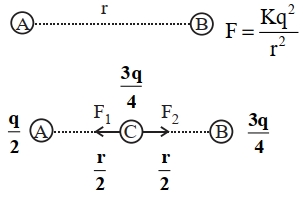
Let \(q _{ A }= q _{ B }= q\)When \(C\) is placed in contact with \(A\), charge on \(A\) and \( C\) will be \(=\frac{ q }{2}\)
Now \(C\) is placed in contact with \(B\), charge on \(B\) and \(C\) will be \(=\frac{q+\frac{q}{2}}{2}=\frac{3 q}{4}\)
\(F ^{\prime}= F _{2}- F _{1}=\frac{\left( K \frac{3 q }{4}- K \frac{ q }{2}\right)}{\frac{ r ^{2}}{4}} \cdot \frac{3 q }{4}\)
\(=\frac{3 Kq ^{2}}{4 r ^{2}}=\frac{3 F }{4}\)
-
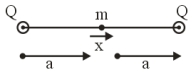
- (A) \(\sqrt{\frac{4 \pi^{3} \varepsilon_{0} m a^{3}}{q_{0} Q}}\)
- (B) \(\sqrt{\frac{q_{0} Q}{4 \pi^{3} \varepsilon_{0} m a^{3}}}\)
- (C) \(\sqrt{\frac{2 \pi^{2} \varepsilon_{0} m a^{3}}{q_{0} Q}}\)
- (D) \(\sqrt{\frac{8 \pi^{3} \varepsilon_{0} m \alpha^{3}}{q_{0} Q}}\)
Show answer and solution
Correct Answer: (A)
\(m \operatorname{acc}^{ n }=\frac{ KQq _{0}[2 a ][2 x ]}{\left( a ^{2}- x ^{2}\right)^{2}}\)\(\Rightarrow \operatorname{acc}^{ n } \approx\left(\frac{4 kQq _{0}}{ ma ^{3}}\right) x\)
\(T =2 \pi \sqrt{\frac{\pi \varepsilon_{0} ma ^{3}}{ Qq _{0}}}\)
\(T =\sqrt{\frac{4 \pi^{3} \varepsilon_{0} ma ^{3}}{ Qq _{0}}}\)
-
- (A) \(2.0\)
- (B) \(3.0\)
- (C) \(1.0\)
- (D) \(4.0\)
Show answer and solution
Correct Answer: (B)
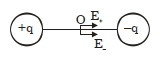
\(E _{0}=2 \times \frac{ Kq }{( d / 2)^{2}}\)\(\Rightarrow E _{0}=8 \frac{ Kq }{ d ^{2}}\)
\(\Rightarrow d ^{2}=\frac{8 \times 9 \times 10^{9} \times 8 \times 10^{-6}}{6.4 \times 10^{4}}\)
\(d =3\,m\)
-
- (A) \(x=d\)
- (B) \(x=\frac{d}{2}\)
- (C) \(x=\frac{d}{\sqrt{2}}\)
- (D) \(x=\frac{d}{2 \sqrt{2}}\)
Show answer and solution
Correct Answer: (D)
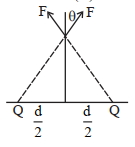
\(F =\frac{ KQq }{\left( x ^{2}+\frac{ d ^{2}}{4}\right)}\)Net force on \(g =2 F \cos \theta\)
\(F _{\text {act }}=\frac{2 KQqx }{\left( x ^{2}+\frac{ d ^{2}}{4}\right)^{3 / 2}}\)
For maximum \(F _{\text {act }}\)
\(\frac{ d F _{\text {net }}}{ dx }=0\)
we get \(x=\frac{d}{2 \sqrt{2}}\)
-
- (A) \(2 \pi\)
- (B) \(5 \pi\)
- (C) \(\pi\)
- (D) \(\frac{5 \pi}{2}\)
Show answer and solution
Correct Answer: (B)
\(V _{ P } \max =4 V _{\text {wave }}\)\(\omega A =4\left(\frac{\omega}{ k }\right) \Rightarrow A =\frac{4 \lambda}{2 \pi}\)
\(\lambda=\frac{2 \pi A }{4} \Rightarrow \frac{20 \pi}{4} \Rightarrow 5 \pi\)
-
- (A) \(151\)
- (B) \(152\)
- (C) \(153\)
- (D) \(154\)
Show answer and solution
Correct Answer: (B)
\(f_{1}= f\)\(f _{2}= f +4\)
\(f _{3}= f +2 \times 4\)
\(f _{4}= f +3 \times 4\)
\(f _{20}= f +19 \times 4\)
\(f +(19 \times 4)=2 \times f\)
\(f =76 \; Hz\)
Frequency of last tuning forks \(=2 \; f\)
\(=152 \; Hz\)
-
- (A) \(4 \pi\)
- (B) \(2 \pi\)
- (C) \(\pi\)
- (D) \(2\)
Show answer and solution
Correct Answer: (A)
\(y=2 \sin (\omega t-k x)\)Maximum particle velocity \(= A \omega\)
Wave velocity \(=\frac{\omega}{ k }\)
\(\frac{\omega}{ k }= A \omega\)
\(k =\frac{1}{ A }=\frac{2 \pi}{\lambda}\)
\(\lambda =2 \pi A\)
\(=4 \pi\,cm\)
-
- (A) \(48\)
- (B) \(49\)
- (C) \(50\)
- (D) \(54\)
Show answer and solution
Correct Answer: (C)
Assumption : Ignore word "fundamental mode" in question.\(\lambda=\frac{ V }{ f }=\frac{340}{340}=1\,m\)
First resonating length \(=\frac{\lambda}{4}=25\,cm\)
Second resonating length \(=\frac{3 \lambda}{4}=75\,cm\)
Third resonating length \(=\frac{5 \lambda}{4}=125\,cm\)
Height of water required \(=125-75=50\,cm\)
-
- (A) \(1.5\)
- (B) \(6\)
- (C) \(9\)
- (D) \(3\)
Show answer and solution
Correct Answer: (D)
\(\frac{ nv }{0.6}=400 \& \frac{( n +1) v }{0.6}=450\)\(\left[\frac{0.6 \times 400}{ v }+1\right] \frac{ v }{0.6}=450\)
\(= v =30\)
\(\sqrt{\frac{ T }{\mu}}=30\)
\(\frac{2700}{\mu}=900=\mu=3\)
-
- (A) \(19\)
- (B) \(200\)
- (C) \(20\)
- (D) \(2\)
Show answer and solution
Correct Answer: (C)
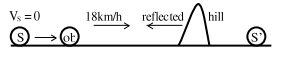
\(V_{S}=0, V_{o b}=5 m / s\)\(f _{\text {direct }}=\left(\frac{320-5}{320}\right) 640=630 Hz\)
\(f _{\text {reflected }}=\left(\frac{320+5}{320}\right) 640=650 Hz\)
\(f _{\text {beat }}=650-630=20 Hz\)
-
- (A) \(20\)
- (B) \(10\)
- (C) \(5\)
- (D) \(0\)
Show answer and solution
Correct Answer: (A)
\(f_{0}=\left(\frac{v+v_{0}}{v}\right) f_{s}\)\(f_{0}=\left(\frac{v+\frac{v}{5}}{v}\right) f_{s}\)
\(f_{0}=\frac{6}{5} f_{s}\)
\(\%\) change \(=\frac{f_{0}-f_{s}}{f_{s}} \times 100\)
\(=\frac{1}{5} \times 100=20 \%\)
-
- (A) \(103\)
- (B) \(100\)
- (C) \(110\)
- (D) \(104\)
Show answer and solution
Correct Answer: (D)
For first resonance\(\ell_{1}+ e =\frac{\lambda}{4}\)
\(\lambda=\frac{336}{400} \times 100 \,cm =84 \,cm \Rightarrow \frac{\lambda}{4}=21 \,cm\)
\(e =21-20=1 \,cm\)
For third resonance
\(\ell_{3}+ e =\frac{5 \lambda}{4}=105 \,cm \Rightarrow \ell_{3}=104 \,cm\)
- 376. In the wave equation \(y =0.5 \sin \frac{2 \pi}{\lambda}(400 t - x )\,m\) the velocity of the wave will be ......... \(m / s\) 2022 Easy
- (A) \(200\)
- (B) \(200 \sqrt{2}\)
- (C) \(400\)
- (D) \(400 \sqrt{2}\)
Show answer and solution
Correct Answer: (C)
\(y =0.5 \sin \left(\frac{2 \pi}{\lambda} 400 t -\frac{2 \pi}{\lambda} x \right)\)\(\omega=\frac{2 \pi}{\lambda} 400\)
\(K =\frac{2 \pi}{\lambda}\)
\(v =\frac{\omega}{ k } \quad[ v =400\,m / s ]\)
-
- (A) \(2\)
- (B) \(4\)
- (C) \(5.8\)
- (D) \(8\)
Show answer and solution
Correct Answer: (A)
\(A_{1}=5 \quad A_{2}=3\)\(\Delta \theta=2 \pi(1.5)=3 \pi\)
\(A_{\text {net }}=\sqrt{A_{1}^{2}+A_{2}^{2}+2 A_{1} A_{2} \cos (3 \pi)}\)
\(=\left| A _{1}- A _{2}\right|\)
\(=2 \,cm\)
-
- (A) \(90\)
- (B) \(88\)
- (C) \(80\)
- (D) \(100\)
Show answer and solution
Correct Answer: (C)
\(f _{1}=\frac{2 v }{2 l _{1}}\)\(f _{2}=\frac{ v }{41_{2}}\)
\(f _{1}= f _{2}\)
\(=\frac{2 v }{2 l _{1}}=\frac{ v }{41_{2}}\)
\(1_{1}=41_{2}=80 \,cm\)
-
- (A) \(320\)
- (B) \(340\)
- (C) \(360\)
- (D) \(380\)
Show answer and solution
Correct Answer: (B)
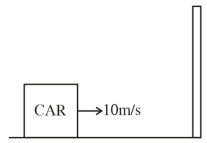
The hill will be a secondary source.\(f _{1}=\) frequency of the car w.r.t. the hill
\(f_{1}=\left(\frac{v}{v-v_{ s }}\right) f=\left(\frac{330}{320}\right) \times 320=330 Hz\)
\(f _{2}=\) Frequency of the sound reflected by hill w.r.t. the car \((echo)\)
\(f_{2}=\left(\frac{v+v_{0}}{v}\right) f_{1}=\frac{(330+10)}{330} \times 330=340\,Hz\)
-
- (A) \(10\)
- (B) \(15\)
- (C) \(13\)
- (D) \(14\)
Show answer and solution
Correct Answer: (B)
Explanation:
Let us calculate the extension of the wire step-by-step by combining wave mechanics and elasticity principles:
1. Calculate the Linear Mass Density (\( \mu \)):
Linear mass density represents the mass per unit length of the string:
\( \text{Mass } (m) = 10\text{ g} = 10 \times 10^{-3}\text{ kg} = 0.01\text{ kg} \)
\( \text{Length } (L) = 50\text{ cm} = 0.5\text{ m} \)
\( \mu = \frac{m}{L} = \frac{10 \times 10^{-3}\text{ kg}}{0.5\text{ m}} = 0.02\text{ kg/m} \)
2. Determine the Tension (\( T \)) using Wave Speed:
The velocity of a transverse wave traveling along a stretched string is governed by the equation:
\( v = \sqrt{\frac{T}{\mu}} \)
Squaring both sides and solving for tension \( T \) gives:
\( v^2 = \frac{T}{\mu} \implies T = v^2 \times \mu \)
Substituting the given speed \( v = 60\text{ ms}^{-1} \):
\( T = (60)^2 \times 0.02 = 3600 \times 0.02 = 72\text{ N} \)
3. Calculate the Longitudinal Extension (\( \Delta l \)):
From Hooke's Law and the definition of Young's Modulus (\( Y \)):
\( Y = \frac{\text{Stress}}{\text{Strain}} = \frac{T / A}{\Delta l / L} \implies \Delta l = \frac{T L}{A Y} \)
Convert the cross-sectional area to standard SI units:
\( A = 2.0\text{ mm}^2 = 2.0 \times 10^{-6}\text{ m}^2 \)
Substituting the parameters into the elongation formula yields:
\( \Delta l = \frac{72 \times 0.5}{2.0 \times 10^{-6} \times 1.2 \times 10^{11}} \)
\( \Delta l = \frac{36}{2.4 \times 10^5} = 15 \times 10^{-5}\text{ m} \)
Comparing this with the format \( x \times 10^{-5}\text{ m} \) given in the problem statement confirms that \( x = 15 \).
Hence, Option B is the correct choice. -
- (A) \(282 .8\)
- (B) \(175.5\)
- (C) \(353.6\)
- (D) \(707.2\)
Show answer and solution
Correct Answer: (D)
\(f_{b}=f_{1}-f_{2}\)\(\frac{v}{4.08}-\frac{v}{4.16}=\frac{40}{12}\)
\(\Rightarrow v =707.2\)
-
- (A) \(4\)
- (B) \(9\)
- (C) \(6\)
- (D) \(5\)
Show answer and solution
Correct Answer: (D)
\(10 \cos \left(\frac{4 \pi}{3}\right)\) -
- (A) \(202\)
- (B) \(2000\)
- (C) \(20\)
- (D) \(200\)
Show answer and solution
Correct Answer: (D)
\(f_{1}=100=f_{0}\left(\frac{C}{C-V_{5}}\right)\)\(C =\) speed of sound
\(V_{S}=\) speed of source
\(f_{2}=50=f_{0}\left(\frac{C}{C+V_{5}}\right)\)
\(\frac{f_{1}}{f_{2}}=2=\frac{C+V_{5}}{C-V_{5}}\)
\(2 C -2 V _{ s }= C + V _{ s }\)
\(3 V _{ s }= C\)
\(V _{ S }=\frac{ C }{3}\)
\(100= f _{0} \frac{ C }{\frac{2 C }{3}}=\frac{3}{2} f _{0}\)
\(f _{0}=\frac{200}{3}\)
-
- (A) \(900\)
- (B) \(800\)
- (C) \(100\)
- (D) \(700\)
Show answer and solution
Correct Answer: (D)
\(A =10 \,cm\)\(\therefore\) Total Energy \(=\frac{1}{2} KA ^{2}\)
By energy conservation we can final \(v\) at \(x =5\)
\(\frac{1}{2} K (10)^{2}=\frac{1}{2} K (5)^{2}+\frac{1}{2} mv ^{2}\)
\(V =\sqrt{\frac{75 K }{ m }}\)
Now, velocity is tripled through external mean so the amplitude of \(SHM\) will charge and so the total energy, (but potential) energy at this moment will remain same)
\(\therefore \frac{1}{2} K (5)^{2}+\frac{1}{2} m \left(3 \sqrt{\frac{75 K }{ m }}\right)^{2}=\frac{1}{2} KA ^{2}\)
\(\Rightarrow 25 K +675 K = KA ^{2}\)
\(\therefore A =\sqrt{700}\)
\(\therefore x =700\)
-
- (A) \(18\)
- (B) \(8\)
- (C) \(16\)
- (D) \(32\)
Show answer and solution
Correct Answer: (C)
\(\frac{1}{2} kA ^{2}=\frac{ p ^{2}}{2\,m }\)\(\Rightarrow\left(\frac{ A _{1}}{ A _{2}}\right)^{2}=\frac{ m _{2}}{ m _{1}}=\frac{1024}{900}\)
\(\Rightarrow \frac{ A _{1}}{ A _{2}}=\frac{32}{30}=\frac{16}{15}=\frac{16}{16-1}\)
\(\therefore \alpha=16\)
-
- (A) \(3\)
- (B) \(5\)
- (C) \(1\)
- (D) \(2\)
Show answer and solution
Correct Answer: (C)
\(t =\frac{\Delta \phi}{\omega}=\frac{\pi / 2-\pi / 6}{2 \pi / 6}=\frac{\pi / 3}{\pi / 3}=1 \,sec\) -
- (A) \(5\)
- (B) \(1\)
- (C) \(2\)
- (D) \(7\)
Show answer and solution
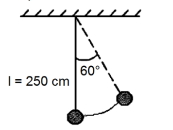
Correct Answer: (A)
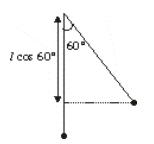
\(V _{\max }=\sqrt{2 gh }\)The speed will be highest at the lowest position.
\(h =\left(\ell-\ell \cos 60^{\circ}\right)=\frac{\ell}{2}\)
\(V _{\max }=\sqrt{2 \times g \times \frac{\ell}{2}}=\sqrt{10 \times 2.5}=5\,m / s\)
-
- (A) \(20\)
- (B) \(1\)
- (C) \(22\)
- (D) \(2\)
Show answer and solution
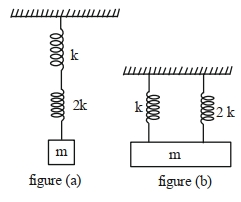
Correct Answer: (D)
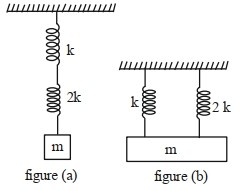
For figure \((a):\)\(K _{\text {oq }}=\frac{ K \times 2 K }{ K +2 K }=\frac{2 K }{3}\)
\(T =2 \pi \sqrt{\frac{ m }{ K _{ eq }}}=2 \pi \sqrt{\frac{ m }{2 K / 3}}=2 \pi \sqrt{\frac{3 m }{2 K }}\)
For figure \((b):\)
\(K _{ eq }=3 K , T ^{\prime}=2 \pi \sqrt{\frac{ m }{3 K }}\)
\(\frac{ T ^{\prime}}{ T }=\sqrt{\frac{ m \times 2 K }{3 K \times 3 m }}=\frac{\sqrt{2}}{3}\)
\(T ^{\prime}=\sqrt{2}\)
\(x =2\)
-
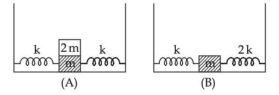
- (A) \(\frac{T_{1}}{T_{2}}=\frac{3}{\sqrt{2}}\)
- (B) \(\frac{ T _{1}}{ T _{2}}=\sqrt{\frac{3}{2}}\)
- (C) \(\frac{ T _{1}}{ T _{2}}=\sqrt{\frac{2}{3}}\)
- (D) \(\frac{ T _{1}}{ T _{2}}=\frac{\sqrt{2}}{3}\)
Show answer and solution
Correct Answer: (A)
\(T _{1}=2 \pi \sqrt{\frac{3 m }{2 k }}\)\(T _{2}=2 \pi \sqrt{\frac{ m }{3 k }}\)
\(\frac{ T _{1}}{ T _{2}}=\frac{2 \pi \sqrt{\frac{3 m }{2 k }}}{2 \pi \sqrt{\frac{ m }{3 k }}}=\frac{3}{\sqrt{2}}\)
-
- (A) \(6\)
- (B) \(8\)
- (C) \(12\)
- (D) \(36\)
Show answer and solution
Correct Answer: (D)
\(X=A \sin \omega t\left(t=3, X=\frac{A}{2}\right)\)\(\Rightarrow \frac{A}{2}=A \sin 3 \omega\)
\(\Rightarrow \sin 3 \omega=\frac{1}{2}\)
\(\Rightarrow 3 \omega=\frac{\pi}{6}\)
\(\Rightarrow \omega=\frac{\pi}{18}=\frac{2 \pi}{T}\)
\(\Rightarrow T=36 \; s\)
-
- (A) \(0\)
- (B) \(157\)
- (C) \(272\)
- (D) \(314\)
Show answer and solution
Correct Answer: (B)
\(x =\sin \pi\left( t +\frac{1}{3}\right)\)\(x =\sin \left(\pi t +\frac{\pi}{3}\right)\)
\(V =\frac{ dx }{ dt }=\cos \left(\pi t +\frac{\pi}{3}\right) \pi\)
\(=-\pi \times \frac{1}{2}=157 \,cm / s\)
-
- (A) \(4\)
- (B) \(5\)
- (C) \(3\)
- (D) \(0\)
Show answer and solution
Correct Answer: (B)
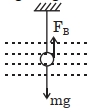
\(g^{\prime}=\frac{m g-F_{B}}{m}\)\(=\frac{\rho_{B} V g-\rho_{\pi} V g}{\rho_{B} V}\)
\(=\left(\frac{\rho_{B}-\rho_{\pi}}{\rho_{B}}\right) g \quad T=2 \pi \sqrt{\frac{\ell}{g}}\)
\(=\frac{5-1}{5} \times g\)
\(=\frac{4}{5} g\)
\(\frac{T^{\prime}}{T^{\prime}}=\sqrt{\frac{g}{g^{\prime}}}=\sqrt{\frac{g}{5} g}=\sqrt{\frac{5}{4}}\)
\(T^{\prime}=T \sqrt{\frac{5}{4}}=\frac{10}{2} \sqrt{5}\)
\(T^{\prime}=5 \sqrt{5}\)
-
- (A) \(97.23\)
- (B) \(25.3\)
- (C) \(99.4\)
- (D) \(406.1\)
Show answer and solution
Correct Answer: (C)
\(\omega=\sqrt{\frac{ g }{\ell}}=\pi\)\(\frac{ g }{\ell}=\pi^{2} \Rightarrow \ell=\frac{ g }{\pi^{2}}\)
\(\ell=\frac{980}{\pi^{2}} \approx 99.4 \,cm\)
-
- (A) \(2\)
- (B) \(3\)
- (C) \(4\)
- (D) \(5\)
Show answer and solution
Correct Answer: (A)
\(U =4(1-\cos 4 x )\)\(F =-\frac{ dU }{ dx }=-4(+\sin 4 x ) 4=-16 \sin (4 x )\)
For small \(\theta\)
\(\sin \theta \approx \theta\)
\(F=-64\,x\)
\(a=-64\,x / m=-16\,x\)
\(\omega^{2}=16\)
\(T =\frac{2 \pi}{\omega}=\frac{\pi}{2}\)
-
- (A) \(\sqrt{\frac{6}{5}} T\)
- (B) \(\sqrt{\frac{5}{6}} T\)
- (C) \(\sqrt{\frac{6}{7}} T\)
- (D) \(\sqrt{\frac{7}{6}} T\)
Show answer and solution
Correct Answer: (C)
\(T =2 \pi \sqrt{\frac{\ell}{ g _{\text {eff }}}}\)\((a)\) when \(a =0, T =2 \pi \sqrt{\frac{\ell}{ g }}\)
\((b)\) when \(a =\frac{ g }{6}, T ^{\prime}=2 \pi \sqrt{\frac{\ell}{ g +\frac{ g }{6}}}\)
\(\therefore T ^{\prime}=\sqrt{\frac{6}{7}} T\)

-
- (A) \(1: 2\)
- (B) \(3: 2\)
- (C) \(3: 1\)
- (D) \(2: 3\)
Show answer and solution
Correct Answer: (B)
\(V _{\max }=\omega A\)\(\Rightarrow \frac{ A _{1}}{ A _{2}}=\frac{\omega_{2}}{\omega_{1}}=\sqrt{\frac{9}{2} \times \frac{1}{2}}=\frac{3}{2}\)
-
- (A) \(55\)
- (B) \(56\)
- (C) \(60\)
- (D) \(53\)
Show answer and solution
Correct Answer: (C)
\(A _{\text {resultrant }}=\sqrt{ A _{1}^{2}+ A _{2}^{2}+2 A _{1} A _{2} \cos \phi}\)\(\sqrt{3} A =\sqrt{ A ^{2}+ A ^{2}+2 A ^{2} \cos \phi}\)
\(3 A ^{2}=2 A ^{2}+2 A ^{2} \cos \phi\)
\(\cos \phi=\frac{1}{2}\)
\(\therefore \phi=60^{\circ}\)
\(\therefore \text { Phase difference }=60 \text { degree }\)
- 398. When a particle executes simple Harmonic motion, the nature of graph of velocity as function of displacement will be. 2022 Medium
- (A) Circular
- (B) Ellipitical
- (C) Sinusoidal
- (D) Straight line
Show answer and solution
Correct Answer: (B)
For a particle in SHM, its speed depends on position as\(v=\omega \sqrt{A^{2}-x^{2}}\)
Where \(\omega\) is angular frequency and \(A\) is amplitude Now \(v ^{2}=\omega^{2} A ^{2}-\omega^{2} x ^{2}\)
So, \(\frac{ v ^{2}}{(\omega A )^{2}}+\frac{ x ^{2}}{( A )^{2}}=1\)
So graph between \(v\) and \(x\) is elliptical
-
- (A) \(12\)
- (B) \(18\)
- (C) \(17\)
- (D) \(122\)
Show answer and solution
Correct Answer: (A)
\(0.056 \,kg N N _{2}=56\, gm\) of \(N _{2}=2\, mole\) of \(N _{2}\)\(T _{1}=400\, K , v \alpha \sqrt{ T }\) so \(T _{2}=4 T _{1}=1600\, K\)
\(Q =\frac{ f }{2} nR \Delta T\)
\(f=5\)
\(Q =12 \,k \,cal\)
-
- (A) \(5810\)
- (B) \(3486\)
- (C) \(11620\)
- (D) \(6972\)
Show answer and solution
Correct Answer: (B)
For a quasi-static process the change in internal energy of an ideal gas is
\(\Delta U = nC _{ V } \Delta T\)
\(= n \times \frac{3 R }{2} \times \Delta T\)
[molar heat capacity at constant volume for mono atomic gas \(=\frac{3 R}{2}\) ]
\(\Delta U =7 \times \frac{3}{2} \times 8.3 \times 40=3486\,J\)

No questions on this page match these filters.