


All JEE Mains 2022 Physics questions
32 chaptersShowing 201–250 of 597 questions
-
- (A) \(50\)
- (B) \(8\)
- (C) \(5\)
- (D) \(88\)
Show answer and solution
Correct Answer: (C)
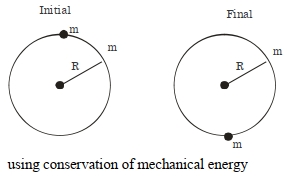
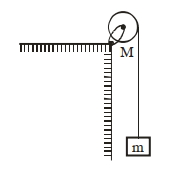
\(mg 2 R =\frac{1}{2} I _{\text {disc }} \omega^{2}+\frac{1}{2} I _{\text {particle }} \omega^{2}\)\(mg 2 R =\frac{\omega^{2}}{2}\left[\frac{ mR ^{2}}{2}+ mR ^{2}\right]\)
\(mg 2 R =\frac{\omega^{2}}{2} \frac{3}{2} mR ^{2}\)
\(\frac{3}{4} \omega^{2}=\frac{2 g }{ R }\)
\(\omega^{2}=\frac{8 g }{3 R }\)
\(\omega=\sqrt{\frac{80}{3 R}}\)
\(16 \frac{ x }{3 R }=\frac{80}{3 R }\)
\(x =5\)
-
- (A) \(9\)
- (B) \(6\)
- (C) \(60\)
- (D) \(7\)
Show answer and solution
Correct Answer: (B)
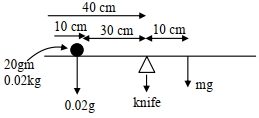
Let mass of meter scale be \(m\).Balancing torque about knife edge
\((0.02 \;g ) \times\left(30 \times 10^{-2}\right)= mg \times\left(10 \times 10^{-2}\right)\)
\(m =0.06\; kg =6 \times 10^{-2} \;kg\)
-
- (A) \(18 \)
- (B) \(9\)
- (C) \(3\)
- (D) \(6\)
Show answer and solution
Correct Answer: (A)
\(\tau= I \alpha \Rightarrow\left(12 t -3 t ^{2}\right) 1.5=4.5 \alpha\)\(\alpha=4 t - t ^{2}\)
\(\frac{ d \omega}{ dt }=4 t - t ^{2} \Rightarrow \omega=\int_{0}^{ t }\left(4 t - t ^{2}\right) dt\)
\(\omega=2 t ^{2}- t ^{3} / 3\)
For \(\omega=0=2 t^{2}-\frac{t^{3}}{3} \Rightarrow t^{2}\left(2-\frac{t}{3}\right)=0\)
\(t=0,6\)
\(\frac{d \theta}{d t}=2 t^{2}-\frac{t^{3}}{3} \Rightarrow \theta=\int_{0}^{6}\left(2 t^{2}-\frac{t^{3}}{3}\right) d t\)
\(=\left[\frac{2 t^{3}}{3}-\frac{t^{4}}{12}\right]_{0}^{6}\)
\(=6^{3}\left(\frac{2}{3}-\frac{6}{12}\right)=6^{3}\left(\frac{8-6}{12}\right)\)
\(=\frac{6^{3}}{6}=36\)
\(\therefore K =18\)
-
- (A) \(5\)
- (B) \(6\)
- (C) \(1\)
- (D) \(3\)
Show answer and solution
Correct Answer: (D)
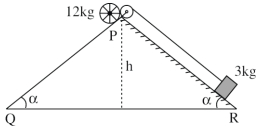
Net loss in \(PE =\) Gain in \(KE\)\(12 gh -3 gh =\frac{1}{2} 3 v ^{2}+\frac{1}{2} 12 v ^{2}+\frac{1}{2}\left[12 r ^{2}\right]\left(\frac{ v }{ r }\right)^{2}\)
\(9 gh =\frac{1}{2}[3+12+12] v ^{2}\)
\(v ^{2}=\frac{2 gh }{3} \Rightarrow v =\frac{1}{2} \sqrt{\frac{8}{3} gh }\)
\(x =\frac{8}{3} \simeq 3\)
-
- (A) \(\sqrt{\frac{5}{3}}\)
- (B) \(\sqrt{\frac{4}{5}}\)
- (C) \(\sqrt{\frac{3}{5}}\)
- (D) \(\sqrt{\frac{14}{15}}\)
Show answer and solution
Correct Answer: (D)
\(V=\sqrt{\frac{2 g H}{1+ k ^{2} / R ^{2}}}\)\(\frac{V_{\text {cylinder }}}{V_{\text {sphere }}}=\sqrt{\frac{\left(1+ k ^{2} / R ^{2}\right)_{\text {sphere }}}{\left(1+ k ^{2} / R ^{2}\right)_{\text {cylinder }}}}\)
\(=\sqrt{\frac{1+2 / 5}{1+1 / 2}}=\sqrt{\frac{7}{5} \times \frac{2}{3}}=\sqrt{\frac{14}{15}}\)
-
- (A) \(60\)
- (B) \(30\)
- (C) \(120\)
- (D) \(150\)
Show answer and solution
Correct Answer: (C)
From energy conservation\(mgh =\frac{1}{2} m v^{2}+\frac{1}{2} I ^{2}\)
\(mgh =\frac{1}{2} mv ^{2}+\frac{1}{2} \frac{ mR ^{2}}{2} \omega^{2}\)
\(10\,h =\frac{16}{2}+\frac{16}{4} \Rightarrow h =1.2\,m =120\,cm\)
-
- (A) \(2\)
- (B) \(3\)
- (C) \(5\)
- (D) \(4\)
Show answer and solution
Correct Answer: (C)
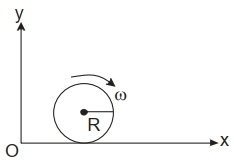
\(L _{0}=\) angular momentum of shell about \(O\).As shell is rolling
\(\text { so } V _{ cm }=\omega R\)
\(L _{0}= mV _{ cm } R + I \omega\)
\(=1 \times \omega R \times R +\frac{2}{3} R ^{2} \omega\)
\(=\frac{5}{3} R ^{2} \omega\)
\(\text { so } a =5\)
-
- (A) \(\frac{M}{(M+m)}\)
- (B) \(\frac{( M +2 m )}{2 M }\)
- (C) \(\frac{2 M }{( M +2 m )}\)
- (D) \(\frac{2( M +2 m )}{ M }\)
Show answer and solution
Correct Answer: (C)
Applying conservation of angular momentum\(M R^{2} \omega=\left(M R^{2}+2 m R^{2}\right) \omega^{\prime}\)
\(\omega^{\prime}=\frac{2 M }{ M +2 m }\)
-
- (A) \(2\)
- (B) \(3\)
- (C) \(1\)
- (D) \(4\)
Show answer and solution
Correct Answer: (D)
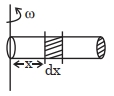
\(F =\int_{0}( dm ) \omega^{2} x\)\(=\int_{0}^{ L }\left(\frac{ m }{ L } dx \right) \omega^{2} x\)
\(=\frac{ m }{ L } \omega^{2} \frac{ L ^{2}}{2}\)
\(=\frac{ m \omega^{2} L }{2}\)
\(\omega=\sqrt{\frac{2}{ mL }} \sqrt{ F }\)
\(=\sqrt{\frac{2}{0.25 \times 0.5}} \sqrt{ F }\)
\(=\sqrt{16} \sqrt{ F }\)
\(=4 \sqrt{ F }\)
-
- (A) \(2\)
- (B) \(11\)
- (C) \(12\)
- (D) \(10\)
Show answer and solution
Correct Answer: (D)
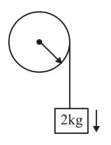
\(2 g-T=2 a\) ...........\((1)\)\(TR =\frac{ MR ^{2}}{2} \alpha\) ...........\((2)\)
\(\alpha=\frac{ a }{ R }\) ..........\((3)\)
\(T =2 a\)
\(2 g - T =2 a\)
\(T = g =10\,N\)
-
- (A) \(2\)
- (B) \(1\)
- (C) \(4\)
- (D) \(3\)
Show answer and solution
Correct Answer: (D)
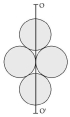
\(I _{1}= I _{3}=\frac{ MR ^{2}}{4}\)\(I _{2}=\frac{ MR ^{2}}{4}+ MR ^{2}=\frac{5}{4} MR ^{2}= I _{4}\)
So \(I = I _{1}+ I _{2}+ I _{3}+ I _{4}\)
\(=\frac{ MR ^{2}}{2}+\frac{5}{2} MR ^{2}\)
\(=3 MR ^{2}, \text { Putting } R =\frac{ a }{2}\)
\(I =\frac{3 Ma ^{2}}{4}, \text { So } x =3\)
-
- (A) \(3 \hat{ i }+4 \hat{ j }-2 \hat{ k }\)
- (B) \(-10 \hat{ i }+10 \hat{ j }+5 \hat{ k }\)
- (C) \(10 \hat{ i }+5 \hat{ j }-10 \hat{ k }\)
- (D) \(10 \hat{ i }+\hat{ j }-5 \hat{ k }\)
Show answer and solution
Correct Answer: (B)
\(\vec{\tau}=\vec{r} \times \vec{F}\)\(=\left|\begin{array}{ccc}\hat{i} & \hat{j} & \hat{k} \\ 2 & 1 & 2 \\ 3 & 4 & -2\end{array}\right|\)
\(=\hat{\hat{i}}(-2-8)-\hat{ j }(-4-6)+\hat{ k }(8-3)\)
\(=-10 \hat{ i }+10 \hat{ j }+5 \hat{ k }\)
-
- (A) \(A-II, B-II, C-IV, D-III\)
- (B) \(A-I, B-II, C-IV, D-III\)
- (C) \(A-II, B-I, C-III, D-IV\)
- (D) \(A-I, B-II, C-III, D-IV\)
Show answer and solution
Correct Answer: (A)
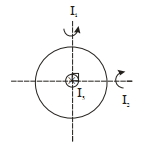
\(I _{0}= I _{ com }+ MR ^{2}\)(Parallel Axis theorem)
\(I_{0}=\frac{2}{5} M^{2}+M^{2}\)
\(I_{0}=\frac{7}{5} M R^{2}\)
Hollow sphere
\(I_{0}=I_{\text {com }}+M^{2}\)
\(=\frac{2}{3} M^{2}+M^{2}=\frac{5}{3} M^{2}\)
\(I _{1}+ I _{2}+ I _{3}\) (Perpendicular axis theorem)
By symmetry MOI
About \(1"\) and \(2"\) Axis are same i.e.
\(I _{1}= I _{2}\)
\(\therefore 2 I_{1}=I_{3}=M^{2}\left(I_{\text {com }}=M^{2}\right)\)
\(I_{1}=\frac{M R^{2}}{2}\)
Similarly in disc
\(2 I_{1}=\frac{M R^{2}}{2}\left\{I_{\text {com }}=\frac{M^{2}}{2}\right\}\)
\(I _{1}=\frac{ MR ^{2}}{4}\)
-
- (A) \(57\)
- (B) \(55\)
- (C) \(5\)
- (D) \(9\)
Show answer and solution
Correct Answer: (C)
\(I _{1}=\frac{2}{5} M (2 R )^{2}=\frac{8}{5} MR ^{2}\)\(I _{1}=\frac{1}{2} M (2 R )^{2}=2 MR ^{2}\)
\(I _{3}=\frac{ M (2 R )^{2}}{4}= MR ^{2}\)
\(I _{4}=\frac{ M (2 R )^{2}}{2}=2 MR ^{2}\)
\(2\left( I _{2}+ I _{3}\right)+ I _{4}= x I _{1}\)
\(8 MR { }^{2}= x \frac{8}{5} MR ^{2}\)
\(x =5\)
-
- (A) \(3\)
- (B) \(4\)
- (C) \(8\)
- (D) \(2\)
Show answer and solution
Correct Answer: (C)
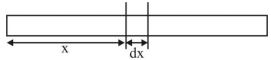
\(dm =\lambda \cdot dx =\lambda_{0}\left(1-\frac{ x ^{2}}{\ell^{2}}\right)\)\(X _{ cm }=\frac{\int xdm }{\int dm _{\ell}}\)
\(=\frac{\lambda_{0} \int_{0}^{\ell}\left( x -\frac{ x ^{3}}{\ell^{2}}\right) dx }{\int_{0}^{\ell} \lambda_{0}\left(1-\frac{ x ^{2}}{\ell^{2}}\right) dx }=\frac{\frac{\ell^{2}}{2}-\frac{\ell^{4}}{4 \ell^{2}}}{\ell-\frac{\ell^{3}}{3 \ell^{2}}}=\frac{3 \ell}{8}\)
-
- (A) \(8\)
- (B) \(7\)
- (C) \(2\)
- (D) \(1\)
Show answer and solution
Correct Answer: (A)
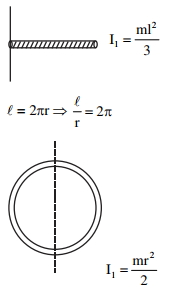
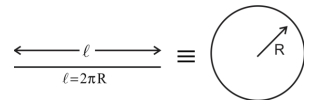
\(\frac{ I _{1}}{ I _{2}}=\frac{2}{3}\left(\frac{\ell}{ r }\right)^{2}\)\(=\frac{2}{3} \times 4 \pi^{2}=\frac{8 \pi^{2}}{3}\)
\(x =8\)
-
- (A) \(89\)
- (B) \(91\)
- (C) \(90\)
- (D) \(95\)
Show answer and solution
Correct Answer: (B)
Using \(\overrightarrow{ L }=\overrightarrow{ r } \times \overrightarrow{ p }=\overrightarrow{ r } \times m \overrightarrow{ v }, m =1\,kg\)\(\overrightarrow{ L }=(3 \hat{ i }-\hat{ j }) \times(3 \hat{ j }+\hat{ k })=(9 \hat{ k }-3 \hat{ j }-\hat{ i })\,N - s\)
\(\Rightarrow|\overline{ L }|=\sqrt{91}\,N - s\)
-
- (A) \(5\)
- (B) \(4\)
- (C) \(8\)
- (D) \(18\)
Show answer and solution
Correct Answer: (A)
\(I =\frac{ m \ell^{2}}{12}= mk ^{2} \Rightarrow k ^{2}=\frac{\ell^{2}}{12} \Rightarrow k =\frac{\ell}{\sqrt{12}}=\frac{\ell}{2 \sqrt{3}}=\frac{10 \sqrt{3}}{2 \sqrt{3}}=5\)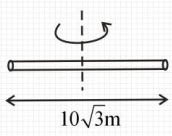
-
- (A) \(11 \hat{i}+19 \hat{j}-4 \hat{k}\)
- (B) \(-11 \hat{i}+9 \hat{j}-16 \hat{k}\)
- (C) \(-17 \hat{i}+19 \hat{j}-4 \hat{k}\)
- (D) \(17 \hat{i}+9 \hat{j}+16 \hat{k}\)
Show answer and solution
Correct Answer: (C)
\(\vec{\tau}=\vec{r} \times \vec{F}=\left|\begin{array}{ccc}i & j & k \\ 2 & 2 & 1 \\ 5 & 3 & -7\end{array}\right|\)\(=i(-14-3)-j(-14-5)+\hat{k}(6-10)\)
\(=-17 \hat{i}+19 \hat{j}-4 \hat{k}\)
-
- (A) \(2\)
- (B) \(3\)
- (C) \(4\)
- (D) \(1\)
Show answer and solution
Correct Answer: (A)
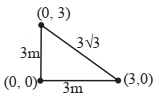
\(\overrightarrow{ r }_{\text {com }}=\frac{ M (0 \hat{ i }+0 \hat{ j })+ M (3 \hat{ i })+ M (3 \hat{ j })}{3 M }\)\(\overrightarrow{ r }_{\text {coma }}=\hat{ i }+\hat{ j }\)
\(\left|\overrightarrow{ r }_{\text {com }}\right|=\sqrt{2}=\sqrt{ x }\)
\(x =2\)
-
- (A) \(4 \; cm\) towards the \(10 \; kg\) block
- (B) \(2 \; cm\) away from the \(10 \; kg\) block
- (C) \(2 \; cm\) towards the \(10 \; kg\) block
- (D) \(4 \; cm\) away from the \(10 \; kg\) block
Show answer and solution
Correct Answer: (C)
\(\Delta x_{G}=\frac{m_{1} \Delta x_{1}+m_{2} \Delta x_{2}}{m_{1}+m_{2}}\)\(0=\frac{10 \times 6+30\left(\Delta x_{2}\right)}{40}\)
\(\Delta x_{2}=-2 \; c m\)
Block of mass \(30 \; kg\) will to move towards \(10 \; kg\).
-
- (A) \(0.1\)
- (B) \(10\)
- (C) \(25\)
- (D) \(0.25\)
Show answer and solution
Correct Answer: (B)
\(S=\frac{R_{G}}{\frac{I}{I_{g}}-1}\)\(8=\frac{72}{\frac{I}{I_{g}}-1}\)
\(\frac{I}{I_{g}}-1=9\)
\(\frac{I}{I_{g}}=10 \Rightarrow \frac{I_{g}}{I}=\frac{1}{10} \quad \% I=\frac{I_{g}}{I} \times 100=10 \%\)
-
- (A) \(3\)
- (B) \(6\)
- (C) \(12\)
- (D) \(2\)
Show answer and solution
Correct Answer: (B)
As \(\overrightarrow{ F }= q (\overrightarrow{ v } \times \overrightarrow{ B })\)\(\overrightarrow{ a }=\frac{ q }{ m }(\overrightarrow{ v } \times \overrightarrow{ B })\)
So, \(\overrightarrow{ a }\,and\,\overrightarrow{ B }\) are \(\perp\) to each other
Hence, \(\vec{a} \cdot \vec{B}=0\)
\((\alpha \hat{i}-4 \hat{j}) \cdot(2 \hat{i}+3 \hat{j})=0\)
\(\alpha(2)+(-4)(3)=0\)
\(\alpha=\frac{12}{2} \Rightarrow \alpha=6\)
-
- (A) \(1: 1\)
- (B) \(1: 2\)
- (C) \(2: 1\)
- (D) \(1: 4\)
Show answer and solution
Correct Answer: (C)
radius of paerticle in cyclotron\(r =\frac{\sqrt{2 mK . E .}}{ qB }\)
So ratio of new radius to original
\(\frac{ r _{ n }}{ r _{0}}=\sqrt{\frac{( K \cdot E .)_{ n }}{( K \cdot E )_{0}}}=\sqrt{4} \Rightarrow 2: 1\)
-
- (A) \(3\)
- (B) \(6\)
- (C) \(9\)
- (D) \(12\)
Show answer and solution
Correct Answer: (A)
\(B _{\text {centre}}=\frac{N \mu_{0} I}{2 R }\)\(37.68 \times 10^{-4}=\frac{100 \times 4 \pi \times 10^{-7} \times I }{2 \times 5 \times 10^{-2}}\)
\(I =3\,A\)
-
- (A) \(12\)
- (B) \(18\)
- (C) \(16\)
- (D) \(32\)
Show answer and solution
Correct Answer: (B)
Kinetic energy of electron in cyclotron\(=\left[\frac{ q ^{2} B ^{2} r _{0}^{2}}{2 m }\right]\)
\(=18\,MeV\)
-
- (A) \(2\)
- (B) \(3\)
- (C) \(4\)
- (D) \(5\)
Show answer and solution
Correct Answer: (A)
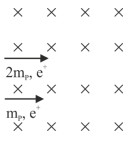
\(R =\frac{ mv }{ q _{ B }}\)\(R _{ D }=\frac{\left(2 m _{ p }\right) v _{ D }}{ e B}\)
\(R _{ p }=\frac{\left( m _{ p }\right) v _{ p }}{ e B }\)
\(\frac{ R _{ D }}{ R _{ p }}=\frac{2 v _{ D }}{ v _{ p }}=\frac{2 v _{ D }}{\sqrt{2} v _{ D }}=\frac{\sqrt{2}}{1}\)
\(\frac{1}{2}\left(2 mp _{ D }\right) v _{ D }^{2}=\frac{1}{2} m _{ p } \cdot v _{ p }^{2}\)
\(\sqrt{2} v _{ D }= v _{ p }\)
\(x =2\)
-
- (A) \(B \propto r^{2}\)
- (B) \(B \propto r\)
- (C) \(B \propto \frac{1}{ r ^{2}}\)
- (D) \(B \propto \frac{1}{r}\)
Show answer and solution
Correct Answer: (B)
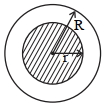
Use Ampere's law\(\text { B. } 2 \pi r =\mu_{0} \cdot \frac{ I }{\pi R ^{2}} \cdot \pi r ^{2}\)
Thus \(B \propto r\)
-
- (A) \(1: \sqrt{2}: \sqrt{2}\)
- (B) \(1: 1: \sqrt{2}\)
- (C) \(\sqrt{2}: 1: 1\)
- (D) \(1: \sqrt{2}: 1\)
Show answer and solution
Correct Answer: (D)
\(R =\frac{\sqrt{2 \,km }}{ qB } \propto \frac{\sqrt{ m }}{ q }\)\(\frac{\sqrt{ m }}{ e }: \frac{\sqrt{2 \,m }}{ e }: \frac{\sqrt{4\, m }}{2 e }\)
\(1: \sqrt{2}: 1\)
-
- (A) \(9\)
- (B) \(3\)
- (C) \(7\)
- (D) \(10\)
Show answer and solution
Correct Answer: (D)
\(R =\frac{ mv }{ qB }=\frac{\sqrt{2 mK }}{ qB }\) -
- (A) \(\frac{1}{3}\) deflection method cannot be used for determining the resistance of the galvanometer.
- (B) \(\frac{1}{3}\) deflection method can be used and in this case the \(G\) equals to twice the value of shunt resistance\((s).\)
- (C) \(\frac{1}{3}\) deflection method can be used and in this case, the \(G\) equals to three times the value of shunt resistance\((s)\)
- (D) \(\frac{1}{3}\) deflection method can be used and in this case the \(G\) value equals to the shunt resistance\((s).\)
Show answer and solution
Correct Answer: (B)
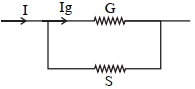
\(\Rightarrow\left( I - I _{ g }\right) S = I _{ g } G\)\(\frac{I_{g}}{I}=\frac{S}{S+G}\)
\(\Rightarrow \frac{1}{3}=\frac{S}{S+G} \Rightarrow S+G=3 S \Rightarrow G=2 S\)
-
- (A) \(0.126\)
- (B) \(0.312\)
- (C) \(0.216\)
- (D) \(0.245\)
Show answer and solution
Correct Answer: (C)
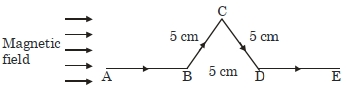
\(F _{ M }( CD )= BI \ell_{\text {eff }}\)\(=0.5 \times(10) \times\left(5 \sin 60 \times 10^{-2}\right)\)
\(=0.216\,N\)
-
- (A) \(10\)
- (B) \(11\)
- (C) \(54\)
- (D) \(0\)
Show answer and solution
Correct Answer: (B)
\(\frac{314}{100}=2 \pi R \quad R =0.5 m\)\(\text { Magnetic Moment }= IA\)
\(=14 \times \pi R ^{2}\)
\(= 14 \times(3.14) \times \frac{1}{4}\)3
\(=10.99 \approx 11.00\)
-
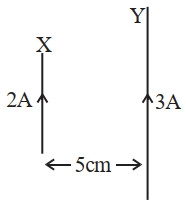
- (A) \(1.2 \times 10^{-5} \;N\) directed towards wire \(X\).
- (B) \(1.2 \times 10^{-4}\;N\) directed away from wire \(X\).
- (C) \(1.2 \times 10^{-4}\; N\) directed towards wire \(X\).
- (D) \(2.4 \times 10^{-5} \;N\) directed towards wire \(X\).
Show answer and solution
Correct Answer: (A)
Force of interaction \(=I_{1} \ell_{1} B_{12}\)\(=\frac{\mu_{0} I _{1} I _{2}}{2 \pi r } \ell_{1}\)
\(=\frac{4 \pi \times 10^{-7} \times 6 \times 5}{2 \pi \times 5 \times 10^{-2}}\)
\(=1.2 \times 10^{-5} \text { towards } X\)
-
- (A) \(1.6 \times 10^5\,Hz\)
- (B) \(5.6 \times 10^5\,Hz\)
- (C) \(2.8 \times 10^6\,Hz\)
- (D) \(1.8 \times 10^6\,Hz\)
Show answer and solution
Correct Answer: (C)
\(f =\frac{1}{ T }=\frac{ eB }{2 \pi m }\)\(=\frac{1.6 \times 10^{-19} \times 10^{-4}}{2 \pi \times 9 \times 10^{-31}}=2.8 \times 10^{6}\,Hz\)
-
- (A) \(30\)
- (B) \(15\)
- (C) \(10\)
- (D) \(3\)
Show answer and solution
Correct Answer: (A)
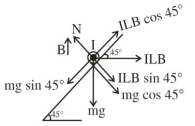
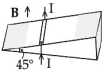
\(mg \sin 45^{\circ}= ILB \cos 45^{\circ}\)\(\therefore I =\left(\frac{ m }{ L }\right) \frac{ g }{ B }\)
\(=\frac{(0.45)(10)}{0.15}=30\,A\)
-
- (A) \(1: 1\)
- (B) \(1: 2\)
- (C) \(2: 1\)
- (D) \(4: 1\)
Show answer and solution
Correct Answer: (B)
At centre \(B=N\left(\frac{\mu_{0} i }{2 R}\right)\)\(B_{x}=200\left(\frac{\mu_{0} \dot{i}}{2 \times 20 cm }\right)\)
\(B_{y}=400\left(\frac{\mu_{0} i}{2 \times 20 cm }\right)\)
\(\frac{ B _{x}}{ B _{y}}=\frac{1}{2}\)
-
- (A) Both \((A)\) and \((R)\) are true and \((R)\) is the correct explanation of \(( A )\)
- (B) Both \((A)\) and \((R)\) are true but \((R)\) is NOT the correct explanation of \(( A )\)
- (C) \((A)\) is true but \((R)\) is false
- (D) \((A)\) is false but \((R)\) is true.
Show answer and solution
Correct Answer: (A)
\(\overrightarrow{ F }= q (\overrightarrow{ v } \times \overrightarrow{ B })\)\(\overrightarrow{ F } \perp \overrightarrow{ V }\)
Work done \(=\overrightarrow{ F } \cdot \overrightarrow{ S }\)
Work done \(=0\)
-
- (A) Both Statement \(I\) and Statement \(II\) are correct
- (B) Both Statement \(I\) and Statement \(II\) are incorrect
- (C) Statement \(I\) is correct but Statement \(II\) is incorrect
- (D) Statement \(I\) is incorrect but Statement \(II\) is correct
Show answer and solution
Correct Answer: (C)
Electric field can change speed and kinetic energy but magnetic field can not change speed \(\triangle KE\). Because magnetic force is always \(\perp\) to velocity. -
- (A) \(\frac{ KS }{( S + G )}\)
- (B) \(\frac{( G + S )}{ nKS }\)
- (C) \(\frac{ nKS }{( G + S )}\)
- (D) \(\frac{n K ( G + S )}{ S }\)
Show answer and solution
Correct Answer: (D)
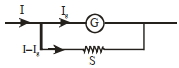
Figure of merit \(\frac{ I _{ g }}{\theta}= K\)\(I _{ g }= Kn\)
\(I =\frac{ I _{ g }}{ s }( G + S )\)
\(I =\frac{ nK }{ S }( G + S )\)
-
- (A) \((B)\) and \((C)\) only
- (B) \((C)\) and \((D)\) only
- (C) \((A)\) and \((C)\) only
- (D) \((B)\) and \((D)\) only
Show answer and solution
Correct Answer: (D)
\(i=\left(\frac{ K }{ NAB }\right) \theta\)\(\therefore \frac{ d \theta}{ di }=\frac{ NAB }{ K }\)
-
- (A) \(\frac{5}{2}\)
- (B) \(\frac{25}{4}\)
- (C) \(\frac{5}{4}\)
- (D) \(\frac{25}{2}\)
Show answer and solution
Correct Answer: (B)
\(B=\frac{N \mu_{0} 1}{2 R}\)\(B_{1}=\frac{N_{1} \mu_{0} i}{2 R_{1}}\)
For \(N _{2}=5\)
Radius of coil \(= R _{2}=\frac{ N _{1} \times R _{1}}{ N _{2}}\)
\(B _{2}=\frac{ N _{2} \mu_{0} i }{ R _{2}}\)
\(\frac{ B _{2}}{ B _{1}}=\frac{ N _{2}}{ N _{1}} \frac{ R _{1}}{ R _{2}}=\frac{ N _{2}}{ N _{1}} \times \frac{ N _{2}}{ N _{1}} ; \quad \frac{ B _{2}}{ B _{1}}=\frac{25}{4}\)
-
- (A) \(9: 4\)
- (B) \(12: \sqrt{5}\)
- (C) \(8: 1\)
- (D) \(5: \sqrt{3}\)
Show answer and solution
Correct Answer: (C)
\(B_{1}=\frac{\mu_{0} I}{2 R}\)\(B_{2}=\frac{\mu_{0} I^{2}}{2\left(R^{2}+3 R^{2}\right)^{3 / 2}}=\frac{1}{8}\left(\frac{\mu_{0} I}{2 R}\right)=\frac{B_{1}}{8}\)
\(\frac{B_{1}}{B_{2}}=\frac{8}{1}\)

-
- (A) \(B / 2\)
- (B) \(2 B\)
- (C) \(\left(\frac{2}{\sqrt{5}}\right)^{3} B\)
- (D) \(\left(\frac{2}{\sqrt{3}}\right)^{3} B\)
Show answer and solution
Correct Answer: (C)
\(B_{C}=\frac{\mu_{0} I}{2 r}, B_{a}=\frac{\mu_{0} I^{2}}{2\left(x^{2}+r^{2}\right)^{3 / 2}}\)\(At \,\,x =\frac{r}{2}\)
\(B _{ a }=\frac{\mu_{0} Ir ^{2}}{2\left(\frac{ r ^{2}}{4}+ r ^{2}\right)^{3 / 2}}\)
\(=\frac{\mu_{0} Ir ^{2}}{2\left(\frac{5}{4} r ^{2}\right)^{3 / 2}}=\frac{\mu_{0} I }{2 r }\left(\frac{4}{5}\right)^{3 / 2}\)
\(=\frac{\mu_{0} I }{2 r }\left(\frac{2}{\sqrt{5}}\right)^{3}\)
- 245. The magnetic moment of an electron \((e)\) revolving in an orbit around nucleus with an orbital angular momentum is given by : 2022 Medium
- (A) \(\vec{\mu}_{ L }=\frac{ e \overrightarrow{ L }}{2 m }\)
- (B) \(\vec{\mu}_{ L }=-\frac{ e \overrightarrow{ L }}{2 m }\)
- (C) \(\vec{\mu}_{1}=-\frac{e \vec{L}}{m}\)
- (D) \(\vec{\mu}_{1}=\frac{2 e \overrightarrow{ L }}{ m }\)
Show answer and solution
Correct Answer: (B)
Ratio of magnetic moment and angular momentum\(\frac{\vec{\mu}}{\vec{L}}=\frac{q}{2 m}\)
For \(e^{-}\)
\(\vec{\mu}=-\frac{e}{2 m} \vec{L}\)
-
- (A) \(1.2 \times 10^{-5}\)
- (B) \(1.2 \times 10^{-3}\)
- (C) \(1.8 \times 10^{-3}\)
- (D) \(2.4 \times 10^{-5}\)
Show answer and solution
Correct Answer: (A)
\(\chi=1.2 \times 10^{-5}\)\(\mu_{ r }=1+\chi=1+1.2 \times 10^{-5}\)
Fractional Change
\(=\frac{\Delta B }{ B }=\frac{\mu_{0} \mu_{ I } ni -\mu_{0} ni }{\mu_{0} ni }=\left(\mu_{ r }-1\right)\)
\(=1.2 \times 10^{-5}\)
-
- (A) \(3\)
- (B) \(4\)
- (C) \(5\)
- (D) \(6\)
Show answer and solution
Correct Answer: (C)
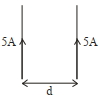
It should be mentioned, \(10 \; cm\) wire is part of long wire.Force experienced by unit length of wire
\(=\frac{\mu_{0} I _{1} I _{2}}{2 \pi d }, I _{1}= I _{2}=5 \; A\)
Force experienced by wires of length \(10 \; cm\)
\(=\frac{\mu_{0} I _{1} I _{2}}{2 \pi d } \times 10 \times 10^{-2}\)
\(10^{-5}=\frac{2 \times 10^{-7} \times 5 \times 5}{ d } \times 10 \times 10^{-2}\)
\(d =50 \times 10^{-3} \; m\)
\(d =50 \times 10^{-1} cm =5 \; cm\)
-
- (A) \(8: 5\)
- (B) \(5: 4\)
- (C) \(5: 3\)
- (D) \(8: 7\)
Show answer and solution
Correct Answer: (B)
Radius of circular path \(R =\frac{\sqrt{2 mk }}{ qB }\)\(q =\frac{\sqrt{2 mk }}{ RB }\)
\(\frac{ q _{1}}{ q _{2}}=\sqrt{\frac{ m _{1}}{ m _{2}}} \times \frac{ R _{2}}{ R _{1}}=\sqrt{\frac{9}{4}} \times \frac{5}{6}=\frac{5}{4}\)
-
- (A) \(\frac{7}{2} \hat{ k } Am ^{2}\)
- (B) \(-\frac{7}{2} \hat{ k } Am ^{2}\)
- (C) \(7 \hat{ k } Am ^{2}\)
- (D) \(-7 \hat{ k } Am ^{2}\)
Show answer and solution
Correct Answer: (B)
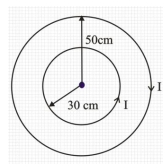
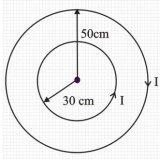
\(\overrightarrow{ M }=- i \pi(0.5)^{2} \hat{ k }+ i \pi(0.3)^{2} \hat{ k }\)\(\overrightarrow{ M }=-7 \times \frac{22}{7}\left(\frac{25}{100}-\frac{9}{100}\right) \hat{ k }\)
\(=-22\left(\frac{16}{100}\right) \hat{ k }\)
\(\overrightarrow{ M }=-3.52 \hat{ k }\,Am ^{2}\)
\(=-\frac{7}{2} \hat{ k }\,Am ^{2}\)
-
- (A) \(30 \,A\) in the same direction
- (B) \(30 \,A\) in the opposite direction
- (C) \(60 \,A\) in the opposite direction
- (D) \(300 \,A\) in the opposite direction
Show answer and solution
Correct Answer: (B)
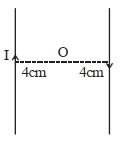
\(B\) at \(O =2 \frac{\mu_{0} I }{2 \pi r }\)\(\frac{2 \times 4 \pi \times 10^{-7} I }{2 \pi 4 \times 10^{-2}}=3 \times 10^{-4} T\)
\(I =30\, A\) in opp. direction
No questions on this page match these filters.