


Questions
25 questionsShowing 1–25 of 25 questions
-
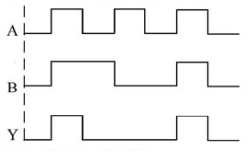
- (A) \(AND\) gate
- (B) \(OR\) gate
- (C) \(NOR\) gate
- (D) \(NAND\) gate
Show answer and solution
Correct Answer: (A)
By making Truth table\(A\) \(B\) \(Output\) \(0\) \(0\) \(1\) \(1\) \(1\) \(1\) \(0\) \(1\) \(0\) \(1\) \(0\) \(0\) Comparing with output of \(AND\) gate
\(A\) \(B\) \(AND\) \(0\) \(0\) \(0\) \(0\) \(1\) \(0\) \(1\) \(0\) \(0\) \(1\) \(1\) \(1\) -
- (A) \(11\)
- (B) \(13\)
- (C) \(14\)
- (D) \(20\)
Show answer and solution
Correct Answer: (C)
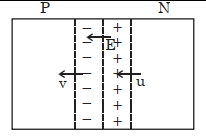
Work done by Electric field \(=K_{ r }- K _{ I }\)\(\frac{1}{2} mv ^{2}-\frac{1}{2} mu ^{2}=-1.6-10^{-19} \times 0.4\)
\(\frac{1}{2} 9 \times 10^{-31}\left( v ^{2}- u ^{2}\right)=-0.64 \times 10^{-19}\)
\(u ^{2}- v ^{2}=\frac{2 \times 0.64 \times 10^{12}}{9}\)
\(v ^{2}=\left(36-\frac{128}{9}\right) \times 10^{10}\)
\(v =\frac{14}{3} \times 10^{5} \,m / s\)
\(x =14\)
-
- (A) \(2\)
- (B) \(5\)
- (C) \(3\)
- (D) \(1\)
Show answer and solution
Correct Answer: (A)
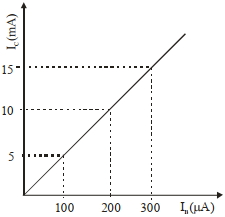
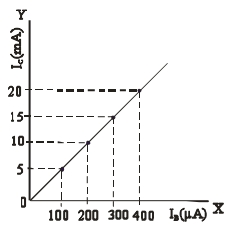
\(\Delta i _{ B }=100 \,\mu A \quad \beta=\frac{\Delta i _{ C }}{\Delta i _{ B }}\)\(\Delta i _{ c }=10 \,mA\)
power \(=\beta^{2} \times \frac{R_{0}}{R_{i n}}\)
Power \(=\left(\frac{10}{0.1}\right)^{2} \times \frac{2}{1}\)
Power \(=100 \times 100 \times 2\)
Gain \(=2 \times 10^{4}\)
-
- (A) \(950\)
- (B) \(750\)
- (C) \(780\)
- (D) \(790\)
Show answer and solution
Correct Answer: (B)
\(I _{ i }=\frac{10 mV }{10 \mu A }=10^{3} \Omega\)\(\beta=\frac{1.5 mA }{10 \mu A }=150\)
\(A _{ V }=\left(\frac{ R _{0}}{ r _{ i }}\right) \beta=\left(\frac{5000}{1000}\right) \times 150=750\)
-
- (A) \(1\)
- (B) \(2\)
- (C) \(3\)
- (D) \(4\)
Show answer and solution
Correct Answer: (B)
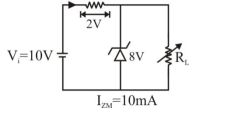
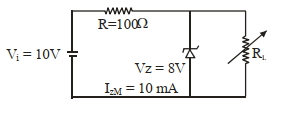
\(I =\frac{2}{100}=20 mA\)\(V _{ L }= I _{ L } R _{ L }\)
\(8=10 \times 10^{-3} \times R _{ L _{\max }}\)
\(\frac{4}{5} \times 10^{3}= R _{ L _{\max }}\)
\(800= R _{ L _{\max }}\)
\(I = I _{ Z }+ I _{ L }\)
\(I _{ L }=10 mA\)
If \(I _{ Z }=0\)
\(I _{ L _{\max }}=20 mA\)
\(V _{ L }= I _{ L _{\max }} \times R _{ L _{\min }}\)
\(\frac{8}{20} \times 10^{3}= R _{ L _{\min }}\)
\(400= R _{ L _{\min }}\)
\(\frac{ R _{ L _{\max }}}{ R _{ L _{\min }}}=\frac{800}{400}=2\)
-
- (A) \(0.1\)
- (B) \(1.0\)
- (C) \(10\)
- (D) \(100\)
Show answer and solution
Correct Answer: (B)
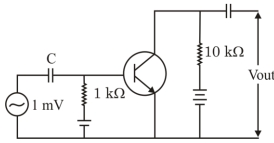
\(\frac{v_{\text {out }}}{v_{\text {in }}}=\beta \frac{R_{\text {out }}}{R_{\text {in }}}\)\(v_{\text {out }}=\frac{100 \times 10 \times 10^{3}}{10^{3}} \times 10^{-3}\)
\(=1\,V\)
- 7. As per the given circuit, the value of current through the battery will be \(\dots \; A\).
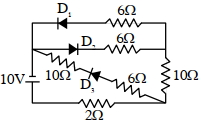 2022 Medium
- (A) \(0\)
- (B) \(1\)
- (C) \(2\)
- (D) \(3\)
Show answer and solution
Correct Answer: (B)
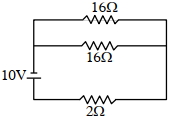
\(V = IR _{\text {net }}\)\(10= I \times 10\)
\(I=1 A\)
Ans. \(1\)
-
- (A) \(240\)
- (B) \(400\)
- (C) \(0.0025\)
- (D) \(200\)
Show answer and solution
Correct Answer: (B)
\(3\,V_{C E}=8\,V = I _{ C }=6\,mA\) from \(4\,mA\)\(I _{ B }=20\, \mu A\) to \(25\, \mu A\)
Current gain \(\beta_{ av }=\frac{ I _{ C }{ }^{\prime}- I _{ C }}{ I _{ B }{ }^{\prime}- I _{ B }}=\frac{2\, mA }{5\, \mu A }\)
\(\beta_{ av }=\frac{2}{5} \times 10^{3}=\frac{2000}{5}=400\)
-
- (A) Active region
- (B) Saturation state only
- (C) Cut-off state only
- (D) Saturation and cut-off state
Show answer and solution
Correct Answer: (D)
Transistor act as a switch in saturation and cut of region. - 10. For using a multimeter to identify diode from electrical components. choose the correct statement out of the following about the diode 2022 Medium
- (A) It is two terminal device which conducts current in both directions
- (B) It is two terminal device which conducts current in one direction only
- (C) It does not conduct current gives an initial deflection which decays to zero
- (D) It is three terminal device which conducts current in ne direction only between central terminal and either of the remaining two terminals
Show answer and solution
Correct Answer: (B)
In forward bias diode conductsIn revers bias it does not conducts
-
- (A) Both \(A\) and \(R\) true. and \(R\) is correct explanation of \(A\)
- (B) Both \(A\) and \(R\) are true but \(R\) is \(NOT\) the correct explanation of \(A\)
- (C) \(A\) is true but \(R\) is false
- (D) \(A\) is false but \(R\) is true
Show answer and solution
Correct Answer: (A)
Theory -
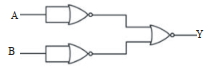
- (A) \(AND\) gate
- (B) \(OR\) gate
- (C) \(OR\) gate
- (D) \(NAND\) gate
Show answer and solution
Correct Answer: (A)
\(=[\overline{[\overline{ A + A }]+[\overline{ B + B }]}]\)\(Y =\overline{\overline{ A }+\overline{ B }}\left( D ^{\prime} \,MORGA\,\, LAW \right)\)
\(Y = AB\)
-
- (A) \(0\)
- (B) \(1\)
- (C) \(10\)
- (D) \(100\)
Show answer and solution
Correct Answer: (B)
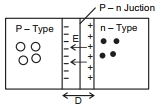
\(E =\frac{ V }{ d }=\frac{\text { Potential barrier Across Junction }}{\text { width of Depletion layer }}\)\(=\frac{0.6\,V }{6 \times 10^{-6}\,m }=1 \times 10^{5}\,V / m\)
\(=1 \times 10^{5}\,N / C\)
-
- (A) \(155\)
- (B) \(78\)
- (C) \(17\)
- (D) \(15\)
Show answer and solution
Correct Answer: (D)
Voltage Gain \(=\frac{ I _{ C }}{ I _{ B }} \times \frac{ R _{0}}{ R _{ I }}=\frac{10 \times 10^{-3}}{200 \times 10^{-6}} \times \frac{60}{200}=15\) -
- (A) \(9\)
- (B) \(90\)
- (C) \(95\)
- (D) \(45\)
Show answer and solution
Correct Answer: (A)
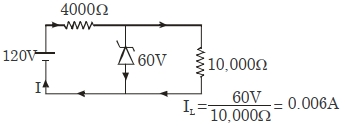
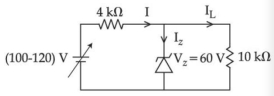
\(I =\frac{(120-60)\,V }{4000\,\Omega}=0.015\,A\)Thus \(\quad I _{2}= I - I _{ L }\)
\(=0.015-0.006=0.009 A =9\,mA\)
-
- (A)
\(A\) \(B\) \(y\) \(0\) \(0\) \(0\) \(1\) \(0\) \(0\) \(0\) \(1\) \(0\) \(1\) \(1\) \(1\) - (B)
\(A\) \(B\) \(y\) \(0\) \(0\) \(0\) \(1\) \(0\) \(1\) \(0\) \(1\) \(1\) \(1\) \(1\) \(1\) - (C)
\(A\) \(B\) \(y\) \(0\) \(0\) \(0\) \(1\) \(0\) \(0\) \(0\) \(1\) \(0\) \(1\) \(1\) \(0\) - (D)
\(A\) \(B\) \(y\) \(0\) \(0\) \(1\) \(1\) \(0\) \(1\) \(0\) \(1\) \(1\) \(1\) \(1\) \(0\)
Show answer and solution
Correct Answer: (A)
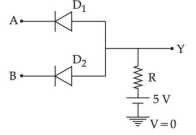
When both \(A\) and \(B\) have logical value \(' 1 '\) both diode are reverse bias and current will flow in resistor hence output will be \(5\) volt i.e. logical value '\(1\)'.In all other case conduction will take place, hence output will be \(zero\) volt i.e. logical value ' \(0\) '.
So truth table is \((AND\,gate)\)
\(A\) \(B\) \(y\) \(0\) \(0\) \(0\) \(0\) \(1\) \(0\) \(1\) \(0\) \(0\) \(1\) \(1\) \(1\) - (A)
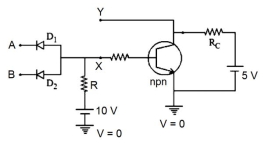
- 17. In the following circuit, the correct relation between output \(( Y )\) and inputs \(A\) and \(B\) will be
 2022 Hard
- (A) \(Y = AB\)
- (B) \(Y = A + B\)
- (C) \(Y =\overline{ AB }\)
- (D) \(Y=\overline{ A + B }\)
Show answer and solution
Correct Answer: (C)
This is \(NAND\) gate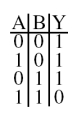
- 18. In the given circuit- the value of current \(I _{ L }\) will be \(mA\). (When \(R _{ L }=1 \,k\, \Omega\) )
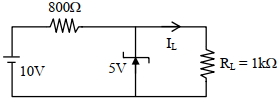 2022 Easy
- (A) \(5\)
- (B) \(55\)
- (C) \(7\)
- (D) \(1\)
Show answer and solution
Correct Answer: (A)
\(I_{L}=\frac{5}{1000}=5 \,mA\) -
- (A) \(3\)
- (B) \(4\)
- (C) \(5\)
- (D) \(6\)
Show answer and solution
Correct Answer: (B)
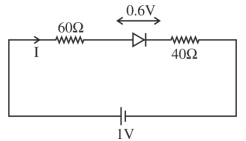
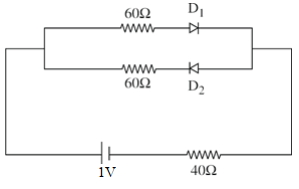
\(1- I (60)-0.6- I (40)=0\)\(\frac{0.4}{100}= I\)
\(I =4 \,mA\)
-
- (A) \(3\)
- (B) \(2\)
- (C) \(4\)
- (D) \(1\)
Show answer and solution
Correct Answer: (A)
\(E _{ g }=\frac{ hc }{\lambda}=\frac{1242}{\lambda( nm )}=\frac{1242}{400}=3.105\)Answer rounded to \(3\,eV\)
-
- (A) \(1: 2\)
- (B) \(5: 1\)
- (C) \(1: 40\)
- (D) \(20: 1\)
Show answer and solution
Correct Answer: (B)
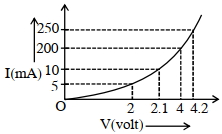
\(R =\frac{\Delta V }{\Delta i }\)\(\frac{ R _{1}}{ R _{2}}=\frac{\Delta v _{1}}{\Delta v _{2}} \frac{\Delta i _{2}}{\Delta i _{1}}=\frac{0.1}{0.2} \times \frac{50}{5}=5\)
- 22. The photodiode is used to detect the optiocal signals. These diodes are preferably operated in reverse biased mode because. 2022 Medium
- (A) fractional change in majority carriers produce higher forward bias current
- (B) fractional change in majority carriers produce higher reverse bias current
- (C) fractional change in minority carriers produce higher forward bias current
- (D) fractional change in minority carriers produce higher reverse bias current
Show answer and solution
Correct Answer: (D)
Very small change in minority charge carriers produces high value of reverse bias current. - 23. The positive feedback is required by an amplifier to act an oscillator. The feedback here means ........... 2022 Medium
- (A) External input is necessary to sustain ac signal in output.
- (B) A portion of the output power is returned back to the input.
- (C) Feedback can be achieved by \(LR\) network.
- (D) The base-collector junction must be forward biased.
Show answer and solution
Correct Answer: (B)
When the amplifier connects with positive feedback, it acts as the oscillator the feedback here is positive feedback which means some amount of voltage is given to the input. -
- (A) \(100\)
- (B) \(200\)
- (C) \(20\)
- (D) \(2000\)
Show answer and solution
Correct Answer: (B)
Current gain in C-E configuration\(\Rightarrow \beta=\frac{\Delta I _{ C }}{\Delta I _{ B }}\)
\(R _{ C }=2 k \Omega, R _{ B }=0.50 k \Omega\)
\(\text { Voltage gain }=\frac{\Delta I _{ C } R _{ C }}{\Delta I _{ B } R _{ B }}=\frac{5 \times 10^{-3}}{100 \times 10^{-6}} \times \frac{2}{0.5}\)
\(=\frac{10^{-2}}{5 \times 10^{-5}}=\frac{1000}{5}=200\)
- 25. Two ideal diodes are connected in the network as shown in figure. The equivalent resistance between \(A\) and \(B\) is \(.......\Omega\).
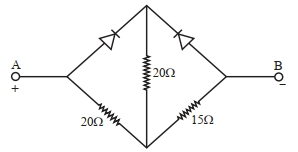 2022 Medium
- (A) \(24\)
- (B) \(25\)
- (C) \(23\)
- (D) \(22\)
Show answer and solution
Correct Answer: (B)
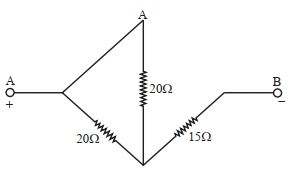
The forward biased diode will conduct while the reverse biased will not\(\therefore\) Equivalent resistance \(=10+15=25\,\Omega\)
No questions on this page match these filters.