


All JEE Mains 2022 Physics questions
32 chaptersShowing 301–350 of 597 questions
-
- (A) \(2\)
- (B) \(40\)
- (C) \(4\)
- (D) \(400\)
Show answer and solution
Correct Answer: (B)
Independent of area in case of uniform wire. -
- (A) \(3\)
- (B) \(4\)
- (C) \(40\)
- (D) \(8\)
Show answer and solution
Correct Answer: (B)
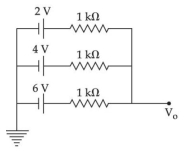
By nodal analysis \(\frac{V_{0}-2}{1 k \Omega}+\frac{V_{0}-4}{1 k \Omega}+\frac{V_{0}-6}{1 k \Omega}=0\)\(3 V _{0}-12=0\)
\(V _{0}=4\)
-
- (A) \(2.2\)
- (B) \(22\)
- (C) \(200\)
- (D) \(20\)
Show answer and solution
Correct Answer: (D)
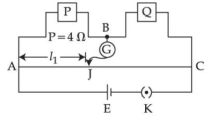
Initially, \(\frac{ P }{ Q }=\frac{40 cm }{60 cm }=\frac{2}{3}\)Finally, \(\frac{ P + x }{ Q }=\frac{80 cm }{20 cm }=\frac{4}{1} \ldots(2)\)
Divide \((2)\) by \((1)\)
\(\frac{ P + x }{ P }=4 \times \frac{3}{2}=6\)
\(1+\frac{ x }{ P }=6 \Rightarrow \frac{ x }{ P }=5\)
\(\therefore x =5 P =5 \times 4=20 \Omega\)
-
- (A) \(0.033\)
- (B) \(-0.033\)
- (C) \(0.011\)
- (D) \(0.055\)
Show answer and solution
Correct Answer: (A)
\(R = R _{0}(1+\alpha \Delta T )\)\(3= R _{0}(1+\alpha(30-0))\)
\(2= R _{0}(1+\alpha(10-0))\)
\(\frac{3}{2}=\frac{1+30 \alpha}{1+10 \alpha}\)
\(\alpha=\frac{1}{30}=0.033\)
-
- (A) \(2\)
- (B) \(4\)
- (C) \(6\)
- (D) \(8\)
Show answer and solution
Correct Answer: (A)
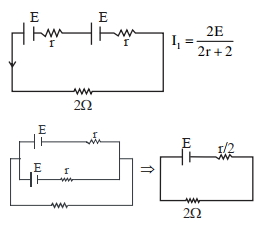
\(I _{2}=\frac{ E }{\frac{ r }{2}+2}=\frac{2 E }{ r +4}\)\(I _{1}= I _{2}\)
\(2 r +2= r +4\)
\(2 r - r =2 \,\Omega \Rightarrow r =2 \,\Omega\)
-
- (A) \(-48\)
- (B) \(48\)
- (C) \(-58\)
- (D) \(58\)
Show answer and solution
Correct Answer: (B)
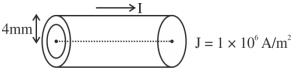
\(J=\frac{I}{A}\)\(I=J A\)
\(=4 \times 10^{6} \times\left[\pi R^{2}-\pi\left(\frac{R}{2}\right)^{2}\right]\)
\(=4 \times 10^{6} \times \pi R^{2} \times \frac{3}{4}\)
\(=4 \times 10^{6} \times \pi \times\left(4 \times 10^{-3}\right)^{2} \times \frac{3}{4}=48 \; \pi A .\)
-
- (A) \(10\)
- (B) \(11\)
- (C) \(12\)
- (D) \(14\)
Show answer and solution
Correct Answer: (C)
\(I =\int JdA\)\(=\int 10^{6} \times 2 \pi xdx\)
\(\left.=10^{6} \times 2 \pi \cdot x \frac{ x ^{2}}{2}\right]_{\frac{ r }{2}}^{ T }\)
\(=\pi \times 10^{6}\left[ r ^{2}-\frac{ r ^{2}}{4}\right]=12 \pi\)
\(x =12\)
-
- (A) \(8\)
- (B) \(5\)
- (C) \(4\)
- (D) \(2\)
Show answer and solution
Correct Answer: (D)
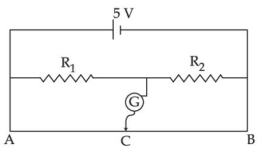
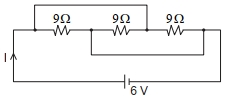
\(I=6 / 3=2\,A\)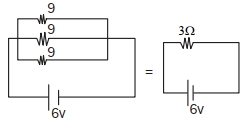
-
- (A) \(10\)
- (B) \(20\)
- (C) \(4\)
- (D) \(40\)
Show answer and solution
Correct Answer: (A)
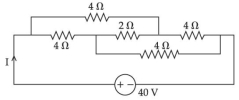
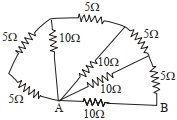
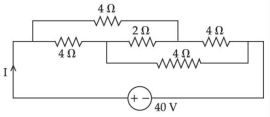
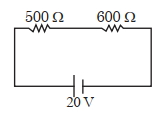
Given circuit is balanced wheat stone bridge Hence \(2 \Omega\) can be neglected\(R_{\text {net }}=4 \Omega\)
\(I=\frac{40}{4}\)
\(I=10\,A\)
- 310. The equivalent resistance between points \(A\) and \(B\) in the given network is ............ \(\Omega\)
 2022 Medium
- (A) \(65\)
- (B) \(20\)
- (C) \(5\)
- (D) \(2\)
Show answer and solution
Correct Answer: (C)
\(R _{ AB }=5 \,\Omega\)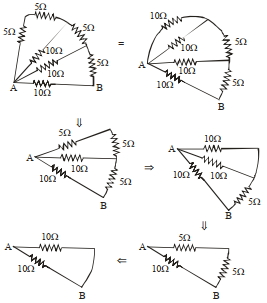
-
- (A) \(390\)
- (B) \(300\)
- (C) \(370\)
- (D) \(399\)
Show answer and solution
Correct Answer: (B)
\(V ^{\prime}= V\)\(\ell^{\prime} A =\ell A\)
\(2 \ell A ^{\prime}=\ell A\)
\(A ^{\prime}=\frac{ A }{2}\)
\(R =\rho \frac{\ell}{ A } \ldots\,\, (i)\)
\(\ell^{\prime}=2 \ell\)
\(A ^{\prime}=\frac{ A }{2}\)
\(R ^{\prime}=\frac{\rho \ell^{\prime}}{ A }=\frac{\rho 2 \ell}{\frac{ A }{2}}\)
\(R ^{\prime}=\frac{4 \rho \ell}{ A }\)
\(R ^{\prime}=4 R\) from equation \((i)\)
\(\%\) increase in resistance
\(=\frac{ R ^{\prime}- R }{ R } \times 100=\frac{4 R - R }{ R } \times 100\)
\(=300 \%\)
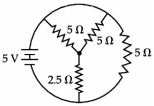
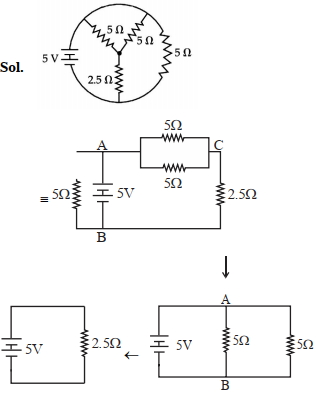
- 312. The total current supplied to the circuit as shown in figure by the \(5 V\) battery is \(A\)
 2022 Medium
- (A) \(7\)
- (B) \(2\)
- (C) \(9\)
- (D) \(60\)
Show answer and solution
Correct Answer: (B)
Current supplied by \(5 \,V\) battery\(=\frac{5 V }{2.5 \Omega}=2 A\)
-
- (A) \(134\)
- (B) \(143\)
- (C) \(150\)
- (D) \(144\)
Show answer and solution
Correct Answer: (D)
\(1=\rho \frac{\ell}{ A }\)\(1=\frac{\rho \times 31.4}{\frac{\pi(2.4)^{2}}{4}}\)
\(\frac{\pi(2.4)^{2}}{4}=\rho \times 314\)
\(\frac{2.4 \times 2.4}{4}=\rho \times 10\)
\(\frac{0.6 \times 2.4}{10}=\rho\)
\(\frac{1.44}{10}=\rho\)
\(0.144=\rho\)
\(144 \times 10^{-3}=\rho\)
-
- (A) \(r _{2}- r _{1}\)
- (B) \(r_{1}-r_{2}\)
- (C) \(r _{1}\)
- (D) \(r _{2}\)
Show answer and solution
Correct Answer: (A)
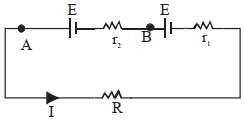
\(I=\frac{2 E }{R+I_{1}+I_{2}} \ldots \text{(i)}\)But \(V _{ A }- V _{ B }= E - I _{2}=0\)
\(\Rightarrow I =\frac{ E }{ I _{2}} \ldots \text{(ii)}\)
Comparing values of \(I\) from \((i)\) and \((ii)\)
\(\frac{E}{r_{2}}=\frac{2 E}{R+r_{1}+r_{2}}\)
\(\Rightarrow R=r_{2}-r_{1}\)
-
- (A) \(10\)
- (B) \(15\)
- (C) \(17\)
- (D) \(14\)
Show answer and solution
Correct Answer: (B)
\(\frac{d Q}{d t}=i^{2} R=\frac{V^{2}}{R}\) (we know)\(\Rightarrow \text { In 't' time , } \Delta Q =\left(\frac{ V ^{2}}{ R }\right) t\)
Given that, (for same source, \(v=\) same)
\(Q _{0}=\frac{ v ^{2}}{ R _{1}} \times 20=\frac{ V ^{2}}{ R _{2}} \times 60 \ldots\) \((i)\)
\(\Rightarrow R _{2}=3 R _{1} \ldots.\) \((ii)\)
If they are connected in parallel then
\(\operatorname{Req}=\frac{ R _{2} R _{1}}{ R _{1}+ R _{2}}=\frac{3 R _{1} \cdot R _{1}}{3 R _{1}+ R _{1}}=\left(\frac{3 R _{1}}{4}\right)\)
To produce same heat, using equation ...\((i)\)
\(Q _{0}=\frac{ V ^{2}}{ R _{1}} \times 20=\frac{ v ^{2}}{\left(\frac{3 R _{1}}{4}\right)} \times t\)
\(t =\frac{3 \times 20}{4}=15 \,min\)
-
- (A) \(2.5\)
- (B) \(4\)
- (C) \(5\)
- (D) \(10\)
Show answer and solution
Correct Answer: (C)
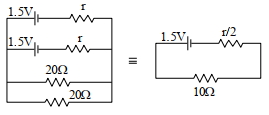
\(V = E - ir / 2\)\(1.2=1.5- i \left(\frac{ r }{2}\right)\)
\(i \frac{ r }{2}=0.3\)
\(i =\frac{1.5}{10+\frac{ r }{2}} \Rightarrow 10 i +\frac{ ir }{2}=1.5\)
\(10 i =1.5-0.3\)
\(i =0.12\, A\)
\(\Rightarrow r =\frac{0.6}{0.12}=5 \,\Omega\)
-
- (A) \(2\)
- (B) \(7\)
- (C) \(8\)
- (D) \(9\)
Show answer and solution
Correct Answer: (C)
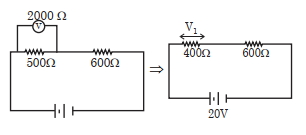
\(I=\frac{20}{1000} \,A\)\(V_{1}=I \times 400=\frac{20}{1000} \times 400\)
\(=8 \,V\)
-
- (A) \(25\)
- (B) \(50\)
- (C) \(100\)
- (D) \(18\)
Show answer and solution
Correct Answer: (B)
\(\frac{9 \times 10^{4} \times g \times 40}{3600} \times 0.5= n \times 100\)\(\frac{10^{4} \times 0.5}{100}= n\)
\(100 \times 0.5= n\)
\(n =50\)
-
- (A) Parallel combination of \(A\) and \(C\) connected in series with \(B\)
- (B) Parallel combination of \(A\) and \(B\) connected in series with \(C\).
- (C) Series combination of \(A\) and \(C\) connected in parallel with \(B\).
- (D) Series combination of \(B\) and \(C\) connected in parallel with \(A\).
Show answer and solution
Correct Answer: (B)
\(\Rightarrow \frac{4}{3}+6=\frac{22}{3}\) - 320. \(27\) identical drops are charged at \(22\, V\,\,each.\) They combine to form a bigger drop. The potential of the bigger drop will be............ \(V.\) 2022 Medium
- (A) \(200\)
- (B) \(198\)
- (C) \(87\)
- (D) \(177\)
Show answer and solution
Correct Answer: (B)
\(q \rightarrow nq\)\(n \frac{4}{3} \pi r ^{3}=\frac{4}{3} \pi\left( r ^{\prime}\right)^{3}\)
\(\Rightarrow r ^{\prime}= n ^{\frac{1}{3} r }\)
\(V =\frac{ kq }{ r } \propto \frac{ n }{ n ^{1 / 3}} \propto n ^{2 / 3} \propto 27^{2 / 3} \Rightarrow v ^{\prime}=9 V =9 \times 22=198\)
-
- (A) \(100\)
- (B) \(101\)
- (C) \(105\)
- (D) \(111\)
Show answer and solution
Correct Answer: (A)
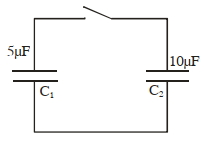
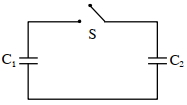
Before closing the switch\(Q = C _{1} V _{0}=5 \times 30=150\,\mu C\)
After closing the switch
\(V =\frac{ Q }{ C _{1}+ C _{2}}=\frac{150}{10+5}=10\,V\)
\(Q _{2}= C _{2} V =10 \times 10=100\,\mu C\)
-
- (A) \(1 / 2\)
- (B) \(1 / 3\)
- (C) \(1 / 4\)
- (D) \(1 / 6\)
Show answer and solution
Correct Answer: (D)
In \(t_{1}\) time energy becomes half so charge will become \(\frac{1}{\sqrt{2}}\) time\(q = Q _{0} e ^{\frac{ T _{1}}{ RC }}=\frac{ Q _{0}}{\sqrt{2}}\)
and \(q = Q _{0} e ^{\frac{ t _{1}}{ RC }}=\frac{ Q _{0}}{8}=\left(\frac{ Q _{0}}{\sqrt{2}}\right)^{6}\)
\(t _{2}=6 t _{1}\)
\(\frac{ t _{1}}{ t _{2}}=\frac{1}{6}\)
-
- (A) \(155\)
- (B) \(145\)
- (C) \(135\)
- (D) \(125\)
Show answer and solution
Correct Answer: (D)
Energy loss \(=\frac{1}{2} \frac{C_{1} C_{2}}{C_{1}+C_{2}}\left(V_{1}-V_{2}\right)^{2}\)\(=\frac{1}{2} \frac{50 \times 50 \times 10^{-12} \times 10^{-12}}{(50+50) 10^{-12}}(100-0)^{2}=125 \; n J\)
-
- (A) \(6\)
- (B) \(66\)
- (C) \(600\)
- (D) \(60\)
Show answer and solution
Correct Answer: (D)
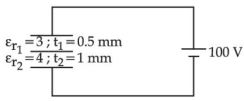
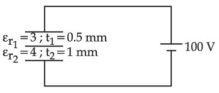
Capacitance of each capacitor\(C _{1}=\frac{ A 3 \epsilon_{0}}{\frac{1}{2}}=6 A \epsilon_{0}\)
\(C _{2}= A 4 E _{0}=4 A \in_{0}\)
Equivalent capacitance
\(C _{\text {eq }}=\frac{ C _{1} C _{2}}{ C _{1}+ C _{2}} \Rightarrow \frac{24}{10} A \in_{0}\)
\(q _{\text {net }}= C _{\text {eq }}(\Delta V ) \Rightarrow 240 A \in_{0}\)
\(\Delta V _{2}=\frac{240 A \epsilon_{0}}{4 A \epsilon_{0}}=60\,V\)
\(\left(\Delta V _{2}=\text { Potential drop across } C _{2}\right)\)
\(V _{\text {foil }}=60\,V\)
-
- (A) \(5\)
- (B) \(10\)
- (C) \(20\)
- (D) \(0\)
Show answer and solution
Correct Answer: (A)
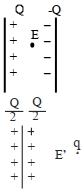
\(F=q E=q\left(\frac{Q}{A \epsilon_{0}}\right)=\frac{q Q}{A \epsilon_{0}}=10 \; N\)Now, when one plate is removed.
\(E^{\prime}=\frac{Q}{2 A \epsilon_{0}}\)
\(F=q E^{\prime}=\frac{Q q}{2 A \epsilon_{0}}=5 \; N\)
-
- (A) \(21\)
- (B) \(22\)
- (C) \(23\)
- (D) \(25\)
Show answer and solution
Correct Answer: (C)
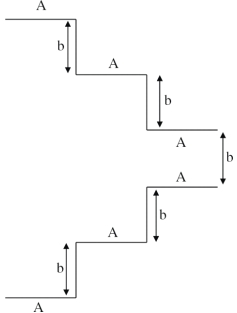
Parallel combination\(c _{ eq }=\varepsilon_{0} A \left[\frac{1}{5 b }+\frac{1}{3 b }+\frac{1}{ b }\right]=\frac{23}{15} \frac{\varepsilon_{0} A }{ b }\)
-
- (A) increase by \(50 \%\)
- (B) decrease by \(15 \%\)
- (C) increase by \(25 \%\)
- (D) increase by \(33 \%\)
Show answer and solution
Correct Answer: (A)
\(E \Rightarrow \frac{1}{2}( KC ) v ^{2}\)
\(\therefore \%\) change
\(\Rightarrow \frac{\frac{1}{2} K _{2} CV ^{2}-\frac{1}{2} K _{1} CV ^{2}}{\frac{1}{2} K _{1} CV ^{2}}=\frac{ K _{2}- K _{1}}{ K _{1}} \times 100\)
\(\Rightarrow \frac{15-10}{10} \times 100=50 \%\) -
- (A) \(1.66\)
- (B) \(1.75\)
- (C) \(2.25\)
- (D) \(2.33\)
Show answer and solution
Correct Answer: (D)
\(K =\frac{ q }{ A \in_{0} E }=\frac{7 \times 10^{-6}}{30 \pi \times 10^{-4} \times \frac{1}{4 \pi \times 9 \times 10^{9}} \times 3.6 \times 10^{7}}\)\(K =\frac{36 \times 7}{30 \times 3.6}=2.33\)
-
- (A) \(2\)
- (B) \(32\)
- (C) \(6\)
- (D) \(8\)
Show answer and solution
Correct Answer: (C)
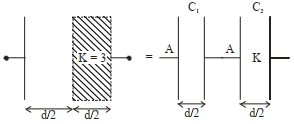
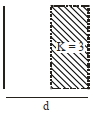
\(C _{\text {original }}=\frac{ A \varepsilon_{0}}{ d }\)\(C _{1}=\frac{ A \varepsilon_{0}}{ d / 2}=\frac{2 A \varepsilon_{0}}{ d }= C\)
\(C _{2}=\frac{ KA \varepsilon_{0}}{ d / 2}=\frac{2 KA \varepsilon_{0}}{ d }=\frac{6 A \varepsilon_{0}}{ d }=3 C\)
\(C_{1}\) and \(C_{2}\) are in series
\(C _{\text {new }}=\frac{ C _{1} C _{2}}{ C _{1}+ C _{2}}=\frac{ C \times 3 C }{ C +3 C }=\frac{3 C }{4}\)
\(=\frac{3}{4} \times \frac{2 A \varepsilon_{0}}{d}=\frac{3}{2} \times \frac{A \varepsilon_{0}}{d}\)
\(C _{\text {new }}=\frac{3}{2} C _{\text {original }}\)
\(=\frac{3}{2} \times 4=6\, \mu\, F\)
-
- (A) \(240\)
- (B) \(241\)
- (C) \(242\)
- (D) \(243\)
Show answer and solution
Correct Answer: (A)
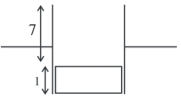
\(C _{\text {eff }}=\left[\frac{\varepsilon_{0}(7 \times 4)}{4 / 10}+\frac{5 \varepsilon_{0}(1 \times 4)}{4 / 10}\right] \times 10^{-2}\)\(C _{\text {eff }}=1.2 \varepsilon_{0}\)
Energy \(=\frac{1}{2} C _{\text {eff }} V ^{2}\)
\(=\frac{1}{2}(1.2) \varepsilon_{0}(20)(20)=240 \varepsilon_{0}\)
-
- (A) \(\frac{4 KC _{0}}{3+ K }\)
- (B) \(\frac{3 KC _{0}}{3+ K }\)
- (C) \(\frac{3+ K }{4 KC _{0}}\)
- (D) \(\frac{ K }{4+ K }\)
Show answer and solution
Correct Answer: (A)
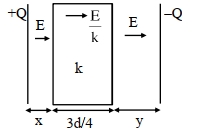
\(x + y +\frac{3 d }{4}= d\)\(x + y =\frac{ d }{4}\)
\(\frac{ A \epsilon_{0}}{ d }= C _{0}\)
\(\Delta V = Ex +\frac{ E }{ k } \times \frac{3 d }{4}+ Ey\)
\(=\frac{3 Ed }{4 k }+ E ( x + y )\)
\(\Delta V = E \left[\frac{3 d }{4 k }+\frac{ d }{4}\right]\)
\(\Delta V =\frac{\sigma}{\epsilon_{0}}\left[\frac{3 d + dk }{4 k }\right]=\frac{ Qd }{ A \epsilon_{0}}\left[\frac{3+ k }{4 k }\right]\)
\(\frac{ Q }{\Delta V }= C =\frac{ A \epsilon_{0}}{ d }\left[\frac{4 k }{3+ k }\right]=\frac{4 k C _{0}}{ k +3}\)
-
- (A) \(\frac{1}{10}\)
- (B) \(\frac{2}{5}\)
- (C) \(\frac{5}{13}\)
- (D) \(\frac{5}{26}\)
Show answer and solution
Correct Answer: (C)
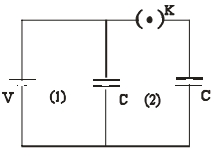
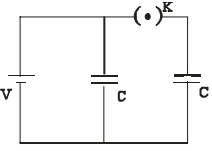
\((1)\) Switch is closed\(C _{ eq }=2 C\)
Energy \(E_{1}=\frac{1}{2} C_{\text {oq }} V^{2}\)
\(=\frac{1}{2} 2 C ^{2} \times V ^{2}\)
\(E _{1}= CV ^{2}\)
\((ii)\) When switch is opened charge on right capacitor remain CV while potential on left capacitor remain same
Dielectric \(K =5\)
\(C ^{\prime}= KC\)
\(C ^{\prime}=5\,C\)
\(E _{2}=\frac{1}{2}(5 C ) V ^{2}+\frac{( CV )^{2}}{2(5 C )}\)
\(E _{2}=\frac{5 CV ^{2}}{2}+\frac{ CV ^{2}}{10}\)
\(E _{2}=\frac{13 CV ^{2}}{5}\)
\(\frac{ E _{1}}{ E _{2}}=\frac{ CV ^{2}}{\frac{13 CV ^{2}}{5}}=\frac{5}{13}\)
\(\frac{ E _{1}}{ E _{2}}=\frac{5}{13}\)
-
- (A) \(\sqrt{2}: 1\)
- (B) \(2 \sqrt{2}: 1\)
- (C) \(4 \sqrt{2}: 1\)
- (D) \(8: 1\)
Show answer and solution
Correct Answer: (B)
\(p =\sqrt{2 mE }=\sqrt{2 mqV }\)\(\frac{ p _{\alpha}}{ p _{ p }}=\sqrt{\frac{ m _{\alpha} q _{\alpha}}{ m _{ p } q _{ p }}}=\sqrt{\frac{4}{1} \times \frac{2}{1}}\)
\(=\frac{2 \sqrt{2}}{1}\)
-
- (A) \(\frac{ n }{ n -1}\)
- (B) \(\frac{2 n}{2 n+1}\)
- (C) \(\frac{ n +1}{ n }\)
- (D) \(\frac{2 n+1}{n}\)
Show answer and solution
Correct Answer: (A)
Capacitance of isolated Conducting sphere \(=4 \pi \varepsilon_{0} R_{1}\)By enclosing inside another sphere of radius \(R_{2}\), new capacitance \(=\frac{4 \pi \varepsilon_{0} R_{1} R_{2}}{\left(R_{2}-R_{1}\right)}\)
Given: \(\frac{4 \pi \varepsilon_{0} R_{1} R_{2}}{\left(R_{2}-R_{1}\right)}=n \times 4 \pi \varepsilon_{0} R_{1}\)
\(\frac{ R _{2}}{\left( R _{2}- R _{1}\right)}= n \Rightarrow \frac{\frac{ R _{2}}{ R _{1}}}{\left(\frac{ R _{2}}{ R _{1}}-1\right)}= n\)
\(\frac{ R _{2}}{ R _{1}}= n \frac{ R _{2}}{ R _{1}}- n \Rightarrow \frac{ R _{2}}{ R _{1}}=\frac{ n }{( n -1)}\)
-
- (A) Both statement \(I\) and statement \(II\) are correct
- (B) Both statement \(I\) and statement \(II\) are incorrect
- (C) Statement \(I\) is correct but statement \(II\) is incorrect
- (D) Statement \(I\) is incorrect but and statement \(II\) is correct
Show answer and solution
Correct Answer: (A)
Statement \(- I\), true as body of conductor acts as equipotential surface.Statement \(-2\) True, as conductor is equipotential. Tangential component of electric field should be zero. Therefore electric field should be perpendicular to surface.
- 336. If the charge on a capacitor is increased by \(2C\), the energy stored in it increases by \(44 \%\). The original charge on the capacitor is (in \(C\) ) 2022 Medium
- (A) \(10\)
- (B) \(20\)
- (C) \(30\)
- (D) \(40\)
Show answer and solution
Correct Answer: (A)
\(U \propto q ^{2}\)\(\Rightarrow q _{ f }=1.2 \,q\)
\(q _{ f }- q =2\)
\(\Rightarrow 1.2 \,q - q =2\)
\(q =10\)
-
- (A) \(3 \,Vm ^{-1}\), directed along positive \(x\)-axis
- (B) \(3 \,Vm ^{-1}\), directed along negative \(x\)-axis
- (C) \(6 \,Vm ^{-1}\), directed along positive \(x\)-axis
- (D) \(6 \,Vm ^{-1}\), directed along negative \(x\)-axis
Show answer and solution
Correct Answer: (D)
\(E _{ x }=-\frac{\partial V }{\partial x }=-6 x\)At \((1,0,3)\)
\(\overrightarrow{ E }=-6 \,V / m \hat{ i }\)
-
- (A) \(1: 4\)
- (B) \(4: 1\)
- (C) \(1: 8\)
- (D) \(8: 1\)
Show answer and solution
Correct Answer: (B)
Let \(R=\) radius of combined drop\(r=\) radius of smaller drop
Volume will remain same
\(\frac{4}{3} \pi R ^{3}=64 \times \frac{4}{3} \pi r ^{3}\)
\(R =4 r\)
\(Q =64 q ;\)
\(q\) : charge of smaller drop
\(Q\) : Charge of combined drop
\(\frac{\sigma_{\text {bigger }}}{\sigma_{\text {smaller }}}=\frac{\frac{ Q }{4 \pi R ^{2}}}{\frac{ q }{4 \pi r ^{2}}}=\frac{ Q }{ q } \cdot \frac{ r ^{2}}{ R ^{2}}\)
\(=64 \frac{ r ^{2}}{16 r ^{2}}=4\)
\(\frac{\sigma_{\text {bigger }}}{\sigma_{\text {smaller }}}=\frac{4}{1}\)
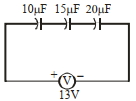
- 339. The charge on capacitor of capacitance \(15 \mu F\) in the figure given below is \(\dots \; \mu c\)
 2022 Medium
- (A) \(60\)
- (B) \(130\)
- (C) \(260\)
- (D) \(585\)
Show answer and solution
Correct Answer: (A)
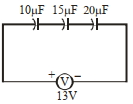
\(\frac{1}{ C _{ eq }}=\frac{1}{10}+\frac{1}{15}+\frac{1}{20}=\frac{12+8+6}{120}=\frac{26}{120}\)\(C _{ eq }=\frac{60}{13} \,\mu F\)
\(Q =\frac{13 \times 60}{13}=60 \,\mu C\)
Charge on each capacitor is same
\(\because\) they are in series.
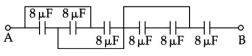
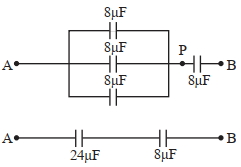
- 340. The equivalent capacitance between points \(A\) and \(B\) in below shown figure will be..........\(\mu F\).
 2022 Hard
- (A) \(9\)
- (B) \(60\)
- (C) \(6\)
- (D) \(79\)
Show answer and solution
Correct Answer: (C)
Two capacitors are short circuitedFinally equivalent capacitance
\(=\frac{24 \times 8}{24+8}=\frac{24 \times 8}{32}=6 \mu F\)
-
- (A) \(200\)
- (B) \(20\)
- (C) \(10\)
- (D) \(100\)
Show answer and solution
Correct Answer: (A)
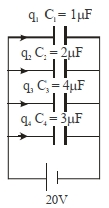
Total charge \(= q _{1}+ q _{2}+ q _{2}+ q _{4}\)\(=1 \times 20+2 \times 20+4 \times 20+3 \times 20=200\,\mu C\)
-
- (A) \(1.5\)
- (B) \(2.5\)
- (C) \(1.2\)
- (D) \(3\)
Show answer and solution
Correct Answer: (A)
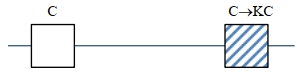
\(C _{ eq }=\frac{ C ( KC )}{ C + KC }=\frac{ KC }{ K +1}\)\(24=\frac{K 40}{K+1}\)
\({[K=1 \cdot 5] }\)
-
- (A) \(\frac{ C _{1} C _{2}}{\left( C _{1}+ C _{2}\right)} V\)
- (B) \(\frac{\left( C _{1}+ C _{2}\right)}{ C _{1} C _{2}} V\)
- (C) \(\left( C _{1}+ C _{2}\right) V\)
- (D) \(\left( C _{1}- C _{2}\right) V\)
Show answer and solution
Correct Answer: (A)
Charge on capacitor \(C _{2}\)\(=\frac{ C _{2} \times Q _{\text {total }}}{ C _{\text {total }}}=\frac{ C _{2}\left[ C _{1} V \right]}{ C _{1}+ C _{2}}=\frac{ C _{1} C _{2} V }{ C _{1}+ C _{2}}\)
-
- (A) \(\frac{\left(q_{1}+q_{2}\right)}{C}\)
- (B) \(\frac{\left( q _{1}- q _{2}\right)}{ C }\)
- (C) \(\frac{\left(q_{1}-q_{2}\right)}{2 C}\)
- (D) \(\frac{2\left(q_{1}-q_{2}\right)}{C}\)
Show answer and solution
Correct Answer: (C)
Flux \(\phi = EA=\frac{ q _{1}- q _{2}}{2 \varepsilon_{0}}\)Electric field between plates \(E =\frac{ q _{1}- q _{2}}{2 A \varepsilon_{0}}\)
\(V = Ed =\frac{ q _{1}- q _{2}}{2 A \in_{0}} d\)
\(V =\frac{ q _{1}- q _{2}}{2 C }\)
-
- (A) \(2: 1\)
- (B) \(1: 2\)
- (C) \(1: 4\)
- (D) \(4: 1\)
Show answer and solution
Correct Answer: (A)
\(C _{1}=\frac{\epsilon_{0} A }{ d }\)\(C _{2}=\frac{\epsilon_{0} A }{\frac{ d }{2}+\frac{ d / 2}{\propto}}=\frac{2 \epsilon_{0} A }{ d }\)
\(\frac{ C _{2}}{ C _{1}}=\frac{2}{1}\)
-
- (A) \(5\)
- (B) \(4\)
- (C) \(6\)
- (D) \(1\)
Show answer and solution
Correct Answer: (C)
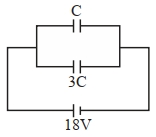
Initial charge on \(C =18\,CV\)initial charge on \(3 C =54\,CV\)
Let final common potential difference \(= V ^{\prime}\)
\(9\,CV ^{\prime}+3\,CV ^{\prime}=18\,CV +54\,CV\)
\(12\,CV ^{\prime}=72\,CV \Rightarrow V ^{\prime}=6 V\)
-
- (A) \(1:2\)
- (B) \(2:1\)
- (C) \(1:1\)
- (D) \(1:4\)
Show answer and solution
Correct Answer: (B)
\(V _{ A }= V _{ B }\)\(\frac{ KQ _{ A }}{ R _{ A }}=\frac{ KQ _{ B }}{ R _{ B }}\)
\(\frac{ Q _{ A }}{ Q _{ B }}=\frac{ R _{ A }}{ R _{ B }}=\frac{1}{2}\)
\(E _{ A }=\frac{ KQ _{ A }}{ R _{ A }^{2}} ; E _{ B }=\frac{ KQ _{ B }}{ R _{ B }^{2}}\)
\(\frac{ E _{ A }}{ E _{ B }}=\frac{ Q _{ A }}{ Q _{ B }} \times \frac{ R _{ B }{ }^{2}}{ R _{ A }{ }^{2}}=\frac{ R _{ B }}{ R _{ A }}=\frac{2}{1}\)
-
- (A) \(1\; \mu C\) and \(3\; \mu C\)
- (B) \(2\; \mu C\) and \(2\; \mu C\)
- (C) \(0\) and \(4\; \mu C\)
- (D) \(1.5\; \mu C\) and \(2.5\; \mu C\)
Show answer and solution
Correct Answer: (B)
\(F =\frac{ Kq (4- q )}{ d ^{2}}\)\(\frac{ dF }{ dq }=\frac{ K }{ d ^{2}}[4-2 q ]=0\)
\(q =2\)

-
- (A) \(\frac{\rho q R^{2}}{4 \varepsilon_{0}}\)
- (B) \(\frac{\rho q R^{2}}{2 \varepsilon_{0}}\)
- (C) \(\frac{q \rho}{4 \varepsilon_{0} R^{2}}\)
- (D) \(\frac{4 \varepsilon_{0} R^{2}}{q \rho}\)
Show answer and solution
Correct Answer: (A)
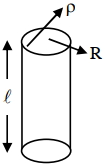
\(E\cdot 2 \pi r \ell=\frac{\rho \pi r ^{2} \ell}{\varepsilon_{0}}\)\(qE =\frac{ q \rho R ^{2}}{2 \varepsilon_{0} r }=\frac{ mv ^{2}}{ r }\)
\(mv ^{2}=\frac{ q \rho R ^{2}}{2 \varepsilon_{0}}\)
-
- (A) \(2\)
- (B) \(1\)
- (C) \(0\)
- (D) \(3\)
Show answer and solution
Correct Answer: (B)
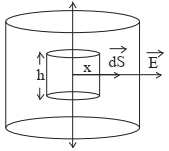
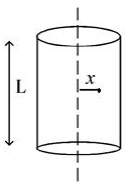
\(\int Eds \cos 0=\frac{ q }{\varepsilon_{0}}\)\(\Rightarrow E \cdot 2 \pi \times xh =\frac{\rho \times \pi x ^{2} h }{\varepsilon_{0}}\)
\(\Rightarrow E =\frac{\rho x }{2 \varepsilon_{0}}\)
\(\Rightarrow E =\frac{\rho}{2 \varepsilon_{0}} \times \frac{2 \varepsilon_{0}}{\rho}=1\)
No questions on this page match these filters.