


Questions
20 questionsShowing 1–20 of 20 questions
-
- (A) \(1\; \mu C\) and \(3\; \mu C\)
- (B) \(2\; \mu C\) and \(2\; \mu C\)
- (C) \(0\) and \(4\; \mu C\)
- (D) \(1.5\; \mu C\) and \(2.5\; \mu C\)
Show answer and solution
Correct Answer: (B)
\(F =\frac{ Kq (4- q )}{ d ^{2}}\)\(\frac{ dF }{ dq }=\frac{ K }{ d ^{2}}[4-2 q ]=0\)
\(q =2\)

-
- (A) \(\frac{\rho q R^{2}}{4 \varepsilon_{0}}\)
- (B) \(\frac{\rho q R^{2}}{2 \varepsilon_{0}}\)
- (C) \(\frac{q \rho}{4 \varepsilon_{0} R^{2}}\)
- (D) \(\frac{4 \varepsilon_{0} R^{2}}{q \rho}\)
Show answer and solution
Correct Answer: (A)
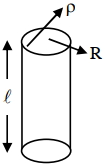
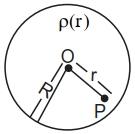
\(E\cdot 2 \pi r \ell=\frac{\rho \pi r ^{2} \ell}{\varepsilon_{0}}\)\(qE =\frac{ q \rho R ^{2}}{2 \varepsilon_{0} r }=\frac{ mv ^{2}}{ r }\)
\(mv ^{2}=\frac{ q \rho R ^{2}}{2 \varepsilon_{0}}\)
-
- (A) \(2\)
- (B) \(1\)
- (C) \(0\)
- (D) \(3\)
Show answer and solution
Correct Answer: (B)
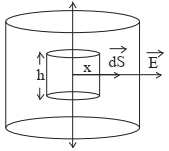
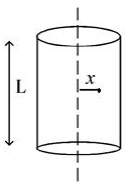
\(\int Eds \cos 0=\frac{ q }{\varepsilon_{0}}\)\(\Rightarrow E \cdot 2 \pi \times xh =\frac{\rho \times \pi x ^{2} h }{\varepsilon_{0}}\)
\(\Rightarrow E =\frac{\rho x }{2 \varepsilon_{0}}\)
\(\Rightarrow E =\frac{\rho}{2 \varepsilon_{0}} \times \frac{2 \varepsilon_{0}}{\rho}=1\)
-
- (A) \(1\)
- (B) \(5\)
- (C) \(10\)
- (D) \(0.5\)
Show answer and solution
Correct Answer: (D)
Distance travelled by particle before stopping\(\frac{ V ^{2}}{2 a }= S \Rightarrow \frac{ v ^{2} m }{2 qE }\)
\(\Rightarrow \frac{(200)^{2} \times 100 \times 10^{-6}}{2 \times 40 \times 10^{-6} \times 10^{5}}=0.5 \,m\)
-
- (A) \(\frac{\rho_{0} r}{4 \varepsilon_{0}}\left(\frac{3}{4}-\frac{r}{R}\right)\)
- (B) \(\frac{\rho_{0} r}{3 \varepsilon_{0}}\left(\frac{3}{4}-\frac{r}{R}\right)\)
- (C) \(\frac{\rho_{0} r}{4 \varepsilon_{0}}\left(1-\frac{r}{R}\right)\)
- (D) \(\frac{\rho_{0} r}{5 \varepsilon_{0}}\left(1-\frac{r}{R}\right)\)
Show answer and solution
Correct Answer: (C)
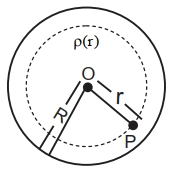
\(\oint \overrightarrow{ E } \cdot d \overrightarrow{ s }=\frac{ Q _{\text {in }}}{\varepsilon_{ o }}\)\(E .4 \pi r ^{2}=\frac{\int_{0}^{ r } \rho_{ o }\left(\frac{3}{4}-\frac{ r }{ R }\right) 4 \pi r ^{2} dr }{\varepsilon_{0}}\)
\(E 4 \pi r ^{2}=\frac{\rho_{ o } 4 \pi}{\varepsilon_{ o }}\left(\frac{3}{4} \frac{ r ^{3}}{3}-\frac{ r ^{4}}{4 R }\right)\)
\(Er { }^{2}=\frac{\rho_{ o } r ^{3}}{4 \varepsilon_{ o }}\left\{1-\frac{ r }{ R }\right\}\)
\(E =\frac{\rho_{0} r }{4 \varepsilon_{ o }}\left\{1-\frac{ r }{ R }\right\}\)
-
- (A) \(\tan ^{-1} (4)\)
- (B) \(\tan ^{-1}(2)\)
- (C) \(\tan ^{-1}\left(\frac{1}{3}\right)\)
- (D) \(\tan ^{-1} (3)\)
Show answer and solution
Correct Answer: (B)
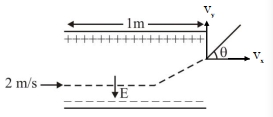
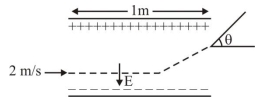
\(a _{ y }=\frac{ F _{ y }}{ m }=\frac{ e ( E )}{ m }=\frac{ e \left(\frac{8\,m }{ e }\right)}{ m }=8\,m / s ^{2}\)\(s _{ x }= u _{ x } t\)
\(1=2 \times t\)
\(t =\frac{1}{2} sec\)
\(v _{ y }= u _{ y }+ a _{ y } t\)
\(v _{ y }=0+8 \times \frac{1}{2}\)
\(v _{ y }=4\,m / s\)
\(\tan \theta=\frac{ v _{ y }}{ v _{ x }}=\frac{4}{2}=2 \Rightarrow \theta=\tan ^{-1}(2)\)
-
- (A) \(1.6 \times 10^{-9} C\)
- (B) \(2.0 \times 10^{-9} C\)
- (C) \(3.2 \times 10^{-9} C\)
- (D) \(0.5 \times 10^{-9} C\)
Show answer and solution
Correct Answer: (B)
\(Mg = qE\)\(\left(0.1 \times 10^{-3}\right)(9.8)=4.9 \times 10^{5} q\)
\(\frac{2 \times 10^{-4}}{10^{5}}= q\)
\(q=2 \times 10^{-9} C\)
-
- (A) Both statement \(-I\) and statement \(-I\) are true.
- (B) Both statement \(-I\) and statement \(-I\) are false.
- (C) Statement \(-I\) is true but statement \(-I\) is false.
- (D) Statement \(-I\) is false but statement \(-II\) is true.
Show answer and solution
Correct Answer: (C)
If the electric field is in the positive direction and the positive charge is to the left of that point then the electric field will increase. But to the left of the positive charge the electric field would decrease.If the dipole is kept at the point where the electric field is maximum then the force on it will be zero.
-
- (A) \(\frac{q}{\varepsilon_{0}}\)
- (B) \(\frac{q}{2 \varepsilon_{0}}\)
- (C) \(\frac{q}{4 \varepsilon_{0}}\)
- (D) \(\frac{ q }{2 \pi \varepsilon_{0}}\)
Show answer and solution
Correct Answer: (B)
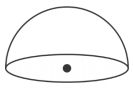
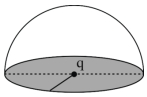
Total flux through complete spherical surface is \(\frac{ q }{\varepsilon_{0}}\)So the flux through curved surface will be \(\frac{q}{2 \varepsilon_{0}}\). The flux through flat surface will be zero.
Remark : Electric flux through flat surface is zero but no option is given, option is available for electric flux passing through curved surface.
-
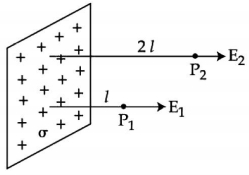
- (A) \(E _{1}=\sigma / \varepsilon_{0}, E _{2}=\sigma / 2 \varepsilon_{0}\)
- (B) \(E _{1}=2 \sigma / \varepsilon_{0}, E _{2}=\sigma / \varepsilon_{0}\)
- (C) \(E _{1}= E _{2}=\sigma / 2 \varepsilon_{0}\)
- (D) \(E _{1}= E _{2}=\sigma / \varepsilon_{0}\)
Show answer and solution
Correct Answer: (C)
As the sheet is very large \(\overrightarrow{ E }\) is independent of distance from it.Thus \(E _{1}= E _{2}=\frac{\sigma}{2 \varepsilon_{0}}\)
-
- (A) \(\frac{ q }{4 \pi \epsilon_{0} a ^{2}}\left(\frac{1}{\sqrt{2}}+\frac{1}{2}\right)\)
- (B) \(\frac{ q }{4 \pi \in_{0} a ^{2}}\left(1+\frac{1}{\sqrt{2}}\right)\)
- (C) \(\frac{ q }{4 \pi \epsilon_{0} a ^{2}}\left(1-\frac{1}{\sqrt{2}}\right)\)
- (D) \(\frac{ q }{4 \pi \in_{0} a ^{2}}\left(\frac{1}{\sqrt{2}}-\frac{1}{2}\right)\)
Show answer and solution
Correct Answer: (A)
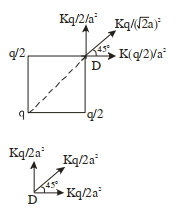
\(\left( E _{\text {ner }}\right)_{D}=\frac{ kq }{2 a ^{2}}+\frac{\sqrt{2 kq }}{2 a ^{2}}\)\(\left( E _{\text {ner }}\right)_{ D }=\frac{ kq }{ a ^{2}}\left(\frac{1}{2}+\frac{1}{\sqrt{2}}\right)\)
\(\left( E _{\text {net }}\right)_{ D }=\frac{ q }{4 \pi \epsilon_{0} a ^{2}}\left(\frac{1}{2}+\frac{1}{\sqrt{2}}\right)\)
-
- (A) \(44\)
- (B) \(43\)
- (C) \(45\)
- (D) \(42\)
Show answer and solution
Correct Answer: (C)
No. of electric field lines per unit area \(=\) electric field.\(E =\frac{\rho r}{3 \epsilon_{0}}, \text { for } r=R\)
\(E=\frac{\rho R}{3 \epsilon_{0}}=\frac{2 \times 6}{3 \times 8.85 \times 10^{-12}}=0.45 \times 10^{12}\,NC ^{-1}\)
\(=45 \times 10^{10}\,N / C\)
-
- (A) \(1: 1\)
- (B) \(1: 4\)
- (C) \(\sqrt{3}: 2\)
- (D) \(\sqrt{3}: 1\)
Show answer and solution
Correct Answer: (D)
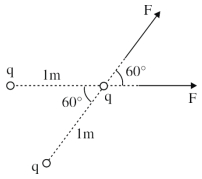
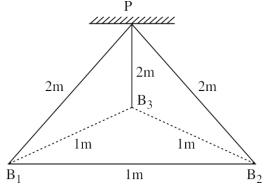
\(F=\frac{k(2)(2)}{(1)^{2}}\)( \(F=\) Force between two charges).
\(F =4 k\)
\(F_{\text {net }}=2 F \cos 30^{\circ}=2 \cdot F \cdot \frac{\sqrt{3}}{2}=F \sqrt{3}\)
\(\left(F_{\text {net }}=\right.\) Net electrostatic force on one charged ball)
\(\frac{F_{\text {net }}}{F}=\frac{\sqrt{3} F}{F}=(\sqrt{3})\)
Remark : Net force on any one of the ball is zero. But no option given in options.
-
- (A) \(177\)
- (B) \(12\)
- (C) \(17\)
- (D) \(29\)
Show answer and solution
Correct Answer: (C)
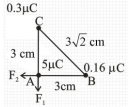
\(F _{1}=\frac{ k \times 5 \times 0.3 \times 10^{-12}}{9 \times 10^{-4}}\)\(=\frac{9 \times 10^{9} \times 5 \times 0.3 \times 10^{-12}}{9 \times 10^{-4}}\)
\(=1.5 \times 10=15\,N\)
\(F _{2}=\frac{9 \times 10^{9} \times 5 \times 0.16 \times 10^{-12}}{9 \times 10^{-4}}=8\,N\)
force experienced by charge at \(A =\sqrt{ F _{1}^{2}+ F _{2}^{2}}\)
\(=\sqrt{15^{2}+8^{2}}\)
\(=\sqrt{289}=17\,N\)
-
- (A) \(6\)
- (B) \(9\)
- (C) \(61\)
- (D) \(3\)
Show answer and solution
Correct Answer: (A)
\(|\tau|_{\max }= PE\)\(\frac{\tau_{1}}{\tau_{2}}=\frac{ P _{1} E _{1}}{ P _{2} E _{2}}=\frac{1 \cdot 2 \times 10^{-30} \times 5 \times 10^{4}}{2 \cdot 4 \times 10^{-30} \times 15 \times 10^{4}}\)
\(=\frac{1}{6}\)
Hence \(x=6\)
-
- (A) \(12\)
- (B) \(10\)
- (C) \(8\)
- (D) \(5\)
Show answer and solution
Correct Answer: (A)
\(\frac{ kq ^{2}}{ L ^{2}}=\mu mg \Rightarrow L =\sqrt{\frac{ k }{\mu mg } q }\) -
- (A) \(3\,F / 2\)
- (B) \(3\,F / 4\)
- (C) \(F\)
- (D) \(2\,F\)
Show answer and solution
Correct Answer: (B)
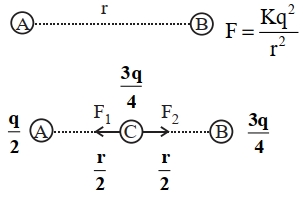
Let \(q _{ A }= q _{ B }= q\)When \(C\) is placed in contact with \(A\), charge on \(A\) and \( C\) will be \(=\frac{ q }{2}\)
Now \(C\) is placed in contact with \(B\), charge on \(B\) and \(C\) will be \(=\frac{q+\frac{q}{2}}{2}=\frac{3 q}{4}\)
\(F ^{\prime}= F _{2}- F _{1}=\frac{\left( K \frac{3 q }{4}- K \frac{ q }{2}\right)}{\frac{ r ^{2}}{4}} \cdot \frac{3 q }{4}\)
\(=\frac{3 Kq ^{2}}{4 r ^{2}}=\frac{3 F }{4}\)
-
- (A) \(\sqrt{\frac{4 \pi^{3} \varepsilon_{0} m a^{3}}{q_{0} Q}}\)
- (B) \(\sqrt{\frac{q_{0} Q}{4 \pi^{3} \varepsilon_{0} m a^{3}}}\)
- (C) \(\sqrt{\frac{2 \pi^{2} \varepsilon_{0} m a^{3}}{q_{0} Q}}\)
- (D) \(\sqrt{\frac{8 \pi^{3} \varepsilon_{0} m \alpha^{3}}{q_{0} Q}}\)
Show answer and solution
Correct Answer: (A)
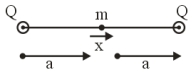
\(m \operatorname{acc}^{ n }=\frac{ KQq _{0}[2 a ][2 x ]}{\left( a ^{2}- x ^{2}\right)^{2}}\)\(\Rightarrow \operatorname{acc}^{ n } \approx\left(\frac{4 kQq _{0}}{ ma ^{3}}\right) x\)
\(T =2 \pi \sqrt{\frac{\pi \varepsilon_{0} ma ^{3}}{ Qq _{0}}}\)
\(T =\sqrt{\frac{4 \pi^{3} \varepsilon_{0} ma ^{3}}{ Qq _{0}}}\)
-
- (A) \(2.0\)
- (B) \(3.0\)
- (C) \(1.0\)
- (D) \(4.0\)
Show answer and solution
Correct Answer: (B)
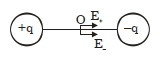
\(E _{0}=2 \times \frac{ Kq }{( d / 2)^{2}}\)\(\Rightarrow E _{0}=8 \frac{ Kq }{ d ^{2}}\)
\(\Rightarrow d ^{2}=\frac{8 \times 9 \times 10^{9} \times 8 \times 10^{-6}}{6.4 \times 10^{4}}\)
\(d =3\,m\)
-
- (A) \(x=d\)
- (B) \(x=\frac{d}{2}\)
- (C) \(x=\frac{d}{\sqrt{2}}\)
- (D) \(x=\frac{d}{2 \sqrt{2}}\)
Show answer and solution
Correct Answer: (D)
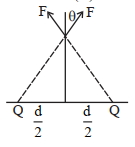
\(F =\frac{ KQq }{\left( x ^{2}+\frac{ d ^{2}}{4}\right)}\)Net force on \(g =2 F \cos \theta\)
\(F _{\text {act }}=\frac{2 KQqx }{\left( x ^{2}+\frac{ d ^{2}}{4}\right)^{3 / 2}}\)
For maximum \(F _{\text {act }}\)
\(\frac{ d F _{\text {net }}}{ dx }=0\)
we get \(x=\frac{d}{2 \sqrt{2}}\)

No questions on this page match these filters.