


Questions
15 questionsShowing 1–15 of 15 questions
-
- (A) \(900\)
- (B) \(800\)
- (C) \(100\)
- (D) \(700\)
Show answer and solution
Correct Answer: (D)
\(A =10 \,cm\)\(\therefore\) Total Energy \(=\frac{1}{2} KA ^{2}\)
By energy conservation we can final \(v\) at \(x =5\)
\(\frac{1}{2} K (10)^{2}=\frac{1}{2} K (5)^{2}+\frac{1}{2} mv ^{2}\)
\(V =\sqrt{\frac{75 K }{ m }}\)
Now, velocity is tripled through external mean so the amplitude of \(SHM\) will charge and so the total energy, (but potential) energy at this moment will remain same)
\(\therefore \frac{1}{2} K (5)^{2}+\frac{1}{2} m \left(3 \sqrt{\frac{75 K }{ m }}\right)^{2}=\frac{1}{2} KA ^{2}\)
\(\Rightarrow 25 K +675 K = KA ^{2}\)
\(\therefore A =\sqrt{700}\)
\(\therefore x =700\)
-
- (A) \(18\)
- (B) \(8\)
- (C) \(16\)
- (D) \(32\)
Show answer and solution
Correct Answer: (C)
\(\frac{1}{2} kA ^{2}=\frac{ p ^{2}}{2\,m }\)\(\Rightarrow\left(\frac{ A _{1}}{ A _{2}}\right)^{2}=\frac{ m _{2}}{ m _{1}}=\frac{1024}{900}\)
\(\Rightarrow \frac{ A _{1}}{ A _{2}}=\frac{32}{30}=\frac{16}{15}=\frac{16}{16-1}\)
\(\therefore \alpha=16\)
-
- (A) \(3\)
- (B) \(5\)
- (C) \(1\)
- (D) \(2\)
Show answer and solution
Correct Answer: (C)
\(t =\frac{\Delta \phi}{\omega}=\frac{\pi / 2-\pi / 6}{2 \pi / 6}=\frac{\pi / 3}{\pi / 3}=1 \,sec\) -
- (A) \(5\)
- (B) \(1\)
- (C) \(2\)
- (D) \(7\)
Show answer and solution
Correct Answer: (A)
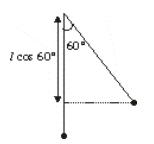
\(V _{\max }=\sqrt{2 gh }\)The speed will be highest at the lowest position.
\(h =\left(\ell-\ell \cos 60^{\circ}\right)=\frac{\ell}{2}\)
\(V _{\max }=\sqrt{2 \times g \times \frac{\ell}{2}}=\sqrt{10 \times 2.5}=5\,m / s\)
-
- (A) \(20\)
- (B) \(1\)
- (C) \(22\)
- (D) \(2\)
Show answer and solution
Correct Answer: (D)
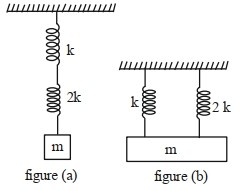
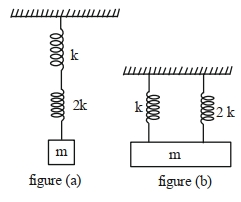
For figure \((a):\)\(K _{\text {oq }}=\frac{ K \times 2 K }{ K +2 K }=\frac{2 K }{3}\)
\(T =2 \pi \sqrt{\frac{ m }{ K _{ eq }}}=2 \pi \sqrt{\frac{ m }{2 K / 3}}=2 \pi \sqrt{\frac{3 m }{2 K }}\)
For figure \((b):\)
\(K _{ eq }=3 K , T ^{\prime}=2 \pi \sqrt{\frac{ m }{3 K }}\)
\(\frac{ T ^{\prime}}{ T }=\sqrt{\frac{ m \times 2 K }{3 K \times 3 m }}=\frac{\sqrt{2}}{3}\)
\(T ^{\prime}=\sqrt{2}\)
\(x =2\)
-
- (A) \(\frac{T_{1}}{T_{2}}=\frac{3}{\sqrt{2}}\)
- (B) \(\frac{ T _{1}}{ T _{2}}=\sqrt{\frac{3}{2}}\)
- (C) \(\frac{ T _{1}}{ T _{2}}=\sqrt{\frac{2}{3}}\)
- (D) \(\frac{ T _{1}}{ T _{2}}=\frac{\sqrt{2}}{3}\)
Show answer and solution
Correct Answer: (A)
\(T _{1}=2 \pi \sqrt{\frac{3 m }{2 k }}\)\(T _{2}=2 \pi \sqrt{\frac{ m }{3 k }}\)
\(\frac{ T _{1}}{ T _{2}}=\frac{2 \pi \sqrt{\frac{3 m }{2 k }}}{2 \pi \sqrt{\frac{ m }{3 k }}}=\frac{3}{\sqrt{2}}\)
-
- (A) \(6\)
- (B) \(8\)
- (C) \(12\)
- (D) \(36\)
Show answer and solution
Correct Answer: (D)
\(X=A \sin \omega t\left(t=3, X=\frac{A}{2}\right)\)\(\Rightarrow \frac{A}{2}=A \sin 3 \omega\)
\(\Rightarrow \sin 3 \omega=\frac{1}{2}\)
\(\Rightarrow 3 \omega=\frac{\pi}{6}\)
\(\Rightarrow \omega=\frac{\pi}{18}=\frac{2 \pi}{T}\)
\(\Rightarrow T=36 \; s\)
-
- (A) \(0\)
- (B) \(157\)
- (C) \(272\)
- (D) \(314\)
Show answer and solution
Correct Answer: (B)
\(x =\sin \pi\left( t +\frac{1}{3}\right)\)\(x =\sin \left(\pi t +\frac{\pi}{3}\right)\)
\(V =\frac{ dx }{ dt }=\cos \left(\pi t +\frac{\pi}{3}\right) \pi\)
\(=-\pi \times \frac{1}{2}=157 \,cm / s\)
-
- (A) \(4\)
- (B) \(5\)
- (C) \(3\)
- (D) \(0\)
Show answer and solution
Correct Answer: (B)
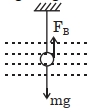
\(g^{\prime}=\frac{m g-F_{B}}{m}\)\(=\frac{\rho_{B} V g-\rho_{\pi} V g}{\rho_{B} V}\)
\(=\left(\frac{\rho_{B}-\rho_{\pi}}{\rho_{B}}\right) g \quad T=2 \pi \sqrt{\frac{\ell}{g}}\)
\(=\frac{5-1}{5} \times g\)
\(=\frac{4}{5} g\)
\(\frac{T^{\prime}}{T^{\prime}}=\sqrt{\frac{g}{g^{\prime}}}=\sqrt{\frac{g}{5} g}=\sqrt{\frac{5}{4}}\)
\(T^{\prime}=T \sqrt{\frac{5}{4}}=\frac{10}{2} \sqrt{5}\)
\(T^{\prime}=5 \sqrt{5}\)
-
- (A) \(97.23\)
- (B) \(25.3\)
- (C) \(99.4\)
- (D) \(406.1\)
Show answer and solution
Correct Answer: (C)
\(\omega=\sqrt{\frac{ g }{\ell}}=\pi\)\(\frac{ g }{\ell}=\pi^{2} \Rightarrow \ell=\frac{ g }{\pi^{2}}\)
\(\ell=\frac{980}{\pi^{2}} \approx 99.4 \,cm\)
-
- (A) \(2\)
- (B) \(3\)
- (C) \(4\)
- (D) \(5\)
Show answer and solution
Correct Answer: (A)
\(U =4(1-\cos 4 x )\)\(F =-\frac{ dU }{ dx }=-4(+\sin 4 x ) 4=-16 \sin (4 x )\)
For small \(\theta\)
\(\sin \theta \approx \theta\)
\(F=-64\,x\)
\(a=-64\,x / m=-16\,x\)
\(\omega^{2}=16\)
\(T =\frac{2 \pi}{\omega}=\frac{\pi}{2}\)
-
- (A) \(\sqrt{\frac{6}{5}} T\)
- (B) \(\sqrt{\frac{5}{6}} T\)
- (C) \(\sqrt{\frac{6}{7}} T\)
- (D) \(\sqrt{\frac{7}{6}} T\)
Show answer and solution
Correct Answer: (C)
\(T =2 \pi \sqrt{\frac{\ell}{ g _{\text {eff }}}}\)\((a)\) when \(a =0, T =2 \pi \sqrt{\frac{\ell}{ g }}\)
\((b)\) when \(a =\frac{ g }{6}, T ^{\prime}=2 \pi \sqrt{\frac{\ell}{ g +\frac{ g }{6}}}\)
\(\therefore T ^{\prime}=\sqrt{\frac{6}{7}} T\)

-
- (A) \(1: 2\)
- (B) \(3: 2\)
- (C) \(3: 1\)
- (D) \(2: 3\)
Show answer and solution
Correct Answer: (B)
\(V _{\max }=\omega A\)\(\Rightarrow \frac{ A _{1}}{ A _{2}}=\frac{\omega_{2}}{\omega_{1}}=\sqrt{\frac{9}{2} \times \frac{1}{2}}=\frac{3}{2}\)
-
- (A) \(55\)
- (B) \(56\)
- (C) \(60\)
- (D) \(53\)
Show answer and solution
Correct Answer: (C)
\(A _{\text {resultrant }}=\sqrt{ A _{1}^{2}+ A _{2}^{2}+2 A _{1} A _{2} \cos \phi}\)\(\sqrt{3} A =\sqrt{ A ^{2}+ A ^{2}+2 A ^{2} \cos \phi}\)
\(3 A ^{2}=2 A ^{2}+2 A ^{2} \cos \phi\)
\(\cos \phi=\frac{1}{2}\)
\(\therefore \phi=60^{\circ}\)
\(\therefore \text { Phase difference }=60 \text { degree }\)
- 15. When a particle executes simple Harmonic motion, the nature of graph of velocity as function of displacement will be. 2022 Medium
- (A) Circular
- (B) Ellipitical
- (C) Sinusoidal
- (D) Straight line
Show answer and solution
Correct Answer: (B)
For a particle in SHM, its speed depends on position as\(v=\omega \sqrt{A^{2}-x^{2}}\)
Where \(\omega\) is angular frequency and \(A\) is amplitude Now \(v ^{2}=\omega^{2} A ^{2}-\omega^{2} x ^{2}\)
So, \(\frac{ v ^{2}}{(\omega A )^{2}}+\frac{ x ^{2}}{( A )^{2}}=1\)
So graph between \(v\) and \(x\) is elliptical
No questions on this page match these filters.