


Questions
18 questionsShowing 1–18 of 18 questions
-
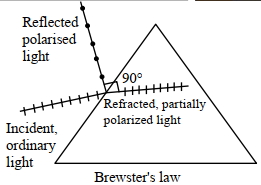
- (A) Reflected and refracted rays will be perpendicular to each other
- (B) Wave will propagate along the surface of prism
- (C) No refraction, and there will be total reflection of light.
- (D) No reflection and there will be total transmission of light
Show answer and solution
Correct Answer: (D)
But as the incident light electric field vectors are completely removed so there will be no reflection and there will be total transmission of light, explained by an experiment in \(NCERT.\)[Reference \(NCERT\) Part\(-2\) \(Pg\) \(-380,\) (A special case of total transmission)]
Note : Since direction of polarization is not mentioned hence most suitable option \((D)\) corresponding to case in which electric field is absent perpendicular to plane consisting incident and normal.
-
- (A) Resolving power will be \(\frac{1}{4}\) in the oil than it was in the air
- (B) Resolving power will be twice in the oil than it was in the air.
- (C) Resolving power will be four times in the oil than it was in the air.
- (D) Resolving power will be \(\frac{1}{2}\) in the oil than it was in the air.
Show answer and solution
Correct Answer: (B)
\((\text { R.P })_{\text {air }}=\frac{2 \sin \theta}{1.22 \lambda}\)\((\text { R.P })_{\text {oil }}=\frac{2 \sin \theta}{1.22 \lambda_{\text {oil }}}=\frac{2 \sin \theta \times \mu}{1.22 \lambda}\)
\((\text { R.P })_{\text {oil }}=(\text { R.P })_{\text {oir }} \times 2\)
-
- (A) \(\frac{I_{0}}{4}\)
- (B) \(\frac{I_{0}}{2}\)
- (C) \(\frac{3 I_{0}}{4}\)
- (D) \(\frac{3 I_{0}}{2}\)
Show answer and solution
Correct Answer: (C)
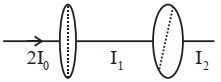
\(I _{1}=\frac{1}{2}\left(2 I _{0}\right)= I _{0}\)\(I _{2}= I _{1} \cos ^{2} 30^{\circ}\)
\(= I _{0} \cdot \frac{3}{4}=\frac{3 I _{0}}{4}\)
-
- (A) \(3 \times 10^{8} \; ms ^{-1}\)
- (B) \(3 \times 10^{10} \; ms ^{-1}\)
- (C) \(3.13 \times 10^{5} \; ms ^{-1}\)
- (D) \(4.48 \times 10^{5} \; ms ^{-1}\)
Show answer and solution
Correct Answer: (C)
\(\lambda_{\text {emitted }}=670 \; nm\)\(\lambda_{\text {obs }}=670.7 \; nm\)
\(v =?\)
\(c =3 \times 10^{8} \; m / s\)
If \(v << c\)
\(\frac{\lambda_{\text {obs }}-\lambda_{\text {emitted }}}{\lambda_{\text {emiited }}}=\frac{ v }{ c }\)
\(\frac{670.7-670}{670}=\frac{ v }{ c }\)
\(V =3.13 \times 10^{5} \; m / s\)
-
- (A) \(500\)
- (B) \(600\)
- (C) \(700\)
- (D) \(900\)
Show answer and solution
Correct Answer: (B)
\(\beta=\frac{\lambda D}{d}\)
\(\Delta \beta=\frac{\lambda}{ d } \Delta D\)
\(\lambda=\frac{\Delta \beta \cdot d}{\Delta D }\)
\(=\frac{3 \times 10^{-5} \times 1 \times 10^{-3}}{5 \times 10^{-2}}\)
\(=60 \times 10^{-8}=600 \times 10^{-9} \,m\)
\(=600 \,nm\) -
- (A) \(600\)
- (B) \(620\)
- (C) \(630\)
- (D) \(645\)
Show answer and solution
Correct Answer: (C)
\(\beta \propto \lambda\)\(\lambda_{2}=\frac{9}{8} \lambda_{1}\)
\(\therefore \beta_{2}=\frac{9}{8} \beta_{1}=\frac{9}{8} \times 560=630\,nm\)
-
- (A) \(1\)
- (B) \(4\)
- (C) \(5\)
- (D) \(0\)
Show answer and solution
Correct Answer: (B)
\(\beta=\frac{0.35 \times 5}{7}=0.25\)\(\frac{1}{\alpha}=\frac{2.5}{100}\)
\(\alpha=4\)
-
- (A) \(3\)
- (B) \(2\)
- (C) \(1.5\)
- (D) \(0.5\)
Show answer and solution
Correct Answer: (B)
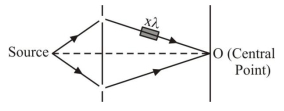
Path difference at \(O =(\mu-1) t\).If the intensity at \(O\) remains (maximum) unchanged, path difference must be \(n \lambda\).
\(\Rightarrow(\mu-1) t = n \lambda\)
\((1.5-1) x \lambda= n \lambda\)
\(\Rightarrow x =2 n\)
For \(n =1, x =2\)
-
- (A) \(16\)
- (B) \(9\)
- (C) \(48\)
- (D) \(12\)
Show answer and solution
Correct Answer: (B)
For a given light wavelength corresponding a medium of refractive index \(\mu\)\(\lambda_{\text {med }}=\frac{\lambda_{\text {vacuum }}}{\mu}\)
and we know that fringe width \(\beta=\frac{\lambda D}{ d }\)
Therefore, \(\beta_{\text {med }}=\frac{\beta_{\text {vacuum }}}{\mu}=\frac{12}{\frac{4}{3}}=9\,mm\)
-
- (A) \(450\)
- (B) \(550\)
- (C) \(650\)
- (D) \(750\)
Show answer and solution
Correct Answer: (A)
\(d=0.6 \times 10^{-3}\)\(D=80 \times 10^{-2}\)
\(1st\) Dark fringe \(=\frac{D \lambda}{2 d}=\frac{d}{2}, \quad \lambda=\frac{d^{2}}{D}\)
\(=450 \times 10^{-9} \; m\)
-
- (A) \(9\)
- (B) \(31\)
- (C) \(3\)
- (D) \(5\)
Show answer and solution
Correct Answer: (C)
\(\operatorname{asin} \theta=\frac{3 \lambda}{2}\)\(\frac{ y }{ L }=\theta=\frac{3 \lambda}{2 a } \quad L =2 m\)
\(y _{1}=\frac{3 \lambda_{1} L }{2 a } \quad \lambda_{2}=655\, nm\)
\(y _{2}=\frac{3 \lambda_{2} L }{2 a } \quad \lambda_{1}=650\, nm\)
\(a=0.5 \,nm\)
\(\Delta y = y _{2}- y _{1}=\frac{3\left(\lambda_{2}-\lambda_{1}\right)}{2 a } L\)
\(=\frac{3(655-650)}{2 \times 0.5 \times 10^{-3}} \times 2 \times 10^{-9}\)
\(=\frac{3 \times 5 \times 2}{1 \times 10^{-3}} \times 10^{-9}\)
\(=3 \times 10^{-5}\)
-
- (A) \(8.1 \times 10^{6}\)
- (B) \(10.0 \times 10^{7}\)
- (C) \(8.2 \times 10^{5}\)
- (D) \(1.0 \times 10^{-8}\)
Show answer and solution
Correct Answer: (C)
\(R.P =\frac{ d }{1.22 \lambda}=\frac{24.4 \times 10^{-2}}{1.22 \times 2440 \times 10^{-10}}=8.2 \times 10^{5}\) -
- (A) \(2\)
- (B) \(6\)
- (C) \(5\)
- (D) \(7\)
Show answer and solution
Correct Answer: (B)
\(I _{ P }= I +9 I +2 \sqrt{ I \times 9 I } \cos \frac{\pi}{2}\)\(I _{ P }=10\, I\)
\(I _{ Q }= I +9 I +2 \sqrt{ I \times 9 I } \cos \pi\)
\(=10 I -6 I =4 I\)
\(\therefore I _{ P }- I _{ Q }=10 I -4 I =6 I\)
-
- (A) \(1\)
- (B) \(3\)
- (C) \(4\)
- (D) \(2\)
Show answer and solution
Correct Answer: (D)
\(\phi_{ A }=\frac{\pi}{2}\)\(\phi_{ B }=\frac{\pi}{3}\)
\(I _{ A }= I +4 I +2 \sqrt{ I } \sqrt{4 I } \cos \left(\frac{\pi}{2}\right)\)
\(=5 I +4 I (0)=5 I\)
\(I _{ B }= I +4 I +2 \sqrt{ I } \sqrt{4 I } \cos \left(60^{\circ}\right)\)
\(=5 I +4 I \times \frac{1}{2}=7 I\)
\(I _{ B }- I _{ A }=7 I -5 I =2 I ,( x =2)\)
-
- (A) \(1.5\)
- (B) \(2\)
- (C) \(0.5\)
- (D) \(1\)
Show answer and solution
Correct Answer: (B)
\(\frac{ I _{1}}{ I _{2}}=\frac{1}{4}\)\(I _{2}=4 I _{1}\)
\(I _{\max }= I _{1}+4 I _{1}+2 \sqrt{ I _{1} 4 I _{1}}=9 I _{1}\)
\(I_{\min }=I_{1}+4 I_{1}-2 \sqrt{I_{1} 4 I_{1}}=I_{1}\)
\(\therefore \frac{9 I _{1}+ I _{1}}{9 I _{1}- I _{1}}=\frac{10}{8}=\frac{5}{4}=\frac{2 \alpha+1}{\beta+1}\)
\(\alpha=2 \beta=1\)
\(\therefore \frac{\alpha}{\beta}=\frac{2}{1}=2\)
-
- (A) \(24\)
- (B) \(12\)
- (C) \(6\)
- (D) \(3\)
Show answer and solution
Correct Answer: (A)
\(I _{\text {met }}=I_{1}+I_{2}+2 \sqrt{I_{1}} \sqrt{I_{2}} \cos \phi\)\(I_{\max }\) for \(\phi=0 \& I_{\min }\) for \(\phi=\pi\)
\(I_{\max }=\left(\sqrt{I_{1}}+\sqrt{I_{2}}\right)^{2}=(\sqrt{9 I}+\sqrt{4 I})^{2}=25\,I\)
\(I_{\min }=\left(\sqrt{I_{1}}-\sqrt{I_{2}}\right)^{2}=(\sqrt{9 I}-\sqrt{4 I})^{2}=I\)
\(I_{\max }-I_{\min }=25 I - I =24\,I\)
- 17. Two light beams of intensities in the ratio of \(9: 4\) are allowed to interfere. The ratio of the intensity of maxima and minima will be 2022 Medium
- (A) \(2: 3\)
- (B) \(16: 81\)
- (C) \(25: 169\)
- (D) \(25: 1\)
Show answer and solution
Correct Answer: (D)
\(\sqrt{\frac{I_{1}}{I_{2}}}=\sqrt{\frac{9}{4}}=\frac{3}{2}\)\(\left(\frac{\sqrt{ I _{1}}+\sqrt{ I _{2}}}{\sqrt{ I _{1}}-\sqrt{ I _{2}}}\right)^{2}=5^{2}=25\)
-
- (A) \(0.5\)
- (B) \(1.0\)
- (C) \(0.6\)
- (D) \(0.3\)
Show answer and solution
Correct Answer: (D)
Fringe width \(\beta=\frac{ D \lambda}{ d }\)\(\lambda_{1}=5000 \,\mathring A\)
\(\beta_{1}=\frac{ D }{ d }\left(5000 \times 10^{-10}\right)=5 \times 10^{-4} \,m\)......\((I)\)
\(\beta_{2}=\frac{ D }{(2 d )}\left(6000 \times 10^{-10}\right)= x \text { (let) }\).....\((II)\)
Divide \((II)\) and \((I)\)
\(\frac{\beta_{2}}{\beta_{1}}=\frac{3000 \times 10^{-10}}{5000 \times 10^{-10}}=\frac{x}{5 \times 10^{-4}}\)
\(x=3 \times 10^{-4} m \text { or } 0.3 \,mm\)
No questions on this page match these filters.