


Questions
46 questionsShowing 1–46 of 46 questions
-
- (A) \(137\)
- (B) \(136\)
- (C) \(135\)
- (D) \(134\)
Show answer and solution
Correct Answer: (B)
\(l=1\,m\)\(i =1\,A\)
Area \(=2 \times 10^{-6}\)
\(\rho=1.7 \times 10^{-8}\)
\(R =\frac{\rho \ell}{ A }=\frac{1.7 \times 10^{-8} \times 1}{2 \times 10^{-5}}=\frac{1.7}{2} \times 10^{-2}\)
\(V =\frac{1.7}{2} \times 10^{-2}\)
\(F =1.6 \times 10^{-19} \times \frac{1.7}{2} \times 10^{-2}\)
\(=1.36 \times 10^{-21}\)
\(=136 \times 10^{-23}\)
-
- (A) \(1: 4\)
- (B) \(1: 2\)
- (C) \(4: 1\)
- (D) \(2: 1\)
Show answer and solution
Correct Answer: (B)
\(\frac{ R _{ X }}{ R _{ Y }}=\frac{\ell_{ X }}{\ell_{ Y }}\)When wire is stretched to double of its length, then resistance becomes 4 times
\(R _{ W }=4 R _{ X }=2 R _{ Y }\)
\(\frac{ R _{ X }}{ R _{ Y }}=\frac{1}{2}\)
So. \(\frac{\ell_{ X }}{\ell_{ y }}=\frac{1}{2}\)
-
- (A) \(975\)
- (B) \(875\)
- (C) \(775\)
- (D) \(675\)
Show answer and solution
Correct Answer: (A)
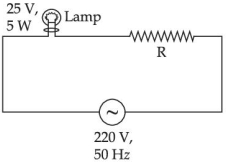
\(P = Vi\)\(5=25 i\)
\(i=\frac{1}{5}\)
\(V_{R}=i R\)
\((220-25)=\frac{1}{5} R\)
\(R=195 \times 5=975 \Omega\)
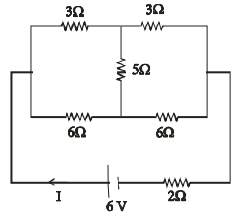
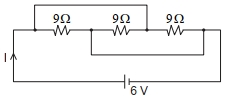
- 4. A battery of \(6\,V\) is connected to the circuit as shown below. The current I drawn from the battery is:
 2022 Medium
- (A) \(1\,A\)
- (B) \(2\,A\)
- (C) \(\frac{6}{11}\,A\)
- (D) \(\frac{4}{3}\,A\)
Show answer and solution
Correct Answer: (A)
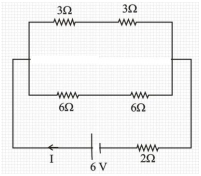
Balanced wheat stone bridge in circuit so there is no current in \(5\,\Omega\) resistor so it can be removed from the circuit.\(R _{eq }=\frac{6 \times 12}{6+12}+2\)
\(=\frac{6 \times 12}{18}+2\)
\(R _{e q }=6\,\Omega\)
\(I =\frac{ V }{ R _{a q }}=\frac{6}{6}=1\,Amp\)
-
- (A) \(7\)
- (B) \(8\)
- (C) \(9\)
- (D) \(10\)
Show answer and solution
Correct Answer: (B)
\(\frac{V_{1}}{V_{2}}=\frac{3}{2}=\frac{E-i_{1} r}{E-i_{2} r}\)\(=\frac{E-\frac{E}{8+r} \times r}{E-\frac{E}{4+r} \times r}\)
\(\frac{3}{2}=\frac{8(4+r)}{4(8+r)}\)
\(24+3 r=16+4 r\)
\(r=8 \; \Omega\)
-
- (A) \(50\)
- (B) \(75\)
- (C) \(150\)
- (D) \(275\)
Show answer and solution
Correct Answer: (D)
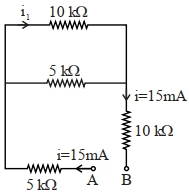
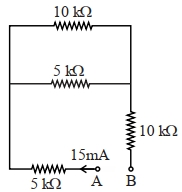
\(i_{1}=\frac{5}{10+5} \times 15 mA =5 mA\)\(V _{ A }-5 i -10 i _{1}-10 i = V _{ B }\)
\(V _{ A }- V _{ B }=75+50+150=275\,V\)
-
- (A) \(19\)
- (B) \(20\)
- (C) \(24\)
- (D) \(18\)
Show answer and solution
Correct Answer: (A)
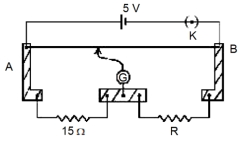
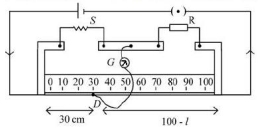
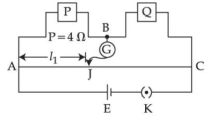
Using the conditions of a balanced wheat stone bridge and adding the end correction.\(\frac{15}{(43+2)}=\frac{R}{(102-45)} \Rightarrow R=\frac{57}{45} \times 15\)
\(R=19\,\Omega\)
-
- (A) \(56\)
- (B) \(85\)
- (C) \(25\)
- (D) \(55\)
Show answer and solution
Correct Answer: (C)
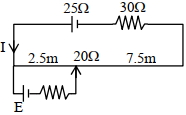
\(I =\frac{25}{50}=\frac{1}{2} \,A\)\(\therefore \Delta\, V =10 \,V\)
\(10 \,m \rightarrow 10 \,V\)
\(2.5\, m \rightarrow 2.5\, V\)
-
- (A) \(78\)
- (B) \(200\)
- (C) \(2\)
- (D) \(20\)
Show answer and solution
Correct Answer: (D)
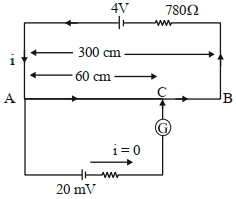
Let resistance of potentiometers wire is \(R\)\(i=\frac{4}{R+780}\)
Potential difference across \(AB\)
\(=\frac{4 R}{R+780}\)
Potential difference across \(AC\)
\(=\frac{4 R \times 60}{(R+780) \times 300}=\frac{4 R}{5(R+780)}\)
This should be equal to \(20\,mV\)
\(\frac{4 R}{5(R+780)}=20 \times 10^{-3}=2 \times 10^{-2}\)
\(4 R=10^{-1}(R+780)\)
\(4 R=\frac{R}{10}+78\)
\(4 R-\frac{R}{10}=78\)
\(\frac{39 R}{10}=78\)
\(R=20\,\Omega\)
-
- (A) \(480\)
- (B) \(450\)
- (C) \(490\)
- (D) \(45\)
Show answer and solution
Correct Answer: (B)
\(H =i^{2} Rt\)\(300=2^{2} \times R \times 15\)
\(\Rightarrow R =\frac{300}{60}=5 \Omega\)
Now, for \(i =3 A , t =10 s , R =5 \Omega\)
\(H =3^{2} \times 5 \times 10=450 \,J\)
-
- (A) \(A\) and \(B\) only
- (B) \(A\) and \(D\) only
- (C) \(B\) and \(E\) only
- (D) \(B\) and \(C\) only
Show answer and solution
Correct Answer: (B)
Drift velocity \(=\left(\frac{ e \tau}{ m }\right) E\)\(v _{ d }=\left(\frac{ e \tau}{ m }\right)\left(\frac{\Delta V }{\ell}\right)\)
\(\Delta V=\) Potential difference applied across the wire
As temperature increases, relaxation time decreases, hence \(V _{ d }\) decreases.
As per formula, \(V _{ d } \propto \frac{1}{\ell}\)
\(v _{ d }=\frac{ I }{\text { neA }}\), as it is not mentioned that current is at steady state neither it is mentioned that \(n\) is constant for given conductor. So it can't be said that \(v _{ d }\) is inversely proportional to \(A\).
\(I=n e A v_{d}=\frac{V}{R}=\frac{V}{\rho \ell} A\)
\(v _{ d }=\frac{ V }{\rho \ell \text { ne }} \quad\left( E =\frac{ V }{\ell}\right)\)
\(v _{ d }=\frac{ eE \tau}{ m }\)
\(\tau\) decrease with temperature increase.
First and fourth statements are correct.
-
- (A) \(9: 1\)
- (B) \(1: 9\)
- (C) \(4: 1\)
- (D) \(3: 1\)
Show answer and solution
Correct Answer: (A)
Explanation:
Let us decode the phrasing and compute the resistance ratio step-by-step using the principles of conservation of volume:
1. Decoding the Phrase "Increased By":
There is a vital difference between increased "to" and increased "by":
- "Increased to 2 times" implies the final length is \( 2L_1 \).
- "Increased by 2 times" implies the extension added to the wire is \( 2L_1 \).
Therefore, the final length \( L_2 \) is:
\( L_2 = L_1 + 2L_1 = 3L_1 \)
2. Conservation of Volume:
When a wire is stretched, its total volume \( V \) remains constant. Let \( A_1 \) be the initial cross-sectional area and \( A_2 \) be the final cross-sectional area:
\( V = L_1 A_1 = L_2 A_2 \)
\( L_1 A_1 = (3L_1) A_2 \implies A_2 = \frac{A_1}{3} \)
3. Resistance Calculation:
The baseline resistance formula is \( R = \rho \frac{L}{A} \), where \( \rho \) is the material resistivity. Writing the ratio of final resistance \( R_2 \) to initial resistance \( R_1 \) gives:
\( \frac{R_2}{R_1} = \frac{\rho \frac{L_2}{A_2}}{\rho \frac{L_1}{A_1}} = \left(\frac{L_2}{L_1}\right) \times \left(\frac{A_1}{A_2}\right) \)
Substituting our derived values into this expression:
\( \frac{R_2}{R_1} = \left(\frac{3L_1}{L_1}\right) \times \left(\frac{A_1}{A_1 / 3}\right) = 3 \times 3 = 9 \)
Expressing this as a standard fraction ratio yields 9 : 1.
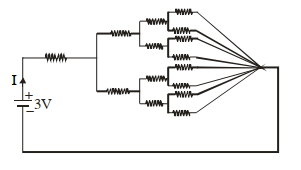
Hence, Option A is the correct choice. - 13. All resistances in figure are \(1\,\Omega\) each. The value of current ' \(I\) ' is \(\frac{a}{5}\,A\). The value of \(a\) is
 2022 Hard
- (A) \(8\)
- (B) \(2\)
- (C) \(1\)
- (D) \(11\)
Show answer and solution
Correct Answer: (A)
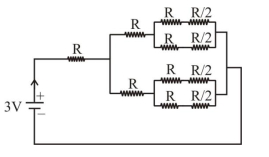
\(R_{e q}=\frac{15 R}{8}=\frac{15}{8}\,\Omega\)\(I=\frac{3}{\frac{15}{8}}=\frac{8}{5}\,A\)
\(\therefore a=8\)
- 14. An aluminium wire is stretched to make its length, \(0.4 \,\%\) larger. Then percentage change in resistance is \(.....\,\%\) 2022 Medium
- (A) \(0.4\)
- (B) \(0.2\)
- (C) \(0.8\)
- (D) \(0.6\)
Show answer and solution
Correct Answer: (C)
\(R =\frac{\rho \ell}{ A }\)\(\frac{\Delta R }{ R }=\frac{\Delta \ell}{\ell}-\frac{\Delta A }{ A }\)
\(\ell A = k\)
\(\frac{\Delta \ell}{\ell}+\frac{\Delta A }{ A }=0\)
\(\frac{\Delta R }{ R }=\frac{2 \Delta \ell}{\ell}\)
\(\frac{\Delta R }{ R }=2 \times 0.4=0.8 \%\)
-
- (A) \(14\)
- (B) \(13\)
- (C) \(12\)
- (D) \(11\)
Show answer and solution
Correct Answer: (A)
\(R _{1}=\frac{ V ^{2}}{ P }=\frac{220^{2}}{100}=484\)\(R _{2}=\frac{ V ^{2}}{ P }=\frac{220^{2}}{60}=484\left(\frac{10}{6}\right)\)
\(I =\frac{220}{484+484 \times \frac{10}{6}}\)
\(P _{1}= I ^{2} R _{1}=14.06\,W\)
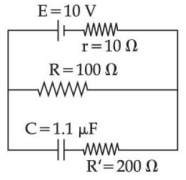
- 16. As show in the figure, in steady state, the charge stored in the capacitor is....... \(\times 10^{-6}\,C\).
 2022 Hard
- (A) \(10\)
- (B) \(9\)
- (C) \(1\)
- (D) \(100\)
Show answer and solution
Correct Answer: (A)
\(q = CV _{100 \Omega}\)\(=\left(1.1 \times 10^{-6}\right)\left(\frac{10}{ R + r } R \right)\)
\(=1.1 \times 10^{-6}\left(\frac{10}{110} \times 100\right)\)
\(=10\,\mu C\)
-
- (A) \(780\)
- (B) \(78\)
- (C) \(870\)
- (D) \(654\)
Show answer and solution
Correct Answer: (A)
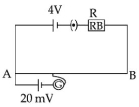
\(E =\frac{ AC }{ AB }\left( V _{ A }- V _{ B }\right)\)\(\therefore 20 \times 10^{-3}=\frac{60}{300} \times \frac{4 \times 20}{ R +20}\)
\(\therefore R =780\,\Lambda\)
-
- (A) \(10\)
- (B) \(9\)
- (C) \(11\)
- (D) \(8\)
Show answer and solution
Correct Answer: (A)
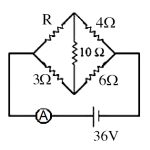
Using the condition of a balanced wheat stone bridge,\(\Rightarrow \frac{ R }{3}=\frac{4}{6} \Rightarrow R =2\,\Omega\)
So the effective resistance of the circuit is
\(R _{\text {eq }}=\frac{6 \times 9}{6+9}=\frac{18}{5}\,\Omega\)
\(i=\frac{36}{R_{e q}}=10\,A\)
-
- (A) \(3\)
- (B) \(4\)
- (C) \(2\)
- (D) \(1\)
Show answer and solution
Correct Answer: (B)
Each wire has resistance \(=\rho \frac{4 \ell}{\pi d ^{2}}=r\)Eight wire in parallel, then equivalent resistance is \(\frac{ r }{8}=\frac{\rho \ell}{2 \pi d ^{2}}\)
Single copper wire of length \(2 l\) has resistance
\(R =\rho \frac{2 \ell \times 4}{\pi d _{1}^{2}}=\frac{\rho \ell}{2 \pi d ^{2}}\)
\(d _{1}=4 d\)
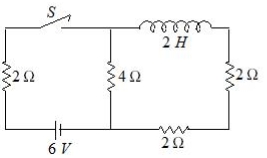
- 20. For the given circuit the current through battery of \(6\,V\) just after closing the switch ' \(S\) ' will be\(.......A\).
 2022 Medium
- (A) \(3\)
- (B) \(2\)
- (C) \(0\)
- (D) \(1\)
Show answer and solution
Correct Answer: (D)
Just after closing the switch \(S\), inductor behaveslike an open circuit.
\(I=\frac{6}{2+4}=1\,A\)
-
- (A) \(9\)
- (B) \(20\)
- (C) \(10\)
- (D) \(30\)
Show answer and solution
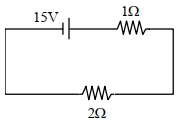
Correct Answer: (C)
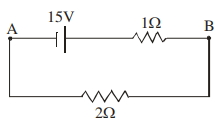
\(i =\frac{15}{3}=5 \,A\)\(15-5(1)=10 \,Volt\)
-
- (A) Both \(A\) and \(R\) are true and \(R\) is the correct explanation of \(A\).
- (B) Both A and R are true but \(R\) is NOT the correct explanation of \(A\).
- (C) \(A\) is true but \(R\) is false.
- (D) \(A\) is false but \(R\) is true.
Show answer and solution
Correct Answer: (A)
Theory based -
- (A) Both statement \(I\) and statement \(II\) are correct
- (B) Both statement \(I\) and statement \(II\) are incorrect
- (C) Statement \(I\) is correct but statement \(II\) is incorrect.
- (D) Statement \(I\) is incorrect but statement \(II\) is correct.
Show answer and solution
Correct Answer: (C)
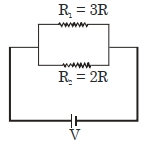
Statement \(1- R =80\,\Omega\)\(R _{1}= R _{2}= R _{3}= R _{4}=20\,\Omega\)
Statement \(2-\)
\(P _{ th }=\frac{ v ^{2}}{ R }\)
\(\frac{P_{1}}{P_{2}}=\left(\frac{R_{2}}{R_{1}}\right)=\frac{2}{3}\) (where \(P\) is power)
-
- (A) \(25\)
- (B) \(255\)
- (C) \(95\)
- (D) \(27\)
Show answer and solution
Correct Answer: (A)
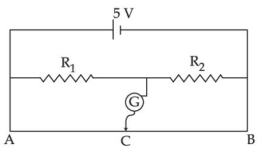
\(\frac{\varepsilon_{1}}{\varepsilon_{2}}=\frac{\ell_{1}}{\ell_{2}}\)\(\frac{3}{2}=\frac{75 \,cm }{\ell_{2}}\)
\(\ell_{2}=50\, cm\)
\(\ell_{1}-\ell_{2}=75-50\)
\(=25 \,cm\)
-
- (A) \(17\)
- (B) \(18\)
- (C) \(16\)
- (D) \(12\)
Show answer and solution
Correct Answer: (B)
\(1.2=(\) Potential Gradient \() \times 36\)\(1.8=(\) Potential Gradient \() \times x\)
On dividing, we get
\(\frac{2}{3}=\frac{36}{x}\)
\(x=18 \times 3=54\,cm\)
Hence difference \(=54-36=18\,cm\)
-
- (A) \(240\)
- (B) \(24\)
- (C) \(48\)
- (D) \(2400\)
Show answer and solution
Correct Answer: (D)
\(\frac{ S }{30}=\frac{5.6 \times 10^{3}}{70}\)\(S =\frac{3}{7} \times 5.6 \times 10^{3}=2400\)
-
- (A) \(3\)
- (B) \(4\)
- (C) \(5\)
- (D) \(6\)
Show answer and solution
Correct Answer: (A)
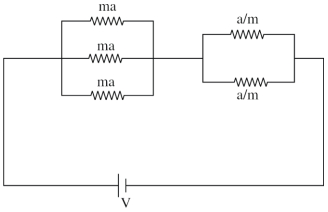
\(R =\left(\frac{ ma }{3}\right)+\left(\frac{ a }{2 m }\right)\)\(\frac{ dR }{ dm }=\frac{ a }{3}-\frac{ a }{2 m ^{2}}=0\)
\(\frac{ a }{3}=\frac{ a }{2 m ^{2}}\)
\(m ^{2}=\frac{3}{2}\)
\(m =\sqrt{\frac{3}{2}}\)
\(x =3\)
-
- (A) \(2\)
- (B) \(40\)
- (C) \(4\)
- (D) \(400\)
Show answer and solution
Correct Answer: (B)
Independent of area in case of uniform wire. -
- (A) \(3\)
- (B) \(4\)
- (C) \(40\)
- (D) \(8\)
Show answer and solution
Correct Answer: (B)
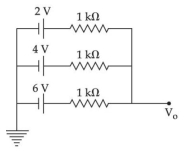
By nodal analysis \(\frac{V_{0}-2}{1 k \Omega}+\frac{V_{0}-4}{1 k \Omega}+\frac{V_{0}-6}{1 k \Omega}=0\)\(3 V _{0}-12=0\)
\(V _{0}=4\)
-
- (A) \(2.2\)
- (B) \(22\)
- (C) \(200\)
- (D) \(20\)
Show answer and solution
Correct Answer: (D)
Initially, \(\frac{ P }{ Q }=\frac{40 cm }{60 cm }=\frac{2}{3}\)Finally, \(\frac{ P + x }{ Q }=\frac{80 cm }{20 cm }=\frac{4}{1} \ldots(2)\)
Divide \((2)\) by \((1)\)
\(\frac{ P + x }{ P }=4 \times \frac{3}{2}=6\)
\(1+\frac{ x }{ P }=6 \Rightarrow \frac{ x }{ P }=5\)
\(\therefore x =5 P =5 \times 4=20 \Omega\)
-
- (A) \(0.033\)
- (B) \(-0.033\)
- (C) \(0.011\)
- (D) \(0.055\)
Show answer and solution
Correct Answer: (A)
\(R = R _{0}(1+\alpha \Delta T )\)\(3= R _{0}(1+\alpha(30-0))\)
\(2= R _{0}(1+\alpha(10-0))\)
\(\frac{3}{2}=\frac{1+30 \alpha}{1+10 \alpha}\)
\(\alpha=\frac{1}{30}=0.033\)
-
- (A) \(2\)
- (B) \(4\)
- (C) \(6\)
- (D) \(8\)
Show answer and solution
Correct Answer: (A)
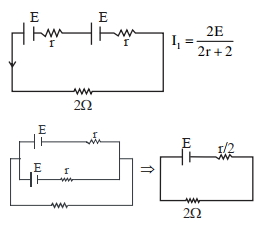
\(I _{2}=\frac{ E }{\frac{ r }{2}+2}=\frac{2 E }{ r +4}\)\(I _{1}= I _{2}\)
\(2 r +2= r +4\)
\(2 r - r =2 \,\Omega \Rightarrow r =2 \,\Omega\)
-
- (A) \(-48\)
- (B) \(48\)
- (C) \(-58\)
- (D) \(58\)
Show answer and solution
Correct Answer: (B)
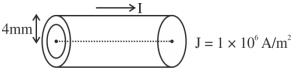
\(J=\frac{I}{A}\)\(I=J A\)
\(=4 \times 10^{6} \times\left[\pi R^{2}-\pi\left(\frac{R}{2}\right)^{2}\right]\)
\(=4 \times 10^{6} \times \pi R^{2} \times \frac{3}{4}\)
\(=4 \times 10^{6} \times \pi \times\left(4 \times 10^{-3}\right)^{2} \times \frac{3}{4}=48 \; \pi A .\)
-
- (A) \(10\)
- (B) \(11\)
- (C) \(12\)
- (D) \(14\)
Show answer and solution
Correct Answer: (C)
\(I =\int JdA\)\(=\int 10^{6} \times 2 \pi xdx\)
\(\left.=10^{6} \times 2 \pi \cdot x \frac{ x ^{2}}{2}\right]_{\frac{ r }{2}}^{ T }\)
\(=\pi \times 10^{6}\left[ r ^{2}-\frac{ r ^{2}}{4}\right]=12 \pi\)
\(x =12\)
-
- (A) \(8\)
- (B) \(5\)
- (C) \(4\)
- (D) \(2\)
Show answer and solution
Correct Answer: (D)
\(I=6 / 3=2\,A\)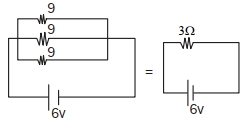
-
- (A) \(10\)
- (B) \(20\)
- (C) \(4\)
- (D) \(40\)
Show answer and solution
Correct Answer: (A)
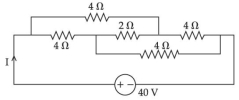
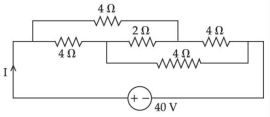
Given circuit is balanced wheat stone bridge Hence \(2 \Omega\) can be neglected\(R_{\text {net }}=4 \Omega\)
\(I=\frac{40}{4}\)
\(I=10\,A\)
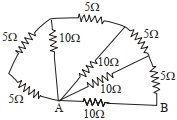
- 37. The equivalent resistance between points \(A\) and \(B\) in the given network is ............ \(\Omega\)
 2022 Medium
- (A) \(65\)
- (B) \(20\)
- (C) \(5\)
- (D) \(2\)
Show answer and solution
Correct Answer: (C)
\(R _{ AB }=5 \,\Omega\)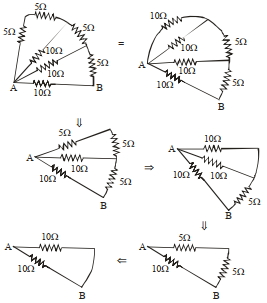
-
- (A) \(390\)
- (B) \(300\)
- (C) \(370\)
- (D) \(399\)
Show answer and solution
Correct Answer: (B)
\(V ^{\prime}= V\)\(\ell^{\prime} A =\ell A\)
\(2 \ell A ^{\prime}=\ell A\)
\(A ^{\prime}=\frac{ A }{2}\)
\(R =\rho \frac{\ell}{ A } \ldots\,\, (i)\)
\(\ell^{\prime}=2 \ell\)
\(A ^{\prime}=\frac{ A }{2}\)
\(R ^{\prime}=\frac{\rho \ell^{\prime}}{ A }=\frac{\rho 2 \ell}{\frac{ A }{2}}\)
\(R ^{\prime}=\frac{4 \rho \ell}{ A }\)
\(R ^{\prime}=4 R\) from equation \((i)\)
\(\%\) increase in resistance
\(=\frac{ R ^{\prime}- R }{ R } \times 100=\frac{4 R - R }{ R } \times 100\)
\(=300 \%\)
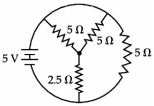
- 39. The total current supplied to the circuit as shown in figure by the \(5 V\) battery is \(A\)
 2022 Medium
- (A) \(7\)
- (B) \(2\)
- (C) \(9\)
- (D) \(60\)
Show answer and solution
Correct Answer: (B)
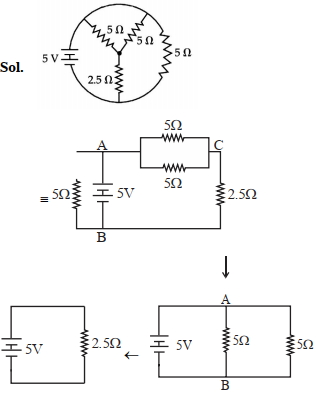
Current supplied by \(5 \,V\) battery\(=\frac{5 V }{2.5 \Omega}=2 A\)
-
- (A) \(134\)
- (B) \(143\)
- (C) \(150\)
- (D) \(144\)
Show answer and solution
Correct Answer: (D)
\(1=\rho \frac{\ell}{ A }\)\(1=\frac{\rho \times 31.4}{\frac{\pi(2.4)^{2}}{4}}\)
\(\frac{\pi(2.4)^{2}}{4}=\rho \times 314\)
\(\frac{2.4 \times 2.4}{4}=\rho \times 10\)
\(\frac{0.6 \times 2.4}{10}=\rho\)
\(\frac{1.44}{10}=\rho\)
\(0.144=\rho\)
\(144 \times 10^{-3}=\rho\)
-
- (A) \(r _{2}- r _{1}\)
- (B) \(r_{1}-r_{2}\)
- (C) \(r _{1}\)
- (D) \(r _{2}\)
Show answer and solution
Correct Answer: (A)
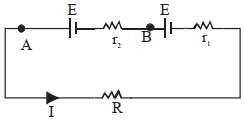
\(I=\frac{2 E }{R+I_{1}+I_{2}} \ldots \text{(i)}\)But \(V _{ A }- V _{ B }= E - I _{2}=0\)
\(\Rightarrow I =\frac{ E }{ I _{2}} \ldots \text{(ii)}\)
Comparing values of \(I\) from \((i)\) and \((ii)\)
\(\frac{E}{r_{2}}=\frac{2 E}{R+r_{1}+r_{2}}\)
\(\Rightarrow R=r_{2}-r_{1}\)
-
- (A) \(10\)
- (B) \(15\)
- (C) \(17\)
- (D) \(14\)
Show answer and solution
Correct Answer: (B)
\(\frac{d Q}{d t}=i^{2} R=\frac{V^{2}}{R}\) (we know)\(\Rightarrow \text { In 't' time , } \Delta Q =\left(\frac{ V ^{2}}{ R }\right) t\)
Given that, (for same source, \(v=\) same)
\(Q _{0}=\frac{ v ^{2}}{ R _{1}} \times 20=\frac{ V ^{2}}{ R _{2}} \times 60 \ldots\) \((i)\)
\(\Rightarrow R _{2}=3 R _{1} \ldots.\) \((ii)\)
If they are connected in parallel then
\(\operatorname{Req}=\frac{ R _{2} R _{1}}{ R _{1}+ R _{2}}=\frac{3 R _{1} \cdot R _{1}}{3 R _{1}+ R _{1}}=\left(\frac{3 R _{1}}{4}\right)\)
To produce same heat, using equation ...\((i)\)
\(Q _{0}=\frac{ V ^{2}}{ R _{1}} \times 20=\frac{ v ^{2}}{\left(\frac{3 R _{1}}{4}\right)} \times t\)
\(t =\frac{3 \times 20}{4}=15 \,min\)
-
- (A) \(2.5\)
- (B) \(4\)
- (C) \(5\)
- (D) \(10\)
Show answer and solution
Correct Answer: (C)
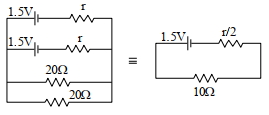
\(V = E - ir / 2\)\(1.2=1.5- i \left(\frac{ r }{2}\right)\)
\(i \frac{ r }{2}=0.3\)
\(i =\frac{1.5}{10+\frac{ r }{2}} \Rightarrow 10 i +\frac{ ir }{2}=1.5\)
\(10 i =1.5-0.3\)
\(i =0.12\, A\)
\(\Rightarrow r =\frac{0.6}{0.12}=5 \,\Omega\)
-
- (A) \(2\)
- (B) \(7\)
- (C) \(8\)
- (D) \(9\)
Show answer and solution
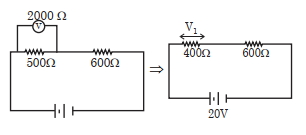
Correct Answer: (C)
\(I=\frac{20}{1000} \,A\)\(V_{1}=I \times 400=\frac{20}{1000} \times 400\)
\(=8 \,V\)
-
- (A) \(25\)
- (B) \(50\)
- (C) \(100\)
- (D) \(18\)
Show answer and solution
Correct Answer: (B)
\(\frac{9 \times 10^{4} \times g \times 40}{3600} \times 0.5= n \times 100\)\(\frac{10^{4} \times 0.5}{100}= n\)
\(100 \times 0.5= n\)
\(n =50\)
-
- (A) Parallel combination of \(A\) and \(C\) connected in series with \(B\)
- (B) Parallel combination of \(A\) and \(B\) connected in series with \(C\).
- (C) Series combination of \(A\) and \(C\) connected in parallel with \(B\).
- (D) Series combination of \(B\) and \(C\) connected in parallel with \(A\).
Show answer and solution
Correct Answer: (B)
\(\Rightarrow \frac{4}{3}+6=\frac{22}{3}\)
No questions on this page match these filters.