


Questions
16 questionsShowing 1–16 of 16 questions
-
- (A) \(2 \pi\)
- (B) \(5 \pi\)
- (C) \(\pi\)
- (D) \(\frac{5 \pi}{2}\)
Show answer and solution
Correct Answer: (B)
\(V _{ P } \max =4 V _{\text {wave }}\)\(\omega A =4\left(\frac{\omega}{ k }\right) \Rightarrow A =\frac{4 \lambda}{2 \pi}\)
\(\lambda=\frac{2 \pi A }{4} \Rightarrow \frac{20 \pi}{4} \Rightarrow 5 \pi\)
-
- (A) \(151\)
- (B) \(152\)
- (C) \(153\)
- (D) \(154\)
Show answer and solution
Correct Answer: (B)
\(f_{1}= f\)\(f _{2}= f +4\)
\(f _{3}= f +2 \times 4\)
\(f _{4}= f +3 \times 4\)
\(f _{20}= f +19 \times 4\)
\(f +(19 \times 4)=2 \times f\)
\(f =76 \; Hz\)
Frequency of last tuning forks \(=2 \; f\)
\(=152 \; Hz\)
-
- (A) \(4 \pi\)
- (B) \(2 \pi\)
- (C) \(\pi\)
- (D) \(2\)
Show answer and solution
Correct Answer: (A)
\(y=2 \sin (\omega t-k x)\)Maximum particle velocity \(= A \omega\)
Wave velocity \(=\frac{\omega}{ k }\)
\(\frac{\omega}{ k }= A \omega\)
\(k =\frac{1}{ A }=\frac{2 \pi}{\lambda}\)
\(\lambda =2 \pi A\)
\(=4 \pi\,cm\)
-
- (A) \(48\)
- (B) \(49\)
- (C) \(50\)
- (D) \(54\)
Show answer and solution
Correct Answer: (C)
Assumption : Ignore word "fundamental mode" in question.\(\lambda=\frac{ V }{ f }=\frac{340}{340}=1\,m\)
First resonating length \(=\frac{\lambda}{4}=25\,cm\)
Second resonating length \(=\frac{3 \lambda}{4}=75\,cm\)
Third resonating length \(=\frac{5 \lambda}{4}=125\,cm\)
Height of water required \(=125-75=50\,cm\)
-
- (A) \(1.5\)
- (B) \(6\)
- (C) \(9\)
- (D) \(3\)
Show answer and solution
Correct Answer: (D)
\(\frac{ nv }{0.6}=400 \& \frac{( n +1) v }{0.6}=450\)\(\left[\frac{0.6 \times 400}{ v }+1\right] \frac{ v }{0.6}=450\)
\(= v =30\)
\(\sqrt{\frac{ T }{\mu}}=30\)
\(\frac{2700}{\mu}=900=\mu=3\)
-
- (A) \(19\)
- (B) \(200\)
- (C) \(20\)
- (D) \(2\)
Show answer and solution
Correct Answer: (C)
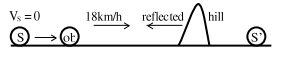
\(V_{S}=0, V_{o b}=5 m / s\)\(f _{\text {direct }}=\left(\frac{320-5}{320}\right) 640=630 Hz\)
\(f _{\text {reflected }}=\left(\frac{320+5}{320}\right) 640=650 Hz\)
\(f _{\text {beat }}=650-630=20 Hz\)
-
- (A) \(20\)
- (B) \(10\)
- (C) \(5\)
- (D) \(0\)
Show answer and solution
Correct Answer: (A)
\(f_{0}=\left(\frac{v+v_{0}}{v}\right) f_{s}\)\(f_{0}=\left(\frac{v+\frac{v}{5}}{v}\right) f_{s}\)
\(f_{0}=\frac{6}{5} f_{s}\)
\(\%\) change \(=\frac{f_{0}-f_{s}}{f_{s}} \times 100\)
\(=\frac{1}{5} \times 100=20 \%\)
-
- (A) \(103\)
- (B) \(100\)
- (C) \(110\)
- (D) \(104\)
Show answer and solution
Correct Answer: (D)
For first resonance\(\ell_{1}+ e =\frac{\lambda}{4}\)
\(\lambda=\frac{336}{400} \times 100 \,cm =84 \,cm \Rightarrow \frac{\lambda}{4}=21 \,cm\)
\(e =21-20=1 \,cm\)
For third resonance
\(\ell_{3}+ e =\frac{5 \lambda}{4}=105 \,cm \Rightarrow \ell_{3}=104 \,cm\)
-
- (A) \(200\)
- (B) \(200 \sqrt{2}\)
- (C) \(400\)
- (D) \(400 \sqrt{2}\)
Show answer and solution
Correct Answer: (C)
\(y =0.5 \sin \left(\frac{2 \pi}{\lambda} 400 t -\frac{2 \pi}{\lambda} x \right)\)\(\omega=\frac{2 \pi}{\lambda} 400\)
\(K =\frac{2 \pi}{\lambda}\)
\(v =\frac{\omega}{ k } \quad[ v =400\,m / s ]\)
-
- (A) \(2\)
- (B) \(4\)
- (C) \(5.8\)
- (D) \(8\)
Show answer and solution
Correct Answer: (A)
\(A_{1}=5 \quad A_{2}=3\)\(\Delta \theta=2 \pi(1.5)=3 \pi\)
\(A_{\text {net }}=\sqrt{A_{1}^{2}+A_{2}^{2}+2 A_{1} A_{2} \cos (3 \pi)}\)
\(=\left| A _{1}- A _{2}\right|\)
\(=2 \,cm\)
-
- (A) \(90\)
- (B) \(88\)
- (C) \(80\)
- (D) \(100\)
Show answer and solution
Correct Answer: (C)
\(f _{1}=\frac{2 v }{2 l _{1}}\)\(f _{2}=\frac{ v }{41_{2}}\)
\(f _{1}= f _{2}\)
\(=\frac{2 v }{2 l _{1}}=\frac{ v }{41_{2}}\)
\(1_{1}=41_{2}=80 \,cm\)
-
- (A) \(320\)
- (B) \(340\)
- (C) \(360\)
- (D) \(380\)
Show answer and solution
Correct Answer: (B)
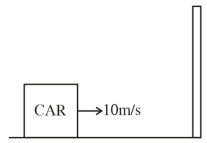
The hill will be a secondary source.\(f _{1}=\) frequency of the car w.r.t. the hill
\(f_{1}=\left(\frac{v}{v-v_{ s }}\right) f=\left(\frac{330}{320}\right) \times 320=330 Hz\)
\(f _{2}=\) Frequency of the sound reflected by hill w.r.t. the car \((echo)\)
\(f_{2}=\left(\frac{v+v_{0}}{v}\right) f_{1}=\frac{(330+10)}{330} \times 330=340\,Hz\)
-
- (A) \(10\)
- (B) \(15\)
- (C) \(13\)
- (D) \(14\)
Show answer and solution
Correct Answer: (B)
Explanation:
Let us calculate the extension of the wire step-by-step by combining wave mechanics and elasticity principles:
1. Calculate the Linear Mass Density (\( \mu \)):
Linear mass density represents the mass per unit length of the string:
\( \text{Mass } (m) = 10\text{ g} = 10 \times 10^{-3}\text{ kg} = 0.01\text{ kg} \)
\( \text{Length } (L) = 50\text{ cm} = 0.5\text{ m} \)
\( \mu = \frac{m}{L} = \frac{10 \times 10^{-3}\text{ kg}}{0.5\text{ m}} = 0.02\text{ kg/m} \)
2. Determine the Tension (\( T \)) using Wave Speed:
The velocity of a transverse wave traveling along a stretched string is governed by the equation:
\( v = \sqrt{\frac{T}{\mu}} \)
Squaring both sides and solving for tension \( T \) gives:
\( v^2 = \frac{T}{\mu} \implies T = v^2 \times \mu \)
Substituting the given speed \( v = 60\text{ ms}^{-1} \):
\( T = (60)^2 \times 0.02 = 3600 \times 0.02 = 72\text{ N} \)
3. Calculate the Longitudinal Extension (\( \Delta l \)):
From Hooke's Law and the definition of Young's Modulus (\( Y \)):
\( Y = \frac{\text{Stress}}{\text{Strain}} = \frac{T / A}{\Delta l / L} \implies \Delta l = \frac{T L}{A Y} \)
Convert the cross-sectional area to standard SI units:
\( A = 2.0\text{ mm}^2 = 2.0 \times 10^{-6}\text{ m}^2 \)
Substituting the parameters into the elongation formula yields:
\( \Delta l = \frac{72 \times 0.5}{2.0 \times 10^{-6} \times 1.2 \times 10^{11}} \)
\( \Delta l = \frac{36}{2.4 \times 10^5} = 15 \times 10^{-5}\text{ m} \)
Comparing this with the format \( x \times 10^{-5}\text{ m} \) given in the problem statement confirms that \( x = 15 \).
Hence, Option B is the correct choice. -
- (A) \(282 .8\)
- (B) \(175.5\)
- (C) \(353.6\)
- (D) \(707.2\)
Show answer and solution
Correct Answer: (D)
\(f_{b}=f_{1}-f_{2}\)\(\frac{v}{4.08}-\frac{v}{4.16}=\frac{40}{12}\)
\(\Rightarrow v =707.2\)
-
- (A) \(4\)
- (B) \(9\)
- (C) \(6\)
- (D) \(5\)
Show answer and solution
Correct Answer: (D)
\(10 \cos \left(\frac{4 \pi}{3}\right)\) -
- (A) \(202\)
- (B) \(2000\)
- (C) \(20\)
- (D) \(200\)
Show answer and solution
Correct Answer: (D)
\(f_{1}=100=f_{0}\left(\frac{C}{C-V_{5}}\right)\)\(C =\) speed of sound
\(V_{S}=\) speed of source
\(f_{2}=50=f_{0}\left(\frac{C}{C+V_{5}}\right)\)
\(\frac{f_{1}}{f_{2}}=2=\frac{C+V_{5}}{C-V_{5}}\)
\(2 C -2 V _{ s }= C + V _{ s }\)
\(3 V _{ s }= C\)
\(V _{ S }=\frac{ C }{3}\)
\(100= f _{0} \frac{ C }{\frac{2 C }{3}}=\frac{3}{2} f _{0}\)
\(f _{0}=\frac{200}{3}\)
No questions on this page match these filters.