


All JEE Mains 2025 Physics questions
32 chaptersShowing 201–250 of 454 questions
-
- (A) 10
- (B) 8
- (C) 6
- (D) 4
Show answer and solution
Correct Answer: (B)
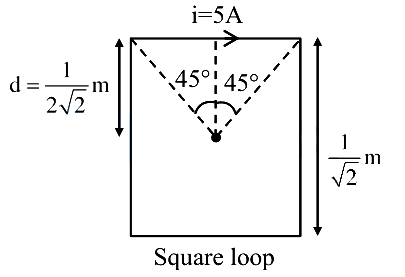
Let B be the magnetic field due to single side
\(\begin{aligned}
& \text { then } B=\frac{\mu_0 \mathrm{i}}{4 \pi \mathrm{~d}}\left(\sin \theta_1+\sin \theta_2\right) \\
& =\frac{10^{-7} \times 5 \times 2}{\frac{1}{2 \sqrt{2}}} \times \frac{1}{\sqrt{2}}=2 \times 10^{-6} \\
& \therefore B_{\text {net }} \text { at centre } O=4 B \\
& =8 \times 10^{-6}
\end{aligned}\) -
- (A) 596
- (B) 149
- (C) 298
- (D) 447
Show answer and solution
Correct Answer: (B)
\(\begin{aligned} & \left(I-I_g\right) R=I_g G \\ & (3-0.02) \times R=0.02 \times G \Rightarrow R=\frac{30}{149} \\ & \Rightarrow 149=\text { Required } X\end{aligned}\) -
- (A) 1
- (B) 2
- (C) 3
- (D) 4
Show answer and solution
Correct Answer: (A)
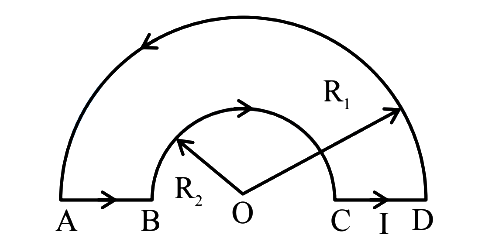
Magnetic field due to \(\mathrm{AB} \& \mathrm{CD}=0\)
\(\begin{aligned}
& \mathrm{B}_0=\left|\mathrm{B}_{\mathrm{R}_1}-\mathrm{B}_{\mathrm{R}_2}\right| \\
& =\frac{\mu_0 \mathrm{I}}{4 \mathrm{R}_2}-\frac{\mu_0 \mathrm{I}}{4 \mathrm{R}_1} \\
& =\frac{4 \pi \times 10^{-7} \times 12}{4}\left(\frac{1}{4 \pi}-\frac{1}{6 \pi}\right) \\
& =12 \pi \times 10^{-7}\left(\frac{1}{12 \pi}\right) \\
& =1 \times 10^{-7}
\end{aligned}\)
\(K=1\) -
- (A) 5
- (B) 4
- (C) 3
- (D) \(0\)
Show answer and solution
Correct Answer: (D)
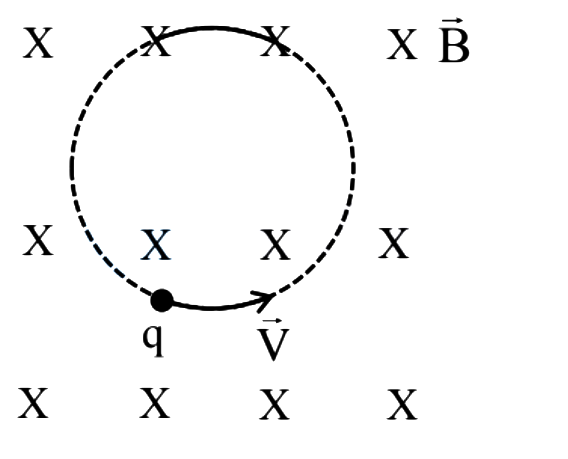
Angle between \(\overrightarrow{\mathrm{V}}\) of charge \(\& \overrightarrow{\mathrm{~B}}\) is \(90^{\circ}\) motion will be uniform circular motion time period is given by
\(\mathrm{T}=\frac{2 \pi \mathrm{~m}}{\mathrm{qB}}=\frac{2 \pi \times 16 \times 10^{-9} \mathrm{~kg}}{1.6 \times 10^{-6} \times 6.28}\)
\(\mathrm{T}=0.01\) seconds
NTA Answer is 10
Correct Answer is 0 (nearest integer) -
- (A) 4
- (B) 6
- (C) 2
- (D) 8
Show answer and solution
Correct Answer: (C)
\(\begin{aligned} & B v q=E q \\ & E=B v \\ & r=\frac{v m}{B q} \\ & B=\frac{m v}{r q} \\ & E=\left(\frac{m v}{r q}\right) v=\frac{m v^2}{r q} \\ & =\frac{1.6 \times 10^{-27} \times 4 \times 10^{10}}{2 \times 10^{-2} \times 1.6 \times 10^{-19}} \\ & =2 \times 10^4 \mathrm{~N} / \mathrm{C} \\ & x=2\end{aligned}\) -
- (A) 200
- (B) 250
- (C) 300
- (D) 350
Show answer and solution
Correct Answer: (B)
Since time period of a revolving charge is \(\frac{2 \pi m}{q B}\)
Where \(\mathrm{B}=\) magnetic field
due to a solenoid \(=\mu_0 \mathrm{nI}\)
\(\begin{aligned}
& \therefore \mathrm{T}=\frac{2 \pi \mathrm{~m}}{\mathrm{q}\left(\mu_0 \mathrm{nI}\right)} \\
& 75 \times 10^{-9}=\frac{(2 \pi)\left(9 \times 10^{-31}\right)}{1.6 \times 10^{-19} \times 4 \pi \times 10^{-7} \times \mathrm{n} \times 1.5} \\
& \mathrm{~N}=250
\end{aligned}\) -
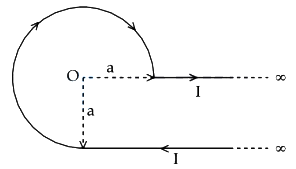
- (A) \(\frac{\mu_0}{4 \pi} \frac{I}{a}\left[\frac{\pi}{2}+1\right]\)
- (B) \(\frac{\mu_0}{4 \pi} \frac{\mathrm{I}}{\mathrm{a}}\left[\frac{3 \pi}{2}+2\right]\)
- (C) \(\frac{\mu_0}{2 \pi} \frac{\mathrm{I}}{\mathrm{a}}\left[\frac{\pi}{2}+2\right]\)
- (D) \(\frac{\mu_0}{4 \pi} \frac{\mathrm{I}}{\mathrm{a}}\left[\frac{3 \pi}{2}+1\right]\)
Show answer and solution
Correct Answer: (D)
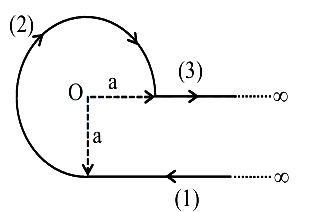
\(\begin{aligned} & \mathrm{B}_1=\frac{\mu_0 \mathrm{i}}{4 \pi \mathrm{a}} \otimes \\ & \mathrm{B}_2=\frac{\mu_0}{4 \pi} \frac{\mathrm{i}}{\mathrm{a}}\left(\frac{3 \pi}{2}\right) \otimes \\ & \mathrm{B}_3=0 \\ & \mathrm{~B}=\frac{\mu_0}{4 \pi} \frac{\mathrm{i}}{\mathrm{a}}\left(1 \frac{3 \pi}{2}\right) \otimes\end{aligned}\) -
- (A) \([a / 4,3 a / 2]\)
- (B) \([a / 4,2 a]\)
- (C) \([\mathrm{a} / 2,2 \mathrm{a}]\)
- (D) \([a / 2,3 a]\)
Show answer and solution
Correct Answer: (C)
Maximum possible magnetic field is at the surface
\(\begin{aligned}
& \mathrm{B}_{\max }=\frac{\mu_0 \mathrm{I}}{2 \pi \mathrm{a}} \\
& \frac{\mathrm{~B}_{\max }}{2}=\frac{\mu_0 \mathrm{I}}{4 \pi \mathrm{a}}
\end{aligned}\)
It can be obtained inside as well as outside the wire For inside,
\(\begin{aligned}
& \frac{\mu_0 \mathrm{I}}{4 \pi \mathrm{a}}=\frac{\mu_0 \mathrm{Ir}}{2 \pi \mathrm{a}^2} \\
& \Rightarrow \mathrm{r}=\frac{\mathrm{a}}{2}
\end{aligned}\)
For outside
\(\begin{aligned}
& \frac{\mu_0 \mathrm{I}}{4 \pi \mathrm{a}}=\frac{\mu_0 \mathrm{I}}{2 \pi \mathrm{r}} \\
& \Rightarrow \mathrm{r}=2 \mathrm{a}
\end{aligned}\)
Correct answer \(\left[\frac{\mathrm{a}}{2}, 2 \mathrm{a}\right]\) -
- (A) \(a e^{-\frac{4 \pi \mathrm{mv}_{\mathrm{o}}}{\mathrm{q} \mu_{\mathrm{o}} \mathrm{I}}}\)
- (B) \(a\left[1-\frac{\mathrm{mv}_{\mathrm{o}}}{2 q \mu_{\mathrm{o}} \mathrm{I}}\right]\)
- (C) \(a\left[1-\frac{\mathrm{mv}}{\mathrm{q} \mu_{\mathrm{o}} \mathrm{I}}\right]\)
- (D) \(\frac{a}{2}\)
Show answer and solution
Correct Answer: (A)
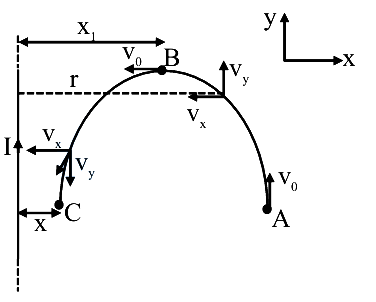
\(\begin{aligned} & A \rightarrow B \\ & \vec{V}=-v_x \hat{i}+v_y \hat{j} \\ & \vec{B}=\frac{\mu_0 I}{2 \pi r}(-\hat{k}) \\ & \overrightarrow{\mathrm{F}}=\mathrm{q}(\overrightarrow{\mathrm{v}} \times \overrightarrow{\mathrm{B}})=\frac{\mu_0 \mathrm{Iq}}{2 \pi r}\left[-\mathrm{v}_{\mathrm{x}} \hat{\mathrm{j}}-\mathrm{v}_{\mathrm{y}} \hat{\mathrm{i}}\right] \\ & \mathrm{a}_{\mathrm{x}}=-\frac{\mu_0 \mathrm{Iq}}{2 \pi \mathrm{~m}} \cdot \frac{v_y}{\mathrm{r}} \\ & \mathrm{a}_{\mathrm{y}}=-\frac{\mu_0 \mathrm{Iq}}{2 \pi m} \cdot \frac{v_x}{\mathrm{r}}\end{aligned}\)
\(\begin{aligned} & \frac{\mathrm{v}_{\mathrm{x}} \mathrm{dv}_{\mathrm{x}}}{\mathrm{dr}}=-\frac{\mu_0 \mathrm{Iq}}{2 \pi \mathrm{~m}} \frac{\mathrm{v}_{\mathrm{y}}}{\mathrm{r}} \\ & \frac{\mathrm{v}_{\mathrm{x}} \mathrm{dv}_{\mathrm{x}}}{\mathrm{v}_{\mathrm{y}}}=-\frac{\mu_0 \mathrm{Iq}}{2 \pi \mathrm{~m}} \frac{\mathrm{dr}}{\mathrm{r}} \\ & \int_0^{\mathrm{v}_0} \frac{\mathrm{v}_{\mathrm{x}} \mathrm{dv}_{\mathrm{x}}}{\sqrt{\mathrm{v}_0^2-\mathrm{v}_{\mathrm{x}}^2}}=-\frac{\mu_0 \mathrm{Iq}^{\mathrm{x}_1}}{2 \pi \mathrm{~m}} \int_{\mathrm{a}}^{\mathrm{dr}} \frac{\mathrm{r}}{2} \\ & \text { Let, } \mathrm{z}^2=\mathrm{v}_0^2-\mathrm{v}_{\mathrm{x}}^2 \\ & 2 \mathrm{zdz}=-2 \mathrm{v}_{\mathrm{x}} \mathrm{dv}_{\mathrm{x}}\end{aligned}\)
\(\begin{aligned}
& \mathrm{zdz}=-\mathrm{v}_{\mathrm{x}} \mathrm{dv}_{\mathrm{x}} \\
& \frac{\mathrm{v}_{\mathrm{x}} \mathrm{dv}_x}{\sqrt{\mathrm{v}_0^2-\mathrm{v}_{\mathrm{x}}^2}}=\frac{-\mathrm{zdz}}{\mathrm{z}}=-\mathrm{dz}
\end{aligned}\)
then integral becomes
\(\begin{aligned}
& -\int_{\mathrm{v}_0}^0 \mathrm{dz}=-\frac{\mu_0 \mathrm{Iq}}{2 \pi \mathrm{~m}} \ln \frac{\mathrm{x}_1}{\mathrm{a}} \\
& \mathrm{v}_0=-\frac{\mu_0 \mathrm{Iq}}{2 \pi \mathrm{~m}} \ln \frac{\mathrm{x}_1}{\mathrm{a}}
\end{aligned}\)
\(\left.\mathrm{x}_1=\mathrm{a} \mathrm{e}^{-\frac{2 \pi \mathrm{mv}}{\mu_0}} \mathrm{H}_0 \mathrm{q} \right\rvert\, \ldots \ldots\)
For B \(\rightarrow\) C
\(\begin{aligned}
& \overrightarrow{\mathrm{v}}=-v_x \hat{\mathrm{i}}-v_y \hat{\mathrm{j}} \\
& \overrightarrow{\mathrm{~B}}=\frac{\mu_0 \mathrm{I}}{2 \pi \mathrm{r}}(-\hat{\mathrm{k}}) \\
& \overrightarrow{\mathrm{F}}=\mathrm{q}(\overrightarrow{\mathrm{v}} \times \overrightarrow{\mathrm{B}})=\frac{\mu_0 \mathrm{Iq}}{2 \pi r}\left(-v_x \hat{j}+v_y \hat{\mathrm{i}}\right)
\end{aligned}\)
\(\begin{aligned}
& \mathrm{a}_{\mathrm{x}}=+\frac{\mu_0 \mathrm{Iq}}{2 \pi \mathrm{~m}} \frac{\mathrm{v}_{\mathrm{y}}}{\mathrm{r}} \quad \mathrm{a}_{\mathrm{y}}=-\frac{\mu_0 \mathrm{Iq}}{2 \pi \mathrm{~m}} \cdot \frac{\mathrm{v}_{\mathrm{x}}}{\mathrm{r}} \\
& \frac{\mathrm{v}_{\mathrm{x}} \mathrm{dv}_{\mathrm{x}}}{\mathrm{dr}}=\frac{\mu_0 \mathrm{Iq}}{2 \pi \mathrm{~m}} \frac{\mathrm{v}_{\mathrm{y}}}{\mathrm{r}} \\
& \int_{v_0}^0 \frac{\mathrm{v}_{\mathrm{x}} \mathrm{dv}_{\mathrm{x}}}{\sqrt{\mathrm{v}_0^2-\mathrm{v}_{\mathrm{x}}^2}}=\frac{\mu_0 \mathrm{Iq}}{2 \pi \mathrm{~m}} \int_{\mathrm{x_1}}^{\mathrm{x}}\frac{dr}{r}
\end{aligned}\)
\(\begin{aligned}
& \frac{\mu_0 \mathrm{Iq}}{2 \pi \mathrm{~m}} \ln \frac{\mathrm{x}}{\mathrm{x}_1}=-\int_0^{\mathrm{v}_0} \mathrm{~d} \mathrm{z}=-\mathrm{v}_0 \\
& \mathrm{x}=\mathrm{x}_1 \mathrm{e}^{-\frac{2 \pi \mathrm{~m}_0}{\mu_0 \mathrm{Iq}}} \ldots \ldots \text { (2) }
\end{aligned}\)
From equation 1 and 2
\(X=a e^{-\frac{4 \pi \mathrm{mv}_0}{\mu_0 \mathrm{Iq}}}\) -
- (A) A, D Only
- (B) A, B, E Only
- (C) B, D, E Only
- (D) A, B Only
Show answer and solution
Correct Answer: (D)
(A) \(\tau=\mathrm{C} \theta \Rightarrow\left[\mathrm{ML}^2 \mathrm{~T}^{-2}\right]=[\mathrm{C}][1]\)
(B) \(\mathbf{C} . \mathrm{S}=\frac{\theta}{\mathrm{I}}=\frac{\mathrm{BNA}}{\mathrm{C}}\);
V.S. \(=\frac{\mathrm{BNA}}{\mathrm{RC}}[\mathrm{R}\) also depends on ' N ']
(C) V.S. \(\propto \frac{\mathrm{NAB}}{\mathrm{CR}} \quad \mathrm{R} \rightarrow \mathrm{NR}\)
(D) False [Theory]
(E) E [False]
\(\mathrm{C} . \mathrm{S} \propto \mathrm{~N}\)
\(\Rightarrow \because \mathrm{C} . \mathrm{S} .=\frac{\mathrm{NAB}}{\mathrm{C}}\) -
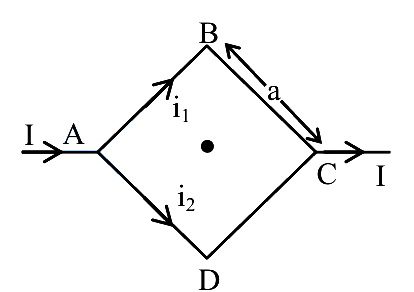
- (A) \(\frac{3 \pi \mu_0 \mathrm{I}}{\sqrt{2} \mathrm{a}}\)
- (B) \(\frac{\mu_0 \mathrm{I}}{2 \pi \mathrm{a}}\)
- (C) \(\frac{\sqrt{2} \mu_0 \mathrm{I}}{3 \pi \mathrm{a}}\)
- (D) \(\frac{2 \mu_0 \mathrm{I}}{3 \pi \mathrm{a}}\)
Show answer and solution
Correct Answer: (C)
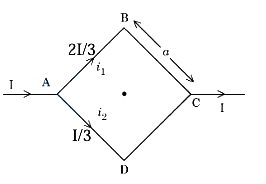
\(\overrightarrow{\mathrm{B}}=\overrightarrow{\mathrm{B}}_{\mathrm{AB}}+\overrightarrow{\mathrm{B}}_{\mathrm{BC}}+\overrightarrow{\mathrm{B}}_{\mathrm{CD}}+\overrightarrow{\mathrm{B}}_{\mathrm{DA}}\)
\(\begin{aligned} \overrightarrow{\mathrm{B}}= & {\left[\frac{-\mu_0(2 \mathrm{I} / 3)}{4 \pi(\mathrm{a} / 2)} \sqrt{2}-\frac{\mu_0(2 \mathrm{I} / 3)}{4 \pi(\mathrm{a} / 2)} \sqrt{2}\right.} \\ & \left.+\frac{\mu_0(\mathrm{I} / 3)}{4 \pi(\mathrm{a} / 2)} \sqrt{2}+\frac{\mu_0(\mathrm{I} / 3)}{4 \pi(\mathrm{a} / 2)} \sqrt{2}\right] \hat{\mathrm{k}} \\ \overrightarrow{\mathrm{B}}= & {\left[\frac{-2 \sqrt{2} \mu_0 \mathrm{I}}{3 \pi \mathrm{a}}+\frac{\sqrt{2} \mu_0 \mathrm{I}}{3 \pi \mathrm{a}}\right] \hat{\mathrm{k}} } \\ \overrightarrow{\mathrm{B}}= & \frac{-\sqrt{2} \mu_0 \mathrm{I}}{3 \pi \mathrm{a}} \hat{\mathrm{k}}\end{aligned}\) -
- (A) (A) is true but (R) is false
- (B) Both (A) and (R) are true but (R) is NOT the correct explanation of (A)
- (C) Both \((\mathbf{A})\) and \((\mathbf{R})\) are true and \((\mathbf{R})\) is the correct explanation of \((\mathbf{A})\)
- (D) (A) is false but (R) is true
Show answer and solution
Correct Answer: (C)
If the electron's velocity is along the direction of magnetic field then magnetic force on electron is zero and it will not accelerate. -
- (A) \(\mathrm{A}\) is true but \(\mathrm{R}\) is false.
- (B) Both \(\mathrm{A}\) and \(\mathrm{R}\) are true but \(\mathrm{R}\) is NOT the correct explanation of \(\mathrm{A}\).
- (C) \(\mathrm{A}\) is false but \(\mathrm{R}\) is true.
- (D) Both \(\mathrm{A}\) and \(\mathrm{R}\) are true and \(\mathrm{R}\) is the correct explanation of \(\mathrm{A}\).
Show answer and solution
Correct Answer: (A)
\(\begin{aligned} & r=\frac{m v}{q B}=\frac{p}{q B} \\ & r \propto \frac{1}{q}\end{aligned}\)
Assertion is true reason is false -
- (A) \(1: 1\)
- (B) \(1: 4\)
- (C) \(1: 3\)
- (D) \(1: 2\)
Show answer and solution
Correct Answer: (A)
\(\text { Voltage sensitivity }=\frac{\theta}{V}=\frac{N A B}{c R} \)
\( \text { Ratio }==\left(\frac{\mathrm{N}_1 \mathrm{~A}_1 \mathrm{~B}_1}{\mathrm{~N}_2 \mathrm{~A}_2 \mathrm{~B}_2}\right) \frac{\mathrm{R}_2}{\mathrm{R}_1}=\frac{15 \times 3.6 \times 0.25}{21 \times 1.8 \times 0.5} \times \frac{7}{5}=\frac{1}{1}\) -
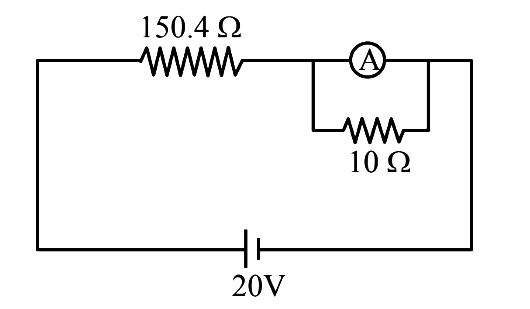
- (A) 10
- (B) 15
- (C) 20
- (D) 5
Show answer and solution
Correct Answer: (D)
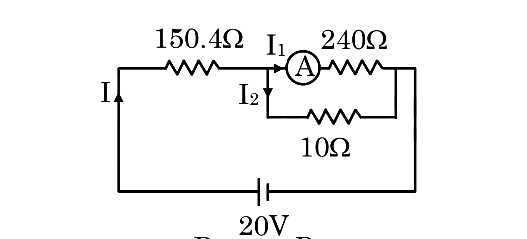
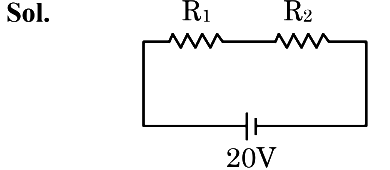
\(\begin{aligned} & \mathrm{R}_{\mathrm{eq}}=\mathrm{R}_1+\mathrm{R}_2 \\ & \mathrm{R}_{\mathrm{eq}}=150.4+\frac{240 \times 10}{250} \\ & =150.4+9.6=160 \Omega \\ & \mathrm{I}_1=\frac{\mathrm{I} \mathrm{R}_2}{240} \\ & \mathrm{I}_1=\frac{\mathrm{I} \times 9.6}{240} \\ & =\frac{20}{160} \times \frac{9.6}{2400}=\frac{1}{200}=5 \times 10^{-3} \mathrm{~A}=5 \mathrm{~mA}\end{aligned}\) -
- (A) \(4: 5\)
- (B) \(16: 25\)
- (C) \(64: 125\)
- (D) \(25: 16\)
Show answer and solution
Correct Answer: (C)
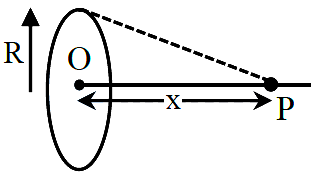
\(\begin{aligned} & \mathrm{B}_1=\frac{\mu_0 \mathrm{i}}{2 \mathrm{R}} \qquad \mathrm{B}_2=\mathrm{B}_1 \sin ^3 \theta \\ & \therefore \frac{\mathrm{~B}_2}{\mathrm{~B}_1}=\sin ^3 \theta=\left(\frac{4}{5}\right)^3=\frac{64}{125}\end{aligned}\) -
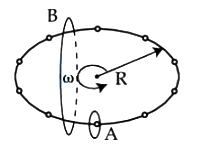
- (A) \(\frac{2 \pi}{N} q \omega\)
- (B) \(\frac{\mathrm{N}^2}{2 \pi} \mathrm{q} \omega\)
- (C) \(\frac{\mathrm{N}}{\pi} \mathrm{q} \omega\)
- (D) \(\frac{\mathrm{N}}{2 \pi} \mathrm{q} \omega\)
Show answer and solution
Correct Answer: (D)
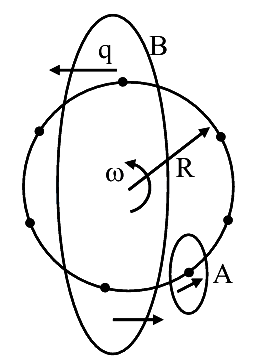
\(\begin{aligned} & I_A=\frac{N q}{\frac{2 \pi}{\omega}} \\ & I_A=\frac{N q \omega}{2 \pi}, I_B=0 \\ & I_A=I_B=\frac{N q \omega}{2 \pi}\end{aligned}\) -
- (A) 10
- (B) 8
- (C) 6
- (D) 4
Show answer and solution
Correct Answer: (B)
Assuming long solenoid
\(\begin{aligned}
& \mathrm{B}=\mu_0\left(\frac{\mathrm{~N}}{\ell}\right) \mathrm{i} \\
& \ell=\frac{\mu_0 \mathrm{Ni}}{\mathrm{~B}}=\frac{\left(4 \pi \times 10^{-7}\right)(200)(0.29)}{2.9 \times 10^{-4}} \mathrm{~m} \\
& =8 \pi \mathrm{~cm}
\end{aligned}\) -
- (A) 5
- (B) 4
- (C) 3
- (D) 1
Show answer and solution
Correct Answer: (D)
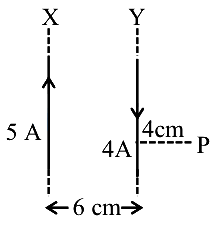
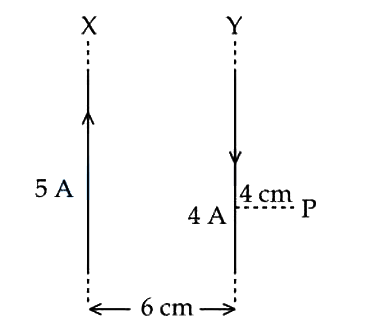
\(\begin{aligned} & B=\frac{\mu_0(5)}{2 \pi \times .01}-\frac{\mu_0 4}{2 \pi \times 0.04} \\ & =-\frac{100 \mu_0}{4 \pi} \\ & =-100 \times 10^{-7} \\ & =-1 \times 10^{-5} \mathrm{~T}\end{aligned}\) -
- (A) \(\frac{\mathrm{mv}}{\mathrm{qB}_1}\left(1-\frac{\mathrm{B}_2}{\mathrm{~B}_1}\right) \times 2\)
- (B) \(\frac{\mathrm{mv}}{\mathrm{qB}_1}\left(1-\frac{\mathrm{B}_1}{\mathrm{~B}_2}\right)\)
- (C) \(\frac{\mathrm{mv}}{\mathrm{qB}_1}\left(1-\frac{\mathrm{B}_2}{\mathrm{~B}_1}\right)\)
- (D) \(\frac{\mathrm{mv}}{\mathrm{qB}_1}\left(1-\frac{\mathrm{B}_1}{\mathrm{~B}_2}\right) \times 2\)
Show answer and solution
Correct Answer: (D)
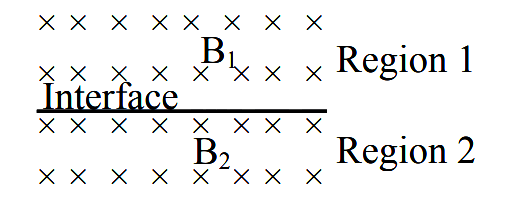
As \(\overrightarrow{\mathrm{v}}\) is \(\perp\) to \(\overrightarrow{\mathrm{B}}\), so charge particle will move in circular path, whose radius is given by
\(\mathrm{R}=\frac{\mathrm{mv}}{\mathrm{qB}}\)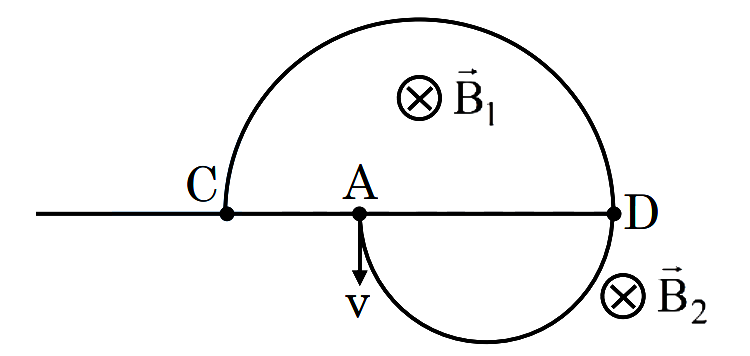
Starting point \(\rightarrow \mathrm{A}\)
Ending point \(\rightarrow \mathrm{C}\)
\(\therefore\) Net displacement \(=\mathrm{AC}\)
\(\begin{aligned} & \mathrm{AC}=\mathrm{CD}-\mathrm{AD} \\ & \mathrm{AC}=\frac{2 \mathrm{mv}}{\mathrm{qB}_1}-\frac{2 \mathrm{mv}}{\mathrm{qB}_2} \\ & \mathrm{AC}=\frac{2 \mathrm{mv}}{\mathrm{qB}_1}\left[1-\frac{\mathrm{B}_1}{\mathrm{~B}_2}\right]\end{aligned}\) -
- (A) \(\varphi=\mathrm{AB}, \varepsilon=0\)
- (B) \(\varphi=0, \varepsilon=0\)
- (C) \(\varphi=0, \varepsilon=\mathrm{NAB} \omega\)
- (D) \(\varphi=\mathrm{AB}, \varepsilon=\mathrm{NAB} \omega\)
Show answer and solution
Correct Answer: (C)
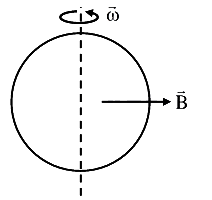
\(\begin{aligned}
\phi & =\mathrm{BAN} \cdot \cos (\omega \mathrm{t}) \\
\varepsilon & =\frac{-\mathrm{d} \phi}{\mathrm{dt}}=\mathrm{BA} \omega \mathrm{~N} \cdot \sin (\omega \mathrm{t})
\end{aligned}\)
When \(B\) is parallel to plane, \(\underline{\underline{\omega t}}=\frac{\pi}{2}\)
\(\Rightarrow \phi=0, \varepsilon=\mathrm{BA} \omega \mathrm{~N}\) -
- (A) 3
- (B) 2
- (C) 1
- (D) 4
Show answer and solution
Correct Answer: (C)
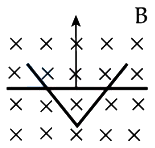
As the bar moves without change in orientation, the length of bar will be proportional to its distance from the vertex.
i.e. \(I=c(v t)\)
\(\begin{aligned}
& \text { induced emf } E=B / v \\
& =c B v^2 t
\end{aligned}\)
\(\Rightarrow n=1\) -
- (A) \(\frac{\mathrm{B}^2 \mathrm{~A} l}{\mu_0}\)
- (B) \(\frac{\mathrm{B}^2 \mathrm{~A} l}{2 \mu_0}\)
- (C) \(\mathrm{B}^2 \mathrm{Al}\)
- (D) \(\frac{\mathrm{B}^2 \mathrm{~A} l}{4 \mu_0}\)
Show answer and solution
Correct Answer: (D)
\(\frac{\mathrm{U}}{\mathrm{V}}=\frac{\mathrm{B}^2}{2 \mu_{\mathrm{r}} \mathrm{u}_0} \Rightarrow \mathrm{U}=\frac{\mathrm{B}^2}{4 \mu_0} \mathrm{~V}=\frac{\mathrm{B}^2}{4 \mu_0} \mathrm{~A} \ell\) -
- (A) \(0.5024 \mathrm{~V}\)
- (B) \(\mathrm{~V}\)
- (C) \(0.2512 \mathrm{~V}\)
- (D) \(0.1256 \mathrm{~V}\)
Show answer and solution
Correct Answer: (C)
\(\begin{aligned} & \mathrm{B}=0.4 \mathrm{~T} \\ & \mathrm{r}=20 \mathrm{~cm} \\ & \omega=10 \pi \mathrm{rad} / \mathrm{s} \\ & \mathrm{E}=\frac{1}{2} \mathrm{~B} \omega \mathrm{R}^2 \\ & =0.2512 \mathrm{~V}\end{aligned}\) -
- (A) 10
- (B) 15
- (C) 20
- (D) 25
Show answer and solution
Correct Answer: (A)
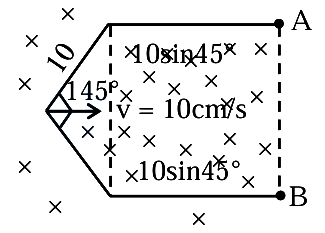
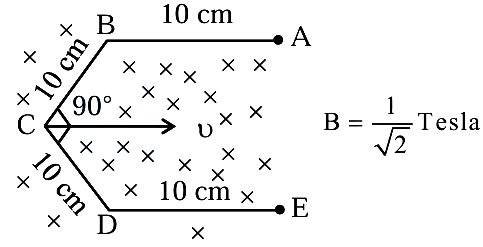
As field is uniform we can replace the bent wire with straight wire from \(A\) to \(B\).
So EMF :
\(\varepsilon=\mathrm{Bv} \ell_{\mathrm{AB}}\)
\(\begin{aligned} & =\frac{1}{\sqrt{2}} \times \frac{10 \mathrm{~cm}}{5} \times 2\left(10 \sin 45^{\circ}\right) \mathrm{cm} \\ & \varepsilon=10 \mathrm{mV}\end{aligned}\) -
- (A) \(\varepsilon_1=-L_1 \frac{\mathrm{dI}_2}{d t}-\mathrm{M}_{12} \frac{\mathrm{dI}_1}{d t}\)
- (B) \(\varepsilon_1=-L_1 \frac{\mathrm{dI}_1}{d t}-\mathrm{M}_{12} \frac{\mathrm{dI}_2}{d t}\)
- (C) \(\varepsilon_1=-L_1 \frac{\mathrm{dI}_1}{d t}-\mathrm{M}_{12} \frac{\mathrm{dI}_1}{d t}\)
- (D) \(\varepsilon_1=-L_1 \frac{\mathrm{dI}_1}{d t}+\mathrm{M}_{12} \frac{\mathrm{dI}_2}{\mathrm{dt}}\)
Show answer and solution
Correct Answer: (B)
\(\begin{aligned} & \phi_1=\mathrm{L}_1 \mathrm{I}_1+\mathrm{M}_{12} \mathrm{I}_2 \\ & \varepsilon_1=-\frac{\mathrm{d} \phi_1}{\mathrm{dt}}=-\mathrm{L}_1 \frac{\mathrm{dI}}{1} \frac{\mathrm{I}_{12}}{\mathrm{dt}}-\mathrm{M}_{12} \frac{\mathrm{~d} I_2}{\mathrm{dt}}\end{aligned}\) -
- (A) 3
- (B) 4
- (C) 5
- (D) 6
Show answer and solution
Correct Answer: (A)
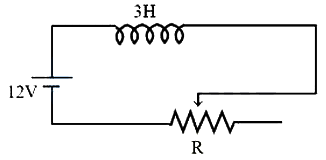
\(\begin{aligned} & \varepsilon-\frac{\mathrm{LdI}}{\mathrm{dt}}-\mathrm{IR}=0 \\ & 12-3 \times(-8)-\mathrm{I} \times 12=0 \\ & \mathrm{I}=3\end{aligned}\) -
- (A) \(\mathrm{A}, \mathrm{B}, \mathrm{C}, \mathrm{E}\) only
- (B) B, C, D, E only
- (C) \(\mathrm{A}, \mathrm{C}, \mathrm{D}, \mathrm{E}\) only
- (D) A, B, C, D only
Show answer and solution
Correct Answer: (C)
A. The self-inductance of the coil depends on its geometry.
This is true because the self-inductance of a coil is given by formulas that include its geometrical parameters (number of turns, cross-sectional area, length, etc.). For example, for a solenoid,
\(L=\mu_0 \mu_r \frac{N^2 A}{l}\)
where \(N\) is the number of turns, \(A\) is the cross-sectional area, and \(l\) is the length.
B. Self-inductance does not depend on the permeability of the medium.
This is false. The permeability of the medium (represented by \(\mu=\mu_0 \mu_r\)) directly influences the inductance, as seen in the formula above. So, any change in the medium's permeability will affect the inductance.
C. Self-induced e.m.f. opposes any change in the current in a circuit.
This is true, and it is a direct consequence of Lenz's law. The induced electromotive force (e.m.f.) always acts in a direction such that it opposes the change in current that produced it.
D. Self-inductance is the electromagnetic analogue of mass in mechanics.
This is true. Just as mass resists changes in velocity (inertia), inductance resists changes in current, which is why it is often compared to the inertial mass in mechanical systems.
E. Work needs to be done against self-induced e.m.f. in establishing the current.
This is true because, when you try to change the current, you must do work to overcome the opposing self-induced e.m.f., storing energy in the magnetic field of the inductor. Based on the above reasoning, the true statements are \(\mathrm{A}, \mathrm{C}, \mathrm{D}\), and E.
Thus, the correct answer is:
Option C
A, C, D, E only -
- (A) \(4 \%\)
- (B) \(15 \%\)
- (C) \(5 \%\)
- (D) \(10 \%\)
Show answer and solution
Correct Answer: (A)
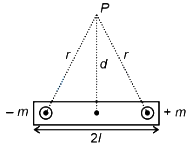
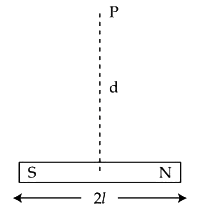
Magnetic field at \(P, B=\frac{\mu_0}{4 \pi} \frac{m(2 l)}{r^3}\), where \(m\) is the pole strength
\(\begin{aligned}
\Rightarrow\left(\frac{\Delta B}{B} \times 100\right) & =\left(\frac{\Delta l}{l}\right) \times 100+3\left|\frac{\Delta r}{r}\right| \times 100 \\
& =1 \%+3 \%=4 \%
\end{aligned}\) -
- (A) \(80 \mathrm{~J}\)
- (B) \(-40 \sqrt{3} \mathrm{~J}\)
- (C) \(-60 \mathrm{~J}\)
- (D) \(-80 \mathrm{~J}\)
Show answer and solution
Correct Answer: (D)
\(\tau=\mathrm{M} \times \mathrm{B}=\mathrm{MB} \sin 60=\frac{\sqrt{3}}{2} \mathrm{MB}=80 \sqrt{3}\)
\(\begin{aligned} & \mathrm{MB}=160 \\ & \mathrm{U}=-\mathrm{M} \cdot \mathrm{B}=-\mathrm{MB} \cos 60 \\ & \mathrm{U}=-160 \times 1 / 2=-80 \mathrm{~J}\end{aligned}\) -
- (A) Both \((\mathrm{A})\) and \((\mathrm{R})\) are correct but \((\mathrm{R})\) is not the correct explanation of (A)
- (B) (A) is correct but \((\mathrm{R})\) is not correct
- (C) Both \((\mathrm{A})\) and \((\mathrm{R})\) are correct and \((\mathrm{R})\) is the correct explanation of (A)
- (D) (A) is not correct but ( \(\mathrm{R}\)) is correct
Show answer and solution
Correct Answer: (C)
Both statements are correct and reason is also the correct explanation of assertion. -
- (A) \(\frac{6}{5} \times 10^{-3} \%\)
- (B) \(\frac{5}{6} \times 10^{-5} \%\)
- (C) \(\frac{5}{6} \times 10^{-4} \%\)
- (D) \(\frac{5}{3} \times 10^{-5} \%\)
Show answer and solution
Correct Answer: (A)
\(\begin{aligned} & \% \text { change in } B=\frac{B_{\text {new }}-B_{\text {old }}}{B_{\text {old }}} \times 100 \% \\ & =\frac{\mu \mathrm{ni}-\mu_0 \mathrm{ni}}{\mu_0 \mathrm{ni}} \times 100 \%=\frac{\left(\mu-\mu_0\right)}{\mu_0} \times 100 \% \\ & =\frac{\left(\mu_0 \mu_{\mathrm{r}}-\mu_0\right)}{\mu_0} \times 100 \% \\ & =\left(\mu_{\mathrm{r}}-1\right) \times 100 \% \\ & =\chi_{\mathrm{n}} \times 100 \% \\ & =1.2 \times 10^{-3} \%\end{aligned}\) -
- (A) \(\chi=\frac{\mu}{\mu_0}-1\)
- (B) \(\chi=\frac{\mu_{\mathrm{r}}}{\mu_0}+1\)
- (C) \(\chi=\mu_{\mathrm{r}}+1\)
- (D) \(\chi=1-\frac{\mu}{\mu_0}\)
Show answer and solution
Correct Answer: (A)
We have
\(\begin{aligned} & \mu_{\mathrm{r}}=(1+\chi) \Rightarrow \chi=\left(\mu_{\mathrm{r}}-1\right) \\ & \mu=\mu_0 \mu_{\mathrm{r}} \Rightarrow \mu_{\mathrm{r}}=\frac{\mu}{\mu_0} \\ & \therefore \chi=\left(\frac{\mu}{\mu_0}-1\right)\end{aligned}\) -
- (A) \(4\)
- (B) \(8.4\)
- (C) \(2\)
- (D) \(6.2\)
Show answer and solution
Correct Answer: (C)
\(\begin{aligned} & P_{\text {input }}=V i=100 \mathrm{~W} \\ & \eta=\frac{P_{\text {out }}}{P_{\text {input }}}=0.916\end{aligned}\)
\(\begin{aligned} & P_{\text {out }}=91.6 \mathrm{~W} \\ & \text { Loss }=100-91.6=8.4 \mathrm{~J} / \mathrm{s}=2 \mathrm{cal} / \mathrm{s}\end{aligned}\) -
- (A) 1400
- (B) 1600
- (C) 1200
- (D) 1000
Show answer and solution
Correct Answer: (C)
\(i_d=i_c\)
\(\therefore\) Total displacement current \(=6 \mathrm{~A}\)
Through \(A_0\)
\(\begin{aligned}
& i=\left(\frac{A_0}{A}\right) 6 \\
& =\frac{3.2}{16} \times 6=1.2 \mathrm{~A}=1200 \mathrm{~mA}
\end{aligned}\) -
- (A) \(12.5 \Omega\)
- (B) \(50 \Omega\)
- (C) \(100 \Omega\)
- (D) \(25 \Omega\)
Show answer and solution
Correct Answer: (D)
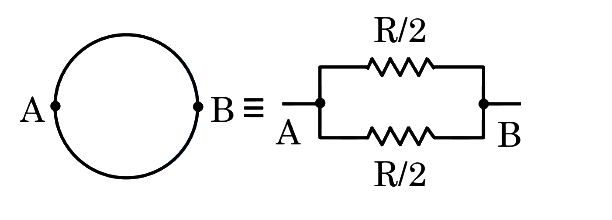
\(\begin{aligned}
& \mathrm{L}=25 \mathrm{~m}, \mathrm{~A}=5 \mathrm{~mm}^2=5 \times 10^{-6} \mathrm{~m}^2 \\
& \rho=2 \times 10^{-6} \Omega \mathrm{~m} \\
& \mathrm{R}_{\text {wire }}=\frac{\rho \mathrm{L}}{\mathrm{~A}}=\frac{2 \times 10^{-6} \times 25}{5 \times 10^{-6}}=10 \\
& \mathrm{R}_{\mathrm{eq}}=\frac{\mathrm{R}}{4}=\frac{10}{4}=2.5 \Omega
\end{aligned}\)
Answer does not match with NTA option. -
- (A) 4
- (B) 6
- (C) 8
- (D) 2
Show answer and solution
Correct Answer: (D)
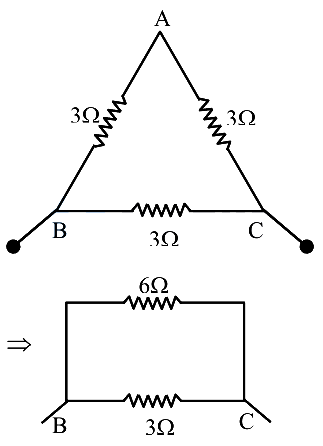
\(9 \Omega\) is the resistance of whole wire
\(\therefore\) resistance of each wire \(=3 \Omega\).
\(\therefore\) Equivalent resistance \(=2 \Omega\) -
- (A) 16
- (B) 14
- (C) 10
- (D) 12
Show answer and solution
Correct Answer: (D)
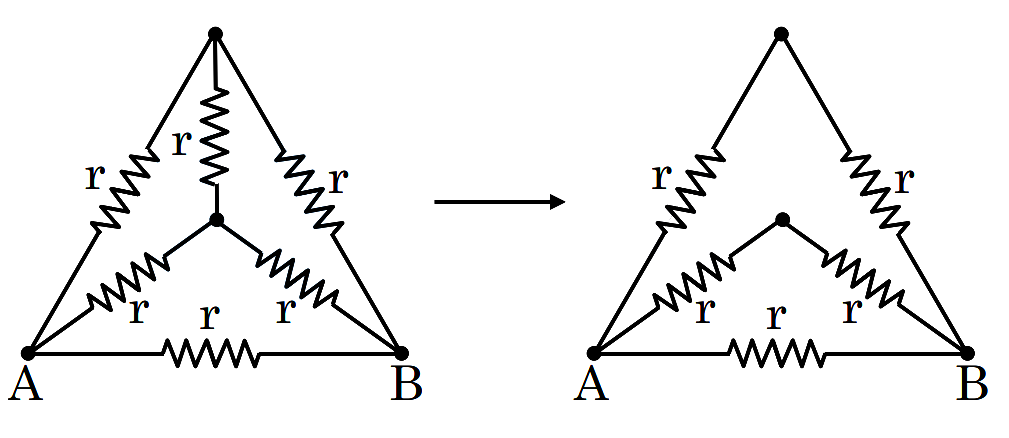
Explanation:
The equivalent resistance of the pyramidal wire framework can be evaluated using circuit symmetry:
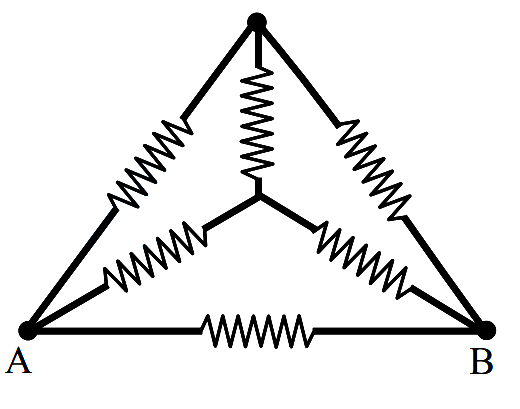
1. Resistance of Each Segment: A triangular pyramid (tetrahedron) consists of exactly 6 identical edges. Since a single continuous wire of total resistance \( R \) is uniformly divided to form these 6 segments, the resistance \( r \) of each individual segment is given by:
\( r = \frac{R}{6} \)
2. Symmetry of the Circuit: When measuring the equivalent resistance across vertices \( A \) and \( B \), the remaining two vertices form a balanced bridge. Due to the symmetrical distribution of the resistors, these two intermediate nodes sit at the exact same electrical potential.
3. Circuit Simplification: Because no potential difference exists between the two intermediate nodes, no electrical current flows through the resistor connecting them. Removing this inactive branch simplifies the network into three parallel paths connected across terminals \( A \) and \( B \):
- One direct branch of resistance \( r \)
- Two separate series branches, each with a total resistance of \( r + r = 2r \)
4. Equivalent Resistance Calculation: Combining these three parallel paths gives:
\( \frac{1}{R_{AB}} = \frac{1}{2r} + \frac{1}{2r} + \frac{1}{r} = \frac{1}{r} + \frac{1}{r} = \frac{2}{r} \)
\( R_{AB} = \frac{r}{2} \)
5. Substituting the Value of r:
\( R_{AB} = \frac{\left(\frac{R}{6}\right)}{2} = \frac{R}{12} \)
Comparing \( \frac{R}{12} \) with the given expression \( \frac{R}{n} \) yields \( n = 12 \).
Hence, Option D is the correct choice. -
- (A) 8/9
- (B) \(27 / 32\)
- (C) \(32 / 27\)
- (D) \(9 / 8\)
Show answer and solution
Correct Answer: (C)
For the wire bent into an equilateral triangle, each side has a resistance \(\frac{R}{3}\).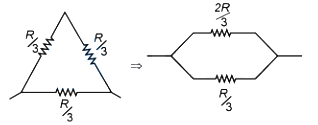
\(R_{\text {eq }}=\frac{\left(\frac{2 R}{3}\right)\left(\frac{R}{3}\right)}{\frac{2 R}{3}+\frac{R}{3}}=\frac{2 R}{9}=R_1\) (lets say)
For the wire bent into a square, each side has a resistance \(\frac{R}{4}\).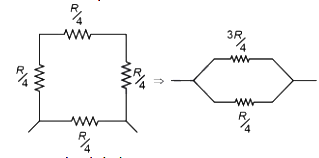
\(\begin{aligned} & R_{\text {eq }}=\frac{\left(\frac{3 R}{4}\right)\left(\frac{R}{4}\right)}{\frac{3 R}{4}+\frac{R}{4}}=\frac{3 R}{16}=R_3 \text { (lets say) } \\ & \Rightarrow \frac{R_1}{R_3}=\frac{\frac{2 R}{9}}{\frac{3 R}{16}}=\frac{32}{27}\end{aligned}\) -
- (A) 0.06 C
- (B) 0.02 C
- (C) 0.07 C
- (D) 0.04 C
Show answer and solution
Correct Answer: (D)
\(\begin{aligned} & \mathrm{q}=\int \mathrm{idt} \\ & \int_0^2(0.02 \mathrm{t}+0.01) \mathrm{dt}\end{aligned}\)
\(\begin{aligned} & \mathrm{q}=\left[0.02 \frac{\mathrm{t}^2}{2}+0.01 \mathrm{t}\right]_1^2 \\ & =0.01(3)+0.01(1) \\ & =0.04 \mathrm{C}\end{aligned}\) -
- (A) \(\frac{r}{9}\)
- (B) \(\frac{\mathrm{r}}{3}\)
- (C) r
- (D) \(\frac{\mathrm{r}}{6}\)
Show answer and solution
Correct Answer: (A)
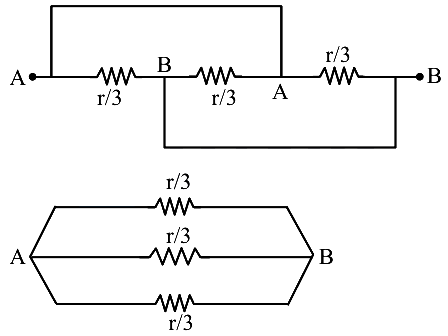
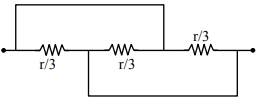
All are in parallel
\(\mathrm{R}_{\mathrm{eq}}=\frac{\mathrm{r} / 3}{3}=\mathrm{r} / 9\) -
- (A) Both Statement-I and Statement-II are false
- (B) Statement-I is false but Statement-II is true
- (C) Both Statement-I and Statement-II are true
- (D) Statement-I is true but Statement-II is false
Show answer and solution
Correct Answer: (B)
In parallel connections
\(\begin{aligned}
& \frac{1}{r_{\mathrm{eq}}}=\frac{1}{r_1}+\frac{1}{r_2} \\
& \frac{E_{\mathrm{eq}}}{r_{\mathrm{eq}}}=\frac{E_1}{r_1}+\frac{E_2}{r_2}
\end{aligned}\)
If \(E_1=E_2\) and \(r_1=r_2, E_{\text {eq }}=E_1=E_2\)
\(\therefore\) Statement 1 is false.
\(r_{\text {eq }}\) is less then both \(r_1\) and \(r_2\)
\(\therefore\) Statement II is true -
- (A) 0.9 A
- (B) 1.35 A
- (C) 0.3 A
- (D) 1.0 A
Show answer and solution
Correct Answer: (D)
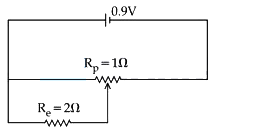
The circuit can be considered as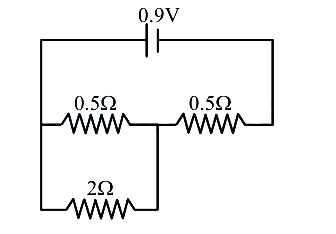
\(\begin{aligned} & \therefore \mathrm{R}_{\text {eq }}=0.5+\frac{0.5 \times 2}{2+0.5}=\left(\frac{5}{10}+\frac{10}{25}\right) \Omega \\ & =\frac{45}{50}=\frac{9}{10}=0.9 \\ & \therefore \mathrm{i}=\frac{0.9}{0.9}=1 \mathrm{~A}\end{aligned}\) -
- (A) high thermal conductivity and high electrical conductivity
- (B) low thermal conductivity and low electrical conductivity
- (C) high thermal conductivity and low electrical conductivity
- (D) low thermal conductivity and high electrical conductivity
Show answer and solution
Correct Answer: (D)
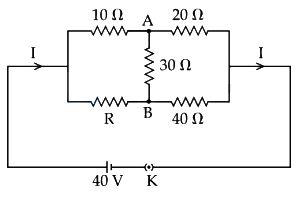
Material should have low thermal conductivity and high electrical conductivity. - 245. The value of current I in the electrical circuit as given below, when potential at A is equal to the potential at B, will be ____ A.
 2025 Medium
- (A) 2
- (B) 10
- (C) 15
- (D) 4
Show answer and solution
Correct Answer: (A)
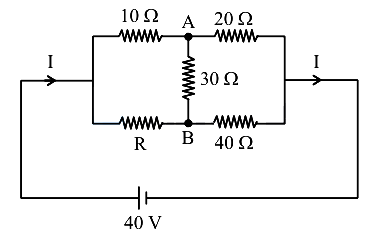
\(\begin{aligned} & \mathrm{V}_{\mathrm{A}}=\mathrm{V}_{\mathrm{B}} \Rightarrow \text { the bridge is balanced } \\ & \Rightarrow \frac{10}{\mathrm{R}}=\frac{20}{40} \\ & \mathrm{R}=20 \Omega \\ & \mathrm{I}=\frac{40}{20}=2 \mathrm{~A}\end{aligned}\) -
- (A) np
- (B) \(\frac{\mathrm{p}}{\mathrm{n}^2}\)
- (C) \(\frac{\mathrm{p}}{\mathrm{n}}\)
- (D) p
Show answer and solution
Correct Answer: (C)
\(\begin{aligned} & R_s=R_1+R_2+R_3+\ldots \ldots..+R_n \\ & \frac{V^2}{P_s}=\frac{V^2}{P}+\frac{V^2}{P}+\ldots \ldots.+\frac{V^2}{P_n} \\ & P_s=\frac{P}{n}\end{aligned}\) -
- (A) 4
- (B) 6
- (C) 8
- (D) 10
Show answer and solution
Correct Answer: (A)
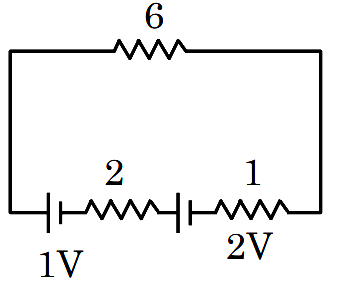
\(\begin{aligned} & \varepsilon_{\mathrm{eq}}=3 \\ & \mathrm{R}_{\mathrm{eq}}=9 \\ & \mathrm{i}_1=\frac{3}{9}=\frac{1}{3}\end{aligned}\)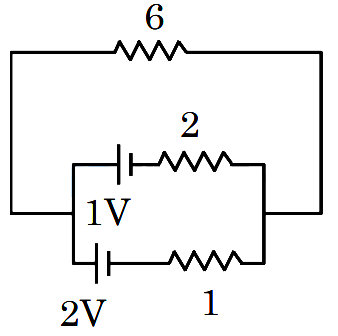
\(\varepsilon_{\mathrm{eq}}=\frac{\frac{\varepsilon_1}{\mathrm{r}_1}+\frac{\varepsilon_2}{\mathrm{r}_2}}{\frac{1}{\mathrm{r}_1}+\frac{1}{\mathrm{r}_2}}\)
\(\varepsilon_{\mathrm{eq}}=\frac{\frac{1}{2}+\frac{2}{1}}{\frac{1}{2}+\frac{1}{1}}=\frac{5}{3}\)
\(\begin{aligned} & \mathrm{r}_{\text {equ }}=\frac{2 \times 1}{3}+6=\frac{20}{3} \\ & \mathrm{i}_2=\frac{1}{4} \Rightarrow \frac{\mathrm{i}_1}{\mathrm{i}_2}=\frac{4}{3}\end{aligned}\) -
- (A) \(q_1=10 \mu \mathrm{C}, \mathrm{q}_2=20 \mu \mathrm{C}\)
- (B) \(\mathrm{q}_1=30 \mu \mathrm{C}, \mathrm{q}_2=15 \mu \mathrm{C}\)
- (C) \(\mathrm{q}_1=20 \mu \mathrm{C}, \mathrm{q}_2=10 \mu \mathrm{C}\)
- (D) \(\mathrm{q}_1=15 \mu \mathrm{C}, \mathrm{q}_2=30 \mu \mathrm{C}\)
Show answer and solution
Correct Answer: (A)
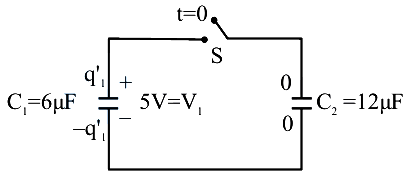
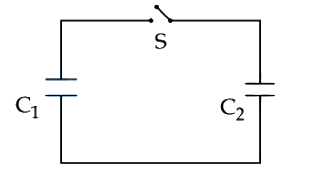
\(\mathrm{q}_1^{\prime}=6 \times 5=30 \mu \mathrm{C}\)
Finally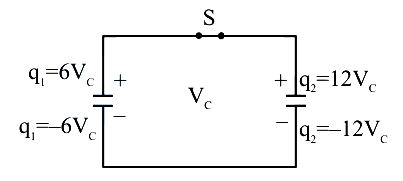
\(\begin{aligned} & 6 \mathrm{~V}_{\mathrm{C}}+12 \mathrm{~V}_{\mathrm{c}}=30+0 \\ & 18 \mathrm{~V}_{\mathrm{C}}=30 \\ & \mathrm{~V}_{\mathrm{C}}=\frac{30}{18}=\frac{5}{3} \mathrm{Volt} \\ & \Rightarrow \mathrm{q}_1=\frac{6 \times 5}{3}=10 \mu \mathrm{C} \\ & \Rightarrow \mathrm{q}_2=\frac{12 \times 5}{3}=20 \mu \mathrm{C}\end{aligned}\) -
- (A) 43.8 kJ
- (B) 48.7 kJ
- (C) 87.7 kJ
- (D) 24.4 kJ
Show answer and solution
Correct Answer: (C)
Given \(\mathrm{V}=4.2\) volt
\(\therefore\) Energy supplied by battery
\(=\mathrm{vq}=4.2 \times 5800 \times 3600 \times 10^{-3} \mathrm{~J}=87.696 \mathrm{~kJ}\)
\(\therefore\) Energy stored in the battery when fully charged
\(=87.696 \mathrm{~kJ} \approx 87.7 \mathrm{~kJ}\) -
- (A) 10
- (B) 15
- (C) 5
- (D) 20
Show answer and solution
Correct Answer: (C)
\(\begin{aligned} & \mathrm{Q}_{\mathrm{in}}=\mathrm{Q}\left(1-\frac{1}{\mathrm{~K}}\right) \\ & 4 \times 10^{-6}=5 \times 10^{-6}\left(1-\frac{1}{\mathrm{~K}}\right) \\ & 1-\frac{1}{\mathrm{~K}}=\frac{4}{5} \\ & \mathrm{~K}=5\end{aligned}\)
No questions on this page match these filters.