


All JEE Mains 2025 Physics questions
32 chaptersShowing 401–450 of 454 questions
-
- (A) \(2.8\)
- (B) \(11.2\)
- (C) \(5.6\)
- (D) \(8.4\)
Show answer and solution
Correct Answer: (C)
\(\begin{aligned} & \mathrm{V}_{\text {escape }}=\sqrt{\frac{2 \mathrm{GM}}{\mathrm{R}}} \\ & \frac{\left(\mathrm{V}_{\text {escape }}\right)_{\text {Planet }}}{\left(\mathrm{V}_{\text {escape }}\right)_{\text {Earth }}}=\sqrt{\left(\frac{\mathrm{M}_{\mathrm{P}}}{\mathrm{M}_{\mathrm{E}}}\right) \times\left(\frac{\mathrm{R}_{\mathrm{E}}}{\mathrm{R}_{\mathrm{P}}}\right)}=\frac{1}{2} \\ & \left(\mathrm{~V}_{\text {escape }}\right)_{\text {Planet }}=\frac{1}{2}\left(\mathrm{~V}_{\text {escape }}\right)_{\text {Earth }}=5.6 \mathrm{~km} / \mathrm{s}\end{aligned}\) -
- (A) Both \((\mathbf{A})\) and \((\mathbf{R})\) are true and \((\mathbf{R})\) is the correct explanation of \((\mathbf{A})\)
- (B) (A) is true but (R) is false
- (C) (A) is false but (R) is true
- (D) Both \((\mathbf{A})\) and \((\mathbf{R})\) are true but \((\mathbf{R})\) is not the correct explanation of \((\mathbf{A})\)
Show answer and solution
Correct Answer: (A)
As h increases, g decreases, T increases
\(\begin{aligned}
& \mathrm{T}=2 \pi \sqrt{\frac{\ell}{\mathrm{~g}}} \\
& \mathrm{~g}=\frac{\mathrm{g}_0 \mathrm{R}^2}{(\mathrm{R}+\mathrm{h})^2}
\end{aligned}\) -
- (A) \(\mathrm{A}\) False but \(\mathrm{R}\) is true
- (B) Both \(\mathrm{A}\) and \(\mathrm{R}\) are true and \(\mathrm{R}\) is the correct explanation of \(\mathrm{A}\)
- (C) \(\mathrm{A}\) is true but \(\mathrm{R}\) is false
- (D) (4) Both \(\mathrm{A}\) and \(\mathrm{R}\) are true but \(\mathrm{R}\) is NOT the correct explanation of \(\mathrm{A}\)
Show answer and solution
Correct Answer: (A)
\(\mathrm{KE}=\frac{1}{2} \mathrm{~m}\left(\frac{2 \mathrm{Gm}}{\mathrm{R}}\right)=\mathrm{mgR}\)
Assertion wrong
at \(\infty\)
\(\mathrm{U}=0\)
\(\therefore\) Reason correct. -
- (A) Both \((\mathrm{A})\) and \((\mathrm{R})\) are correct and \((\mathrm{R})\) is the correct explanation of \(\mathrm{( A)}\)
- (B) Both \((\mathrm{A})\) and \((\mathrm{R})\) are correct but \((\mathrm{R})\) is not the correct explanation of (A)
- (C) (A) is correct but \((\mathrm{R})\) is not correct
- (D) (A) is not correct but (R) is correct
Show answer and solution
Correct Answer: (A)
\(\frac{\mathrm{dA}}{\mathrm{dt}}=\frac{\mathrm{L}}{2 \mathrm{~m}}\)
Due to central force torque is zero \(\&\) angular momentum is constant. -
- (A) \((\mathbf{A})\) is false but (R) is true
- (B) (A) is true but (R) is false
- (C) Both \((\mathbf{A})\) and \((\mathbf{R})\) are true and \((\mathbf{R})\) is the correct explanation of \((\mathbf{A})\)
- (D) Both (A) and (R) are true but (R) is NOT the correct explanation of (A)
Show answer and solution
Correct Answer: (D)
\(\begin{aligned}
& g=\frac{G M}{R^2} \\
& g^{\prime}=\frac{G(4 M)}{(2 R)^2}=g
\end{aligned}\)
A is correct, \(R\) is correct ; but since \(T=2 \pi \sqrt{\frac{\ell}{g}}\) doesn't depend on mass ; R doesn't explain A . -
- (A) 27 days
- (B) 1 day
- (C) 81 days
- (D) 3 days
Show answer and solution
Correct Answer: (B)
\(\begin{aligned} & \mathrm{T}^2 \propto \mathrm{R}^3 \\ & \left(\frac{\mathrm{~T}_{\mathrm{m}}}{\mathrm{T}_{\mathrm{s}}}\right)^2=\left(\frac{\mathrm{R}}{\mathrm{R} / 9}\right)^3 \\ & \frac{\mathrm{~T}_{\mathrm{m}}}{\mathrm{T}_{\mathrm{s}}}=(3)^3 \\ & \Rightarrow \mathrm{~T}_{\mathrm{s}}=\left(\frac{27}{27}\right)=1 \text { day }\end{aligned}\) -
- (A) 10
- (B) 8
- (C) 6
- (D) 4
Show answer and solution
Correct Answer: (B)
\(\begin{aligned} & \mathrm{T} \propto \mathrm{m}^{\mathrm{x}} \mathrm{G}^{\mathrm{y}} \mathrm{a}^{\mathrm{z}} \\ & \mathrm{T} \propto \mathrm{M}^{\mathrm{x}}\left[\mathrm{M}^{-1} \mathrm{~L}^3 \mathrm{~T}^{-2}\right]^y[\mathrm{~L}]^{\mathrm{z}} \\ & \mathrm{T} \propto \mathrm{M}^{\mathrm{x}-\mathrm{y}} \mathrm{L}^{3 \mathrm{y}+\mathrm{z}} \mathrm{T}^{-2 \mathrm{y}} \\ & \mathrm{x}-\mathrm{y}=0 \Rightarrow \mathrm{x}=\mathrm{y} \\ & -2 \mathrm{y}=1 \Rightarrow \mathrm{y}=-\frac{1}{2}, \mathrm{x}=-\frac{1}{2} \\ & \Rightarrow 3 \mathrm{y}+\mathrm{z}=0 \\ & \mathrm{z}=-3 \mathrm{y}=\frac{3}{2}\end{aligned}\)
Hence
\(\begin{aligned}
& \mathrm{T} \propto \mathrm{~m}^{-1 / 2} \mathrm{G}^{-1 / 2} \mathrm{a}^{3 / 2} \\
& \mathrm{~T} \propto\left(\frac{\mathrm{a}^3}{\mathrm{~m}}\right)^{1 / 2} \\
& \mathrm{~T}=4 \times\left(\frac{2^3}{2}\right)^{1 / 2}=8 \mathrm{~s}
\end{aligned}\) -
- (A) 10
- (B) 7
- (C) 9
- (D) 8
Show answer and solution
Correct Answer: (D)
\(\mathrm{L}=\mathrm{mv}_0 \mathrm{R}=\mathrm{m} \sqrt{\frac{\mathrm{GM}}{\mathrm{R}}} \mathrm{R}=\mathrm{m} \sqrt{\mathrm{GMR}}\)
here M is mass of star
\(\begin{aligned}
& \frac{\mathrm{L}_{\mathrm{B}}}{\mathrm{~L}_{\mathrm{A}}}=\frac{\mathrm{m}_{\mathrm{B}}}{\mathrm{~m}_{\mathrm{A}}} \sqrt{\frac{\mathrm{R}_{\mathrm{B}}}{\mathrm{R}_{\mathrm{A}}}} \\
& =4 \sqrt{2} \sqrt{\frac{2}{1}} \\
& \frac{\mathrm{~L}_{\mathrm{B}}}{\mathrm{~L}_{\mathrm{A}}}=8
\end{aligned}\) -
- (A) \(\sqrt{3 \mathrm{Rg}+\frac{\mathrm{kR}^2}{\mathrm{~m}}}\)
- (B) \(2 \sqrt{\mathrm{gR}+\frac{\mathrm{kR}^2}{\mathrm{~m}}}\)
- (C) \(\sqrt{2 \mathrm{Rg}+\frac{\mathrm{kR}^2}{\mathrm{~m}}}\)
- (D) \(\sqrt{2 \mathrm{Rg}+\frac{4 \mathrm{kR}^2}{\mathrm{~m}}}\)
Show answer and solution
Correct Answer: (A)
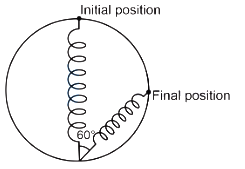
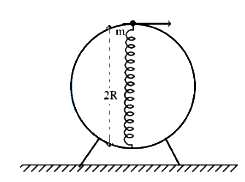
\(\begin{aligned} \text { Work done by gravity } & =m g\left(2 R-R \cos 60^{\circ}\right) \\ & =\frac{3 m g R}{2}\end{aligned}\)
\(\begin{aligned} \text { Work done by spring } & =-\frac{1}{2} k\left(0^2-R^2\right) \\ & =\frac{1}{2} k R^2\end{aligned}\)
Net work = change in kinetic energy
i.e. \(\frac{3 m g R}{2}+\frac{k R^2}{2}=\frac{1}{2} m v^2\)
or \(\quad v^2=3 g R+\frac{k R^2}{m}\)
or \(\quad v=\sqrt{3 g R+\frac{k R^2}{m}}\) -
- (A) \(10[1-(2-x)]^{3 / 2} \mathrm{~m} / \mathrm{s}\)
- (B) \(10\left[1-(2-x)^2\right]^{1 / 2} \mathrm{~m} / \mathrm{s}\)
- (C) \(10\left[1-(2-\mathrm{x})^2\right] \mathrm{m} / \mathrm{s}\)
- (D) \(10\left[1-(2-\mathrm{x})^2\right]^2 \mathrm{~m} / \mathrm{s}\)
Show answer and solution
Correct Answer: (B)
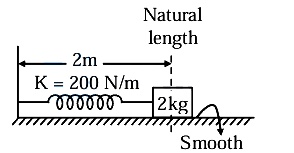
Given, Natural length of spring \(=2 \mathrm{~m}\)
Initial compression in spring \(\left(\mathrm{x}_{\mathrm{i}}\right)=1 \mathrm{~m}\)
Final compression in spring \(\left(\mathrm{x}_{\mathrm{f}}\right)=(2-\mathrm{x}) \mathrm{m}\)
Using energy conservation
\(\begin{aligned}
& \mathrm{K}_{\mathrm{i}}+\mathrm{U}_{\mathrm{i}}=\mathrm{K}_{\mathrm{f}}+\mathrm{U}_{\mathrm{f}} \\
& 0+\frac{1}{2} \mathrm{Kx}_{\mathrm{i}}^2=\frac{1}{2} \mathrm{mv}^2+\frac{1}{2} \mathrm{Kx}_{\mathrm{f}}^2 \\
& \frac{1}{2} \mathrm{mv}^2=\frac{1}{2} \mathrm{~K}\left(\mathrm{x}_{\mathrm{i}}^2-\mathrm{x}_{\mathrm{f}}^2\right) \\
& \frac{1}{2} \times 2 \times \mathrm{v}^2=\frac{1}{2} \times 200 \times\left(1^2-(2-\mathrm{x})^2\right) \\
& \mathrm{v}^2=100\left[1-(2-\mathrm{x})^2\right] \\
& \mathrm{v}=10\left[1-(2-\mathrm{x})^2\right]^{1 / 2}
\end{aligned}\) -
- (A) 970 J
- (B) 735 J
- (C) 245 J
- (D) 490 J
Show answer and solution
Correct Answer: (C)
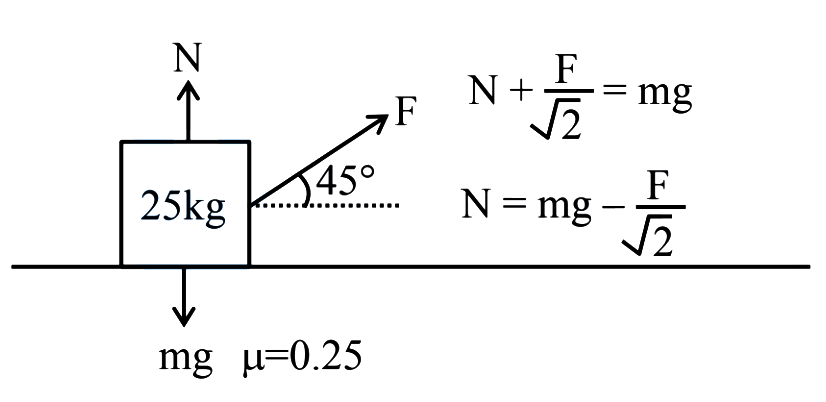
Block travels with uniform velocity
So \(\quad \mathrm{a}=0 \Rightarrow \mathrm{~F} \cos 45^{\circ}=\) friction
\(\begin{aligned}
& \frac{\mathrm{F}}{\sqrt{2}}=\mu\left[\mathrm{mg}-\frac{\mathrm{F}}{\sqrt{2}}\right] \\
& \frac{\mathrm{F}}{\sqrt{2}}=0.25\left[25 \times 9.8-\frac{\mathrm{F}}{\sqrt{2}}\right] \\
& \Rightarrow \quad 1.25 \frac{\mathrm{~F}}{\sqrt{2}}=61.25 \\
& \mathrm{~F}=\frac{61.25 \times \sqrt{2}}{1.25}=49 \sqrt{2} \\
& \mathrm{~W}_{\mathrm{ext}}=\mathrm{FS} \cos 45^{\circ} \\
&=49 \sqrt{2} \times 5 \times \frac{1}{\sqrt{2}}=245 \mathrm{~J}
\end{aligned}\) -
- (A) 1
- (B) 2
- (C) 4
- (D) 3
Show answer and solution
Correct Answer: (B)
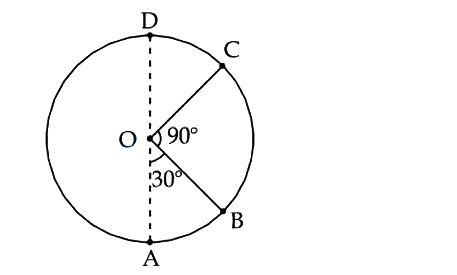
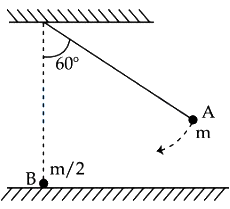
\(\begin{aligned} & \frac{1}{2} \mathrm{mv}_{\mathrm{A}}^2=\frac{1}{2} \mathrm{mv}_{\mathrm{B}}^2+\mathrm{mgh} \\ & \Rightarrow \frac{1}{2} \mathrm{~m}(5 \mathrm{~g} \ell)=\frac{1}{2} \mathrm{mv}_{\mathrm{B}}^2+\mathrm{mg} \frac{\ell}{2} \\ & \Rightarrow \frac{5 \mathrm{mg} \ell}{2}-\frac{\mathrm{mg} \ell}{2}=\mathrm{KE}_{\mathrm{B}} \\ & \Rightarrow \mathrm{KE}_{\mathrm{B}}=2 \mathrm{mg} \ell \\ & \frac{1}{2} \mathrm{mv}_{\mathrm{C}}^2=\frac{1}{2} \mathrm{mv}_{\mathrm{D}}^2+\mathrm{mg} \frac{\ell}{2} \\ & \Rightarrow \mathrm{KE}_{\mathrm{C}}=\frac{1}{2} \mathrm{mg} \ell+\mathrm{mg} \frac{\ell}{2}=\mathrm{mg} \ell \\ & \Rightarrow \frac{\mathrm{KE}_{\mathrm{B}}}{\mathrm{KE}_{\mathrm{C}}}=2\end{aligned}\) -
- (A) \(\frac{2+\sqrt{2}}{3}\)
- (B) \(\frac{2+\sqrt{3}}{3}\)
- (C) \(\frac{3+\sqrt{3}}{2}\)
- (D) \(\frac{3-\sqrt{2}}{2}\)
Show answer and solution
Correct Answer: (C)
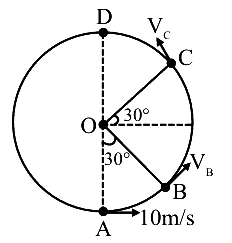
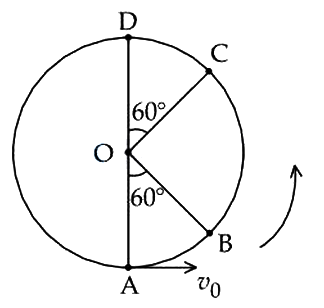
\(\begin{aligned} & \frac{1}{2} \mathrm{~m} \times 100+0=\frac{1}{2} \mathrm{mV}_{\mathrm{B}}^2+\mathrm{mg}\left(\mathrm{R}-\frac{\mathrm{R} \sqrt{3}}{2}\right) \\ & 100=\mathrm{V}_{\mathrm{B}}^2+2 \mathrm{gR}\left(1-\frac{\sqrt{3}}{2}\right] \\ & \mathrm{V}_{\mathrm{B}}^2=100-20(2-\sqrt{3}) \\ & \left.\mathrm{V}_{\mathrm{B}}^2=60+20 \sqrt{3}\right) \\ & \mathrm{K} . \mathrm{E}_{\mathrm{B}}=\frac{1}{2} \mathrm{mV}_{\mathrm{B}}^2=\frac{\mathrm{m}}{2}(60+20 \sqrt{3}) \\ & \frac{1}{2} \mathrm{~m}(100)=\frac{1}{2} \mathrm{mV} \\ & 2 \\ & 100=\mathrm{mg}\left(\frac{3 \mathrm{R}}{2}\right) \\ & 100 \mathrm{~V}_{\mathrm{C}}^2=60 \\ & \mathrm{~V}_{\mathrm{C}}^2=40 \\ & \mathrm{~K} . \mathrm{E}_{\mathrm{C}}=\frac{1}{2} \mathrm{mV} \mathrm{V}_{\mathrm{C}}^2=\frac{1}{2} \mathrm{~m}(40) \\ & \mathrm{K} . \mathrm{E}_{\mathrm{B}}=\frac{60+20 \sqrt{3}}{40}=\frac{3}{2}+\frac{\sqrt{3}}{2}=\frac{3+\sqrt{3}}{2}\end{aligned}\) -
- (A) \(13: 6\)
- (B) \(4: 3\)
- (C) \(1: 2\)
- (D) \(6: 13\)
Show answer and solution
Correct Answer: (D)
\(\begin{aligned} & \langle\mathrm{p}\rangle=\frac{(2 \hat{\mathrm{i}}+3 \hat{\mathrm{j}}) \cdot(3 \hat{\mathrm{i}}+6 \hat{\mathrm{j}})}{4}=6 \\ & \overrightarrow{\mathrm{a}}=\left(\frac{\overrightarrow{\mathrm{F}}}{\mathrm{m}}=\frac{1}{2} \hat{\mathrm{i}}+\frac{3}{4} \hat{\mathrm{j}}\right) \\ & \overrightarrow{\mathrm{v}} \text { at } \mathrm{t}=4 \mathrm{sec}=\left(\frac{1}{2} \hat{\mathrm{i}}+\frac{3}{4} \hat{\mathrm{j}}\right) \times 4=(2 \hat{\mathrm{i}}+3 \hat{\mathrm{j}}) \\ & P_{\text {ins }}=(2 \hat{\mathrm{i}}+3)(2 \hat{\mathrm{i}}+3 \hat{\mathrm{j}})=13 \\ & \frac{\langle\mathrm{P}\rangle}{P_{\text {ins }}}=\frac{6}{13}\end{aligned}\) -
- (A) \(\frac{n^2}{n^2+4}\)
- (B) \(\frac{n^2+4}{n^2}\)
- (C) \(\frac{n+4}{n}\)
- (D) \(\frac{n}{n+4}\)
Show answer and solution
Correct Answer: (B)
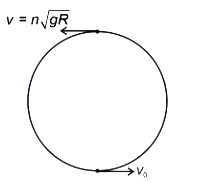
\(\begin{aligned} & v_0=\sqrt{v^2+2 g(2 R)} \\ & v_0=\sqrt{n^2 g R+4 g R} \\ & \therefore \quad \frac{k_{\text {bottom }}}{k_{\text {top }}}=\frac{v_0^2}{v^2}=\frac{n^2+4}{n^2}\end{aligned}\) -
- (A) 0
- (B) \(\frac{1}{2}\)
- (C) 2
- (D) \(\frac{1}{3}\)
Show answer and solution
Correct Answer: (B)
\(\begin{aligned} & w=0 \\ & \therefore \quad \vec{F} \cdot S=0 \\ & (2 \hat{i}+b \hat{j}+\hat{k}) \cdot(\hat{i}-2 \hat{j}-\hat{k})=0 \\ & 2-2 b-1=0 \\ & b=\frac{1}{2}\end{aligned}\) -
- (A) \(15 \mathrm{~N} / \mathrm{m}^2\)
- (B) \(12 \mathrm{~N} / \mathrm{m}^2\)
- (C) \(8 \mathrm{~N} / \mathrm{m}^2\)
- (D) \(10 \mathrm{~N} / \mathrm{m}^2\)
Show answer and solution
Correct Answer: (B)
\(F=\alpha+\beta x^2\)
Work done \(\int d w=\int F \cdot d x\)
\(\begin{aligned}
& \Rightarrow \quad \Delta W=\int F \cdot d x=\int\left(\alpha+\beta x^2\right) d x \\
& \Rightarrow \quad \Delta W=\left|\alpha x+\frac{\beta x^3}{3}\right|_0^1=\alpha+\frac{\beta}{3}=5
\end{aligned}\)
Given \(\alpha=1\)
So, \(\frac{\beta}{3}=4\)
\(\Rightarrow \beta=12 \mathrm{~N} / \mathrm{m}^2\) -
- (A) 152
- (B) 150
- (C) 148
- (D) 146
Show answer and solution
Correct Answer: (A)
\(\begin{aligned} & y=10-x \\ & w=\int_0^4 x^2(10-x) d x+\int_0^2 y^2 d y \\ & =\frac{10 x^3}{3}-\left.\frac{x^4}{4}\right|_0 ^4+\left.\frac{y^3}{3}\right|_0 ^2 \\ & =\frac{640}{3}-\frac{256}{4}+\frac{8}{3} \\ & =216 \times 64 \\ & =152 \mathrm{~J}\end{aligned}\) -
- (A) \(\frac{\mathrm{S}}{2}, \sqrt{\frac{3 \mathrm{gS}}{2}}\)
- (B) \(\frac{\mathrm{S}}{2}, \frac{3 \mathrm{gS}}{2}\)
- (C) \(\frac{\mathrm{S}}{4}, \frac{3 \mathrm{gS}}{2}\)
- (D) \(\frac{\mathrm{S}}{4}, \sqrt{\frac{3 \mathrm{gS}}{2}}\)
Show answer and solution
Correct Answer: (D)
Potential energy at height \( h \): \( U = mgh \)
Initial mechanical energy: \( E = mgS \)
Kinetic energy at height \( h \): \( K = mg(S - h) \)
Given condition: \( K = 3U \)
\( mg(S - h) = 3mgh \)
\( S - h = 3h \Rightarrow S = 4h \)
\( h = \frac{S}{4} \)
Speed at height \( h \): \( \frac{1}{2}mv^2 = mg\left(S - \frac{S}{4}\right) \)
\( \frac{1}{2}mv^2 = mg\frac{3S}{4} \)
\( v = \sqrt{\frac{3gS}{2}} \) -
- (A) \(\mathrm{P} \propto \sqrt{v}\)
- (B) \(\mathrm{P} \propto v\)
- (C) \(\mathrm{P}^2 \propto v^5\)
- (D) \(\mathrm{P}^2 \propto v^3\)
Show answer and solution
Correct Answer: (C)
Power \(=\vec{F} \cdot \vec{V}\)
and \(F=\frac{d p}{d t}=\) Rate of change of linear momentum
\(F=V \cdot \frac{d m}{d t}=K_1 V^{\frac{3}{2}}, K\) is constant
Power \((P)=\left(K V^{\frac{3}{2}}\right) \cdot(V)\)
\(=K V^{\frac{5}{2}}\)
So, \(P^2 \propto V^5\) -
- (A) \(\left(2 t^2+3 t^3\right) W\)
- (B) \(\left(2 t^2+18 t^3\right) W\)
- (C) \(\left(3 t^3+5 t^5\right) W\)
- (D) \(\left(2 t^3+3 t^5\right) W\)
Show answer and solution
Correct Answer: (D)
\(\begin{aligned} & \overrightarrow{\mathrm{F}}=(2 t \hat{\mathrm{i}}+3 \mathrm{t} \hat{\mathrm{j}}) \mathrm{N} \\ & \mathrm{m}=1000 \mathrm{gm}=1 \mathrm{~kg} \\ & \overrightarrow{\mathrm{~F}}=m \overrightarrow{\mathrm{a}}, \overrightarrow{\mathrm{a}}=2 \mathrm{t} \hat{\mathrm{i}}+3 \mathrm{t}^2 \hat{j} \\ & \frac{\mathrm{~d} \overrightarrow{\mathrm{v}}}{\mathrm{dt}}=2 t \hat{\mathrm{i}}+3 \mathrm{t}^2 \hat{\mathrm{j}}\end{aligned}\)
\(\vec{v}=t^2 \hat{i}+t^3 \hat{j}\)
Power, \(\mathrm{P}=\overrightarrow{\mathrm{F}} \cdot \overrightarrow{\mathrm{v}}\)
\(\begin{aligned} & P=\left(2 t \hat{i}+3 t^2 \hat{j}\right) \cdot\left(t^2 \hat{i}+t^3 \hat{j}\right) \\ & P=\left(2 t^3+3 t^5\right) W\end{aligned}\) -
- (A) \(\frac{4}{3} \sqrt{\operatorname{Rg}}\)
- (B) \(\frac{2}{3} \sqrt{\mathrm{Rg}}\)
- (C) \(\sqrt{\mathrm{Rg}}\)
- (D) \(\frac{1}{3} \sqrt{\operatorname{Rg}}\)
Show answer and solution
Correct Answer: (D)
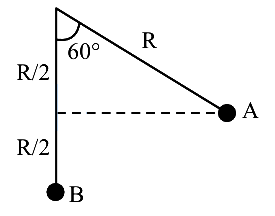
Velocity of a just before hitting :
\(\mathrm{u}=\sqrt{2 \mathrm{~g} \frac{\mathrm{R}}{2}}=\sqrt{\mathrm{gR}}\)
Just after collision, let velocity of A and B are \(\mathrm{v}_1\) and \(v_2\) respectively
\(\therefore \text { by COM: }\)
\(\begin{aligned}
& m u=m v_1+\frac{m}{2} v_2 \\
& 2 v_1+v_2=2 u ...(i)\\
& e=1=\frac{v_2-v_1}{u} \\
& \Rightarrow v_2-v_1=u..(ii)
\end{aligned}\)
From (i) -(ii)
\(\Rightarrow 3 \mathrm{v}_1=\mathrm{u} \Rightarrow \mathrm{v}_1=\frac{\mathrm{u}}{3}=\frac{1}{3} \sqrt{\mathrm{gR}}\) -
- (A) \(\mathbf{A}\) is false but \(\mathbf{R}\) is true
- (B) Both \(\mathbf{A}\) and \(\mathbf{R}\) are true but \(\mathbf{R}\) is NOT the correct explanation of \(\mathbf{A}\)
- (C) \(\mathbf{A}\) is true but \(\mathbf{R}\) is false
- (D) Both \(\mathbf{A}\) and \(\mathbf{R}\) are true and \(\mathbf{R}\) is the correct explanation of \(\mathbf{A}\)
Show answer and solution
Correct Answer: (B)
Assertion is correct as central forces are conservative in nature, i.e. work done is independent of path.
Reason is true as some forces in mechanics like, friction are non-conservative because work done depends on path and only conservative forces have an associated potential energy.
Also, reason does not explain assertion. -
- (A) Coulomb's force
- (B) Gravitational force
- (C) Frictional force
- (D) Restoring force
Show answer and solution
Correct Answer: (C)
Potential energy is defined for conservative force only. It is not defined for non-conservative force i.e. frictional force. -
- (A) \(\mu=\frac{\mathrm{v}_{\mathrm{o}}^2+\mathrm{rg} \tan \theta}{\mathrm{rg}+\mathrm{v}_{\mathrm{o}}^2 \tan \theta}\)
- (B) \(\mu=\frac{v_0^2-r g \tan \theta}{r g-v_0^2 \tan \theta}\)
- (C) \(\mu=\frac{v_0^2-r g \tan \theta}{r g+v_0^2 \tan \theta}\)
- (D) \(\mu=\frac{v_o^2+r g \tan \theta}{\mathrm{rg}-\mathrm{v}_{\mathrm{o}}^2 \tan \theta}\)
Show answer and solution
Correct Answer: (C)
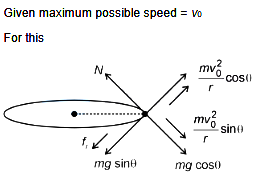
So, \(N=m g \cos \theta+\frac{m v_0^2}{r} \sin \theta\)
\(f_r=\mu m g \cos \theta+\frac{\mu m v_0^2}{r} \sin \theta\)
\(\begin{aligned}
& \text { And } \frac{m v_0^2}{r} \cos \theta=m g \sin \theta+f_r \\
& \Rightarrow \frac{m v_0^2}{r} \cos \theta-m g \sin \theta=\mu\left(m g \cos \theta+\frac{m v_0^2}{r} \sin \theta\right) \\
& \Rightarrow\left(v_0^2-g r \tan \theta\right)=\mu\left(v_0^2 \tan \theta+g r\right) \\
& \Rightarrow \mu=\frac{v_0^2-g r \tan \theta}{g r+v_0^2 \tan \theta}
\end{aligned}\) -
- (A) \(\sqrt{3}-1\)
- (B) \(\frac{\sqrt{3}}{2}\)
- (C) \(\frac{\sqrt{2}}{3}\)
- (D) \(1-\frac{\sqrt{3}}{2}\)
Show answer and solution
Correct Answer: (A)
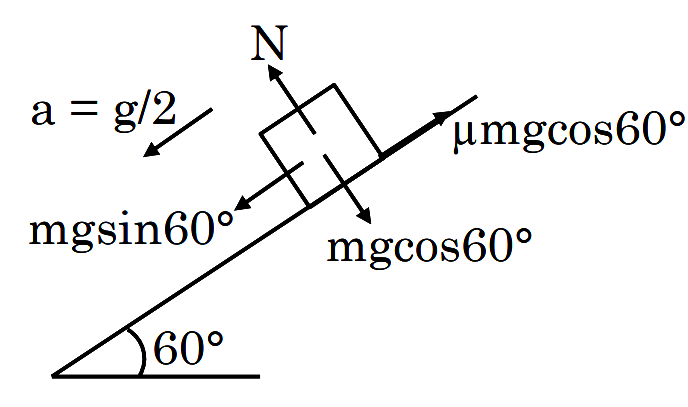
\(\mathrm{mg} \sin 60^{\circ}-\mu \mathrm{mg} \cos 60^{\circ}=\mathrm{ma}\)
\(g \sin 60-\mu g \cos 60=\frac{g}{2}\)
\(\frac{\sqrt{3}}{2}-\frac{\mu}{2}=\frac{1}{2}\)
\(\mu=\sqrt{3}-1\) -
- (A) \(\frac{(\mathrm{KE})}{8}\)
- (B) \(\frac{(\mathrm{KE})}{2}\)
- (C) \(\frac{(\mathrm{KE})}{16}\)
- (D) \(\frac{(\mathrm{KE})}{4}\)
Show answer and solution
Correct Answer: (D)
Initial K.E,
\(\text { K.E. }=\frac{1}{2} \mathrm{mu}^2\)
Speed at heighest point
\(\begin{aligned}
& \mathrm{V}=\mathrm{u} \cos 60^{\circ}=\frac{\mathrm{u}}{2} \\
& \therefore \mathrm{KE}_2=\frac{1}{2} \mathrm{~m}\left(\frac{\mathrm{u}}{2}\right)^2 \\
& =\frac{1}{4} \times \frac{1}{2} \mathrm{mu}^2 \\
& =\frac{\mathrm{KE}}{4}
\end{aligned}\) -
- (A) 5 J
- (B) 15 J
- (C) 20 J
- (D) zero
Show answer and solution
Correct Answer: (B)
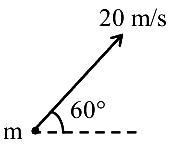
\(\begin{aligned} & \mathrm{k}_{\mathrm{i}}=\frac{1}{2} \mathrm{mv}^2 \\ & \mathrm{k}_{\mathrm{f}}=\frac{1}{2} \mathrm{~m}\left(\mathrm{v} \cos 60^{\circ}\right)^2=\frac{1}{8} m v^2 \\ & \Delta \mathrm{k}=\mathrm{k}_{\mathrm{i}}-\mathrm{k}_{\mathrm{f}}=\frac{3}{8} \mathrm{mv}^2=\frac{3}{8} \times 0.1 \times 400=15 \mathrm{~J}\end{aligned}\) -
- (A) \(2 \sqrt{5} \mathrm{~km}\)
- (B) 4 km
- (C) 7.2 km
- (D) \(2 \sqrt{2} \mathrm{~km}\)
Show answer and solution
Correct Answer: (D)
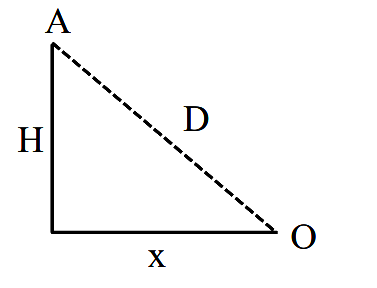
\(\begin{aligned} & \mathrm{u}=360 \times \frac{5}{18}=100 \mathrm{~m} / \mathrm{s} \\ & \mathrm{x}=\mathrm{u} \times \mathrm{t}=2 \times 10^3 \mathrm{~m} \\ & \mathrm{t}=\sqrt{\frac{2 \mathrm{H}}{\mathrm{g}}} \Rightarrow \mathrm{H}=\frac{\mathrm{t}^2 \mathrm{~g}}{2} \\ & \mathrm{H}=\frac{400 \times 10}{2} \\ & \mathrm{H}=2000 \mathrm{~m} \\ & \mathrm{D}=\sqrt{\mathrm{x}^2+\mathrm{H}^2} \\ & \mathrm{D}=2 \sqrt{2} \mathrm{~km}\end{aligned}\) -
- (A) 5
- (B) 6
- (C) 7
- (D) 8
Show answer and solution
Correct Answer: (A)
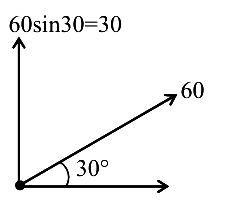
\(\begin{aligned} & \mathrm{S}_1=30 \times 1-\frac{1}{2} \times 10 \times 1=25 \\ & \mathrm{~S}_3=30+\left(\frac{-10}{2}\right) \times(2 \times 3-1)=5 \\ & \frac{\mathrm{~S}_1}{\mathrm{~S}_3}=\frac{25}{5}=5\end{aligned}\) -
- (A) \(6\)
- (B) \(18\)
- (C) \(12\)
- (D) \(24\)
Show answer and solution
Correct Answer: (D)
\(\begin{aligned} & \text { Range }=3 \mathrm{H}_{\max } \\ & \frac{\mathrm{u}^2 \sin 2 \theta}{\mathrm{~g}}=\frac{3 \mathrm{u}^2 \sin ^2 \theta}{2 \mathrm{~g}}\end{aligned}\)
\(2 \sin \theta \cos \theta=\frac{3}{2} \sin ^2 \theta\)
\(\tan \theta=\frac{4}{3} \Rightarrow \theta=53^{\circ}\)
\(\mathrm{R}=\frac{\mathrm{u}^2\left(2 \times \frac{3}{5} \times \frac{4}{5}\right)}{\mathrm{g}} \Rightarrow \frac{24 \mathrm{u}^2}{25 \mathrm{~g}}\) -
- (A) 300 m
- (B) 112.5 m
- (C) 75 m
- (D) \(112.5 \times \sqrt{3} \mathrm{~m}\)
Show answer and solution
Correct Answer: (B)
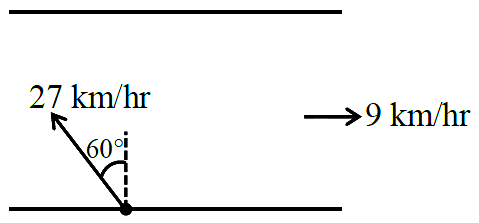
\(\therefore \mathrm{V}_{\perp}=\) river flow \(=27 \times \cos 60^{\circ}=\frac{27}{2} \mathrm{~km} / \mathrm{hr}\).
Time taken \(=30 \mathrm{sec}\).
\(\therefore \mathrm{S}=\mathrm{Vt}=\frac{27}{2} \times \frac{5}{18} \times 30 \mathrm{~m}=112.5 \mathrm{~m}\) -
- (A) 34
- (B) 36
- (C) 38
- (D) 40
Show answer and solution
Correct Answer: (B)
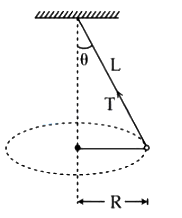
\(\begin{aligned} & \omega=\frac{3}{\pi} \times 2 \pi=6 \mathrm{rad} / \mathrm{s} \\ & R=L \sin \theta\end{aligned}\)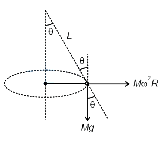
and \(T=M \sqrt{g^2+\omega^4 R^2}\)
Also, \(T \sin \theta=M \omega^2 \cdot L \sin \theta\)
\(\begin{aligned}
& \Rightarrow \quad T=M(36) \mathrm{L} \\
& \Rightarrow \quad T=36 \mathrm{ML}
\end{aligned}\) -
- (A) 5
- (B) 3
- (C) 2
- (D) 1
Show answer and solution
Correct Answer: (D)
Explanation:
Let us calculate the angular velocity by determining the total centrifugal force exerted by the continuous liquid column:
1. Setting up the Integration Element:
Let \( L = 1\text{ m} \) be the total length of the tube and \( m = 2M \) be the total mass of the liquid. Consider a tiny element of the liquid column having a width \( dx \) located at a distance \( x \) from the axis of rotation.
The mass of this small element is:
\( dm = \frac{m}{L} dx \)
2. Integrating the Centrifugal Force:
The outward centrifugal force \( dF \) exerted by this small element during rotation is:
\( dF = (dm) \omega^2 x = \left(\frac{m}{L} dx\right) \omega^2 x \)
To find the total force \( F \) acting on the outer wall, we integrate this expression from the pivot \( x = 0 \) to the outer end \( x = L \):
\( F = \int_{0}^{L} \frac{m}{L} \omega^2 x dx = \frac{m}{L} \omega^2 \left[ \frac{x^2}{2} \right]_{0}^{L} \)
\( F = \frac{m}{L} \omega^2 \frac{L^2}{2} = \frac{1}{2} m \omega^2 L \)
Notice that this matches the center of mass approach: \( F = m \omega^2 r_{cm} \), where \( r_{cm} = \frac{L}{2} = 0.5\text{ m} \).
3. Substituting the Given Constants:
Now, substitute the values \( L = 1\text{ m} \) and \( m = 2M \) into the derived equation:
\( F = \frac{1}{2} (2M) \omega^2 (1) = M \omega^2 \)
Solving explicitly for the angular velocity \( \omega \):
\( \omega^2 = \frac{F}{M} \implies \omega = \sqrt{\frac{F}{M}} \)
Comparing this result with the expression given in the problem \( \omega = \sqrt{\frac{F}{\alpha M}} \), we find that \( \alpha = 1 \).
Hence, Option D is the correct choice. -
- (A) 1000
- (B) 2000
- (C) 3000
- (D) 4000
Show answer and solution
Correct Answer: (B)
\(\overrightarrow{\mathrm{v}}_{\mathrm{b}}=9+27=36 \mathrm{~km} / \mathrm{hr}\)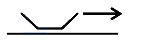
\(\begin{aligned} & \overrightarrow{\mathrm{v}}_{\mathrm{b}}=36 \times \frac{1000}{36000}=10 \mathrm{~m} / \mathrm{sec} \\ & \text { Time of flight }=\frac{2 \times 10}{10}=2 \mathrm{sec} \\ & \text { Range }=10 \times 2=20 \mathrm{~m}=2000 \mathrm{~cm}\end{aligned}\) -
- (A) \(5 \sqrt{15} \mathrm{~m} / \mathrm{s}\), making an angle of \(\tan ^{-1} 4\) with - ve \(Y\) axis
- (B) \(5 \sqrt{15} \mathrm{~m} / \mathrm{s}\), making an angle of \(\tan ^{-1} 4\) with + ve X axis
- (C) \(5 \sqrt{17} \mathrm{~m} / \mathrm{s}\), making an angle of \(\tan ^{-1} 4\) with + ve \(X\) axis
- (D) \(5 \sqrt{17} \mathrm{~m} / \mathrm{s}\), making an angle of \(\tan ^{-1} 4\) with - ve \(Y\) axis
Show answer and solution
Correct Answer: (D)
\(\begin{aligned} & \overrightarrow{\mathrm{r}}=5 t^2 \hat{\mathrm{i}}-5 \mathrm{t}_{\mathrm{j}} \\ & \overrightarrow{\mathrm{v}}=10 \hat{\mathrm{i}}-5 \hat{\mathrm{j}} \\ & \overrightarrow{\mathrm{v}}=20 \hat{\mathrm{i}}-5 \hat{\mathrm{j}} \quad \text { at } \mathrm{t}=2 \mathrm{sec}\end{aligned}\)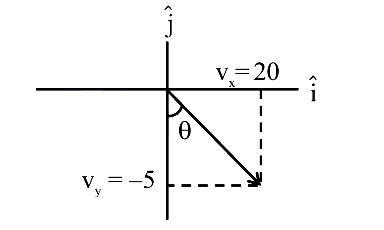
\(\begin{aligned} & \tan \theta=\frac{20}{5}=4 \\ & \theta=\tan ^{-1} 4 \\ & \text { From -veY-axis }\end{aligned}\) -
- (A) \(2 \sqrt{2}: 1\)
- (B) \(2: 1\)
- (C) \(\sqrt{2}: 1\)
- (D) \(4: 1\)
Show answer and solution
Correct Answer: (A)
\(\begin{aligned} & \text { Given, }\left(\mathrm{H}_{\max }\right)_1=8 \times\left(\mathrm{H}_{\max }\right)_2 \\ & \frac{\mathrm{u}^2 \sin ^2 \theta_1}{2 \mathrm{~g}}=8 \times \frac{\mathrm{u}^2 \sin ^2 \theta_2}{2 \mathrm{~g}} \\ & \Rightarrow \sin \theta_1=2 \sqrt{2} \sin \theta_2 \\ & \frac{\mathrm{~T}_1}{\mathrm{~T}_2}=\frac{2 \mathrm{u} \sin \theta_1 / \mathrm{g}}{2 \mathrm{u} \sin \theta_2 / \mathrm{g}}=\frac{\sin \theta_1}{\sin \theta_2}=2 \sqrt{2}\end{aligned}\) -
- (A) 4
- (B) 5
- (C) 3
- (D) 2
Show answer and solution
Correct Answer: (C)
\(\mathrm{a}_{\mathrm{p}}=\mathrm{kt}, \mathrm{k}\) is constant
\(\mathrm{a}_{\mathrm{Q}}=\mathrm{a}, \mathrm{a}\) is constant
\(\mathrm{a}_{\mathrm{QP}}=\mathrm{a}_{\mathrm{Q}}-\mathrm{a}_{\mathrm{p}}=\mathrm{a}-\mathrm{kt}\)
as initial velocities are not mentioned in question, so will have to assume two cases.
Case-I
\(\mathrm{u}_{\mathrm{OP}}\) and \(\mathrm{a}_{\mathrm{QP}}\) in same direction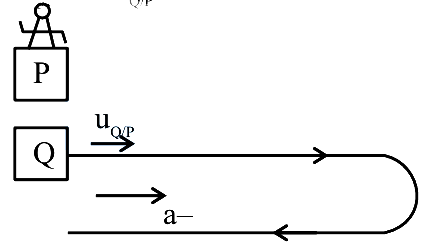
Total number of crossing \(=2\) Case-II
\(\mathrm{u}_{\mathrm{QP}}\) and \(\mathrm{a}_{\mathrm{QP}}\) in opposite direction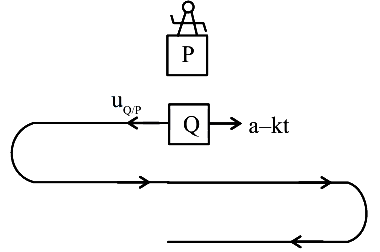
Total number of crossing \(=3\) -
- (A) 1
- (B) \(\frac{1-\tan \alpha}{1+\tan \alpha}\)
- (C) \(\frac{1+\sin 2 \alpha}{1-\sin 2 \alpha}\)
- (D) \(\frac{1+\tan \alpha}{1-\tan \alpha}\)
Show answer and solution
Correct Answer: (D)
\(\theta_1=45+\alpha ; \theta_2=45-\alpha\)
Time of flight, \(\mathrm{T}=\frac{2 \mathrm{v} \sin \theta}{\mathrm{g}}\)
\(\frac{\mathrm{T}_1}{\mathrm{~T}_2}=\frac{\sin (45+\alpha)}{\sin (45-\alpha)}\)
\(\frac{\mathrm{T}_1}{\mathrm{~T}_2}=\frac{\frac{1}{\sqrt{2}} \cos \alpha+\frac{1}{\sqrt{2}} \sin \alpha}{\frac{1}{\sqrt{2}} \cos \alpha-\frac{1}{\sqrt{2}} \sin \alpha}\)
\(\frac{\mathrm{T}_1}{\mathrm{~T}_2}=\frac{\cos \alpha+\sin \alpha}{\cos \alpha-\sin \alpha}=\frac{1+\tan \alpha}{1-\tan \alpha}\) -
- (A) \(\frac{1-\tan \alpha}{1+\tan \alpha}\)
- (B) \(\frac{1-\sin 2 \alpha}{1+\sin 2 \alpha}\)
- (C) \(\frac{1+\sin 2 \alpha}{1-\sin 2 \alpha}\)
- (D) \(\frac{1+\sin \alpha}{1-\sin \alpha}\)
Show answer and solution
Correct Answer: (B)
\(\begin{aligned} & \mathrm{H}_{\mathrm{Max}}=\frac{(\mathrm{u} \sin \theta)^2}{2 \mathrm{~g}} \\ & \frac{\left(\mathrm{H}_{\max }\right)_1}{\left(\mathrm{H}_{\max }\right)_2}=\frac{\mathrm{u}^2 \sin ^2(45-\alpha)}{\mathrm{u}^2 \sin ^2(45+\alpha)} \\ & =\frac{\left(\frac{1}{\sqrt{2}} \cos \alpha-\frac{1}{\sqrt{2}} \sin \alpha\right)^2}{\left(\frac{1}{\sqrt{2}} \cos \alpha+\frac{1}{\sqrt{2}} \sin \alpha\right)^2} \\ & =\frac{1-\sin 2 \alpha}{1+\sin 2 \alpha}\end{aligned}\) -
- (A) the acceleration of the particle is \(2 \mathrm{c}_0\)
- (B) the acceleration of the particle is \(2\mathrm{~c}\)
- (C) the initial velocity of the particle is \(4\mathrm{~c}\)
- (D) the acceleration of the particle is \(2\left(c+c_0\right)\)
Show answer and solution
Correct Answer: (D)
\(\begin{aligned} & \mathrm{v}=\frac{\mathrm{dx}}{\mathrm{dt}}=2 \mathrm{tC}_0+2 \mathrm{C}(\mathrm{t}-2) \\ & \mathrm{a}=\frac{\mathrm{dv}}{\mathrm{dt}}=2 \mathrm{C}_0+2 \mathrm{C}\end{aligned}\) -
- (A) 10
- (B) 2
- (C) 5
- (D) 11
Show answer and solution
Correct Answer: (A)
\(\begin{aligned} & \mathrm{v}_{\text {avg }}=\frac{\mathrm{x}_1+\mathrm{x}_2}{\mathrm{t}_1+\mathrm{t}_2} \\ & \Rightarrow \frac{50}{7}=\frac{\mathrm{x}+\frac{3 \mathrm{x}}{2}}{\frac{\mathrm{x}}{5}+\frac{3 \mathrm{x}}{2 \mathrm{v}_2}} \\ & \Rightarrow \frac{50}{7}=\frac{5 / 2}{\frac{1}{5}+\frac{3}{2 \mathrm{v}_2}} \\ & \Rightarrow \frac{1}{5}+\frac{3}{2 \mathrm{v}_2}=\frac{7}{20}\end{aligned}\)
\(\begin{aligned} & \Rightarrow \frac{3}{2 \mathrm{v}_2}=\frac{7}{20}-\frac{1}{5}=\frac{7-4}{20} \\ & \Rightarrow \frac{3}{2 \mathrm{v}_2}=\frac{3}{20} \\ & \Rightarrow \mathrm{v}_2=10 \mathrm{~m} / \mathrm{s}\end{aligned}\) -
- (A) \(2 \mathrm{r}, 3 \pi \mathrm{r}\)
- (B) \(3 \pi r, \pi r\)
- (C) \(\pi r, 3 r\)
- (D) \(3 \pi r, 2 r\)
Show answer and solution
Correct Answer: (D)
Explanation:
Let us analyze the motion of the sportsman step-by-step along the circular track:
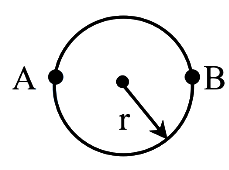
1. Understanding the Path Structure:
From the given diagram, points A and B are diametrically opposite to each other. The sequence of motion is given as \( ABAB \), meaning the sportsman starts at initial position A and moves continuously as follows:
- From A to B: Covers a semi-circle path length = \( \pi r \)
- From B to A: Covers the next semi-circle path length = \( \pi r \)
- From A to B: Covers another semi-circle path length = \( \pi r \)
2. Calculating Distance Travelled:
Distance is defined as the actual total length of the path covered by the moving body:
\( \text{Total Distance} = \pi r + \pi r + \pi r = 3\pi r \)
3. Calculating Displacement:
Displacement is the shortest straight-line distance separating the initial position and the final position.
- Initial Position: Point A
- Final Position: Point B
Since A and B are opposite ends of the diameter, the straight-line separation between them is equal to the diameter of the track:
\( \text{Displacement} = 2r \)
Hence, Option D is the correct choice. -
- (A) (A), (D), (E) only
- (B) (B), (C), (D) only
- (C) (B), (D), (E) only
- (D) (B), (C), (E) only
Show answer and solution
Correct Answer: (D)
\(\begin{aligned}
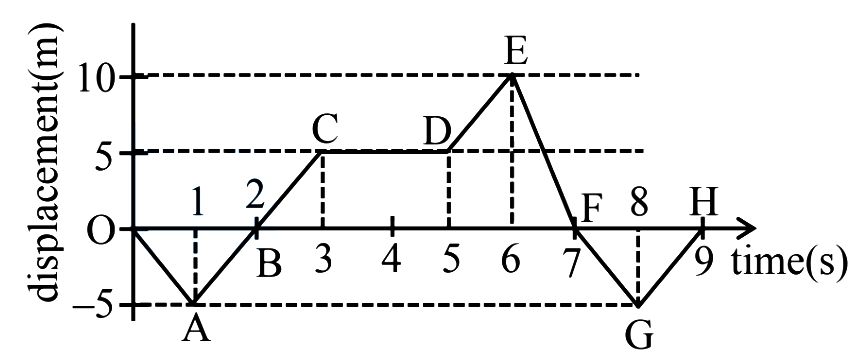
& \langle\overrightarrow{\mathrm{v}}\rangle=\frac{\Delta \overrightarrow{\mathrm{s}}}{\Delta \mathrm{t}}=\frac{\mathrm{S}_{\mathrm{f}}-\mathrm{S}_{\mathrm{i}}}{\mathrm{t}_{\mathrm{f}}-\mathrm{t}_{\mathrm{i}}} \\
& \overrightarrow{\mathrm{v}}=\frac{\mathrm{ds}}{\mathrm{dt}}=\text { slope }
\end{aligned}\)
(A) 0 to \(3 \mathrm{sec} ;\langle\overrightarrow{\mathrm{v}}\rangle=\frac{5-0}{3}=5 / 3 \mathrm{~m} / \mathrm{s}\)
(B) 0 to \(5 \mathrm{sec} ;\langle\vec{v}\rangle=\frac{5-5}{2}=0\)
(C) \(\mathrm{t}=2 ;\) slope \(=\vec{v}=5 \mathrm{~m} / \mathrm{s}\)
(D) \(\mathfrak{t}=5\) to \(7 \mathrm{sec} ;\langle\overrightarrow{\mathrm{v}}\rangle=\frac{0-5}{2}=-2.5 \mathrm{~m} / \mathrm{s}\)
At \(t=6.5 \mathrm{sec} ; \vec{v}=10\)
(E) \(\mathrm{t}=0\) to \(\mathrm{t}=9 ;\langle\overrightarrow{\mathrm{v}}\rangle=0\) -
- (A) \(12\)
- (B) \(3\)
- (C) \(6\)
- (D) \(9\)
Show answer and solution
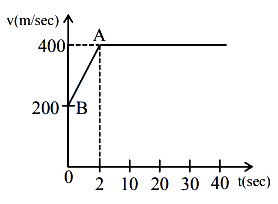
Correct Answer: (A)
Distance = area under the graph
\(\begin{aligned}
d & =300 \times 2+400 \times 28.5 \\
& =600+114000 \\
& =12000 \mathrm{~m}
\end{aligned}\) -
- (A) \(30\mathrm{~m}\)
- (B) \(11\mathrm{~m}\)
- (C) \(10\mathrm{~m}\)
- (D) \(13\mathrm{~m}\)
Show answer and solution
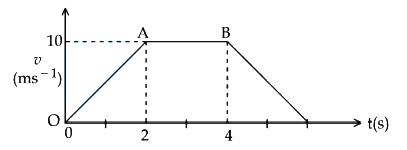
Correct Answer: (A)
Distance travelled = displacement when direction of velocity remains constant
\(\begin{aligned} \Rightarrow \text { Distance } & =\text { Area } \\ & =\frac{1}{2}(2 \mathrm{~s}+4 \mathrm{~s})(10 \mathrm{~m} / \mathrm{s}) \\ & =30 \mathrm{~m}\end{aligned}\) - 447. Which of the following curves possibly represent one-dimensional motion of a particle?
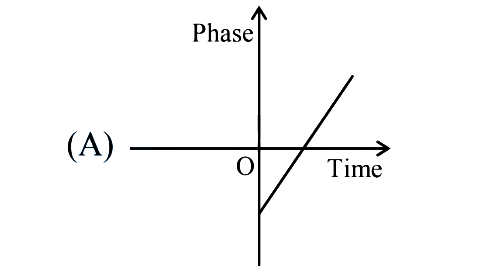
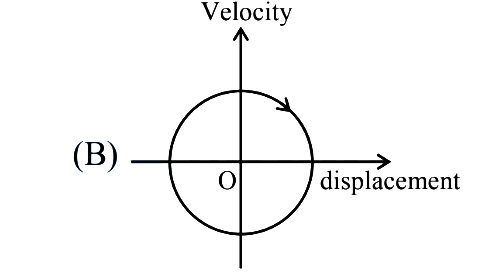
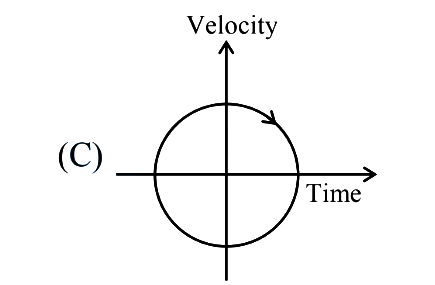
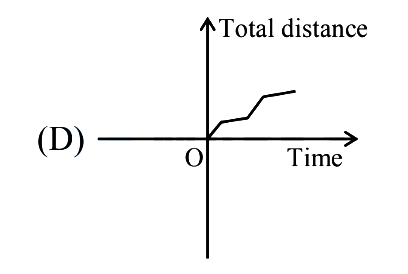
Choose the correct answer from the options given below : 2025 Medium- (A) A, B and D only
- (B) A, B and C only
- (C) A and B only
- (D) A, C and D only
Show answer and solution
Correct Answer: (A)
For option (A)
\(\phi=\mathrm{kt}+\mathrm{C}\) it can be 1D motion
\(\mathrm{eg} \rightarrow \mathrm{x}=\mathrm{A} \sin \phi(\mathrm{SHM})\)
For option (B)
\(\mathrm{v}^2+\mathrm{x}^2=\) constant yes 1D
For option (C)
time can't be negative Not possible
For option (D)
Possible
A, B \& D only -
- (A) \(\frac{13}{10} \mathrm{t}\)
- (B) \(\frac{10}{13} \mathrm{t}\)
- (C) \(\frac{5}{13} \mathrm{t}\)
- (D) \(\frac{13}{5} \mathrm{t}\)
Show answer and solution
Correct Answer: (D)
By using average form of Newton's law of cooling
\(\begin{aligned}
& \frac{90-80}{\mathrm{t}}=\mathrm{k}\left(\frac{90+80}{2}-20\right) \\
& \frac{80-60}{\mathrm{t}^{\prime}}=\mathrm{k}\left(\frac{80+60}{2}-20\right)
\end{aligned}\)
\(\begin{aligned}
& \text { (i)/(ii) } \\
& \frac{10 \times \mathrm{t}^{\prime}}{\mathrm{t} \times 20}=\frac{65}{50} \\
& \mathrm{t}^{\prime}=\frac{65}{50} \times 2 \mathrm{t}=\frac{65}{25} \mathrm{t}=\frac{13}{5} \mathrm{t}
\end{aligned}\) -
- (A) 10
- (B) 5
- (C) 15
- (D) 20
Show answer and solution
Correct Answer: (B)
\(\mathrm{L}=10 \mathrm{~cm}, \mathrm{~d}=0.5 \mathrm{~mm}, \mathrm{~T}=1727^{\circ} \mathrm{C}=2000 \mathrm{~K}\)
Power, \(\mathrm{P}=94.2 \mathrm{~W}\)
\(\mathrm{P}=\varepsilon \sigma \mathrm{AT}^4\)
\(94.2=\varepsilon \times\left(6 \times 10^{-8}\right)(\pi \mathrm{dL})(2000)^4\)
\(94.2=\varepsilon \times\left(6 \times 10^{-8}\right)(3.14)(0.5)\left(10^{-3}\right)\)
\(\left(10 \times 10^{-2}\right)(2000)^4\)
\(\varepsilon=\frac{94.2}{(94.2)(16)}=\frac{5}{8}\) -
- (A) \(\frac{14}{3}{ }^{\circ} \mathrm{C}\)
- (B) \(\frac{42}{3}^{\circ} \mathrm{C}\)
- (C) \(\frac{28}{3}{ }^{\circ} \mathrm{C}\)
- (D) \(\frac{56}{3}{ }^{\circ} \mathrm{C}\)
Show answer and solution
Correct Answer: (D)
\(\begin{aligned}
& \Delta T=T_2-T_1=16^{\circ} \mathrm{C} \\
& \text { And } T_0=16^{\circ} \mathrm{C} \\
& \frac{\Delta T}{t_1}=-k\left(32-16^{\circ}\right)...(i) \\
& \frac{\left(24-T_3\right)}{4}=-k\left(\frac{24+T_3}{2}-16\right) ....(ii) \\
& \frac{16}{4}=-k(16) \\
& \Rightarrow \frac{\left(24-T_3\right)}{4}=-k\left(12+\frac{T_3}{2}-16\right) \\
& \Rightarrow \frac{16}{24-T_3}=\frac{16}{T_3} T_2 \\
& \Rightarrow \frac{T_3}{2}-4=24-T_3 \\
& \Rightarrow \frac{3 T_3}{2}=28 \\
& \Rightarrow T_3=\frac{56}{3}{ }^{\circ} \mathrm{C}
\end{aligned}\)
No questions on this page match these filters.