


Questions
41 questionsShowing 1–41 of 41 questions
-
- (A) \(\frac{1}{3} \mathrm{~cm}\) and \(\frac{1}{3} \mathrm{~cm}\)
- (B) \(\frac{1}{5} \mathrm{~cm}\) and \(\frac{1}{7} \mathrm{~cm}\)
- (C) \(\frac{1}{3} \mathrm{~cm}\) and \(\frac{1}{7} \mathrm{~cm}\)
- (D) \(\frac{1}{6} \mathrm{~cm}\) and \(\frac{1}{9} \mathrm{~cm}\)
Show answer and solution
Correct Answer: (B)
This will happen when
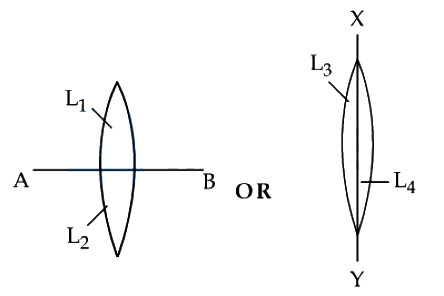
\(\begin{aligned}
& \frac{1}{\mathrm{f}_1}=\frac{1}{\mathrm{f}_2} \\
& (\mu-1)\left(\frac{1}{\mathrm{R}_1}-\frac{1}{-\mathrm{R}_2}\right)=(\mu-1)\left(\frac{2}{\mathrm{R}}\right) \\
& \frac{1}{\mathrm{R}_1}+\frac{1}{\mathrm{R}_2}=\frac{2}{\mathrm{R}}
\end{aligned}\) -
- (A) \(\frac{500}{11} \mathrm{~cm}\)
- (B) \(\frac{800}{11} \mathrm{~cm}\)
- (C) \(\frac{700}{11} \mathrm{~cm}\)
- (D) \(\frac{600}{11} \mathrm{~cm}\)
Show answer and solution
Correct Answer: (D)
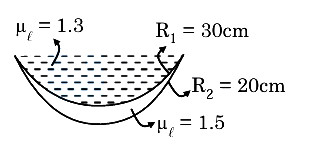
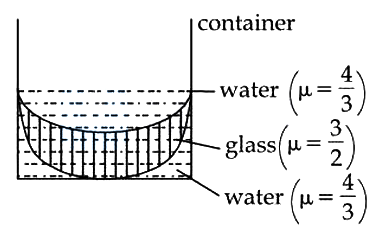
\(\begin{aligned} \frac{1}{\mathrm{f}} & =\left(\frac{1.3-1}{1}\right)\left(\frac{1}{\infty}-\frac{1}{-30}\right) \\ & =\left(\frac{1.5-1}{1}\right)\left(\frac{1}{-30}-\frac{1}{-30}\right) \\ & =\frac{0.3}{30}+\frac{0.5}{60}=\frac{1}{100}+\frac{1}{120} \\ & =\frac{6+5}{600}=\frac{11}{600} \\ \mathrm{f} & =\frac{600}{11} \mathrm{~cm}\end{aligned}\) -
- (A) \(\mu f\)
- (B) \(f\)
- (C) \(\frac{f}{(\mu-1)}\)
- (D) \(\frac{f}{\mu}\)
Show answer and solution
Correct Answer: (B)
Focal length of mirror will not change because focal length of mirror doesn't depend on medium. -
- (A) \(30\mathrm{~cm}\)
- (B) \(3.75\mathrm{~cm}\)
- (C) \(15\mathrm{~cm}\)
- (D) \(7.5\mathrm{~cm}\)
Show answer and solution
Correct Answer: (C)
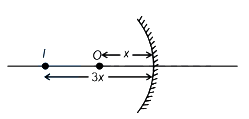
\(\begin{aligned} & m=-3=-\frac{u}{v} \\ & u=-x \\ & v=-3 x \\ & \Rightarrow 2 x=20 \mathrm{~cm}\end{aligned}\)
\(\begin{aligned} & x=10 \mathrm{~cm} \\ & f=\frac{u V}{u+V}=\frac{(-10)(-30)}{(-10)+(-30)}=-7.5 \mathrm{~cm} \\ & f=-\frac{R}{2} \\ & R=-2 f=15 \mathrm{~cm}\end{aligned}\) -
- (A) 100
- (B) 90
- (C) 80
- (D) 70
Show answer and solution
Correct Answer: (C)
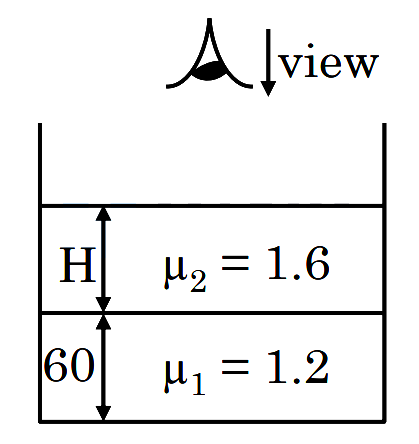
\(y=\) apparent depth of bottom
\(\frac{\mathrm{y}}{1}=\frac{\mathrm{H}}{1.6}+\frac{60}{1.2}\)
Shift \(=40\)
\(H+60-y=40\)
\(\mathrm{H}+60-\frac{\mathrm{H}}{1.6}-\frac{60}{1.2}=40\)
\(\frac{6}{16} \mathrm{H}=30\)
\(\mathrm{H}=80 \mathrm{~cm}\) -
- (A) 24 cm
- (B) 96 cm
- (C) 48 cm
- (D) 72 cm
Show answer and solution
Correct Answer: (B)
\(\begin{aligned}
& \frac{1}{8}=\left(\frac{\mu_{\ell}}{\mu_{\mathrm{s}}}-1\right)\left[\frac{1}{\mathrm{R}_1}-\frac{1}{\mathrm{R}_2}\right] \\
& \frac{1}{24}=(1.5-1)\left[\frac{2}{\mathrm{R}}\right] ...(i)\\
& \frac{1}{\mathrm{f}^{\prime}}=\left(\frac{1.5}{1.33}-1\right)\left(\frac{2}{\mathrm{R}}\right) \\
& \frac{1}{\mathrm{f}^{\prime}}=\left(\frac{1.5 \times 3}{4}-1\right) \frac{2}{\mathrm{R}}...(ii)
\end{aligned}\)
(i) divided by (ii)
\(\begin{aligned}
& \frac{\mathrm{f}^{\prime}}{24}=4 \\
& \mathrm{f}^{\prime}=96 \mathrm{~cm}
\end{aligned}\) -
- (A) 30
- (B) 45
- (C) \(\frac{60}{7}\)
- (D) 15
Show answer and solution
Correct Answer: (D)
Equivalent focal length
\(\begin{aligned}
& \frac{1}{f}=\frac{1}{f_1}+\frac{1}{f_2} \\
& =\frac{1}{30}+\frac{1}{-20}=\frac{2-3}{60}=-\frac{1}{60} \\
& f=-60 \mathrm{~cm}
\end{aligned}\)
Lens formula
\(\begin{aligned}
& \frac{1}{\mathrm{v}}-\frac{1}{\mathrm{u}}=\frac{1}{\mathrm{f}} \\
& \frac{1}{\mathrm{v}}-\frac{1}{-20}=\frac{1}{-60} \\
& \mathrm{v}=-15 \mathrm{~cm}
\end{aligned}\) -
- (A) 45 cm
- (B) 7.5 cm
- (C) 22.5 cm
- (D) 15 cm
Show answer and solution
Correct Answer: (B)
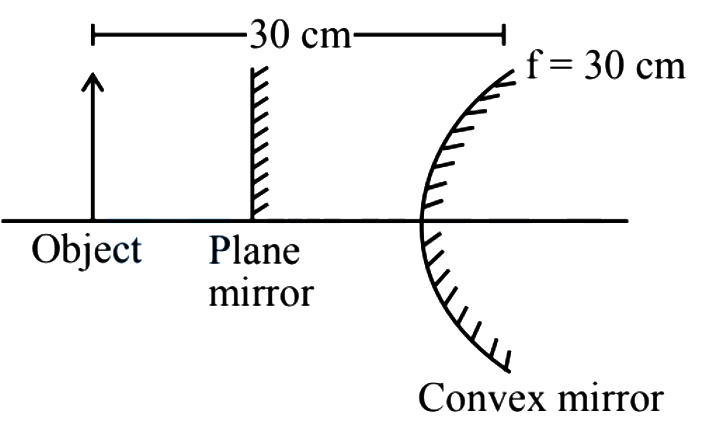
For Convex mirror
\(\begin{aligned}
& \frac{1}{\mathrm{v}}+\frac{1}{\mathrm{u}}=\frac{1}{\mathrm{f}} \\
& \frac{1}{\mathrm{v}}-\frac{1}{30}=\frac{1}{30} \\
& \frac{1}{\mathrm{v}}=\frac{2}{30}=\frac{1}{15} \Rightarrow \mathrm{v}=15 \mathrm{~cm}
\end{aligned}\)
Image formed by convex mirror is at 45 cm from object so plane mirror should be placed midway at 22.5 cm from object so that both of their images may coinside,
Therefore distance between both mirrors
\(=30-22.5=7.5 \mathrm{~cm}\)
Correct Answer : Option 2 -
- (A) \(\sqrt{3}\)
- (B) \(\frac{\sqrt{3}}{2}\)
- (C) \(\frac{3}{2}\)
- (D) \(\sqrt{2}\)
Show answer and solution
Correct Answer: (D)
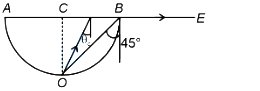
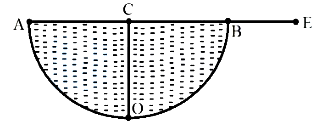
For the rays from coin to reach the point \(E\), the refracted rays must grazing the surface, i.e. they must be incident at critical angle \(\theta_c\) inside the liquid.
\(\mu=\frac{1}{\sin \theta_c}\)
\(\mu\) is minimum when \(\theta_c\) is maximum.
Maximum value of \(\theta_c=45^{\circ}\)
\(\Rightarrow \mu\) has a minimum value of \(\sqrt{2}\). -
- (A) 355 mm
- (B) 288 mm
- (C) 555 mm
- (D) 655 mm
Show answer and solution
Correct Answer: (B)
As we know,
\(\frac{1}{\mathrm{f}}=\left[\frac{\mu_{\mathrm{L}}}{\mu_{\mathrm{m}}}-1\right]\left[\frac{1}{\mathrm{R}_1}-\frac{1}{\mathrm{R}_2}\right]\)
For air \(\mu_{\mathrm{m}}=1\)
\(\begin{aligned} & \frac{1}{12}=[1.6-1]\left[\frac{1}{\mathrm{R}_1}-\frac{1}{\mathrm{R}_2}\right] \\ & \frac{1}{12}=\frac{6}{10}\left[\frac{1}{\mathrm{R}_1}-\frac{1}{\mathrm{R}_2}\right] \\ & {\left[\frac{1}{\mathrm{R}_1}-\frac{1}{\mathrm{R}_2}\right]=\frac{10}{72}}\end{aligned}\)
For water
\(\frac{1}{\mathrm{f}}=\left[\frac{1.6}{1.28}-1\right]\left[\frac{10}{72}\right]=\frac{32}{128} \times \frac{10}{72}\)
\(\begin{aligned} & \frac{1}{\mathrm{f}}=\frac{1}{4} \times \frac{10}{72} \\ & \mathrm{f}=28.8 \mathrm{~cm} \\ & \mathrm{f}=288 \mathrm{~mm}\end{aligned}\) -
- (A) 10 cm
- (B) 12.7 cm
- (C) 10.7 cm
- (D) 15 cm
Show answer and solution
Correct Answer: (C)
\(\begin{aligned} & \mathrm{m}=-\frac{\mathrm{v}}{\mathrm{u}}=-\left(\frac{\mathrm{v}}{-\mathrm{u}}\right)=\frac{\mathrm{v}}{\mathrm{u}} \\ & \frac{1}{4}=\frac{\mathrm{v}}{\mathrm{u}} \Rightarrow \mathrm{u}=4 \mathrm{v} \\ & \mathrm{v}+\mathrm{u}=40 \\ & 5 \mathrm{v}=40 \\ & \mathrm{v}=8 \mathrm{~cm} \\ & \mathrm{u}=32 \mathrm{~cm} \\ & \frac{1}{\mathrm{v}}+\frac{\mathrm{v}}{\mathrm{u}}=\frac{1}{\mathrm{f}} \\ & \frac{1}{8}-\frac{1}{32}=\frac{1}{\mathrm{f}} \\ & \frac{4-1}{32}=\frac{1}{\mathrm{f}} \\ & \mathrm{f}=\frac{32}{3}=10.7 \mathrm{~cm}\end{aligned}\) -
- (A) \(300\mathrm{~nm}\)
- (B) \(600\mathrm{~nm}\)
- (C) \(400\mathrm{~nm}\)
- (D) \(500\mathrm{~nm}\)
Show answer and solution
Correct Answer: (A)
\(\mathrm{f} \lambda=\mathrm{v} \quad \lambda_{\text {medium }}=\frac{\lambda_{\text {vacuum }}}{\mu}\)
\(\lambda_{\text {medium }} \Rightarrow \frac{3 \times 10^8}{2 \times 5 \times 10^{14}} \Rightarrow 0.3 \times 10^{-6} \Rightarrow 300 \mathrm{~nm}\) -
- (A) 1.8 cm
- (B) 0.9 cm
- (C) 2.8 cm
- (D) 2.5 cm
Show answer and solution
Correct Answer: (A)
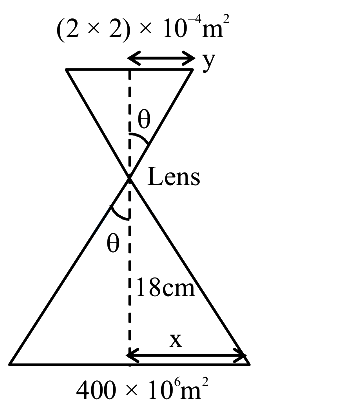
\(\mathrm{H}=18 \mathrm{~km}\)
Size of camera film \(=2 \mathrm{~cm} \times 2 \mathrm{~cm}\)
\(\begin{aligned}
& A_{\text {image }}=400 \mathrm{~km}^2 \\
& x=20 \times 10^3 \mathrm{~m}=2 \times 10^4 \mathrm{~m} \\
& y=2 \times 10^{-2} \mathrm{~m} \\
& \frac{x}{y}=10^6=\frac{18 \mathrm{Km}}{\mathrm{f}} \\
& \mathrm{f}=18 \times 10^{-3} \mathrm{~m}=18 \mathrm{~mm} \\
& \mathrm{f}=1.8 \mathrm{~cm}
\end{aligned}\) -
- (A) \(1: 2\)
- (B) \(1: 3\)
- (C) \(3: 5\)
- (D) \(2: 3\)
Show answer and solution
Correct Answer: (B)
For case (1)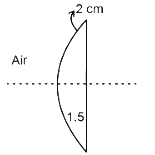
\(\begin{aligned} & \frac{1.5}{v_1}-\frac{1}{\propto}=\frac{(1.5-1)}{R_1} \\ & \frac{1}{f_1}-\frac{1.5}{v_1}=\frac{1-1.5}{\propto}\end{aligned}\)
\(\Rightarrow \frac{1}{f_1}=\frac{(1.5-1)}{R_1}\) ...(1)
\(\Rightarrow \frac{1}{f_1}=\frac{1}{2 R_1}\)
For case (2)
\(\begin{aligned}
& \frac{1.5}{v_1}-\frac{1.2}{\infty}=\frac{(1.5-1.2)}{R_2} \\
& \frac{1.2}{f_2}-\frac{1.5}{v_1}=\frac{(1.2-1.5)}{\propto} \\
& \Rightarrow \frac{1.2}{f_2}=\frac{0.3}{R_2} \\
& \Rightarrow \frac{1}{f_2}=\frac{1}{4 R_2}
\end{aligned}\)
So clearly, \(\frac{f_1}{f_2}=\frac{2 \times 2}{4 \times 3}=\frac{1}{3}\)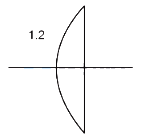
-
- (A) 50
- (B) 55
- (C) 45
- (D) 40
Show answer and solution
Correct Answer: (C)
\(\begin{aligned} & \mu=\frac{\sin \left(\frac{\mathrm{A}+\delta_{\mathrm{m}}}{2}\right)}{\sin \left(\frac{\mathrm{A}}{2}\right)}, \text { since } \mathrm{A}=60^{\circ} \quad \therefore \delta \mathrm{m}=30^{\circ} \\ & \delta_{\mathrm{m}}=2 \mathrm{i}-\mathrm{A}[\text { as } \mathrm{i}=\mathrm{e}] \\ & \Rightarrow \mathrm{i}=45^{\circ}\end{aligned}\) -
- (A) \(-\frac{\alpha}{2}\)
- (B) \(-45^{\circ}\)
- (C) \(+45^{\circ}\)
- (D) \(-\alpha\)
Show answer and solution
Correct Answer: (B)
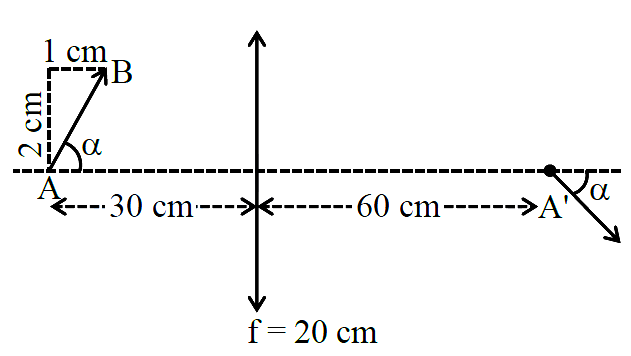
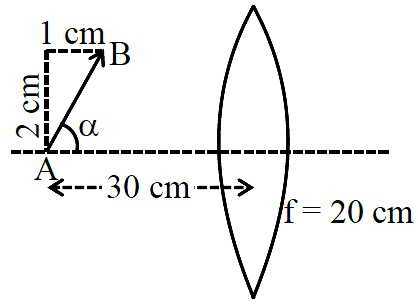
Location of image of \(\mathrm{A}:-\)
\(\begin{aligned} & \frac{1}{\mathrm{v}}-\frac{1}{\mathrm{u}}=\frac{1}{\mathrm{f}} \Rightarrow \frac{1}{\mathrm{v}}-\frac{1}{-30}=\frac{1}{20} \Rightarrow \frac{1}{\mathrm{v}}=\frac{1}{60} \Rightarrow \mathrm{v}=60 \mathrm{~cm} \\ & \therefore \mathrm{~m}=2\end{aligned}\)
Since size of object is small wrt the location hence
\(\begin{aligned} & d v=m^2 d u \Rightarrow d v=4 \times 1=4 \mathrm{~cm} \\ & h_i=m h_0 \Rightarrow h_i(d y)=2 \times 2=4 \mathrm{~cm}\end{aligned}\)
\(\therefore\) Angle made with principle axis \(=-45^{\circ}\) -
- (A) 5 R
- (B) 3 R
- (C) 1.5 R
- (D) 2 R
Show answer and solution
Correct Answer: (A)
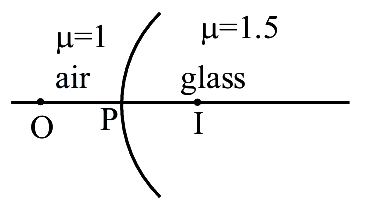
\(\begin{aligned} & \mathrm{PO}=\mathrm{u}=-\mathrm{x} \\ & \mathrm{PI}=\mathrm{v}=\mathrm{x} \\ & \mathrm{PO}=\mathrm{PI} \\ & \frac{\mu_2}{\mathrm{v}}-\frac{\mu_1}{\mathrm{u}}=\frac{\mu_2-\mu_1}{\mathrm{R}} \\ & \frac{1.5}{\mathrm{x}}+\frac{1}{\mathrm{x}}=\frac{1}{2 \mathrm{R}} \\ & \frac{5}{2 \mathrm{x}}=\frac{1}{2 \mathrm{R}} \\ & \mathrm{X}=5 \mathrm{R}\end{aligned}\) -
- (A) 0.24 m right to the spherical surface
- (B) 0.4 m left to the spherical surface
- (C) 0.24 m left to the spherical surface
- (D) 0.4 m right to the spherical surface
Show answer and solution
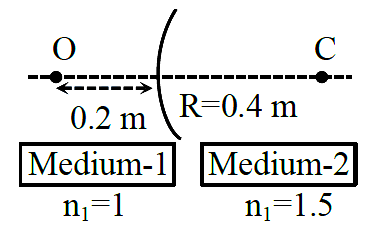
Correct Answer: (B)
\(\begin{aligned} & \frac{\mu_2}{\mathrm{v}}-\frac{\mu_1}{\mathrm{u}}=\frac{\mu_2-\mu_1}{\mathrm{R}} \\ & \frac{1.5}{\mathrm{v}}-\frac{1}{(-0.2)}=\frac{1.5-1}{0.4} \\ & \frac{1.5}{\mathrm{v}}=\frac{0.5}{0.4}-\frac{1}{0.2} \\ & \frac{1.5}{\mathrm{v}}=-\frac{1.5}{0.4} \\ & \mathrm{v}=-0.4 \mathrm{~m}\end{aligned}\) -
- (A) 0.20 m
- (B) 0.25 m
- (C) 0.15 m
- (D) 0.10 m
Show answer and solution
Correct Answer: (D)
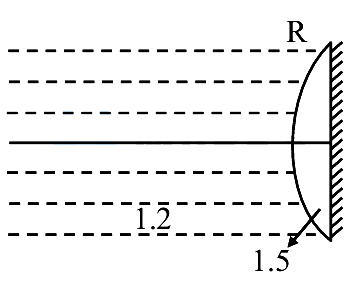
\(\begin{aligned} & \frac{1.5}{\mathrm{v}}=\frac{1.5-1.2}{\mathrm{R}} \\ & \mathrm{v}=\frac{1.5 \mathrm{R}}{0.3}=5 \mathrm{R} \\ & \frac{1.2}{\mathrm{f}}-\frac{1.5}{5 \mathrm{R}}=\frac{1.2-1.5}{-\mathrm{R}} \\ & \frac{1.2}{\mathrm{f}}=\frac{0.3}{\mathrm{R}} \times 2 \Rightarrow \mathrm{f}=2 \mathrm{R} \Rightarrow \mathrm{R}=0.1\end{aligned}\) -
- (A) 3
- (B) 16/3
- (C) 4
- (D) 1.5
Show answer and solution
Correct Answer: (A)
For dispersion without deviation,
\(\begin{aligned}
& \left(\mu_1-1\right) A_1=\left(\mu_2-1\right) A_2 \\
& \Rightarrow \quad(1.54-1) 4^{\circ}=(1.72-1) A_2 \\
& \text { Or } A_2=\frac{0.54}{0.72} \times 4=3^{\circ}
\end{aligned}\) -
- (A) \(\tan ^{-1}(4 / 3)\)
- (B) \(\tan ^{-1}(3 / 4)\)
- (C) \(\sin ^{-1}(3 / 4)\)
- (D) \(\cos ^{-1}(3 / 4)\)
Show answer and solution
Correct Answer: (C)
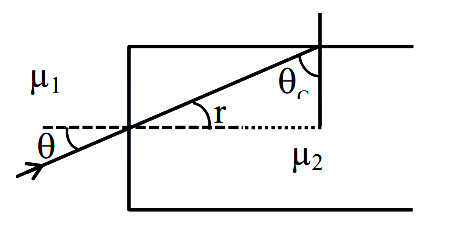
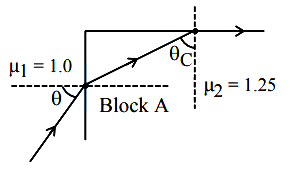
\(\begin{aligned} & \mathrm{r}+\theta_{\mathrm{C}}=90^{\circ} \\ & \mu_1 \sin \theta=\mu_2 \sin \mathrm{r} \\ & \sin \theta=\frac{\mu_2}{\mu_1} \sin \left(90-\theta_{\mathrm{C}}\right) \\ & \sin \theta=\frac{\mu_2}{\mu_1} \cos \theta_{\mathrm{C}} \\ & \sin \theta_{\mathrm{C}}=\frac{\mu_1}{\mu_2}\end{aligned}\)
\(\begin{aligned} & \sin \theta=\frac{\mu_2}{\mu_1} \sqrt{1-\frac{\mu_1^2}{\mu_2^2}} \\ & \sin \theta=\sqrt{\frac{\mu_2^2-\mu_1^2}{\mu_1^2}}=\sqrt{\frac{\frac{25}{16}-1}{1}} \\ & \sin \theta=\frac{3}{4} \\ & \theta=\sin ^{-1}\left(\frac{3}{4}\right)\end{aligned}\) -
- (A) \(\sin ^{-1}\left(\frac{1}{6}\right)\)
- (B) \(\sin ^{-1}\left(\frac{1}{3}\right)\)
- (C) \(\sin ^{-1}\left(\frac{-5}{6}\right)\)
- (D) \(\sin ^{-1}\left(\frac{2}{3}\right)\)
Show answer and solution
Correct Answer: (C)
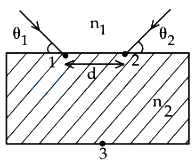
\(\begin{aligned} & \sin \theta_{1 C}=\frac{n_1}{n_2} \\ & \sin \theta_{2 C}=\frac{n_1}{n_3} \\ & \sin \theta_{2 C}-\sin \theta_{1 C}=\frac{1}{2}\end{aligned}\)
\(\begin{aligned} & \mathrm{n}_1 \frac{\mathrm{n}_2}{\mathrm{n}_3}-\frac{\mathrm{n}_1}{\mathrm{n}_2}=\frac{1}{2} \\ & \mathrm{n}_1 \frac{\mathrm{n}_2}{\mathrm{n}_3}-\mathrm{n}_1=\frac{\mathrm{n}_2}{2} \\ & \mathrm{n}_1\left(\frac{2}{5}-1\right)=\frac{\mathrm{n}_2}{2} \\ & \frac{\mathrm{n}_1}{\mathrm{n}_2}=\frac{-5}{6} \\ & =\sin ^{-1}\left(-\frac{5}{6}\right)\end{aligned}\) -
- (A) A, C and D Only
- (B) B, C and D Only
- (C) A, B and E Only
- (D) B, D and E Only
Show answer and solution
Correct Answer: (A)
\(\delta=\mathrm{I}+\mathrm{e}-\mathrm{A}\)
For \(\delta_{\text {min }} \Rightarrow \mathrm{I}=\mathrm{e}\) and refracted ray is parallel to base \(\mathrm{A}, \mathrm{C}, \mathrm{D}\) are correct -
- (A) 40
- (B) 45
- (C) 50
- (D) 55
Show answer and solution
Correct Answer: (B)
\(\begin{aligned} & M=-\frac{1}{3} \\ & -\frac{-V}{-U}=\frac{-1}{3} \Rightarrow V=\frac{U}{3}\end{aligned}\)
Distance \(b / w\) object and image :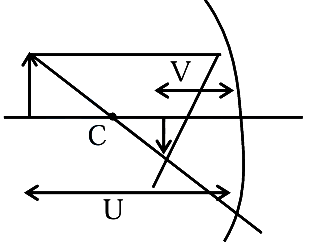
\(\begin{aligned} & \mathrm{U}-\mathrm{V}=30 \\ & \mathrm{U}-\frac{\mu}{3}=30 \\ & \Rightarrow \mathrm{U}=45 \quad \mathrm{~V}=15 \\ & \frac{1}{\mathrm{f}}=\frac{1}{\mathrm{~V}}+\frac{1}{\mathrm{U}}=-\frac{1}{15}-\frac{1}{45} \\ & \Rightarrow \mathrm{~F}=\frac{45}{4} \\ & \mathrm{x}=45\end{aligned}\) -
- (A) \(\frac{\mu_1\left|\mathrm{R}_1\right| \cdot\left|\mathrm{R}_2\right|}{\mu_2\left(\left|\mathrm{R}_1\right|+\left|\mathrm{R}_2\right|\right)-\mu_1\left|\mathrm{R}_2\right|}\)
- (B) \(\frac{\mu_1\left|\mathrm{R}_1\right| \cdot\left|\mathrm{R}_2\right|}{\mu_2\left(\left|\mathrm{R}_1\right|+\left|\mathrm{R}_2\right|\right)-\mu_1\left|\mathrm{R}_1\right|}\)
- (C) \(\frac{\left(\mu_2+\mu_1\right)\left|\mathrm{R}_1\right|}{\left(\mu_2-\mu_1\right)}\)
- (D) \(\frac{\mu_1\left|\mathrm{R}_1\right| \cdot\left|\mathrm{R}_2\right|}{\mu_2\left(2\left|\mathrm{R}_1\right|+\left|\mathrm{R}_2\right|\right)-\mu_1 \sqrt{\left|\mathrm{R}_1\right| \cdot\left|\mathrm{R}_2\right|}}\)
Show answer and solution
Correct Answer: (A)
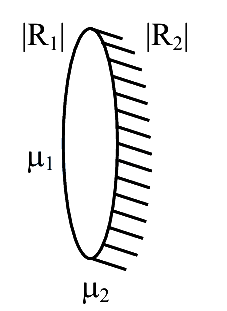
\(\begin{aligned} & \frac{1}{\mathrm{f}_{\mathrm{eq}}}=\frac{2}{\mathrm{f}_{\mathrm{L}}}-\frac{1}{\mathrm{f}_{\mathrm{m}}} \\ & \mathrm{f}_{\mathrm{m}}=-\frac{\left|\mathrm{R}_2\right|}{2} \\ & \frac{1}{\mathrm{f}_{\mathrm{L}}}=\left(\frac{\mu_2}{\mu_1}-1\right)\left(\frac{1}{\mathrm{R}_1}+\frac{1}{\mathrm{R}_2}\right)\end{aligned}\)
\(\begin{aligned}
& \frac{1}{\mathrm{f}_{\mathrm{eq}}}=2\left(\frac{\mu_2-\mu_1}{\mu_1}\right)\left(\frac{\mathrm{R}_1+\mathrm{R}_2}{\mathrm{R}_1 \mathrm{R}_2}\right)+\frac{2}{\mathrm{R}_2} \\
& =\frac{2}{\mathrm{R}_2}\left[\frac{\left(\mu_2-\mu_1\right)\left(\mathrm{R}_1+\mathrm{R}_2\right)+\mu_1 \mathrm{R}_1}{\mu_1 \mathrm{R}_1}\right] \\
& =\frac{2}{\mathrm{R}_2}\left[\frac{\mu_2 \mathrm{R}_1+\mu_2 \mathrm{R}_2-\mu_1 \mathrm{R}_1-\mu_1 \mathrm{R}_2+\mu_1 \mathrm{R}_1}{\mu_1 \mathrm{R}_1}\right] \\
& \frac{1}{\mathrm{f}_{\mathrm{eq}}}=\frac{2\left[\mu_2 \mathrm{R}_1+\mu_2 \mathrm{R}_2-\mu_1 \mathrm{R}_2\right]}{\mu_1 \mathrm{R}_1 \mathrm{R}_2}
\end{aligned}\)
For same size of image
\(\begin{aligned}
& \mathrm{u}=2 \mathrm{f} \\
& \mathrm{u}=\frac{\mu_1 \mathrm{R}_1 \mathrm{R}_2}{\mu_2 \mathrm{R}_1+\mu_2 \mathrm{R}_2-\mu_1 \mathrm{R}_2}
\end{aligned}\) -
- (A) \((\mathrm{A})\) is not correct but \((\mathrm{R})\) is correct
- (B) Both \((\mathrm{A})\) and \((\mathrm{R})\) are correct and \((\mathrm{R})\) is the correct explanation of (A)
- (C) \((A)\) is correct but \((\mathrm{R})\) is not correct
- (D) Both (A) and (R) are correct but (R) is not the correct explanation of (A)
Show answer and solution
Correct Answer: (C)
Refractive index has no relation with mass density because both have different meaning. Hence reason is incorrect.
So (A) is correct but (R) is not correct. -
- (A) \(\mathrm{R} / \mu\)
- (B) \(R /(2 \mu-3)\)
- (C) \(\mu R\)
- (D) \(\mathrm{R} /(2 \mu-1)\)
Show answer and solution
Correct Answer: (D)
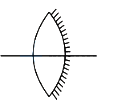
\(\begin{aligned}
-\frac{1}{f_{e q}} & =\frac{2}{f_l}-\frac{1}{f_m} \\
& =2(\mu-1) \frac{2}{R}+\frac{2}{R} \\
-\frac{1}{f_{e q}} & =\frac{2(2 \mu-1)}{R} \\
f_{e q} & =-\frac{R}{2(2 \mu-1)}
\end{aligned}\)
For concave mirror, object should be at \(2 f\) for the image to be at same point
\(\text { Distance }=\frac{R}{(2 \mu-1)}\) -
- (A) \(\frac{1}{3} \mathrm{~cm}\)
- (B) \(\frac{4}{3} \mathrm{~cm}\)
- (C) \(1\mathrm{~cm}\)
- (D) \(\frac{2}{3} \mathrm{~cm}\)
Show answer and solution
Correct Answer: (D)
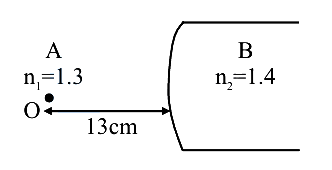
\(\begin{aligned} & \frac{\mathrm{n}_2}{\mathrm{v}}-\frac{\mathrm{n}_1}{\mathrm{u}} \frac{\mathrm{n}_2-\mathrm{n}_1}{\mathrm{R}} \\ & \frac{1.4}{\mathrm{v}}-\frac{1.3}{-13}=\frac{0.1}{\mathrm{R}} \\ & \frac{1.4}{\mathrm{v}}=\frac{1-\mathrm{R}}{10 \mathrm{R}} \\ & \frac{1.4}{\mathrm{v}}=\frac{1-\mathrm{R}}{10 \mathrm{R}} \\ & \mathrm{m}=\frac{\mathrm{v} / \mathrm{n}_2}{\mathrm{u} / \mathrm{n}_1} \\ & -2 \times \frac{(-13)}{1.3}=\frac{10 \mathrm{R}}{1-\mathrm{R}} \\ & \mathrm{R}=\frac{2}{3} \mathrm{~cm}\end{aligned}\) -
- (A) \(\frac{1}{6}\left(\frac{1}{\left|\mathrm{R}_1\right|}-\frac{1}{\left|\mathrm{R}_2\right|}\right)\)
- (B) \(-\frac{1}{6}\left(\frac{1}{\left|\mathrm{R}_1\right|}+\frac{1}{\left|\mathrm{R}_2\right|}\right)\)
- (C) \(\frac{1}{6}\left(\frac{1}{\left|R_1\right|}+\frac{1}{\left|R_2\right|}\right)\)
- (D) \(-\frac{1}{6}\left(\frac{1}{\left|\mathrm{R}_1\right|}-\frac{1}{\left|\mathrm{R}_2\right|}\right)\)
Show answer and solution
Correct Answer: (D)
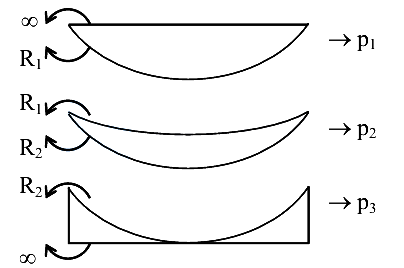
\(\begin{aligned} & \Rightarrow p_{\mathrm{eq}}=\mathrm{p}_1+\mathrm{p}_2+\mathrm{p}_3 \\ & \Rightarrow \mathrm{p}_1=\left(\frac{4}{3}-1\right)\left(\frac{1}{\infty}-\frac{1}{-\left|\mathrm{R}_1\right|}\right) \\ & \Rightarrow \mathrm{p}_1=\left(\frac{1}{3\left|\mathrm{R}_1\right|}\right) \\ & \Rightarrow \mathrm{p}_2=\left(\frac{1}{2}\right)\left(\frac{1}{-\left|\mathrm{R}_1\right|}-\frac{1}{-\left|\mathrm{R}_2\right|}\right) \\ & \Rightarrow \mathrm{p}_2=\frac{1}{2}\left(\frac{1}{\left|\mathrm{R}_2\right|}-\frac{1}{\left|\mathrm{R}_1\right|}\right) \\ & \Rightarrow \mathrm{p}_3=\left(\frac{1}{3}\right)\left(\frac{1}{-\left|\mathrm{R}_2\right|}-\frac{1}{\infty}\right)=-\frac{1}{3\left|\mathrm{R}_2\right|} \\ & \Rightarrow \mathrm{p}_{\mathrm{eq}}=\frac{1}{3}\left(\frac{1}{\left|\mathrm{R}_1\right|}-\frac{1}{\left|\mathrm{R}_2\right|}\right)-\frac{1}{2}\left(\frac{1}{\left|\mathrm{R}_1\right|}-\frac{1}{\left|\mathrm{R}_2\right|}\right) \\ & =-\frac{1}{6}\left(\frac{1}{\left|\mathrm{R}_1\right|}-\frac{1}{\left|\mathrm{R}_2\right|}\right)\end{aligned}\) -
- (A) 10
- (B) 8
- (C) 6
- (D) 4
Show answer and solution
Correct Answer: (D)
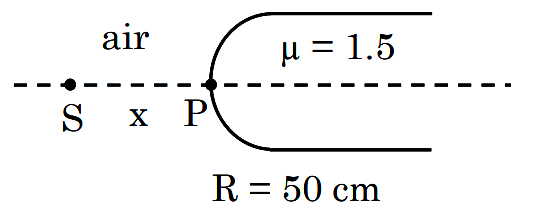
\(\begin{aligned} & \frac{\mu_2}{\mathrm{v}}-\frac{\mu_1}{\mathrm{u}}=\frac{\mu_2-\mu_1}{\mathrm{R}} \\ & \frac{1.5}{200}-\frac{1}{-\mathrm{x}}=\frac{1.5-1}{50}\end{aligned}\)
\(\begin{aligned} & \frac{1}{x}=\frac{1}{100}-\frac{3}{400} \\ & x=400 \mathrm{~cm} \\ & x=4 m\end{aligned}\) -
- (A) 10
- (B) 8
- (C) 12
- (D) 14
Show answer and solution
Correct Answer: (B)
\(\begin{aligned}
& \mathrm{v}=\frac{\mathrm{uf}}{\mathrm{u}-\mathrm{f}}=\frac{-24 \cdot 1}{-24-1}=\frac{24}{25} \\
& \mathrm{~m}=\frac{-\mathrm{v}}{\mathrm{u}}=-\frac{24}{25(-24)}=\frac{1}{25} \\
& \frac{1}{\mathrm{v}}-\frac{1}{\mathrm{u}}=\frac{1}{\mathrm{f}} \\
& \mathrm{v}_{\mathrm{I}}=-\mathrm{m}^2 \cdot \mathrm{v}_0=\frac{-1}{(25)^2} \cdot 25=\frac{-1}{25}
\end{aligned}\)
Diff.
\(\begin{aligned}
& \frac{-1}{\mathrm{v}^2}\left(\frac{\mathrm{dv}}{\mathrm{dt}}\right)+\frac{1}{\mathrm{u}^2}\left(\frac{\mathrm{du}}{\mathrm{dt}}\right)=0\left[\frac{\mathrm{dv}}{\mathrm{dt}}=\mathrm{v}_{\mathrm{i}} ; \frac{\mathrm{du}}{\mathrm{dt}}=\mathrm{v}_0\right] \\
& \frac{+2}{\mathrm{v}^3} \cdot\left(\mathrm{v}_{\mathrm{t}}\right)^2-\frac{1}{\mathrm{v}^2} \cdot \mathrm{a}_{\mathrm{L}}-\frac{2}{\mathrm{u}^3} \cdot\left(\mathrm{v}_0\right)^2+\frac{1}{\mathrm{u}^2} \cdot \mathrm{a}_0=0 \\
& \frac{\mathrm{a}_{\mathrm{I}}}{\mathrm{v}^2}=\frac{2}{\mathrm{v}^3} \cdot \mathrm{v}_{\mathrm{I}}^2-\frac{2}{\mathrm{u}^3} \cdot \mathrm{v}_0^2 \\
& \mathrm{a}_{\mathrm{I}}=\frac{2}{\mathrm{v}} \cdot \mathrm{v}_{\mathrm{I}}^2-\frac{2 \mathrm{v}^2}{\mathrm{u}^3} \cdot \mathrm{v}_0^2 \\
& =\frac{2 \cdot 25}{24} \cdot \frac{1}{25} \cdot \frac{1}{25}-\frac{2}{(24)^3} \cdot \frac{24}{25} \cdot \frac{24}{25} \cdot 25 \cdot 25 \\
& \mathrm{a}_{\mathrm{I}}=\frac{2}{24.25}-\frac{2}{24} \\
& \mathrm{a}_1=\frac{2}{24} \cdot \frac{-24}{25}=\frac{-2}{25} \\
& 100 a_1=\frac{2}{25} \times 100=8
\end{aligned}\) -
- (A) 1.2
- (B) 1.4
- (C) 1.5
- (D) 1.8
Show answer and solution
Correct Answer: (C)
\(\begin{aligned} & \frac{1}{\mathrm{f}}=(\mu-1)\left(\frac{1}{\mathrm{R}_1}-\frac{1}{\mathrm{R}_2}\right) \\ & \frac{1}{12}=(\mu-1)\left(\frac{1}{10}-\frac{1}{-15}\right) \\ & \frac{1}{12}=(\mu-1)\left(\frac{3+2}{30}\right) \\ & \mu=\frac{3}{2}\end{aligned}\) -
- (A) \(60^{\circ}\)
- (B) \(58^{\circ}\)
- (C) \(48^{\circ}\)
- (D) \(50^{\circ}\)
Show answer and solution
Correct Answer: (A)
\(\mu=\frac{\sin \left(\frac{A+\delta_{\min }}{2}\right)}{\sin \frac{A}{2}}\)
Given \(\delta_{\min }=\mathrm{A}\)
\(\begin{aligned}
& \sqrt{3}=\frac{\sin A}{\sin \frac{A}{2}}=\frac{2 \sin \frac{A}{2} \cos \frac{A}{2}}{\sin \frac{A}{2}} \\
& \cos \frac{A}{2}=\frac{\sqrt{3}}{2} \\
& A=60^{\circ}
\end{aligned}\) -
- (A) 0.214 R
- (B) 0.411 R
- (C) 0.124 R
- (D) 0.114 R
Show answer and solution
Correct Answer: (D)
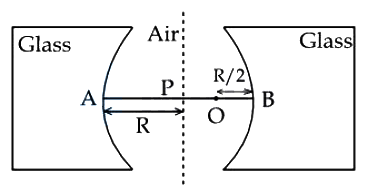
For B
\(\begin{aligned}
& \frac{\mu_2}{\mathrm{~V}}-\frac{\mu_1}{\mathrm{u}}=\frac{\mu_2-\mu_1}{\mathrm{R}} \\
& \frac{1.5}{\mathrm{~V}}+\frac{1}{\frac{R}{2}}=\frac{0.5}{-\mathrm{R}} \\
& \frac{1.5}{\mathrm{~V}}=-\frac{1}{2 \mathrm{R}}-\frac{2}{\mathrm{R}} \\
& \frac{1.5}{\mathrm{~V}}=\frac{-5}{2 \mathrm{R}} \Rightarrow V_B=-0.6 \mathrm{R}
\end{aligned}\)
For A
\(\begin{aligned}
& \frac{1.5}{V}+\frac{2}{3 R}=\frac{0.5}{-R} \\
& \frac{1.5}{V}=-\frac{1}{2 R}-\frac{2}{3 R} \\
& \frac{1.5}{V}=-\frac{7}{6 R} \\
& V_A=-\frac{9}{7} R
\end{aligned}\)
Distance between images
\(=2 \mathrm{R}-\left(0.6 \mathrm{R}+\frac{9}{7} \mathrm{R}\right)=0.114 \mathrm{R}\) -
- (A) \(1 / 2\)
- (B) 2
- (C) 3
- (D) \(1 / 3\)
Show answer and solution
Correct Answer: (A)
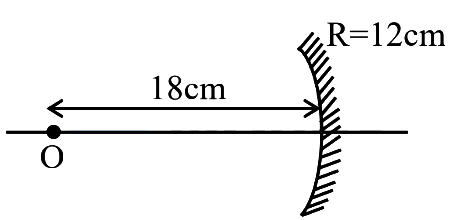
\(\begin{aligned} & \text { Using } m=\frac{f}{u-f} \\ & m_1=\frac{6}{18-6}=\frac{1}{2}\end{aligned}\)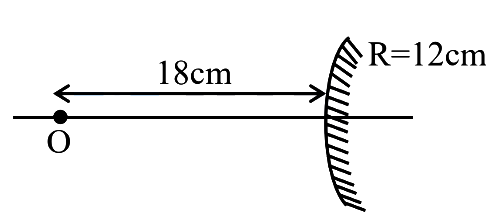
\(\mathrm{m}_2=\frac{6}{18+6}=\frac{1}{4} \quad \therefore \frac{\mathrm{~m}_2}{\mathrm{~m}_1}=\frac{1}{2}\) -
- (A) 1:1
- (B) 1:2
- (C) 1:4
- (D) 2:1
Show answer and solution
Correct Answer: (B)
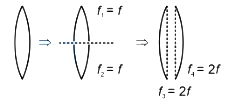
so \(\frac{f_1}{f_3}=1: 2\) -
- (A) 8
- (B) 10
- (C) 6
- (D) 4
Show answer and solution
Correct Answer: (C)
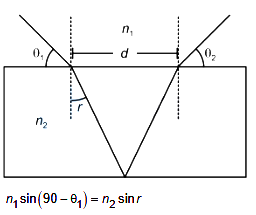
\(\begin{aligned} & n_1 \times \frac{n_2}{2 n_1}=n_2 \sin r \\ & \sin r=\frac{1}{2}\end{aligned}\)
\(\begin{aligned} & r=30^{\circ} \\ & \tan r=\left(\frac{d / 2}{t}\right) \\ & t=\frac{d}{2 \tan r}=\frac{d \sqrt{3}}{2}=\frac{(4 \sqrt{3}) \sqrt{3}}{2} \\ & =6 \mathrm{~cm}\end{aligned}\) - 38. Two thin convex lenses of focal length 30 cm and 10 cm are placed coaxially, 10 cm apart. The power of this combination is : 2025 Medium
- (A) 5 D
- (B) 1 D
- (C) 20 D
- (D) 10 D
Show answer and solution
Correct Answer: (D)
\(\mathrm{f}_1=30 \mathrm{~cm}, \mathrm{f}_2=10 \mathrm{~cm}\)
\(\frac{1}{\mathrm{f}_{\mathrm{eq}}}=\frac{1}{\mathrm{f}_1}+\frac{1}{\mathrm{f}_2}-\frac{\mathrm{d}}{\mathrm{f}_1 \mathrm{f}_2}, \mathrm{~d}=\) distance between lens
\(\frac{1}{\mathrm{f}_{\mathrm{eq}}}=\frac{1}{0.3}+\frac{1}{0.1}-\frac{0.1}{(0.3)(0.1)}\)
\(\frac{1}{\mathrm{f}_{\mathrm{eq}}}=\frac{1}{0.1}\)
Power \(=\frac{1}{\mathrm{f}_{\mathrm{eq}}}=10 \mathrm{D}\) -
- (A) \(\frac{h \tan (i-r)}{\tan r}\)
- (B) \(\frac{h \sin (i-r)}{\cos r}\)
- (C) h
- (D) \(\frac{h \cos (i-r)}{\sin r}\)
Show answer and solution
Correct Answer: (B)
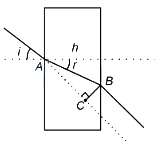
\(\begin{aligned} & A B=h \sec r \\ & B C=h \sec r \sin (\bar{i}-r) \\ & B C=\frac{h \sin (i-r)}{\cos r}\end{aligned}\) - 40. What is the relative decrease in focal length of a lens for an increase in optical power by 0.1 D from 2.5D ? ['D' stands for dioptre] 2025 Medium
- (A) \(0.01\)
- (B) \(0.04\)
- (C) \(0.40\)
- (D) \(0.1\)
Show answer and solution
Correct Answer: (B)
\(\begin{aligned} & P=\frac{1}{f} \\ & \text { So } P_1=\frac{1}{F_1} \Rightarrow F_1=\frac{1}{2.5} \\ & \text { Next } F_2=\frac{1}{2.6} \\ & \left|\frac{\Delta F}{F_1}\right|=\frac{\left|F_2-F_1\right|}{F_1}=\left|\frac{F_2}{F_1}-1\right| \\ & \Rightarrow\left|\frac{\Delta F}{F_1}\right|=\left|\frac{2.5}{2.6}-1\right|=\frac{0.1}{2.6} \approx 0.04\end{aligned}\) -
- (A) 40 cm away from the mirror.
- (B) 80 cm away from the mirror.
- (C) 20 cm towards the mirror.
- (D) 20 cm away from the mirror.
Show answer and solution
Correct Answer: (A)
\(\begin{aligned} & \mathrm{m}=\frac{1}{2}=\frac{\mathrm{f}}{\mathrm{f}-\mathrm{u}} \\ & \frac{1}{2}=\frac{\mathrm{f}}{\mathrm{f}-(-40)} \\ & \mathrm{f}+40=2 \mathrm{f} \Rightarrow \mathrm{f}=40 \mathrm{~cm} \\ & \text { now } \mathrm{m}=\frac{1}{3}=\frac{40}{40-\mathrm{u}} \\ & 40-\mathrm{u}=120 \Rightarrow \mathrm{u}=-80\end{aligned}\)
Thus, the object needs to be placed 80 cm from the mirror, opposite to the initial placement of 40 cm. To achieve this repositioning, the object needs to be moved 40 cm further from its initial 40 cm distance, totaling a move of 40 cm away from the mirror.
No questions on this page match these filters.