


Questions
19 questionsShowing 1–19 of 19 questions
-
- (A) 9
- (B) 11
- (C) 13
- (D) 15
Show answer and solution
Correct Answer: (B)
Position of the \(n^{\text {th }}\) bright fringe w.r.t. central maxima in a YDSE is \(y_n=n \frac{\lambda D}{d}\).
\(\Rightarrow \quad \frac{y_{10}^{\prime}}{y_{10}}=\frac{\lambda^{\prime}}{\lambda}\)
or \(\quad y_{10}^{\prime}=\frac{\lambda^{\prime}}{\lambda} y_{10}\)
\(\begin{aligned} & =\left(\frac{660 \mathrm{~nm}}{600 \mathrm{~nm}}\right) 10 \mathrm{~mm} \\ & =11 \mathrm{~mm}\end{aligned}\) -
- (A) \(\cos ^{-1}\left(\frac{1}{\sqrt{3}}\right)\)
- (B) \(\cos ^{-1}\left(\frac{2}{3}\right)\)
- (C) \(\cos ^{-1}\left(\frac{1}{3}\right)\)
- (D) \(\cos ^{-1}\left(\sqrt{\frac{2}{3}}\right)\)
Show answer and solution
Correct Answer: (A)
The direction of propagation of light is perpendicular to the wave front and is symmetric about \(\mathrm{x}, \mathrm{y}\) and z axis.
\(\therefore\) Angle made by the light with \(\mathrm{x}, \mathrm{y} \& \mathrm{z}\) axis is same.
\(\therefore \quad \cos \alpha=\cos \beta=\cos \gamma(\alpha, \beta \& \gamma\) are angle made by light with \(\mathrm{x}, \mathrm{y} \& \mathrm{z}\) axis respectively)
Also \(\cos ^2 \alpha+\cos ^2 \beta+\cos ^2 \gamma=1\) [Sum of direction cosines]
\(\therefore \alpha=\cos ^{-1} \frac{1}{\sqrt{3}}\) -
- (A) 52
- (B) 50
- (C) 54
- (D) 48
Show answer and solution
Correct Answer: (C)
For a thin film interference, a fringe for transmission is formed.
When
\(2 \mu x=n \lambda\)
\(\begin{aligned} \Rightarrow & \frac{d x}{d t}=\left(\frac{d n}{d t}\right) \frac{\lambda}{2 \mu} \\ & =\left(\frac{1}{12}\right) \frac{560 \times 10^{-9}}{2 \times 1.4}=\frac{5}{3} \times 10^{-8} \mathrm{~m} / \mathrm{s}\end{aligned}\)
\(\begin{aligned} & V=\text { Volume of film }=\pi R^2 x \\ & \frac{d V}{d t}=\pi R^2 \frac{d x}{d t} \\ & =\pi\left(1.8 \times 10^{-2}\right)^2 \frac{5}{3} \times 10^{-8} \mathrm{~m}^3 / \mathrm{s} \\ & =54 \pi \times 10^{-13} \mathrm{~m}^3 / \mathrm{s}\end{aligned}\) -
- (A) 137.5 nm
- (B) 275 nm
- (C) 94.8 nm
- (D) 68.7 nm
Show answer and solution
Correct Answer: (A)
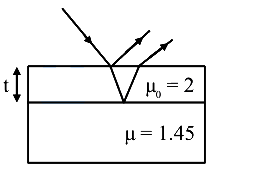
For transmitted green light to be maxima, reflected green should be minima.
\(\begin{aligned}
& \Delta \mathrm{P}=2 \mu_0 \mathrm{t}=\mathrm{n} \lambda \\
& \Rightarrow \mathrm{t}=\frac{\mathrm{n} \lambda}{2 \mu_0} \therefore \mathrm{t}_{\min }=\frac{\lambda}{2 \mu_0}=\frac{550}{2 \times 2}=137.5
\end{aligned}\) -
- (A) Both \((\mathbf{A})\) and \((\mathbf{R})\) are true but \((\mathbf{R})\) is not the correct explanation of \((\mathbf{A})\)
- (B) Both \((\mathbf{A})\) and \((\mathbf{R})\) are true and \((\mathbf{R})\) is the correct explanation of \((\mathbf{A})\)
- (C) (A) is true but (R) is false
- (D) \((A)\) is false but (R) is true
Show answer and solution
Correct Answer: (B)
\(\beta(\text { fringe width })=\frac{\lambda D}{d}\)
In denser medium, \(\lambda \downarrow \Rightarrow \beta \downarrow\) \(\Rightarrow\) fringe come closer
Also, \(\mu=\frac{\mathrm{c}}{\mathrm{V}} \Rightarrow \mathrm{V}=\frac{\mathrm{c}}{\mu}\)
Frequency remains same,
\(\Rightarrow \mu=\frac{\lambda_{\mathrm{vac} .} \mathrm{f}}{\lambda_{\mathrm{med}} \mathrm{f}} \Rightarrow \lambda_{\mathrm{med}}=\frac{\lambda_{\mathrm{vac} .}}{\mu}\) -
- (A) Both \((\mathbf{A})\) and \((\mathbf{R})\) are true but \((\mathbf{R})\) is NOT the correct explanation of \((\mathbf{A})\)
- (B) (A) is true but (R) is false
- (C) Both (A) and (R) are true and (R) is the correct explanation of (A)
- (D) (A) is false but (R) is true
Show answer and solution
Correct Answer: (D)
\(\begin{aligned}
& \beta=\frac{\lambda D}{d} \\
& \lambda_{\text {red }} < \lambda_{\text {blue }}
\end{aligned}\)
Assertion is false.
Reason is true. -
- (A) 6
- (B) 8
- (C) 10
- (D) 12
Show answer and solution
Correct Answer: (A)
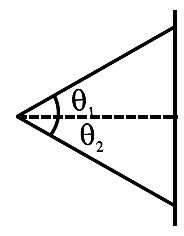
\(\begin{aligned} & \theta_1=\sin ^{-1}\left(\frac{2 \lambda}{a}\right) \\ & \theta_2=\sin ^{-1}\left(\frac{3 \lambda}{a}\right) \\ & \because \quad \theta_1+\theta_2=30^{\circ}\end{aligned}\)
\(\begin{aligned} & \Rightarrow \sin ^{-1}\left(\frac{2 \lambda}{\mathrm{a}}\right)+\sin ^{-1}\left(\frac{3 \lambda}{\mathrm{a}}\right)=\frac{\pi}{6} \\ & \Rightarrow \frac{2 \lambda}{\mathrm{a}} \sqrt{1-\left(\frac{3 \lambda}{\mathrm{a}}\right)^2}+\frac{3 \lambda}{\mathrm{a}} \sqrt{1+\left(\frac{2 \lambda}{\mathrm{a}}\right)^2}=\sin \frac{\pi}{6}\end{aligned}\)
Here \(\lambda=628 \mathrm{~nm}\)
After solving
\(\mathrm{A}=6.07 \mu \mathrm{~m}\)
Approximate Method :
\(\begin{aligned} & \theta=\theta_1+\theta_2 \\ & \Rightarrow \frac{\pi}{6}=\frac{2 \lambda}{a}+\frac{3 \lambda}{a} \\ & \Rightarrow \frac{\pi}{6}=\frac{5}{a}(628 \mathrm{~nm}) \\ & \Rightarrow a=6 \mu \mathrm{~m}\end{aligned}\) -
- (A) \(0 \%\)
- (B) \(100 \%\)
- (C) \(50 \%\)
- (D) \(25 \%\)
Show answer and solution
Correct Answer: (C)
\(\beta=\frac{\mathrm{D} \lambda}{\mathrm{~d}} \propto \frac{1}{\mathrm{~d}}\)
If d is doubled then \(\beta\) is half so \(50 \%\) decrement. -
- (A) There shall be an interference pattern for red distinct from that for green.
- (B) There shall be no interference fringes.
- (C) There shall be alternate interference fringes of red and green.
- (D) There shall be an interference pattern, where each fringe's pattern center is green and outer edges is red.
Show answer and solution
Correct Answer: (B)
Different colours will have different fringe width. Within a few fringes of red, there will be several fringes of violet.
Also, there will be overlapping of colours. -
- (A) \(\frac{I_0}{2}\)
- (B) \(\frac{I_0}{4}\)
- (C) \(\frac{\mathrm{I}_0}{3}\)
- (D) \(I_0\)
Show answer and solution
Correct Answer: (B)
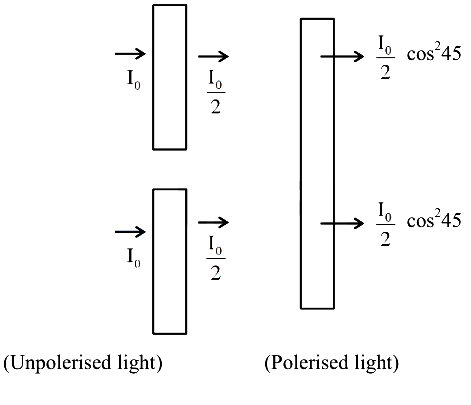
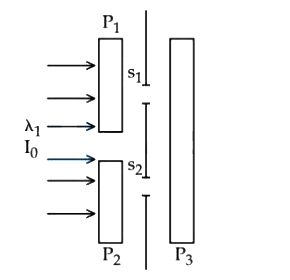
after passing through third poleriser, Intensity of both the waves must be \(\frac{\mathrm{I}_0}{4}\)
now, at a point where path diff is \(\frac{\lambda}{3}\), phase difference
\(\begin{aligned}
& \Delta \phi=2 \mathrm{~K}\left(\frac{\Delta \mathrm{x}}{\lambda}\right)=\frac{2 \pi}{3} \\
& \therefore \mathrm{I}_{\mathrm{res}}=\sqrt{\left(\frac{\mathrm{I}_0}{4}\right)^2+\left(\frac{\mathrm{I}_0}{4}\right)^2+2\left(\frac{\mathrm{I}_0}{4}\right)^2} \cos \frac{2 \pi}{3} \\
& =\frac{\mathrm{I}_0}{4}
\end{aligned}\) -
- (A) 15
- (B) 20
- (C) 25
- (D) 30
Show answer and solution
Correct Answer: (A)
Width of 20 maxima of double slit \(=\) width of central maxima of single slit
\(\begin{aligned}
& \frac{20 \lambda \mathrm{D}}{\mathrm{~d}}=\frac{2 \lambda \mathrm{D}}{\mathrm{a}} \\
& \frac{10}{\mathrm{~d}}=\frac{1}{\mathrm{a}} \\
& \mathrm{a}=\frac{\mathrm{d}}{10}=\frac{1.5 \times 10^{-1}}{10} \mathrm{~cm}=15 \times 10^{-3} \mathrm{~cm}
\end{aligned}\)
Value of \(x\) is 15
Answer is 15 -
- (A) 4
- (B) 5
- (C) 3
- (D) 2
Show answer and solution
Correct Answer: (B)
\(\begin{aligned} & \mathrm{I} \propto(\text { width })^2 \\ & \left(\frac{\sqrt{\mathrm{I}_1}+\sqrt{\mathrm{I}_2}}{\sqrt{\mathrm{I}_1}-\sqrt{\mathrm{I}_2}}\right)^2=\frac{9}{4} \\ & \frac{\sqrt{\mathrm{I}_1}+\sqrt{\mathrm{I}_2}}{\sqrt{\mathrm{I}_1}-\sqrt{\mathrm{I}_2}}=\frac{3}{2} \\ & \frac{(\mathrm{x}+1) \mathrm{d}}{(\mathrm{x}-1) \mathrm{d}}=\frac{3}{2} \\ & \Rightarrow 3 \mathrm{x}-3=2 \mathrm{x}+2 \\ & \mathrm{x}=5\end{aligned}\) -
- (A) \(5\)
- (B) \(4\)
- (C) \(6\)
- (D) \(8\)
Show answer and solution
Correct Answer: (A)
\(\begin{aligned}
& \frac{n_1 \lambda_1 D}{d}=\frac{n_2 \lambda_2 D}{d} \\
& n 480=m 600 \\
& n_{\min }=5
\end{aligned}\) -
- (A) 22
- (B) 24
- (C) 26
- (D) 28
Show answer and solution
Correct Answer: (B)
\(\begin{aligned} & \mathrm{I}_{\max }=\left(\sqrt{\mathrm{I}_1}+\sqrt{\mathrm{I}_2}\right)^2 \\ & =(\sqrt{4 \mathrm{I}}+\sqrt{9 \mathrm{I}})^2=25 \mathrm{I} \\ & \mathrm{I}_{\min }=\left(\sqrt{\mathrm{I}_1}-\sqrt{\mathrm{I}_2}\right)^2 \\ & =(\sqrt{4 \mathrm{I}}-\sqrt{9 \mathrm{I}})^2=\mathrm{I} \\ & \mathrm{I}_{\max }-\mathrm{I}_{\min }=24 \mathrm{I} \\ & \mathrm{x}=24\end{aligned}\) -
- (A) \(8: 1\)
- (B) \(9: 1\)
- (C) \(3: 1\)
- (D) \(4: 1\)
Show answer and solution
Correct Answer: (D)
\(\frac{I_{\max }}{I_{\min }}=\frac{\left(\sqrt{I_1}+\sqrt{I_2}\right)^2}{\left(\sqrt{I_1}-\sqrt{I_2}\right)^2} \Rightarrow \frac{(4)^2}{(2)^2} \Rightarrow \frac{16}{4}=4\) -
- (A) 0.9 E
- (B) \(\mathrm{E}_0\)
- (C) \(1.7 \mathrm{E}_0\)
- (D) \(3.4 \mathrm{E}_0\)
Show answer and solution
Correct Answer: (C)
\(\mathrm{E}=\sqrt{\left(\mathrm{E}_0\right)^2+\left(\mathrm{E}_0\right)^2+2\left(\mathrm{E}_0\right)\left(\mathrm{E}_0\right) \cos \frac{\pi}{3}}\)
\(\mathrm{E}=\sqrt{2 \mathrm{E}_0^2+\mathrm{E}_0^2}=\sqrt{3} \mathrm{E}_0=1.73 \mathrm{E}_0\) -
- (A) \(\frac{\pi}{4}\)
- (B) \(\frac{\pi}{6}\)
- (C) \(\frac{\pi}{8}\)
- (D) \(\frac{\pi}{3}\)
Show answer and solution
Correct Answer: (A)
Through \(P_2 I_1=I_0 \sin ^2\left(\frac{\pi}{2}-\theta\right)\)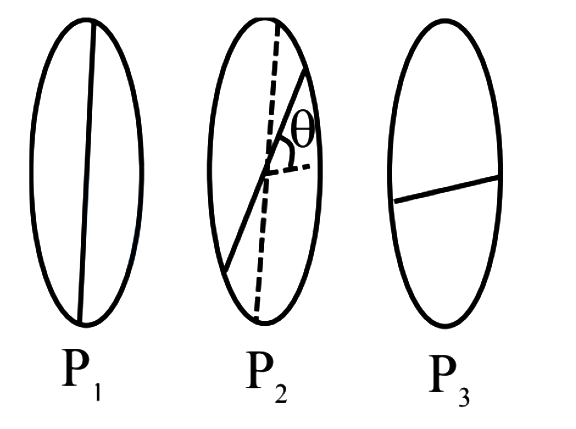
\(I_1=I_0 \cos ^2 \theta\)
Through \(P_3 I_{\text {net }}=\left(I_0 \cos ^2 \theta\right) \sin ^2 \theta\)
\(I_{n c t}=\frac{I_0}{4}[\sin (2 \theta)]^2 \text { for max } I_{\text {net }} \theta=45^{\circ}\)
So angle between \(P_2\) and \(P_3=\frac{\pi}{4}\)
Correct Ans. (1) -
- (A) \((2 \sqrt{2}+1):(2 \sqrt{2}-1)\)
- (B) \((3+2 \sqrt{2}):(3-2 \sqrt{2})\)
- (C) \(9: 1\)
- (D) \(3: 1\)
Show answer and solution
Correct Answer: (B)
\(\mathrm{I} \propto\) width \(\quad\quad \mathrm{I}_{\max }=\left(\sqrt{\mathrm{I}_1}+\sqrt{\mathrm{I}_2}\right)^2\)
\(\therefore \mathrm{I}_1=\mathrm{I}_0, \mathrm{I}_2=2 \mathrm{I}_0 \quad\quad \mathrm{I}_{\min }=\left(\sqrt{\mathrm{I}_1}-\sqrt{\mathrm{I}_2}\right)^2\)
\(\frac{I_{\max }}{I_{\min }}=\frac{(\sqrt{2}+1)^2}{(\sqrt{2}-1)^2} \Rightarrow \frac{3+2 \sqrt{2}}{3-2 \sqrt{2}}\) -
- (A) 0.23 mm
- (B) 0.33 mm
- (C) 0.63 mm
- (D) 0.46 mm
Show answer and solution
Correct Answer: (A)
\(\begin{aligned} & \Delta W=\frac{\lambda D}{d \cdot \mu}=\frac{690 \times 10^{-9} \times 0.72}{1.5 \times 10^{-3} \times 1.44} \\ & \Rightarrow \Delta W=2.3 \times 10^{-4} \mathrm{~m}=0.23 \mathrm{~mm}\end{aligned}\)
No questions on this page match these filters.