


Questions
16 questionsShowing 1–16 of 16 questions
-
- (A) \(\sqrt{3 \mathrm{Rg}+\frac{\mathrm{kR}^2}{\mathrm{~m}}}\)
- (B) \(2 \sqrt{\mathrm{gR}+\frac{\mathrm{kR}^2}{\mathrm{~m}}}\)
- (C) \(\sqrt{2 \mathrm{Rg}+\frac{\mathrm{kR}^2}{\mathrm{~m}}}\)
- (D) \(\sqrt{2 \mathrm{Rg}+\frac{4 \mathrm{kR}^2}{\mathrm{~m}}}\)
Show answer and solution
Correct Answer: (A)
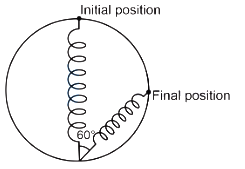
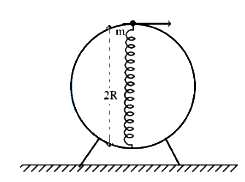
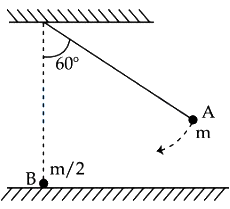
\(\begin{aligned} \text { Work done by gravity } & =m g\left(2 R-R \cos 60^{\circ}\right) \\ & =\frac{3 m g R}{2}\end{aligned}\)
\(\begin{aligned} \text { Work done by spring } & =-\frac{1}{2} k\left(0^2-R^2\right) \\ & =\frac{1}{2} k R^2\end{aligned}\)
Net work = change in kinetic energy
i.e. \(\frac{3 m g R}{2}+\frac{k R^2}{2}=\frac{1}{2} m v^2\)
or \(\quad v^2=3 g R+\frac{k R^2}{m}\)
or \(\quad v=\sqrt{3 g R+\frac{k R^2}{m}}\) -
- (A) \(10[1-(2-x)]^{3 / 2} \mathrm{~m} / \mathrm{s}\)
- (B) \(10\left[1-(2-x)^2\right]^{1 / 2} \mathrm{~m} / \mathrm{s}\)
- (C) \(10\left[1-(2-\mathrm{x})^2\right] \mathrm{m} / \mathrm{s}\)
- (D) \(10\left[1-(2-\mathrm{x})^2\right]^2 \mathrm{~m} / \mathrm{s}\)
Show answer and solution
Correct Answer: (B)
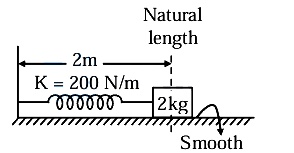
Given, Natural length of spring \(=2 \mathrm{~m}\)
Initial compression in spring \(\left(\mathrm{x}_{\mathrm{i}}\right)=1 \mathrm{~m}\)
Final compression in spring \(\left(\mathrm{x}_{\mathrm{f}}\right)=(2-\mathrm{x}) \mathrm{m}\)
Using energy conservation
\(\begin{aligned}
& \mathrm{K}_{\mathrm{i}}+\mathrm{U}_{\mathrm{i}}=\mathrm{K}_{\mathrm{f}}+\mathrm{U}_{\mathrm{f}} \\
& 0+\frac{1}{2} \mathrm{Kx}_{\mathrm{i}}^2=\frac{1}{2} \mathrm{mv}^2+\frac{1}{2} \mathrm{Kx}_{\mathrm{f}}^2 \\
& \frac{1}{2} \mathrm{mv}^2=\frac{1}{2} \mathrm{~K}\left(\mathrm{x}_{\mathrm{i}}^2-\mathrm{x}_{\mathrm{f}}^2\right) \\
& \frac{1}{2} \times 2 \times \mathrm{v}^2=\frac{1}{2} \times 200 \times\left(1^2-(2-\mathrm{x})^2\right) \\
& \mathrm{v}^2=100\left[1-(2-\mathrm{x})^2\right] \\
& \mathrm{v}=10\left[1-(2-\mathrm{x})^2\right]^{1 / 2}
\end{aligned}\) -
- (A) 970 J
- (B) 735 J
- (C) 245 J
- (D) 490 J
Show answer and solution
Correct Answer: (C)
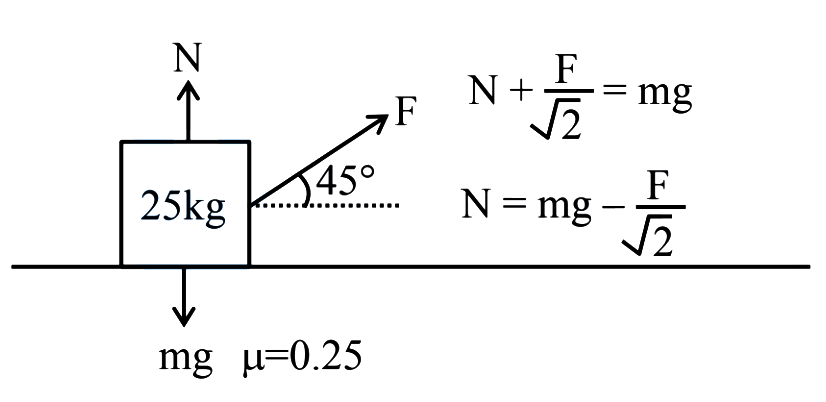
Block travels with uniform velocity
So \(\quad \mathrm{a}=0 \Rightarrow \mathrm{~F} \cos 45^{\circ}=\) friction
\(\begin{aligned}
& \frac{\mathrm{F}}{\sqrt{2}}=\mu\left[\mathrm{mg}-\frac{\mathrm{F}}{\sqrt{2}}\right] \\
& \frac{\mathrm{F}}{\sqrt{2}}=0.25\left[25 \times 9.8-\frac{\mathrm{F}}{\sqrt{2}}\right] \\
& \Rightarrow \quad 1.25 \frac{\mathrm{~F}}{\sqrt{2}}=61.25 \\
& \mathrm{~F}=\frac{61.25 \times \sqrt{2}}{1.25}=49 \sqrt{2} \\
& \mathrm{~W}_{\mathrm{ext}}=\mathrm{FS} \cos 45^{\circ} \\
&=49 \sqrt{2} \times 5 \times \frac{1}{\sqrt{2}}=245 \mathrm{~J}
\end{aligned}\) -
- (A) 1
- (B) 2
- (C) 4
- (D) 3
Show answer and solution
Correct Answer: (B)
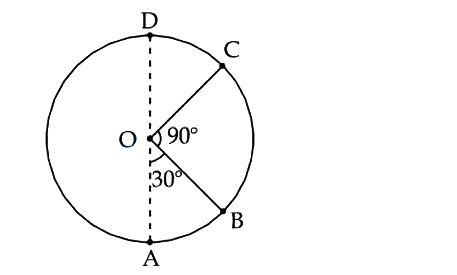
\(\begin{aligned} & \frac{1}{2} \mathrm{mv}_{\mathrm{A}}^2=\frac{1}{2} \mathrm{mv}_{\mathrm{B}}^2+\mathrm{mgh} \\ & \Rightarrow \frac{1}{2} \mathrm{~m}(5 \mathrm{~g} \ell)=\frac{1}{2} \mathrm{mv}_{\mathrm{B}}^2+\mathrm{mg} \frac{\ell}{2} \\ & \Rightarrow \frac{5 \mathrm{mg} \ell}{2}-\frac{\mathrm{mg} \ell}{2}=\mathrm{KE}_{\mathrm{B}} \\ & \Rightarrow \mathrm{KE}_{\mathrm{B}}=2 \mathrm{mg} \ell \\ & \frac{1}{2} \mathrm{mv}_{\mathrm{C}}^2=\frac{1}{2} \mathrm{mv}_{\mathrm{D}}^2+\mathrm{mg} \frac{\ell}{2} \\ & \Rightarrow \mathrm{KE}_{\mathrm{C}}=\frac{1}{2} \mathrm{mg} \ell+\mathrm{mg} \frac{\ell}{2}=\mathrm{mg} \ell \\ & \Rightarrow \frac{\mathrm{KE}_{\mathrm{B}}}{\mathrm{KE}_{\mathrm{C}}}=2\end{aligned}\) -
- (A) \(\frac{2+\sqrt{2}}{3}\)
- (B) \(\frac{2+\sqrt{3}}{3}\)
- (C) \(\frac{3+\sqrt{3}}{2}\)
- (D) \(\frac{3-\sqrt{2}}{2}\)
Show answer and solution
Correct Answer: (C)
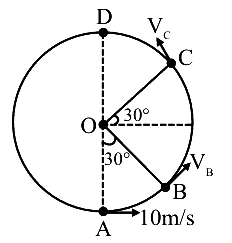
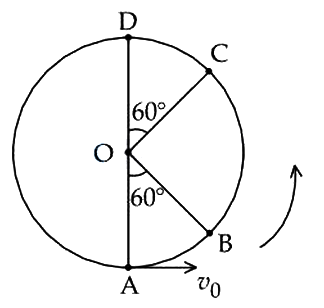
\(\begin{aligned} & \frac{1}{2} \mathrm{~m} \times 100+0=\frac{1}{2} \mathrm{mV}_{\mathrm{B}}^2+\mathrm{mg}\left(\mathrm{R}-\frac{\mathrm{R} \sqrt{3}}{2}\right) \\ & 100=\mathrm{V}_{\mathrm{B}}^2+2 \mathrm{gR}\left(1-\frac{\sqrt{3}}{2}\right] \\ & \mathrm{V}_{\mathrm{B}}^2=100-20(2-\sqrt{3}) \\ & \left.\mathrm{V}_{\mathrm{B}}^2=60+20 \sqrt{3}\right) \\ & \mathrm{K} . \mathrm{E}_{\mathrm{B}}=\frac{1}{2} \mathrm{mV}_{\mathrm{B}}^2=\frac{\mathrm{m}}{2}(60+20 \sqrt{3}) \\ & \frac{1}{2} \mathrm{~m}(100)=\frac{1}{2} \mathrm{mV} \\ & 2 \\ & 100=\mathrm{mg}\left(\frac{3 \mathrm{R}}{2}\right) \\ & 100 \mathrm{~V}_{\mathrm{C}}^2=60 \\ & \mathrm{~V}_{\mathrm{C}}^2=40 \\ & \mathrm{~K} . \mathrm{E}_{\mathrm{C}}=\frac{1}{2} \mathrm{mV} \mathrm{V}_{\mathrm{C}}^2=\frac{1}{2} \mathrm{~m}(40) \\ & \mathrm{K} . \mathrm{E}_{\mathrm{B}}=\frac{60+20 \sqrt{3}}{40}=\frac{3}{2}+\frac{\sqrt{3}}{2}=\frac{3+\sqrt{3}}{2}\end{aligned}\) -
- (A) \(13: 6\)
- (B) \(4: 3\)
- (C) \(1: 2\)
- (D) \(6: 13\)
Show answer and solution
Correct Answer: (D)
\(\begin{aligned} & \langle\mathrm{p}\rangle=\frac{(2 \hat{\mathrm{i}}+3 \hat{\mathrm{j}}) \cdot(3 \hat{\mathrm{i}}+6 \hat{\mathrm{j}})}{4}=6 \\ & \overrightarrow{\mathrm{a}}=\left(\frac{\overrightarrow{\mathrm{F}}}{\mathrm{m}}=\frac{1}{2} \hat{\mathrm{i}}+\frac{3}{4} \hat{\mathrm{j}}\right) \\ & \overrightarrow{\mathrm{v}} \text { at } \mathrm{t}=4 \mathrm{sec}=\left(\frac{1}{2} \hat{\mathrm{i}}+\frac{3}{4} \hat{\mathrm{j}}\right) \times 4=(2 \hat{\mathrm{i}}+3 \hat{\mathrm{j}}) \\ & P_{\text {ins }}=(2 \hat{\mathrm{i}}+3)(2 \hat{\mathrm{i}}+3 \hat{\mathrm{j}})=13 \\ & \frac{\langle\mathrm{P}\rangle}{P_{\text {ins }}}=\frac{6}{13}\end{aligned}\) -
- (A) \(\frac{n^2}{n^2+4}\)
- (B) \(\frac{n^2+4}{n^2}\)
- (C) \(\frac{n+4}{n}\)
- (D) \(\frac{n}{n+4}\)
Show answer and solution
Correct Answer: (B)
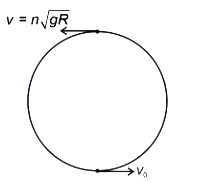
\(\begin{aligned} & v_0=\sqrt{v^2+2 g(2 R)} \\ & v_0=\sqrt{n^2 g R+4 g R} \\ & \therefore \quad \frac{k_{\text {bottom }}}{k_{\text {top }}}=\frac{v_0^2}{v^2}=\frac{n^2+4}{n^2}\end{aligned}\) -
- (A) 0
- (B) \(\frac{1}{2}\)
- (C) 2
- (D) \(\frac{1}{3}\)
Show answer and solution
Correct Answer: (B)
\(\begin{aligned} & w=0 \\ & \therefore \quad \vec{F} \cdot S=0 \\ & (2 \hat{i}+b \hat{j}+\hat{k}) \cdot(\hat{i}-2 \hat{j}-\hat{k})=0 \\ & 2-2 b-1=0 \\ & b=\frac{1}{2}\end{aligned}\) -
- (A) \(15 \mathrm{~N} / \mathrm{m}^2\)
- (B) \(12 \mathrm{~N} / \mathrm{m}^2\)
- (C) \(8 \mathrm{~N} / \mathrm{m}^2\)
- (D) \(10 \mathrm{~N} / \mathrm{m}^2\)
Show answer and solution
Correct Answer: (B)
\(F=\alpha+\beta x^2\)
Work done \(\int d w=\int F \cdot d x\)
\(\begin{aligned}
& \Rightarrow \quad \Delta W=\int F \cdot d x=\int\left(\alpha+\beta x^2\right) d x \\
& \Rightarrow \quad \Delta W=\left|\alpha x+\frac{\beta x^3}{3}\right|_0^1=\alpha+\frac{\beta}{3}=5
\end{aligned}\)
Given \(\alpha=1\)
So, \(\frac{\beta}{3}=4\)
\(\Rightarrow \beta=12 \mathrm{~N} / \mathrm{m}^2\) -
- (A) 152
- (B) 150
- (C) 148
- (D) 146
Show answer and solution
Correct Answer: (A)
\(\begin{aligned} & y=10-x \\ & w=\int_0^4 x^2(10-x) d x+\int_0^2 y^2 d y \\ & =\frac{10 x^3}{3}-\left.\frac{x^4}{4}\right|_0 ^4+\left.\frac{y^3}{3}\right|_0 ^2 \\ & =\frac{640}{3}-\frac{256}{4}+\frac{8}{3} \\ & =216 \times 64 \\ & =152 \mathrm{~J}\end{aligned}\) -
- (A) \(\frac{\mathrm{S}}{2}, \sqrt{\frac{3 \mathrm{gS}}{2}}\)
- (B) \(\frac{\mathrm{S}}{2}, \frac{3 \mathrm{gS}}{2}\)
- (C) \(\frac{\mathrm{S}}{4}, \frac{3 \mathrm{gS}}{2}\)
- (D) \(\frac{\mathrm{S}}{4}, \sqrt{\frac{3 \mathrm{gS}}{2}}\)
Show answer and solution
Correct Answer: (D)
Potential energy at height \( h \): \( U = mgh \)
Initial mechanical energy: \( E = mgS \)
Kinetic energy at height \( h \): \( K = mg(S - h) \)
Given condition: \( K = 3U \)
\( mg(S - h) = 3mgh \)
\( S - h = 3h \Rightarrow S = 4h \)
\( h = \frac{S}{4} \)
Speed at height \( h \): \( \frac{1}{2}mv^2 = mg\left(S - \frac{S}{4}\right) \)
\( \frac{1}{2}mv^2 = mg\frac{3S}{4} \)
\( v = \sqrt{\frac{3gS}{2}} \) -
- (A) \(\mathrm{P} \propto \sqrt{v}\)
- (B) \(\mathrm{P} \propto v\)
- (C) \(\mathrm{P}^2 \propto v^5\)
- (D) \(\mathrm{P}^2 \propto v^3\)
Show answer and solution
Correct Answer: (C)
Power \(=\vec{F} \cdot \vec{V}\)
and \(F=\frac{d p}{d t}=\) Rate of change of linear momentum
\(F=V \cdot \frac{d m}{d t}=K_1 V^{\frac{3}{2}}, K\) is constant
Power \((P)=\left(K V^{\frac{3}{2}}\right) \cdot(V)\)
\(=K V^{\frac{5}{2}}\)
So, \(P^2 \propto V^5\) -
- (A) \(\left(2 t^2+3 t^3\right) W\)
- (B) \(\left(2 t^2+18 t^3\right) W\)
- (C) \(\left(3 t^3+5 t^5\right) W\)
- (D) \(\left(2 t^3+3 t^5\right) W\)
Show answer and solution
Correct Answer: (D)
\(\begin{aligned} & \overrightarrow{\mathrm{F}}=(2 t \hat{\mathrm{i}}+3 \mathrm{t} \hat{\mathrm{j}}) \mathrm{N} \\ & \mathrm{m}=1000 \mathrm{gm}=1 \mathrm{~kg} \\ & \overrightarrow{\mathrm{~F}}=m \overrightarrow{\mathrm{a}}, \overrightarrow{\mathrm{a}}=2 \mathrm{t} \hat{\mathrm{i}}+3 \mathrm{t}^2 \hat{j} \\ & \frac{\mathrm{~d} \overrightarrow{\mathrm{v}}}{\mathrm{dt}}=2 t \hat{\mathrm{i}}+3 \mathrm{t}^2 \hat{\mathrm{j}}\end{aligned}\)
\(\vec{v}=t^2 \hat{i}+t^3 \hat{j}\)
Power, \(\mathrm{P}=\overrightarrow{\mathrm{F}} \cdot \overrightarrow{\mathrm{v}}\)
\(\begin{aligned} & P=\left(2 t \hat{i}+3 t^2 \hat{j}\right) \cdot\left(t^2 \hat{i}+t^3 \hat{j}\right) \\ & P=\left(2 t^3+3 t^5\right) W\end{aligned}\) -
- (A) \(\frac{4}{3} \sqrt{\operatorname{Rg}}\)
- (B) \(\frac{2}{3} \sqrt{\mathrm{Rg}}\)
- (C) \(\sqrt{\mathrm{Rg}}\)
- (D) \(\frac{1}{3} \sqrt{\operatorname{Rg}}\)
Show answer and solution
Correct Answer: (D)
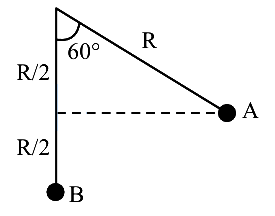
Velocity of a just before hitting :
\(\mathrm{u}=\sqrt{2 \mathrm{~g} \frac{\mathrm{R}}{2}}=\sqrt{\mathrm{gR}}\)
Just after collision, let velocity of A and B are \(\mathrm{v}_1\) and \(v_2\) respectively
\(\therefore \text { by COM: }\)
\(\begin{aligned}
& m u=m v_1+\frac{m}{2} v_2 \\
& 2 v_1+v_2=2 u ...(i)\\
& e=1=\frac{v_2-v_1}{u} \\
& \Rightarrow v_2-v_1=u..(ii)
\end{aligned}\)
From (i) -(ii)
\(\Rightarrow 3 \mathrm{v}_1=\mathrm{u} \Rightarrow \mathrm{v}_1=\frac{\mathrm{u}}{3}=\frac{1}{3} \sqrt{\mathrm{gR}}\) -
- (A) \(\mathbf{A}\) is false but \(\mathbf{R}\) is true
- (B) Both \(\mathbf{A}\) and \(\mathbf{R}\) are true but \(\mathbf{R}\) is NOT the correct explanation of \(\mathbf{A}\)
- (C) \(\mathbf{A}\) is true but \(\mathbf{R}\) is false
- (D) Both \(\mathbf{A}\) and \(\mathbf{R}\) are true and \(\mathbf{R}\) is the correct explanation of \(\mathbf{A}\)
Show answer and solution
Correct Answer: (B)
Assertion is correct as central forces are conservative in nature, i.e. work done is independent of path.
Reason is true as some forces in mechanics like, friction are non-conservative because work done depends on path and only conservative forces have an associated potential energy.
Also, reason does not explain assertion. -
- (A) Coulomb's force
- (B) Gravitational force
- (C) Frictional force
- (D) Restoring force
Show answer and solution
Correct Answer: (C)
Potential energy is defined for conservative force only. It is not defined for non-conservative force i.e. frictional force.
No questions on this page match these filters.