


Questions
14 questionsShowing 1–14 of 14 questions
-
- (A) \(\frac{(\mathrm{KE})}{8}\)
- (B) \(\frac{(\mathrm{KE})}{2}\)
- (C) \(\frac{(\mathrm{KE})}{16}\)
- (D) \(\frac{(\mathrm{KE})}{4}\)
Show answer and solution
Correct Answer: (D)
Initial K.E,
\(\text { K.E. }=\frac{1}{2} \mathrm{mu}^2\)
Speed at heighest point
\(\begin{aligned}
& \mathrm{V}=\mathrm{u} \cos 60^{\circ}=\frac{\mathrm{u}}{2} \\
& \therefore \mathrm{KE}_2=\frac{1}{2} \mathrm{~m}\left(\frac{\mathrm{u}}{2}\right)^2 \\
& =\frac{1}{4} \times \frac{1}{2} \mathrm{mu}^2 \\
& =\frac{\mathrm{KE}}{4}
\end{aligned}\) -
- (A) 5 J
- (B) 15 J
- (C) 20 J
- (D) zero
Show answer and solution
Correct Answer: (B)
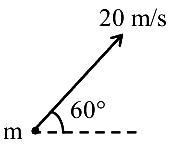
\(\begin{aligned} & \mathrm{k}_{\mathrm{i}}=\frac{1}{2} \mathrm{mv}^2 \\ & \mathrm{k}_{\mathrm{f}}=\frac{1}{2} \mathrm{~m}\left(\mathrm{v} \cos 60^{\circ}\right)^2=\frac{1}{8} m v^2 \\ & \Delta \mathrm{k}=\mathrm{k}_{\mathrm{i}}-\mathrm{k}_{\mathrm{f}}=\frac{3}{8} \mathrm{mv}^2=\frac{3}{8} \times 0.1 \times 400=15 \mathrm{~J}\end{aligned}\) -
- (A) \(2 \sqrt{5} \mathrm{~km}\)
- (B) 4 km
- (C) 7.2 km
- (D) \(2 \sqrt{2} \mathrm{~km}\)
Show answer and solution
Correct Answer: (D)
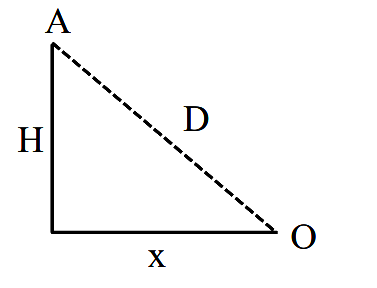
\(\begin{aligned} & \mathrm{u}=360 \times \frac{5}{18}=100 \mathrm{~m} / \mathrm{s} \\ & \mathrm{x}=\mathrm{u} \times \mathrm{t}=2 \times 10^3 \mathrm{~m} \\ & \mathrm{t}=\sqrt{\frac{2 \mathrm{H}}{\mathrm{g}}} \Rightarrow \mathrm{H}=\frac{\mathrm{t}^2 \mathrm{~g}}{2} \\ & \mathrm{H}=\frac{400 \times 10}{2} \\ & \mathrm{H}=2000 \mathrm{~m} \\ & \mathrm{D}=\sqrt{\mathrm{x}^2+\mathrm{H}^2} \\ & \mathrm{D}=2 \sqrt{2} \mathrm{~km}\end{aligned}\) -
- (A) 5
- (B) 6
- (C) 7
- (D) 8
Show answer and solution
Correct Answer: (A)
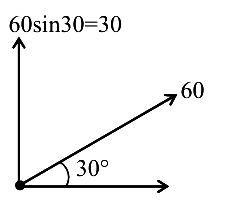
\(\begin{aligned} & \mathrm{S}_1=30 \times 1-\frac{1}{2} \times 10 \times 1=25 \\ & \mathrm{~S}_3=30+\left(\frac{-10}{2}\right) \times(2 \times 3-1)=5 \\ & \frac{\mathrm{~S}_1}{\mathrm{~S}_3}=\frac{25}{5}=5\end{aligned}\) -
- (A) \(6\)
- (B) \(18\)
- (C) \(12\)
- (D) \(24\)
Show answer and solution
Correct Answer: (D)
\(\begin{aligned} & \text { Range }=3 \mathrm{H}_{\max } \\ & \frac{\mathrm{u}^2 \sin 2 \theta}{\mathrm{~g}}=\frac{3 \mathrm{u}^2 \sin ^2 \theta}{2 \mathrm{~g}}\end{aligned}\)
\(2 \sin \theta \cos \theta=\frac{3}{2} \sin ^2 \theta\)
\(\tan \theta=\frac{4}{3} \Rightarrow \theta=53^{\circ}\)
\(\mathrm{R}=\frac{\mathrm{u}^2\left(2 \times \frac{3}{5} \times \frac{4}{5}\right)}{\mathrm{g}} \Rightarrow \frac{24 \mathrm{u}^2}{25 \mathrm{~g}}\) -
- (A) 300 m
- (B) 112.5 m
- (C) 75 m
- (D) \(112.5 \times \sqrt{3} \mathrm{~m}\)
Show answer and solution
Correct Answer: (B)
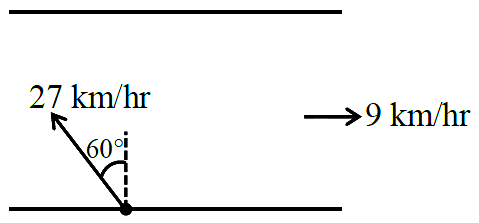
\(\therefore \mathrm{V}_{\perp}=\) river flow \(=27 \times \cos 60^{\circ}=\frac{27}{2} \mathrm{~km} / \mathrm{hr}\).
Time taken \(=30 \mathrm{sec}\).
\(\therefore \mathrm{S}=\mathrm{Vt}=\frac{27}{2} \times \frac{5}{18} \times 30 \mathrm{~m}=112.5 \mathrm{~m}\) -
- (A) 34
- (B) 36
- (C) 38
- (D) 40
Show answer and solution
Correct Answer: (B)
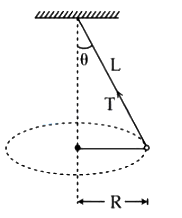
\(\begin{aligned} & \omega=\frac{3}{\pi} \times 2 \pi=6 \mathrm{rad} / \mathrm{s} \\ & R=L \sin \theta\end{aligned}\)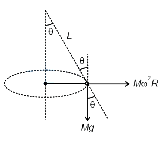
and \(T=M \sqrt{g^2+\omega^4 R^2}\)
Also, \(T \sin \theta=M \omega^2 \cdot L \sin \theta\)
\(\begin{aligned}
& \Rightarrow \quad T=M(36) \mathrm{L} \\
& \Rightarrow \quad T=36 \mathrm{ML}
\end{aligned}\) -
- (A) 5
- (B) 3
- (C) 2
- (D) 1
Show answer and solution
Correct Answer: (D)
Explanation:
Let us calculate the angular velocity by determining the total centrifugal force exerted by the continuous liquid column:
1. Setting up the Integration Element:
Let \( L = 1\text{ m} \) be the total length of the tube and \( m = 2M \) be the total mass of the liquid. Consider a tiny element of the liquid column having a width \( dx \) located at a distance \( x \) from the axis of rotation.
The mass of this small element is:
\( dm = \frac{m}{L} dx \)
2. Integrating the Centrifugal Force:
The outward centrifugal force \( dF \) exerted by this small element during rotation is:
\( dF = (dm) \omega^2 x = \left(\frac{m}{L} dx\right) \omega^2 x \)
To find the total force \( F \) acting on the outer wall, we integrate this expression from the pivot \( x = 0 \) to the outer end \( x = L \):
\( F = \int_{0}^{L} \frac{m}{L} \omega^2 x dx = \frac{m}{L} \omega^2 \left[ \frac{x^2}{2} \right]_{0}^{L} \)
\( F = \frac{m}{L} \omega^2 \frac{L^2}{2} = \frac{1}{2} m \omega^2 L \)
Notice that this matches the center of mass approach: \( F = m \omega^2 r_{cm} \), where \( r_{cm} = \frac{L}{2} = 0.5\text{ m} \).
3. Substituting the Given Constants:
Now, substitute the values \( L = 1\text{ m} \) and \( m = 2M \) into the derived equation:
\( F = \frac{1}{2} (2M) \omega^2 (1) = M \omega^2 \)
Solving explicitly for the angular velocity \( \omega \):
\( \omega^2 = \frac{F}{M} \implies \omega = \sqrt{\frac{F}{M}} \)
Comparing this result with the expression given in the problem \( \omega = \sqrt{\frac{F}{\alpha M}} \), we find that \( \alpha = 1 \).
Hence, Option D is the correct choice. -
- (A) 1000
- (B) 2000
- (C) 3000
- (D) 4000
Show answer and solution
Correct Answer: (B)
\(\overrightarrow{\mathrm{v}}_{\mathrm{b}}=9+27=36 \mathrm{~km} / \mathrm{hr}\)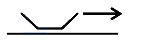
\(\begin{aligned} & \overrightarrow{\mathrm{v}}_{\mathrm{b}}=36 \times \frac{1000}{36000}=10 \mathrm{~m} / \mathrm{sec} \\ & \text { Time of flight }=\frac{2 \times 10}{10}=2 \mathrm{sec} \\ & \text { Range }=10 \times 2=20 \mathrm{~m}=2000 \mathrm{~cm}\end{aligned}\) -
- (A) \(5 \sqrt{15} \mathrm{~m} / \mathrm{s}\), making an angle of \(\tan ^{-1} 4\) with - ve \(Y\) axis
- (B) \(5 \sqrt{15} \mathrm{~m} / \mathrm{s}\), making an angle of \(\tan ^{-1} 4\) with + ve X axis
- (C) \(5 \sqrt{17} \mathrm{~m} / \mathrm{s}\), making an angle of \(\tan ^{-1} 4\) with + ve \(X\) axis
- (D) \(5 \sqrt{17} \mathrm{~m} / \mathrm{s}\), making an angle of \(\tan ^{-1} 4\) with - ve \(Y\) axis
Show answer and solution
Correct Answer: (D)
\(\begin{aligned} & \overrightarrow{\mathrm{r}}=5 t^2 \hat{\mathrm{i}}-5 \mathrm{t}_{\mathrm{j}} \\ & \overrightarrow{\mathrm{v}}=10 \hat{\mathrm{i}}-5 \hat{\mathrm{j}} \\ & \overrightarrow{\mathrm{v}}=20 \hat{\mathrm{i}}-5 \hat{\mathrm{j}} \quad \text { at } \mathrm{t}=2 \mathrm{sec}\end{aligned}\)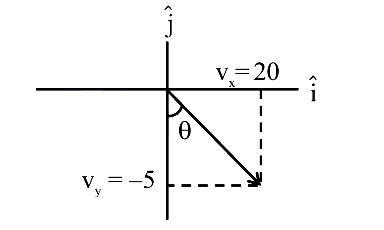
\(\begin{aligned} & \tan \theta=\frac{20}{5}=4 \\ & \theta=\tan ^{-1} 4 \\ & \text { From -veY-axis }\end{aligned}\) -
- (A) \(2 \sqrt{2}: 1\)
- (B) \(2: 1\)
- (C) \(\sqrt{2}: 1\)
- (D) \(4: 1\)
Show answer and solution
Correct Answer: (A)
\(\begin{aligned} & \text { Given, }\left(\mathrm{H}_{\max }\right)_1=8 \times\left(\mathrm{H}_{\max }\right)_2 \\ & \frac{\mathrm{u}^2 \sin ^2 \theta_1}{2 \mathrm{~g}}=8 \times \frac{\mathrm{u}^2 \sin ^2 \theta_2}{2 \mathrm{~g}} \\ & \Rightarrow \sin \theta_1=2 \sqrt{2} \sin \theta_2 \\ & \frac{\mathrm{~T}_1}{\mathrm{~T}_2}=\frac{2 \mathrm{u} \sin \theta_1 / \mathrm{g}}{2 \mathrm{u} \sin \theta_2 / \mathrm{g}}=\frac{\sin \theta_1}{\sin \theta_2}=2 \sqrt{2}\end{aligned}\) -
- (A) 4
- (B) 5
- (C) 3
- (D) 2
Show answer and solution
Correct Answer: (C)
\(\mathrm{a}_{\mathrm{p}}=\mathrm{kt}, \mathrm{k}\) is constant
\(\mathrm{a}_{\mathrm{Q}}=\mathrm{a}, \mathrm{a}\) is constant
\(\mathrm{a}_{\mathrm{QP}}=\mathrm{a}_{\mathrm{Q}}-\mathrm{a}_{\mathrm{p}}=\mathrm{a}-\mathrm{kt}\)
as initial velocities are not mentioned in question, so will have to assume two cases.
Case-I
\(\mathrm{u}_{\mathrm{OP}}\) and \(\mathrm{a}_{\mathrm{QP}}\) in same direction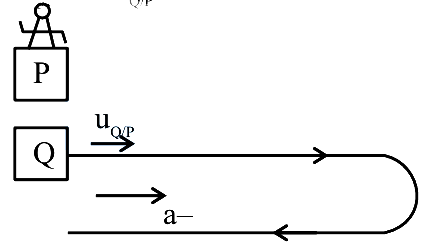
Total number of crossing \(=2\) Case-II
\(\mathrm{u}_{\mathrm{QP}}\) and \(\mathrm{a}_{\mathrm{QP}}\) in opposite direction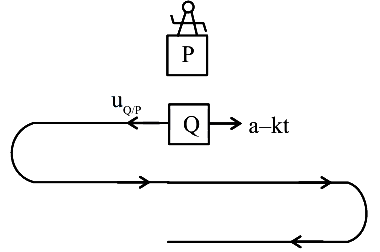
Total number of crossing \(=3\) -
- (A) 1
- (B) \(\frac{1-\tan \alpha}{1+\tan \alpha}\)
- (C) \(\frac{1+\sin 2 \alpha}{1-\sin 2 \alpha}\)
- (D) \(\frac{1+\tan \alpha}{1-\tan \alpha}\)
Show answer and solution
Correct Answer: (D)
\(\theta_1=45+\alpha ; \theta_2=45-\alpha\)
Time of flight, \(\mathrm{T}=\frac{2 \mathrm{v} \sin \theta}{\mathrm{g}}\)
\(\frac{\mathrm{T}_1}{\mathrm{~T}_2}=\frac{\sin (45+\alpha)}{\sin (45-\alpha)}\)
\(\frac{\mathrm{T}_1}{\mathrm{~T}_2}=\frac{\frac{1}{\sqrt{2}} \cos \alpha+\frac{1}{\sqrt{2}} \sin \alpha}{\frac{1}{\sqrt{2}} \cos \alpha-\frac{1}{\sqrt{2}} \sin \alpha}\)
\(\frac{\mathrm{T}_1}{\mathrm{~T}_2}=\frac{\cos \alpha+\sin \alpha}{\cos \alpha-\sin \alpha}=\frac{1+\tan \alpha}{1-\tan \alpha}\) -
- (A) \(\frac{1-\tan \alpha}{1+\tan \alpha}\)
- (B) \(\frac{1-\sin 2 \alpha}{1+\sin 2 \alpha}\)
- (C) \(\frac{1+\sin 2 \alpha}{1-\sin 2 \alpha}\)
- (D) \(\frac{1+\sin \alpha}{1-\sin \alpha}\)
Show answer and solution
Correct Answer: (B)
\(\begin{aligned} & \mathrm{H}_{\mathrm{Max}}=\frac{(\mathrm{u} \sin \theta)^2}{2 \mathrm{~g}} \\ & \frac{\left(\mathrm{H}_{\max }\right)_1}{\left(\mathrm{H}_{\max }\right)_2}=\frac{\mathrm{u}^2 \sin ^2(45-\alpha)}{\mathrm{u}^2 \sin ^2(45+\alpha)} \\ & =\frac{\left(\frac{1}{\sqrt{2}} \cos \alpha-\frac{1}{\sqrt{2}} \sin \alpha\right)^2}{\left(\frac{1}{\sqrt{2}} \cos \alpha+\frac{1}{\sqrt{2}} \sin \alpha\right)^2} \\ & =\frac{1-\sin 2 \alpha}{1+\sin 2 \alpha}\end{aligned}\)
No questions on this page match these filters.