


Questions
12 questionsShowing 1–12 of 12 questions
-
- (A) 3
- (B) 16
- (C) 9
- (D) 4
Show answer and solution
Correct Answer: (D)
\(\lambda=\frac{\mathrm{h}}{\mathrm{mv}}\)
\(\begin{aligned}
& \mathrm{mvr}=\frac{\mathrm{nh}}{2 \pi} \\
& \mathrm{mv}=\frac{\mathrm{nh}}{2 \pi \mathrm{r}} \\
& \lambda=\frac{2 \pi \mathrm{rh}}{\mathrm{nh}} \\
& \lambda \propto \frac{\mathrm{r}}{\mathrm{n}} \\
& \frac{\lambda_1}{\lambda_4}=\frac{\mathrm{r}_1 \mathrm{n}_4}{\mathrm{n}_1 \mathrm{r}_4}=\frac{5.3 \times 10^{-11} \times 4}{1 \times 84.8 \times 10^{-11}} \\
& \frac{\lambda_1}{\lambda_4}=\frac{1}{4}
\end{aligned}\) -
- (A) 4
- (B) 6
- (C) 8
- (D) 2
Show answer and solution
Correct Answer: (D)
\(\mathrm{E}=13.6\left(\frac{1}{\mathrm{n}_1^2}-\frac{1}{\mathrm{n}_1^2}\right)\)
\(2.86=13.6\left(\frac{1}{\mathrm{n}^2}-\frac{1}{5^2}\right)\)
\(\begin{aligned} & \frac{1}{\mathrm{n}^2}=0.21+\frac{1}{2.5} \\ & \mathrm{n}^2=4 \\ & \mathrm{n}=2\end{aligned}\) -
- (A) \(\sqrt{\frac{\mathrm{h}}{\pi \mathrm{eB}}}\)
- (B) \(\sqrt{\frac{2 h}{\pi e B}}\)
- (C) \(\sqrt{\frac{h}{2 \pi e B}}\)
- (D) \(\sqrt{\frac{4 \mathrm{~h}}{\pi e B}}\)
Show answer and solution
Correct Answer: (A)
\(m v r=\frac{n h}{2 \pi}\) ...(i)
\(r=\frac{v m}{B q}\) ....(ii)
\(\begin{aligned} & n=2 \\ & m r\left(\frac{r B q}{m}\right)=\frac{2 h}{2 \pi} \\ & r=\sqrt{\frac{h}{\pi B q}} \\ & q=e \\ & r=\sqrt{\frac{h}{\pi B e}}\end{aligned}\) -
- (A) 2
- (B) 1
- (C) 3
- (D) 9
Show answer and solution
Correct Answer: (C)
\(\mathrm{r}=\mathrm{r}_0 \frac{\mathrm{n}^2}{\mathrm{z}} \& \mathrm{z}=3\) for \(\mathrm{Li}^{+2}\) and \(\mathrm{n}=1\)
\(\therefore \mathrm{r}=\mathrm{r}_0 \frac{1^2}{3}=\frac{\mathrm{r}_0}{3} \quad \therefore \mathrm{x}=3\) -
- (A) (B), (D) only
- (B) (A), (B) only
- (C) (A), (D) only
- (D) (A), (C) only
Show answer and solution
Correct Answer: (B)
\(\begin{aligned} & \mathrm{E} \propto \frac{\mathrm{Z}}{\mathrm{n}^2} \\ & \mathrm{Z}_{\mathrm{H}}=1 \quad \mathrm{Z}_{\mathrm{He}^{+}}=2 \quad \mathrm{Z}_{\mathrm{Li}^{+2}}=3\end{aligned}\)
\(\begin{aligned} & 1^{\text {st }} \text { excited state } \Rightarrow \mathrm{n}=2 \\ & 2^{\text {nd }} \text { excited state } \Rightarrow \mathrm{n}=3\end{aligned}\)
From the given statements only A \& B are correct. -
- (A) \(\frac{3}{2}\)
- (B) \(\frac{4}{9}\)
- (C) \(\frac{9}{4}\)
- (D) \(\frac{2}{3}\)
Show answer and solution
Correct Answer: (D)
\(\mathrm{r}=\mathrm{r} \cdot \frac{\mathrm{n}^2}{2}\)
for \(\mathrm{Li}^{2+}\)
\(r_5=r \cdot \frac{25}{3}\)
for \(\mathrm{He}^{+}\)
\(\begin{aligned}
& \mathrm{r}_5=\mathrm{r} \cdot \frac{25}{2} \\
& \therefore \frac{\mathrm{r}_{\mathrm{Li}^{2+}}}{\mathrm{r}_{\mathrm{He}^{+}}}=\frac{2}{3}
\end{aligned}\) -
- (A) \(4000 Å\)
- (B) \(2000 Å\)
- (C) \(3000 Å\)
- (D) \(6000 Å\)
Show answer and solution
Correct Answer: (C)
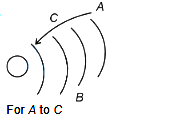
\(\frac{h c}{\lambda_1}=E_0 z^2\left(\frac{1}{n_c^2}-\frac{1}{n_A^2}\right)\) ....(i)
And \(\frac{h c}{\lambda_2}=E_0 z^2\left(\frac{1}{n_c^2}-\frac{1}{n_B^2}\right)\)
So for \(A\) and \(B\) ....(ii)
\(\frac{h c}{\lambda_3}=E_0 z^2\left(\frac{1}{n_B^2}-\frac{1}{n_A^2}\right)\)
Clearly subtracting equation (ii) from equation (i)
\(\begin{aligned}
& h c\left[\frac{1}{\lambda_1}-\frac{1}{\lambda_2}\right]=E_0 z^2\left[\frac{1}{n_B^2}-\frac{1}{n_A^2}\right]=\frac{h c}{\lambda_3} \\
& \Rightarrow \frac{1}{\lambda_3}=\frac{1}{\lambda_1}-\frac{1}{\lambda_2} \Rightarrow \frac{1}{\lambda_3}=\frac{(6000-2000)}{6000 \times 2000}=\frac{1}{3000} \\
& \lambda_3=3000 Å
\end{aligned}\) - 8. For a hydrogen atom, the ratio of the largest wavelength of Lyman series to that of the Balmer series is _______. 2025 Easy
- (A) \(5: 36\)
- (B) \(5: 27\)
- (C) \(3: 4\)
- (D) \(27: 5\)
Show answer and solution
Correct Answer: (B)
\(\mathrm {Lyman}\)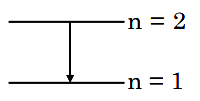
\(\frac{1}{\lambda_1}=\mathrm{R}\left[\frac{1}{1}-\frac{1}{4}\right]=\frac{3 \mathrm{R}}{4}\)
\(\lambda_1=\frac{4}{3 R}\) ________...(1)
and \(\mathrm {Balmer}\)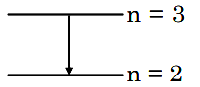
\(\frac{1}{\lambda_2}=\mathrm{R}\left[\frac{1}{4}-\frac{1}{9}\right]=\frac{5 \mathrm{R}}{36}\)
\(\lambda_2=\frac{36}{5 R}\)
Then, \(\frac{\lambda_1}{\lambda_2}=\frac{5}{27}\) -
- (A) Both \(\mathrm{A}\) and \(\mathrm{R}\) are true but \(\mathrm{R}\) is NOT the correct explanation of \(\mathrm{A}\).
- (B) \(\mathrm{A}\) is false but \(\mathrm{R}\) is true.
- (C) Both \(\mathrm{A}\) and \(\mathrm{R}\) are true and \(\mathrm{R}\) is the correct explanation of \(\mathrm{A}\).
- (D) \(\mathrm{A}\) is true but \(\mathrm{R}\) is false.
Show answer and solution
Correct Answer: (C)
Conceptual -
- (A) Both Statement I and Statement II are correct
- (B) Statement I is incorrect but Statement II is correct
- (C) Statement I is correct but Statement II is incorrect
- (D) Both Statement I and Statement II are incorrect
Show answer and solution
Correct Answer: (C)
\(\begin{aligned}
& \mathrm{E}=\mathrm{hf} \\
& \mathrm{ML}^2 \mathrm{~T}^{-2}=[\mathrm{h}] \times\left[\mathrm{T}^{-1}\right] \\
& {[\mathrm{h}]=\left[\mathrm{ML}^2 \mathrm{~T}^{-1}\right]} \\
& \mathrm{L}=[\mathrm{MVR}]=\left[\mathrm{ML}^2 \mathrm{~T}^{-1}\right] \\
& \mathrm{L}=\frac{\mathrm{nh}}{2 \pi}
\end{aligned}\)
L is integral multiple of \(\frac{\mathrm{h}}{2 \pi}\) -
- (A) 4
- (B) 2
- (C) 1
- (D) 3
Show answer and solution
Correct Answer: (D)
\(\Delta \mathrm{E}=13.6 \mathrm{z}^2\left[\frac{1}{\mathrm{n}_1^2}-\frac{1}{\mathrm{n}_2^2}\right]\)
\((13.6) \mathrm{z}^2\left[\frac{1}{1}-\frac{1}{9}\right]=108.8\)
\(\frac{(13.6)(8)}{9}\left(z^2\right)=108.8\)
\(\mathrm{z}=3\) - 12. The frequency of revolution of the electron in Bohr's orbit varies with \(n\), the principal quantum number as _______. 2025 Easy
- (A) \(\frac{1}{n^4}\)
- (B) \(\frac{1}{n^2}\)
- (C) \(\frac{1}{\mathrm{n}}\)
- (D) \(\frac{1}{n^3}\)
Show answer and solution
Correct Answer: (D)
\(\begin{aligned} & f=\frac{v}{2 \pi r}=\left(\frac{V_0}{n}\right)\left(\frac{1}{2 \pi r_0 n^2}\right) \\ & f=\frac{V_0}{2 \pi r_0}=\left(\frac{1}{n^3}\right)=f_0\left(\frac{1}{n^3}\right)\end{aligned}\)
No questions on this page match these filters.