


All JEE Mains 2025 Physics questions
32 chaptersShowing 151–200 of 454 questions
-
- (A) 1:1
- (B) 1:2
- (C) 1:4
- (D) 2:1
Show answer and solution
Correct Answer: (B)
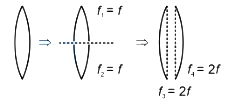
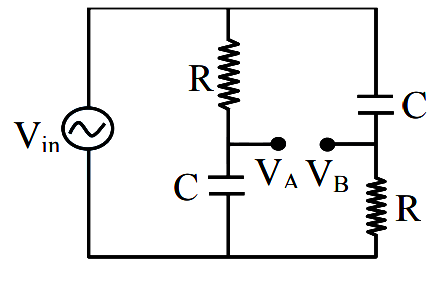
so \(\frac{f_1}{f_3}=1: 2\) -
- (A) 8
- (B) 10
- (C) 6
- (D) 4
Show answer and solution
Correct Answer: (C)
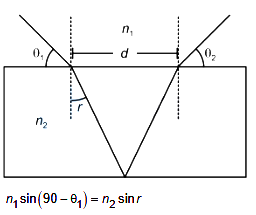
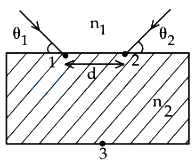
\(\begin{aligned} & n_1 \times \frac{n_2}{2 n_1}=n_2 \sin r \\ & \sin r=\frac{1}{2}\end{aligned}\)
\(\begin{aligned} & r=30^{\circ} \\ & \tan r=\left(\frac{d / 2}{t}\right) \\ & t=\frac{d}{2 \tan r}=\frac{d \sqrt{3}}{2}=\frac{(4 \sqrt{3}) \sqrt{3}}{2} \\ & =6 \mathrm{~cm}\end{aligned}\) - 153. Two thin convex lenses of focal length 30 cm and 10 cm are placed coaxially, 10 cm apart. The power of this combination is : 2025 Medium
- (A) 5 D
- (B) 1 D
- (C) 20 D
- (D) 10 D
Show answer and solution
Correct Answer: (D)
\(\mathrm{f}_1=30 \mathrm{~cm}, \mathrm{f}_2=10 \mathrm{~cm}\)
\(\frac{1}{\mathrm{f}_{\mathrm{eq}}}=\frac{1}{\mathrm{f}_1}+\frac{1}{\mathrm{f}_2}-\frac{\mathrm{d}}{\mathrm{f}_1 \mathrm{f}_2}, \mathrm{~d}=\) distance between lens
\(\frac{1}{\mathrm{f}_{\mathrm{eq}}}=\frac{1}{0.3}+\frac{1}{0.1}-\frac{0.1}{(0.3)(0.1)}\)
\(\frac{1}{\mathrm{f}_{\mathrm{eq}}}=\frac{1}{0.1}\)
Power \(=\frac{1}{\mathrm{f}_{\mathrm{eq}}}=10 \mathrm{D}\) -
- (A) \(\frac{h \tan (i-r)}{\tan r}\)
- (B) \(\frac{h \sin (i-r)}{\cos r}\)
- (C) h
- (D) \(\frac{h \cos (i-r)}{\sin r}\)
Show answer and solution
Correct Answer: (B)
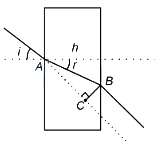
\(\begin{aligned} & A B=h \sec r \\ & B C=h \sec r \sin (\bar{i}-r) \\ & B C=\frac{h \sin (i-r)}{\cos r}\end{aligned}\) - 155. What is the relative decrease in focal length of a lens for an increase in optical power by 0.1 D from 2.5D ? ['D' stands for dioptre] 2025 Medium
- (A) \(0.01\)
- (B) \(0.04\)
- (C) \(0.40\)
- (D) \(0.1\)
Show answer and solution
Correct Answer: (B)
\(\begin{aligned} & P=\frac{1}{f} \\ & \text { So } P_1=\frac{1}{F_1} \Rightarrow F_1=\frac{1}{2.5} \\ & \text { Next } F_2=\frac{1}{2.6} \\ & \left|\frac{\Delta F}{F_1}\right|=\frac{\left|F_2-F_1\right|}{F_1}=\left|\frac{F_2}{F_1}-1\right| \\ & \Rightarrow\left|\frac{\Delta F}{F_1}\right|=\left|\frac{2.5}{2.6}-1\right|=\frac{0.1}{2.6} \approx 0.04\end{aligned}\) -
- (A) 40 cm away from the mirror.
- (B) 80 cm away from the mirror.
- (C) 20 cm towards the mirror.
- (D) 20 cm away from the mirror.
Show answer and solution
Correct Answer: (A)
\(\begin{aligned} & \mathrm{m}=\frac{1}{2}=\frac{\mathrm{f}}{\mathrm{f}-\mathrm{u}} \\ & \frac{1}{2}=\frac{\mathrm{f}}{\mathrm{f}-(-40)} \\ & \mathrm{f}+40=2 \mathrm{f} \Rightarrow \mathrm{f}=40 \mathrm{~cm} \\ & \text { now } \mathrm{m}=\frac{1}{3}=\frac{40}{40-\mathrm{u}} \\ & 40-\mathrm{u}=120 \Rightarrow \mathrm{u}=-80\end{aligned}\)
Thus, the object needs to be placed 80 cm from the mirror, opposite to the initial placement of 40 cm. To achieve this repositioning, the object needs to be moved 40 cm further from its initial 40 cm distance, totaling a move of 40 cm away from the mirror. -
- (A) \(2 \mathrm{I}_0\)
- (B) \(I_0\)
- (C) \(\frac{\mathrm{I}_0}{2}\)
- (D) \(\frac{\mathrm{I}_0}{\sqrt{2}}\)
Show answer and solution
Correct Answer: (C)
Initially, \(\mathrm{I}_0=\frac{\varepsilon_{\mathrm{m}}}{\mathrm{R}}\)
Finally, \(\mathrm{I}_0^1=\frac{\varepsilon_{\mathrm{m}}}{2 \mathrm{R}}=\frac{\mathrm{I}_0}{2}\) -
- (A) 50 Amp
- (B) 100 Amp
- (C) 10 Amp
- (D) \(5 \sqrt{2} \mathrm{Amp}\)
Show answer and solution
Correct Answer: (C)
\(i=5 \sqrt{2}+10 \cos \left(650 \pi t+\frac{\pi}{6}\right)\)
\(\mathrm{i}^2=50+100 \cos ^2\left(650 \pi \mathrm{t}+\frac{\pi}{6}\right)\)
\(+(2)(5 \sqrt{2})(10) \cos \left(650 \pi t+\frac{\pi}{6}\right)\)
\(\left\langle\mathrm{i}^2\right\rangle=50+\frac{100}{2}+0\)
\(\left. \lt \mathrm{i}^2\right\rangle=100\)
\( \lt \mathrm{i} \gt =10 \mathrm{Amp}\) -
- (A) \(\frac{\left|\mathrm{I}_{\mathrm{A}}+\mathrm{I}_{\mathrm{B}}\right|}{\sqrt{2}}\)
- (B) \(\sqrt{\frac{\mathrm{I}_{\mathrm{A}}^2+\mathrm{I}_{\mathrm{B}}^2}{2}}\)
- (C) \(\sqrt{\mathrm{I}_{\mathrm{A}}^2+\mathrm{I}_{\mathrm{B}}^2}\)
- (D) \(\frac{\sqrt{\mathrm{I}_{\mathrm{A}}^2+\mathrm{I}_{\mathrm{B}}^2}}{2}\)
Show answer and solution
Correct Answer: (B)
\(\begin{aligned} & I=I_{\mathrm{A}} \sin \omega t+I_B \cos \omega t \\ & I_{\mathrm{ma}}=\sqrt{I_A^2+I_B^2} \\ & \text { So, } I_{\mathrm{RMS}}=\sqrt{\frac{I_A^2+I_B^2}{2}}\end{aligned}\) -
- (A) \(100 \sqrt{2} \mathrm{~A}, 100 \mathrm{~Hz}\)
- (B) \(\frac{100}{\sqrt{2}} \mathrm{~A}, 100 \mathrm{~Hz}\)
- (C) \(100 \mathrm{~A}, 50 \mathrm{~Hz}\)
- (D) \(50 \sqrt{2} \mathrm{~A}, 50 \mathrm{~Hz}\)
Show answer and solution
Correct Answer: (C)
\(\begin{aligned} & \mathrm{i}_{\mathrm{r}}=\frac{\mathrm{i}_0}{\sqrt{2}}=100 \mathrm{~A} \\ & \mathrm{f}=\frac{\mathrm{w}}{2 \pi}=\frac{100 \pi}{2 \pi}=50 \mathrm{~Hz}\end{aligned}\) -
- (A) \(0.64\mathrm{~A}\)
- (B) \(0.45\mathrm{~A}\)
- (C) \(2.2\mathrm{~A}\)
- (D) \(0.32\mathrm{~A}\)
Show answer and solution
Correct Answer: (A)
\(\begin{aligned} & \mathrm{P}=\mathrm{v}_{\mathrm{rms}} \mathrm{i}_{\mathrm{rms}} \\ & \mathrm{i}_{\mathrm{rms}}=\frac{100}{220} \\ & \mathrm{i}_0=\sqrt{2} \mathrm{i}_{\mathrm{rms}}=0.64 \mathrm{~A}\end{aligned}\) -
- (A) 5
- (B) 4
- (C) 3
- (D) 1
Show answer and solution
Correct Answer: (D)
\(\begin{aligned} & \mathrm{P}=\mathrm{V}_{\mathrm{rms}} \mathrm{I}_{\mathrm{rms}} \cos \phi \\ & \mathrm{P}=\mathrm{V}_{\mathrm{rms}} \times \frac{\mathrm{V}_{\mathrm{rms}}}{\mathrm{z}} \times \frac{\mathrm{R}}{\mathrm{z}} \\ & \mathrm{P}=\mathrm{V}_{\mathrm{rms}}^2 \times \frac{\mathrm{R}}{\mathrm{z}^2} \\ & \mathrm{z}=\sqrt{\mathrm{R}^2+\left(\mathrm{x}_{\mathrm{L}}-\mathrm{x}_{\mathrm{C}}\right)^2} \\ & \mathrm{Z}=50 \sqrt{2} \Omega \\ & \mathrm{P}=100 \times \frac{50}{2500 \times 2}=1 \mathrm{~W}\end{aligned}\) -
- (A) 5
- (B) 6
- (C) 4
- (D) 1
Show answer and solution
Correct Answer: (D)
Impedance of circuit
\(\begin{aligned}
& \mathrm{Z}=\sqrt{\mathrm{R}^2+\left(\mathrm{X}_{\mathrm{L}}\right)^2}=\sqrt{\mathrm{R}^2+\left(\omega_{\mathrm{L}}\right)^2} \\
& =\sqrt{(100 \pi)^2+(2 \pi \times 50 \times 1)^2} \\
& =\sqrt{(100 \pi)^2+(100 \pi)^2} \\
& =\sqrt{2} \times 100 \pi \\
& \mathrm{I}_{\mathrm{rms}}=\frac{V}{2}=\frac{100 \pi}{\sqrt{2} \times 100 \pi}=\frac{1}{\sqrt{2}} \\
& \mathrm{I}_{\max }=\sqrt{2} \mathrm{I}_{\mathrm{rms}}=\sqrt{2} \times \frac{1}{\sqrt{2}}=1 \text { Ampere }
\end{aligned}\)
Correct Answer : 1 -
- (A) 5
- (B) 10
- (C) 15
- (D) 20
Show answer and solution
Correct Answer: (A)
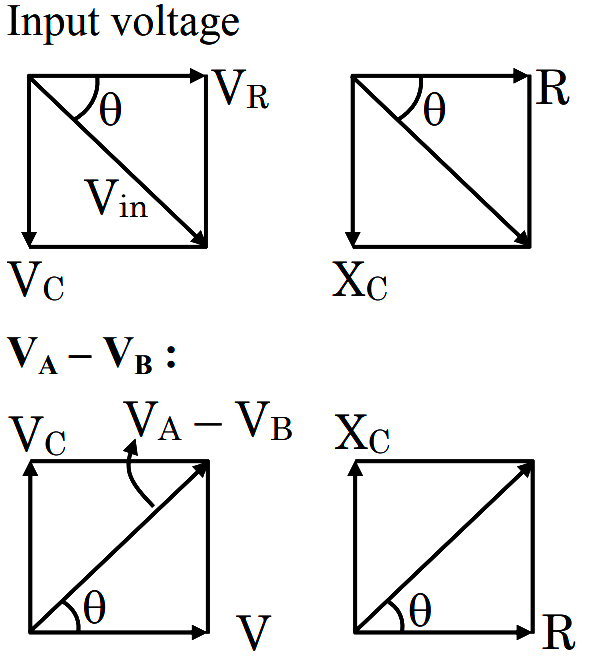
\(\theta+\theta=90^{\circ} ; \theta=45^{\circ}\)
\(\tan \theta=\frac{\mathrm{X}_{\mathrm{C}}}{\mathrm{R}}\)
\(\mathrm{X}_{\mathrm{C}}=\mathrm{R} \Rightarrow \frac{1}{\mathrm{~W}_{\mathrm{C}}}=\mathrm{R}\)
\(\mathrm{W}=\frac{1}{\mathrm{R}_{\mathrm{C}}}=\frac{1}{100 \times 10^3 \times 100 \times 10^{-12}}\)
\(=\frac{10^{12}}{10^7}=10^5\) -
- (A) (A) is true but (R) is false
- (B) Both (A) and (R) are true and (R) is the correct explanation of (A)
- (C) (A) is false but (R) is true
- (D) Both \((\mathbf{A})\) and \((\mathbf{R})\) are true but \((\mathbf{R})\) is not the correct explanation of \((\mathbf{A})\)
Show answer and solution
Correct Answer: (B)
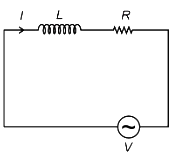
\(I=\frac{V}{\sqrt{R^2+\omega^2 L^2}}\)
\(V_R=\frac{R}{\sqrt{R^2+\omega^2 L^2}} V\) -
- (A) 2
- (B) 4
- (C) 6
- (D) 8
Show answer and solution
Correct Answer: (A)
\(\begin{aligned} & \omega=\frac{1}{\sqrt{\mathrm{LC}}} \\ & \omega=\frac{1}{\sqrt{25 \times 10^{-9} \times 100 \times 10^{-3}}} \\ & \omega=\frac{10^{+6}}{5 \times 10}=2\end{aligned}\) -
- (A) 188
- (B) 199
- (C) 177
- (D) 166
Show answer and solution
Correct Answer: (B)
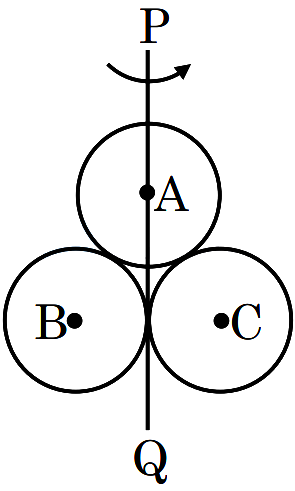
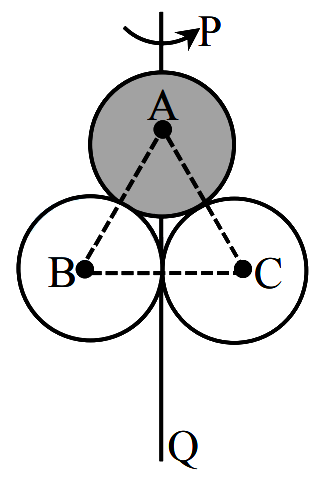
All bodies have same mass and same radius.
\(\mathrm{A} \rightarrow\) Disc
\(\mathrm{B} \rightarrow\) Solid sphere
\(\mathrm{C} \rightarrow\) Spherical shell
and, \(\mathrm{I}=\frac{\mathrm{MR}^2}{4}\)
\(\mathrm{I}_{\mathrm{PQ}}=\frac{\mathrm{MR}^2}{4}+\left(\frac{2}{5} \mathrm{MR}^2+\mathrm{MR}^2\right)+\left(\frac{2}{3} \mathrm{MR}^2+\mathrm{MR}^2\right)\)
\(\mathrm{I}_{\mathrm{PQ}}=\frac{15 \mathrm{MR}^2+24 \mathrm{MR}^2+60 \mathrm{MR}^2+40 \mathrm{MR}^2+60 \mathrm{MR}^2}{60}\)
\(\mathrm{I}_{\mathrm{PQ}}=\frac{199}{60} \mathrm{MR}^2=\frac{199}{15}\left(\frac{\mathrm{MR}^2}{4}\right)\)
\(=\frac{199}{15} \mathrm{I}\) -
- (A) \(72 MR ^2\)
- (B) \(8 MR ^2\)
- (C) \(108 MR ^2\)
- (D) \(60 MR ^2\)
Show answer and solution
Correct Answer: (D)
\(\theta =5 t ^2-8 t \)
\( \omega =\frac{ d \theta}{ dt }=10 t -8 \)
\( \alpha =\frac{ d \omega}{ dt }=10 \)
\( \therefore p =\tau \omega \)
\( =( I \alpha) \omega \)
\( =\left(\frac{ mR ^2}{2}\right) \alpha \omega \)
\( =\left(\frac{ mR ^2}{2}\right)(10)(10\)
Put \(t =2\)
\(p=60 mR^2\) -
- (A) 5
- (B) 6
- (C) 4
- (D) 2
Show answer and solution
Correct Answer: (C)
Applying Mechanical Energy conservation :
\(\mathrm{k}_{\mathrm{i}}+\mathrm{U}_{\mathrm{i}}=\mathrm{k}_{\mathrm{f}}+\mathrm{U}_{\mathrm{f}}\)
\(\begin{aligned}
& \Rightarrow 0+\mathrm{Mgh}=\frac{1}{2} \mathrm{mv}^2\left(1+\frac{\mathrm{k}^2}{\mathrm{R}^2}\right)+0 \\
& \Rightarrow \mathrm{~V}=\sqrt{\frac{2 \mathrm{gh}}{1+\frac{\mathrm{k}^2}{\mathrm{R}^2}}}
\end{aligned}\)
So Ratio of velocities
\(\frac{\mathrm{V}_{\text {Ring }}}{\mathrm{V}_{\text {solids sphere }}}=\sqrt{\frac{1+\frac{2}{5}}{1+1}}=\sqrt{\frac{7}{10}}\)
\(\mathrm{x}=3.5\) Rounding off \(\mathrm{x}=4\) -
- (A) \(20 \mathrm{rad} / \mathrm{s}\)
- (B) \(30 \mathrm{rad} / \mathrm{s}\)
- (C) \(10 \mathrm{rad} / \mathrm{s}\)
- (D) \(0 \mathrm{rad} / \mathrm{s}\)
Show answer and solution
Correct Answer: (A)
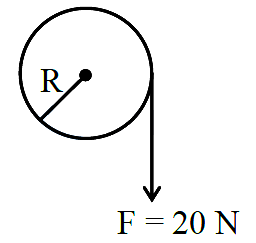
\(\begin{aligned} & \mathrm{W}_{\mathrm{F}}=20 \times 1=20 \mathrm{~J} \\ & \therefore \quad \Delta \mathrm{KE}=20 \mathrm{~J}=\frac{1}{2} \mathrm{I} \omega^2 \\ & \mathrm{I}=\mathrm{MR}^2=10 \times 0.1^2=0.1 \mathrm{~kg} \mathrm{~m}^2 \\ & \therefore \quad 20=\frac{1}{2} \times 0.1 \times \omega^2 \\ & \Rightarrow \omega=20 \mathrm{rad} / \mathrm{sec}\end{aligned}\) -
- (A) \(3.5 \mathrm{~m} / \mathrm{s}^2\)
- (B) \(0.35 \mathrm{~m} / \mathrm{s}^2\)
- (C) \(2.5 \mathrm{~m} / \mathrm{s}^2\)
- (D) \(0.25 \mathrm{~m} / \mathrm{s}^2\)
Show answer and solution
Correct Answer: (A)
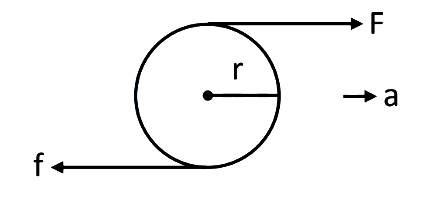
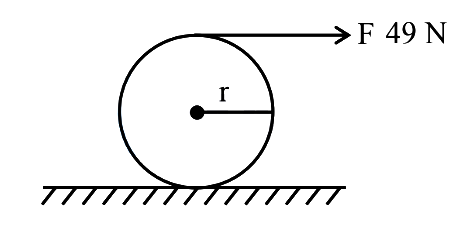
Torque about bottom point
\(\begin{aligned}
& \mathrm{F} \times 2 \mathrm{r}=\mathrm{I} \alpha \\
& 49 \times 2 \mathrm{r}=\frac{7}{5} \mathrm{mr}^2 \alpha \\
& 14=4 \mathrm{r} \alpha
\end{aligned}\)
As sphere rolls without slipping
\(\begin{aligned}
& \mathrm{a}=\mathrm{r} \alpha \\
& \mathrm{a}=\frac{14}{4}=\frac{7}{2}=3.5 \mathrm{~m} / \mathrm{s}^2
\end{aligned}\) -
- (A) \(2 \hat{i}+3 \hat{j}\)
- (B) \(3 \hat{i}+7 \hat{\mathrm{j}}\)
- (C) \(5 \hat{\mathrm{i}}+8 \hat{\mathrm{j}}\)
- (D) \(4 \hat{i}+9 \hat{j}\)
Show answer and solution
Correct Answer: (D)
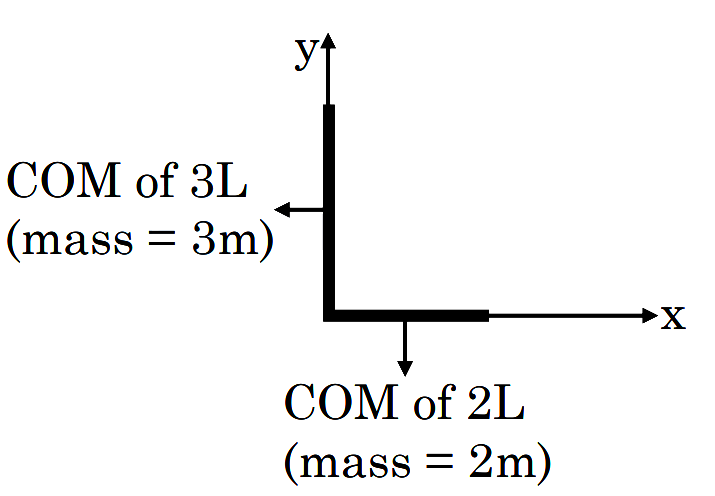
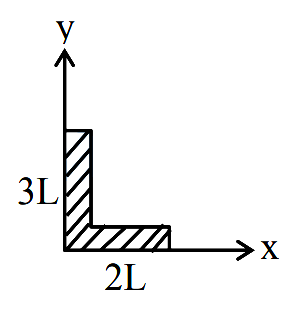
\(\mathrm{x}_{\mathrm{com}}=\frac{2 \mathrm{~m}(10)+3 \mathrm{~m}(0)}{5 \mathrm{~m}}=4 \mathrm{~cm}\)
\(\mathrm{y}_{\mathrm{com}}=\frac{2 \mathrm{~m}(0)+3 \mathrm{~m}(15)}{5 \mathrm{~m}}=9 \mathrm{~cm}\)
\(\overrightarrow{\mathrm{r}}_{\mathrm{com}}=4 \hat{\mathrm{i}}+9 \hat{\mathrm{j}}\) -
- (A) \(\frac{\lambda \mathrm{L}^3}{16 \pi^2}\)
- (B) \(\frac{\lambda \mathrm{L}^3}{12}\)
- (C) \(\frac{\lambda \mathrm{L}^3}{4 \pi^2}\)
- (D) \(\frac{\lambda L^3}{8 \pi^2}\)
Show answer and solution
Correct Answer: (D)
\(L=2 \pi R\)
\(\mathrm{I}=\frac{\mathrm{MR}^2}{2}=\frac{\lambda \times \mathrm{L}}{2} \times\left(\frac{\mathrm{L}}{2 \pi}\right)^2=\frac{\lambda \mathrm{L}^3}{8 \pi^2}\) -
- (A) \(t_1\gt t_2\)
- (B) \(t_1=t_2\)
- (C) \(t_1 \lt t_2\)
- (D) \(t_1=2 t_2\)
Show answer and solution
Correct Answer: (C)
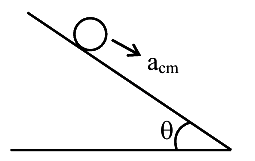
\(\begin{aligned} & \mathrm{t}=\sqrt{\frac{2 \ell}{\mathrm{a}_{\mathrm{cm}}}} \\ & \mathrm{a}_{\mathrm{cm}}=\frac{\mathrm{g} \sin \theta}{1+\frac{\mathrm{I}_{\mathrm{cm}}}{\mathrm{MR}^2}} \\ & \mathrm{a}_1=\mathrm{a}_{\mathrm{cm}_1}=\frac{5 \mathrm{~g} \sin \theta}{7} \ldots . . \text { Solid } \\ & \mathrm{a}_2=\mathrm{a}_{\mathrm{cm}_2}=\frac{3 \mathrm{~g} \sin \theta}{5} \ldots . . \text { Hollow } \\ & \mathrm{a}_1>\mathrm{a}_2 \\ & \mathrm{t}_1 < \mathrm{t}_2\end{aligned}\) -
- (A) \(\frac{3}{4}\)
- (B) \(\frac{4}{3}\)
- (C) \(\frac{5}{2}\)
- (D) \(\frac{2}{5}\)
Show answer and solution
Correct Answer: (C)
\(\begin{aligned}
& \mathrm{KE}_{(T)}=\frac{1}{2} m v^2 \\
& \mathrm{KE}_{(R)}=\frac{1}{2} \cdot \frac{2}{5} m R^2 \cdot \frac{v^2}{R^2}=\frac{1}{2} m v^2\left(\frac{2}{5}\right)
\end{aligned}\)
So, \(\frac{\mathrm{KE}_{(T)}}{\mathrm{KE}_{(R)}}=\frac{5}{2}\) -
- (A) \(1: \sqrt{2}\)
- (B) \(1: \sqrt{3}\)
- (C) \(1: 3\)
- (D) \(1: 2\)
Show answer and solution
Correct Answer: (A)
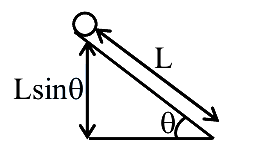
using WET
\(\begin{aligned}
& \mathrm{W}_{\mathrm{g}}=\mathrm{k}_{\mathrm{f}}-\mathrm{k}_{\mathrm{i}} \\
& \mathrm{Mg} \mathrm{~L} \sin \theta=\mathrm{k}_{\mathrm{f}}-\mathrm{k}_{\mathrm{i}}
\end{aligned}\)
K.E. in pure rolling \(\frac{1}{2} \mathrm{mV}_{\mathrm{cm}}^2+\frac{1}{2} \mathrm{I}_{\mathrm{cm}} \omega^2\)
\(\begin{aligned}
& =\frac{1}{2} \mathrm{mV}^2+\frac{1}{2} \times \frac{2}{5} \mathrm{mR}^2 \frac{\mathrm{~V}^2}{\mathrm{R}^2} \\
& \frac{7}{10} \mathrm{mV}^2
\end{aligned}\)
\(\mathrm{mgL} \sin \theta=\frac{7}{10} \mathrm{mV}_{\mathrm{f}}^2-0\)
\(\begin{aligned}
& \mathrm{V}_{\mathrm{f}}^2 \propto \sin \theta \\
& \left(\frac{\mathrm{~V}_1}{\mathrm{~V}_2}\right)^2=\frac{\sin \theta_1}{\sin \theta_2}=\frac{\sin 30^{\circ}}{\sin 45^{\circ}}=\frac{1}{\sqrt{2}}
\end{aligned}\) -
- (A) 34
- (B) 30
- (C) 32
- (D) 36
Show answer and solution
Correct Answer: (C)
When sphere is of radius \(R\), its mass is \(M\), when radius is reduced to \(\frac{\mathrm{R}}{2}\), mass will reduced to \(\frac{\mathrm{M}}{8}\) Now by conservation of angular momentum
\(\begin{aligned}
& \left(\tau_{e x t}=0\right) \\
& L_1=L_2 \\
& I_1 \omega_1=I_2 \omega_2 \\
& \left(\frac{2}{5} M R^2\right) \omega_1=\left(\frac{2}{5}\left(\frac{\mathrm{M}}{8}\right)\left(\frac{\mathrm{R}}{2}\right)^2\right) \omega_2
\end{aligned}\)
\(\omega_2=32 \omega_1\) value of x is 32
Answer is 32 -
- (A) 20 N
- (B) 0 (zero)
- (C) 10 N
- (D) \(10 \sqrt{2} \mathrm{~N}\)
Show answer and solution
Correct Answer: (C)
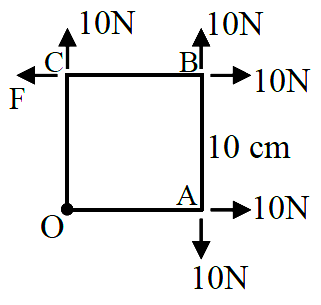
Since the lamina is equilibrium.
\(\therefore \mathrm{F}_{\mathrm{net}}=0 \& \tau_{\mathrm{net}}=0\)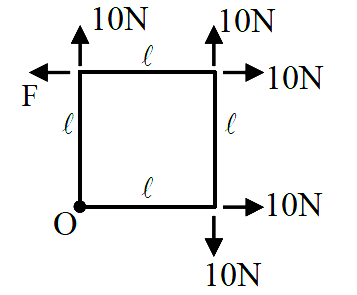
\(\mathrm{T}_{\mathrm{o}}=10 \ell-\mathrm{F} \ell \Rightarrow \mathrm{F}=10 \mathrm{~N}\) -
- (A) 60
- (B) 50
- (C) 40
- (D) 30
Show answer and solution
Correct Answer: (C)
Given, \(\mathrm{m}=1 \mathrm{~kg}\)
\(\begin{aligned}
& \omega_{\mathrm{i}}=1800 \mathrm{rpm}=1800 \times \frac{2 \pi}{60}=60 \pi \frac{\mathrm{rad}}{\mathrm{sec}} \\
& \omega_{\mathrm{f}}=2100 \mathrm{rpm}=2100 \times \frac{2 \pi}{60}=70 \pi \frac{\mathrm{rad}}{\mathrm{sec}} \\
& \tau_{e x t}=25 \pi \mathrm{Nm} \\
& \mathrm{t}=40 \mathrm{sec}
\end{aligned}\)
Using equation of motion
\(\begin{aligned}
& \omega_{\mathrm{f}}=\omega_{\mathrm{i}}+\alpha \mathrm{t} \\
& 70 \pi=60 \pi+\alpha(40) \\
& \alpha=\frac{\pi}{4} \mathrm{rad} / \mathrm{sec}^2
\end{aligned}\)
Also, \(\tau=\mathrm{I} \alpha\)
\(\tau=\frac{\mathrm{mR}^2}{4} \alpha\)
\(\begin{aligned}
& 25 \pi=\frac{1 \times \mathrm{R}^2}{4} \times \frac{\pi}{4} \\
& \mathrm{R}=20 \mathrm{~m}
\end{aligned}\)
Hence, diameter of disk \(=2 \mathrm{R}=2 \times 20=40 \mathrm{~m}\) -
- (A) \(\frac{7}{32} \mathrm{MR}^2\)
- (B) \(\frac{9}{32} \mathrm{MR}^2\)
- (C) \(\frac{17}{32} \mathrm{MR}^2\)
- (D) \(\frac{13}{32} \mathrm{MR}^2\)
Show answer and solution
Correct Answer: (D)
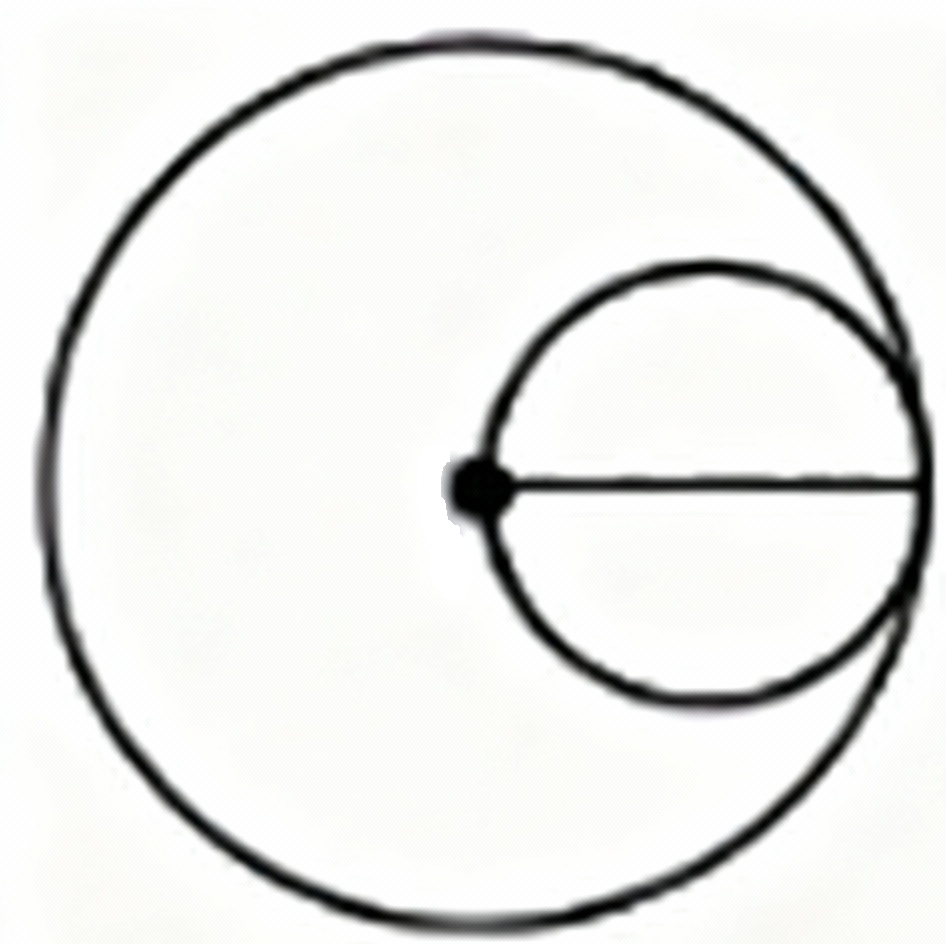
\(\begin{aligned} & I_{\text {complete }}=\frac{M R^2}{2} \\ & \begin{aligned} I_{\text {removed }} & =\left(\frac{M}{4}\right)\left(\frac{R}{2}\right)^2 \frac{1}{2}+\left(\frac{M}{4}\right)\left(\frac{R}{2}\right)^2 \\ & =\frac{3 M R^2}{32} \\ I=\frac{M R^2}{2} & -\frac{3 M R^2}{32}=\frac{13}{32} M R^2\end{aligned}\end{aligned}\) -
- (A) \(190\mathrm {~g}\)
- (B) \(200\mathrm {~g}\)
- (C) \(300\mathrm {~g}\)
- (D) \(290\mathrm {~g}\)
Show answer and solution
Correct Answer: (A)
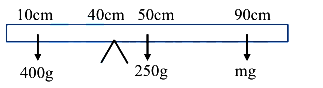
\(\begin{aligned} & \tau_{\text {Net }}=0 \Rightarrow(400 \mathrm{~g} \times 30)=(250 \mathrm{~g} \times 10)(\mathrm{mg} \times 50) \\ & \mathrm{m}=\frac{12000-2500}{50}=\frac{9500}{50} \\ & \mathrm{M}=190 \mathrm{~g}\end{aligned}\) -
- (A) \(\frac{1}{\sqrt{2}} \mathrm{~g}\)
- (B) \(\frac{1}{3 \sqrt{2}} \mathrm{~g}\)
- (C) \(\frac{\sqrt{2} \mathrm{~g}}{3}\)
- (D) \(\sqrt{2} g\)
Show answer and solution
Correct Answer: (C)
\(\begin{aligned} & a=\frac{\mathrm{g} \sin \theta}{1+\frac{\mathrm{I}}{\mathrm{mR}^2}} \\ & a=\frac{\frac{g}{\sqrt{2}}}{1+\frac{1}{2}}=\frac{2 \frac{g}{\sqrt{2}}}{3}=\frac{\sqrt{2} g}{3}\end{aligned}\) -
- (A) \(4 \sqrt{2} \mathrm{~m} / \mathrm{s}\)
- (B) \(8 \mathrm{~m} / \mathrm{s}\)
- (C) \(4 \mathrm{~m} / \mathrm{s}\)
- (D) \(8 \sqrt{2} \mathrm{~m} / \mathrm{s}\)
Show answer and solution
Correct Answer: (A)
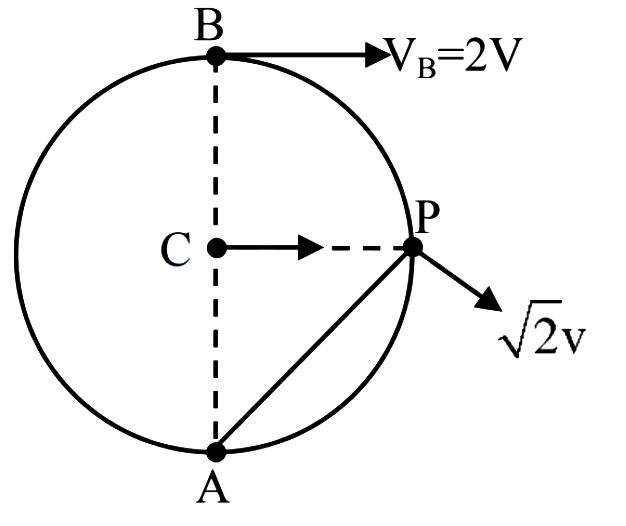
If \(V_B=2 V\)
Point A is instantaneous center of rotation
Given \(V_B=8 \mathrm{~m} / \mathrm{s}\)
\(\begin{aligned}
& \mathrm{V}=4 \mathrm{~m} / \mathrm{s} \\
& \mathrm{~V}_{\mathrm{p}}=\sqrt{2} \mathrm{v} \Rightarrow \mathrm{~V}_{\mathrm{p}}=4 \sqrt{2} \mathrm{~m} / \mathrm{s} \\
& \operatorname{correct}(1)
\end{aligned}\) -
- (A) 1
- (B) 2
- (C) 3
- (D) 4
Show answer and solution
Correct Answer: (A)
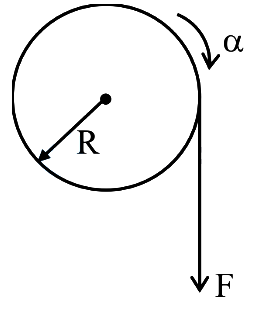
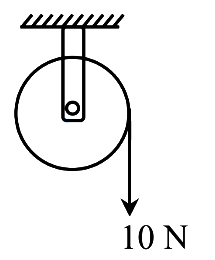
\(\begin{aligned} & \mathrm{FR}=\mathrm{I} \alpha \\ & \Rightarrow \mathrm{I}=\frac{\mathrm{FR}}{\alpha}=\frac{10 \times 0.2}{2}=1 \mathrm{~kg}-\mathrm{m}^2\end{aligned}\) -
- (A) \(\frac{m v_o^3}{2 \sqrt{2} g}\) along negative \(z\)-axis
- (B) \(\frac{m v_o^3}{4 \sqrt{2} g}\) along positive \(z\)-axis
- (C) \(\frac{m v_o^3}{4 \sqrt{2} g}\) along negative \(z\)-axis
- (D) \(\frac{m v_o^3}{2 \sqrt{2} g}\) along positive \(z\)-axis
Show answer and solution
Correct Answer: (C)
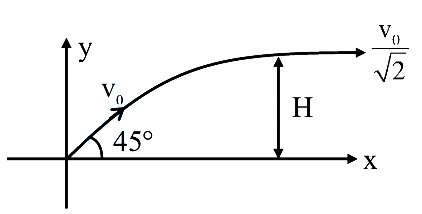
\(\begin{aligned}
& \mathrm{H}=\frac{\left(\frac{\mathrm{v}_0}{\sqrt{2}}\right)^2}{2 \mathrm{~g}}=\frac{\mathrm{v}_0^2}{4 \mathrm{~g}} \\
& \mathrm{~L}=\mathrm{mvh} \\
& \mathrm{~L}=\mathrm{m} \frac{\mathrm{v}_0}{\sqrt{2}} \frac{\mathrm{v}_0^2}{4 \mathrm{~g}}
\end{aligned}\) -
- (A) 2.0 cm
- (B) 1.5 cm
- (C) 1.0 cm
- (D) 0.5 cm
Show answer and solution
Correct Answer: (C)
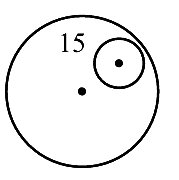
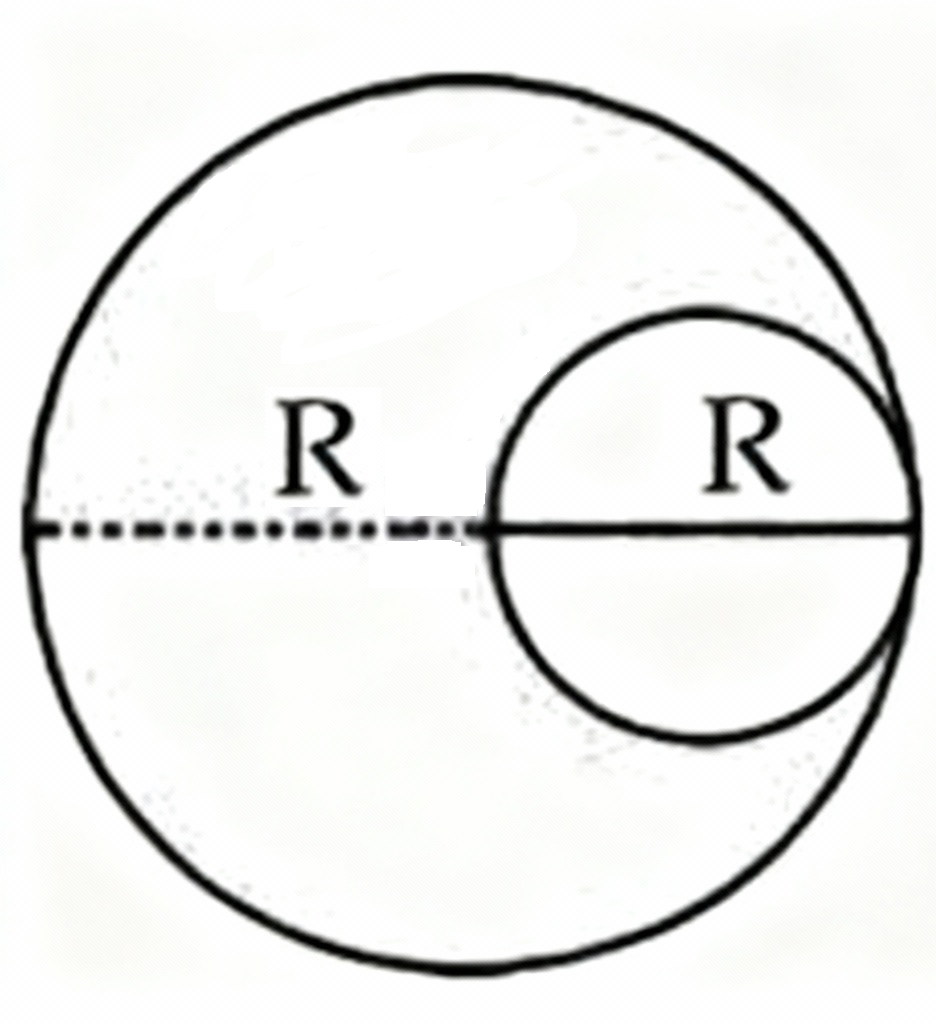
\(\text { mass of disc }=\mathrm{m}\)
\(\text { mass of cut part }=\frac{m}{16}\)
\(X_{c o m}=\frac{m \times 0-\frac{m}{16} \times 15}{m-\frac{m}{16}}\)
\(=1 \mathrm{~cm} .\) -
- (A) \(0.2\mathrm{~m}\)
- (B) \(0.4\mathrm{~m}\)
- (C) \(0.1\mathrm{~m}\)
- (D) \(0.3\mathrm{~m}\)
Show answer and solution
Correct Answer: (C)
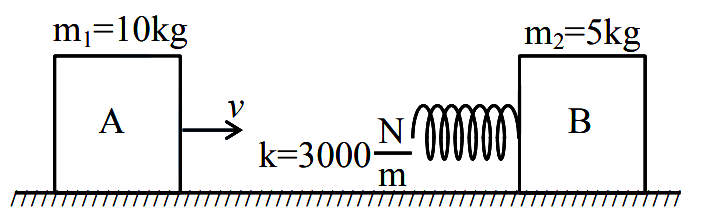
\(\begin{aligned} & \mathrm{m}_1 \mathrm{v}_1+\mathrm{m}_2 \mathrm{v}_2=\left(\mathrm{m}_1+\mathrm{m}_2\right) \mathrm{v}_{\mathrm{cm}} \\ & \mathrm{v}_{\mathrm{cm}} \Rightarrow \frac{10 \times 3}{10+5} \Rightarrow \frac{30}{15}=2 \mathrm{~m} / \mathrm{s}\end{aligned}\)
\(\frac{1}{2} \mathrm{kx}^2=\frac{1}{2}(10)(3)^2-\left[\frac{1}{2}(15)(2)^2\right]\)
\(\Rightarrow 90-60=30=3000 x^2\)
\(\begin{aligned} & \mathrm{x}^2 \Rightarrow \frac{30}{3000}=\frac{1}{100} \\ & \mathrm{x} \Rightarrow \frac{1}{10} \mathrm{~m}.\end{aligned}\) -
- (A) Opposite to the direction of \(\vec{r}\)
- (B) Opposite to the direction of \(\overrightarrow{\mathrm{L}}\)
- (C) Opposite to the direction of \(\vec{P}\)
- (D) Opposite to the direction of \(\overrightarrow{\mathrm{L}} \times \overrightarrow{\mathrm{P}}\)
Show answer and solution
Correct Answer: (A)
\(\overrightarrow{\mathrm{a}}=-\omega^2 \overrightarrow{\mathrm{r}}\)
\(\therefore \overrightarrow{\mathrm{F}}\) opposite to \(\overrightarrow{\mathrm{r}}-\) -
- (A) 9
- (B) 10
- (C) 11
- (D) 12
Show answer and solution
Correct Answer: (A)
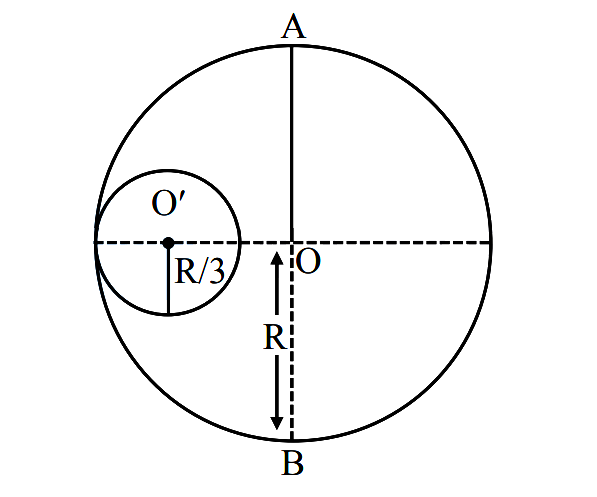
Without cavity \(\mathrm{I}_1=\frac{\mathrm{MR}^2}{2}\)
\(\begin{aligned}
\text { Mass of removed disc }= & \frac{\mathrm{M}}{\pi \mathrm{R}^2} \times\left(\frac{\mathrm{R}}{3}\right)^2 \pi \\
& =\left(\frac{\mathrm{M}}{9}\right)
\end{aligned}\)
M.I. of removed disc \(I_2=\frac{\frac{M}{9}\left(\frac{R}{3}\right)^2}{2}+\frac{M}{9} \times\left(\frac{2 R}{3}\right)^2\)
\(\begin{aligned}
& =\frac{\mathrm{MR}^2}{18} \\
& \mathrm{I}=\mathrm{I}_1-\mathrm{I}_2=\frac{\mathrm{MR}^2}{2}-\frac{\mathrm{MR}^2}{18}=\frac{4 \mathrm{MR}^2}{9} \\
& (\mathrm{n}=9)
\end{aligned}\) -
- (A) \(\alpha\)
- (B) \(\alpha / 4\)
- (C) \(\alpha / 8\)
- (D) \(\alpha / 2\)
Show answer and solution
Correct Answer: (B)
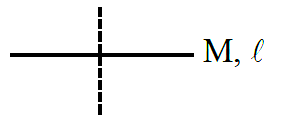
\(\alpha=\frac{\mathrm{M} \ell^2}{12}\)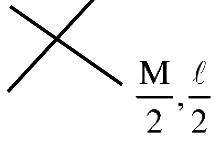
\(\begin{aligned} & \alpha^{\prime}=2\left[\frac{\frac{\mathrm{M}}{2}\left(\frac{\ell}{2}\right)^2}{12}\right] \\ & \alpha^{\prime}=\frac{\mathrm{M} \ell^2}{48}=\frac{\alpha}{4}\end{aligned}\)
Correct option is (2) -
- (A) \(\left(\frac{2}{3} a, \frac{\mathrm{~b}}{2}\right)\)
- (B) \(\left(\frac{a}{2}, \frac{\mathrm{~b}}{2}\right)\)
- (C) \(\left(\frac{1}{3} a, \frac{\mathrm{~b}}{2}\right)\)
- (D) \(\left(\frac{2}{3} a, \frac{2}{3} b\right)\)
Show answer and solution
Correct Answer: (A)
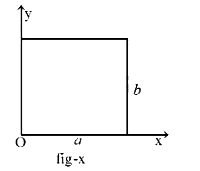
\(\begin{aligned} & d m=\sigma d A \\ & \begin{aligned} d & =\sigma(d x)(d y)=\frac{\sigma_0 x}{a b}(d x)(d y) \\ x_{c o m} & =\frac{\int x d m}{\int d m}=\frac{\int x \frac{\left(\sigma_0 x\right)}{a b}(d x)(d y)}{\int_0 \frac{\sigma_0}{a b}(d x)(d y)} \\ & =\frac{\int_0^a x^2 d x \int_0^b d y}{\int_0^b x d x \int_0^b d y}=\frac{2 a}{3} \\ y_{c o m} & =\frac{\int y d m}{\int d m}=\frac{\int y\left(\frac{\sigma_0 x}{a b}\right)(d x)(d y)}{\int \frac{\sigma_0 x}{a b}(d x)(d y)}\end{aligned}\end{aligned}\)
\(=\frac{\int_0^a x d x \int_0^b y d y}{\int_0^a x d x \int_0^b d y}=\frac{b}{2}\)
i.e., \(\vec{r}_{\mathrm{com}} \equiv\left(\frac{2 a}{3}, \frac{b}{2}\right)\) -
- (A) 2
- (B) 4
- (C) 6
- (D) 8
Show answer and solution
Correct Answer: (A)
\(\begin{aligned} & \vec{\tau}=\overrightarrow{\mathrm{r}} \times \overrightarrow{\mathrm{F}}=\left|\begin{array}{ccc}\hat{\mathrm{i}} & \hat{\mathrm{j}} & \hat{\mathrm{k}} \\ 1 & 1 & 1 \\ 1 & -1 & 1\end{array}\right| \\ & \vec{\tau}=\hat{\mathrm{k}}(-1-1)=-2 \hat{\mathrm{k}} \\ & |\vec{\tau}|=2 \mathrm{Nm}\end{aligned}\) - 193. The moment of inertia of a circular ring of mass \(M\) and diameter r about a tangential axis lying in the plane of the ring is : 2025 Easy
- (A) \(\frac{1}{2} \mathrm{Mr}^2\)
- (B) \(\frac{3}{8} \mathrm{Mr}^2\)
- (C) \(\frac{3}{2} \mathrm{Mr}^2\)
- (D) \(2 \mathrm{Mr}^2\)
Show answer and solution
Correct Answer: (B)
Diameter is given as R.
\(\begin{aligned}
& \therefore \text { Radius }=\mathrm{R} / 2 \\
& \mathrm{I}_{\text {tan gent }}=\frac{3}{2} \mathrm{~m}\left(\frac{\mathrm{R}}{2}\right)^2=\frac{3}{8} \mathrm{mR}^2
\end{aligned}\) -
- (A) 10
- (B) 5
- (C) 4
- (D) 2
Show answer and solution
Correct Answer: (C)
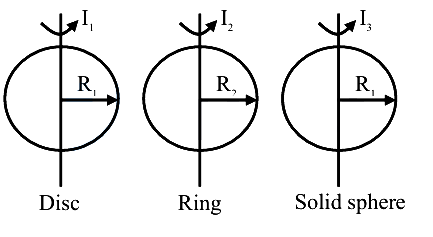
\(\mathrm{I}_1=\frac{\mathrm{MR}_1^2}{4}, \mathrm{I}_2=\frac{\mathrm{MR}_2^2}{2}, \mathrm{I}_3=\frac{2 \mathrm{MR}_1^2}{5}\)
According to problem
\(\frac{\mathrm{I}_1}{\mathrm{I}_2}=2.5 \Rightarrow \frac{\frac{\mathrm{MR}_1^2}{4}}{\frac{\mathrm{MR}_2^2}{2}}=\frac{5}{2} \Rightarrow \frac{\mathrm{R}_1^2}{\mathrm{R}_2^2}=5 \ldots\)
Now we are provided with information that
\(\begin{aligned}
& \frac{\mathrm{I}_3}{\mathrm{I}_2}=\mathrm{n} \\
& \Rightarrow \frac{\frac{2 \mathrm{MR}_1^2}{5}}{\frac{\mathrm{MR}_2^2}{2}}=\mathrm{n} \Rightarrow \frac{4 \mathrm{R}_1^2}{5 \mathrm{R}_2^2}=\mathrm{n}
\end{aligned}\)
From Eq', (1) and (2)
\(\Rightarrow n=4\) -
- (A) 100
- (B) 80
- (C) 70
- (D) 90
Show answer and solution
Correct Answer: (D)
At \(t=1\)
\(r_{A B}=-1 \hat{i}+(3 n+1) \hat{j}+(2-4 p) \hat{k}\)
At \(t=1\)
\(v_A=2 \hat{i}+3 n \hat{j}+2 \hat{k} \)
\(v_B=2 \hat{i}-2 \hat{j}+4 p \hat{k} \)
\(\vec{v}_A-\vec{v}_B=0, \quad 4-6 n+8 p=0\)
\(\left|v_A\right|=\left|v_B\right| \quad(3 n)^2+4=4+16 p^2 \)
\( 3 n=-4 p \)
\( 4+16 p=0 \)
\( p=-\frac{1}{4}, n=\frac{1}{3} \)
\( r_{A B}=-\hat{i}+2 \hat{j}+3 \hat{k} \)
\( v_A=2 \hat{i}+\hat{j}+2 \hat{k} \)
\( \therefore L=m\left|\vec{r}_{A B} \times \vec{v}_A\right|=90\) -
- (A) \(\hat{i}-\hat{k}\)
- (B) \(\hat{i}+\hat{k}\)
- (C) \(\hat{j}+\hat{k}\)
- (D) \(\hat{i}-\hat{j}+\hat{k}\)
Show answer and solution
Correct Answer: (A)
\(\begin{aligned} \tau & =\dot{r} \times \dot{F} \\ \tau & =\left|\begin{array}{lll}\hat{i} & \hat{j} & \hat{k} \\ 1 & 1 & 1 \\ 2 & 1 & 2\end{array}\right| \\ \tau & =\hat{i}(2-1)-\hat{j}[0]+\hat{k}(1-2) \\ & =\hat{i}-\hat{k}\end{aligned}\) -
- (A) \(3 \mathrm{a} \mathrm{m} \mathrm{V}_0\)
- (B) \(\frac{3}{2}\) a \(\mathrm{m} \mathrm{V}_0\)
- (C) \(\frac{\sqrt{3}}{2}\) a \(\mathrm{m} \mathrm{V}_0\)
- (D) \(\frac{1}{2}\) a \(\mathrm{mV}_0\)
Show answer and solution
Correct Answer: (C)
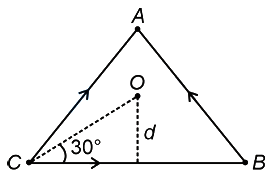
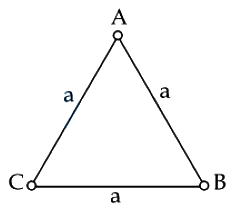
\(d=\frac{a}{2 \sqrt{3}}\)
Angular momentum of one mass about point \(O\)
\(\begin{aligned}
L & =m v d \\
& =m v_0 \cdot \frac{a}{2 \sqrt{3}}
\end{aligned}\)
Net angular momentum about point \(O\)
\(\begin{aligned}
L_{\text {net }} & =32 \\
& =\frac{\sqrt{3} m v_0 a}{2}
\end{aligned}\) -
- (A) 14
- (B) 16
- (C) 12
- (D) 10
Show answer and solution
Correct Answer: (B)
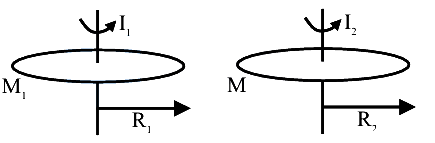
Given \(R_2=2 R_1\)
\(\begin{aligned}
& M_1=\sigma \times \pi R_1^2=M_o \\
& M_2=\sigma \times \pi R_2^2=M_o \\
& M_2=\sigma \times \pi R_2^2=\sigma \times \pi\left[2 R_1\right]^2=\sigma \times 4 \pi R_1^2=4 M_o
\end{aligned}\)
\(\frac{I_1}{I_2}=\frac{\frac{M_1 R_1^2}{2}}{\frac{M_2 R_2^2}{2}}=\frac{M_1 R_1^2}{M_2 R_2^2}=\frac{1}{4} \times \frac{1}{4}=\frac{1}{16}\) -
- (A) B, D and E Only
- (B) C and D Only
- (C) B, C, D and E Only
- (D) A, B, D and E Only
Show answer and solution
Correct Answer: (C)
Conceptual -
- (A) 50
- (B) 52
- (C) 48
- (D) 46
Show answer and solution
Correct Answer: (C)
\(\begin{aligned} & F=I \ell B \\ & =8 \times \frac{4}{100} \times 0.15 \\ & =48 \times 10^{-3} \mathrm{~N}=48 \mathrm{mN}\end{aligned}\)
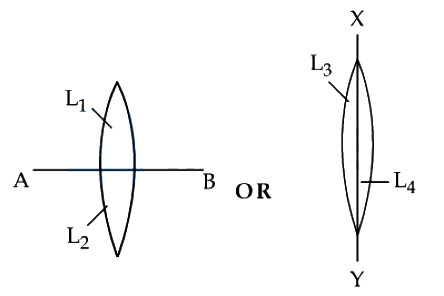
No questions on this page match these filters.