


Questions
14 questionsShowing 1–14 of 14 questions
-
- (A) \(9 \%\)
- (B) \(3 \%\)
- (C) \(4.5 \%\)
- (D) \(2.5 \%\)
Show answer and solution
Correct Answer: (C)
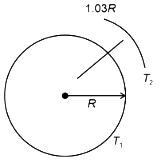
\(T_1 \propto(R)^{3 / 2}\)
and \(T_2 \propto(1.03 R)^{3 / 2}\)
\(\Rightarrow \quad T_2=(1.03 R)^{3 / 2} \cdot T_1 \approx 1.045 T_1\)
So \(T_2\) will larger by \(4.5 \%\) w.r.t. \(T_1\). -
- (A) 5
- (B) 4
- (C) 3
- (D) 2
Show answer and solution
Correct Answer: (C)
Explanation:
Let us calculate the kinetic energy of the satellite step-by-step using gravitational principles:
1. Identify the given parameters:
Mass of the satellite \( (m) = 1000\text{ kg} = 10^3\text{ kg} \)
Mass of the Earth \( (M_e) = 6 \times 10^{24}\text{ kg} \)
Radius of the Earth \( (R_E) = 6.4 \times 10^6\text{ m} \)
Height of the orbit \( (h) = 270\text{ km} = 2.7 \times 10^5\text{ m} \)
2. Calculate the orbital radius \( (r) \):
The total distance of the satellite from the center of the Earth is:
\( r = R_E + h = 6.4 \times 10^6\text{ m} + 0.27 \times 10^6\text{ m} = 6.67 \times 10^6\text{ m} \)
3. Apply the Kinetic Energy formula:
The kinetic energy of a satellite revolving in a stable circular orbit is given by:
\( \text{KE} = \frac{G M_e m}{2r} = \frac{G M_e m}{2(R_E + h)} \)
Substituting the correct values into the expression:
\( \text{KE} = \frac{6.67 \times 10^{-11} \times 6 \times 10^{24} \times 10^3}{2 \times 6.67 \times 10^6} \)
Canceling out the common term \( 6.67 \) from both the numerator and denominator simplifies the math:
\( \text{KE} = \frac{6 \times 10^{16}}{2 \times 10^6} \)
\( \text{KE} = 3 \times 10^{10}\text{ J} \)
Hence, Option C is the correct choice. -
- (A) 7
- (B) 8
- (C) 9
- (D) 3
Show answer and solution
Correct Answer: (D)
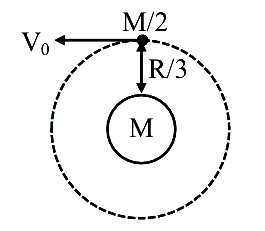
\(\begin{aligned} & \text { orbital velocity } v_0=\sqrt{\frac{\mathrm{GM}}{4 \mathrm{R} / 3}}=\sqrt{\frac{3 \mathrm{GM}}{4 \mathrm{R}}} \\ & \text { Angular momentum of satellite }=\frac{\mathrm{M}}{2} \mathrm{v}_0 \frac{4 R}{3} \\ & =\frac{M}{2} \cdot \sqrt{\frac{3 \mathrm{GM}}{4 \mathrm{R}}} \cdot \frac{4 \mathrm{R}}{3} \\ & =M \sqrt{\frac{\mathrm{GMR}}{3}} \\ & x=3\end{aligned}\)
(ii) Since mass of satellite is comparable to the mass of earth.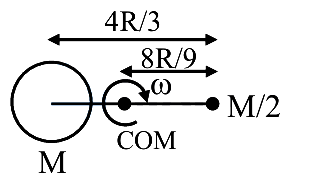
\(\begin{aligned} & \frac{\text { G.M. } \frac{\mathrm{M}}{2}}{\left(\frac{4 \mathrm{R}}{3}\right)^2}=\frac{\mathrm{M}}{2} \omega^2 \cdot \frac{8 \mathrm{R}}{9} \\ & \omega=\sqrt{\frac{81 \mathrm{GM}}{128 \mathrm{R}^3}}\end{aligned}\)
Angular momentum of satellite about common centre of mass,
\(\begin{aligned}
& L=\frac{M}{2} \cdot\left(\frac{8 R}{9}\right)^2 \cdot \omega \\
& L=M \sqrt{\operatorname{GMR}\left(\frac{8}{81}\right)} \\
& x=\frac{81}{8} \simeq 10
\end{aligned}\) -
- (A) \(12: 11\)
- (B) \(11: 10\)
- (C) \(12: 9\)
- (D) \(16: 9\)
Show answer and solution
Correct Answer: (A)
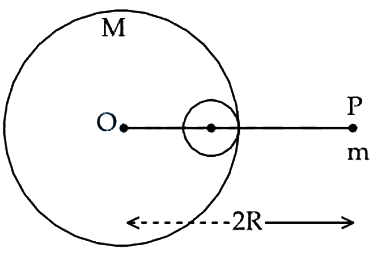
\(\begin{aligned}
& \mathrm{F}_1=\frac{\mathrm{GMm}}{(2 \mathrm{R})^2} .....(1)\\
& \mathrm{~F}_2=\frac{\mathrm{GMm}}{(2 \mathrm{R})^2}-\left(\frac{\mathrm{G}\left(\frac{\mathrm{M}}{27}\right) \mathrm{m}}{\left(\frac{4 \mathrm{R}}{3}\right)^2}\right) \\
& \mathrm{F}_2=\frac{11}{48} \frac{\mathrm{GMm}}{\mathrm{R}^2} ....(2)\\
& \mathrm{~F}_1: \mathrm{F}_2=12: 11
\end{aligned}\) -
- (A) 11
- (B) 7
- (C) 9
- (D) 13
Show answer and solution
Correct Answer: (C)
\(\because\) acceleration due to gravity on surface is given by
\(\mathrm{g}=\frac{\mathrm{GM}}{\mathrm{R}_{\mathrm{e}}^2}\)
Now since diameter is reduced to \(1 / 3^{\text {rd }}\), radius also reduces to \(1 / 3^{\text {rd }}\), keeping mass constant
New value of acceleration due to gravity on Earth's surface is
\(\mathrm{g}^{\prime}=\frac{\mathrm{GM}}{\left(\frac{\mathrm{R}_{\mathrm{e}}}{3}\right)^2}=9 \frac{\mathrm{GMe}}{\mathrm{R}_{\mathrm{e}}^2}=9 \mathrm{~g}\) -
- (A) \(\sqrt{\frac{\mathrm{GM}}{2 \mathrm{R}}}\)
- (B) \(\sqrt{\frac{\mathrm{GM}}{\mathrm{R}}}\)
- (C) \(\sqrt{\frac{3 \mathrm{GM}}{\mathrm{R}}}\)
- (D) \(\sqrt{\frac{2 \mathrm{GM}}{\mathrm{R}}}\)
Show answer and solution
Correct Answer: (A)
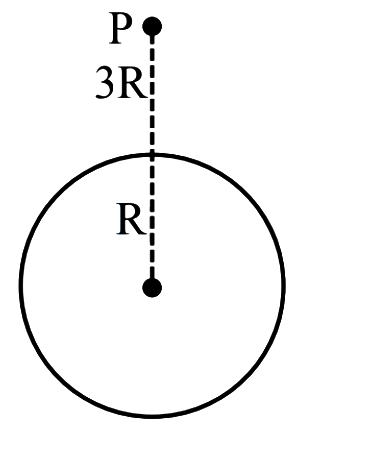
\(\begin{aligned}
& \mathrm{P}_{\mathrm{P}}+\mathrm{k}_{\mathrm{P}}=\mathrm{P}_{\mathrm{o}}+\mathrm{k}_0 \\
& -\frac{\mathrm{GMm}}{4 \mathrm{R}}+\frac{1}{2} \mathrm{mV}_{\mathrm{P}}^2=0 \\
& \mathrm{~V}_{\mathrm{P}}=\sqrt{\frac{\mathrm{GM}}{2 \mathrm{R}}}
\end{aligned}\)
Choice 1 -
- (A) \(2.8\)
- (B) \(11.2\)
- (C) \(5.6\)
- (D) \(8.4\)
Show answer and solution
Correct Answer: (C)
\(\begin{aligned} & \mathrm{V}_{\text {escape }}=\sqrt{\frac{2 \mathrm{GM}}{\mathrm{R}}} \\ & \frac{\left(\mathrm{V}_{\text {escape }}\right)_{\text {Planet }}}{\left(\mathrm{V}_{\text {escape }}\right)_{\text {Earth }}}=\sqrt{\left(\frac{\mathrm{M}_{\mathrm{P}}}{\mathrm{M}_{\mathrm{E}}}\right) \times\left(\frac{\mathrm{R}_{\mathrm{E}}}{\mathrm{R}_{\mathrm{P}}}\right)}=\frac{1}{2} \\ & \left(\mathrm{~V}_{\text {escape }}\right)_{\text {Planet }}=\frac{1}{2}\left(\mathrm{~V}_{\text {escape }}\right)_{\text {Earth }}=5.6 \mathrm{~km} / \mathrm{s}\end{aligned}\) -
- (A) Both \((\mathbf{A})\) and \((\mathbf{R})\) are true and \((\mathbf{R})\) is the correct explanation of \((\mathbf{A})\)
- (B) (A) is true but (R) is false
- (C) (A) is false but (R) is true
- (D) Both \((\mathbf{A})\) and \((\mathbf{R})\) are true but \((\mathbf{R})\) is not the correct explanation of \((\mathbf{A})\)
Show answer and solution
Correct Answer: (A)
As h increases, g decreases, T increases
\(\begin{aligned}
& \mathrm{T}=2 \pi \sqrt{\frac{\ell}{\mathrm{~g}}} \\
& \mathrm{~g}=\frac{\mathrm{g}_0 \mathrm{R}^2}{(\mathrm{R}+\mathrm{h})^2}
\end{aligned}\) -
- (A) \(\mathrm{A}\) False but \(\mathrm{R}\) is true
- (B) Both \(\mathrm{A}\) and \(\mathrm{R}\) are true and \(\mathrm{R}\) is the correct explanation of \(\mathrm{A}\)
- (C) \(\mathrm{A}\) is true but \(\mathrm{R}\) is false
- (D) (4) Both \(\mathrm{A}\) and \(\mathrm{R}\) are true but \(\mathrm{R}\) is NOT the correct explanation of \(\mathrm{A}\)
Show answer and solution
Correct Answer: (A)
\(\mathrm{KE}=\frac{1}{2} \mathrm{~m}\left(\frac{2 \mathrm{Gm}}{\mathrm{R}}\right)=\mathrm{mgR}\)
Assertion wrong
at \(\infty\)
\(\mathrm{U}=0\)
\(\therefore\) Reason correct. -
- (A) Both \((\mathrm{A})\) and \((\mathrm{R})\) are correct and \((\mathrm{R})\) is the correct explanation of \(\mathrm{( A)}\)
- (B) Both \((\mathrm{A})\) and \((\mathrm{R})\) are correct but \((\mathrm{R})\) is not the correct explanation of (A)
- (C) (A) is correct but \((\mathrm{R})\) is not correct
- (D) (A) is not correct but (R) is correct
Show answer and solution
Correct Answer: (A)
\(\frac{\mathrm{dA}}{\mathrm{dt}}=\frac{\mathrm{L}}{2 \mathrm{~m}}\)
Due to central force torque is zero \(\&\) angular momentum is constant. -
- (A) \((\mathbf{A})\) is false but (R) is true
- (B) (A) is true but (R) is false
- (C) Both \((\mathbf{A})\) and \((\mathbf{R})\) are true and \((\mathbf{R})\) is the correct explanation of \((\mathbf{A})\)
- (D) Both (A) and (R) are true but (R) is NOT the correct explanation of (A)
Show answer and solution
Correct Answer: (D)
\(\begin{aligned}
& g=\frac{G M}{R^2} \\
& g^{\prime}=\frac{G(4 M)}{(2 R)^2}=g
\end{aligned}\)
A is correct, \(R\) is correct ; but since \(T=2 \pi \sqrt{\frac{\ell}{g}}\) doesn't depend on mass ; R doesn't explain A . -
- (A) 27 days
- (B) 1 day
- (C) 81 days
- (D) 3 days
Show answer and solution
Correct Answer: (B)
\(\begin{aligned} & \mathrm{T}^2 \propto \mathrm{R}^3 \\ & \left(\frac{\mathrm{~T}_{\mathrm{m}}}{\mathrm{T}_{\mathrm{s}}}\right)^2=\left(\frac{\mathrm{R}}{\mathrm{R} / 9}\right)^3 \\ & \frac{\mathrm{~T}_{\mathrm{m}}}{\mathrm{T}_{\mathrm{s}}}=(3)^3 \\ & \Rightarrow \mathrm{~T}_{\mathrm{s}}=\left(\frac{27}{27}\right)=1 \text { day }\end{aligned}\) -
- (A) 10
- (B) 8
- (C) 6
- (D) 4
Show answer and solution
Correct Answer: (B)
\(\begin{aligned} & \mathrm{T} \propto \mathrm{m}^{\mathrm{x}} \mathrm{G}^{\mathrm{y}} \mathrm{a}^{\mathrm{z}} \\ & \mathrm{T} \propto \mathrm{M}^{\mathrm{x}}\left[\mathrm{M}^{-1} \mathrm{~L}^3 \mathrm{~T}^{-2}\right]^y[\mathrm{~L}]^{\mathrm{z}} \\ & \mathrm{T} \propto \mathrm{M}^{\mathrm{x}-\mathrm{y}} \mathrm{L}^{3 \mathrm{y}+\mathrm{z}} \mathrm{T}^{-2 \mathrm{y}} \\ & \mathrm{x}-\mathrm{y}=0 \Rightarrow \mathrm{x}=\mathrm{y} \\ & -2 \mathrm{y}=1 \Rightarrow \mathrm{y}=-\frac{1}{2}, \mathrm{x}=-\frac{1}{2} \\ & \Rightarrow 3 \mathrm{y}+\mathrm{z}=0 \\ & \mathrm{z}=-3 \mathrm{y}=\frac{3}{2}\end{aligned}\)
Hence
\(\begin{aligned}
& \mathrm{T} \propto \mathrm{~m}^{-1 / 2} \mathrm{G}^{-1 / 2} \mathrm{a}^{3 / 2} \\
& \mathrm{~T} \propto\left(\frac{\mathrm{a}^3}{\mathrm{~m}}\right)^{1 / 2} \\
& \mathrm{~T}=4 \times\left(\frac{2^3}{2}\right)^{1 / 2}=8 \mathrm{~s}
\end{aligned}\) -
- (A) 10
- (B) 7
- (C) 9
- (D) 8
Show answer and solution
Correct Answer: (D)
\(\mathrm{L}=\mathrm{mv}_0 \mathrm{R}=\mathrm{m} \sqrt{\frac{\mathrm{GM}}{\mathrm{R}}} \mathrm{R}=\mathrm{m} \sqrt{\mathrm{GMR}}\)
here M is mass of star
\(\begin{aligned}
& \frac{\mathrm{L}_{\mathrm{B}}}{\mathrm{~L}_{\mathrm{A}}}=\frac{\mathrm{m}_{\mathrm{B}}}{\mathrm{~m}_{\mathrm{A}}} \sqrt{\frac{\mathrm{R}_{\mathrm{B}}}{\mathrm{R}_{\mathrm{A}}}} \\
& =4 \sqrt{2} \sqrt{\frac{2}{1}} \\
& \frac{\mathrm{~L}_{\mathrm{B}}}{\mathrm{~L}_{\mathrm{A}}}=8
\end{aligned}\)
No questions on this page match these filters.