


Questions
20 questionsShowing 1–20 of 20 questions
-
- (A) 3 eV
- (B) 2 eV
- (C) 6 eV
- (D) 5 eV
Show answer and solution
Correct Answer: (D)
Einstein's photoelectric equation
\(\begin{aligned}
& \mathrm{KE}=\frac{h c}{\lambda}=\phi_0 \\
& 2 \mathrm{eV}=\frac{h c}{\lambda}-1 \mathrm{eV} \\
& \frac{h c}{\lambda}=3 \mathrm{eV} \\
& \mathrm{KE}^{\prime}=\frac{h c}{(\lambda / 2)}-\phi_0=6 \mathrm{eV}-1 \mathrm{eV}
\end{aligned}\)
\(=5 \mathrm{eV}\) -
- (A) \(\sqrt{2 \mathrm{~m}\left(\frac{\mathrm{hc}}{\lambda}-\phi\right)} / \mathrm{eB}\)
- (B) \(\sqrt{\mathrm{m}\left(\frac{\mathrm{hc}}{\lambda}-\phi\right)} / \mathrm{eB}\)
- (C) \(\sqrt{8 \mathrm{~m}\left(\frac{\mathrm{hc}}{\lambda}-\phi\right)} / \mathrm{eB}\)
- (D) \(2 \sqrt{\mathrm{~m}\left(\frac{\mathrm{hc}}{\lambda}-\phi\right)} / \mathrm{eB}\)
Show answer and solution
Correct Answer: (C)
\(\begin{aligned} & \mathrm{KE}_{\max }=\frac{\mathrm{hc}}{\lambda}-\phi \\ & \mathrm{p}=\sqrt{2 \mathrm{mK}_{\max }} \\ & \mathrm{p}=\sqrt{2 \mathrm{~m}\left(\frac{\mathrm{hc}}{\lambda}-\phi\right)} \\ & \mathrm{d}_{\mathrm{A}-\mathrm{B}}=2 \mathrm{R} \\ & =2\left[\frac{\mathrm{p}}{\mathrm{qB}}\right]\end{aligned}\)
\(\mathrm{d}_{\mathrm{AB}}=\frac{2 \sqrt{2 \mathrm{~m}\left(\frac{\mathrm{hc}}{\lambda}-\phi\right)}}{\mathrm{eB}}=\frac{\sqrt{8 \mathrm{~m}\left(\frac{\mathrm{hc}}{\lambda}-\phi\right)}}{\mathrm{eB}}\) -
- (A) \(\lambda_{\mathrm{e}}=\sqrt{\frac{\mathrm{h}}{2 \mathrm{mc}\left(\frac{1}{\lambda_{\mathrm{i}}}-\frac{1}{\lambda_0}\right)}}\)
- (B) \(\lambda_{\mathrm{e}}=\sqrt{\frac{\mathrm{h} \lambda_0}{2 \mathrm{mc}}}\)
- (C) \(\lambda_{\mathrm{e}}=\frac{\mathrm{h}}{\sqrt{2 \mathrm{mc}\left(\frac{1}{\lambda_{\mathrm{i}}}-\frac{1}{\lambda_0}\right)}}\)
- (D) \(\lambda_{\mathrm{e}}=\sqrt{\frac{\mathrm{h} \lambda_{\mathrm{i}}}{2 \mathrm{mc}}}\)
Show answer and solution
Correct Answer: (A)
\(\begin{aligned} & \mathrm{K}. \mathrm{E}=\mathrm{E}-\mathrm{W} \\ & \lambda_{\mathrm{e}}=\frac{\mathrm{h}}{\sqrt{2 \mathrm{mK} \cdot \mathrm{E}}}, \mathrm{E}=\frac{\mathrm{hc}}{\lambda_{\mathrm{i}}}, \mathrm{W}=\frac{\mathrm{hc}}{\lambda_0} \\ & \frac{\mathrm{~h}^2}{2 \mathrm{~m} \lambda_{\mathrm{e}}^2}=\frac{\mathrm{hc}}{\lambda_{\mathrm{i}}}-\frac{\mathrm{hc}}{\lambda_0} \\ & \lambda_{\mathrm{e}}=\sqrt{\frac{\mathrm{h}}{2 \mathrm{mc}\left(\frac{1}{\lambda_{\mathrm{i}}}-\frac{1}{\lambda_0}\right)}}\end{aligned}\) -
- (A) \(\frac{1}{\mathrm{c}} \sqrt{\frac{\mathrm{E}}{\mathrm{m}_{\mathrm{p}}}}\)
- (B) \(\frac{1}{\mathrm{c}} \sqrt{\frac{2 \mathrm{E}}{\mathrm{m}_{\mathrm{p}}}}\)
- (C) \(\frac{1}{2 c} \sqrt{\frac{E}{m_p}}\)
- (D) \(\frac{1}{\mathrm{c}} \sqrt{\frac{\mathrm{E}}{2 \mathrm{~m}_{\mathrm{p}}}}\)
Show answer and solution
Correct Answer: (D)
Energy of photon \(=E=\frac{h c}{\lambda}\)
\(\Rightarrow\) Wavelength of photon \(=\lambda=\frac{h c}{E}\)
Energy of proton \(=E=\frac{1}{2} m_p v^2=\frac{P^2}{2 m_p}\)
\(\Rightarrow\) Linear momentum of proton \(=P=\sqrt{2 m_p E}\)
Or de-Broglie wavelength of proton
\(\begin{aligned}
=\lambda_p= & \frac{h}{P}=\frac{h}{\sqrt{2 m_p E}} \\
\text { Ratio } \frac{\lambda_p}{\lambda} & =\frac{h}{\sqrt{2 m_p E}} \times \frac{E}{h c} \\
& =\frac{1}{c} \sqrt{\frac{E}{2 m_p}}
\end{aligned}\) -
- (A) \(\theta=\frac{3 \mathrm{E}}{4 \mathrm{mc} \sqrt{\mathrm{g} l}}\)
- (B) \(\theta=\frac{\mathrm{E}}{\mathrm{mc} \sqrt{\mathrm{g} l}}\)
- (C) \(\theta=\frac{\mathrm{E}}{2 \mathrm{mc} \sqrt{\mathrm{gl}}}\)
- (D) \(\theta=\frac{2 \mathrm{E}}{\mathrm{mc} \sqrt{\mathrm{g} l}}\)
Show answer and solution
Correct Answer: (D)
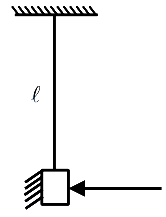
Force due to beam assuming complete reflection \(\mathrm{F}=\frac{2 \mathrm{P}}{\mathrm{C}}=\frac{2}{\mathrm{C}} \frac{\mathrm{dE}}{\mathrm{dt}} ; \mathrm{P}\) is power
So change in momentum of mirror.
\(\mathrm{m}(\mathrm{~V}-0)=\int \mathrm{Fdt}=\frac{2}{\mathrm{C}} \int \mathrm{dE}=\frac{2 \mathrm{E}}{\mathrm{C}}\)
Now using work energy theorem ...(1)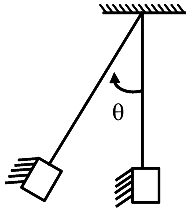
\(\begin{aligned}
& \mathrm{W}_{\mathrm{g}}=\Delta \mathrm{k} \\
& -\mathrm{mg} \ell(1-\cos \theta)=0-\frac{1}{2} \mathrm{mv}^2 \\
& \mathrm{~g} \ell\left(2 \sin ^2 \frac{\theta}{2}\right)=\frac{\mathrm{v}^2}{2}
\end{aligned}\)
as \(\theta\) is small
\(\begin{aligned} & \mathrm{g} \ell 2\left(\frac{\theta}{2}\right)^2=\frac{1}{2} \frac{4 \mathrm{E}^2}{\mathrm{~m}^2 \mathrm{c}^2} \\ & \mathrm{~g} \ell \theta^2=\frac{4 \mathrm{E}^2}{\mathrm{~m}^2 \mathrm{c}^2} \\ & \theta=\frac{2 \mathrm{E}}{\mathrm{mc} \sqrt{\mathrm{g} \ell}}\end{aligned}\) -
- (A) Visible radiation
- (B) Gamma rays
- (C) Infra-red radiation
- (D) X-rays
Show answer and solution
Correct Answer: (D)
\(\begin{aligned}
& \lambda=\frac{\mathrm{h}}{\mathrm{p}}=\frac{6.63 \times 10^{-34}}{10^{-30} \times 2.21 \times 10^6} \\
& =3 \times 10^{-10} \mathrm{~m}
\end{aligned}\)
Hence particle will behave as x-ray. -
- (A) 2
- (B) 4
- (C) 6
- (D) 8
Show answer and solution
Correct Answer: (A)
Let the momentum of \(\mathrm{e}^{-}\)at any time t is p and its de-broglie wavelength is \(\lambda\).
Then, \(\mathrm{p}=\frac{\mathrm{h}}{\lambda}\)
\(\begin{aligned}
& \frac{\mathrm{dp}}{\mathrm{dt}}=\frac{-\mathrm{h}}{\lambda^2} \frac{\mathrm{~d} \lambda}{\mathrm{dt}} \\
& \mathrm{ma}=\mathrm{F}=-\frac{\mathrm{h}}{\lambda} \frac{\mathrm{~d} \lambda}{\mathrm{dt}} \quad[\mathrm{~m}=\text { mass of } \mathrm{e}]
\end{aligned}\)
Where, -ve sign represents decrease in \(\lambda\) with time
\(\mathrm{ma}=\frac{-\mathrm{h}}{(\mathrm{~h} / \mathrm{p})^2} \frac{\mathrm{~d} \lambda}{\mathrm{dt}}\)
\(\begin{aligned}
& \mathrm{a}=-\frac{\mathrm{p}^2}{\mathrm{mh}} \frac{\mathrm{~d} \lambda}{\mathrm{dt}} \\
& \mathrm{a}=-\frac{\mathrm{mv}^2}{\mathrm{~h}} \frac{\mathrm{~d} \lambda}{\mathrm{dt}} \\
& \frac{\mathrm{~d} \lambda}{\mathrm{dt}}=-\frac{\mathrm{ah}}{\mathrm{mv}^2}...(1)
\end{aligned}\)
here, \(\mathrm{a}=\frac{\mathrm{qE}}{\mathrm{m}}=\frac{\mathrm{e}}{\mathrm{m}} \frac{\sigma}{2 \varepsilon_0}\)
\(\mathrm{a}=\frac{\sigma \mathrm{e}}{2 \mathrm{~m} \varepsilon_0}\)
and \(\mathrm{v}=\mathrm{u}+\mathrm{at}\)
\(\mathrm{v}=\mathrm{at}\)
Substituting values of a \& v in equation (1)
\(\begin{aligned}
& \frac{\mathrm{d} \lambda}{\mathrm{dt}}=-\frac{2 \mathrm{~h} \varepsilon_0}{\sigma \mathrm{et}^2} \\
& \Rightarrow \frac{\mathrm{~d} \lambda}{\mathrm{dt}} \propto \frac{1}{\mathrm{t}^2} \\
& \Rightarrow \mathrm{n}=2
\end{aligned}\) -
- (A) \(\frac{\lambda_0}{\sqrt{1+\frac{\mathrm{e}^2 \mathrm{E}_0{ }^2 \mathrm{t}^2}{\mathrm{~m}^2 \mathrm{v}_0{ }^2}}}\)
- (B) \(\lambda_{\mathrm{o}} \sqrt{1+\frac{\mathrm{e}^2 \mathrm{E}_0^2 \mathrm{t}^2}{\mathrm{~m}^2 \mathrm{v}_{\mathrm{o}}^2}}\)
- (C) \(\frac{\lambda_0}{\sqrt{1-\frac{\mathrm{e}^2 \mathrm{E}_{\mathrm{o}}{ }^2 \mathrm{t}^2}{\mathrm{~m}^2 \mathrm{v}_{\mathrm{o}}^2}}}\)
- (D) \(\lambda_0\)
Show answer and solution
Correct Answer: (A)
\(\begin{aligned} & \overrightarrow{\mathrm{v}}=\mathrm{v}_0 \hat{\mathrm{i}}-\frac{\mathrm{E}_0 \mathrm{e}}{\mathrm{m}} t \hat{\mathrm{k}} \\ & |\overrightarrow{\mathrm{v}}|=\sqrt{\mathrm{v}_0^2+\frac{\mathrm{E}_0^2 \mathrm{e}^2 \mathrm{t}^2}{\mathrm{~m}^2}} \\ & \lambda_0=\frac{\mathrm{h}}{\mathrm{mv}_0} \\ & \lambda^{\prime}=\frac{\mathrm{h}}{\mathrm{mv}_0 \sqrt{1+\frac{\mathrm{E}_0^2 \mathrm{e}^2 \mathrm{t}^2}{\mathrm{v}_0^2 \mathrm{~m}^2}}} \\ & \lambda^{\prime}=\frac{\lambda_0}{\sqrt{1+\frac{\mathrm{E}_0^2 \mathrm{e}^2 \mathrm{t}^2}{\mathrm{v}_0^2 \mathrm{~m}^2}}}\end{aligned}\) -
- (A) \(\frac{\lambda_0}{\sqrt{1-\frac{\mathrm{e}^2 \mathrm{~B}_0^2 \mathrm{t}^2}{\mathrm{~m}^2}}}\)
- (B) \(\frac{\lambda_0}{\sqrt{1+\frac{\mathrm{e}^2 \mathrm{~B}_0^2 \mathrm{t}^2}{\mathrm{~m}^2}}}\)
- (C) \(\lambda_0 \sqrt{1+\frac{\mathrm{e}^2 \mathrm{~B}_0^2 \mathrm{t}^2}{\mathrm{~m}^2}}\)
- (D) \(\lambda_0\)
Show answer and solution
Correct Answer: (D)
Magnetic field does not work
\(\therefore\) Speed will not charge, so De-Broglie wavelength remains same. -
- (A) (A) is false but (R) is true
- (B) (A) is true but (R) is false
- (C) Both \((\mathbf{A})\) and \((\mathbf{R})\) are true and \((\mathbf{R})\) is the correct explanation of \((\mathbf{A})\)
- (D) Both \((\mathbf{A})\) and \((\mathbf{R})\) are true but \((\mathbf{R})\) is not the correct explanation of \((\mathbf{A})\)
Show answer and solution
Correct Answer: (D)
Assertion (A) is true because a sufficiently negative potential can repel and stop the emitted electrons from leaving the surface.
Reason (R) is also true because the stopping potential \(V_{\text {stop }}\) varies linearly with the frequency \(\nu\) of the incident light \(\left(V_{\text {stop }}=\frac{h}{e} \nu-\frac{\phi}{e}\right)\).
However, (R) does not directly explain why a negative potential suppresses electron emission; it only shows how much potential is needed for different frequencies.
Therefore, both (A) and (R) are true, but (R) is not the correct explanation of (A). -
- (A) Both (A) and (R) are true and (R) is the correct explanation of \((\mathbf{A})\)
- (B) Both \((\mathbf{A})\) and \((\mathbf{R})\) are true but \((\mathbf{R})\) is not the correct explanation of \((\mathbf{A})\)
- (C) (A) is false but (R) is true
- (D) (A) is true but (\(\mathbf{R}\)) is false
Show answer and solution
Correct Answer: (C)
EM wave carry both energy and momentum. Rest mass of photon is zero. -
- (A) Both \(\mathrm{A}\) and \(\mathrm{R}\) are true but \(\mathrm{R}\) is NOT the correct explanation of \(\mathrm{A}\)
- (B) \(\mathrm{A}\) is false but \(\mathrm{R}\) is true
- (C) \(\mathrm{A}\) is true but \(\mathrm{R}\) is false
- (D) Both \(\mathrm{A}\) and \(\mathrm{R}\) are true and \(\mathrm{R}\) is the correct explanation of \(\mathrm{A}\)
Show answer and solution
Correct Answer: (B)
\(\mathrm{V}_{\mathrm{S}}=\frac{\mathrm{hv}-\phi}{\mathrm{e}}\)
so stopping potential doesn't depend on Intensity
\(\mathrm{I}=\frac{\eta \mathrm{hv}}{\mathrm{~A}}\)
On increasing intensity no. of photons per sec. \(n\) increases so the no. of electrons. -
- (A) increases with increase in the intensity of the incident light
- (B) decreases with increase in the intensity of the incident light
- (C) increases with increase in the wavelength of the incident light
- (D) is \(\left(\frac{1}{\mathrm{e}}\right)\) times the maximum kinetic energy of the emitted photoelectrons
Show answer and solution
Correct Answer: (D)
From Einstein photoelectric equation
\(\frac{h c}{\lambda}=\phi+e V_S\)
Maximum K.E. \(=(\mathrm{K})_{\max }=e V s\)
So, \(V_S=\frac{(\mathrm{K})_{\max }}{e}\) -
- (A) 300 nm
- (B) 400 nm
- (C) 600 nm
- (D) 200 nm
Show answer and solution
Correct Answer: (A)
\(\begin{aligned}
& \phi=2.14 \\
& V_S=2 \mathrm{~V}
\end{aligned}\)
Using photoelectric equation.
\(\begin{aligned}
& \frac{h c}{\lambda}=2.14+2=4.14 \mathrm{eV} \\
& \lambda=\frac{1242}{4.14}=300 \mathrm{~nm}
\end{aligned}\) -
- (A) (C) and (D) only
- (B) (A), (C) and (E) only
- (C) (A), (B) and (C) only
- (D) (D) and (E) only
Show answer and solution
Correct Answer: (B)
\(\begin{aligned}
& \mathrm{hv}=\phi+\mathrm{KE}_{\max } \\
& \mathrm{KE}_{\max }=\mathrm{eV}_0 \\
& \mathrm{~V}_0=\frac{\mathrm{hv}-\phi}{\mathrm{e}}
\end{aligned}\)
(A) \(\mathrm{V}_0 \mathrm{v} / \mathrm{s} \mathrm{V}\) is linear correct
(B) Slope
\(\mathrm{v}_0=\left(\frac{\mathrm{h}}{\mathrm{e}}\right) \mathrm{v}-\frac{\phi}{\mathrm{e}} \text { Wrong }\)
Slope \(\frac{h}{e}\)
(C) Correct
(D) Incorrect
(E) Correct - 16. The radiation pressure exerted by a 450 W light source on a perfectly reflecting surface placed at 2 m away from it, is : 2025 Medium
- (A) \(1.5 \times 10^{-8}\) Pascals
- (B) 0
- (C) \(6 \times 10^{-8}\) Pascals
- (D) \(3 \times 10^{-8}\) Pascals
Show answer and solution
Correct Answer: (C)
\(P_{\mathrm{rad}}=\frac{2 I}{\mathrm{C}}\)
Where \(\mathrm{I}=\) intensity at surface
\(\mathrm{C}=\) Speed of light
\(\begin{aligned}
& I=\frac{\text { Power }}{\text { Area }}=\frac{450}{4 \pi \mathrm{r}^2} \\
& =\frac{450}{4 \pi \times 4}=\frac{450}{16 \pi} \\
& P_{\mathrm{rad}}=\frac{2 \times 450}{16 \pi \times 3 \times 10^8}=\frac{150}{8 \pi \times 10^8}
\end{aligned}\)
\(=5.97 \times 10^{-8} \approx 6 \times 10^{-8}\) Pascals -
- (A) 10
- (B) 5
- (C) 15
- (D) 20
Show answer and solution
Correct Answer: (B)
Since power emitting by a source is given as
\(\begin{aligned}
& =\frac{\text { Total energy emitted }}{\text { time }} \\
& =\frac{\left(E_1 \text { photon }\right) \times \text { Number of photons }(N)}{t} \\
& P_1=\left(E_1\right) n
\end{aligned}\)
\(\begin{aligned}
& \frac{\mathrm{P}_1}{\mathrm{P}_2}=\frac{\left(\mathrm{E}_1\right) \mathrm{n}_1}{\left(\mathrm{E}_2\right) \mathrm{n}_2}=\frac{\left(\frac{\mathrm{hC}}{\lambda_1}\right) \mathrm{n}_1}{\left(\frac{\mathrm{hC}}{\lambda_2}\right) \mathrm{n}_2} \\
& \frac{\mathrm{P}_1}{\mathrm{P}_2}=\left(\frac{\lambda_2}{\lambda_1}\right) \frac{\mathrm{n}_1}{\mathrm{n}_2}
\end{aligned}\)
Substituting the given values
\(\begin{aligned}
& 2=\left(\frac{300}{600}\right) \times \frac{2 \times 10^{15}}{\mathrm{n}_2} \\
& \mathrm{n}_2=\frac{1}{2} \times 10^{15}=5 \times 10^{14} \text { Photon } / \mathrm{sec}
\end{aligned}\) -
- (A) Green
- (B) Blue
- (C) Red
- (D) Yellow
Show answer and solution
Correct Answer: (B)
\(\begin{aligned}
& (\mathrm{KE})_{\max }=\frac{\mathrm{hc}}{\lambda}-\phi \\
& \frac{\mathrm{hc}}{\lambda} \gt \phi[\text { for emission }] \\
& \lambda \lt \frac{\mathrm{hc}}{\phi} \Rightarrow \lambda \lt \frac{1242}{3} \mathrm{~nm}
\end{aligned}\)
So blue light option (B) -
- (A) Both Cs and Li
- (B) Neither Cs nor Li
- (C) Cs only
- (D) Li only
Show answer and solution
Correct Answer: (C)
\(E=\frac{1240 \mathrm{eV} \cdot \mathrm{~nm}}{550 \mathrm{~nm}}=2.25 \mathrm{eV}\)
Possible for \(C_s\) as \(E > \phi_{c s}\)
Not for Li as \(E < \phi_{L i}\) -
- (A) Compton effect
- (B) Refraction of light
- (C) Reflection of light
- (D) Diffraction of light
Show answer and solution
Correct Answer: (A)
Compton effect refers to scattering of a photon by free electrons. This phenomenon provides an evidence for particle nature of light.
No questions on this page match these filters.