


Questions
14 questionsShowing 1–14 of 14 questions
-
- (A) \(4\)
- (B) \(8.4\)
- (C) \(2\)
- (D) \(6.2\)
Show answer and solution
Correct Answer: (C)
\(\begin{aligned} & P_{\text {input }}=V i=100 \mathrm{~W} \\ & \eta=\frac{P_{\text {out }}}{P_{\text {input }}}=0.916\end{aligned}\)
\(\begin{aligned} & P_{\text {out }}=91.6 \mathrm{~W} \\ & \text { Loss }=100-91.6=8.4 \mathrm{~J} / \mathrm{s}=2 \mathrm{cal} / \mathrm{s}\end{aligned}\) -
- (A) 1400
- (B) 1600
- (C) 1200
- (D) 1000
Show answer and solution
Correct Answer: (C)
\(i_d=i_c\)
\(\therefore\) Total displacement current \(=6 \mathrm{~A}\)
Through \(A_0\)
\(\begin{aligned}
& i=\left(\frac{A_0}{A}\right) 6 \\
& =\frac{3.2}{16} \times 6=1.2 \mathrm{~A}=1200 \mathrm{~mA}
\end{aligned}\) -
- (A) \(12.5 \Omega\)
- (B) \(50 \Omega\)
- (C) \(100 \Omega\)
- (D) \(25 \Omega\)
Show answer and solution
Correct Answer: (D)
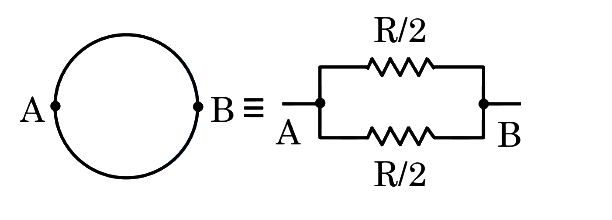
\(\begin{aligned}
& \mathrm{L}=25 \mathrm{~m}, \mathrm{~A}=5 \mathrm{~mm}^2=5 \times 10^{-6} \mathrm{~m}^2 \\
& \rho=2 \times 10^{-6} \Omega \mathrm{~m} \\
& \mathrm{R}_{\text {wire }}=\frac{\rho \mathrm{L}}{\mathrm{~A}}=\frac{2 \times 10^{-6} \times 25}{5 \times 10^{-6}}=10 \\
& \mathrm{R}_{\mathrm{eq}}=\frac{\mathrm{R}}{4}=\frac{10}{4}=2.5 \Omega
\end{aligned}\)
Answer does not match with NTA option. -
- (A) 4
- (B) 6
- (C) 8
- (D) 2
Show answer and solution
Correct Answer: (D)
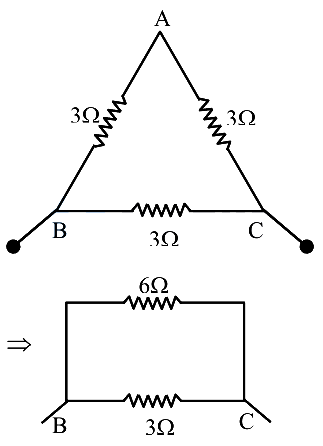
\(9 \Omega\) is the resistance of whole wire
\(\therefore\) resistance of each wire \(=3 \Omega\).
\(\therefore\) Equivalent resistance \(=2 \Omega\) -
- (A) 16
- (B) 14
- (C) 10
- (D) 12
Show answer and solution
Correct Answer: (D)
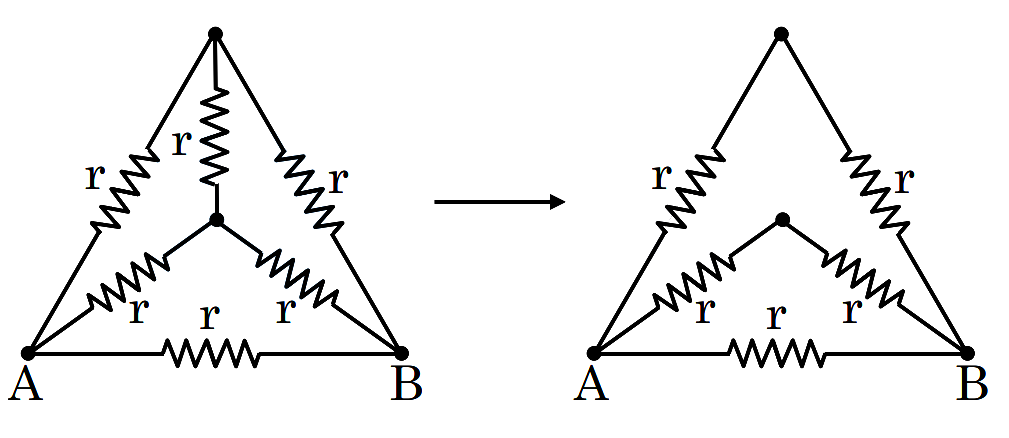
Explanation:
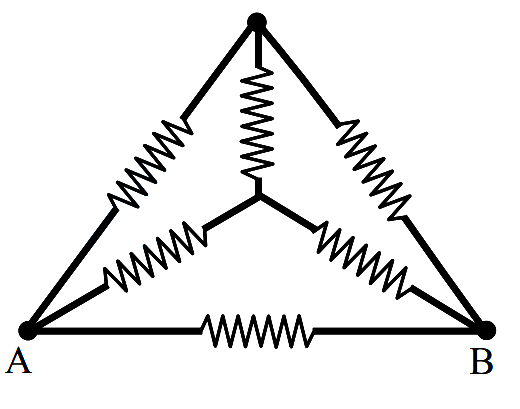
The equivalent resistance of the pyramidal wire framework can be evaluated using circuit symmetry:
1. Resistance of Each Segment: A triangular pyramid (tetrahedron) consists of exactly 6 identical edges. Since a single continuous wire of total resistance \( R \) is uniformly divided to form these 6 segments, the resistance \( r \) of each individual segment is given by:
\( r = \frac{R}{6} \)
2. Symmetry of the Circuit: When measuring the equivalent resistance across vertices \( A \) and \( B \), the remaining two vertices form a balanced bridge. Due to the symmetrical distribution of the resistors, these two intermediate nodes sit at the exact same electrical potential.
3. Circuit Simplification: Because no potential difference exists between the two intermediate nodes, no electrical current flows through the resistor connecting them. Removing this inactive branch simplifies the network into three parallel paths connected across terminals \( A \) and \( B \):
- One direct branch of resistance \( r \)
- Two separate series branches, each with a total resistance of \( r + r = 2r \)
4. Equivalent Resistance Calculation: Combining these three parallel paths gives:
\( \frac{1}{R_{AB}} = \frac{1}{2r} + \frac{1}{2r} + \frac{1}{r} = \frac{1}{r} + \frac{1}{r} = \frac{2}{r} \)
\( R_{AB} = \frac{r}{2} \)
5. Substituting the Value of r:
\( R_{AB} = \frac{\left(\frac{R}{6}\right)}{2} = \frac{R}{12} \)
Comparing \( \frac{R}{12} \) with the given expression \( \frac{R}{n} \) yields \( n = 12 \).
Hence, Option D is the correct choice. -
- (A) 8/9
- (B) \(27 / 32\)
- (C) \(32 / 27\)
- (D) \(9 / 8\)
Show answer and solution
Correct Answer: (C)
For the wire bent into an equilateral triangle, each side has a resistance \(\frac{R}{3}\).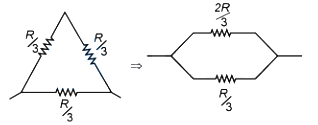
\(R_{\text {eq }}=\frac{\left(\frac{2 R}{3}\right)\left(\frac{R}{3}\right)}{\frac{2 R}{3}+\frac{R}{3}}=\frac{2 R}{9}=R_1\) (lets say)
For the wire bent into a square, each side has a resistance \(\frac{R}{4}\).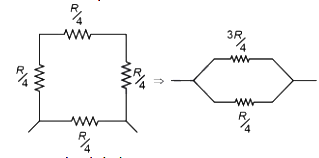
\(\begin{aligned} & R_{\text {eq }}=\frac{\left(\frac{3 R}{4}\right)\left(\frac{R}{4}\right)}{\frac{3 R}{4}+\frac{R}{4}}=\frac{3 R}{16}=R_3 \text { (lets say) } \\ & \Rightarrow \frac{R_1}{R_3}=\frac{\frac{2 R}{9}}{\frac{3 R}{16}}=\frac{32}{27}\end{aligned}\) -
- (A) 0.06 C
- (B) 0.02 C
- (C) 0.07 C
- (D) 0.04 C
Show answer and solution
Correct Answer: (D)
\(\begin{aligned} & \mathrm{q}=\int \mathrm{idt} \\ & \int_0^2(0.02 \mathrm{t}+0.01) \mathrm{dt}\end{aligned}\)
\(\begin{aligned} & \mathrm{q}=\left[0.02 \frac{\mathrm{t}^2}{2}+0.01 \mathrm{t}\right]_1^2 \\ & =0.01(3)+0.01(1) \\ & =0.04 \mathrm{C}\end{aligned}\) -
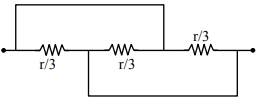
- (A) \(\frac{r}{9}\)
- (B) \(\frac{\mathrm{r}}{3}\)
- (C) r
- (D) \(\frac{\mathrm{r}}{6}\)
Show answer and solution
Correct Answer: (A)
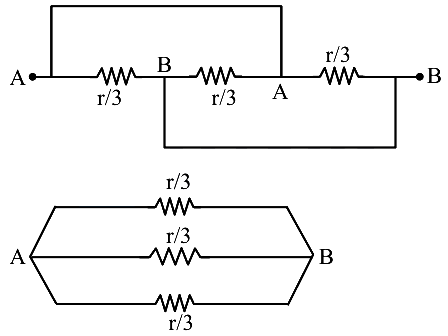
All are in parallel
\(\mathrm{R}_{\mathrm{eq}}=\frac{\mathrm{r} / 3}{3}=\mathrm{r} / 9\) -
- (A) Both Statement-I and Statement-II are false
- (B) Statement-I is false but Statement-II is true
- (C) Both Statement-I and Statement-II are true
- (D) Statement-I is true but Statement-II is false
Show answer and solution
Correct Answer: (B)
In parallel connections
\(\begin{aligned}
& \frac{1}{r_{\mathrm{eq}}}=\frac{1}{r_1}+\frac{1}{r_2} \\
& \frac{E_{\mathrm{eq}}}{r_{\mathrm{eq}}}=\frac{E_1}{r_1}+\frac{E_2}{r_2}
\end{aligned}\)
If \(E_1=E_2\) and \(r_1=r_2, E_{\text {eq }}=E_1=E_2\)
\(\therefore\) Statement 1 is false.
\(r_{\text {eq }}\) is less then both \(r_1\) and \(r_2\)
\(\therefore\) Statement II is true -
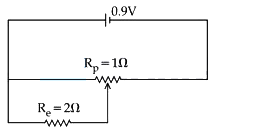
- (A) 0.9 A
- (B) 1.35 A
- (C) 0.3 A
- (D) 1.0 A
Show answer and solution
Correct Answer: (D)
The circuit can be considered as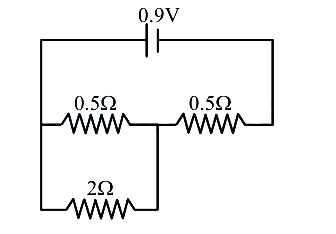
\(\begin{aligned} & \therefore \mathrm{R}_{\text {eq }}=0.5+\frac{0.5 \times 2}{2+0.5}=\left(\frac{5}{10}+\frac{10}{25}\right) \Omega \\ & =\frac{45}{50}=\frac{9}{10}=0.9 \\ & \therefore \mathrm{i}=\frac{0.9}{0.9}=1 \mathrm{~A}\end{aligned}\) -
- (A) high thermal conductivity and high electrical conductivity
- (B) low thermal conductivity and low electrical conductivity
- (C) high thermal conductivity and low electrical conductivity
- (D) low thermal conductivity and high electrical conductivity
Show answer and solution
Correct Answer: (D)
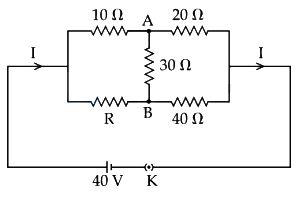
Material should have low thermal conductivity and high electrical conductivity. - 12. The value of current I in the electrical circuit as given below, when potential at A is equal to the potential at B, will be ____ A.
 2025 Medium
- (A) 2
- (B) 10
- (C) 15
- (D) 4
Show answer and solution
Correct Answer: (A)
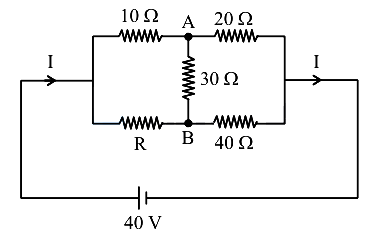
\(\begin{aligned} & \mathrm{V}_{\mathrm{A}}=\mathrm{V}_{\mathrm{B}} \Rightarrow \text { the bridge is balanced } \\ & \Rightarrow \frac{10}{\mathrm{R}}=\frac{20}{40} \\ & \mathrm{R}=20 \Omega \\ & \mathrm{I}=\frac{40}{20}=2 \mathrm{~A}\end{aligned}\) -
- (A) np
- (B) \(\frac{\mathrm{p}}{\mathrm{n}^2}\)
- (C) \(\frac{\mathrm{p}}{\mathrm{n}}\)
- (D) p
Show answer and solution
Correct Answer: (C)
\(\begin{aligned} & R_s=R_1+R_2+R_3+\ldots \ldots..+R_n \\ & \frac{V^2}{P_s}=\frac{V^2}{P}+\frac{V^2}{P}+\ldots \ldots.+\frac{V^2}{P_n} \\ & P_s=\frac{P}{n}\end{aligned}\) -
- (A) 4
- (B) 6
- (C) 8
- (D) 10
Show answer and solution
Correct Answer: (A)
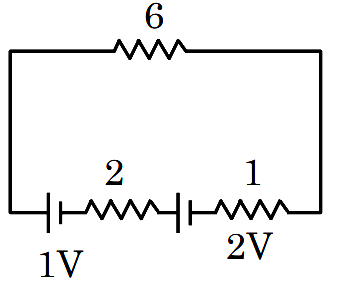
\(\begin{aligned} & \varepsilon_{\mathrm{eq}}=3 \\ & \mathrm{R}_{\mathrm{eq}}=9 \\ & \mathrm{i}_1=\frac{3}{9}=\frac{1}{3}\end{aligned}\)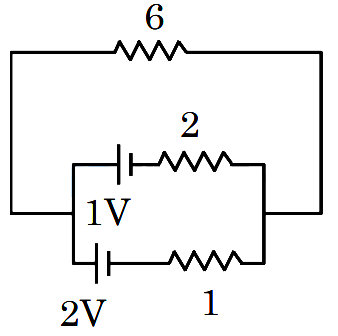
\(\varepsilon_{\mathrm{eq}}=\frac{\frac{\varepsilon_1}{\mathrm{r}_1}+\frac{\varepsilon_2}{\mathrm{r}_2}}{\frac{1}{\mathrm{r}_1}+\frac{1}{\mathrm{r}_2}}\)
\(\varepsilon_{\mathrm{eq}}=\frac{\frac{1}{2}+\frac{2}{1}}{\frac{1}{2}+\frac{1}{1}}=\frac{5}{3}\)
\(\begin{aligned} & \mathrm{r}_{\text {equ }}=\frac{2 \times 1}{3}+6=\frac{20}{3} \\ & \mathrm{i}_2=\frac{1}{4} \Rightarrow \frac{\mathrm{i}_1}{\mathrm{i}_2}=\frac{4}{3}\end{aligned}\)
No questions on this page match these filters.