


All JEE Mains 2025 Physics questions
32 chaptersShowing 101–150 of 454 questions
-
- (A) Both \((\mathbf{A})\) and \((\mathbf{R})\) are true but \((\mathbf{R})\) is not the correct explanation of \((\mathbf{A})\)
- (B) Both \((\mathbf{A})\) and \((\mathbf{R})\) are true and \((\mathbf{R})\) is the correct explanation of \((\mathbf{A})\)
- (C) (A) is true but (R) is false
- (D) \((A)\) is false but (R) is true
Show answer and solution
Correct Answer: (B)
\(\beta(\text { fringe width })=\frac{\lambda D}{d}\)
In denser medium, \(\lambda \downarrow \Rightarrow \beta \downarrow\) \(\Rightarrow\) fringe come closer
Also, \(\mu=\frac{\mathrm{c}}{\mathrm{V}} \Rightarrow \mathrm{V}=\frac{\mathrm{c}}{\mu}\)
Frequency remains same,
\(\Rightarrow \mu=\frac{\lambda_{\mathrm{vac} .} \mathrm{f}}{\lambda_{\mathrm{med}} \mathrm{f}} \Rightarrow \lambda_{\mathrm{med}}=\frac{\lambda_{\mathrm{vac} .}}{\mu}\) -
- (A) Both \((\mathbf{A})\) and \((\mathbf{R})\) are true but \((\mathbf{R})\) is NOT the correct explanation of \((\mathbf{A})\)
- (B) (A) is true but (R) is false
- (C) Both (A) and (R) are true and (R) is the correct explanation of (A)
- (D) (A) is false but (R) is true
Show answer and solution
Correct Answer: (D)
\(\begin{aligned}
& \beta=\frac{\lambda D}{d} \\
& \lambda_{\text {red }} < \lambda_{\text {blue }}
\end{aligned}\)
Assertion is false.
Reason is true. -
- (A) 6
- (B) 8
- (C) 10
- (D) 12
Show answer and solution
Correct Answer: (A)
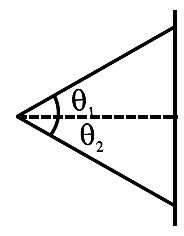
\(\begin{aligned} & \theta_1=\sin ^{-1}\left(\frac{2 \lambda}{a}\right) \\ & \theta_2=\sin ^{-1}\left(\frac{3 \lambda}{a}\right) \\ & \because \quad \theta_1+\theta_2=30^{\circ}\end{aligned}\)
\(\begin{aligned} & \Rightarrow \sin ^{-1}\left(\frac{2 \lambda}{\mathrm{a}}\right)+\sin ^{-1}\left(\frac{3 \lambda}{\mathrm{a}}\right)=\frac{\pi}{6} \\ & \Rightarrow \frac{2 \lambda}{\mathrm{a}} \sqrt{1-\left(\frac{3 \lambda}{\mathrm{a}}\right)^2}+\frac{3 \lambda}{\mathrm{a}} \sqrt{1+\left(\frac{2 \lambda}{\mathrm{a}}\right)^2}=\sin \frac{\pi}{6}\end{aligned}\)
Here \(\lambda=628 \mathrm{~nm}\)
After solving
\(\mathrm{A}=6.07 \mu \mathrm{~m}\)
Approximate Method :
\(\begin{aligned} & \theta=\theta_1+\theta_2 \\ & \Rightarrow \frac{\pi}{6}=\frac{2 \lambda}{a}+\frac{3 \lambda}{a} \\ & \Rightarrow \frac{\pi}{6}=\frac{5}{a}(628 \mathrm{~nm}) \\ & \Rightarrow a=6 \mu \mathrm{~m}\end{aligned}\) -
- (A) \(0 \%\)
- (B) \(100 \%\)
- (C) \(50 \%\)
- (D) \(25 \%\)
Show answer and solution
Correct Answer: (C)
\(\beta=\frac{\mathrm{D} \lambda}{\mathrm{~d}} \propto \frac{1}{\mathrm{~d}}\)
If d is doubled then \(\beta\) is half so \(50 \%\) decrement. - 105. In a Young's double slit experiment, the source is white light. One of the slits is covered by red filter and another by a green filter. In this case... 2025 Medium
- (A) There shall be an interference pattern for red distinct from that for green.
- (B) There shall be no interference fringes.
- (C) There shall be alternate interference fringes of red and green.
- (D) There shall be an interference pattern, where each fringe's pattern center is green and outer edges is red.
Show answer and solution
Correct Answer: (B)
Different colours will have different fringe width. Within a few fringes of red, there will be several fringes of violet.
Also, there will be overlapping of colours. -
- (A) \(\frac{I_0}{2}\)
- (B) \(\frac{I_0}{4}\)
- (C) \(\frac{\mathrm{I}_0}{3}\)
- (D) \(I_0\)
Show answer and solution
Correct Answer: (B)
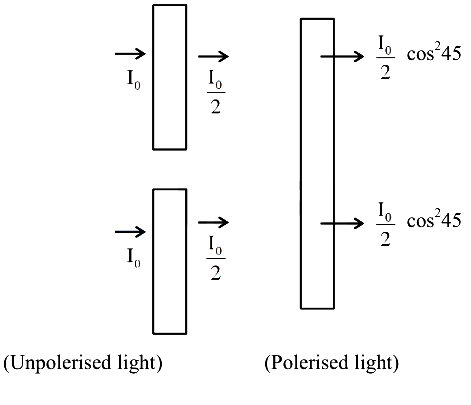
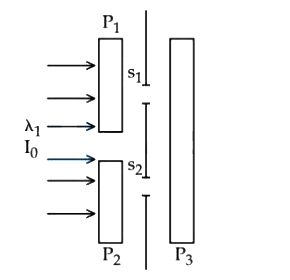
after passing through third poleriser, Intensity of both the waves must be \(\frac{\mathrm{I}_0}{4}\)
now, at a point where path diff is \(\frac{\lambda}{3}\), phase difference
\(\begin{aligned}
& \Delta \phi=2 \mathrm{~K}\left(\frac{\Delta \mathrm{x}}{\lambda}\right)=\frac{2 \pi}{3} \\
& \therefore \mathrm{I}_{\mathrm{res}}=\sqrt{\left(\frac{\mathrm{I}_0}{4}\right)^2+\left(\frac{\mathrm{I}_0}{4}\right)^2+2\left(\frac{\mathrm{I}_0}{4}\right)^2} \cos \frac{2 \pi}{3} \\
& =\frac{\mathrm{I}_0}{4}
\end{aligned}\) -
- (A) 15
- (B) 20
- (C) 25
- (D) 30
Show answer and solution
Correct Answer: (A)
Width of 20 maxima of double slit \(=\) width of central maxima of single slit
\(\begin{aligned}
& \frac{20 \lambda \mathrm{D}}{\mathrm{~d}}=\frac{2 \lambda \mathrm{D}}{\mathrm{a}} \\
& \frac{10}{\mathrm{~d}}=\frac{1}{\mathrm{a}} \\
& \mathrm{a}=\frac{\mathrm{d}}{10}=\frac{1.5 \times 10^{-1}}{10} \mathrm{~cm}=15 \times 10^{-3} \mathrm{~cm}
\end{aligned}\)
Value of \(x\) is 15
Answer is 15 -
- (A) 4
- (B) 5
- (C) 3
- (D) 2
Show answer and solution
Correct Answer: (B)
\(\begin{aligned} & \mathrm{I} \propto(\text { width })^2 \\ & \left(\frac{\sqrt{\mathrm{I}_1}+\sqrt{\mathrm{I}_2}}{\sqrt{\mathrm{I}_1}-\sqrt{\mathrm{I}_2}}\right)^2=\frac{9}{4} \\ & \frac{\sqrt{\mathrm{I}_1}+\sqrt{\mathrm{I}_2}}{\sqrt{\mathrm{I}_1}-\sqrt{\mathrm{I}_2}}=\frac{3}{2} \\ & \frac{(\mathrm{x}+1) \mathrm{d}}{(\mathrm{x}-1) \mathrm{d}}=\frac{3}{2} \\ & \Rightarrow 3 \mathrm{x}-3=2 \mathrm{x}+2 \\ & \mathrm{x}=5\end{aligned}\) -
- (A) \(5\)
- (B) \(4\)
- (C) \(6\)
- (D) \(8\)
Show answer and solution
Correct Answer: (A)
\(\begin{aligned}
& \frac{n_1 \lambda_1 D}{d}=\frac{n_2 \lambda_2 D}{d} \\
& n 480=m 600 \\
& n_{\min }=5
\end{aligned}\) -
- (A) 22
- (B) 24
- (C) 26
- (D) 28
Show answer and solution
Correct Answer: (B)
\(\begin{aligned} & \mathrm{I}_{\max }=\left(\sqrt{\mathrm{I}_1}+\sqrt{\mathrm{I}_2}\right)^2 \\ & =(\sqrt{4 \mathrm{I}}+\sqrt{9 \mathrm{I}})^2=25 \mathrm{I} \\ & \mathrm{I}_{\min }=\left(\sqrt{\mathrm{I}_1}-\sqrt{\mathrm{I}_2}\right)^2 \\ & =(\sqrt{4 \mathrm{I}}-\sqrt{9 \mathrm{I}})^2=\mathrm{I} \\ & \mathrm{I}_{\max }-\mathrm{I}_{\min }=24 \mathrm{I} \\ & \mathrm{x}=24\end{aligned}\) -
- (A) \(8: 1\)
- (B) \(9: 1\)
- (C) \(3: 1\)
- (D) \(4: 1\)
Show answer and solution
Correct Answer: (D)
\(\frac{I_{\max }}{I_{\min }}=\frac{\left(\sqrt{I_1}+\sqrt{I_2}\right)^2}{\left(\sqrt{I_1}-\sqrt{I_2}\right)^2} \Rightarrow \frac{(4)^2}{(2)^2} \Rightarrow \frac{16}{4}=4\) -
- (A) 0.9 E
- (B) \(\mathrm{E}_0\)
- (C) \(1.7 \mathrm{E}_0\)
- (D) \(3.4 \mathrm{E}_0\)
Show answer and solution
Correct Answer: (C)
\(\mathrm{E}=\sqrt{\left(\mathrm{E}_0\right)^2+\left(\mathrm{E}_0\right)^2+2\left(\mathrm{E}_0\right)\left(\mathrm{E}_0\right) \cos \frac{\pi}{3}}\)
\(\mathrm{E}=\sqrt{2 \mathrm{E}_0^2+\mathrm{E}_0^2}=\sqrt{3} \mathrm{E}_0=1.73 \mathrm{E}_0\) -
- (A) \(\frac{\pi}{4}\)
- (B) \(\frac{\pi}{6}\)
- (C) \(\frac{\pi}{8}\)
- (D) \(\frac{\pi}{3}\)
Show answer and solution
Correct Answer: (A)
Through \(P_2 I_1=I_0 \sin ^2\left(\frac{\pi}{2}-\theta\right)\)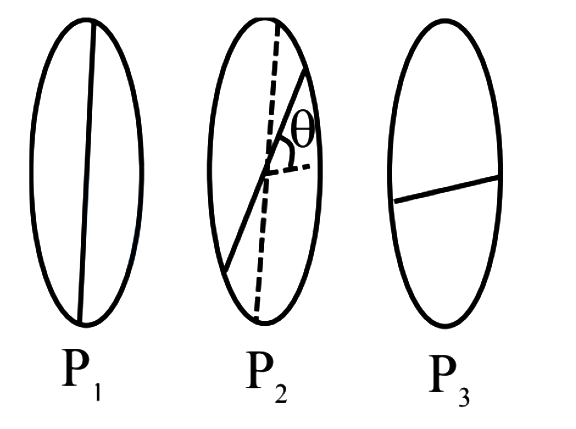
\(I_1=I_0 \cos ^2 \theta\)
Through \(P_3 I_{\text {net }}=\left(I_0 \cos ^2 \theta\right) \sin ^2 \theta\)
\(I_{n c t}=\frac{I_0}{4}[\sin (2 \theta)]^2 \text { for max } I_{\text {net }} \theta=45^{\circ}\)
So angle between \(P_2\) and \(P_3=\frac{\pi}{4}\)
Correct Ans. (1) -
- (A) \((2 \sqrt{2}+1):(2 \sqrt{2}-1)\)
- (B) \((3+2 \sqrt{2}):(3-2 \sqrt{2})\)
- (C) \(9: 1\)
- (D) \(3: 1\)
Show answer and solution
Correct Answer: (B)
\(\mathrm{I} \propto\) width \(\quad\quad \mathrm{I}_{\max }=\left(\sqrt{\mathrm{I}_1}+\sqrt{\mathrm{I}_2}\right)^2\)
\(\therefore \mathrm{I}_1=\mathrm{I}_0, \mathrm{I}_2=2 \mathrm{I}_0 \quad\quad \mathrm{I}_{\min }=\left(\sqrt{\mathrm{I}_1}-\sqrt{\mathrm{I}_2}\right)^2\)
\(\frac{I_{\max }}{I_{\min }}=\frac{(\sqrt{2}+1)^2}{(\sqrt{2}-1)^2} \Rightarrow \frac{3+2 \sqrt{2}}{3-2 \sqrt{2}}\) -
- (A) 0.23 mm
- (B) 0.33 mm
- (C) 0.63 mm
- (D) 0.46 mm
Show answer and solution
Correct Answer: (A)
\(\begin{aligned} & \Delta W=\frac{\lambda D}{d \cdot \mu}=\frac{690 \times 10^{-9} \times 0.72}{1.5 \times 10^{-3} \times 1.44} \\ & \Rightarrow \Delta W=2.3 \times 10^{-4} \mathrm{~m}=0.23 \mathrm{~mm}\end{aligned}\) -
- (A) \(\frac{1}{3} \mathrm{~cm}\) and \(\frac{1}{3} \mathrm{~cm}\)
- (B) \(\frac{1}{5} \mathrm{~cm}\) and \(\frac{1}{7} \mathrm{~cm}\)
- (C) \(\frac{1}{3} \mathrm{~cm}\) and \(\frac{1}{7} \mathrm{~cm}\)
- (D) \(\frac{1}{6} \mathrm{~cm}\) and \(\frac{1}{9} \mathrm{~cm}\)
Show answer and solution
Correct Answer: (B)
This will happen when
\(\begin{aligned}
& \frac{1}{\mathrm{f}_1}=\frac{1}{\mathrm{f}_2} \\
& (\mu-1)\left(\frac{1}{\mathrm{R}_1}-\frac{1}{-\mathrm{R}_2}\right)=(\mu-1)\left(\frac{2}{\mathrm{R}}\right) \\
& \frac{1}{\mathrm{R}_1}+\frac{1}{\mathrm{R}_2}=\frac{2}{\mathrm{R}}
\end{aligned}\) -
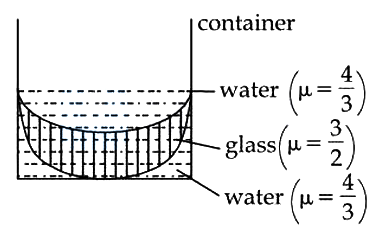
- (A) \(\frac{500}{11} \mathrm{~cm}\)
- (B) \(\frac{800}{11} \mathrm{~cm}\)
- (C) \(\frac{700}{11} \mathrm{~cm}\)
- (D) \(\frac{600}{11} \mathrm{~cm}\)
Show answer and solution
Correct Answer: (D)
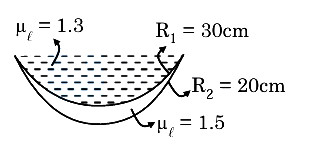
\(\begin{aligned} \frac{1}{\mathrm{f}} & =\left(\frac{1.3-1}{1}\right)\left(\frac{1}{\infty}-\frac{1}{-30}\right) \\ & =\left(\frac{1.5-1}{1}\right)\left(\frac{1}{-30}-\frac{1}{-30}\right) \\ & =\frac{0.3}{30}+\frac{0.5}{60}=\frac{1}{100}+\frac{1}{120} \\ & =\frac{6+5}{600}=\frac{11}{600} \\ \mathrm{f} & =\frac{600}{11} \mathrm{~cm}\end{aligned}\) - 118. A concave mirror of focal length \(f\) in air is dipped in a liquid of refractive index \(\mu\). Its focal length in the liquid will be: 2025 Medium
- (A) \(\mu f\)
- (B) \(f\)
- (C) \(\frac{f}{(\mu-1)}\)
- (D) \(\frac{f}{\mu}\)
Show answer and solution
Correct Answer: (B)
Focal length of mirror will not change because focal length of mirror doesn't depend on medium. -
- (A) \(30\mathrm{~cm}\)
- (B) \(3.75\mathrm{~cm}\)
- (C) \(15\mathrm{~cm}\)
- (D) \(7.5\mathrm{~cm}\)
Show answer and solution
Correct Answer: (C)
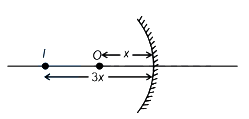
\(\begin{aligned} & m=-3=-\frac{u}{v} \\ & u=-x \\ & v=-3 x \\ & \Rightarrow 2 x=20 \mathrm{~cm}\end{aligned}\)
\(\begin{aligned} & x=10 \mathrm{~cm} \\ & f=\frac{u V}{u+V}=\frac{(-10)(-30)}{(-10)+(-30)}=-7.5 \mathrm{~cm} \\ & f=-\frac{R}{2} \\ & R=-2 f=15 \mathrm{~cm}\end{aligned}\) -
- (A) 100
- (B) 90
- (C) 80
- (D) 70
Show answer and solution
Correct Answer: (C)
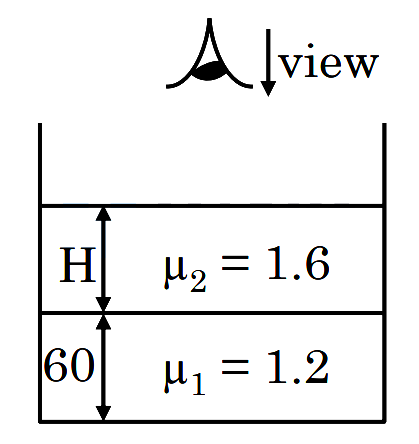
\(y=\) apparent depth of bottom
\(\frac{\mathrm{y}}{1}=\frac{\mathrm{H}}{1.6}+\frac{60}{1.2}\)
Shift \(=40\)
\(H+60-y=40\)
\(\mathrm{H}+60-\frac{\mathrm{H}}{1.6}-\frac{60}{1.2}=40\)
\(\frac{6}{16} \mathrm{H}=30\)
\(\mathrm{H}=80 \mathrm{~cm}\) -
- (A) 24 cm
- (B) 96 cm
- (C) 48 cm
- (D) 72 cm
Show answer and solution
Correct Answer: (B)
\(\begin{aligned}
& \frac{1}{8}=\left(\frac{\mu_{\ell}}{\mu_{\mathrm{s}}}-1\right)\left[\frac{1}{\mathrm{R}_1}-\frac{1}{\mathrm{R}_2}\right] \\
& \frac{1}{24}=(1.5-1)\left[\frac{2}{\mathrm{R}}\right] ...(i)\\
& \frac{1}{\mathrm{f}^{\prime}}=\left(\frac{1.5}{1.33}-1\right)\left(\frac{2}{\mathrm{R}}\right) \\
& \frac{1}{\mathrm{f}^{\prime}}=\left(\frac{1.5 \times 3}{4}-1\right) \frac{2}{\mathrm{R}}...(ii)
\end{aligned}\)
(i) divided by (ii)
\(\begin{aligned}
& \frac{\mathrm{f}^{\prime}}{24}=4 \\
& \mathrm{f}^{\prime}=96 \mathrm{~cm}
\end{aligned}\) -
- (A) 30
- (B) 45
- (C) \(\frac{60}{7}\)
- (D) 15
Show answer and solution
Correct Answer: (D)
Equivalent focal length
\(\begin{aligned}
& \frac{1}{f}=\frac{1}{f_1}+\frac{1}{f_2} \\
& =\frac{1}{30}+\frac{1}{-20}=\frac{2-3}{60}=-\frac{1}{60} \\
& f=-60 \mathrm{~cm}
\end{aligned}\)
Lens formula
\(\begin{aligned}
& \frac{1}{\mathrm{v}}-\frac{1}{\mathrm{u}}=\frac{1}{\mathrm{f}} \\
& \frac{1}{\mathrm{v}}-\frac{1}{-20}=\frac{1}{-60} \\
& \mathrm{v}=-15 \mathrm{~cm}
\end{aligned}\) -
- (A) 45 cm
- (B) 7.5 cm
- (C) 22.5 cm
- (D) 15 cm
Show answer and solution
Correct Answer: (B)
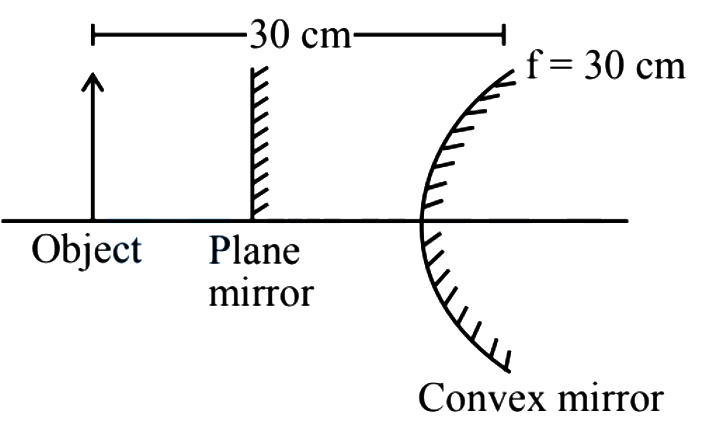
For Convex mirror
\(\begin{aligned}
& \frac{1}{\mathrm{v}}+\frac{1}{\mathrm{u}}=\frac{1}{\mathrm{f}} \\
& \frac{1}{\mathrm{v}}-\frac{1}{30}=\frac{1}{30} \\
& \frac{1}{\mathrm{v}}=\frac{2}{30}=\frac{1}{15} \Rightarrow \mathrm{v}=15 \mathrm{~cm}
\end{aligned}\)
Image formed by convex mirror is at 45 cm from object so plane mirror should be placed midway at 22.5 cm from object so that both of their images may coinside,
Therefore distance between both mirrors
\(=30-22.5=7.5 \mathrm{~cm}\)
Correct Answer : Option 2 -
- (A) \(\sqrt{3}\)
- (B) \(\frac{\sqrt{3}}{2}\)
- (C) \(\frac{3}{2}\)
- (D) \(\sqrt{2}\)
Show answer and solution
Correct Answer: (D)
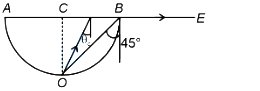
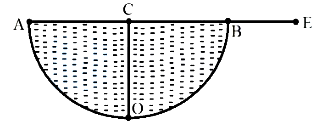
For the rays from coin to reach the point \(E\), the refracted rays must grazing the surface, i.e. they must be incident at critical angle \(\theta_c\) inside the liquid.
\(\mu=\frac{1}{\sin \theta_c}\)
\(\mu\) is minimum when \(\theta_c\) is maximum.
Maximum value of \(\theta_c=45^{\circ}\)
\(\Rightarrow \mu\) has a minimum value of \(\sqrt{2}\). -
- (A) 355 mm
- (B) 288 mm
- (C) 555 mm
- (D) 655 mm
Show answer and solution
Correct Answer: (B)
As we know,
\(\frac{1}{\mathrm{f}}=\left[\frac{\mu_{\mathrm{L}}}{\mu_{\mathrm{m}}}-1\right]\left[\frac{1}{\mathrm{R}_1}-\frac{1}{\mathrm{R}_2}\right]\)
For air \(\mu_{\mathrm{m}}=1\)
\(\begin{aligned} & \frac{1}{12}=[1.6-1]\left[\frac{1}{\mathrm{R}_1}-\frac{1}{\mathrm{R}_2}\right] \\ & \frac{1}{12}=\frac{6}{10}\left[\frac{1}{\mathrm{R}_1}-\frac{1}{\mathrm{R}_2}\right] \\ & {\left[\frac{1}{\mathrm{R}_1}-\frac{1}{\mathrm{R}_2}\right]=\frac{10}{72}}\end{aligned}\)
For water
\(\frac{1}{\mathrm{f}}=\left[\frac{1.6}{1.28}-1\right]\left[\frac{10}{72}\right]=\frac{32}{128} \times \frac{10}{72}\)
\(\begin{aligned} & \frac{1}{\mathrm{f}}=\frac{1}{4} \times \frac{10}{72} \\ & \mathrm{f}=28.8 \mathrm{~cm} \\ & \mathrm{f}=288 \mathrm{~mm}\end{aligned}\) -
- (A) 10 cm
- (B) 12.7 cm
- (C) 10.7 cm
- (D) 15 cm
Show answer and solution
Correct Answer: (C)
\(\begin{aligned} & \mathrm{m}=-\frac{\mathrm{v}}{\mathrm{u}}=-\left(\frac{\mathrm{v}}{-\mathrm{u}}\right)=\frac{\mathrm{v}}{\mathrm{u}} \\ & \frac{1}{4}=\frac{\mathrm{v}}{\mathrm{u}} \Rightarrow \mathrm{u}=4 \mathrm{v} \\ & \mathrm{v}+\mathrm{u}=40 \\ & 5 \mathrm{v}=40 \\ & \mathrm{v}=8 \mathrm{~cm} \\ & \mathrm{u}=32 \mathrm{~cm} \\ & \frac{1}{\mathrm{v}}+\frac{\mathrm{v}}{\mathrm{u}}=\frac{1}{\mathrm{f}} \\ & \frac{1}{8}-\frac{1}{32}=\frac{1}{\mathrm{f}} \\ & \frac{4-1}{32}=\frac{1}{\mathrm{f}} \\ & \mathrm{f}=\frac{32}{3}=10.7 \mathrm{~cm}\end{aligned}\) -
- (A) \(300\mathrm{~nm}\)
- (B) \(600\mathrm{~nm}\)
- (C) \(400\mathrm{~nm}\)
- (D) \(500\mathrm{~nm}\)
Show answer and solution
Correct Answer: (A)
\(\mathrm{f} \lambda=\mathrm{v} \quad \lambda_{\text {medium }}=\frac{\lambda_{\text {vacuum }}}{\mu}\)
\(\lambda_{\text {medium }} \Rightarrow \frac{3 \times 10^8}{2 \times 5 \times 10^{14}} \Rightarrow 0.3 \times 10^{-6} \Rightarrow 300 \mathrm{~nm}\) -
- (A) 1.8 cm
- (B) 0.9 cm
- (C) 2.8 cm
- (D) 2.5 cm
Show answer and solution
Correct Answer: (A)
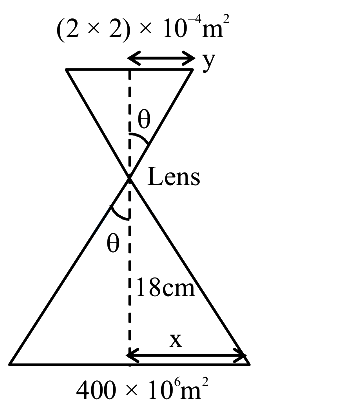
\(\mathrm{H}=18 \mathrm{~km}\)
Size of camera film \(=2 \mathrm{~cm} \times 2 \mathrm{~cm}\)
\(\begin{aligned}
& A_{\text {image }}=400 \mathrm{~km}^2 \\
& x=20 \times 10^3 \mathrm{~m}=2 \times 10^4 \mathrm{~m} \\
& y=2 \times 10^{-2} \mathrm{~m} \\
& \frac{x}{y}=10^6=\frac{18 \mathrm{Km}}{\mathrm{f}} \\
& \mathrm{f}=18 \times 10^{-3} \mathrm{~m}=18 \mathrm{~mm} \\
& \mathrm{f}=1.8 \mathrm{~cm}
\end{aligned}\) -
- (A) \(1: 2\)
- (B) \(1: 3\)
- (C) \(3: 5\)
- (D) \(2: 3\)
Show answer and solution
Correct Answer: (B)
For case (1)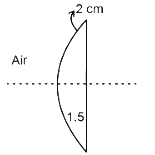
\(\begin{aligned} & \frac{1.5}{v_1}-\frac{1}{\propto}=\frac{(1.5-1)}{R_1} \\ & \frac{1}{f_1}-\frac{1.5}{v_1}=\frac{1-1.5}{\propto}\end{aligned}\)
\(\Rightarrow \frac{1}{f_1}=\frac{(1.5-1)}{R_1}\) ...(1)
\(\Rightarrow \frac{1}{f_1}=\frac{1}{2 R_1}\)
For case (2)
\(\begin{aligned}
& \frac{1.5}{v_1}-\frac{1.2}{\infty}=\frac{(1.5-1.2)}{R_2} \\
& \frac{1.2}{f_2}-\frac{1.5}{v_1}=\frac{(1.2-1.5)}{\propto} \\
& \Rightarrow \frac{1.2}{f_2}=\frac{0.3}{R_2} \\
& \Rightarrow \frac{1}{f_2}=\frac{1}{4 R_2}
\end{aligned}\)
So clearly, \(\frac{f_1}{f_2}=\frac{2 \times 2}{4 \times 3}=\frac{1}{3}\)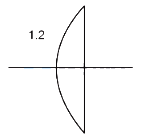
-
- (A) 50
- (B) 55
- (C) 45
- (D) 40
Show answer and solution
Correct Answer: (C)
\(\begin{aligned} & \mu=\frac{\sin \left(\frac{\mathrm{A}+\delta_{\mathrm{m}}}{2}\right)}{\sin \left(\frac{\mathrm{A}}{2}\right)}, \text { since } \mathrm{A}=60^{\circ} \quad \therefore \delta \mathrm{m}=30^{\circ} \\ & \delta_{\mathrm{m}}=2 \mathrm{i}-\mathrm{A}[\text { as } \mathrm{i}=\mathrm{e}] \\ & \Rightarrow \mathrm{i}=45^{\circ}\end{aligned}\) -
- (A) \(-\frac{\alpha}{2}\)
- (B) \(-45^{\circ}\)
- (C) \(+45^{\circ}\)
- (D) \(-\alpha\)
Show answer and solution
Correct Answer: (B)
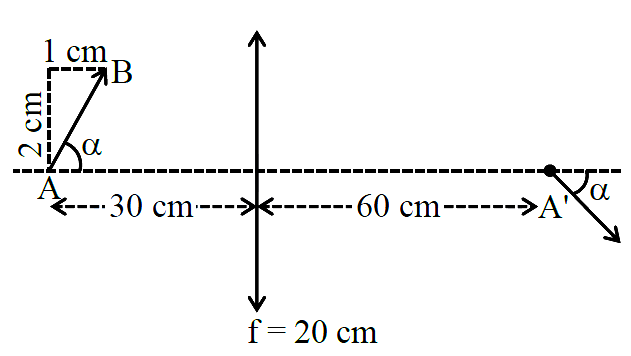
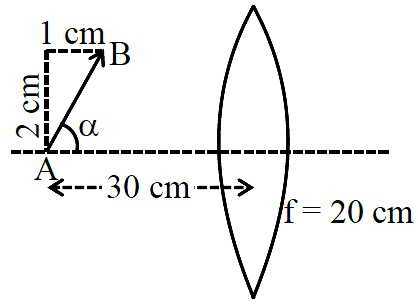
Location of image of \(\mathrm{A}:-\)
\(\begin{aligned} & \frac{1}{\mathrm{v}}-\frac{1}{\mathrm{u}}=\frac{1}{\mathrm{f}} \Rightarrow \frac{1}{\mathrm{v}}-\frac{1}{-30}=\frac{1}{20} \Rightarrow \frac{1}{\mathrm{v}}=\frac{1}{60} \Rightarrow \mathrm{v}=60 \mathrm{~cm} \\ & \therefore \mathrm{~m}=2\end{aligned}\)
Since size of object is small wrt the location hence
\(\begin{aligned} & d v=m^2 d u \Rightarrow d v=4 \times 1=4 \mathrm{~cm} \\ & h_i=m h_0 \Rightarrow h_i(d y)=2 \times 2=4 \mathrm{~cm}\end{aligned}\)
\(\therefore\) Angle made with principle axis \(=-45^{\circ}\) -
- (A) 5 R
- (B) 3 R
- (C) 1.5 R
- (D) 2 R
Show answer and solution
Correct Answer: (A)
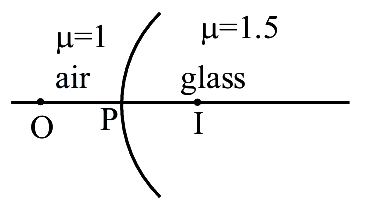
\(\begin{aligned} & \mathrm{PO}=\mathrm{u}=-\mathrm{x} \\ & \mathrm{PI}=\mathrm{v}=\mathrm{x} \\ & \mathrm{PO}=\mathrm{PI} \\ & \frac{\mu_2}{\mathrm{v}}-\frac{\mu_1}{\mathrm{u}}=\frac{\mu_2-\mu_1}{\mathrm{R}} \\ & \frac{1.5}{\mathrm{x}}+\frac{1}{\mathrm{x}}=\frac{1}{2 \mathrm{R}} \\ & \frac{5}{2 \mathrm{x}}=\frac{1}{2 \mathrm{R}} \\ & \mathrm{X}=5 \mathrm{R}\end{aligned}\) -
- (A) 0.24 m right to the spherical surface
- (B) 0.4 m left to the spherical surface
- (C) 0.24 m left to the spherical surface
- (D) 0.4 m right to the spherical surface
Show answer and solution
Correct Answer: (B)
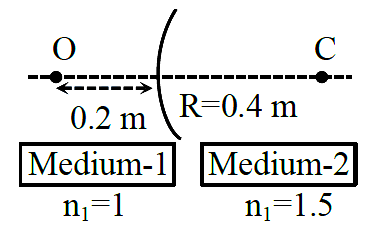
\(\begin{aligned} & \frac{\mu_2}{\mathrm{v}}-\frac{\mu_1}{\mathrm{u}}=\frac{\mu_2-\mu_1}{\mathrm{R}} \\ & \frac{1.5}{\mathrm{v}}-\frac{1}{(-0.2)}=\frac{1.5-1}{0.4} \\ & \frac{1.5}{\mathrm{v}}=\frac{0.5}{0.4}-\frac{1}{0.2} \\ & \frac{1.5}{\mathrm{v}}=-\frac{1.5}{0.4} \\ & \mathrm{v}=-0.4 \mathrm{~m}\end{aligned}\) -
- (A) 0.20 m
- (B) 0.25 m
- (C) 0.15 m
- (D) 0.10 m
Show answer and solution
Correct Answer: (D)
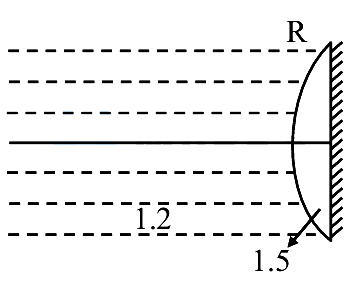
\(\begin{aligned} & \frac{1.5}{\mathrm{v}}=\frac{1.5-1.2}{\mathrm{R}} \\ & \mathrm{v}=\frac{1.5 \mathrm{R}}{0.3}=5 \mathrm{R} \\ & \frac{1.2}{\mathrm{f}}-\frac{1.5}{5 \mathrm{R}}=\frac{1.2-1.5}{-\mathrm{R}} \\ & \frac{1.2}{\mathrm{f}}=\frac{0.3}{\mathrm{R}} \times 2 \Rightarrow \mathrm{f}=2 \mathrm{R} \Rightarrow \mathrm{R}=0.1\end{aligned}\) -
- (A) 3
- (B) 16/3
- (C) 4
- (D) 1.5
Show answer and solution
Correct Answer: (A)
For dispersion without deviation,
\(\begin{aligned}
& \left(\mu_1-1\right) A_1=\left(\mu_2-1\right) A_2 \\
& \Rightarrow \quad(1.54-1) 4^{\circ}=(1.72-1) A_2 \\
& \text { Or } A_2=\frac{0.54}{0.72} \times 4=3^{\circ}
\end{aligned}\) -
- (A) \(\tan ^{-1}(4 / 3)\)
- (B) \(\tan ^{-1}(3 / 4)\)
- (C) \(\sin ^{-1}(3 / 4)\)
- (D) \(\cos ^{-1}(3 / 4)\)
Show answer and solution
Correct Answer: (C)
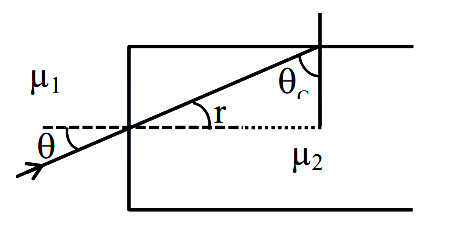
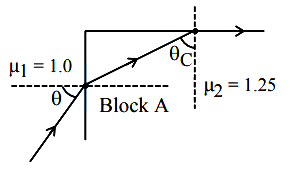
\(\begin{aligned} & \mathrm{r}+\theta_{\mathrm{C}}=90^{\circ} \\ & \mu_1 \sin \theta=\mu_2 \sin \mathrm{r} \\ & \sin \theta=\frac{\mu_2}{\mu_1} \sin \left(90-\theta_{\mathrm{C}}\right) \\ & \sin \theta=\frac{\mu_2}{\mu_1} \cos \theta_{\mathrm{C}} \\ & \sin \theta_{\mathrm{C}}=\frac{\mu_1}{\mu_2}\end{aligned}\)
\(\begin{aligned} & \sin \theta=\frac{\mu_2}{\mu_1} \sqrt{1-\frac{\mu_1^2}{\mu_2^2}} \\ & \sin \theta=\sqrt{\frac{\mu_2^2-\mu_1^2}{\mu_1^2}}=\sqrt{\frac{\frac{25}{16}-1}{1}} \\ & \sin \theta=\frac{3}{4} \\ & \theta=\sin ^{-1}\left(\frac{3}{4}\right)\end{aligned}\) -
- (A) \(\sin ^{-1}\left(\frac{1}{6}\right)\)
- (B) \(\sin ^{-1}\left(\frac{1}{3}\right)\)
- (C) \(\sin ^{-1}\left(\frac{-5}{6}\right)\)
- (D) \(\sin ^{-1}\left(\frac{2}{3}\right)\)
Show answer and solution
Correct Answer: (C)
\(\begin{aligned} & \sin \theta_{1 C}=\frac{n_1}{n_2} \\ & \sin \theta_{2 C}=\frac{n_1}{n_3} \\ & \sin \theta_{2 C}-\sin \theta_{1 C}=\frac{1}{2}\end{aligned}\)
\(\begin{aligned} & \mathrm{n}_1 \frac{\mathrm{n}_2}{\mathrm{n}_3}-\frac{\mathrm{n}_1}{\mathrm{n}_2}=\frac{1}{2} \\ & \mathrm{n}_1 \frac{\mathrm{n}_2}{\mathrm{n}_3}-\mathrm{n}_1=\frac{\mathrm{n}_2}{2} \\ & \mathrm{n}_1\left(\frac{2}{5}-1\right)=\frac{\mathrm{n}_2}{2} \\ & \frac{\mathrm{n}_1}{\mathrm{n}_2}=\frac{-5}{6} \\ & =\sin ^{-1}\left(-\frac{5}{6}\right)\end{aligned}\) -
- (A) A, C and D Only
- (B) B, C and D Only
- (C) A, B and E Only
- (D) B, D and E Only
Show answer and solution
Correct Answer: (A)
\(\delta=\mathrm{I}+\mathrm{e}-\mathrm{A}\)
For \(\delta_{\text {min }} \Rightarrow \mathrm{I}=\mathrm{e}\) and refracted ray is parallel to base \(\mathrm{A}, \mathrm{C}, \mathrm{D}\) are correct -
- (A) 40
- (B) 45
- (C) 50
- (D) 55
Show answer and solution
Correct Answer: (B)
\(\begin{aligned} & M=-\frac{1}{3} \\ & -\frac{-V}{-U}=\frac{-1}{3} \Rightarrow V=\frac{U}{3}\end{aligned}\)
Distance \(b / w\) object and image :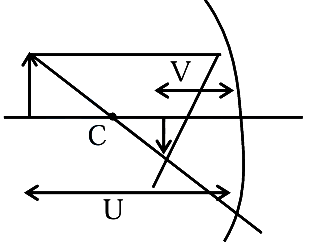
\(\begin{aligned} & \mathrm{U}-\mathrm{V}=30 \\ & \mathrm{U}-\frac{\mu}{3}=30 \\ & \Rightarrow \mathrm{U}=45 \quad \mathrm{~V}=15 \\ & \frac{1}{\mathrm{f}}=\frac{1}{\mathrm{~V}}+\frac{1}{\mathrm{U}}=-\frac{1}{15}-\frac{1}{45} \\ & \Rightarrow \mathrm{~F}=\frac{45}{4} \\ & \mathrm{x}=45\end{aligned}\) -
- (A) \(\frac{\mu_1\left|\mathrm{R}_1\right| \cdot\left|\mathrm{R}_2\right|}{\mu_2\left(\left|\mathrm{R}_1\right|+\left|\mathrm{R}_2\right|\right)-\mu_1\left|\mathrm{R}_2\right|}\)
- (B) \(\frac{\mu_1\left|\mathrm{R}_1\right| \cdot\left|\mathrm{R}_2\right|}{\mu_2\left(\left|\mathrm{R}_1\right|+\left|\mathrm{R}_2\right|\right)-\mu_1\left|\mathrm{R}_1\right|}\)
- (C) \(\frac{\left(\mu_2+\mu_1\right)\left|\mathrm{R}_1\right|}{\left(\mu_2-\mu_1\right)}\)
- (D) \(\frac{\mu_1\left|\mathrm{R}_1\right| \cdot\left|\mathrm{R}_2\right|}{\mu_2\left(2\left|\mathrm{R}_1\right|+\left|\mathrm{R}_2\right|\right)-\mu_1 \sqrt{\left|\mathrm{R}_1\right| \cdot\left|\mathrm{R}_2\right|}}\)
Show answer and solution
Correct Answer: (A)
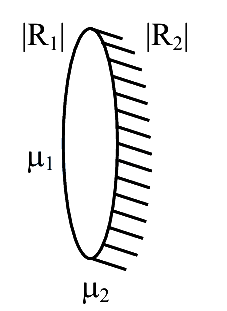
\(\begin{aligned} & \frac{1}{\mathrm{f}_{\mathrm{eq}}}=\frac{2}{\mathrm{f}_{\mathrm{L}}}-\frac{1}{\mathrm{f}_{\mathrm{m}}} \\ & \mathrm{f}_{\mathrm{m}}=-\frac{\left|\mathrm{R}_2\right|}{2} \\ & \frac{1}{\mathrm{f}_{\mathrm{L}}}=\left(\frac{\mu_2}{\mu_1}-1\right)\left(\frac{1}{\mathrm{R}_1}+\frac{1}{\mathrm{R}_2}\right)\end{aligned}\)
\(\begin{aligned}
& \frac{1}{\mathrm{f}_{\mathrm{eq}}}=2\left(\frac{\mu_2-\mu_1}{\mu_1}\right)\left(\frac{\mathrm{R}_1+\mathrm{R}_2}{\mathrm{R}_1 \mathrm{R}_2}\right)+\frac{2}{\mathrm{R}_2} \\
& =\frac{2}{\mathrm{R}_2}\left[\frac{\left(\mu_2-\mu_1\right)\left(\mathrm{R}_1+\mathrm{R}_2\right)+\mu_1 \mathrm{R}_1}{\mu_1 \mathrm{R}_1}\right] \\
& =\frac{2}{\mathrm{R}_2}\left[\frac{\mu_2 \mathrm{R}_1+\mu_2 \mathrm{R}_2-\mu_1 \mathrm{R}_1-\mu_1 \mathrm{R}_2+\mu_1 \mathrm{R}_1}{\mu_1 \mathrm{R}_1}\right] \\
& \frac{1}{\mathrm{f}_{\mathrm{eq}}}=\frac{2\left[\mu_2 \mathrm{R}_1+\mu_2 \mathrm{R}_2-\mu_1 \mathrm{R}_2\right]}{\mu_1 \mathrm{R}_1 \mathrm{R}_2}
\end{aligned}\)
For same size of image
\(\begin{aligned}
& \mathrm{u}=2 \mathrm{f} \\
& \mathrm{u}=\frac{\mu_1 \mathrm{R}_1 \mathrm{R}_2}{\mu_2 \mathrm{R}_1+\mu_2 \mathrm{R}_2-\mu_1 \mathrm{R}_2}
\end{aligned}\) -
- (A) \((\mathrm{A})\) is not correct but \((\mathrm{R})\) is correct
- (B) Both \((\mathrm{A})\) and \((\mathrm{R})\) are correct and \((\mathrm{R})\) is the correct explanation of (A)
- (C) \((A)\) is correct but \((\mathrm{R})\) is not correct
- (D) Both (A) and (R) are correct but (R) is not the correct explanation of (A)
Show answer and solution
Correct Answer: (C)
Refractive index has no relation with mass density because both have different meaning. Hence reason is incorrect.
So (A) is correct but (R) is not correct. -
- (A) \(\mathrm{R} / \mu\)
- (B) \(R /(2 \mu-3)\)
- (C) \(\mu R\)
- (D) \(\mathrm{R} /(2 \mu-1)\)
Show answer and solution
Correct Answer: (D)
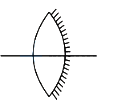
\(\begin{aligned}
-\frac{1}{f_{e q}} & =\frac{2}{f_l}-\frac{1}{f_m} \\
& =2(\mu-1) \frac{2}{R}+\frac{2}{R} \\
-\frac{1}{f_{e q}} & =\frac{2(2 \mu-1)}{R} \\
f_{e q} & =-\frac{R}{2(2 \mu-1)}
\end{aligned}\)
For concave mirror, object should be at \(2 f\) for the image to be at same point
\(\text { Distance }=\frac{R}{(2 \mu-1)}\) -
- (A) \(\frac{1}{3} \mathrm{~cm}\)
- (B) \(\frac{4}{3} \mathrm{~cm}\)
- (C) \(1\mathrm{~cm}\)
- (D) \(\frac{2}{3} \mathrm{~cm}\)
Show answer and solution
Correct Answer: (D)
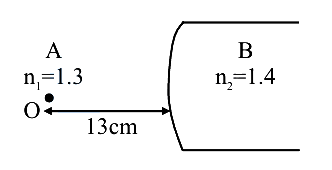
\(\begin{aligned} & \frac{\mathrm{n}_2}{\mathrm{v}}-\frac{\mathrm{n}_1}{\mathrm{u}} \frac{\mathrm{n}_2-\mathrm{n}_1}{\mathrm{R}} \\ & \frac{1.4}{\mathrm{v}}-\frac{1.3}{-13}=\frac{0.1}{\mathrm{R}} \\ & \frac{1.4}{\mathrm{v}}=\frac{1-\mathrm{R}}{10 \mathrm{R}} \\ & \frac{1.4}{\mathrm{v}}=\frac{1-\mathrm{R}}{10 \mathrm{R}} \\ & \mathrm{m}=\frac{\mathrm{v} / \mathrm{n}_2}{\mathrm{u} / \mathrm{n}_1} \\ & -2 \times \frac{(-13)}{1.3}=\frac{10 \mathrm{R}}{1-\mathrm{R}} \\ & \mathrm{R}=\frac{2}{3} \mathrm{~cm}\end{aligned}\) -
- (A) \(\frac{1}{6}\left(\frac{1}{\left|\mathrm{R}_1\right|}-\frac{1}{\left|\mathrm{R}_2\right|}\right)\)
- (B) \(-\frac{1}{6}\left(\frac{1}{\left|\mathrm{R}_1\right|}+\frac{1}{\left|\mathrm{R}_2\right|}\right)\)
- (C) \(\frac{1}{6}\left(\frac{1}{\left|R_1\right|}+\frac{1}{\left|R_2\right|}\right)\)
- (D) \(-\frac{1}{6}\left(\frac{1}{\left|\mathrm{R}_1\right|}-\frac{1}{\left|\mathrm{R}_2\right|}\right)\)
Show answer and solution
Correct Answer: (D)
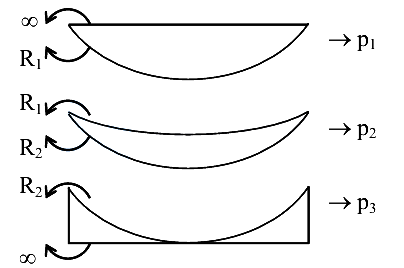
\(\begin{aligned} & \Rightarrow p_{\mathrm{eq}}=\mathrm{p}_1+\mathrm{p}_2+\mathrm{p}_3 \\ & \Rightarrow \mathrm{p}_1=\left(\frac{4}{3}-1\right)\left(\frac{1}{\infty}-\frac{1}{-\left|\mathrm{R}_1\right|}\right) \\ & \Rightarrow \mathrm{p}_1=\left(\frac{1}{3\left|\mathrm{R}_1\right|}\right) \\ & \Rightarrow \mathrm{p}_2=\left(\frac{1}{2}\right)\left(\frac{1}{-\left|\mathrm{R}_1\right|}-\frac{1}{-\left|\mathrm{R}_2\right|}\right) \\ & \Rightarrow \mathrm{p}_2=\frac{1}{2}\left(\frac{1}{\left|\mathrm{R}_2\right|}-\frac{1}{\left|\mathrm{R}_1\right|}\right) \\ & \Rightarrow \mathrm{p}_3=\left(\frac{1}{3}\right)\left(\frac{1}{-\left|\mathrm{R}_2\right|}-\frac{1}{\infty}\right)=-\frac{1}{3\left|\mathrm{R}_2\right|} \\ & \Rightarrow \mathrm{p}_{\mathrm{eq}}=\frac{1}{3}\left(\frac{1}{\left|\mathrm{R}_1\right|}-\frac{1}{\left|\mathrm{R}_2\right|}\right)-\frac{1}{2}\left(\frac{1}{\left|\mathrm{R}_1\right|}-\frac{1}{\left|\mathrm{R}_2\right|}\right) \\ & =-\frac{1}{6}\left(\frac{1}{\left|\mathrm{R}_1\right|}-\frac{1}{\left|\mathrm{R}_2\right|}\right)\end{aligned}\) -
- (A) 10
- (B) 8
- (C) 6
- (D) 4
Show answer and solution
Correct Answer: (D)
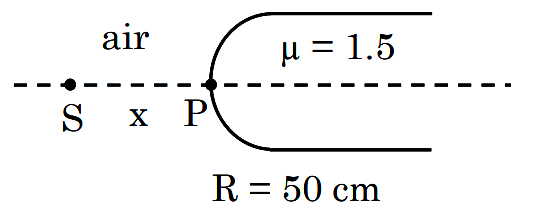
\(\begin{aligned} & \frac{\mu_2}{\mathrm{v}}-\frac{\mu_1}{\mathrm{u}}=\frac{\mu_2-\mu_1}{\mathrm{R}} \\ & \frac{1.5}{200}-\frac{1}{-\mathrm{x}}=\frac{1.5-1}{50}\end{aligned}\)
\(\begin{aligned} & \frac{1}{x}=\frac{1}{100}-\frac{3}{400} \\ & x=400 \mathrm{~cm} \\ & x=4 m\end{aligned}\) -
- (A) 10
- (B) 8
- (C) 12
- (D) 14
Show answer and solution
Correct Answer: (B)
\(\begin{aligned}
& \mathrm{v}=\frac{\mathrm{uf}}{\mathrm{u}-\mathrm{f}}=\frac{-24 \cdot 1}{-24-1}=\frac{24}{25} \\
& \mathrm{~m}=\frac{-\mathrm{v}}{\mathrm{u}}=-\frac{24}{25(-24)}=\frac{1}{25} \\
& \frac{1}{\mathrm{v}}-\frac{1}{\mathrm{u}}=\frac{1}{\mathrm{f}} \\
& \mathrm{v}_{\mathrm{I}}=-\mathrm{m}^2 \cdot \mathrm{v}_0=\frac{-1}{(25)^2} \cdot 25=\frac{-1}{25}
\end{aligned}\)
Diff.
\(\begin{aligned}
& \frac{-1}{\mathrm{v}^2}\left(\frac{\mathrm{dv}}{\mathrm{dt}}\right)+\frac{1}{\mathrm{u}^2}\left(\frac{\mathrm{du}}{\mathrm{dt}}\right)=0\left[\frac{\mathrm{dv}}{\mathrm{dt}}=\mathrm{v}_{\mathrm{i}} ; \frac{\mathrm{du}}{\mathrm{dt}}=\mathrm{v}_0\right] \\
& \frac{+2}{\mathrm{v}^3} \cdot\left(\mathrm{v}_{\mathrm{t}}\right)^2-\frac{1}{\mathrm{v}^2} \cdot \mathrm{a}_{\mathrm{L}}-\frac{2}{\mathrm{u}^3} \cdot\left(\mathrm{v}_0\right)^2+\frac{1}{\mathrm{u}^2} \cdot \mathrm{a}_0=0 \\
& \frac{\mathrm{a}_{\mathrm{I}}}{\mathrm{v}^2}=\frac{2}{\mathrm{v}^3} \cdot \mathrm{v}_{\mathrm{I}}^2-\frac{2}{\mathrm{u}^3} \cdot \mathrm{v}_0^2 \\
& \mathrm{a}_{\mathrm{I}}=\frac{2}{\mathrm{v}} \cdot \mathrm{v}_{\mathrm{I}}^2-\frac{2 \mathrm{v}^2}{\mathrm{u}^3} \cdot \mathrm{v}_0^2 \\
& =\frac{2 \cdot 25}{24} \cdot \frac{1}{25} \cdot \frac{1}{25}-\frac{2}{(24)^3} \cdot \frac{24}{25} \cdot \frac{24}{25} \cdot 25 \cdot 25 \\
& \mathrm{a}_{\mathrm{I}}=\frac{2}{24.25}-\frac{2}{24} \\
& \mathrm{a}_1=\frac{2}{24} \cdot \frac{-24}{25}=\frac{-2}{25} \\
& 100 a_1=\frac{2}{25} \times 100=8
\end{aligned}\) -
- (A) 1.2
- (B) 1.4
- (C) 1.5
- (D) 1.8
Show answer and solution
Correct Answer: (C)
\(\begin{aligned} & \frac{1}{\mathrm{f}}=(\mu-1)\left(\frac{1}{\mathrm{R}_1}-\frac{1}{\mathrm{R}_2}\right) \\ & \frac{1}{12}=(\mu-1)\left(\frac{1}{10}-\frac{1}{-15}\right) \\ & \frac{1}{12}=(\mu-1)\left(\frac{3+2}{30}\right) \\ & \mu=\frac{3}{2}\end{aligned}\) -
- (A) \(60^{\circ}\)
- (B) \(58^{\circ}\)
- (C) \(48^{\circ}\)
- (D) \(50^{\circ}\)
Show answer and solution
Correct Answer: (A)
\(\mu=\frac{\sin \left(\frac{A+\delta_{\min }}{2}\right)}{\sin \frac{A}{2}}\)
Given \(\delta_{\min }=\mathrm{A}\)
\(\begin{aligned}
& \sqrt{3}=\frac{\sin A}{\sin \frac{A}{2}}=\frac{2 \sin \frac{A}{2} \cos \frac{A}{2}}{\sin \frac{A}{2}} \\
& \cos \frac{A}{2}=\frac{\sqrt{3}}{2} \\
& A=60^{\circ}
\end{aligned}\) -
- (A) 0.214 R
- (B) 0.411 R
- (C) 0.124 R
- (D) 0.114 R
Show answer and solution
Correct Answer: (D)
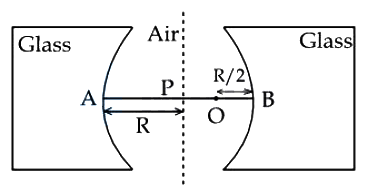
For B
\(\begin{aligned}
& \frac{\mu_2}{\mathrm{~V}}-\frac{\mu_1}{\mathrm{u}}=\frac{\mu_2-\mu_1}{\mathrm{R}} \\
& \frac{1.5}{\mathrm{~V}}+\frac{1}{\frac{R}{2}}=\frac{0.5}{-\mathrm{R}} \\
& \frac{1.5}{\mathrm{~V}}=-\frac{1}{2 \mathrm{R}}-\frac{2}{\mathrm{R}} \\
& \frac{1.5}{\mathrm{~V}}=\frac{-5}{2 \mathrm{R}} \Rightarrow V_B=-0.6 \mathrm{R}
\end{aligned}\)
For A
\(\begin{aligned}
& \frac{1.5}{V}+\frac{2}{3 R}=\frac{0.5}{-R} \\
& \frac{1.5}{V}=-\frac{1}{2 R}-\frac{2}{3 R} \\
& \frac{1.5}{V}=-\frac{7}{6 R} \\
& V_A=-\frac{9}{7} R
\end{aligned}\)
Distance between images
\(=2 \mathrm{R}-\left(0.6 \mathrm{R}+\frac{9}{7} \mathrm{R}\right)=0.114 \mathrm{R}\) -
- (A) \(1 / 2\)
- (B) 2
- (C) 3
- (D) \(1 / 3\)
Show answer and solution
Correct Answer: (A)
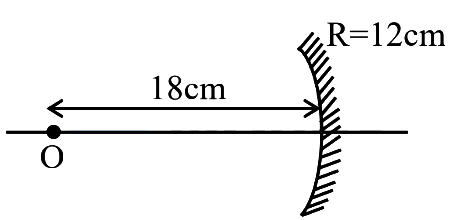
\(\begin{aligned} & \text { Using } m=\frac{f}{u-f} \\ & m_1=\frac{6}{18-6}=\frac{1}{2}\end{aligned}\)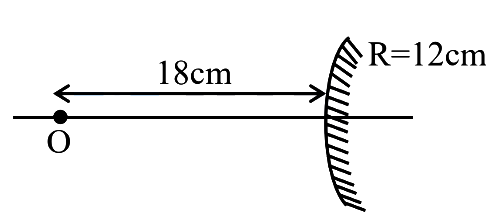
\(\mathrm{m}_2=\frac{6}{18+6}=\frac{1}{4} \quad \therefore \frac{\mathrm{~m}_2}{\mathrm{~m}_1}=\frac{1}{2}\)
No questions on this page match these filters.