


Questions
21 questionsShowing 1–21 of 21 questions
-
- (A) 50
- (B) 52
- (C) 48
- (D) 46
Show answer and solution
Correct Answer: (C)
\(\begin{aligned} & F=I \ell B \\ & =8 \times \frac{4}{100} \times 0.15 \\ & =48 \times 10^{-3} \mathrm{~N}=48 \mathrm{mN}\end{aligned}\) -
- (A) 10
- (B) 8
- (C) 6
- (D) 4
Show answer and solution
Correct Answer: (B)
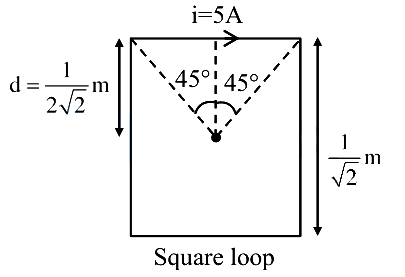
Let B be the magnetic field due to single side
\(\begin{aligned}
& \text { then } B=\frac{\mu_0 \mathrm{i}}{4 \pi \mathrm{~d}}\left(\sin \theta_1+\sin \theta_2\right) \\
& =\frac{10^{-7} \times 5 \times 2}{\frac{1}{2 \sqrt{2}}} \times \frac{1}{\sqrt{2}}=2 \times 10^{-6} \\
& \therefore B_{\text {net }} \text { at centre } O=4 B \\
& =8 \times 10^{-6}
\end{aligned}\) -
- (A) 596
- (B) 149
- (C) 298
- (D) 447
Show answer and solution
Correct Answer: (B)
\(\begin{aligned} & \left(I-I_g\right) R=I_g G \\ & (3-0.02) \times R=0.02 \times G \Rightarrow R=\frac{30}{149} \\ & \Rightarrow 149=\text { Required } X\end{aligned}\) -
- (A) 1
- (B) 2
- (C) 3
- (D) 4
Show answer and solution
Correct Answer: (A)
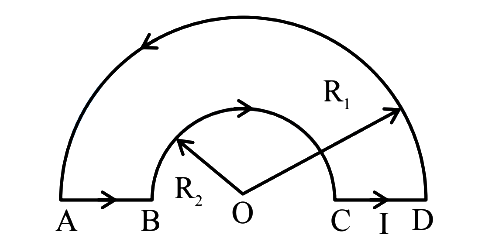
Magnetic field due to \(\mathrm{AB} \& \mathrm{CD}=0\)
\(\begin{aligned}
& \mathrm{B}_0=\left|\mathrm{B}_{\mathrm{R}_1}-\mathrm{B}_{\mathrm{R}_2}\right| \\
& =\frac{\mu_0 \mathrm{I}}{4 \mathrm{R}_2}-\frac{\mu_0 \mathrm{I}}{4 \mathrm{R}_1} \\
& =\frac{4 \pi \times 10^{-7} \times 12}{4}\left(\frac{1}{4 \pi}-\frac{1}{6 \pi}\right) \\
& =12 \pi \times 10^{-7}\left(\frac{1}{12 \pi}\right) \\
& =1 \times 10^{-7}
\end{aligned}\)
\(K=1\) -
- (A) 5
- (B) 4
- (C) 3
- (D) \(0\)
Show answer and solution
Correct Answer: (D)
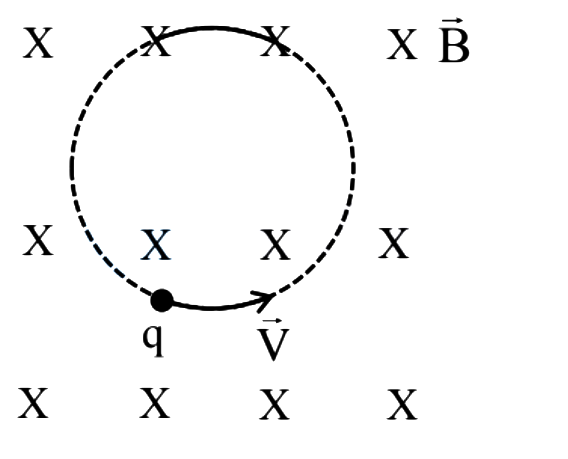
Angle between \(\overrightarrow{\mathrm{V}}\) of charge \(\& \overrightarrow{\mathrm{~B}}\) is \(90^{\circ}\) motion will be uniform circular motion time period is given by
\(\mathrm{T}=\frac{2 \pi \mathrm{~m}}{\mathrm{qB}}=\frac{2 \pi \times 16 \times 10^{-9} \mathrm{~kg}}{1.6 \times 10^{-6} \times 6.28}\)
\(\mathrm{T}=0.01\) seconds
NTA Answer is 10
Correct Answer is 0 (nearest integer) -
- (A) 4
- (B) 6
- (C) 2
- (D) 8
Show answer and solution
Correct Answer: (C)
\(\begin{aligned} & B v q=E q \\ & E=B v \\ & r=\frac{v m}{B q} \\ & B=\frac{m v}{r q} \\ & E=\left(\frac{m v}{r q}\right) v=\frac{m v^2}{r q} \\ & =\frac{1.6 \times 10^{-27} \times 4 \times 10^{10}}{2 \times 10^{-2} \times 1.6 \times 10^{-19}} \\ & =2 \times 10^4 \mathrm{~N} / \mathrm{C} \\ & x=2\end{aligned}\) -
- (A) 200
- (B) 250
- (C) 300
- (D) 350
Show answer and solution
Correct Answer: (B)
Since time period of a revolving charge is \(\frac{2 \pi m}{q B}\)
Where \(\mathrm{B}=\) magnetic field
due to a solenoid \(=\mu_0 \mathrm{nI}\)
\(\begin{aligned}
& \therefore \mathrm{T}=\frac{2 \pi \mathrm{~m}}{\mathrm{q}\left(\mu_0 \mathrm{nI}\right)} \\
& 75 \times 10^{-9}=\frac{(2 \pi)\left(9 \times 10^{-31}\right)}{1.6 \times 10^{-19} \times 4 \pi \times 10^{-7} \times \mathrm{n} \times 1.5} \\
& \mathrm{~N}=250
\end{aligned}\) -
- (A) \(\frac{\mu_0}{4 \pi} \frac{I}{a}\left[\frac{\pi}{2}+1\right]\)
- (B) \(\frac{\mu_0}{4 \pi} \frac{\mathrm{I}}{\mathrm{a}}\left[\frac{3 \pi}{2}+2\right]\)
- (C) \(\frac{\mu_0}{2 \pi} \frac{\mathrm{I}}{\mathrm{a}}\left[\frac{\pi}{2}+2\right]\)
- (D) \(\frac{\mu_0}{4 \pi} \frac{\mathrm{I}}{\mathrm{a}}\left[\frac{3 \pi}{2}+1\right]\)
Show answer and solution
Correct Answer: (D)
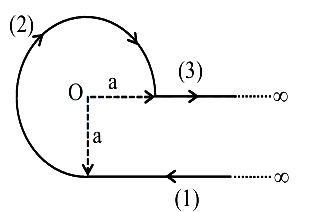
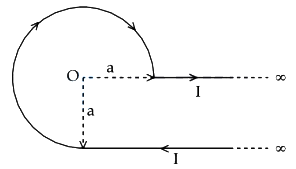
\(\begin{aligned} & \mathrm{B}_1=\frac{\mu_0 \mathrm{i}}{4 \pi \mathrm{a}} \otimes \\ & \mathrm{B}_2=\frac{\mu_0}{4 \pi} \frac{\mathrm{i}}{\mathrm{a}}\left(\frac{3 \pi}{2}\right) \otimes \\ & \mathrm{B}_3=0 \\ & \mathrm{~B}=\frac{\mu_0}{4 \pi} \frac{\mathrm{i}}{\mathrm{a}}\left(1 \frac{3 \pi}{2}\right) \otimes\end{aligned}\) -
- (A) \([a / 4,3 a / 2]\)
- (B) \([a / 4,2 a]\)
- (C) \([\mathrm{a} / 2,2 \mathrm{a}]\)
- (D) \([a / 2,3 a]\)
Show answer and solution
Correct Answer: (C)
Maximum possible magnetic field is at the surface
\(\begin{aligned}
& \mathrm{B}_{\max }=\frac{\mu_0 \mathrm{I}}{2 \pi \mathrm{a}} \\
& \frac{\mathrm{~B}_{\max }}{2}=\frac{\mu_0 \mathrm{I}}{4 \pi \mathrm{a}}
\end{aligned}\)
It can be obtained inside as well as outside the wire For inside,
\(\begin{aligned}
& \frac{\mu_0 \mathrm{I}}{4 \pi \mathrm{a}}=\frac{\mu_0 \mathrm{Ir}}{2 \pi \mathrm{a}^2} \\
& \Rightarrow \mathrm{r}=\frac{\mathrm{a}}{2}
\end{aligned}\)
For outside
\(\begin{aligned}
& \frac{\mu_0 \mathrm{I}}{4 \pi \mathrm{a}}=\frac{\mu_0 \mathrm{I}}{2 \pi \mathrm{r}} \\
& \Rightarrow \mathrm{r}=2 \mathrm{a}
\end{aligned}\)
Correct answer \(\left[\frac{\mathrm{a}}{2}, 2 \mathrm{a}\right]\) -
- (A) \(a e^{-\frac{4 \pi \mathrm{mv}_{\mathrm{o}}}{\mathrm{q} \mu_{\mathrm{o}} \mathrm{I}}}\)
- (B) \(a\left[1-\frac{\mathrm{mv}_{\mathrm{o}}}{2 q \mu_{\mathrm{o}} \mathrm{I}}\right]\)
- (C) \(a\left[1-\frac{\mathrm{mv}}{\mathrm{q} \mu_{\mathrm{o}} \mathrm{I}}\right]\)
- (D) \(\frac{a}{2}\)
Show answer and solution
Correct Answer: (A)
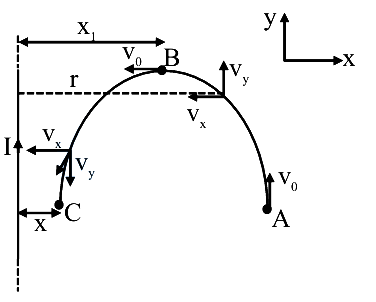
\(\begin{aligned} & A \rightarrow B \\ & \vec{V}=-v_x \hat{i}+v_y \hat{j} \\ & \vec{B}=\frac{\mu_0 I}{2 \pi r}(-\hat{k}) \\ & \overrightarrow{\mathrm{F}}=\mathrm{q}(\overrightarrow{\mathrm{v}} \times \overrightarrow{\mathrm{B}})=\frac{\mu_0 \mathrm{Iq}}{2 \pi r}\left[-\mathrm{v}_{\mathrm{x}} \hat{\mathrm{j}}-\mathrm{v}_{\mathrm{y}} \hat{\mathrm{i}}\right] \\ & \mathrm{a}_{\mathrm{x}}=-\frac{\mu_0 \mathrm{Iq}}{2 \pi \mathrm{~m}} \cdot \frac{v_y}{\mathrm{r}} \\ & \mathrm{a}_{\mathrm{y}}=-\frac{\mu_0 \mathrm{Iq}}{2 \pi m} \cdot \frac{v_x}{\mathrm{r}}\end{aligned}\)
\(\begin{aligned} & \frac{\mathrm{v}_{\mathrm{x}} \mathrm{dv}_{\mathrm{x}}}{\mathrm{dr}}=-\frac{\mu_0 \mathrm{Iq}}{2 \pi \mathrm{~m}} \frac{\mathrm{v}_{\mathrm{y}}}{\mathrm{r}} \\ & \frac{\mathrm{v}_{\mathrm{x}} \mathrm{dv}_{\mathrm{x}}}{\mathrm{v}_{\mathrm{y}}}=-\frac{\mu_0 \mathrm{Iq}}{2 \pi \mathrm{~m}} \frac{\mathrm{dr}}{\mathrm{r}} \\ & \int_0^{\mathrm{v}_0} \frac{\mathrm{v}_{\mathrm{x}} \mathrm{dv}_{\mathrm{x}}}{\sqrt{\mathrm{v}_0^2-\mathrm{v}_{\mathrm{x}}^2}}=-\frac{\mu_0 \mathrm{Iq}^{\mathrm{x}_1}}{2 \pi \mathrm{~m}} \int_{\mathrm{a}}^{\mathrm{dr}} \frac{\mathrm{r}}{2} \\ & \text { Let, } \mathrm{z}^2=\mathrm{v}_0^2-\mathrm{v}_{\mathrm{x}}^2 \\ & 2 \mathrm{zdz}=-2 \mathrm{v}_{\mathrm{x}} \mathrm{dv}_{\mathrm{x}}\end{aligned}\)
\(\begin{aligned}
& \mathrm{zdz}=-\mathrm{v}_{\mathrm{x}} \mathrm{dv}_{\mathrm{x}} \\
& \frac{\mathrm{v}_{\mathrm{x}} \mathrm{dv}_x}{\sqrt{\mathrm{v}_0^2-\mathrm{v}_{\mathrm{x}}^2}}=\frac{-\mathrm{zdz}}{\mathrm{z}}=-\mathrm{dz}
\end{aligned}\)
then integral becomes
\(\begin{aligned}
& -\int_{\mathrm{v}_0}^0 \mathrm{dz}=-\frac{\mu_0 \mathrm{Iq}}{2 \pi \mathrm{~m}} \ln \frac{\mathrm{x}_1}{\mathrm{a}} \\
& \mathrm{v}_0=-\frac{\mu_0 \mathrm{Iq}}{2 \pi \mathrm{~m}} \ln \frac{\mathrm{x}_1}{\mathrm{a}}
\end{aligned}\)
\(\left.\mathrm{x}_1=\mathrm{a} \mathrm{e}^{-\frac{2 \pi \mathrm{mv}}{\mu_0}} \mathrm{H}_0 \mathrm{q} \right\rvert\, \ldots \ldots\)
For B \(\rightarrow\) C
\(\begin{aligned}
& \overrightarrow{\mathrm{v}}=-v_x \hat{\mathrm{i}}-v_y \hat{\mathrm{j}} \\
& \overrightarrow{\mathrm{~B}}=\frac{\mu_0 \mathrm{I}}{2 \pi \mathrm{r}}(-\hat{\mathrm{k}}) \\
& \overrightarrow{\mathrm{F}}=\mathrm{q}(\overrightarrow{\mathrm{v}} \times \overrightarrow{\mathrm{B}})=\frac{\mu_0 \mathrm{Iq}}{2 \pi r}\left(-v_x \hat{j}+v_y \hat{\mathrm{i}}\right)
\end{aligned}\)
\(\begin{aligned}
& \mathrm{a}_{\mathrm{x}}=+\frac{\mu_0 \mathrm{Iq}}{2 \pi \mathrm{~m}} \frac{\mathrm{v}_{\mathrm{y}}}{\mathrm{r}} \quad \mathrm{a}_{\mathrm{y}}=-\frac{\mu_0 \mathrm{Iq}}{2 \pi \mathrm{~m}} \cdot \frac{\mathrm{v}_{\mathrm{x}}}{\mathrm{r}} \\
& \frac{\mathrm{v}_{\mathrm{x}} \mathrm{dv}_{\mathrm{x}}}{\mathrm{dr}}=\frac{\mu_0 \mathrm{Iq}}{2 \pi \mathrm{~m}} \frac{\mathrm{v}_{\mathrm{y}}}{\mathrm{r}} \\
& \int_{v_0}^0 \frac{\mathrm{v}_{\mathrm{x}} \mathrm{dv}_{\mathrm{x}}}{\sqrt{\mathrm{v}_0^2-\mathrm{v}_{\mathrm{x}}^2}}=\frac{\mu_0 \mathrm{Iq}}{2 \pi \mathrm{~m}} \int_{\mathrm{x_1}}^{\mathrm{x}}\frac{dr}{r}
\end{aligned}\)
\(\begin{aligned}
& \frac{\mu_0 \mathrm{Iq}}{2 \pi \mathrm{~m}} \ln \frac{\mathrm{x}}{\mathrm{x}_1}=-\int_0^{\mathrm{v}_0} \mathrm{~d} \mathrm{z}=-\mathrm{v}_0 \\
& \mathrm{x}=\mathrm{x}_1 \mathrm{e}^{-\frac{2 \pi \mathrm{~m}_0}{\mu_0 \mathrm{Iq}}} \ldots \ldots \text { (2) }
\end{aligned}\)
From equation 1 and 2
\(X=a e^{-\frac{4 \pi \mathrm{mv}_0}{\mu_0 \mathrm{Iq}}}\) -
- (A) A, D Only
- (B) A, B, E Only
- (C) B, D, E Only
- (D) A, B Only
Show answer and solution
Correct Answer: (D)
(A) \(\tau=\mathrm{C} \theta \Rightarrow\left[\mathrm{ML}^2 \mathrm{~T}^{-2}\right]=[\mathrm{C}][1]\)
(B) \(\mathbf{C} . \mathrm{S}=\frac{\theta}{\mathrm{I}}=\frac{\mathrm{BNA}}{\mathrm{C}}\);
V.S. \(=\frac{\mathrm{BNA}}{\mathrm{RC}}[\mathrm{R}\) also depends on ' N ']
(C) V.S. \(\propto \frac{\mathrm{NAB}}{\mathrm{CR}} \quad \mathrm{R} \rightarrow \mathrm{NR}\)
(D) False [Theory]
(E) E [False]
\(\mathrm{C} . \mathrm{S} \propto \mathrm{~N}\)
\(\Rightarrow \because \mathrm{C} . \mathrm{S} .=\frac{\mathrm{NAB}}{\mathrm{C}}\) -
- (A) \(\frac{3 \pi \mu_0 \mathrm{I}}{\sqrt{2} \mathrm{a}}\)
- (B) \(\frac{\mu_0 \mathrm{I}}{2 \pi \mathrm{a}}\)
- (C) \(\frac{\sqrt{2} \mu_0 \mathrm{I}}{3 \pi \mathrm{a}}\)
- (D) \(\frac{2 \mu_0 \mathrm{I}}{3 \pi \mathrm{a}}\)
Show answer and solution
Correct Answer: (C)
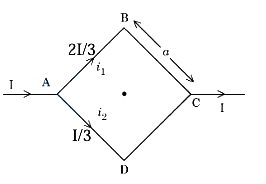
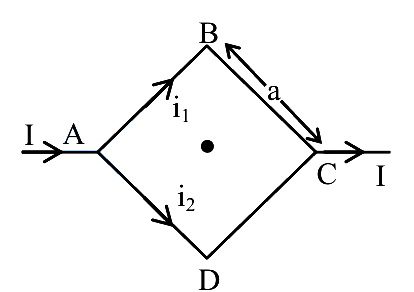
\(\overrightarrow{\mathrm{B}}=\overrightarrow{\mathrm{B}}_{\mathrm{AB}}+\overrightarrow{\mathrm{B}}_{\mathrm{BC}}+\overrightarrow{\mathrm{B}}_{\mathrm{CD}}+\overrightarrow{\mathrm{B}}_{\mathrm{DA}}\)
\(\begin{aligned} \overrightarrow{\mathrm{B}}= & {\left[\frac{-\mu_0(2 \mathrm{I} / 3)}{4 \pi(\mathrm{a} / 2)} \sqrt{2}-\frac{\mu_0(2 \mathrm{I} / 3)}{4 \pi(\mathrm{a} / 2)} \sqrt{2}\right.} \\ & \left.+\frac{\mu_0(\mathrm{I} / 3)}{4 \pi(\mathrm{a} / 2)} \sqrt{2}+\frac{\mu_0(\mathrm{I} / 3)}{4 \pi(\mathrm{a} / 2)} \sqrt{2}\right] \hat{\mathrm{k}} \\ \overrightarrow{\mathrm{B}}= & {\left[\frac{-2 \sqrt{2} \mu_0 \mathrm{I}}{3 \pi \mathrm{a}}+\frac{\sqrt{2} \mu_0 \mathrm{I}}{3 \pi \mathrm{a}}\right] \hat{\mathrm{k}} } \\ \overrightarrow{\mathrm{B}}= & \frac{-\sqrt{2} \mu_0 \mathrm{I}}{3 \pi \mathrm{a}} \hat{\mathrm{k}}\end{aligned}\) -
- (A) (A) is true but (R) is false
- (B) Both (A) and (R) are true but (R) is NOT the correct explanation of (A)
- (C) Both \((\mathbf{A})\) and \((\mathbf{R})\) are true and \((\mathbf{R})\) is the correct explanation of \((\mathbf{A})\)
- (D) (A) is false but (R) is true
Show answer and solution
Correct Answer: (C)
If the electron's velocity is along the direction of magnetic field then magnetic force on electron is zero and it will not accelerate. -
- (A) \(\mathrm{A}\) is true but \(\mathrm{R}\) is false.
- (B) Both \(\mathrm{A}\) and \(\mathrm{R}\) are true but \(\mathrm{R}\) is NOT the correct explanation of \(\mathrm{A}\).
- (C) \(\mathrm{A}\) is false but \(\mathrm{R}\) is true.
- (D) Both \(\mathrm{A}\) and \(\mathrm{R}\) are true and \(\mathrm{R}\) is the correct explanation of \(\mathrm{A}\).
Show answer and solution
Correct Answer: (A)
\(\begin{aligned} & r=\frac{m v}{q B}=\frac{p}{q B} \\ & r \propto \frac{1}{q}\end{aligned}\)
Assertion is true reason is false -
- (A) \(1: 1\)
- (B) \(1: 4\)
- (C) \(1: 3\)
- (D) \(1: 2\)
Show answer and solution
Correct Answer: (A)
\(\text { Voltage sensitivity }=\frac{\theta}{V}=\frac{N A B}{c R} \)
\( \text { Ratio }==\left(\frac{\mathrm{N}_1 \mathrm{~A}_1 \mathrm{~B}_1}{\mathrm{~N}_2 \mathrm{~A}_2 \mathrm{~B}_2}\right) \frac{\mathrm{R}_2}{\mathrm{R}_1}=\frac{15 \times 3.6 \times 0.25}{21 \times 1.8 \times 0.5} \times \frac{7}{5}=\frac{1}{1}\) -
- (A) 10
- (B) 15
- (C) 20
- (D) 5
Show answer and solution
Correct Answer: (D)
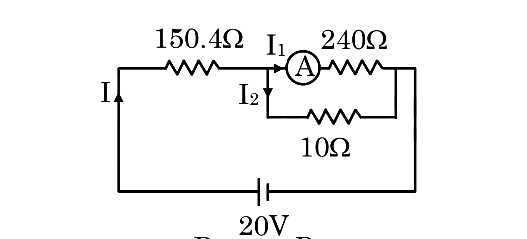
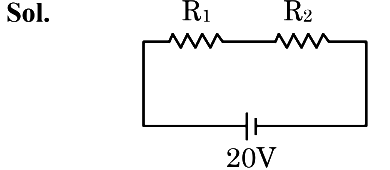
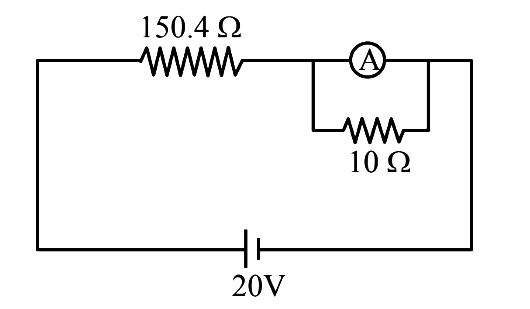
\(\begin{aligned} & \mathrm{R}_{\mathrm{eq}}=\mathrm{R}_1+\mathrm{R}_2 \\ & \mathrm{R}_{\mathrm{eq}}=150.4+\frac{240 \times 10}{250} \\ & =150.4+9.6=160 \Omega \\ & \mathrm{I}_1=\frac{\mathrm{I} \mathrm{R}_2}{240} \\ & \mathrm{I}_1=\frac{\mathrm{I} \times 9.6}{240} \\ & =\frac{20}{160} \times \frac{9.6}{2400}=\frac{1}{200}=5 \times 10^{-3} \mathrm{~A}=5 \mathrm{~mA}\end{aligned}\) -
- (A) \(4: 5\)
- (B) \(16: 25\)
- (C) \(64: 125\)
- (D) \(25: 16\)
Show answer and solution
Correct Answer: (C)
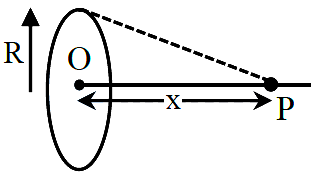
\(\begin{aligned} & \mathrm{B}_1=\frac{\mu_0 \mathrm{i}}{2 \mathrm{R}} \qquad \mathrm{B}_2=\mathrm{B}_1 \sin ^3 \theta \\ & \therefore \frac{\mathrm{~B}_2}{\mathrm{~B}_1}=\sin ^3 \theta=\left(\frac{4}{5}\right)^3=\frac{64}{125}\end{aligned}\) -
- (A) \(\frac{2 \pi}{N} q \omega\)
- (B) \(\frac{\mathrm{N}^2}{2 \pi} \mathrm{q} \omega\)
- (C) \(\frac{\mathrm{N}}{\pi} \mathrm{q} \omega\)
- (D) \(\frac{\mathrm{N}}{2 \pi} \mathrm{q} \omega\)
Show answer and solution
Correct Answer: (D)
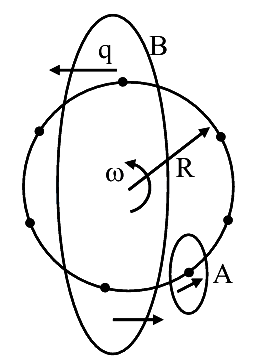
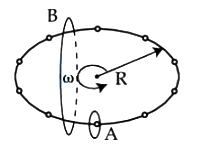
\(\begin{aligned} & I_A=\frac{N q}{\frac{2 \pi}{\omega}} \\ & I_A=\frac{N q \omega}{2 \pi}, I_B=0 \\ & I_A=I_B=\frac{N q \omega}{2 \pi}\end{aligned}\) -
- (A) 10
- (B) 8
- (C) 6
- (D) 4
Show answer and solution
Correct Answer: (B)
Assuming long solenoid
\(\begin{aligned}
& \mathrm{B}=\mu_0\left(\frac{\mathrm{~N}}{\ell}\right) \mathrm{i} \\
& \ell=\frac{\mu_0 \mathrm{Ni}}{\mathrm{~B}}=\frac{\left(4 \pi \times 10^{-7}\right)(200)(0.29)}{2.9 \times 10^{-4}} \mathrm{~m} \\
& =8 \pi \mathrm{~cm}
\end{aligned}\) -
- (A) 5
- (B) 4
- (C) 3
- (D) 1
Show answer and solution
Correct Answer: (D)
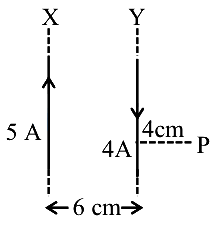
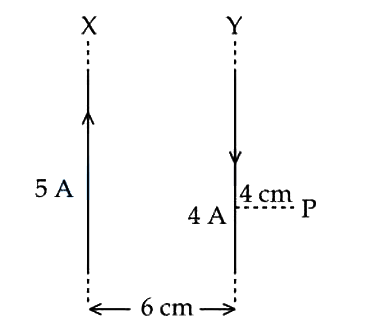
\(\begin{aligned} & B=\frac{\mu_0(5)}{2 \pi \times .01}-\frac{\mu_0 4}{2 \pi \times 0.04} \\ & =-\frac{100 \mu_0}{4 \pi} \\ & =-100 \times 10^{-7} \\ & =-1 \times 10^{-5} \mathrm{~T}\end{aligned}\) -
- (A) \(\frac{\mathrm{mv}}{\mathrm{qB}_1}\left(1-\frac{\mathrm{B}_2}{\mathrm{~B}_1}\right) \times 2\)
- (B) \(\frac{\mathrm{mv}}{\mathrm{qB}_1}\left(1-\frac{\mathrm{B}_1}{\mathrm{~B}_2}\right)\)
- (C) \(\frac{\mathrm{mv}}{\mathrm{qB}_1}\left(1-\frac{\mathrm{B}_2}{\mathrm{~B}_1}\right)\)
- (D) \(\frac{\mathrm{mv}}{\mathrm{qB}_1}\left(1-\frac{\mathrm{B}_1}{\mathrm{~B}_2}\right) \times 2\)
Show answer and solution
Correct Answer: (D)
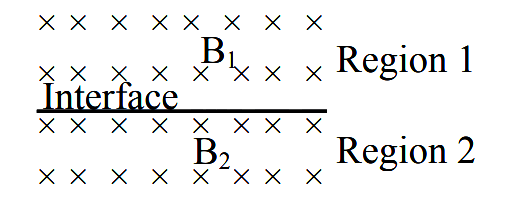
As \(\overrightarrow{\mathrm{v}}\) is \(\perp\) to \(\overrightarrow{\mathrm{B}}\), so charge particle will move in circular path, whose radius is given by
\(\mathrm{R}=\frac{\mathrm{mv}}{\mathrm{qB}}\)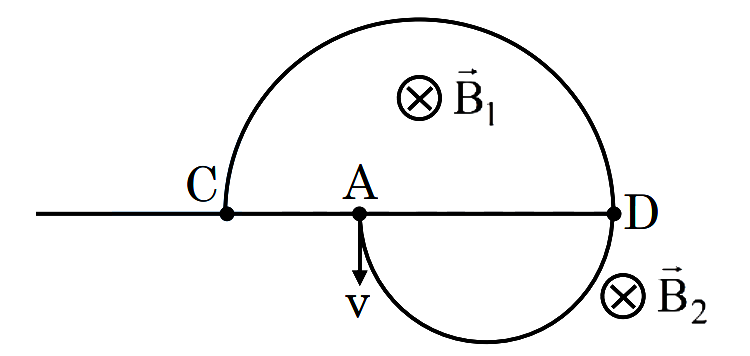
Starting point \(\rightarrow \mathrm{A}\)
Ending point \(\rightarrow \mathrm{C}\)
\(\therefore\) Net displacement \(=\mathrm{AC}\)
\(\begin{aligned} & \mathrm{AC}=\mathrm{CD}-\mathrm{AD} \\ & \mathrm{AC}=\frac{2 \mathrm{mv}}{\mathrm{qB}_1}-\frac{2 \mathrm{mv}}{\mathrm{qB}_2} \\ & \mathrm{AC}=\frac{2 \mathrm{mv}}{\mathrm{qB}_1}\left[1-\frac{\mathrm{B}_1}{\mathrm{~B}_2}\right]\end{aligned}\)
No questions on this page match these filters.