


Questions
33 questionsShowing 1–33 of 33 questions
-
- (A) 188
- (B) 199
- (C) 177
- (D) 166
Show answer and solution
Correct Answer: (B)
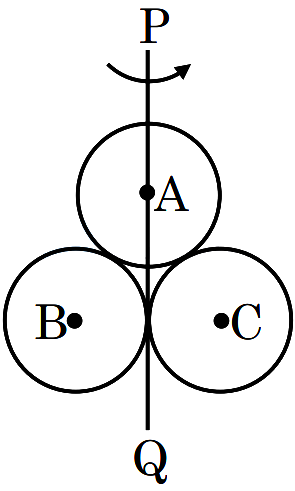
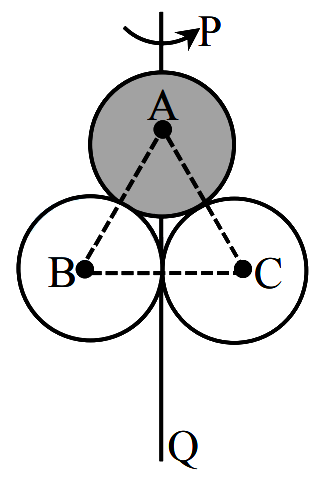
All bodies have same mass and same radius.
\(\mathrm{A} \rightarrow\) Disc
\(\mathrm{B} \rightarrow\) Solid sphere
\(\mathrm{C} \rightarrow\) Spherical shell
and, \(\mathrm{I}=\frac{\mathrm{MR}^2}{4}\)
\(\mathrm{I}_{\mathrm{PQ}}=\frac{\mathrm{MR}^2}{4}+\left(\frac{2}{5} \mathrm{MR}^2+\mathrm{MR}^2\right)+\left(\frac{2}{3} \mathrm{MR}^2+\mathrm{MR}^2\right)\)
\(\mathrm{I}_{\mathrm{PQ}}=\frac{15 \mathrm{MR}^2+24 \mathrm{MR}^2+60 \mathrm{MR}^2+40 \mathrm{MR}^2+60 \mathrm{MR}^2}{60}\)
\(\mathrm{I}_{\mathrm{PQ}}=\frac{199}{60} \mathrm{MR}^2=\frac{199}{15}\left(\frac{\mathrm{MR}^2}{4}\right)\)
\(=\frac{199}{15} \mathrm{I}\) -
- (A) \(72 MR ^2\)
- (B) \(8 MR ^2\)
- (C) \(108 MR ^2\)
- (D) \(60 MR ^2\)
Show answer and solution
Correct Answer: (D)
\(\theta =5 t ^2-8 t \)
\( \omega =\frac{ d \theta}{ dt }=10 t -8 \)
\( \alpha =\frac{ d \omega}{ dt }=10 \)
\( \therefore p =\tau \omega \)
\( =( I \alpha) \omega \)
\( =\left(\frac{ mR ^2}{2}\right) \alpha \omega \)
\( =\left(\frac{ mR ^2}{2}\right)(10)(10\)
Put \(t =2\)
\(p=60 mR^2\) -
- (A) 5
- (B) 6
- (C) 4
- (D) 2
Show answer and solution
Correct Answer: (C)
Applying Mechanical Energy conservation :
\(\mathrm{k}_{\mathrm{i}}+\mathrm{U}_{\mathrm{i}}=\mathrm{k}_{\mathrm{f}}+\mathrm{U}_{\mathrm{f}}\)
\(\begin{aligned}
& \Rightarrow 0+\mathrm{Mgh}=\frac{1}{2} \mathrm{mv}^2\left(1+\frac{\mathrm{k}^2}{\mathrm{R}^2}\right)+0 \\
& \Rightarrow \mathrm{~V}=\sqrt{\frac{2 \mathrm{gh}}{1+\frac{\mathrm{k}^2}{\mathrm{R}^2}}}
\end{aligned}\)
So Ratio of velocities
\(\frac{\mathrm{V}_{\text {Ring }}}{\mathrm{V}_{\text {solids sphere }}}=\sqrt{\frac{1+\frac{2}{5}}{1+1}}=\sqrt{\frac{7}{10}}\)
\(\mathrm{x}=3.5\) Rounding off \(\mathrm{x}=4\) -
- (A) \(20 \mathrm{rad} / \mathrm{s}\)
- (B) \(30 \mathrm{rad} / \mathrm{s}\)
- (C) \(10 \mathrm{rad} / \mathrm{s}\)
- (D) \(0 \mathrm{rad} / \mathrm{s}\)
Show answer and solution
Correct Answer: (A)
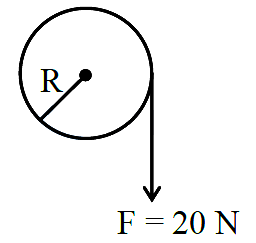
\(\begin{aligned} & \mathrm{W}_{\mathrm{F}}=20 \times 1=20 \mathrm{~J} \\ & \therefore \quad \Delta \mathrm{KE}=20 \mathrm{~J}=\frac{1}{2} \mathrm{I} \omega^2 \\ & \mathrm{I}=\mathrm{MR}^2=10 \times 0.1^2=0.1 \mathrm{~kg} \mathrm{~m}^2 \\ & \therefore \quad 20=\frac{1}{2} \times 0.1 \times \omega^2 \\ & \Rightarrow \omega=20 \mathrm{rad} / \mathrm{sec}\end{aligned}\) -
- (A) \(3.5 \mathrm{~m} / \mathrm{s}^2\)
- (B) \(0.35 \mathrm{~m} / \mathrm{s}^2\)
- (C) \(2.5 \mathrm{~m} / \mathrm{s}^2\)
- (D) \(0.25 \mathrm{~m} / \mathrm{s}^2\)
Show answer and solution
Correct Answer: (A)
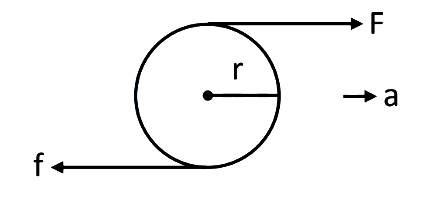
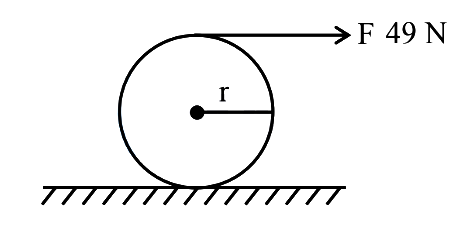
Torque about bottom point
\(\begin{aligned}
& \mathrm{F} \times 2 \mathrm{r}=\mathrm{I} \alpha \\
& 49 \times 2 \mathrm{r}=\frac{7}{5} \mathrm{mr}^2 \alpha \\
& 14=4 \mathrm{r} \alpha
\end{aligned}\)
As sphere rolls without slipping
\(\begin{aligned}
& \mathrm{a}=\mathrm{r} \alpha \\
& \mathrm{a}=\frac{14}{4}=\frac{7}{2}=3.5 \mathrm{~m} / \mathrm{s}^2
\end{aligned}\) -
- (A) \(2 \hat{i}+3 \hat{j}\)
- (B) \(3 \hat{i}+7 \hat{\mathrm{j}}\)
- (C) \(5 \hat{\mathrm{i}}+8 \hat{\mathrm{j}}\)
- (D) \(4 \hat{i}+9 \hat{j}\)
Show answer and solution
Correct Answer: (D)
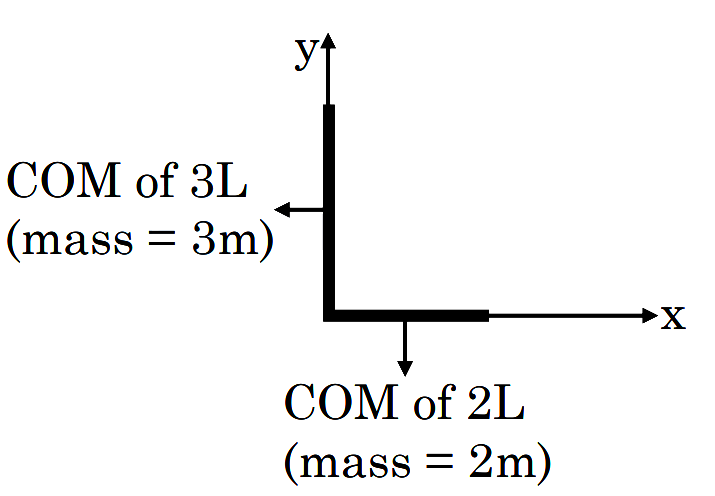
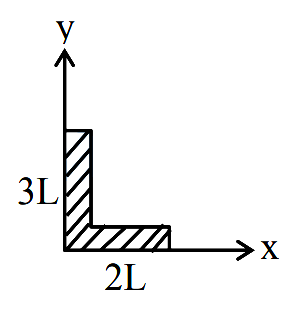
\(\mathrm{x}_{\mathrm{com}}=\frac{2 \mathrm{~m}(10)+3 \mathrm{~m}(0)}{5 \mathrm{~m}}=4 \mathrm{~cm}\)
\(\mathrm{y}_{\mathrm{com}}=\frac{2 \mathrm{~m}(0)+3 \mathrm{~m}(15)}{5 \mathrm{~m}}=9 \mathrm{~cm}\)
\(\overrightarrow{\mathrm{r}}_{\mathrm{com}}=4 \hat{\mathrm{i}}+9 \hat{\mathrm{j}}\) -
- (A) \(\frac{\lambda \mathrm{L}^3}{16 \pi^2}\)
- (B) \(\frac{\lambda \mathrm{L}^3}{12}\)
- (C) \(\frac{\lambda \mathrm{L}^3}{4 \pi^2}\)
- (D) \(\frac{\lambda L^3}{8 \pi^2}\)
Show answer and solution
Correct Answer: (D)
\(L=2 \pi R\)
\(\mathrm{I}=\frac{\mathrm{MR}^2}{2}=\frac{\lambda \times \mathrm{L}}{2} \times\left(\frac{\mathrm{L}}{2 \pi}\right)^2=\frac{\lambda \mathrm{L}^3}{8 \pi^2}\) -
- (A) \(t_1\gt t_2\)
- (B) \(t_1=t_2\)
- (C) \(t_1 \lt t_2\)
- (D) \(t_1=2 t_2\)
Show answer and solution
Correct Answer: (C)
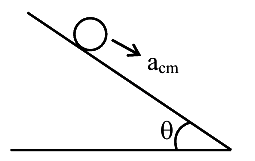
\(\begin{aligned} & \mathrm{t}=\sqrt{\frac{2 \ell}{\mathrm{a}_{\mathrm{cm}}}} \\ & \mathrm{a}_{\mathrm{cm}}=\frac{\mathrm{g} \sin \theta}{1+\frac{\mathrm{I}_{\mathrm{cm}}}{\mathrm{MR}^2}} \\ & \mathrm{a}_1=\mathrm{a}_{\mathrm{cm}_1}=\frac{5 \mathrm{~g} \sin \theta}{7} \ldots . . \text { Solid } \\ & \mathrm{a}_2=\mathrm{a}_{\mathrm{cm}_2}=\frac{3 \mathrm{~g} \sin \theta}{5} \ldots . . \text { Hollow } \\ & \mathrm{a}_1>\mathrm{a}_2 \\ & \mathrm{t}_1 < \mathrm{t}_2\end{aligned}\) -
- (A) \(\frac{3}{4}\)
- (B) \(\frac{4}{3}\)
- (C) \(\frac{5}{2}\)
- (D) \(\frac{2}{5}\)
Show answer and solution
Correct Answer: (C)
\(\begin{aligned}
& \mathrm{KE}_{(T)}=\frac{1}{2} m v^2 \\
& \mathrm{KE}_{(R)}=\frac{1}{2} \cdot \frac{2}{5} m R^2 \cdot \frac{v^2}{R^2}=\frac{1}{2} m v^2\left(\frac{2}{5}\right)
\end{aligned}\)
So, \(\frac{\mathrm{KE}_{(T)}}{\mathrm{KE}_{(R)}}=\frac{5}{2}\) -
- (A) \(1: \sqrt{2}\)
- (B) \(1: \sqrt{3}\)
- (C) \(1: 3\)
- (D) \(1: 2\)
Show answer and solution
Correct Answer: (A)
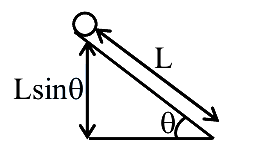
using WET
\(\begin{aligned}
& \mathrm{W}_{\mathrm{g}}=\mathrm{k}_{\mathrm{f}}-\mathrm{k}_{\mathrm{i}} \\
& \mathrm{Mg} \mathrm{~L} \sin \theta=\mathrm{k}_{\mathrm{f}}-\mathrm{k}_{\mathrm{i}}
\end{aligned}\)
K.E. in pure rolling \(\frac{1}{2} \mathrm{mV}_{\mathrm{cm}}^2+\frac{1}{2} \mathrm{I}_{\mathrm{cm}} \omega^2\)
\(\begin{aligned}
& =\frac{1}{2} \mathrm{mV}^2+\frac{1}{2} \times \frac{2}{5} \mathrm{mR}^2 \frac{\mathrm{~V}^2}{\mathrm{R}^2} \\
& \frac{7}{10} \mathrm{mV}^2
\end{aligned}\)
\(\mathrm{mgL} \sin \theta=\frac{7}{10} \mathrm{mV}_{\mathrm{f}}^2-0\)
\(\begin{aligned}
& \mathrm{V}_{\mathrm{f}}^2 \propto \sin \theta \\
& \left(\frac{\mathrm{~V}_1}{\mathrm{~V}_2}\right)^2=\frac{\sin \theta_1}{\sin \theta_2}=\frac{\sin 30^{\circ}}{\sin 45^{\circ}}=\frac{1}{\sqrt{2}}
\end{aligned}\) -
- (A) 34
- (B) 30
- (C) 32
- (D) 36
Show answer and solution
Correct Answer: (C)
When sphere is of radius \(R\), its mass is \(M\), when radius is reduced to \(\frac{\mathrm{R}}{2}\), mass will reduced to \(\frac{\mathrm{M}}{8}\) Now by conservation of angular momentum
\(\begin{aligned}
& \left(\tau_{e x t}=0\right) \\
& L_1=L_2 \\
& I_1 \omega_1=I_2 \omega_2 \\
& \left(\frac{2}{5} M R^2\right) \omega_1=\left(\frac{2}{5}\left(\frac{\mathrm{M}}{8}\right)\left(\frac{\mathrm{R}}{2}\right)^2\right) \omega_2
\end{aligned}\)
\(\omega_2=32 \omega_1\) value of x is 32
Answer is 32 -
- (A) 20 N
- (B) 0 (zero)
- (C) 10 N
- (D) \(10 \sqrt{2} \mathrm{~N}\)
Show answer and solution
Correct Answer: (C)
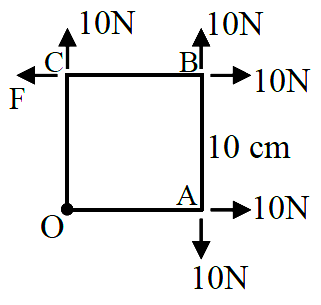
Since the lamina is equilibrium.
\(\therefore \mathrm{F}_{\mathrm{net}}=0 \& \tau_{\mathrm{net}}=0\)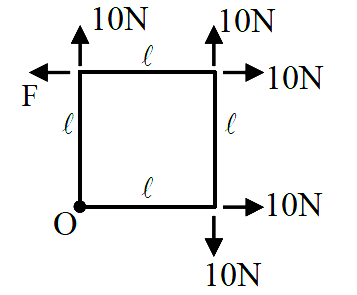
\(\mathrm{T}_{\mathrm{o}}=10 \ell-\mathrm{F} \ell \Rightarrow \mathrm{F}=10 \mathrm{~N}\) -
- (A) 60
- (B) 50
- (C) 40
- (D) 30
Show answer and solution
Correct Answer: (C)
Given, \(\mathrm{m}=1 \mathrm{~kg}\)
\(\begin{aligned}
& \omega_{\mathrm{i}}=1800 \mathrm{rpm}=1800 \times \frac{2 \pi}{60}=60 \pi \frac{\mathrm{rad}}{\mathrm{sec}} \\
& \omega_{\mathrm{f}}=2100 \mathrm{rpm}=2100 \times \frac{2 \pi}{60}=70 \pi \frac{\mathrm{rad}}{\mathrm{sec}} \\
& \tau_{e x t}=25 \pi \mathrm{Nm} \\
& \mathrm{t}=40 \mathrm{sec}
\end{aligned}\)
Using equation of motion
\(\begin{aligned}
& \omega_{\mathrm{f}}=\omega_{\mathrm{i}}+\alpha \mathrm{t} \\
& 70 \pi=60 \pi+\alpha(40) \\
& \alpha=\frac{\pi}{4} \mathrm{rad} / \mathrm{sec}^2
\end{aligned}\)
Also, \(\tau=\mathrm{I} \alpha\)
\(\tau=\frac{\mathrm{mR}^2}{4} \alpha\)
\(\begin{aligned}
& 25 \pi=\frac{1 \times \mathrm{R}^2}{4} \times \frac{\pi}{4} \\
& \mathrm{R}=20 \mathrm{~m}
\end{aligned}\)
Hence, diameter of disk \(=2 \mathrm{R}=2 \times 20=40 \mathrm{~m}\) -
- (A) \(\frac{7}{32} \mathrm{MR}^2\)
- (B) \(\frac{9}{32} \mathrm{MR}^2\)
- (C) \(\frac{17}{32} \mathrm{MR}^2\)
- (D) \(\frac{13}{32} \mathrm{MR}^2\)
Show answer and solution
Correct Answer: (D)
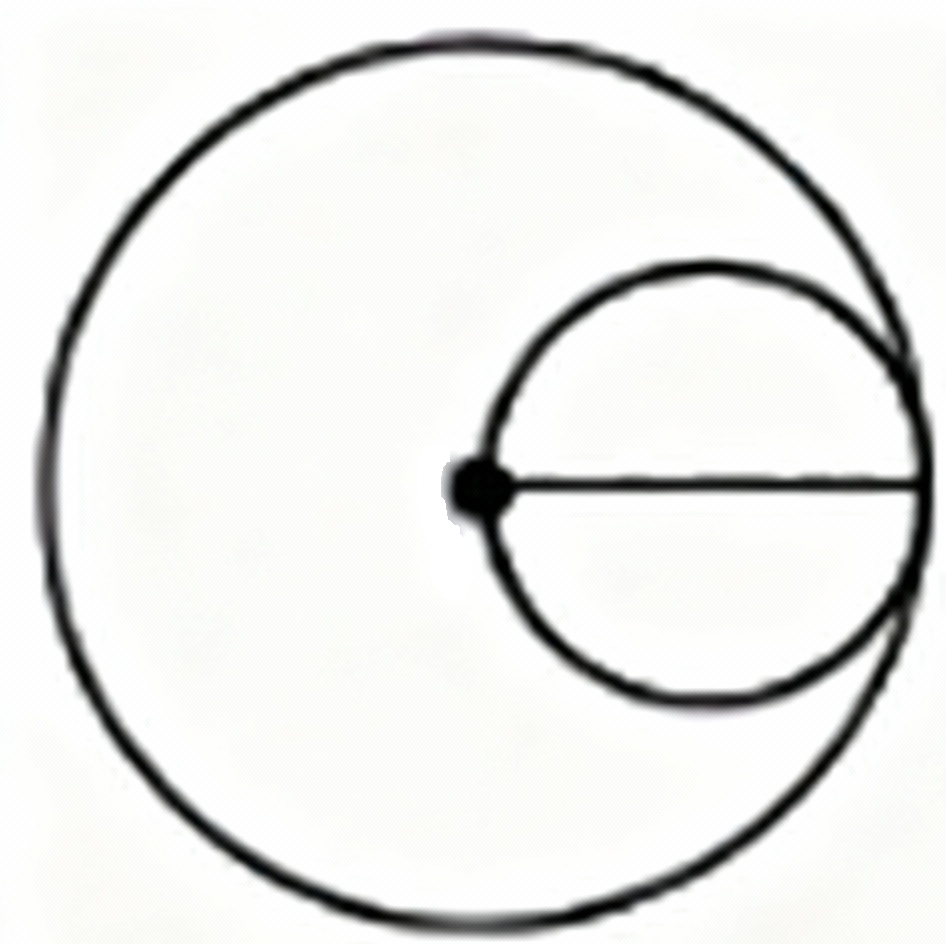
\(\begin{aligned} & I_{\text {complete }}=\frac{M R^2}{2} \\ & \begin{aligned} I_{\text {removed }} & =\left(\frac{M}{4}\right)\left(\frac{R}{2}\right)^2 \frac{1}{2}+\left(\frac{M}{4}\right)\left(\frac{R}{2}\right)^2 \\ & =\frac{3 M R^2}{32} \\ I=\frac{M R^2}{2} & -\frac{3 M R^2}{32}=\frac{13}{32} M R^2\end{aligned}\end{aligned}\) -
- (A) \(190\mathrm {~g}\)
- (B) \(200\mathrm {~g}\)
- (C) \(300\mathrm {~g}\)
- (D) \(290\mathrm {~g}\)
Show answer and solution
Correct Answer: (A)
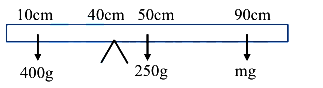
\(\begin{aligned} & \tau_{\text {Net }}=0 \Rightarrow(400 \mathrm{~g} \times 30)=(250 \mathrm{~g} \times 10)(\mathrm{mg} \times 50) \\ & \mathrm{m}=\frac{12000-2500}{50}=\frac{9500}{50} \\ & \mathrm{M}=190 \mathrm{~g}\end{aligned}\) -
- (A) \(\frac{1}{\sqrt{2}} \mathrm{~g}\)
- (B) \(\frac{1}{3 \sqrt{2}} \mathrm{~g}\)
- (C) \(\frac{\sqrt{2} \mathrm{~g}}{3}\)
- (D) \(\sqrt{2} g\)
Show answer and solution
Correct Answer: (C)
\(\begin{aligned} & a=\frac{\mathrm{g} \sin \theta}{1+\frac{\mathrm{I}}{\mathrm{mR}^2}} \\ & a=\frac{\frac{g}{\sqrt{2}}}{1+\frac{1}{2}}=\frac{2 \frac{g}{\sqrt{2}}}{3}=\frac{\sqrt{2} g}{3}\end{aligned}\) -
- (A) \(4 \sqrt{2} \mathrm{~m} / \mathrm{s}\)
- (B) \(8 \mathrm{~m} / \mathrm{s}\)
- (C) \(4 \mathrm{~m} / \mathrm{s}\)
- (D) \(8 \sqrt{2} \mathrm{~m} / \mathrm{s}\)
Show answer and solution
Correct Answer: (A)
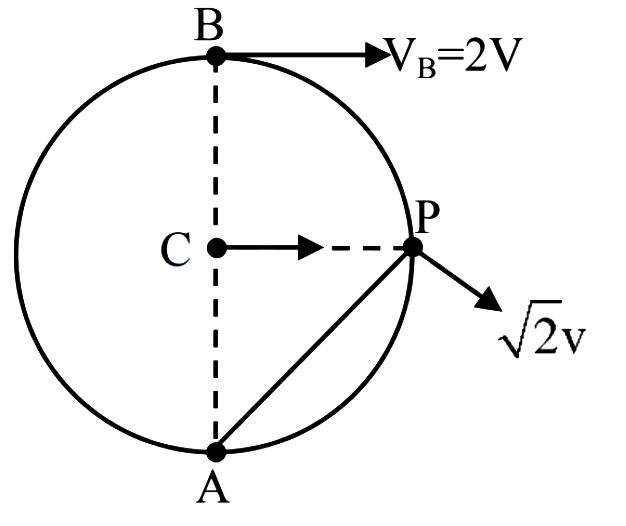
If \(V_B=2 V\)
Point A is instantaneous center of rotation
Given \(V_B=8 \mathrm{~m} / \mathrm{s}\)
\(\begin{aligned}
& \mathrm{V}=4 \mathrm{~m} / \mathrm{s} \\
& \mathrm{~V}_{\mathrm{p}}=\sqrt{2} \mathrm{v} \Rightarrow \mathrm{~V}_{\mathrm{p}}=4 \sqrt{2} \mathrm{~m} / \mathrm{s} \\
& \operatorname{correct}(1)
\end{aligned}\) -
- (A) 1
- (B) 2
- (C) 3
- (D) 4
Show answer and solution
Correct Answer: (A)
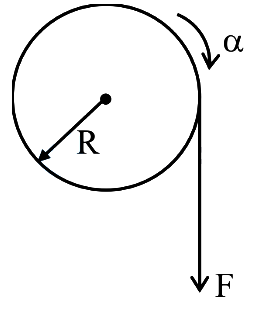
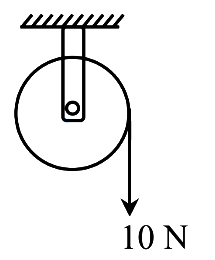
\(\begin{aligned} & \mathrm{FR}=\mathrm{I} \alpha \\ & \Rightarrow \mathrm{I}=\frac{\mathrm{FR}}{\alpha}=\frac{10 \times 0.2}{2}=1 \mathrm{~kg}-\mathrm{m}^2\end{aligned}\) -
- (A) \(\frac{m v_o^3}{2 \sqrt{2} g}\) along negative \(z\)-axis
- (B) \(\frac{m v_o^3}{4 \sqrt{2} g}\) along positive \(z\)-axis
- (C) \(\frac{m v_o^3}{4 \sqrt{2} g}\) along negative \(z\)-axis
- (D) \(\frac{m v_o^3}{2 \sqrt{2} g}\) along positive \(z\)-axis
Show answer and solution
Correct Answer: (C)
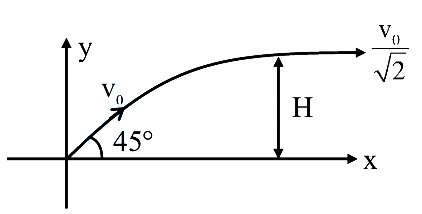
\(\begin{aligned}
& \mathrm{H}=\frac{\left(\frac{\mathrm{v}_0}{\sqrt{2}}\right)^2}{2 \mathrm{~g}}=\frac{\mathrm{v}_0^2}{4 \mathrm{~g}} \\
& \mathrm{~L}=\mathrm{mvh} \\
& \mathrm{~L}=\mathrm{m} \frac{\mathrm{v}_0}{\sqrt{2}} \frac{\mathrm{v}_0^2}{4 \mathrm{~g}}
\end{aligned}\) -
- (A) 2.0 cm
- (B) 1.5 cm
- (C) 1.0 cm
- (D) 0.5 cm
Show answer and solution
Correct Answer: (C)
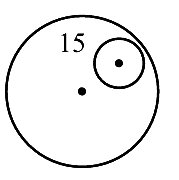
\(\text { mass of disc }=\mathrm{m}\)
\(\text { mass of cut part }=\frac{m}{16}\)
\(X_{c o m}=\frac{m \times 0-\frac{m}{16} \times 15}{m-\frac{m}{16}}\)
\(=1 \mathrm{~cm} .\) -
- (A) \(0.2\mathrm{~m}\)
- (B) \(0.4\mathrm{~m}\)
- (C) \(0.1\mathrm{~m}\)
- (D) \(0.3\mathrm{~m}\)
Show answer and solution
Correct Answer: (C)
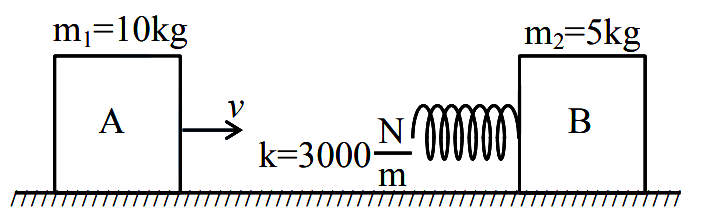
\(\begin{aligned} & \mathrm{m}_1 \mathrm{v}_1+\mathrm{m}_2 \mathrm{v}_2=\left(\mathrm{m}_1+\mathrm{m}_2\right) \mathrm{v}_{\mathrm{cm}} \\ & \mathrm{v}_{\mathrm{cm}} \Rightarrow \frac{10 \times 3}{10+5} \Rightarrow \frac{30}{15}=2 \mathrm{~m} / \mathrm{s}\end{aligned}\)
\(\frac{1}{2} \mathrm{kx}^2=\frac{1}{2}(10)(3)^2-\left[\frac{1}{2}(15)(2)^2\right]\)
\(\Rightarrow 90-60=30=3000 x^2\)
\(\begin{aligned} & \mathrm{x}^2 \Rightarrow \frac{30}{3000}=\frac{1}{100} \\ & \mathrm{x} \Rightarrow \frac{1}{10} \mathrm{~m}.\end{aligned}\) -
- (A) Opposite to the direction of \(\vec{r}\)
- (B) Opposite to the direction of \(\overrightarrow{\mathrm{L}}\)
- (C) Opposite to the direction of \(\vec{P}\)
- (D) Opposite to the direction of \(\overrightarrow{\mathrm{L}} \times \overrightarrow{\mathrm{P}}\)
Show answer and solution
Correct Answer: (A)
\(\overrightarrow{\mathrm{a}}=-\omega^2 \overrightarrow{\mathrm{r}}\)
\(\therefore \overrightarrow{\mathrm{F}}\) opposite to \(\overrightarrow{\mathrm{r}}-\) -
- (A) 9
- (B) 10
- (C) 11
- (D) 12
Show answer and solution
Correct Answer: (A)
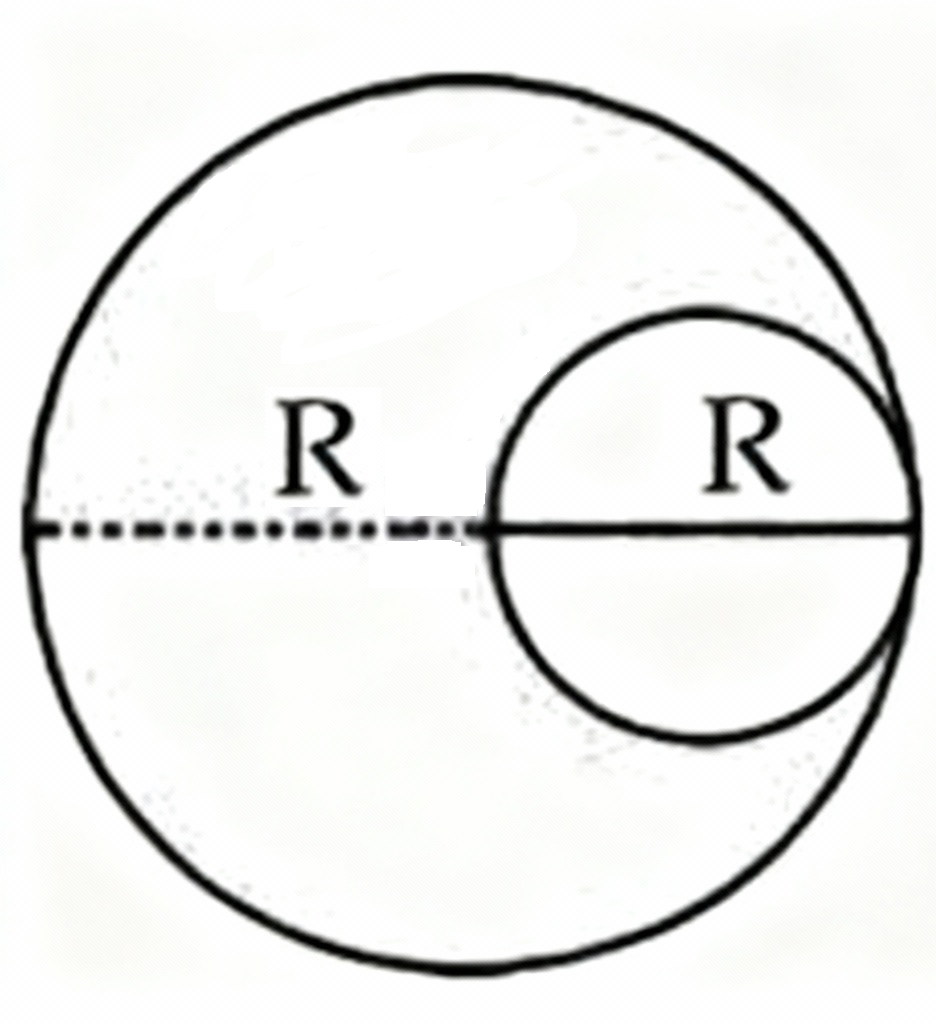
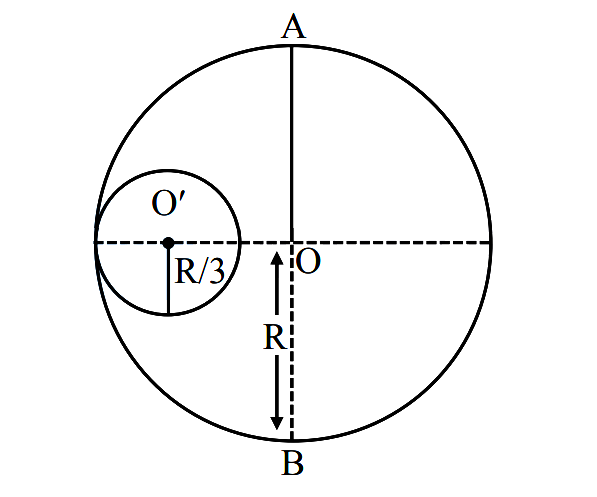
Without cavity \(\mathrm{I}_1=\frac{\mathrm{MR}^2}{2}\)
\(\begin{aligned}
\text { Mass of removed disc }= & \frac{\mathrm{M}}{\pi \mathrm{R}^2} \times\left(\frac{\mathrm{R}}{3}\right)^2 \pi \\
& =\left(\frac{\mathrm{M}}{9}\right)
\end{aligned}\)
M.I. of removed disc \(I_2=\frac{\frac{M}{9}\left(\frac{R}{3}\right)^2}{2}+\frac{M}{9} \times\left(\frac{2 R}{3}\right)^2\)
\(\begin{aligned}
& =\frac{\mathrm{MR}^2}{18} \\
& \mathrm{I}=\mathrm{I}_1-\mathrm{I}_2=\frac{\mathrm{MR}^2}{2}-\frac{\mathrm{MR}^2}{18}=\frac{4 \mathrm{MR}^2}{9} \\
& (\mathrm{n}=9)
\end{aligned}\) -
- (A) \(\alpha\)
- (B) \(\alpha / 4\)
- (C) \(\alpha / 8\)
- (D) \(\alpha / 2\)
Show answer and solution
Correct Answer: (B)
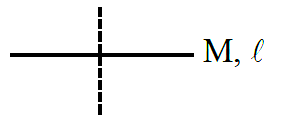
\(\alpha=\frac{\mathrm{M} \ell^2}{12}\)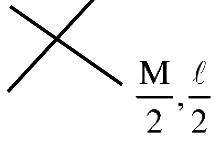
\(\begin{aligned} & \alpha^{\prime}=2\left[\frac{\frac{\mathrm{M}}{2}\left(\frac{\ell}{2}\right)^2}{12}\right] \\ & \alpha^{\prime}=\frac{\mathrm{M} \ell^2}{48}=\frac{\alpha}{4}\end{aligned}\)
Correct option is (2) -
- (A) \(\left(\frac{2}{3} a, \frac{\mathrm{~b}}{2}\right)\)
- (B) \(\left(\frac{a}{2}, \frac{\mathrm{~b}}{2}\right)\)
- (C) \(\left(\frac{1}{3} a, \frac{\mathrm{~b}}{2}\right)\)
- (D) \(\left(\frac{2}{3} a, \frac{2}{3} b\right)\)
Show answer and solution
Correct Answer: (A)
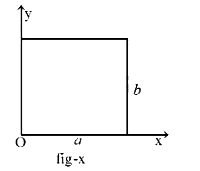
\(\begin{aligned} & d m=\sigma d A \\ & \begin{aligned} d & =\sigma(d x)(d y)=\frac{\sigma_0 x}{a b}(d x)(d y) \\ x_{c o m} & =\frac{\int x d m}{\int d m}=\frac{\int x \frac{\left(\sigma_0 x\right)}{a b}(d x)(d y)}{\int_0 \frac{\sigma_0}{a b}(d x)(d y)} \\ & =\frac{\int_0^a x^2 d x \int_0^b d y}{\int_0^b x d x \int_0^b d y}=\frac{2 a}{3} \\ y_{c o m} & =\frac{\int y d m}{\int d m}=\frac{\int y\left(\frac{\sigma_0 x}{a b}\right)(d x)(d y)}{\int \frac{\sigma_0 x}{a b}(d x)(d y)}\end{aligned}\end{aligned}\)
\(=\frac{\int_0^a x d x \int_0^b y d y}{\int_0^a x d x \int_0^b d y}=\frac{b}{2}\)
i.e., \(\vec{r}_{\mathrm{com}} \equiv\left(\frac{2 a}{3}, \frac{b}{2}\right)\) -
- (A) 2
- (B) 4
- (C) 6
- (D) 8
Show answer and solution
Correct Answer: (A)
\(\begin{aligned} & \vec{\tau}=\overrightarrow{\mathrm{r}} \times \overrightarrow{\mathrm{F}}=\left|\begin{array}{ccc}\hat{\mathrm{i}} & \hat{\mathrm{j}} & \hat{\mathrm{k}} \\ 1 & 1 & 1 \\ 1 & -1 & 1\end{array}\right| \\ & \vec{\tau}=\hat{\mathrm{k}}(-1-1)=-2 \hat{\mathrm{k}} \\ & |\vec{\tau}|=2 \mathrm{Nm}\end{aligned}\) -
- (A) \(\frac{1}{2} \mathrm{Mr}^2\)
- (B) \(\frac{3}{8} \mathrm{Mr}^2\)
- (C) \(\frac{3}{2} \mathrm{Mr}^2\)
- (D) \(2 \mathrm{Mr}^2\)
Show answer and solution
Correct Answer: (B)
Diameter is given as R.
\(\begin{aligned}
& \therefore \text { Radius }=\mathrm{R} / 2 \\
& \mathrm{I}_{\text {tan gent }}=\frac{3}{2} \mathrm{~m}\left(\frac{\mathrm{R}}{2}\right)^2=\frac{3}{8} \mathrm{mR}^2
\end{aligned}\) -
- (A) 10
- (B) 5
- (C) 4
- (D) 2
Show answer and solution
Correct Answer: (C)
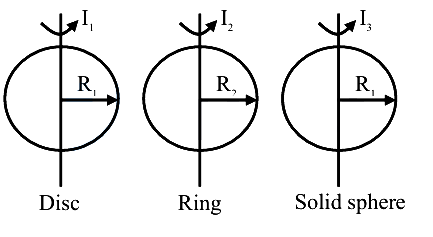
\(\mathrm{I}_1=\frac{\mathrm{MR}_1^2}{4}, \mathrm{I}_2=\frac{\mathrm{MR}_2^2}{2}, \mathrm{I}_3=\frac{2 \mathrm{MR}_1^2}{5}\)
According to problem
\(\frac{\mathrm{I}_1}{\mathrm{I}_2}=2.5 \Rightarrow \frac{\frac{\mathrm{MR}_1^2}{4}}{\frac{\mathrm{MR}_2^2}{2}}=\frac{5}{2} \Rightarrow \frac{\mathrm{R}_1^2}{\mathrm{R}_2^2}=5 \ldots\)
Now we are provided with information that
\(\begin{aligned}
& \frac{\mathrm{I}_3}{\mathrm{I}_2}=\mathrm{n} \\
& \Rightarrow \frac{\frac{2 \mathrm{MR}_1^2}{5}}{\frac{\mathrm{MR}_2^2}{2}}=\mathrm{n} \Rightarrow \frac{4 \mathrm{R}_1^2}{5 \mathrm{R}_2^2}=\mathrm{n}
\end{aligned}\)
From Eq', (1) and (2)
\(\Rightarrow n=4\) -
- (A) 100
- (B) 80
- (C) 70
- (D) 90
Show answer and solution
Correct Answer: (D)
At \(t=1\)
\(r_{A B}=-1 \hat{i}+(3 n+1) \hat{j}+(2-4 p) \hat{k}\)
At \(t=1\)
\(v_A=2 \hat{i}+3 n \hat{j}+2 \hat{k} \)
\(v_B=2 \hat{i}-2 \hat{j}+4 p \hat{k} \)
\(\vec{v}_A-\vec{v}_B=0, \quad 4-6 n+8 p=0\)
\(\left|v_A\right|=\left|v_B\right| \quad(3 n)^2+4=4+16 p^2 \)
\( 3 n=-4 p \)
\( 4+16 p=0 \)
\( p=-\frac{1}{4}, n=\frac{1}{3} \)
\( r_{A B}=-\hat{i}+2 \hat{j}+3 \hat{k} \)
\( v_A=2 \hat{i}+\hat{j}+2 \hat{k} \)
\( \therefore L=m\left|\vec{r}_{A B} \times \vec{v}_A\right|=90\) -
- (A) \(\hat{i}-\hat{k}\)
- (B) \(\hat{i}+\hat{k}\)
- (C) \(\hat{j}+\hat{k}\)
- (D) \(\hat{i}-\hat{j}+\hat{k}\)
Show answer and solution
Correct Answer: (A)
\(\begin{aligned} \tau & =\dot{r} \times \dot{F} \\ \tau & =\left|\begin{array}{lll}\hat{i} & \hat{j} & \hat{k} \\ 1 & 1 & 1 \\ 2 & 1 & 2\end{array}\right| \\ \tau & =\hat{i}(2-1)-\hat{j}[0]+\hat{k}(1-2) \\ & =\hat{i}-\hat{k}\end{aligned}\) -
- (A) \(3 \mathrm{a} \mathrm{m} \mathrm{V}_0\)
- (B) \(\frac{3}{2}\) a \(\mathrm{m} \mathrm{V}_0\)
- (C) \(\frac{\sqrt{3}}{2}\) a \(\mathrm{m} \mathrm{V}_0\)
- (D) \(\frac{1}{2}\) a \(\mathrm{mV}_0\)
Show answer and solution
Correct Answer: (C)
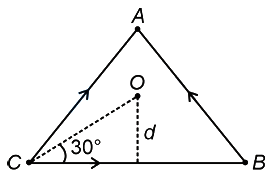
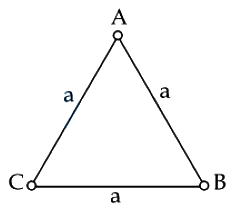
\(d=\frac{a}{2 \sqrt{3}}\)
Angular momentum of one mass about point \(O\)
\(\begin{aligned}
L & =m v d \\
& =m v_0 \cdot \frac{a}{2 \sqrt{3}}
\end{aligned}\)
Net angular momentum about point \(O\)
\(\begin{aligned}
L_{\text {net }} & =32 \\
& =\frac{\sqrt{3} m v_0 a}{2}
\end{aligned}\) -
- (A) 14
- (B) 16
- (C) 12
- (D) 10
Show answer and solution
Correct Answer: (B)
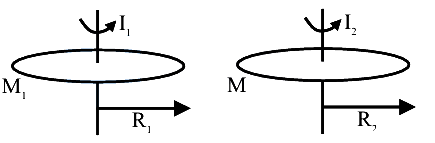
Given \(R_2=2 R_1\)
\(\begin{aligned}
& M_1=\sigma \times \pi R_1^2=M_o \\
& M_2=\sigma \times \pi R_2^2=M_o \\
& M_2=\sigma \times \pi R_2^2=\sigma \times \pi\left[2 R_1\right]^2=\sigma \times 4 \pi R_1^2=4 M_o
\end{aligned}\)
\(\frac{I_1}{I_2}=\frac{\frac{M_1 R_1^2}{2}}{\frac{M_2 R_2^2}{2}}=\frac{M_1 R_1^2}{M_2 R_2^2}=\frac{1}{4} \times \frac{1}{4}=\frac{1}{16}\) -
- (A) B, D and E Only
- (B) C and D Only
- (C) B, C, D and E Only
- (D) A, B, D and E Only
Show answer and solution
Correct Answer: (C)
Conceptual
No questions on this page match these filters.