


All JEE Mains 2025 Physics questions
32 chaptersShowing 301–350 of 454 questions
-
- (A) \(\sqrt{\frac{7}{5}}: \sqrt{\frac{5}{3}}: \sqrt{\frac{4}{3}}\)
- (B) \(\sqrt{\frac{5}{3}}: \sqrt{\frac{4}{3}}: \sqrt{\frac{7}{5}}\)
- (C) \(\sqrt{\frac{5}{3}}: \sqrt{\frac{4}{3}}: \sqrt{\frac{4}{3}}\)
- (D) \(\sqrt{\frac{4}{3}}: \sqrt{\frac{5}{3}}: \sqrt{\frac{7}{5}}\)
Show answer and solution
Correct Answer: (C)
\(\mathrm{v}_{\text {sound }}=\sqrt{\frac{\gamma \mathrm{p}}{\rho}} \\ \gamma=1+\frac{2}{\mathrm{f}} \\ \gamma_{\mathrm{He}}=\frac{5}{3} \\ \gamma_{\mathrm{CH}_4}=\gamma_{\mathrm{CO}_2} \approx 1.33=\frac{4}{3}\) (Experimental data) -
- (A) 5 m
- (B) 3 m
- (C) 0.5 m
- (D) 0.33 m
Show answer and solution
Correct Answer: (B)
\(\begin{aligned} & \mathrm{x}(\mathrm{t})=5 \cos \left[628 \mathrm{t}+\frac{\pi}{2}\right] \mathrm{m} \\ & \text { velocity }\left(\mathrm{v}_\omega\right)=300 \mathrm{~m} / \mathrm{s} \\ & \mathrm{v}_{\mathrm{w}}=\frac{\omega}{\mathrm{K}} \\ & 300=\frac{628}{\mathrm{~K}} \Rightarrow \mathrm{~K}=\frac{628}{300} \\ & \frac{2 \pi}{\lambda}=\frac{628}{300} \Rightarrow \lambda=\frac{2 \times 3.14 \times 300}{628} \\ & \lambda=2 \mathrm{~m}\end{aligned}\) -
- (A) Both \(\mathbf{A}\) and \(\mathbf{R}\) are true but \(\mathbf{R}\) is NOT the correct explanation of \(\mathbf{A}\)
- (B) \(\mathbf{A}\) is true but \(\mathbf{R}\) is false
- (C) \(\mathbf{A}\) is false but \(\mathbf{R}\) is true
- (D) Both \(\mathbf{A}\) and \(\mathbf{R}\) are true and \(\mathbf{R}\) is the correct explanation of \(\mathbf{A}\)
Show answer and solution
Correct Answer: (B)
Speed of sound in a medium depends on inertial and elastic properties as \(v=\sqrt{\frac{B}{P}}\) for gases and \(v=\sqrt{\frac{Y}{P}}\) for solids. Since the elastic property of solid happens to be many folds greater than that of gases, the speed of sound in solids i5 higher than in gases.
Also, bulk modulus of gases varies between 0 and \(\infty\left(B=-v \frac{d P}{d v}\right)\) hence reason is false. -
- (A) \(25 \%\)
- (B) \(20 \%\)
- (C) \(-20 \%\)
- (D) \(-25 \%\)
Show answer and solution
Correct Answer: (A)
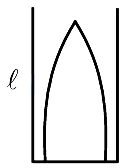
\(\lambda_1=4 \ell\)
\(\mathrm{f}_1=\frac{\mathrm{v}}{4 \ell}\)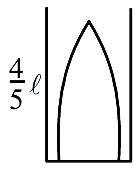
\(\begin{aligned} & \lambda_2=\frac{16 \ell}{5} \\ & \mathrm{f}_2=\frac{5 \mathrm{~V}}{16 \ell} \\ & \frac{\Delta \mathrm{f}}{\mathrm{f}}=\frac{\frac{\mathrm{V}}{\ell}\left(\frac{1}{16}\right)}{\frac{\mathrm{V}}{4 \ell}} \times 100=25 \%\end{aligned}\) -
- (A) \(335 \mathrm{~m} / \mathrm{s}\)
- (B) \(370 \mathrm{~m} / \mathrm{s}\)
- (C) \(340 \mathrm{~m} / \mathrm{s}\)
- (D) \(360 \mathrm{~m} / \mathrm{s}\)
Show answer and solution
Correct Answer: (D)
Fundamental frequency in close/organ pipe
\(\begin{aligned} & (\mathrm{f})=\frac{\mathrm{v}}{4 \ell} \\ & \mathrm{f}_1=\frac{\mathrm{v}}{4 \ell_1} \& \mathrm{f}_2=\frac{\mathrm{v}}{4 \ell_2}\end{aligned}\)
Beat \(=\left(\mathrm{f}_1-\mathrm{f}_2\right)=\frac{\mathrm{v}}{4}\left(\frac{1}{\ell_1}-\frac{1}{\ell_2}\right)\)
\(\begin{aligned} & 15=\frac{\mathrm{v}}{4}\left(\frac{1}{1}-\frac{1}{1.2}\right) \\ & \mathrm{v}=\left(\frac{15 \times 4 \times 1.2}{0.2}\right)=60 \times 6=360 \mathrm{~m} / \mathrm{s}\end{aligned}\) -
- (A) \(\left[6, \frac{2 \pi}{3}\right]\)
- (B) \(\left[6, \frac{\pi}{3}\right]\)
- (C) \(\left[\sqrt{3}, \frac{\pi}{6}\right]\)
- (D) \(\left[2 \sqrt{3}, \frac{\pi}{6}\right]\)
Show answer and solution
Correct Answer: (D)
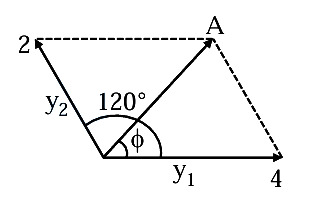
\(\begin{aligned} & \begin{array}{l}\mathrm{A}=\sqrt{2^2+4^2+2 \times 2 \times 4 \times \cos 120^{\circ}} \\ \quad=\sqrt{12}=2 \sqrt{3} \\ \tan \phi=\frac{2 \sin 120^{\circ}}{4+2 \cos 120^{\circ}}=\frac{\sqrt{3}}{3}=\frac{1}{\sqrt{3}} \\ \phi=\frac{\pi}{6}\end{array}\end{aligned}\) -
- (A) \(-60 \mathrm{~m} / \mathrm{s}\)
- (B) \(-30 \mathrm{~m} / \mathrm{s}\)
- (C) \(+30 \mathrm{~m} / \mathrm{s}\)
- (D) \(+60 \mathrm{~m} / \mathrm{s}\)
Show answer and solution
Correct Answer: (B)
\(\begin{aligned}
& k=20 \times 10^{-3} \mathrm{~mm}^{-1}=20 \mathrm{~m}^{-1} \\
& w=600 \mathrm{~s}^{-1} \\
& v=\frac{W}{k}=\frac{600}{20}=30 \mathrm{~m} / \mathrm{s}
\end{aligned}\)
and \(x \& t\) carry same sign
Therefore \(\mathrm{v}=-30 \mathrm{~m} / \mathrm{s}\) -
- (A) 5.0 cm
- (B) 20 cm
- (C) 10 cm
- (D) 2.5 cm
Show answer and solution
Correct Answer: (A)
Minimum distance between 2 points having same speed is \(\frac{\lambda}{2}\).
\(\lambda=\frac{2 \pi}{\mathrm{k}}=\frac{1}{10} \mathrm{~m}=10 \mathrm{~cm}\)
\(\text { Distance }=\frac{\lambda}{2}=5 \mathrm{~cm}\) -
- (A) 6 s
- (B) 4 s
- (C) 1 s
- (D) 2 s
Show answer and solution
Correct Answer: (D)
The given equation can be written as
\(\mathrm{x}=\frac{\mathrm{a}}{2} \cos [1.5+50.5] \mathrm{t}+\frac{\mathrm{a}}{2} \cos [50.5-1.5]\)
\(x=\frac{a}{2} \cos [52 t]+\frac{a}{2} \cos [49 t]\)
Here, \(2 \pi \mathrm{f}_1 \& 2 \pi \mathrm{f}_2=49\)
\(\mathrm{f}_1=\frac{52}{2 \pi}, \mathrm{f}_2=\frac{49}{2 \pi}\)
\(\therefore \mathrm{f}_{\text {Bat }}=\mathrm{f}_1-\mathrm{f}_2=\frac{3}{2 \pi} \mathrm{~Hz}\)
\(\therefore \mathrm{T}_{\text {Beat }}=\frac{1}{\mathrm{f}_{\text {Beat }}}=\frac{2 \pi}{3} \mathrm{sec}\)
\(=2.09 \mathrm{sec} \approx 2 \mathrm{sec}\) -
- (A) \(\sqrt{2}\)
- (B) 2
- (C) 8
- (D) 4
Show answer and solution
Correct Answer: (B)
\(\begin{aligned} & v=\sqrt{\frac{T}{\mu}}=\sqrt{\frac{T}{f \pi R^2}} \\ & \frac{v_2}{v_1}=\frac{R_1}{R_2}=2\end{aligned}\) -
- (A) \(6\)
- (B) \(2\)
- (C) \(4\)
- (D) \(1\)
Show answer and solution
Correct Answer: (B)
Additional buoyant force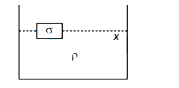
\(\begin{aligned}
& g \rho a^2 x=\sigma a^3 A \\
& A=\frac{\rho}{\sigma} \frac{g}{a} x \\
& T=2 \pi \sqrt{\frac{\sigma a}{\rho g}}
\end{aligned}\)
Now, \(\sigma=\frac{10 \times 10^{-3}}{10^{-3}}=10\)
\(\begin{aligned} \Rightarrow \quad T & =2 \pi \sqrt{\frac{10 \times 0.1}{10^3 \times 10}} \\ & =2 \pi \times 10^{-2}\end{aligned}\) -
- (A) \(\frac{16}{5}\)
- (B) \(10\)
- (C) \(\frac{15}{4}\)
- (D) \(25\)
Show answer and solution
Correct Answer: (D)
A = 1 cm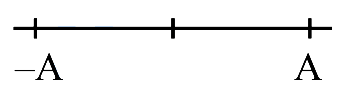
\(\begin{aligned} & \mathrm{n}=\frac{12.5}{2}=6.25 \text { cycles } \\ & \therefore \mathrm{D}=4 \times 6+1=25 \\ & \mathrm{~d}=1 \\ & \frac{D}{d}=25\end{aligned}\) -
- (A) \(175\)
- (B) \(25 \sqrt{7}\)
- (C) \(5 \sqrt{7}\)
- (D) \(125\)
Show answer and solution
Correct Answer: (A)
\(\begin{aligned} & \mathrm{x}_1=\sqrt{7} \sin 5 \mathrm{t} \\ & \mathrm{x}_2=2 \sqrt{7} \sin \left(5 \mathrm{t}+\frac{\pi}{3}\right)\end{aligned}\)
From phasor,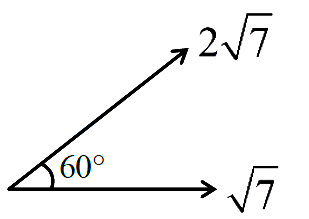
\(\therefore\) Amplitude of resultant \(\mathrm{SHM}=7\)
\(\begin{aligned} & \phi=\tan ^{-1} \frac{2 \sqrt{7} \times \sqrt{3} / 2}{\sqrt{7}+2 \sqrt{7} \times \frac{1}{2}}=\tan ^{-1} \frac{\sqrt{21}}{2 \sqrt{7}}=\tan ^{-1} \frac{\sqrt{3}}{2} \\ & \therefore \quad \mathrm{X}_{\mathrm{R}}=7 \sin (5 \mathrm{t}+\phi) \\ & \quad \mathrm{a}_{\mathrm{R}}=-7 \times 25 \sin (5 \mathrm{t}+\phi) \\ & \therefore \mathrm{a}_{\max }=175 \mathrm{~cm} / \mathrm{sec}=175 \times 10^{-2} \mathrm{~m} / \mathrm{sec}\end{aligned}\) -
- (A) (A) is false but (R) is true
- (B) (A) is true but (R) is false
- (C) Both (A) and (R) are true but (R) is NOT the correct explanation of (A)
- (D) Both \((\mathbf{A})\) and \((\mathbf{R})\) are true and \((\mathbf{R})\) is the correct explanation of \((\mathbf{A})\)
Show answer and solution
Correct Answer: (D)
\(\begin{aligned} & \text { If we express position } x(t)=A \sin (\omega t+\phi) \\ & \text { then } x_0=A \sin \phi \\ & v_0=A \omega \cos \phi \\ & \Rightarrow \tan \phi=\frac{\omega x_0}{v_0} \\ & A=\sqrt{x_0^2+\frac{v_0^2}{\omega^2}}\end{aligned}\)
Hence both position and linear momentum of a particle can be expressed as a function of time if we know initial momentum and position -
- (A) A, B, D Only
- (B) B, C, D Only
- (C) C, D, E Only
- (D) A, B, C Only
Show answer and solution
Correct Answer: (A)
(A) As both blocks moving together so Time period \(=2 \pi \sqrt{\frac{\mathrm{~m}}{\mathrm{~K}}} ;\) where \(\mathrm{m}=\mathrm{M}+\mathrm{m}\)
\(\mathrm{T}=2 \pi \sqrt{\frac{\mathrm{M}+\mathrm{m}}{\mathrm{~K}}}\)
(B) Let block is displaced by x in \((+\mathrm{ve})\) direction so force on block will be in(-ve) direction
\(\begin{aligned}
& \mathrm{F}=-\mathrm{Kx} \\
& (\mathrm{M}+\mathrm{m}) \mathrm{a}=-\mathrm{Kx} \\
& \mathrm{a}=-\frac{\mathrm{Kx}}{(\mathrm{M}+\mathrm{m})}
\end{aligned}\)
(C) As upper block is moving due to friction thus
\(\mathrm{f}=\mathrm{ma}=\frac{\mathrm{mKx}}{(\mathrm{M}+\mathrm{m})}\)
(D) This option is like two block problem in friction for maximum amplitude, force on block is also maximum, for which both blocks are moving together.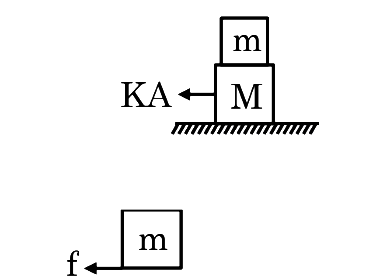
\(\begin{aligned}
& K A=(M+m) a \\
& a=\frac{K A}{(M+m)} \\
& f=m a=\frac{m K A}{(M+m)} \\
& f_{\max }=f_L=\mu \mathrm{mg} \\
& f=\mu m g \\
& \frac{m K A}{(M+m)}=\mu m g \\
& A=\frac{\mu(M+m) g}{K}
\end{aligned}\)
(E) Maximum friction can be \(\mu \mathrm{mg}\) as force is acting between blocks & normal force here is mg. -
- (A) \(\frac{\mathrm{k}_1}{\mathrm{k}_2}\)
- (B) \(\sqrt{\frac{\mathrm{k}_1}{\mathrm{k}_2}}\)
- (C) \(\sqrt{\frac{\mathrm{k}_2}{\mathrm{k}_1}}\)
- (D) \(\frac{\mathrm{k}_2}{\mathrm{k}_1}\)
Show answer and solution
Correct Answer: (B)
\(\begin{aligned} & \mathrm{V}_1=\mathrm{A}_1 \omega_1 \\ & \mathrm{~V}_2=\mathrm{A}_2 \omega_2 \\ & \mathrm{~A}_1=\mathrm{A}_2 \\ & \frac{\mathrm{~V}_1}{\mathrm{~V}_2}=\frac{\omega_1}{\omega_2}=\frac{\sqrt{\frac{\mathrm{K}_1}{\mathrm{~m}}}}{\sqrt{\frac{\mathrm{~K}_2}{\mathrm{~m}}}} \\ & \frac{\mathrm{~V}_1}{\mathrm{~V}_2}=\sqrt{\frac{\mathrm{K}_1}{\mathrm{~K}_2}}\end{aligned}\) -
- (A) \(\theta_1 l_2^2=\theta_2 l_1^2\)
- (B) \(\theta_1 l_1=\theta_2 l_2\)
- (C) \(\theta_1 l_1^2=\theta_2 l_2^2\)
- (D) \(\theta_1 l_2=\theta_2 l_1\)
Show answer and solution
Correct Answer: (D)
\(\begin{aligned} & \omega=\sqrt{\frac{\mathrm{g}}{\ell}} \\ & \alpha=-\omega^2 \theta \\ & \therefore \frac{\mathrm{~g}}{\ell_1} \theta_1=\frac{\mathrm{g}}{\ell_2} \theta_2 \\ & \Rightarrow \theta_1 \ell_2=\theta_2 \ell_2\end{aligned}\) -
- (A) 327
- (B) 328
- (C) 329
- (D) 330
Show answer and solution
Correct Answer: (A)
\(\begin{aligned} V & =\text { constant } \\ \frac{P_1}{T_1} & =\frac{P_2}{T_2} \\ P_2 & =2 P_1 \\ T_2 & =2 T_1 \\ & =2 \times 300=600 \mathrm{~K} \\ \therefore T_2 & =327^{\circ} \mathrm{C}\end{aligned}\) -
- (A) 3
- (B) 4
- (C) 5
- (D) 6
Show answer and solution
Correct Answer: (A)
\(\begin{aligned} & \frac{\gamma_A}{\gamma_B}=\frac{\mathrm{f}_{\mathrm{A}}+2}{\mathrm{f}_{\mathrm{A}}} \times \frac{\mathrm{f}_{\mathrm{B}}}{\mathrm{f}_{\mathrm{B}}+2} \\ & =\frac{3+2}{3} \times \frac{(6+2)}{(6+2)+2} \\ & =\frac{5}{3} \times \frac{8}{10}=\frac{40}{30} \\ & \because \frac{40}{30}=1+\frac{1}{\mathrm{n}} \\ & \Rightarrow \frac{40}{30}-1=\frac{1}{\mathrm{n}}\end{aligned}\)
\(\Rightarrow \mathrm{n}=3\) -
- (A) \(\gamma_2=\gamma_1\)
- (B) \(2 \gamma_2=\gamma_1\)
- (C) \(\gamma_2 \lt \gamma_1\)
- (D) \(\gamma_2\gt\gamma_1\)
Show answer and solution
Correct Answer: (C)
For rigid diatomic molecules
\(\begin{array}{ll}
& f=5 \\
\therefore & \gamma_1=\frac{7}{5}=1.4
\end{array}\)
For non-rigid diatomic molecules
\(\begin{array}{ll}
& f=5+2=7 \\
& \gamma_2=\frac{9}{7}=1.28 \\
\therefore & \gamma_1>\gamma_2
\end{array}\) -
- (A) A-III, B-IV, C-I, D-II
- (B) A-III, B-II, C-IV, D-I
- (C) A-II, B-IV, C-I, D-III
- (D) A-IV, B-II, C-III, D-I
Show answer and solution
Correct Answer: (A)
\(\gamma=1+\frac{2}{\mathrm{f}}\)
\(f=6\), Triatomic rigid gas
\(\mathrm{f}=7\), Diatomic non-rigid gas
\(f=5\), Diatomic rigid gas
\(\mathrm{f}=3\), monoatomic rigid gas
\(\gamma=1+\frac{2}{6}=\frac{4}{3}\) (Triatomic)
\(\gamma=1+\frac{2}{7}=\frac{9}{7}(\) Diatomic, non-rigid \()\)
\(\gamma=1+\frac{2}{5}=\frac{7}{5}(\) Diatomic, rigid \()\)
\(\gamma=1+\frac{2}{3}=\frac{5}{3}(\) Monoatomic, rigid \()\)
A-III, B-IV, C-I, D-II -
- (A) \(25^{\circ} \mathrm{C}\)
- (B) \(2500\mathrm{~K}\)
- (C) \(250\mathrm{~K}\)
- (D) \(250^{\circ} \mathrm{C}\)
Show answer and solution
Correct Answer: (C)
Isochoric process
\(\begin{aligned} & \mathrm{P} \propto \mathrm{T} \\ & \frac{\Delta \mathrm{P}}{\mathrm{P}}=\frac{\Delta \mathrm{T}}{\mathrm{T}}\end{aligned}\)
\(\begin{aligned} & \frac{0.4}{100}=\frac{1}{T} \\ & T=250 \mathrm{~K}\end{aligned}\) -
- (A) \(1: 10\)
- (B) \(10: 1\)
- (C) \(1: \sqrt{10}\)
- (D) \(1: 1\)
Show answer and solution
Correct Answer: (D)
\(K. E=\frac{f}{2} K T\)
For He and \(\mathrm{Ar}=3\)
\(\frac{\mathrm{K} \cdot \mathrm{E}_{\mathrm{He}}}{\mathrm{~K} \cdot \mathrm{E}_{\mathrm{Ar}}}=\frac{1}{1}\) -
- (A) 10
- (B) 12
- (C) 14
- (D) 16
Show answer and solution
Correct Answer: (B)
To find the internal energy of gas in the room.
\(\begin{aligned}
& \mathrm{U}=\mathrm{nC}_{\mathrm{v}} \mathrm{~T}=\mathrm{n} \frac{5 \mathrm{RT}}{2} \\
& =\frac{5}{2} \mathrm{PV}=\frac{5}{2} \times 10^5 \times 48=12 \times 10^6 \mathrm{~J}
\end{aligned}\) - 325. The kinetic energy of translation of the molecules in 50 g of \(\mathrm{CO}_2\) gas at \(17^{\circ} \mathrm{C}\) is 2025 Easy
- (A) 4205.5 J
- (B) 4102.8 J
- (C) 3582.7 J
- (D) 3986.3 J
Show answer and solution
Correct Answer: (B)
Kinetic energy of translation \(=\frac{3}{2} n R T\)
\(\begin{aligned}
& n=\frac{50 \mathrm{~g}}{44 \mathrm{~g}}=\frac{25}{22} \mathrm{~mol} \\
& T=17^{\circ} \mathrm{C}=290 \mathrm{~K}
\end{aligned}\)
\(\Rightarrow\) Kinetic energy of translation
\(\begin{aligned}
& =\frac{3}{2}\left(\frac{25}{22}\right)(8.3)(290) \mathrm{J} \\
& =4102.8 \mathrm{~J}
\end{aligned}\) -
- (A) \(2 \times 10^{10} / \mathrm{s}\)
- (B) \(9 \times 10^5 / \mathrm{s}\)
- (C) \(2 \times 10^9 / \mathrm{s}\)
- (D) \(5 \times 10^8 / \mathrm{s}\)
Show answer and solution
Correct Answer: (C)
\(\begin{aligned} & \text { Frequency }=\frac{1}{T}=\frac{V_{\text {avg }}}{\lambda} \\ & =\frac{600}{3 \times 157}=2 \times 10^9 \mathrm{sec}^{-1}\end{aligned}\) - 327. The ratio of vapour densities of two gases at the same temperature is \(\frac{4}{25}\), then the ratio of r.m.s. velocities will be: 2025 Easy
- (A) \(\frac{25}{4}\)
- (B) \(\frac{2}{5}\)
- (C) \(\frac{5}{2}\)
- (D) \(\frac{4}{25}\)
Show answer and solution
Correct Answer: (C)
(Vapor density) \(=\left(\frac{\text { Molar mass }}{2}\right)\), I.e, \(v d=\frac{M}{2}\)
\(\begin{aligned} & v_{\mathrm{rms}}=\sqrt{\frac{3 R T}{M}} \\ & \frac{v_2}{v_1}=\sqrt{\frac{M_1}{M_2}}=\sqrt{\frac{25}{4}}=\frac{5}{2}\end{aligned}\) -
- (A) \(4.4\)
- (B) \(6\)
- (C) \(24\)
- (D) \(18\)
Show answer and solution
Correct Answer: (B)
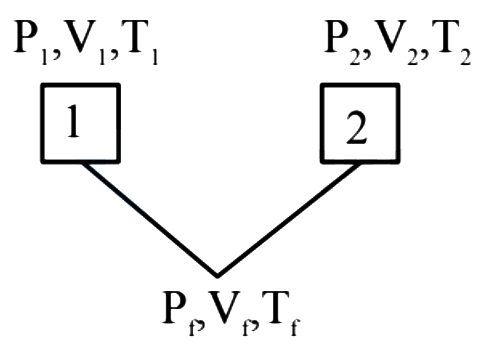
Number of masses will remain constant
\(\begin{aligned}
& \mathrm{n}_1+\mathrm{n}_2=\mathrm{n}_{\mathrm{f}} \\
& \frac{\mathrm{P}_1 \mathrm{~V}_1}{\mathrm{RT}_1}+\frac{\mathrm{P}_2 \mathrm{~V}_2}{\mathrm{RT}_2}=\frac{\mathrm{P}_{\mathrm{f}} \mathrm{~V}_{\mathrm{f}}}{\mathrm{RT}_{\mathrm{f}}} \\
& \frac{8 \times 2 \mathrm{~V}}{\mathrm{R} \times 1000}+\frac{7 \times \mathrm{V}}{\mathrm{R} \times 500}=\frac{\mathrm{P}_{\mathrm{f}}(3 \mathrm{~V})}{\mathrm{R} \times 600} \\
& \frac{16}{1000}+\frac{14}{1000}=\frac{\mathrm{P}_{\mathrm{f}}}{\mathrm{R} \times 600} \\
& \frac{30}{1000}=\frac{\mathrm{P}_{\mathrm{f}}}{200} \\
& \mathrm{P}_{\mathrm{f}}=6 \mathrm{kPa}
\end{aligned}\) -
- (A) \(\eta_{12}=\eta_1 \eta_2\)
- (B) \(\eta_{12} \geq \eta_1+\eta_2\)
- (C) \(\eta_{12}=\eta_1+\eta_2\)
- (D) \(\eta_{12} \lt \eta_1+\eta_2\)
Show answer and solution
Correct Answer: (D)
Efficiencies of a carnot engine \(\eta=1-\frac{T_{\text {sink }}}{T_{\text {source }}}\)
\(\begin{aligned}
\Rightarrow & \eta_1=1-\frac{373 \mathrm{~K}}{473 \mathrm{~K}}=\frac{100}{473} \\
& \eta_2=1-\frac{273 \mathrm{~K}}{373 \mathrm{~K}}=\frac{100}{373} \\
& \eta_{12}=1-\frac{273 \mathrm{~K}}{473 \mathrm{~K}}=\frac{100}{473} \\
& \eta_{12}-\eta_1=\frac{200}{473}-\frac{100}{473}=\frac{100}{473} < \frac{100}{373} \\
\Rightarrow & \eta_{12}-\eta_1 < \eta_2 \\
\text { or } & \eta_{12} < \eta_1+\eta_2
\end{aligned}\) -
- (A) 327 K
- (B) 600 K
- (C) 522 K
- (D) 300 K
Show answer and solution
Correct Answer: (D)
\(\begin{aligned}
& \mathrm{V}_1=800 \mathrm{~cm}^3 \quad \mathrm{~V}_2=200 \mathrm{~cm}^3 \\
& \mathrm{~T}_1=300 \mathrm{~K}
\end{aligned}\)
for adiabatic
\(\begin{aligned}
& \mathrm{TV}^{\gamma-1}=\text { const. } \\
& (300)(800)^{1.5-1}=\mathrm{T}_2(200)^{1.5-1} \\
& \mathrm{~T}_2=300\left[\frac{800}{200}\right]^{0.5}=300 \times\left(2^2\right)^{1 / 2} \\
& \mathrm{~T}_2=600 \mathrm{~K} \\
& \Delta \mathrm{~T}=600-300=300 \mathrm{~K}
\end{aligned}\) -
- (A) 16
- (B) 40
- (C) 32
- (D) 28
Show answer and solution
Correct Answer: (C)
\(\begin{aligned} & P_i V_i^\gamma=P_f V_f^\gamma \\ & \frac{P_f}{P_i}=\left(\frac{V_i}{V_f}\right)^\gamma=(8)^{5 / 3} \\ & \frac{P_f}{P_i}=32\end{aligned}\) -
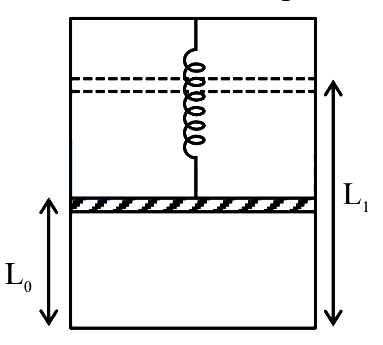
- (A) \(3 n R T \ln \left(\frac{L_1}{L_0}\right)+2 \mathrm{Mg}\left(L_1-L_0\right)+\frac{k}{3}\left(L_1^3-L_0^3\right)\)
- (B) \(n R T \ln \left(\frac{L_1^2}{L_0^2}\right)+\frac{M g}{2}\left(L_1-L_0\right)+\frac{k}{4}\left(L_1^4-L_0^4\right)\)
- (C) \(n R T \ln \left(\frac{L_1}{L_0}\right)+M g\left(L_1-L_0\right)+\frac{k}{4}\left(L_1^4-L_0^4\right)\)
- (D) \(n R T \ln \left(\frac{L_1}{L_0}\right)+M g\left(L_1-L_0\right)+\frac{3 k}{4}\left(L_1^4-L_0^4\right)\)
Show answer and solution
Correct Answer: (C)
Using WET
Total energy supplied \(=\) gravitational potential energy + spring potential energy + work done by gas
\(\begin{aligned}
& \operatorname{Mg} \quad\left(L_1-L_0\right)+\int_{L_0}^{L_1} k^3 d x+n R T \ell n \\
& {\left[\frac{L_1 \mathrm{~A}}{\mathrm{~L}_0 \mathrm{~A}}\right]+\mathrm{W}_{\mathrm{ext}}=0} \\
& \frac{\mathrm{~K}}{4}\left[\mathrm{x}^4\right]_{\mathrm{L}_0}^{\mathrm{L}_1}+\operatorname{Mg}\left(\mathrm{L}_1-\mathrm{L}_0\right)+\int_{\mathrm{L}_0}^{\mathrm{L}_1} k x^3 d x+n R T \ell n
\end{aligned}\)
\(\begin{aligned} & {\left[\frac{L_1}{L_0}\right]+\mathrm{W}_{\mathrm{ext}}=0} \\ & \frac{\mathrm{k}}{4}\left(\mathrm{~L}_1^4-\mathrm{L}_0^4\right)+\operatorname{Mg} \quad\left(\mathrm{L}_1-\mathrm{L}_0\right)+\mathrm{nRT} \ell \mathrm{n} \\ & {\left[\frac{\mathrm{L}_1}{\mathrm{~L}_0}\right]+\mathrm{W}_{\mathrm{ext}}=0} \\ & \mathrm{~W}_{\mathrm{ext}}=\frac{\mathrm{k}}{4}\left(\mathrm{~L}_1^4-\mathrm{L}_0^4\right)+\operatorname{Mg}\left(\mathrm{L}_1-\mathrm{L}_0\right)+\mathrm{nRT} \ell \mathrm{n}\left[\frac{\mathrm{L}_1}{\mathrm{~L}_0}\right]\end{aligned}\) -
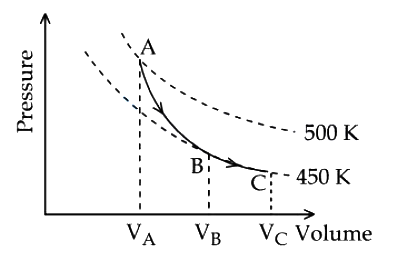
- (A) \(500 \mathrm{R}(\ln 3+\ln 4)\)
- (B) \(450 \mathrm{R}(\ln 4-\ln 3)\)
- (C) \(500 \mathrm{R} \ln 2\)
- (D) \(400 \mathrm{R} \ln 4\)
Show answer and solution
Correct Answer: (B)
\(\begin{aligned} & \Delta \mathrm{Q}_{\mathrm{AB}}=0 \text { adiabatic } \\ & \Delta \mathrm{Q}_{\mathrm{BC}}=\Delta \mathrm{W}_{\mathrm{BC}} \\ & =\mathrm{nRT} \ell \mathrm{n}\left(\frac{\mathrm{V}_{\mathrm{C}}}{\mathrm{V}_{\mathrm{B}}}\right)=450 \mathrm{R} \ell \mathrm{n}\left(\frac{8 \times 10^{-6}}{6 \times 10^{-6}}\right) \\ & =450 \mathrm{R} \ell \mathrm{n}\left(\frac{4}{3}\right)=450 \mathrm{R}(\ln 4-\ell \mathrm{n} 3) \\ & \therefore \Delta \mathrm{Q}=\Delta \mathrm{Q}_{\mathrm{AB}}+\Delta \mathrm{Q}_{\mathrm{BC}} \\ & \Delta \mathrm{Q}=450 \mathrm{R}(\ell \mathrm{n} 4-\ell \mathrm{n} 3)\end{aligned}\) -
- (A) \(\mathrm{P}_0 \mathrm{~V}_0(2 \ln 2-0.75)\)
- (B) \(\mathrm{P}_0 \mathrm{~V}_0(\ln 2-0.75)\)
- (C) \(\mathrm{P}_0 \mathrm{~V}_0(\ln 2-0.25)\)
- (D) \(P_0 V_0(2 \ln 2-0.25)\)
Show answer and solution
Correct Answer: (A)
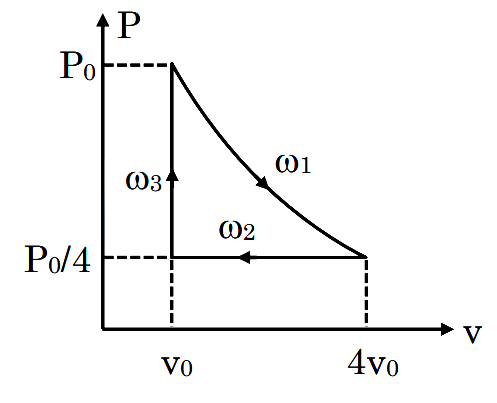
\(\begin{aligned} & \omega_1=P_0 v_0 \ln 4 \\ & \omega_2=\frac{P_0}{4}\left(-3 v_0\right)=-\frac{3 P_0 v_0}{4}\end{aligned}\)
\(\begin{aligned} & \omega_3=0 \\ & \mathrm{Q}_{\mathrm{T}}=\Delta \mathrm{U}_{\text {cyclic }}+\omega\end{aligned}\)
\(\mathrm{Q}_{\mathrm{T}}=\omega \quad\left(\Delta \mathrm{U}_{\text {cyclic }}=0\right)\)
\(\begin{aligned} & \mathrm{Q}_{\mathrm{T}}=\mathrm{P}_0 \mathrm{v}_0\left(\ln 4-\frac{3}{4}\right) \\ & =\mathrm{P}_0 \mathrm{v}_0(2 \ln 2-0.75)\end{aligned}\) -
- (A) E Only
- (B) A, B, C, D Only
- (C) A, D, E Only
- (D) A, C Only
Show answer and solution
Correct Answer: (C)
Given that
\(\mathrm{P}=\mathrm{kT}\)
\(\frac{\mathrm{P}}{\mathrm{~T}}=\text { constant }\)
\(\therefore\) Volume is constant or isochoric process.
\(\begin{aligned}
& \therefore \mathrm{W}_{\mathrm{D}}=0 \\
& \therefore \mathrm{Q}=\Delta \mathrm{U}
\end{aligned}\)
Also temperature increases hence internal energy increases. -
- (A) 310
- (B) 314
- (C) 320
- (D) 319
Show answer and solution
Correct Answer: (B)
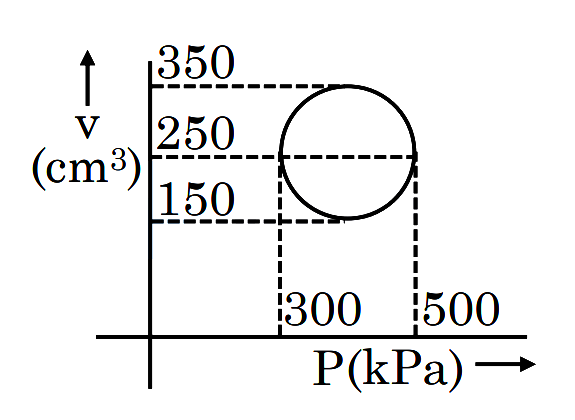
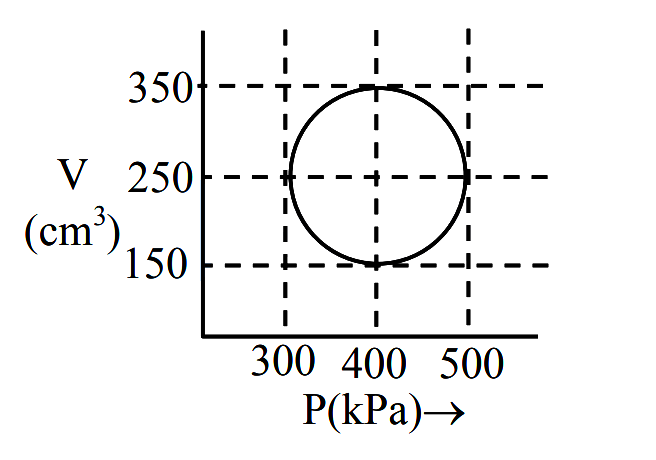
Area of circle, \(\mathrm{W}=\frac{\pi}{4} \mathrm{~d}_1 \mathrm{~d}_2\)
\(\mathrm{W}=\frac{\pi}{4}(500-300) \times 10^3(350-150) \times 10^{-6}\)
W = 31.4 Joule
\(\mathrm{W}=314 \times 10^{-1} \mathrm{Joule}\) -
- (A) 274
- (B) 275
- (C) 273
- (D) 272
Show answer and solution
Correct Answer: (C)
\(\begin{aligned} & \gamma=\frac{3}{2} \\ & \mathrm{Tv}^{\gamma-1}=\mathrm{C} \\ & 273 \mathrm{~V}_0^{0.5}=\mathrm{T}\left(\frac{\mathrm{V}_0}{4}\right)^{0.5} \\ & \mathrm{~T}=273 \times 2=546 \\ & \Delta \mathrm{~T}=273\end{aligned}\) -
- (A) Internal energy of ice-water system remains unchanged.
- (B) Positive work is done by the ice-water system on the atmosphere.
- (C) Internal energy of the ice-water system decreases.
- (D) Positive work is done on the ice-water system by the atmosphere.
Show answer and solution
Correct Answer: (D)
Volume decreases during melting of ice so positive work is done on ice water system by atmosphere
Heat absorbed by ice water so \(\Delta \mathrm{Q}\) is positive, work done by ice water system is negative
Hence by first law of thermodynamics
\(\Delta \mathrm{U}=\Delta \mathrm{Q}+\Delta \mathrm{W}=\text { Positive }\)
So internal energy increases -
- (A) (B) and (C) Only
- (B) (C) and (D) Only
- (C) (D) and (A) Only
- (D) (A) and (B) Only
Show answer and solution
Correct Answer: (D)
Extensive variables depend on size and amount of system.
Extensive : Volume, mass, internal energy
Intensive : Pressure, temperature, density -
- (A) Both (A) and (R) are true and (R) is the correct explanation of (A)
- (B) Both (A) and (R) are true but (R) is NOT the correct explanation of (A)
- (C) (A) is true but (R) is false
- (D) (A) is false but (R) is true
Show answer and solution
Correct Answer: (A)
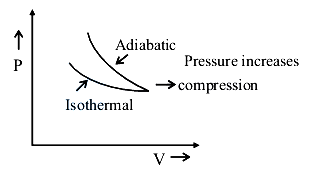
\(\left(\frac{\mathrm{dP}}{\mathrm{dV}}\right)_{\text {Adiabatic }}>\left(\frac{\mathrm{dP}}{\mathrm{dV}}\right)_{\text {Isothermal }}\) -
- (A) Both \((\mathbf{A})\) and \((\mathbf{R})\) are true but \((\mathbf{R})\) is NOT the correct explanation of \((\mathbf{A})\)
- (B) (A) is false but (R) is true
- (C) (A) is true but (R) is false
- (D) Both \((\mathbf{A})\) and \((\mathbf{R})\) are true and \((\mathbf{R})\) is the correct explanation of \((\mathbf{A})\)
Show answer and solution
Correct Answer: (B)
If the container is insulated then temperature is expected to increase in adiabatic compression. So (A) is wrong.
And free expansion is irreversible and adiabatic process. So (R) is correct. -
- (A) (A), (C), (D) only
- (B) (A), (C), (E) only
- (C) (B), (E) only
- (D) (B), (D) only
Show answer and solution
Correct Answer: (C)
\(\begin{aligned} & \mathrm{Q}=\Delta \mathrm{U}+\mathrm{W}=0 \Rightarrow-\Delta \mathrm{U}=\mathrm{W} \\ & \mathrm{WD}=-\mathrm{nC}_{\mathrm{v}} \Delta \mathrm{T} \Rightarrow|\mathrm{WD}|=\mathrm{nC}_{\mathrm{v}} \Delta \mathrm{T} \propto \mathrm{T}_2-\mathrm{T}_1\end{aligned}\)
\(\therefore \mathrm{B} \& \mathrm{E}\) [Only possibility] -
- (A) The molar heat capacity is infinite
- (B) Work done by the gas equals the increase in internal energy
- (C) The molar heat capacity is zero
- (D) The internal energy of the gas decreases as the temperature increases
Show answer and solution
Correct Answer: (C)
For adiabatic process, \(\mathrm{dQ}=0\)
\(\therefore\) Molar heat capacity \(=0\)
\(\because \mathrm{dQ}=0 \Rightarrow \mathrm{dU}=-\mathrm{dW}\)
Also \(\mathrm{dU}=\frac{\mathrm{f}}{2} \mathrm{nRdT}\)
\(\therefore\) Only option (3) is correct. -
- (A) (A)-(III), (B)-(II), (C)-(I), (D)-(IV)
- (B) (A)-(IV), (B)-(I), (C)-(III), (D)-(II)
- (C) (A)-(IV), (B)-(II), (C)-(III), (D)-(I)
- (D) (A)-(II), (B)-(IV), (C)-(I), (D)-(III)
Show answer and solution
Correct Answer: (C)
(A) Isothermal \(\rightarrow \Delta \mathrm{T}=0 \rightarrow \Delta \mathrm{U}=0\) (IV)
(B) Adiabatic \(\rightarrow \Delta \mathrm{Q}=0\) (II)
(C) Isobaric \(\rightarrow \Delta \mathrm{P}=0 \rightarrow \Delta \mathrm{U} \neq 0\) (III)
(D) Isochoric \(\rightarrow \Delta \mathrm{V}=0 \rightarrow \Delta \mathrm{~W}=0(\mathrm{I})\) -
- (A) (A)-(IV), (B)-(III), (C)-(II), (D)-(I)
- (B) (A)-(IV), (B)-(I), (C)-(III), (D)-(II)
- (C) (A)-(IV), (B)-(II), (C)-(III), (D)-(I)
- (D) (A)-(II), (B)-(IV), (C)-(III), (D)-(I)
Show answer and solution
Correct Answer: (C)
(A) Isobaric \((\mathrm{P}=\mathrm{C})\)
\(\Delta \mathrm{Q}=\Delta \mathrm{U}+\mathrm{P} \Delta \mathrm{~V}\)
(B) Isochoric \((\mathrm{V}=\mathrm{C})\)
\(\Delta \mathrm{Q}=\Delta \mathrm{U}\)
(C) Adiabatic \((\Delta \mathrm{Q}=0)\)
\(\Delta \mathrm{Q}=0\)
(D) Isothermal \((\Delta \mathrm{U}=0)\)
\(\Delta \mathrm{Q}=\Delta \mathrm{W}\) -
- (A) A-III, B-IV, C-I, D-II
- (B) A-I, B-IV, C-II, D-III
- (C) A-III, B-I, C-IV, D-II
- (D) A-I, B-III, C-II, D-IV
Show answer and solution
Correct Answer: (A)
\(\begin{aligned}
& \mathrm{A} \rightarrow \mathrm{P} \propto \frac{1}{\mathrm{~V}} \\
& \Rightarrow \mathrm{PV}=\text { constant } \\
& \Rightarrow \mathrm{nRT}=\text { const. } \Rightarrow \mathrm{T}=\text { const. }
\end{aligned}\)
Hence Isothermal III
B \(\rightarrow\) IV
\(\mathrm{W} \neq 0, \Delta \mathrm{U} \neq 0, \Delta \mathrm{Q} \neq 0\) [only isobaric]
\(\mathrm{C} \rightarrow \mathrm{I} \Delta \mathrm{Q}=0\) Adiabatic
\(\mathrm{D} \rightarrow\) II w \(=0\) Isochoric
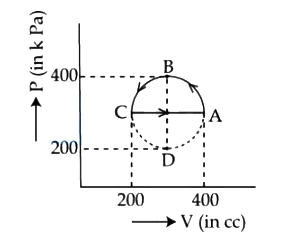
III, IV, I, II - 347. The magnitude of heat exchanged by a system for the given cyclic process ABCA (as shown in figure) is (in SI unit) :
2025 Hard- (A) \(5 \pi\)
- (B) \(40 \pi\)
- (C) \(10 \pi\)
- (D) zero
Show answer and solution
Correct Answer: (A)
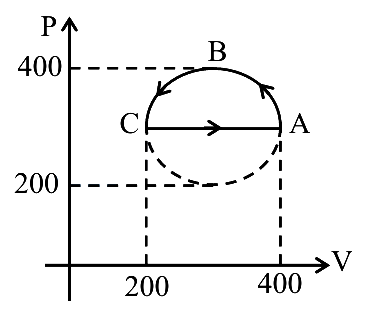
\(\begin{aligned} & \mathrm{W}=\frac{1}{2} \pi \mathrm{R}^2 \\ & =\frac{1}{2} \times \pi \times\left(\frac{200}{2} \times 10^3\right) \times \frac{200}{2} \times 10^{-6} \\ & =\frac{10 \pi}{2}=5 \pi \mathrm{~J}\end{aligned}\) -
- (A) 15
- (B) 20
- (C) 25
- (D) 30
Show answer and solution
Correct Answer: (A)
Given that process is isobaric \(\Delta \mathrm{T}=50^{\circ} \mathrm{C}\)
Q in isobaric process \(=\mathrm{nC}_{\mathrm{p}} \Delta \mathrm{T}=\mathrm{E}_1\)
\(\Delta \mathrm{U}\) in isobaric process \(=\mathrm{nC}_{\mathrm{v}} \Delta \mathrm{T}=\mathrm{E}_2\)
\(\therefore \frac{\mathrm{E}_1}{\mathrm{E}_2}=\frac{\mathrm{C}_{\mathrm{P}}}{\mathrm{C}_{\mathrm{v}}}=\gamma\)
Given, gas is monoatomic
\(\begin{aligned}
\therefore \gamma & =1+\frac{2}{\mathrm{f}} \\
& =1+\frac{2}{3} \\
& =\frac{5}{3}
\end{aligned}\)
Now, as per question.
\(\begin{aligned}
& \frac{5}{3}=\frac{x}{9} \\
& x=15
\end{aligned}\) -
- (A) change in its temperature
- (B) change in its volume
- (C) change in its pressure
- (D) change in its specific heat
Show answer and solution
Correct Answer: (A)
Work done in adiabatic process \(=\frac{n R \Delta T}{1-\gamma}\)
So, depends upon change in temperature. - 350.
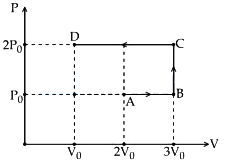
Using the given \(\mathrm{P}-\mathrm{V}\) diagram, the work done by an ideal gas along the path ABCD is : 2025 Easy- (A) \(3 \mathrm{P}_0 \mathrm{~V}_0\)
- (B) \(-4 \mathrm{P}_0 \mathrm{~V}_0\)
- (C) \(-3 \mathrm{P}_0 \mathrm{~V}_0\)
- (D) \(4 \mathrm{P}_0 \mathrm{~V}_0\)
Show answer and solution
Correct Answer: (C)
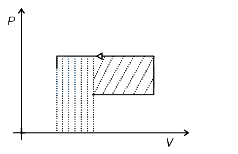
Area under graph will be magnitude of graph and being counterclockwise graph it would be negative
\(\begin{aligned}
& \text { Area }=2 P_0 \times V_0+P_0 V_0=3 P_0 V_0 \\
& \mathrm{~W}=-3 P_0 V_0
\end{aligned}\)
No questions on this page match these filters.