


Questions
23 questionsShowing 1–23 of 23 questions
-
- (A) \(\eta_{12}=\eta_1 \eta_2\)
- (B) \(\eta_{12} \geq \eta_1+\eta_2\)
- (C) \(\eta_{12}=\eta_1+\eta_2\)
- (D) \(\eta_{12} \lt \eta_1+\eta_2\)
Show answer and solution
Correct Answer: (D)
Efficiencies of a carnot engine \(\eta=1-\frac{T_{\text {sink }}}{T_{\text {source }}}\)
\(\begin{aligned}
\Rightarrow & \eta_1=1-\frac{373 \mathrm{~K}}{473 \mathrm{~K}}=\frac{100}{473} \\
& \eta_2=1-\frac{273 \mathrm{~K}}{373 \mathrm{~K}}=\frac{100}{373} \\
& \eta_{12}=1-\frac{273 \mathrm{~K}}{473 \mathrm{~K}}=\frac{100}{473} \\
& \eta_{12}-\eta_1=\frac{200}{473}-\frac{100}{473}=\frac{100}{473} < \frac{100}{373} \\
\Rightarrow & \eta_{12}-\eta_1 < \eta_2 \\
\text { or } & \eta_{12} < \eta_1+\eta_2
\end{aligned}\) -
- (A) 327 K
- (B) 600 K
- (C) 522 K
- (D) 300 K
Show answer and solution
Correct Answer: (D)
\(\begin{aligned}
& \mathrm{V}_1=800 \mathrm{~cm}^3 \quad \mathrm{~V}_2=200 \mathrm{~cm}^3 \\
& \mathrm{~T}_1=300 \mathrm{~K}
\end{aligned}\)
for adiabatic
\(\begin{aligned}
& \mathrm{TV}^{\gamma-1}=\text { const. } \\
& (300)(800)^{1.5-1}=\mathrm{T}_2(200)^{1.5-1} \\
& \mathrm{~T}_2=300\left[\frac{800}{200}\right]^{0.5}=300 \times\left(2^2\right)^{1 / 2} \\
& \mathrm{~T}_2=600 \mathrm{~K} \\
& \Delta \mathrm{~T}=600-300=300 \mathrm{~K}
\end{aligned}\) -
- (A) 16
- (B) 40
- (C) 32
- (D) 28
Show answer and solution
Correct Answer: (C)
\(\begin{aligned} & P_i V_i^\gamma=P_f V_f^\gamma \\ & \frac{P_f}{P_i}=\left(\frac{V_i}{V_f}\right)^\gamma=(8)^{5 / 3} \\ & \frac{P_f}{P_i}=32\end{aligned}\) -
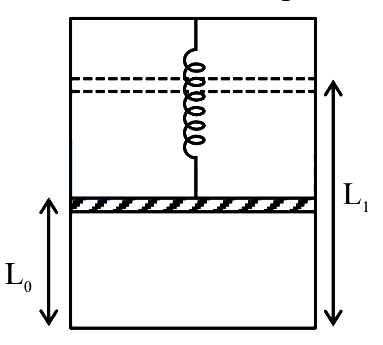
- (A) \(3 n R T \ln \left(\frac{L_1}{L_0}\right)+2 \mathrm{Mg}\left(L_1-L_0\right)+\frac{k}{3}\left(L_1^3-L_0^3\right)\)
- (B) \(n R T \ln \left(\frac{L_1^2}{L_0^2}\right)+\frac{M g}{2}\left(L_1-L_0\right)+\frac{k}{4}\left(L_1^4-L_0^4\right)\)
- (C) \(n R T \ln \left(\frac{L_1}{L_0}\right)+M g\left(L_1-L_0\right)+\frac{k}{4}\left(L_1^4-L_0^4\right)\)
- (D) \(n R T \ln \left(\frac{L_1}{L_0}\right)+M g\left(L_1-L_0\right)+\frac{3 k}{4}\left(L_1^4-L_0^4\right)\)
Show answer and solution
Correct Answer: (C)
Using WET
Total energy supplied \(=\) gravitational potential energy + spring potential energy + work done by gas
\(\begin{aligned}
& \operatorname{Mg} \quad\left(L_1-L_0\right)+\int_{L_0}^{L_1} k^3 d x+n R T \ell n \\
& {\left[\frac{L_1 \mathrm{~A}}{\mathrm{~L}_0 \mathrm{~A}}\right]+\mathrm{W}_{\mathrm{ext}}=0} \\
& \frac{\mathrm{~K}}{4}\left[\mathrm{x}^4\right]_{\mathrm{L}_0}^{\mathrm{L}_1}+\operatorname{Mg}\left(\mathrm{L}_1-\mathrm{L}_0\right)+\int_{\mathrm{L}_0}^{\mathrm{L}_1} k x^3 d x+n R T \ell n
\end{aligned}\)
\(\begin{aligned} & {\left[\frac{L_1}{L_0}\right]+\mathrm{W}_{\mathrm{ext}}=0} \\ & \frac{\mathrm{k}}{4}\left(\mathrm{~L}_1^4-\mathrm{L}_0^4\right)+\operatorname{Mg} \quad\left(\mathrm{L}_1-\mathrm{L}_0\right)+\mathrm{nRT} \ell \mathrm{n} \\ & {\left[\frac{\mathrm{L}_1}{\mathrm{~L}_0}\right]+\mathrm{W}_{\mathrm{ext}}=0} \\ & \mathrm{~W}_{\mathrm{ext}}=\frac{\mathrm{k}}{4}\left(\mathrm{~L}_1^4-\mathrm{L}_0^4\right)+\operatorname{Mg}\left(\mathrm{L}_1-\mathrm{L}_0\right)+\mathrm{nRT} \ell \mathrm{n}\left[\frac{\mathrm{L}_1}{\mathrm{~L}_0}\right]\end{aligned}\) -
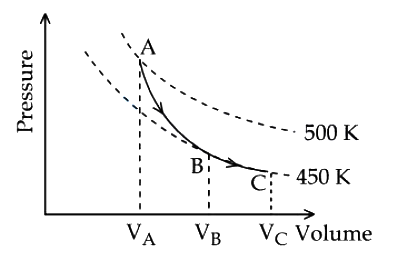
- (A) \(500 \mathrm{R}(\ln 3+\ln 4)\)
- (B) \(450 \mathrm{R}(\ln 4-\ln 3)\)
- (C) \(500 \mathrm{R} \ln 2\)
- (D) \(400 \mathrm{R} \ln 4\)
Show answer and solution
Correct Answer: (B)
\(\begin{aligned} & \Delta \mathrm{Q}_{\mathrm{AB}}=0 \text { adiabatic } \\ & \Delta \mathrm{Q}_{\mathrm{BC}}=\Delta \mathrm{W}_{\mathrm{BC}} \\ & =\mathrm{nRT} \ell \mathrm{n}\left(\frac{\mathrm{V}_{\mathrm{C}}}{\mathrm{V}_{\mathrm{B}}}\right)=450 \mathrm{R} \ell \mathrm{n}\left(\frac{8 \times 10^{-6}}{6 \times 10^{-6}}\right) \\ & =450 \mathrm{R} \ell \mathrm{n}\left(\frac{4}{3}\right)=450 \mathrm{R}(\ln 4-\ell \mathrm{n} 3) \\ & \therefore \Delta \mathrm{Q}=\Delta \mathrm{Q}_{\mathrm{AB}}+\Delta \mathrm{Q}_{\mathrm{BC}} \\ & \Delta \mathrm{Q}=450 \mathrm{R}(\ell \mathrm{n} 4-\ell \mathrm{n} 3)\end{aligned}\) -
- (A) \(\mathrm{P}_0 \mathrm{~V}_0(2 \ln 2-0.75)\)
- (B) \(\mathrm{P}_0 \mathrm{~V}_0(\ln 2-0.75)\)
- (C) \(\mathrm{P}_0 \mathrm{~V}_0(\ln 2-0.25)\)
- (D) \(P_0 V_0(2 \ln 2-0.25)\)
Show answer and solution
Correct Answer: (A)
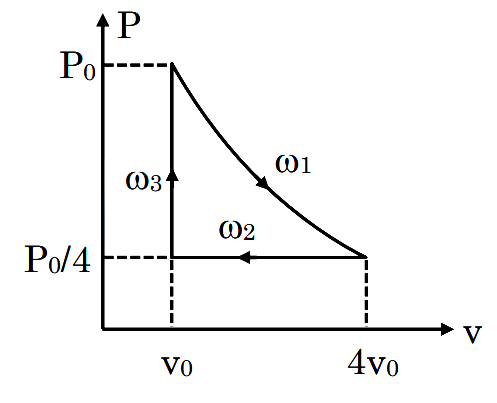
\(\begin{aligned} & \omega_1=P_0 v_0 \ln 4 \\ & \omega_2=\frac{P_0}{4}\left(-3 v_0\right)=-\frac{3 P_0 v_0}{4}\end{aligned}\)
\(\begin{aligned} & \omega_3=0 \\ & \mathrm{Q}_{\mathrm{T}}=\Delta \mathrm{U}_{\text {cyclic }}+\omega\end{aligned}\)
\(\mathrm{Q}_{\mathrm{T}}=\omega \quad\left(\Delta \mathrm{U}_{\text {cyclic }}=0\right)\)
\(\begin{aligned} & \mathrm{Q}_{\mathrm{T}}=\mathrm{P}_0 \mathrm{v}_0\left(\ln 4-\frac{3}{4}\right) \\ & =\mathrm{P}_0 \mathrm{v}_0(2 \ln 2-0.75)\end{aligned}\) -
- (A) E Only
- (B) A, B, C, D Only
- (C) A, D, E Only
- (D) A, C Only
Show answer and solution
Correct Answer: (C)
Given that
\(\mathrm{P}=\mathrm{kT}\)
\(\frac{\mathrm{P}}{\mathrm{~T}}=\text { constant }\)
\(\therefore\) Volume is constant or isochoric process.
\(\begin{aligned}
& \therefore \mathrm{W}_{\mathrm{D}}=0 \\
& \therefore \mathrm{Q}=\Delta \mathrm{U}
\end{aligned}\)
Also temperature increases hence internal energy increases. -
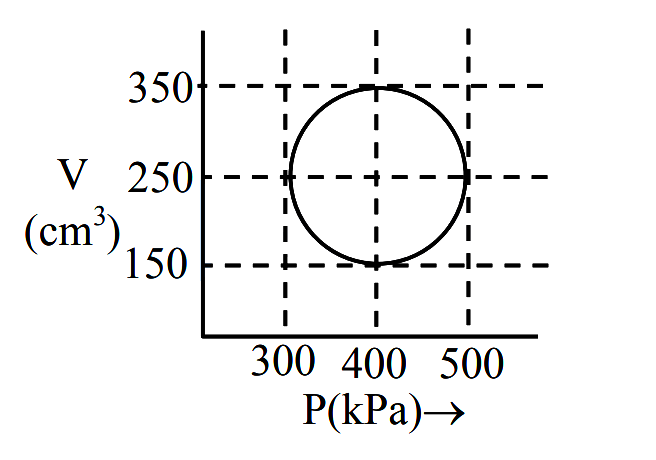
- (A) 310
- (B) 314
- (C) 320
- (D) 319
Show answer and solution
Correct Answer: (B)
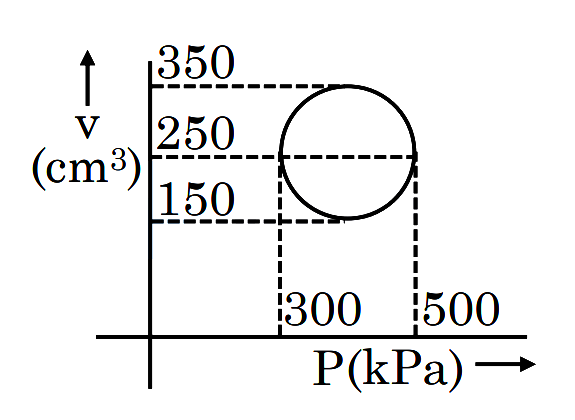
Area of circle, \(\mathrm{W}=\frac{\pi}{4} \mathrm{~d}_1 \mathrm{~d}_2\)
\(\mathrm{W}=\frac{\pi}{4}(500-300) \times 10^3(350-150) \times 10^{-6}\)
W = 31.4 Joule
\(\mathrm{W}=314 \times 10^{-1} \mathrm{Joule}\) -
- (A) 274
- (B) 275
- (C) 273
- (D) 272
Show answer and solution
Correct Answer: (C)
\(\begin{aligned} & \gamma=\frac{3}{2} \\ & \mathrm{Tv}^{\gamma-1}=\mathrm{C} \\ & 273 \mathrm{~V}_0^{0.5}=\mathrm{T}\left(\frac{\mathrm{V}_0}{4}\right)^{0.5} \\ & \mathrm{~T}=273 \times 2=546 \\ & \Delta \mathrm{~T}=273\end{aligned}\) -
- (A) Internal energy of ice-water system remains unchanged.
- (B) Positive work is done by the ice-water system on the atmosphere.
- (C) Internal energy of the ice-water system decreases.
- (D) Positive work is done on the ice-water system by the atmosphere.
Show answer and solution
Correct Answer: (D)
Volume decreases during melting of ice so positive work is done on ice water system by atmosphere
Heat absorbed by ice water so \(\Delta \mathrm{Q}\) is positive, work done by ice water system is negative
Hence by first law of thermodynamics
\(\Delta \mathrm{U}=\Delta \mathrm{Q}+\Delta \mathrm{W}=\text { Positive }\)
So internal energy increases -
- (A) (B) and (C) Only
- (B) (C) and (D) Only
- (C) (D) and (A) Only
- (D) (A) and (B) Only
Show answer and solution
Correct Answer: (D)
Extensive variables depend on size and amount of system.
Extensive : Volume, mass, internal energy
Intensive : Pressure, temperature, density -
- (A) Both (A) and (R) are true and (R) is the correct explanation of (A)
- (B) Both (A) and (R) are true but (R) is NOT the correct explanation of (A)
- (C) (A) is true but (R) is false
- (D) (A) is false but (R) is true
Show answer and solution
Correct Answer: (A)
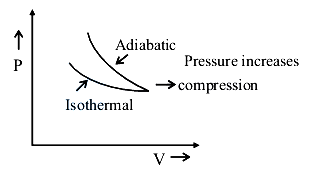
\(\left(\frac{\mathrm{dP}}{\mathrm{dV}}\right)_{\text {Adiabatic }}>\left(\frac{\mathrm{dP}}{\mathrm{dV}}\right)_{\text {Isothermal }}\) -
- (A) Both \((\mathbf{A})\) and \((\mathbf{R})\) are true but \((\mathbf{R})\) is NOT the correct explanation of \((\mathbf{A})\)
- (B) (A) is false but (R) is true
- (C) (A) is true but (R) is false
- (D) Both \((\mathbf{A})\) and \((\mathbf{R})\) are true and \((\mathbf{R})\) is the correct explanation of \((\mathbf{A})\)
Show answer and solution
Correct Answer: (B)
If the container is insulated then temperature is expected to increase in adiabatic compression. So (A) is wrong.
And free expansion is irreversible and adiabatic process. So (R) is correct. -
- (A) (A), (C), (D) only
- (B) (A), (C), (E) only
- (C) (B), (E) only
- (D) (B), (D) only
Show answer and solution
Correct Answer: (C)
\(\begin{aligned} & \mathrm{Q}=\Delta \mathrm{U}+\mathrm{W}=0 \Rightarrow-\Delta \mathrm{U}=\mathrm{W} \\ & \mathrm{WD}=-\mathrm{nC}_{\mathrm{v}} \Delta \mathrm{T} \Rightarrow|\mathrm{WD}|=\mathrm{nC}_{\mathrm{v}} \Delta \mathrm{T} \propto \mathrm{T}_2-\mathrm{T}_1\end{aligned}\)
\(\therefore \mathrm{B} \& \mathrm{E}\) [Only possibility] -
- (A) The molar heat capacity is infinite
- (B) Work done by the gas equals the increase in internal energy
- (C) The molar heat capacity is zero
- (D) The internal energy of the gas decreases as the temperature increases
Show answer and solution
Correct Answer: (C)
For adiabatic process, \(\mathrm{dQ}=0\)
\(\therefore\) Molar heat capacity \(=0\)
\(\because \mathrm{dQ}=0 \Rightarrow \mathrm{dU}=-\mathrm{dW}\)
Also \(\mathrm{dU}=\frac{\mathrm{f}}{2} \mathrm{nRdT}\)
\(\therefore\) Only option (3) is correct. -
- (A) (A)-(III), (B)-(II), (C)-(I), (D)-(IV)
- (B) (A)-(IV), (B)-(I), (C)-(III), (D)-(II)
- (C) (A)-(IV), (B)-(II), (C)-(III), (D)-(I)
- (D) (A)-(II), (B)-(IV), (C)-(I), (D)-(III)
Show answer and solution
Correct Answer: (C)
(A) Isothermal \(\rightarrow \Delta \mathrm{T}=0 \rightarrow \Delta \mathrm{U}=0\) (IV)
(B) Adiabatic \(\rightarrow \Delta \mathrm{Q}=0\) (II)
(C) Isobaric \(\rightarrow \Delta \mathrm{P}=0 \rightarrow \Delta \mathrm{U} \neq 0\) (III)
(D) Isochoric \(\rightarrow \Delta \mathrm{V}=0 \rightarrow \Delta \mathrm{~W}=0(\mathrm{I})\) -
- (A) (A)-(IV), (B)-(III), (C)-(II), (D)-(I)
- (B) (A)-(IV), (B)-(I), (C)-(III), (D)-(II)
- (C) (A)-(IV), (B)-(II), (C)-(III), (D)-(I)
- (D) (A)-(II), (B)-(IV), (C)-(III), (D)-(I)
Show answer and solution
Correct Answer: (C)
(A) Isobaric \((\mathrm{P}=\mathrm{C})\)
\(\Delta \mathrm{Q}=\Delta \mathrm{U}+\mathrm{P} \Delta \mathrm{~V}\)
(B) Isochoric \((\mathrm{V}=\mathrm{C})\)
\(\Delta \mathrm{Q}=\Delta \mathrm{U}\)
(C) Adiabatic \((\Delta \mathrm{Q}=0)\)
\(\Delta \mathrm{Q}=0\)
(D) Isothermal \((\Delta \mathrm{U}=0)\)
\(\Delta \mathrm{Q}=\Delta \mathrm{W}\) -
- (A) A-III, B-IV, C-I, D-II
- (B) A-I, B-IV, C-II, D-III
- (C) A-III, B-I, C-IV, D-II
- (D) A-I, B-III, C-II, D-IV
Show answer and solution
Correct Answer: (A)
\(\begin{aligned}
& \mathrm{A} \rightarrow \mathrm{P} \propto \frac{1}{\mathrm{~V}} \\
& \Rightarrow \mathrm{PV}=\text { constant } \\
& \Rightarrow \mathrm{nRT}=\text { const. } \Rightarrow \mathrm{T}=\text { const. }
\end{aligned}\)
Hence Isothermal III
B \(\rightarrow\) IV
\(\mathrm{W} \neq 0, \Delta \mathrm{U} \neq 0, \Delta \mathrm{Q} \neq 0\) [only isobaric]
\(\mathrm{C} \rightarrow \mathrm{I} \Delta \mathrm{Q}=0\) Adiabatic
\(\mathrm{D} \rightarrow\) II w \(=0\) Isochoric
III, IV, I, II - 19. The magnitude of heat exchanged by a system for the given cyclic process ABCA (as shown in figure) is (in SI unit) :
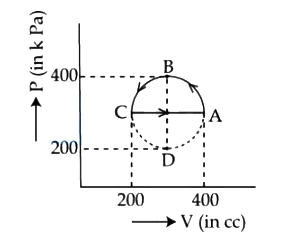
2025 Hard- (A) \(5 \pi\)
- (B) \(40 \pi\)
- (C) \(10 \pi\)
- (D) zero
Show answer and solution
Correct Answer: (A)
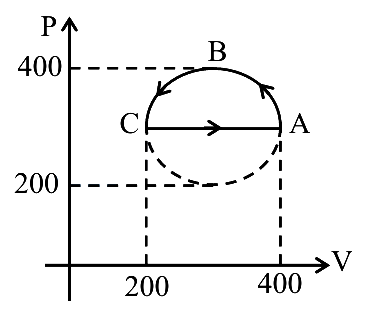
\(\begin{aligned} & \mathrm{W}=\frac{1}{2} \pi \mathrm{R}^2 \\ & =\frac{1}{2} \times \pi \times\left(\frac{200}{2} \times 10^3\right) \times \frac{200}{2} \times 10^{-6} \\ & =\frac{10 \pi}{2}=5 \pi \mathrm{~J}\end{aligned}\) -
- (A) 15
- (B) 20
- (C) 25
- (D) 30
Show answer and solution
Correct Answer: (A)
Given that process is isobaric \(\Delta \mathrm{T}=50^{\circ} \mathrm{C}\)
Q in isobaric process \(=\mathrm{nC}_{\mathrm{p}} \Delta \mathrm{T}=\mathrm{E}_1\)
\(\Delta \mathrm{U}\) in isobaric process \(=\mathrm{nC}_{\mathrm{v}} \Delta \mathrm{T}=\mathrm{E}_2\)
\(\therefore \frac{\mathrm{E}_1}{\mathrm{E}_2}=\frac{\mathrm{C}_{\mathrm{P}}}{\mathrm{C}_{\mathrm{v}}}=\gamma\)
Given, gas is monoatomic
\(\begin{aligned}
\therefore \gamma & =1+\frac{2}{\mathrm{f}} \\
& =1+\frac{2}{3} \\
& =\frac{5}{3}
\end{aligned}\)
Now, as per question.
\(\begin{aligned}
& \frac{5}{3}=\frac{x}{9} \\
& x=15
\end{aligned}\) -
- (A) change in its temperature
- (B) change in its volume
- (C) change in its pressure
- (D) change in its specific heat
Show answer and solution
Correct Answer: (A)
Work done in adiabatic process \(=\frac{n R \Delta T}{1-\gamma}\)
So, depends upon change in temperature. - 22.
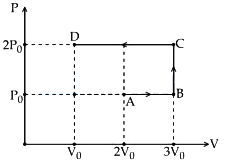
Using the given \(\mathrm{P}-\mathrm{V}\) diagram, the work done by an ideal gas along the path ABCD is : 2025 Easy- (A) \(3 \mathrm{P}_0 \mathrm{~V}_0\)
- (B) \(-4 \mathrm{P}_0 \mathrm{~V}_0\)
- (C) \(-3 \mathrm{P}_0 \mathrm{~V}_0\)
- (D) \(4 \mathrm{P}_0 \mathrm{~V}_0\)
Show answer and solution
Correct Answer: (C)
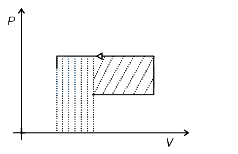
Area under graph will be magnitude of graph and being counterclockwise graph it would be negative
\(\begin{aligned}
& \text { Area }=2 P_0 \times V_0+P_0 V_0=3 P_0 V_0 \\
& \mathrm{~W}=-3 P_0 V_0
\end{aligned}\) -
- (A) \(\mathrm{m} \ln \left(\frac{\mathrm{T}_2}{\mathrm{~T}_1}\right)\)
- (B) zero
- (C) \(\mathrm{m} \ln \left(\frac{\mathrm{T}_1}{\mathrm{~T}_2}\right)\)
- (D) \(\mathrm{m}\left(\mathrm{T}_2-\mathrm{T}_1\right)\)
Show answer and solution
Correct Answer: (A)
\(\begin{aligned} & d \mathrm{Q}=\mathrm{msdT} \\ & \mathrm{dS}=\frac{\mathrm{dQ}}{\mathrm{T}}=\frac{\mathrm{msdT}}{\mathrm{T}} \\ & \Delta \mathrm{S}=\int \frac{\mathrm{msdT}}{\mathrm{T}}=\mathrm{ms} \ln \frac{\mathrm{T}_{\mathrm{f}}}{\mathrm{T}_{\mathrm{i}}} \\ & \Delta \mathrm{S}=\mathrm{m} \ln \frac{\mathrm{T}_2}{\mathrm{~T}_1}\end{aligned}\)
No questions on this page match these filters.