


Questions
5 questionsShowing 1–5 of 5 questions
-
- (A) \(4 \%\)
- (B) \(15 \%\)
- (C) \(5 \%\)
- (D) \(10 \%\)
Show answer and solution
Correct Answer: (A)
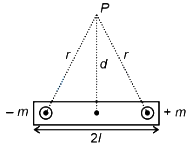
Magnetic field at \(P, B=\frac{\mu_0}{4 \pi} \frac{m(2 l)}{r^3}\), where \(m\) is the pole strength
\(\begin{aligned}
\Rightarrow\left(\frac{\Delta B}{B} \times 100\right) & =\left(\frac{\Delta l}{l}\right) \times 100+3\left|\frac{\Delta r}{r}\right| \times 100 \\
& =1 \%+3 \%=4 \%
\end{aligned}\) -
- (A) \(80 \mathrm{~J}\)
- (B) \(-40 \sqrt{3} \mathrm{~J}\)
- (C) \(-60 \mathrm{~J}\)
- (D) \(-80 \mathrm{~J}\)
Show answer and solution
Correct Answer: (D)
\(\tau=\mathrm{M} \times \mathrm{B}=\mathrm{MB} \sin 60=\frac{\sqrt{3}}{2} \mathrm{MB}=80 \sqrt{3}\)
\(\begin{aligned} & \mathrm{MB}=160 \\ & \mathrm{U}=-\mathrm{M} \cdot \mathrm{B}=-\mathrm{MB} \cos 60 \\ & \mathrm{U}=-160 \times 1 / 2=-80 \mathrm{~J}\end{aligned}\) -
- (A) Both \((\mathrm{A})\) and \((\mathrm{R})\) are correct but \((\mathrm{R})\) is not the correct explanation of (A)
- (B) (A) is correct but \((\mathrm{R})\) is not correct
- (C) Both \((\mathrm{A})\) and \((\mathrm{R})\) are correct and \((\mathrm{R})\) is the correct explanation of (A)
- (D) (A) is not correct but ( \(\mathrm{R}\)) is correct
Show answer and solution
Correct Answer: (C)
Both statements are correct and reason is also the correct explanation of assertion. -
- (A) \(\frac{6}{5} \times 10^{-3} \%\)
- (B) \(\frac{5}{6} \times 10^{-5} \%\)
- (C) \(\frac{5}{6} \times 10^{-4} \%\)
- (D) \(\frac{5}{3} \times 10^{-5} \%\)
Show answer and solution
Correct Answer: (A)
\(\begin{aligned} & \% \text { change in } B=\frac{B_{\text {new }}-B_{\text {old }}}{B_{\text {old }}} \times 100 \% \\ & =\frac{\mu \mathrm{ni}-\mu_0 \mathrm{ni}}{\mu_0 \mathrm{ni}} \times 100 \%=\frac{\left(\mu-\mu_0\right)}{\mu_0} \times 100 \% \\ & =\frac{\left(\mu_0 \mu_{\mathrm{r}}-\mu_0\right)}{\mu_0} \times 100 \% \\ & =\left(\mu_{\mathrm{r}}-1\right) \times 100 \% \\ & =\chi_{\mathrm{n}} \times 100 \% \\ & =1.2 \times 10^{-3} \%\end{aligned}\) -
- (A) \(\chi=\frac{\mu}{\mu_0}-1\)
- (B) \(\chi=\frac{\mu_{\mathrm{r}}}{\mu_0}+1\)
- (C) \(\chi=\mu_{\mathrm{r}}+1\)
- (D) \(\chi=1-\frac{\mu}{\mu_0}\)
Show answer and solution
Correct Answer: (A)
We have
\(\begin{aligned} & \mu_{\mathrm{r}}=(1+\chi) \Rightarrow \chi=\left(\mu_{\mathrm{r}}-1\right) \\ & \mu=\mu_0 \mu_{\mathrm{r}} \Rightarrow \mu_{\mathrm{r}}=\frac{\mu}{\mu_0} \\ & \therefore \chi=\left(\frac{\mu}{\mu_0}-1\right)\end{aligned}\)
No questions on this page match these filters.