


All JEE Mains 2025 Physics questions
32 chaptersShowing 51–100 of 454 questions
-
- (A) 8.1 MeV
- (B) 5.9 MeV
- (C) 23.6 MeV
- (D) 26.8 MeV
Show answer and solution
Correct Answer: (C)
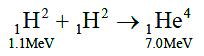
\(\begin{aligned} & E_B=\mathrm{BE}_{\text {reactant }}-\mathrm{BE}_{\text {product }} \\ & =1.1 \times 2+1.1 \times 2-7 \times 4=-23.6 \mathrm{MeV} \\ & =\mathrm{Q}=23.6 \mathrm{MeV}\end{aligned}\) - 52. For a nucleus of mass number \(A\) and radius \(R\), the mass density of nucleus can be represented as how? 2025 Easy
- (A) \(\mathrm{A}^3\)
- (B) \(\mathrm{A}^{\frac{1}{3}}\)
- (C) \(\mathrm{A}^{\frac{2}{3}}\)
- (D) Independent of A
Show answer and solution
Correct Answer: (D)
The mass density ( \(\rho\)) of a nucleus is defined as the ratio of its mass to its volume:
\(\rho=\) Mass of nucleus / Volume of nucleus
For a spherical nucleus with radius R , the volume is:
\(\text { Volume }=(4 / 3) \pi R^3\)
The mass of the nucleus is related to the mass number A :
\(\text { Mass }-\mathrm{A} \times \mathrm{m} \text {u}\)
(where m_u is the atomic mass unit, approximately \(1.66 \times 10^{-27} \mathrm{~kg}\))
Therefore:
\(\rho=\left(\mathrm{A} \times \mathrm{m} \_\mathrm{u}\right) /\left[(4 / 3) \pi \mathrm{R}^3\right]\)
Now, there's an important relationship between the mass number A and nuclear radius R. Empirically, it has been found that:
\(\mathrm{R}=\mathrm{Ro} * \mathrm{~A}^{\wedge}(1 / 3)\)
Where Ro is a constant approximately equal to \(1.2 \times 10^{-15} \mathrm{~m}(1.2\) fermi).
Substituting this into the density equation:
\(\begin{aligned}
& \rho=\left(\mathrm{A} \times \mathrm{m} \ \mathrm{u}\right) /\left[(4 / 3) \pi\left(\mathrm{Ro} \times \mathrm{A}^{\wedge}(1 / 3)\right)^3\right] \\
& \rho=(\mathrm{A} \times \mathrm{m} \text { u }) /\left[(4 / 3) \pi \mathrm{Ro}^3 \times \mathrm{A}\right] \\
& \rho=\mathrm{m} \_\mathrm{u} /\left[(4 / 3) \pi \mathrm{Ro}^3\right]
\end{aligned}\)
This shows that the nuclear density is approximately constant for all nuclei, regardless of their mass number. This is a fundamental property of nuclear matter known as nuclear saturation density.
The numerical value is:
\(\rho=2.3 \times 10^{17} \mathrm{~kg} / \mathrm{m}^3\) -
- (A) \((\mathrm{A})\) is correct but \((\mathrm{R})\) is not correct
- (B) \((\mathrm{A})\) is not correct but \((\mathrm{R})\) is correct
- (C) Both \((\mathrm{A})\) and \((\mathrm{R})\) are correct and \((\mathrm{R})\) is the correct explanation of (A)
- (D) Both (A) and (R) are correct but (R) is not the correct explanation of (A)
Show answer and solution
Correct Answer: (B)
\(\rho=\frac{\mathrm{M}}{\mathrm{~V}}=\frac{\mathrm{m}_{\mathrm{n}} \times \mathrm{A}}{\frac{4}{3} \pi \mathrm{R}^3}=\frac{\mathrm{m}_{\mathrm{n}} \times \mathrm{A}}{\frac{4}{3} \pi \mathrm{AR}_0^3}\)
So \(\rho\) is almost is constant
\(\begin{aligned}
& \mathrm{R}=\mathrm{R}_0 \mathrm{~A}^{1 / 3} \\
& \mathrm{R} \propto \mathrm{~A}^{1 / 3}
\end{aligned}\) -
- (A) \((A)\) is true but (R) is false
- (B) (A) is false but (R) is true
- (C) Both \((\mathbf{A})\) and \((\mathbf{R})\) are true and \((\mathbf{R})\) is the correct explanation of \((\mathbf{A})\)
- (D) Both (A) and (R) are true but (R) is NOT the correct explanation of (A)
Show answer and solution
Correct Answer: (A)
From graph between B.E/N & A we can see BE/N is almost constant \(\Rightarrow\) correct
Reason \(\Rightarrow\) incorrect as nuclear forces are short range forces. -
- (A) A-II, B-I, C-III, D-IV
- (B) A-III, B-I, C-II, D-IV
- (C) A-II, B-I, C-IV, D-III
- (D) A-III, B-I, C-IV, D-II
Show answer and solution
Correct Answer: (B)
Conceptual -
- (A) \(\mathrm{E}^2=\mathrm{pc}^2+\mathrm{m}^2 \mathrm{c}^2\)
- (B) \(\mathrm{E}^2=\mathrm{p}^2 \mathrm{c}^2+\mathrm{m}^2 \mathrm{c}^2\)
- (C) \(\mathrm{E}^2=\mathrm{pc}^2+\mathrm{m}^2 \mathrm{c}^4\)
- (D) \(\mathrm{E}^2=\mathrm{p}^2 \mathrm{c}^2+\mathrm{m}^2 \mathrm{c}^4\)
Show answer and solution
Correct Answer: (D)
We need to check the dimensions only.
With momentum the dimension
\(E^2=p^2 C^2\)
And with mass \(E^2=m^2 c^4\)
So \(E^2=p^2 C^2+m^2 c^4\) (dimensionally) -
- (A) 3
- (B) 16
- (C) 9
- (D) 4
Show answer and solution
Correct Answer: (D)
\(\lambda=\frac{\mathrm{h}}{\mathrm{mv}}\)
\(\begin{aligned}
& \mathrm{mvr}=\frac{\mathrm{nh}}{2 \pi} \\
& \mathrm{mv}=\frac{\mathrm{nh}}{2 \pi \mathrm{r}} \\
& \lambda=\frac{2 \pi \mathrm{rh}}{\mathrm{nh}} \\
& \lambda \propto \frac{\mathrm{r}}{\mathrm{n}} \\
& \frac{\lambda_1}{\lambda_4}=\frac{\mathrm{r}_1 \mathrm{n}_4}{\mathrm{n}_1 \mathrm{r}_4}=\frac{5.3 \times 10^{-11} \times 4}{1 \times 84.8 \times 10^{-11}} \\
& \frac{\lambda_1}{\lambda_4}=\frac{1}{4}
\end{aligned}\) -
- (A) 4
- (B) 6
- (C) 8
- (D) 2
Show answer and solution
Correct Answer: (D)
\(\mathrm{E}=13.6\left(\frac{1}{\mathrm{n}_1^2}-\frac{1}{\mathrm{n}_1^2}\right)\)
\(2.86=13.6\left(\frac{1}{\mathrm{n}^2}-\frac{1}{5^2}\right)\)
\(\begin{aligned} & \frac{1}{\mathrm{n}^2}=0.21+\frac{1}{2.5} \\ & \mathrm{n}^2=4 \\ & \mathrm{n}=2\end{aligned}\) -
- (A) \(\sqrt{\frac{\mathrm{h}}{\pi \mathrm{eB}}}\)
- (B) \(\sqrt{\frac{2 h}{\pi e B}}\)
- (C) \(\sqrt{\frac{h}{2 \pi e B}}\)
- (D) \(\sqrt{\frac{4 \mathrm{~h}}{\pi e B}}\)
Show answer and solution
Correct Answer: (A)
\(m v r=\frac{n h}{2 \pi}\) ...(i)
\(r=\frac{v m}{B q}\) ....(ii)
\(\begin{aligned} & n=2 \\ & m r\left(\frac{r B q}{m}\right)=\frac{2 h}{2 \pi} \\ & r=\sqrt{\frac{h}{\pi B q}} \\ & q=e \\ & r=\sqrt{\frac{h}{\pi B e}}\end{aligned}\) -
- (A) 2
- (B) 1
- (C) 3
- (D) 9
Show answer and solution
Correct Answer: (C)
\(\mathrm{r}=\mathrm{r}_0 \frac{\mathrm{n}^2}{\mathrm{z}} \& \mathrm{z}=3\) for \(\mathrm{Li}^{+2}\) and \(\mathrm{n}=1\)
\(\therefore \mathrm{r}=\mathrm{r}_0 \frac{1^2}{3}=\frac{\mathrm{r}_0}{3} \quad \therefore \mathrm{x}=3\) -
- (A) (B), (D) only
- (B) (A), (B) only
- (C) (A), (D) only
- (D) (A), (C) only
Show answer and solution
Correct Answer: (B)
\(\begin{aligned} & \mathrm{E} \propto \frac{\mathrm{Z}}{\mathrm{n}^2} \\ & \mathrm{Z}_{\mathrm{H}}=1 \quad \mathrm{Z}_{\mathrm{He}^{+}}=2 \quad \mathrm{Z}_{\mathrm{Li}^{+2}}=3\end{aligned}\)
\(\begin{aligned} & 1^{\text {st }} \text { excited state } \Rightarrow \mathrm{n}=2 \\ & 2^{\text {nd }} \text { excited state } \Rightarrow \mathrm{n}=3\end{aligned}\)
From the given statements only A \& B are correct. -
- (A) \(\frac{3}{2}\)
- (B) \(\frac{4}{9}\)
- (C) \(\frac{9}{4}\)
- (D) \(\frac{2}{3}\)
Show answer and solution
Correct Answer: (D)
\(\mathrm{r}=\mathrm{r} \cdot \frac{\mathrm{n}^2}{2}\)
for \(\mathrm{Li}^{2+}\)
\(r_5=r \cdot \frac{25}{3}\)
for \(\mathrm{He}^{+}\)
\(\begin{aligned}
& \mathrm{r}_5=\mathrm{r} \cdot \frac{25}{2} \\
& \therefore \frac{\mathrm{r}_{\mathrm{Li}^{2+}}}{\mathrm{r}_{\mathrm{He}^{+}}}=\frac{2}{3}
\end{aligned}\) -
- (A) \(4000 Å\)
- (B) \(2000 Å\)
- (C) \(3000 Å\)
- (D) \(6000 Å\)
Show answer and solution
Correct Answer: (C)
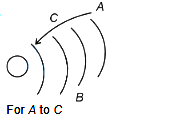
\(\frac{h c}{\lambda_1}=E_0 z^2\left(\frac{1}{n_c^2}-\frac{1}{n_A^2}\right)\) ....(i)
And \(\frac{h c}{\lambda_2}=E_0 z^2\left(\frac{1}{n_c^2}-\frac{1}{n_B^2}\right)\)
So for \(A\) and \(B\) ....(ii)
\(\frac{h c}{\lambda_3}=E_0 z^2\left(\frac{1}{n_B^2}-\frac{1}{n_A^2}\right)\)
Clearly subtracting equation (ii) from equation (i)
\(\begin{aligned}
& h c\left[\frac{1}{\lambda_1}-\frac{1}{\lambda_2}\right]=E_0 z^2\left[\frac{1}{n_B^2}-\frac{1}{n_A^2}\right]=\frac{h c}{\lambda_3} \\
& \Rightarrow \frac{1}{\lambda_3}=\frac{1}{\lambda_1}-\frac{1}{\lambda_2} \Rightarrow \frac{1}{\lambda_3}=\frac{(6000-2000)}{6000 \times 2000}=\frac{1}{3000} \\
& \lambda_3=3000 Å
\end{aligned}\) - 64. For a hydrogen atom, the ratio of the largest wavelength of Lyman series to that of the Balmer series is _______. 2025 Easy
- (A) \(5: 36\)
- (B) \(5: 27\)
- (C) \(3: 4\)
- (D) \(27: 5\)
Show answer and solution
Correct Answer: (B)
\(\mathrm {Lyman}\)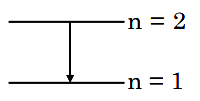
\(\frac{1}{\lambda_1}=\mathrm{R}\left[\frac{1}{1}-\frac{1}{4}\right]=\frac{3 \mathrm{R}}{4}\)
\(\lambda_1=\frac{4}{3 R}\) ________...(1)
and \(\mathrm {Balmer}\)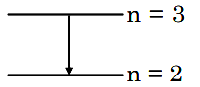
\(\frac{1}{\lambda_2}=\mathrm{R}\left[\frac{1}{4}-\frac{1}{9}\right]=\frac{5 \mathrm{R}}{36}\)
\(\lambda_2=\frac{36}{5 R}\)
Then, \(\frac{\lambda_1}{\lambda_2}=\frac{5}{27}\) -
- (A) Both \(\mathrm{A}\) and \(\mathrm{R}\) are true but \(\mathrm{R}\) is NOT the correct explanation of \(\mathrm{A}\).
- (B) \(\mathrm{A}\) is false but \(\mathrm{R}\) is true.
- (C) Both \(\mathrm{A}\) and \(\mathrm{R}\) are true and \(\mathrm{R}\) is the correct explanation of \(\mathrm{A}\).
- (D) \(\mathrm{A}\) is true but \(\mathrm{R}\) is false.
Show answer and solution
Correct Answer: (C)
Conceptual -
- (A) Both Statement I and Statement II are correct
- (B) Statement I is incorrect but Statement II is correct
- (C) Statement I is correct but Statement II is incorrect
- (D) Both Statement I and Statement II are incorrect
Show answer and solution
Correct Answer: (C)
\(\begin{aligned}
& \mathrm{E}=\mathrm{hf} \\
& \mathrm{ML}^2 \mathrm{~T}^{-2}=[\mathrm{h}] \times\left[\mathrm{T}^{-1}\right] \\
& {[\mathrm{h}]=\left[\mathrm{ML}^2 \mathrm{~T}^{-1}\right]} \\
& \mathrm{L}=[\mathrm{MVR}]=\left[\mathrm{ML}^2 \mathrm{~T}^{-1}\right] \\
& \mathrm{L}=\frac{\mathrm{nh}}{2 \pi}
\end{aligned}\)
L is integral multiple of \(\frac{\mathrm{h}}{2 \pi}\) -
- (A) 4
- (B) 2
- (C) 1
- (D) 3
Show answer and solution
Correct Answer: (D)
\(\Delta \mathrm{E}=13.6 \mathrm{z}^2\left[\frac{1}{\mathrm{n}_1^2}-\frac{1}{\mathrm{n}_2^2}\right]\)
\((13.6) \mathrm{z}^2\left[\frac{1}{1}-\frac{1}{9}\right]=108.8\)
\(\frac{(13.6)(8)}{9}\left(z^2\right)=108.8\)
\(\mathrm{z}=3\) - 68. The frequency of revolution of the electron in Bohr's orbit varies with \(n\), the principal quantum number as _______. 2025 Easy
- (A) \(\frac{1}{n^4}\)
- (B) \(\frac{1}{n^2}\)
- (C) \(\frac{1}{\mathrm{n}}\)
- (D) \(\frac{1}{n^3}\)
Show answer and solution
Correct Answer: (D)
\(\begin{aligned} & f=\frac{v}{2 \pi r}=\left(\frac{V_0}{n}\right)\left(\frac{1}{2 \pi r_0 n^2}\right) \\ & f=\frac{V_0}{2 \pi r_0}=\left(\frac{1}{n^3}\right)=f_0\left(\frac{1}{n^3}\right)\end{aligned}\) -
- (A) 3 eV
- (B) 2 eV
- (C) 6 eV
- (D) 5 eV
Show answer and solution
Correct Answer: (D)
Einstein's photoelectric equation
\(\begin{aligned}
& \mathrm{KE}=\frac{h c}{\lambda}=\phi_0 \\
& 2 \mathrm{eV}=\frac{h c}{\lambda}-1 \mathrm{eV} \\
& \frac{h c}{\lambda}=3 \mathrm{eV} \\
& \mathrm{KE}^{\prime}=\frac{h c}{(\lambda / 2)}-\phi_0=6 \mathrm{eV}-1 \mathrm{eV}
\end{aligned}\)
\(=5 \mathrm{eV}\) -
- (A) \(\sqrt{2 \mathrm{~m}\left(\frac{\mathrm{hc}}{\lambda}-\phi\right)} / \mathrm{eB}\)
- (B) \(\sqrt{\mathrm{m}\left(\frac{\mathrm{hc}}{\lambda}-\phi\right)} / \mathrm{eB}\)
- (C) \(\sqrt{8 \mathrm{~m}\left(\frac{\mathrm{hc}}{\lambda}-\phi\right)} / \mathrm{eB}\)
- (D) \(2 \sqrt{\mathrm{~m}\left(\frac{\mathrm{hc}}{\lambda}-\phi\right)} / \mathrm{eB}\)
Show answer and solution
Correct Answer: (C)
\(\begin{aligned} & \mathrm{KE}_{\max }=\frac{\mathrm{hc}}{\lambda}-\phi \\ & \mathrm{p}=\sqrt{2 \mathrm{mK}_{\max }} \\ & \mathrm{p}=\sqrt{2 \mathrm{~m}\left(\frac{\mathrm{hc}}{\lambda}-\phi\right)} \\ & \mathrm{d}_{\mathrm{A}-\mathrm{B}}=2 \mathrm{R} \\ & =2\left[\frac{\mathrm{p}}{\mathrm{qB}}\right]\end{aligned}\)
\(\mathrm{d}_{\mathrm{AB}}=\frac{2 \sqrt{2 \mathrm{~m}\left(\frac{\mathrm{hc}}{\lambda}-\phi\right)}}{\mathrm{eB}}=\frac{\sqrt{8 \mathrm{~m}\left(\frac{\mathrm{hc}}{\lambda}-\phi\right)}}{\mathrm{eB}}\) -
- (A) \(\lambda_{\mathrm{e}}=\sqrt{\frac{\mathrm{h}}{2 \mathrm{mc}\left(\frac{1}{\lambda_{\mathrm{i}}}-\frac{1}{\lambda_0}\right)}}\)
- (B) \(\lambda_{\mathrm{e}}=\sqrt{\frac{\mathrm{h} \lambda_0}{2 \mathrm{mc}}}\)
- (C) \(\lambda_{\mathrm{e}}=\frac{\mathrm{h}}{\sqrt{2 \mathrm{mc}\left(\frac{1}{\lambda_{\mathrm{i}}}-\frac{1}{\lambda_0}\right)}}\)
- (D) \(\lambda_{\mathrm{e}}=\sqrt{\frac{\mathrm{h} \lambda_{\mathrm{i}}}{2 \mathrm{mc}}}\)
Show answer and solution
Correct Answer: (A)
\(\begin{aligned} & \mathrm{K}. \mathrm{E}=\mathrm{E}-\mathrm{W} \\ & \lambda_{\mathrm{e}}=\frac{\mathrm{h}}{\sqrt{2 \mathrm{mK} \cdot \mathrm{E}}}, \mathrm{E}=\frac{\mathrm{hc}}{\lambda_{\mathrm{i}}}, \mathrm{W}=\frac{\mathrm{hc}}{\lambda_0} \\ & \frac{\mathrm{~h}^2}{2 \mathrm{~m} \lambda_{\mathrm{e}}^2}=\frac{\mathrm{hc}}{\lambda_{\mathrm{i}}}-\frac{\mathrm{hc}}{\lambda_0} \\ & \lambda_{\mathrm{e}}=\sqrt{\frac{\mathrm{h}}{2 \mathrm{mc}\left(\frac{1}{\lambda_{\mathrm{i}}}-\frac{1}{\lambda_0}\right)}}\end{aligned}\) -
- (A) \(\frac{1}{\mathrm{c}} \sqrt{\frac{\mathrm{E}}{\mathrm{m}_{\mathrm{p}}}}\)
- (B) \(\frac{1}{\mathrm{c}} \sqrt{\frac{2 \mathrm{E}}{\mathrm{m}_{\mathrm{p}}}}\)
- (C) \(\frac{1}{2 c} \sqrt{\frac{E}{m_p}}\)
- (D) \(\frac{1}{\mathrm{c}} \sqrt{\frac{\mathrm{E}}{2 \mathrm{~m}_{\mathrm{p}}}}\)
Show answer and solution
Correct Answer: (D)
Energy of photon \(=E=\frac{h c}{\lambda}\)
\(\Rightarrow\) Wavelength of photon \(=\lambda=\frac{h c}{E}\)
Energy of proton \(=E=\frac{1}{2} m_p v^2=\frac{P^2}{2 m_p}\)
\(\Rightarrow\) Linear momentum of proton \(=P=\sqrt{2 m_p E}\)
Or de-Broglie wavelength of proton
\(\begin{aligned}
=\lambda_p= & \frac{h}{P}=\frac{h}{\sqrt{2 m_p E}} \\
\text { Ratio } \frac{\lambda_p}{\lambda} & =\frac{h}{\sqrt{2 m_p E}} \times \frac{E}{h c} \\
& =\frac{1}{c} \sqrt{\frac{E}{2 m_p}}
\end{aligned}\) -
- (A) \(\theta=\frac{3 \mathrm{E}}{4 \mathrm{mc} \sqrt{\mathrm{g} l}}\)
- (B) \(\theta=\frac{\mathrm{E}}{\mathrm{mc} \sqrt{\mathrm{g} l}}\)
- (C) \(\theta=\frac{\mathrm{E}}{2 \mathrm{mc} \sqrt{\mathrm{gl}}}\)
- (D) \(\theta=\frac{2 \mathrm{E}}{\mathrm{mc} \sqrt{\mathrm{g} l}}\)
Show answer and solution
Correct Answer: (D)
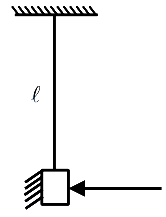
Force due to beam assuming complete reflection \(\mathrm{F}=\frac{2 \mathrm{P}}{\mathrm{C}}=\frac{2}{\mathrm{C}} \frac{\mathrm{dE}}{\mathrm{dt}} ; \mathrm{P}\) is power
So change in momentum of mirror.
\(\mathrm{m}(\mathrm{~V}-0)=\int \mathrm{Fdt}=\frac{2}{\mathrm{C}} \int \mathrm{dE}=\frac{2 \mathrm{E}}{\mathrm{C}}\)
Now using work energy theorem ...(1)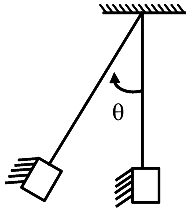
\(\begin{aligned}
& \mathrm{W}_{\mathrm{g}}=\Delta \mathrm{k} \\
& -\mathrm{mg} \ell(1-\cos \theta)=0-\frac{1}{2} \mathrm{mv}^2 \\
& \mathrm{~g} \ell\left(2 \sin ^2 \frac{\theta}{2}\right)=\frac{\mathrm{v}^2}{2}
\end{aligned}\)
as \(\theta\) is small
\(\begin{aligned} & \mathrm{g} \ell 2\left(\frac{\theta}{2}\right)^2=\frac{1}{2} \frac{4 \mathrm{E}^2}{\mathrm{~m}^2 \mathrm{c}^2} \\ & \mathrm{~g} \ell \theta^2=\frac{4 \mathrm{E}^2}{\mathrm{~m}^2 \mathrm{c}^2} \\ & \theta=\frac{2 \mathrm{E}}{\mathrm{mc} \sqrt{\mathrm{g} \ell}}\end{aligned}\) -
- (A) Visible radiation
- (B) Gamma rays
- (C) Infra-red radiation
- (D) X-rays
Show answer and solution
Correct Answer: (D)
\(\begin{aligned}
& \lambda=\frac{\mathrm{h}}{\mathrm{p}}=\frac{6.63 \times 10^{-34}}{10^{-30} \times 2.21 \times 10^6} \\
& =3 \times 10^{-10} \mathrm{~m}
\end{aligned}\)
Hence particle will behave as x-ray. -
- (A) 2
- (B) 4
- (C) 6
- (D) 8
Show answer and solution
Correct Answer: (A)
Let the momentum of \(\mathrm{e}^{-}\)at any time t is p and its de-broglie wavelength is \(\lambda\).
Then, \(\mathrm{p}=\frac{\mathrm{h}}{\lambda}\)
\(\begin{aligned}
& \frac{\mathrm{dp}}{\mathrm{dt}}=\frac{-\mathrm{h}}{\lambda^2} \frac{\mathrm{~d} \lambda}{\mathrm{dt}} \\
& \mathrm{ma}=\mathrm{F}=-\frac{\mathrm{h}}{\lambda} \frac{\mathrm{~d} \lambda}{\mathrm{dt}} \quad[\mathrm{~m}=\text { mass of } \mathrm{e}]
\end{aligned}\)
Where, -ve sign represents decrease in \(\lambda\) with time
\(\mathrm{ma}=\frac{-\mathrm{h}}{(\mathrm{~h} / \mathrm{p})^2} \frac{\mathrm{~d} \lambda}{\mathrm{dt}}\)
\(\begin{aligned}
& \mathrm{a}=-\frac{\mathrm{p}^2}{\mathrm{mh}} \frac{\mathrm{~d} \lambda}{\mathrm{dt}} \\
& \mathrm{a}=-\frac{\mathrm{mv}^2}{\mathrm{~h}} \frac{\mathrm{~d} \lambda}{\mathrm{dt}} \\
& \frac{\mathrm{~d} \lambda}{\mathrm{dt}}=-\frac{\mathrm{ah}}{\mathrm{mv}^2}...(1)
\end{aligned}\)
here, \(\mathrm{a}=\frac{\mathrm{qE}}{\mathrm{m}}=\frac{\mathrm{e}}{\mathrm{m}} \frac{\sigma}{2 \varepsilon_0}\)
\(\mathrm{a}=\frac{\sigma \mathrm{e}}{2 \mathrm{~m} \varepsilon_0}\)
and \(\mathrm{v}=\mathrm{u}+\mathrm{at}\)
\(\mathrm{v}=\mathrm{at}\)
Substituting values of a \& v in equation (1)
\(\begin{aligned}
& \frac{\mathrm{d} \lambda}{\mathrm{dt}}=-\frac{2 \mathrm{~h} \varepsilon_0}{\sigma \mathrm{et}^2} \\
& \Rightarrow \frac{\mathrm{~d} \lambda}{\mathrm{dt}} \propto \frac{1}{\mathrm{t}^2} \\
& \Rightarrow \mathrm{n}=2
\end{aligned}\) -
- (A) \(\frac{\lambda_0}{\sqrt{1+\frac{\mathrm{e}^2 \mathrm{E}_0{ }^2 \mathrm{t}^2}{\mathrm{~m}^2 \mathrm{v}_0{ }^2}}}\)
- (B) \(\lambda_{\mathrm{o}} \sqrt{1+\frac{\mathrm{e}^2 \mathrm{E}_0^2 \mathrm{t}^2}{\mathrm{~m}^2 \mathrm{v}_{\mathrm{o}}^2}}\)
- (C) \(\frac{\lambda_0}{\sqrt{1-\frac{\mathrm{e}^2 \mathrm{E}_{\mathrm{o}}{ }^2 \mathrm{t}^2}{\mathrm{~m}^2 \mathrm{v}_{\mathrm{o}}^2}}}\)
- (D) \(\lambda_0\)
Show answer and solution
Correct Answer: (A)
\(\begin{aligned} & \overrightarrow{\mathrm{v}}=\mathrm{v}_0 \hat{\mathrm{i}}-\frac{\mathrm{E}_0 \mathrm{e}}{\mathrm{m}} t \hat{\mathrm{k}} \\ & |\overrightarrow{\mathrm{v}}|=\sqrt{\mathrm{v}_0^2+\frac{\mathrm{E}_0^2 \mathrm{e}^2 \mathrm{t}^2}{\mathrm{~m}^2}} \\ & \lambda_0=\frac{\mathrm{h}}{\mathrm{mv}_0} \\ & \lambda^{\prime}=\frac{\mathrm{h}}{\mathrm{mv}_0 \sqrt{1+\frac{\mathrm{E}_0^2 \mathrm{e}^2 \mathrm{t}^2}{\mathrm{v}_0^2 \mathrm{~m}^2}}} \\ & \lambda^{\prime}=\frac{\lambda_0}{\sqrt{1+\frac{\mathrm{E}_0^2 \mathrm{e}^2 \mathrm{t}^2}{\mathrm{v}_0^2 \mathrm{~m}^2}}}\end{aligned}\) -
- (A) \(\frac{\lambda_0}{\sqrt{1-\frac{\mathrm{e}^2 \mathrm{~B}_0^2 \mathrm{t}^2}{\mathrm{~m}^2}}}\)
- (B) \(\frac{\lambda_0}{\sqrt{1+\frac{\mathrm{e}^2 \mathrm{~B}_0^2 \mathrm{t}^2}{\mathrm{~m}^2}}}\)
- (C) \(\lambda_0 \sqrt{1+\frac{\mathrm{e}^2 \mathrm{~B}_0^2 \mathrm{t}^2}{\mathrm{~m}^2}}\)
- (D) \(\lambda_0\)
Show answer and solution
Correct Answer: (D)
Magnetic field does not work
\(\therefore\) Speed will not charge, so De-Broglie wavelength remains same. -
- (A) (A) is false but (R) is true
- (B) (A) is true but (R) is false
- (C) Both \((\mathbf{A})\) and \((\mathbf{R})\) are true and \((\mathbf{R})\) is the correct explanation of \((\mathbf{A})\)
- (D) Both \((\mathbf{A})\) and \((\mathbf{R})\) are true but \((\mathbf{R})\) is not the correct explanation of \((\mathbf{A})\)
Show answer and solution
Correct Answer: (D)
Assertion (A) is true because a sufficiently negative potential can repel and stop the emitted electrons from leaving the surface.
Reason (R) is also true because the stopping potential \(V_{\text {stop }}\) varies linearly with the frequency \(\nu\) of the incident light \(\left(V_{\text {stop }}=\frac{h}{e} \nu-\frac{\phi}{e}\right)\).
However, (R) does not directly explain why a negative potential suppresses electron emission; it only shows how much potential is needed for different frequencies.
Therefore, both (A) and (R) are true, but (R) is not the correct explanation of (A). -
- (A) Both (A) and (R) are true and (R) is the correct explanation of \((\mathbf{A})\)
- (B) Both \((\mathbf{A})\) and \((\mathbf{R})\) are true but \((\mathbf{R})\) is not the correct explanation of \((\mathbf{A})\)
- (C) (A) is false but (R) is true
- (D) (A) is true but (\(\mathbf{R}\)) is false
Show answer and solution
Correct Answer: (C)
EM wave carry both energy and momentum. Rest mass of photon is zero. -
- (A) Both \(\mathrm{A}\) and \(\mathrm{R}\) are true but \(\mathrm{R}\) is NOT the correct explanation of \(\mathrm{A}\)
- (B) \(\mathrm{A}\) is false but \(\mathrm{R}\) is true
- (C) \(\mathrm{A}\) is true but \(\mathrm{R}\) is false
- (D) Both \(\mathrm{A}\) and \(\mathrm{R}\) are true and \(\mathrm{R}\) is the correct explanation of \(\mathrm{A}\)
Show answer and solution
Correct Answer: (B)
\(\mathrm{V}_{\mathrm{S}}=\frac{\mathrm{hv}-\phi}{\mathrm{e}}\)
so stopping potential doesn't depend on Intensity
\(\mathrm{I}=\frac{\eta \mathrm{hv}}{\mathrm{~A}}\)
On increasing intensity no. of photons per sec. \(n\) increases so the no. of electrons. -
- (A) increases with increase in the intensity of the incident light
- (B) decreases with increase in the intensity of the incident light
- (C) increases with increase in the wavelength of the incident light
- (D) is \(\left(\frac{1}{\mathrm{e}}\right)\) times the maximum kinetic energy of the emitted photoelectrons
Show answer and solution
Correct Answer: (D)
From Einstein photoelectric equation
\(\frac{h c}{\lambda}=\phi+e V_S\)
Maximum K.E. \(=(\mathrm{K})_{\max }=e V s\)
So, \(V_S=\frac{(\mathrm{K})_{\max }}{e}\) -
- (A) 300 nm
- (B) 400 nm
- (C) 600 nm
- (D) 200 nm
Show answer and solution
Correct Answer: (A)
\(\begin{aligned}
& \phi=2.14 \\
& V_S=2 \mathrm{~V}
\end{aligned}\)
Using photoelectric equation.
\(\begin{aligned}
& \frac{h c}{\lambda}=2.14+2=4.14 \mathrm{eV} \\
& \lambda=\frac{1242}{4.14}=300 \mathrm{~nm}
\end{aligned}\) -
- (A) (C) and (D) only
- (B) (A), (C) and (E) only
- (C) (A), (B) and (C) only
- (D) (D) and (E) only
Show answer and solution
Correct Answer: (B)
\(\begin{aligned}
& \mathrm{hv}=\phi+\mathrm{KE}_{\max } \\
& \mathrm{KE}_{\max }=\mathrm{eV}_0 \\
& \mathrm{~V}_0=\frac{\mathrm{hv}-\phi}{\mathrm{e}}
\end{aligned}\)
(A) \(\mathrm{V}_0 \mathrm{v} / \mathrm{s} \mathrm{V}\) is linear correct
(B) Slope
\(\mathrm{v}_0=\left(\frac{\mathrm{h}}{\mathrm{e}}\right) \mathrm{v}-\frac{\phi}{\mathrm{e}} \text { Wrong }\)
Slope \(\frac{h}{e}\)
(C) Correct
(D) Incorrect
(E) Correct - 84. The radiation pressure exerted by a 450 W light source on a perfectly reflecting surface placed at 2 m away from it, is : 2025 Medium
- (A) \(1.5 \times 10^{-8}\) Pascals
- (B) 0
- (C) \(6 \times 10^{-8}\) Pascals
- (D) \(3 \times 10^{-8}\) Pascals
Show answer and solution
Correct Answer: (C)
\(P_{\mathrm{rad}}=\frac{2 I}{\mathrm{C}}\)
Where \(\mathrm{I}=\) intensity at surface
\(\mathrm{C}=\) Speed of light
\(\begin{aligned}
& I=\frac{\text { Power }}{\text { Area }}=\frac{450}{4 \pi \mathrm{r}^2} \\
& =\frac{450}{4 \pi \times 4}=\frac{450}{16 \pi} \\
& P_{\mathrm{rad}}=\frac{2 \times 450}{16 \pi \times 3 \times 10^8}=\frac{150}{8 \pi \times 10^8}
\end{aligned}\)
\(=5.97 \times 10^{-8} \approx 6 \times 10^{-8}\) Pascals -
- (A) 10
- (B) 5
- (C) 15
- (D) 20
Show answer and solution
Correct Answer: (B)
Since power emitting by a source is given as
\(\begin{aligned}
& =\frac{\text { Total energy emitted }}{\text { time }} \\
& =\frac{\left(E_1 \text { photon }\right) \times \text { Number of photons }(N)}{t} \\
& P_1=\left(E_1\right) n
\end{aligned}\)
\(\begin{aligned}
& \frac{\mathrm{P}_1}{\mathrm{P}_2}=\frac{\left(\mathrm{E}_1\right) \mathrm{n}_1}{\left(\mathrm{E}_2\right) \mathrm{n}_2}=\frac{\left(\frac{\mathrm{hC}}{\lambda_1}\right) \mathrm{n}_1}{\left(\frac{\mathrm{hC}}{\lambda_2}\right) \mathrm{n}_2} \\
& \frac{\mathrm{P}_1}{\mathrm{P}_2}=\left(\frac{\lambda_2}{\lambda_1}\right) \frac{\mathrm{n}_1}{\mathrm{n}_2}
\end{aligned}\)
Substituting the given values
\(\begin{aligned}
& 2=\left(\frac{300}{600}\right) \times \frac{2 \times 10^{15}}{\mathrm{n}_2} \\
& \mathrm{n}_2=\frac{1}{2} \times 10^{15}=5 \times 10^{14} \text { Photon } / \mathrm{sec}
\end{aligned}\) -
- (A) Green
- (B) Blue
- (C) Red
- (D) Yellow
Show answer and solution
Correct Answer: (B)
\(\begin{aligned}
& (\mathrm{KE})_{\max }=\frac{\mathrm{hc}}{\lambda}-\phi \\
& \frac{\mathrm{hc}}{\lambda} \gt \phi[\text { for emission }] \\
& \lambda \lt \frac{\mathrm{hc}}{\phi} \Rightarrow \lambda \lt \frac{1242}{3} \mathrm{~nm}
\end{aligned}\)
So blue light option (B) -
- (A) Both Cs and Li
- (B) Neither Cs nor Li
- (C) Cs only
- (D) Li only
Show answer and solution
Correct Answer: (C)
\(E=\frac{1240 \mathrm{eV} \cdot \mathrm{~nm}}{550 \mathrm{~nm}}=2.25 \mathrm{eV}\)
Possible for \(C_s\) as \(E > \phi_{c s}\)
Not for Li as \(E < \phi_{L i}\) -
- (A) Compton effect
- (B) Refraction of light
- (C) Reflection of light
- (D) Diffraction of light
Show answer and solution
Correct Answer: (A)
Compton effect refers to scattering of a photon by free electrons. This phenomenon provides an evidence for particle nature of light. -
- (A) 1320
- (B) 1310
- (C) 1330
- (D) 1340
Show answer and solution
Correct Answer: (A)
\(\begin{aligned}
& Q=c V \\
& V=\frac{Q}{c}=\frac{i t}{\left(\frac{\varepsilon_0 A}{d}\right)} \\
& d=\frac{\varepsilon_0 \pi r^2}{i}\left(\frac{v}{t}\right)
\end{aligned}\)
Putting values
\(\begin{aligned}
d & =\frac{9 \times 10^{-12} \times \frac{22}{7} \times(0.1)^2}{0.15} \times\left(7 \times 10^8\right) \\
& =1320 \mu \mathrm{~m}
\end{aligned}\) -
- (A) \(\mathrm{B}_z=6.2 \times 10^{-8} \mathrm{~T}\)
- (B) \(\mathrm{B}_z=3.1 \times 10^{-8} \mathrm{~T}\)
- (C) \(\mathrm{B}_z=1.55 \times 10^{-8} \mathrm{~T}\)
- (D) \(\mathrm{B}_z=9.3 \times 10^{-8} \mathrm{~T}\)
Show answer and solution
Correct Answer: (B)
\(\begin{aligned} & \mathrm{E}=\mathrm{BC} \\ & 9.3=\mathrm{B} \times 3 \times 10^8 \\ & \mathrm{~B}=\frac{9.3}{3 \times 10^8}=3.1 \times 10^{-8} \mathrm{~T}\end{aligned}\) -
- (A) \(\mathrm{E}_x, \mathrm{~B}_y\)
- (B) \(\mathrm{E}_y, \mathrm{~B}_z\)
- (C) \(\mathrm{E}_z, \mathrm{~B}_y\)
- (D) \(\mathrm{E}_y, \mathrm{~B}_x\)
Show answer and solution
Correct Answer: (B)
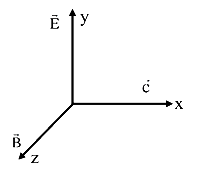
Direction of propagation
\(=\overrightarrow{\mathrm{E}} \times \overrightarrow{\mathrm{B}}\) -
- (A) 100
- (B) 200
- (C) 300
- (D) 400
Show answer and solution
Correct Answer: (A)
\(\begin{aligned} & \frac{\mathrm{CdV}}{\mathrm{dt}}=\mathrm{I}_{\mathrm{d}} \\ & \frac{\mathrm{dV}}{\mathrm{dt}}=\frac{\mathrm{I}_{\mathrm{d}}}{\mathrm{C}} \\ & =\frac{0.25 \times 10^{-3}}{2.5 \times 10^{-6}} \\ & =100\end{aligned}\) -
- (A) \(400 \sin (\omega \mathrm{t}-\mathrm{kx}) \mathrm{NC}^{-1}\)
- (B) \(200 \sin (\omega t-k x) \mathrm{NC}^{-1}\)
- (C) \(50 \sin (\omega \mathrm{t}-\mathrm{kx}) \mathrm{NC}^{-1}\)
- (D) \(25 \sin (\omega \mathrm{t}-\mathrm{kx}) \mathrm{NC}^{-1}\)
Show answer and solution
Correct Answer: (B)
Energy density of an \(E M_{\text {wave }}=\frac{1}{2} \varepsilon E_0^2\), whare \(E_0\) is the amplitude of the wave.
Since total energy is same for both cylinders
\(\begin{aligned}
& \left(\frac{1}{2} \varepsilon E_1^2\right) \pi R_1^2 L_1=\left(\frac{1}{2} \varepsilon E_2^2\right) \pi R_2^2 L_2 \\
& \Rightarrow E_1^2 R_1^2 L_1=E_2^2 R_2^2 L_2 \\
& \text { or } E_2=\frac{E_1 R_1}{R_2} \sqrt{\frac{L_1}{L_2}}=\frac{100 \mathrm{~d}}{(\mathrm{~d} / 2)} \sqrt{\frac{L_1}{L 1}}=200 \mathrm{~N} / \mathrm{C} \\
& \qquad \quad\left[\because L_1=L_2=200 \mathrm{~cm}\right]
\end{aligned}\)
\(\Rightarrow\) The amplitude of corresponding \(E M\) wave is 200 N/C
or the wave is \(E=200 \sin (\omega t-k x) \mathrm{NC}^{-1}\) -
- (A) 12
- (B) 6
- (C) 18
- (D) 24
Show answer and solution
Correct Answer: (B)
Since velocity of light in terms of \(\mu \& E\) is
\(\begin{aligned}
& V=\frac{1}{\sqrt{\mu \epsilon}}=\frac{1}{\sqrt{\mu_0 \mu_r}} \times \frac{1}{\sqrt{\epsilon_0 \epsilon_r}} \\
& =\frac{1}{\sqrt{\mu_{\mathrm{r}} \epsilon_{\mathrm{r}}}} \times \frac{1}{\sqrt{\mu_0 \epsilon_0}} \\
& =\frac{C}{\sqrt{\mu_{\mathrm{r}} \epsilon_{\mathrm{r}}}}=\frac{C}{\sqrt{\frac{10}{\pi} \times \frac{1}{0.0885}}} \\
& =\frac{C}{\sqrt{36}}=\frac{C}{6}
\end{aligned}\)
\(\begin{aligned}
\mathrm{V} & =\frac{\mathrm{C}}{6} \\
\mathrm{C} & =6 \mathrm{~V}
\end{aligned}\)
Velocity of light in vacuum is greater by 6 times the velocity of light in medium
Answer is 6 -
- (A) \(\stackrel{\rightharpoonup}{\mathrm{B}}=\frac{57}{3 \times 10^8} \cos \left[7.5 \times 10^6 \mathrm{t}-5 \times 10^{-3}(3 x+4 y)\right](\hat{k})\)
- (B) \(\overrightarrow{\mathrm{B}}=-\frac{57}{3 \times 10^8} \cos \left[7.5 \times 10^6 \mathrm{t}-5 \times 10^{-3}(3 x+4 y)\right](\hat{k})\)
- (C) \(\overrightarrow{\mathrm{B}}=-\frac{57}{3 \times 10^8} \cos \left[7.5 \times 10^6 \mathrm{t}-5 \times 10^{-3}(3 x+4 y)\right](5 \hat{k})\)
- (D) \(\overrightarrow{\mathrm{B}}=\frac{57}{3 \times 10^8} \cos \left[7.5 \times 10^6 \mathrm{t}-5 \times 10^{-3}(3 x+4 y)\right](5 \hat{k})\)
Show answer and solution
Correct Answer: (C)
\(\begin{aligned} & \overrightarrow{\mathrm{K}}=3 \hat{\mathrm{i}}+4 \hat{\mathrm{j}} \\ & \hat{\mathrm{K}}=\frac{3 \hat{\mathrm{i}}+4 \hat{\mathrm{j}}}{5} \\ & \hat{\mathrm{E}}=\frac{4 \hat{\mathrm{i}}-3 \hat{\mathrm{j}}}{5} \\ & \hat{\mathrm{~B}}=\hat{\mathrm{K}} \times \hat{\mathrm{E}} \\ & \hat{\mathrm{B}}=-\hat{\mathrm{Z}} \\ & \mathrm{B}_0=\frac{\mathrm{E}_0}{\mathrm{C}}=\frac{57}{3 \times 10^8}\end{aligned}\) -
- (A) \(\overrightarrow{\mathrm{E}}=\left(\frac{1}{2} \hat{i}-\frac{\sqrt{3}}{2} \hat{j}\right) 30 \mathrm{c} \sin \left[\omega\left(\mathrm{t}-\frac{z}{\mathrm{c}}\right)\right]\)
- (B) \(\overrightarrow{\mathrm{E}}=\left(\frac{3}{4} \hat{i}+\frac{1}{4} \hat{j}\right) 30 \mathrm{c} \cos \left[\omega\left(\mathrm{t}-\frac{z}{\mathrm{c}}\right)\right]\)
- (C) \(\overrightarrow{\mathrm{E}}=\left(\frac{1}{2} \hat{i}+\frac{\sqrt{3}}{2} \hat{j}\right) 30 \mathrm{c} \sin \left[\omega\left(\mathrm{t}+\frac{z}{\mathrm{c}}\right)\right]\)
- (D) \(\overrightarrow{\mathrm{E}}=\left(\frac{\sqrt{3}}{2} \hat{i}-\frac{1}{2} \hat{j}\right) 30 \mathrm{c} \sin \left[\omega\left(\mathrm{t}+\frac{z}{\mathrm{c}}\right)\right]\)
Show answer and solution
Correct Answer: (A)
\(\begin{aligned}
& \overrightarrow{\mathrm{B}}=\left(\frac{\sqrt{3}}{2} \hat{\mathrm{i}}+\frac{1}{2} \hat{\mathrm{j}}\right) 30 \sin \left[\omega\left(\mathrm{t}-\frac{\mathrm{z}}{\mathrm{c}}\right)\right] \\
& \overrightarrow{\mathrm{E}}=\overrightarrow{\mathrm{B}} \times \overrightarrow{\mathrm{c}} \text { and } \mathrm{E}=\mathrm{B}_0 \mathrm{c}
\end{aligned}\)
Here \(\overrightarrow{\mathrm{E}}\left(\frac{\sqrt{3}}{2}(-\hat{\mathrm{j}})+\frac{1}{2} \hat{\mathrm{i}}\right)\)
\(\begin{aligned}
& \mathrm{E}_0=30 \mathrm{c} \\
& \overrightarrow{\mathrm{E}}=\left(\frac{1}{2} \hat{\mathrm{i}}-\frac{\sqrt{3}}{2} \hat{\mathrm{j}}\right) 30 \mathrm{c} \sin \left[\omega\left(\mathrm{t}-\frac{\mathrm{z}}{\mathrm{c}}\right)\right]
\end{aligned}\) -
- (A) 9
- (B) 11
- (C) 13
- (D) 15
Show answer and solution
Correct Answer: (B)
Position of the \(n^{\text {th }}\) bright fringe w.r.t. central maxima in a YDSE is \(y_n=n \frac{\lambda D}{d}\).
\(\Rightarrow \quad \frac{y_{10}^{\prime}}{y_{10}}=\frac{\lambda^{\prime}}{\lambda}\)
or \(\quad y_{10}^{\prime}=\frac{\lambda^{\prime}}{\lambda} y_{10}\)
\(\begin{aligned} & =\left(\frac{660 \mathrm{~nm}}{600 \mathrm{~nm}}\right) 10 \mathrm{~mm} \\ & =11 \mathrm{~mm}\end{aligned}\) -
- (A) \(\cos ^{-1}\left(\frac{1}{\sqrt{3}}\right)\)
- (B) \(\cos ^{-1}\left(\frac{2}{3}\right)\)
- (C) \(\cos ^{-1}\left(\frac{1}{3}\right)\)
- (D) \(\cos ^{-1}\left(\sqrt{\frac{2}{3}}\right)\)
Show answer and solution
Correct Answer: (A)
The direction of propagation of light is perpendicular to the wave front and is symmetric about \(\mathrm{x}, \mathrm{y}\) and z axis.
\(\therefore\) Angle made by the light with \(\mathrm{x}, \mathrm{y} \& \mathrm{z}\) axis is same.
\(\therefore \quad \cos \alpha=\cos \beta=\cos \gamma(\alpha, \beta \& \gamma\) are angle made by light with \(\mathrm{x}, \mathrm{y} \& \mathrm{z}\) axis respectively)
Also \(\cos ^2 \alpha+\cos ^2 \beta+\cos ^2 \gamma=1\) [Sum of direction cosines]
\(\therefore \alpha=\cos ^{-1} \frac{1}{\sqrt{3}}\) -
- (A) 52
- (B) 50
- (C) 54
- (D) 48
Show answer and solution
Correct Answer: (C)
For a thin film interference, a fringe for transmission is formed.
When
\(2 \mu x=n \lambda\)
\(\begin{aligned} \Rightarrow & \frac{d x}{d t}=\left(\frac{d n}{d t}\right) \frac{\lambda}{2 \mu} \\ & =\left(\frac{1}{12}\right) \frac{560 \times 10^{-9}}{2 \times 1.4}=\frac{5}{3} \times 10^{-8} \mathrm{~m} / \mathrm{s}\end{aligned}\)
\(\begin{aligned} & V=\text { Volume of film }=\pi R^2 x \\ & \frac{d V}{d t}=\pi R^2 \frac{d x}{d t} \\ & =\pi\left(1.8 \times 10^{-2}\right)^2 \frac{5}{3} \times 10^{-8} \mathrm{~m}^3 / \mathrm{s} \\ & =54 \pi \times 10^{-13} \mathrm{~m}^3 / \mathrm{s}\end{aligned}\) -
- (A) 137.5 nm
- (B) 275 nm
- (C) 94.8 nm
- (D) 68.7 nm
Show answer and solution
Correct Answer: (A)
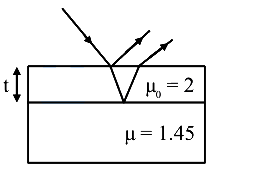
For transmitted green light to be maxima, reflected green should be minima.
\(\begin{aligned}
& \Delta \mathrm{P}=2 \mu_0 \mathrm{t}=\mathrm{n} \lambda \\
& \Rightarrow \mathrm{t}=\frac{\mathrm{n} \lambda}{2 \mu_0} \therefore \mathrm{t}_{\min }=\frac{\lambda}{2 \mu_0}=\frac{550}{2 \times 2}=137.5
\end{aligned}\)
No questions on this page match these filters.