


Questions
35 questionsShowing 1–35 of 35 questions
-
- (A) 661.845 g
- (B) 662 g
- (C) 661.8 g
- (D) 661.84 g
Show answer and solution
Correct Answer: (C)
\(\mathrm{m}_1+\mathrm{m}_2+\mathrm{m}_3=435.42+226.3+0.125\)
According to least significant digits \(\mathrm{m}=661.8 \mathrm{~g}\) -
- (A) 10
- (B) 15
- (C) 20
- (D) 50
Show answer and solution
Correct Answer: (B)
\(\mathrm{C}=\mathrm{P}^1 \mathrm{q}^2 \mathrm{r}^{-3} \mathrm{~s}^{1 / 2}\)
\(\left(\frac{\mathrm{dC}}{\mathrm{C}}\right)_{\max }=\frac{\mathrm{dP}}{\mathrm{P}}+\frac{2 \mathrm{dq}}{\mathrm{q}}+\frac{3 \mathrm{dr}}{\mathrm{r}}+\frac{1}{2} \frac{\mathrm{ds}}{\mathrm{s}}\)
\(\begin{aligned}& =\left(1+2 \times 2+3 \times 3+\frac{1}{2} \times 2\right) \% \\& =15 \%\end{aligned}\)
Ans. \(15\) -
- (A) 7500
- (B) 7200
- (C) 7700
- (D) 7100
Show answer and solution
Correct Answer: (C)
\(\begin{aligned} & \mathrm{Q}=\frac{\mathrm{ab}^4}{\mathrm{~cd}} \\ & \Rightarrow \frac{\Delta \mathrm{Q}}{\mathrm{Q}} \times 100=\left[\frac{\Delta \mathrm{a}}{\mathrm{a}}+4 \frac{\Delta \mathrm{~b}}{\mathrm{~b}}+\frac{\Delta \mathrm{c}}{\mathrm{c}}+\frac{\Delta \mathrm{d}}{\mathrm{d}}\right] \times 100 \\ & \Rightarrow \frac{\mathrm{x}}{1000}=\left[\frac{3}{60}+4\left(\frac{0.1}{20}\right)+\left(\frac{0.2}{40}\right)+\frac{0.1}{50}\right] \times 100 \\ & \Rightarrow \mathrm{x}=7700\end{aligned}\) -
- (A) 0.1
- (B) 0.8
- (C) 0.7
- (D) 0.6
Show answer and solution
Correct Answer: (C)
\(\begin{aligned} & \text { Fractional error }=2 \frac{\Delta X}{X}+\frac{3}{2} \frac{\Delta Y}{Y}+\frac{2}{5} \frac{\Delta Z}{Z} \\ & =2(0.1)+\frac{3}{2}(0.2)+\frac{2}{5}(0.5) \\ & =0.2+0.3+0.2=0.7\end{aligned}\) -
- (A) 5
- (B) 3
- (C) 4
- (D) 2
Show answer and solution
Correct Answer: (B)
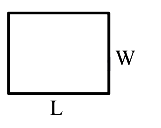
Since least count of the instrument can be calculated as
\(\begin{aligned}
& \text { Least count }=\frac{\text { pitch length }}{\text { No. of division on circular scale }} \\
& =\frac{0.75}{15}=0.05 \mathrm{~mm} .
\end{aligned}\)
Here we are provided \(\mathrm{L}=5 \mathrm{~mm} \& \mathrm{~W}=2.5 \mathrm{~mm}\) \(\mathrm{L}=5 \mathrm{~mm} \& \mathrm{~W}=2.5 \mathrm{~mm}\)
\(\because\) We know that
\(\mathrm{A}=\mathrm{L} . \mathrm{W}\)
For calculating fractional error, we can write
\(\frac{\mathrm{dA}}{\mathrm{~A}}=\frac{\mathrm{dL}}{\mathrm{~L}}+\frac{\mathrm{dW}}{\mathrm{~W}}\)
Here \(\mathrm{dL}=\mathrm{dW}=0.05 \mathrm{~mm}\)
\(\begin{aligned}
& \frac{\mathrm{dA}}{\mathrm{~A}}=\frac{0.05}{5}+\frac{0.05}{2.5} \\
& \Rightarrow \frac{\mathrm{dA}}{\mathrm{~A}}=\frac{1}{100}+\frac{2}{100}=\frac{3}{100}
\end{aligned}\)
So, \(x=3\) -
- (A) \(y=1326.19\)
- (B) \(y=1330\)
- (C) \(y=1326.186\)
- (D) \(y=1326.2\)
Show answer and solution
Correct Answer: (B)
Explanation:
The provided answer key is completely correct. The preference for Option D usually happens when the rule for addition/subtraction is mistakenly applied instead of the rule for multiplication/division:
1. Rule for Multiplication and Division:
In operations involving multiplication and division, the final result must be rounded off to contain the same number of significant figures as present in the component term with the least number of significant figures.
2. Counting Significant Figures in the Given Terms:
- \( 32.3 \) has 3 significant figures.
- \( 1125 \) has 4 significant figures.
- \( 27.4 \) has 3 significant figures.
Since the minimum number of significant figures among the given values is 3, the final answer must be rounded off to exactly 3 significant figures.
3. Calculation and Rounding:
\( y = \frac{32.3 \times 1125}{27.4} = 1326.186... \)
Rounding off \( 1326.186... \) to 3 significant figures:
The first three digits are 1, 3, and 2. The fourth digit is 6 (which is greater than 5), so the third digit increases by 1, yielding \( 1330 \). In the number \( 1330 \), the trailing zero without a decimal point is not significant, leaving exactly 3 significant figures.
Option D (\( 1326.2 \)) has 5 significant figures, which violates the rounding rule for multiplication and division.
Hence, Option B is the correct choice. -
- (A) \(0.001\)
- (B) \(0.002\)
- (C) \(0.0005\)
- (D) \(0.0025\)
Show answer and solution
Correct Answer: (B)
\(\begin{aligned} & 300 \mathrm{msd}=15 \mathrm{~cm} \\ & 1 \mathrm{msd}=\frac{15}{300} \mathrm{~cm}=0.05 \mathrm{~cm} \\ & 25 \mathrm{vsd}=24 \mathrm{msd} \\ & 1 \mathrm{vsd}=\frac{24}{25} \mathrm{msd} \\ & \mathrm{LC}=1 \mathrm{msd}-1 \mathrm{vsd}\end{aligned}\)
\(\begin{aligned}
& \mathrm{LC}=1 \mathrm{msd}-\frac{24}{25} \mathrm{msd}=\frac{1}{25} \mathrm{msd} \\
& \mathrm{LC}=\frac{1}{25} \times 0.05=0.002 \mathrm{~cm}
\end{aligned}\)
correct option (2) - 8. Given a charge \(q\), current I and permeability of vacuum \(\mu_0\). Which of the following quantity has the dimension of momentum? 2025 Medium
- (A) \(\mathrm{qI} / \mu_0\)
- (B) \(q \mu_0 I\)
- (C) \(q^2 \mu_0 I\)
- (D) \(q \mu_0 / I\)
Show answer and solution
Correct Answer: (B)
\(\begin{aligned} & \mathrm{Q}=\mathrm{AT} \\ & \mathrm{I}=\mathrm{A} \\ & \mu_0=\mathrm{MLT}^{-2} \mathrm{~A}^{-2} \\ & \mathrm{P}=\mathrm{Q}^{\mathrm{x}} \mu_0^{\mathrm{y}} \mathrm{I}^{\mathrm{z}}=[\mathrm{AT}]^{\mathrm{x}}\left[\mathrm{MLT}^{-2} \mathrm{~A}^{-2}\right]^{\mathrm{y}}[\mathrm{A}]^{\mathrm{z}} \\ & \mathrm{MLT}^{-1}=\mathrm{M}^{\mathrm{y}} \mathrm{L}^{\mathrm{y}} \mathrm{T}^{\mathrm{x}-2 \mathrm{y}} \mathrm{A}^{-2 \mathrm{y}+\mathrm{z+x}} \\ & \text { Now; } \mathrm{y}=1 \\ & \mathrm{x}-2 \mathrm{y}=-1 \\ & -2 \mathrm{y}+\mathrm{z}=0 \\ & \therefore \mathrm{x}=\mathrm{y}=\mathrm{z}=1\end{aligned}\) -
- (A) Statement I is true but Statement II is false
- (B) Statement I is false but Statement II is true
- (C) Both Statement I and Statement II are false
- (D) Both Statement I and Statement II are true
Show answer and solution
Correct Answer: (C)
In general one vernier scale division is smaller than one main scale division but in some modified cases it may be not correct. Also least count is given by one main scale division / number of vernier scale division for normal vernier calliper. -
- (A) \(\mathrm{L} / \mathrm{T}^2\)
- (B) \(L^2 / T^2\)
- (C) \(T^2 / L\)
- (D) \(\mathrm{T}^2 / \mathrm{L}^2\)
Show answer and solution
Correct Answer: (B)
\(\mathrm{C}=\frac{1}{\sqrt{\mu_0 \varepsilon_0}} \Rightarrow \frac{1}{\mu_0 \varepsilon_0}=\mathrm{C}^2=\mathrm{L}^2 \mathrm{~T}^{-2}\) -
- (A) Electric field
- (B) Electric potential
- (C) Electric charge
- (D) Electric current
Show answer and solution
Correct Answer: (D)
We know that formula for displacement current is given by
\(\mathrm{id}=\varepsilon_0 \frac{\mathrm{~d} \phi_{\varepsilon}}{\mathrm{dt}}\) - 12. If \(B\) is magnetic field and \(\mu_0\) is permeability of free space, then the dimensions of \(\left(B / \mu_0\right)\) is 2025 Easy
- (A) \(\mathrm{ML}^2 \mathrm{~T}^{-2} \mathrm{~A}^{-1}\)
- (B) \(\mathrm{MT}^{-2} \mathrm{~A}^{-1}\)
- (C) \(\mathrm{L}^{-1} \mathrm{~A}\)
- (D) \(\mathrm{LT}^{-2} \mathrm{~A}^{-1}\)
Show answer and solution
Correct Answer: (C)
For a current carrying loop at centre
\(\begin{aligned}
& B=\frac{\mu_0 i}{2 R} \\
& \therefore \quad \frac{B}{\mu_0} \equiv \frac{i}{R} \equiv\left[\mathrm{AL}^{-1}\right]
\end{aligned}\) -
- (A) 0
- (B) -5
- (C) -6
- (D) -1
Show answer and solution
Correct Answer: (A)
Modulus of Elasticity: \(E = \left[ML^{-1}T^{-2}\right]\)
Torque: \(\tau = \left[ML^2T^{-2}\right]\)
Dimension of \(\frac{E}{\tau}\): \(\frac{\left[ML^{-1}T^{-2}\right]}{\left[ML^2T^{-2}\right]} = \left[M^{1-1} L^{-1-2} T^{-2-(-2)}\right] = \left[M^0 L^{-3} T^0\right]\)
Comparing with \(\left[M^a L^b T^c\right]\): \(a=0, b=-3, c=0\)
Given \(b=-3\), the value of \(c\) is \(0\).
-
- (A) \(-1,0\)
- (B) \(-1,1\)
- (C) \(1,-1\)
- (D) \(0,-1\)
Show answer and solution
Correct Answer: (D)
Electric dipole moment \((\overrightarrow{\mathrm{P}})=\mathrm{q} \times 2 \ell\)
Magnetic dipole moment \((\overrightarrow{\mathrm{M}})=\mathrm{IA}\)
\(\left[\frac{\mathrm{P}}{\mathrm{M}}\right]=\left[\frac{\mathrm{LTA}}{\mathrm{~L}^2 \mathrm{~A}}\right]=\mathrm{L}^{-1} \mathrm{~T}=\mathrm{M}^0 \mathrm{~L}^{-1} \mathrm{~T}^1 \mathrm{~A}^0\)
After compering values of \(\mathrm{P} \& \mathrm{Q}\) are \(0,-1\) Correct Answer : Option 4 -
- (A) \((3,-5)\)
- (B) \((-2,2)\)
- (C) \((-2,1)\)
- (D) \((1,-1)\)
Show answer and solution
Correct Answer: (D)
\(\begin{aligned} & \frac{\phi_{\mathrm{E}}}{\phi_{\mathrm{M}}}=\frac{\mathrm{EA}}{\mathrm{BA}}=\frac{E}{B} \\ & \mathrm{~B}=\frac{\mathrm{M} \ell \mathrm{T}^{-2}}{\mathrm{ATLT}^{-1}} \\ & \text { So }\left[\frac{\mathrm{E}}{\mathrm{B}}\right]=\frac{\mathrm{ML}^{-3} \mathrm{~A}^{-1}}{\mathrm{MT}^{-2} \mathrm{~A}^{-1}}=\mathrm{LT}^{-1}\end{aligned}\)
\(\begin{aligned} & \text { Or } \\ & E=c \cdot B \\ & {\left[\frac{E}{B}\right]=L T^{-1}}\end{aligned}\) -
- (A) (A)-(III), (B)-(I), (C)-(II), (D)-(IV)
- (B) (A)-(IV), (B)-(III), (C)-(II), (D)-(I)
- (C) (A)-(III), (B)-(IV), (C)-(I), (D)-(II)
- (D) (A)-(II), (B)-(III), (C)-(I), (D)-(IV)
Show answer and solution
Correct Answer: (D)
\(\begin{aligned} & \mathrm{C}^{\prime}=\frac{\Delta \mathrm{Q}}{\Delta \mathrm{T}}=\mathrm{JK}^{-1} \\ & \mathrm{~S}=\frac{\Delta \mathrm{Q}}{\mathrm{m} \Delta \mathrm{T}}=\mathrm{Jkg}^{-1} \mathrm{~K}^{-1} \\ & \mathrm{~L}=\frac{\Delta \mathrm{Q}}{\mathrm{m}}=\mathrm{Jkg}^{-1} \\ & \Delta \mathrm{Q}=\frac{\mathrm{KA} \Delta \mathrm{T}}{\mathrm{L}} \Rightarrow \mathrm{K}=\frac{\Delta \mathrm{Q}(\mathrm{L})}{\mathrm{A} \Delta \mathrm{T}}=\mathrm{Jm}^{-1} \mathrm{~K}^{-1} \mathrm{~s}^{-1}\end{aligned}\) -
- (A) (A)-(IV), (B)-(III), (C)-(I), (D)-(II)
- (B) (A)-(III), (B)-(II), (C)-(IV), (D)-(I)
- (C) (A)-(I), (B)-(IV), (C)-(II), (D)-(III)
- (D) (A)-(II), (B)-(I), (C)-(III), (D)-(IV)
Show answer and solution
Correct Answer: (B)
(A) \(B=\frac{\mu_0 i}{2 \pi r} \& q v B=F\)
\(\mu_0 \equiv \frac{B r}{i} \equiv \frac{F r}{q v i} \equiv \frac{\mathrm{MLT}^{-2} \times L}{\mathrm{~A}^2 \mathrm{TLT}^{-1}} \equiv \mathrm{MLT}^{-2} A^{-2}\)
(B) \(B \equiv \frac{F}{q V} \equiv \frac{\mathrm{MLT}^{-2}}{\mathrm{ATLT}^{-1}}=\mathrm{MT}^{-2} \mathrm{~A}^{-1}\)
(C) \(M=i A \equiv \mathrm{AL}^2\)
(D) \(\tau=C \theta \Rightarrow C \equiv \mathrm{ML}^2 \mathrm{~T}^{-2}\) -
- (A) (A)-(I), (B)-(III), (C)-(II), (D)-(IV)
- (B) (A)-(IV), (B)-(II), (C)-(III), (D)-(I)
- (C) (A)-(II), (B)-(IV), (C)-(I), (D)-(III)
- (D) (A)-(II), (B)-(I), (C)-(IV), (D)-(III)
Show answer and solution
Correct Answer: (C)
(A) \([\mathrm{Y}]=\frac{\mathrm{F}}{\mathrm{A}\left(\frac{\Delta \ell}{\ell}\right)} \Rightarrow \frac{\mathrm{MLT}^{-2}}{\mathrm{~L}^2}=\mathrm{ML}^{-1} \mathrm{~T}^{-2}\)
(B) Torque \((\vec{\tau})=\overrightarrow{\mathrm{r}} \times \overrightarrow{\mathrm{F}}\)
\((\vec{\tau})=\mathrm{L} \times \mathrm{MLT}^{-2}=\mathrm{ML}^2 \mathrm{~T}^{-2}(\mathrm{IV})\)
(C) Coefficient of viscosity \(\Rightarrow F=\eta A \frac{d V}{d t}\)
\(\eta \rightarrow \mathrm{Pa} \cdot \mathrm{sec}\)
\([\eta]=\frac{\mathrm{MLT}^{-2}}{\mathrm{~L}^2} \times \mathrm{T}=\mathrm{ML}^{-1} \mathrm{~T}^{-1}\)
(D) Gravitational constant (G)
\(\begin{aligned}
& \mathrm{F}=\frac{\mathrm{GM}_1 \mathrm{M}_2}{\mathrm{r}^2} \\
& {[\mathrm{G}]=\frac{\mathrm{F} \cdot \mathrm{r}^2}{\mathrm{~m}_1 \mathrm{~m}_2}=\frac{\mathrm{MLT}^{-2} \times \mathrm{L}^2}{\mathrm{M}^2}=\mathrm{M}^{-1} \mathrm{~L}^3 \mathrm{~T}^{-2}}
\end{aligned}\) -
- (A) (A)-(II), (B)-(I), (C)-(IV), (D)-(III)
- (B) (A)-(I), (B)-(III), (C)-(IV), (D)-(II)
- (C) (A)-(III), (B)-(I), (C)-(II), (D)-(IV)
- (D) (A)-(III), (B)-(I), (C)-(IV), (D)-(II)
Show answer and solution
Correct Answer: (D)
Angular impulse = \(\left[M L^2 T^{-1}\right]\)
Latent Heat = \(\left[M^0 L^2 T^{-2}\right]\)
Electrical resistivity = \(\left[M L^3 T^{-3} A^{-2}\right]\)
Electromotive force = \(\left[M L^2 T^{-3} A^{-1}\right]\) -
- (A) (A)-(IV), (B)-(II), (C)-(III), (D)-(I)
- (B) (A)-(I), (B)-(III), (C)-(IV), (D)-(II)
- (C) (A)-(IV), (B)-(II), (C)-(I), (D)-(III)
- (D) (A)-(II), (B)-(III), (C)-(IV), (D)-(I)
Show answer and solution
Correct Answer: (C)
(A) Mass density \(=\frac{M}{V}=M^1 L^{-3}\)...(iv)
(B) Impulse \(=\mathrm{M} \times \mathrm{u}=\mathrm{M}^1 \mathrm{~L}^1 \mathrm{~T}^{-1}\)....(ii)
(C) Power \(=\mathrm{F}. \mathrm{V}=\mathrm{M}^1 \mathrm{~L}^2 \mathrm{~T}^{-3}\)....(i)
(D) Moment of inertia \(=\mathrm{Mr}^2=\mathrm{M}^1 \mathrm{~L}^2\)...(iii) -
- (A) (A)-(I), (B)-(II), (C)-(III), (D)-(IV)
- (B) (A)-(III), (B)-(IV), (C)-(I), (D)-(II)
- (C) (A)-(III), (B)-(II), (C)-(I), (D)-(IV)
- (D) (A)-(III), (B)-(IV), (C)-(II), (D)-(I)
Show answer and solution
Correct Answer: (D)
(A) Magnetic induction \(\rightarrow\) Gauss (III)
(B) Magnetic intensity
\(\left(\mathrm{H}=\frac{\mathrm{B}}{\mu}\right) \rightarrow\) Ampere \(/\) meter (IV)
(C) Magnetic flux \(\rightarrow\) Weber (Wb) (II)
(D) Magnetic moment \(\rightarrow\) Ampere-meter \({ }^2\)
\((\overrightarrow{\mathrm{M}}=\mathrm{i} \overrightarrow{\mathrm{~A}})\) -
- (A) \((\mathrm{A})-(\mathrm{I}),(\mathrm{B})-(\mathrm{IV}),(\mathrm{C})-(\mathrm{III}),(\mathrm{D})-(\mathrm{II})\)
- (B) (A)-(IV), (B)-(I), (C)-(II), (D)-(III)
- (C) \((\mathrm{A})-(\mathrm{IV}),(\mathrm{B})-(\mathrm{II}),(\mathrm{C})-(\mathrm{I}),(\mathrm{D})-(\mathrm{III})\)
- (D) (A)-(II), (B)-(III), (C)-(IV), (D)-(I)
Show answer and solution
Correct Answer: (B)
(A) Coefficient of viscosity \([\eta]=\left[\mathrm{M}^1 \mathrm{~L}^{-1} \mathrm{~T}^{-1}\right]\)
(B) Intensity \([\mathrm{I}]=\left[\mathrm{M}^1 \mathrm{~L}^0 \mathrm{~T}^{-3}\right]\)
(C) Pressure gradient \(=\left[\mathrm{ML}^{-2} \mathrm{~T}^{-2}\right]\)
(D) Compressibility \([\mathrm{K}]=\left[\mathrm{M}^{-1} \mathrm{~L}^1 \mathrm{~T}^2\right]\) -
- (A) A-III, B-IV, C-I, D-II
- (B) A-II, B-III, C-IV, D-I
- (C) A-III, B-II, C-I, D-IV
- (D) A-III, B-IV, C-II, D-I
Show answer and solution
Correct Answer: (A)
(A) \([\mathrm{k}]=\frac{\mathrm{PV}}{\mathrm{NT}}=\frac{\mathrm{ML}^2 \mathrm{~T}^{-2}}{\mathrm{~K}}=\mathrm{ML}^2 \mathrm{~T}^{-2} \mathrm{~K}^{-1}\)
(B) \([\eta]=\frac{\mathrm{F}}{6 \pi \mathrm{rv}}=\frac{\mathrm{MLT}^{-2}}{\mathrm{~L}^2 \mathrm{~T}^{-1}}=\mathrm{ML}^{-1} \mathrm{~T}^{-1}\)
(C) \([\mathrm{h}]=\frac{\mathrm{E}}{\mathrm{f}}=\frac{\mathrm{ML}^2 \mathrm{~T}^{-2}}{\mathrm{~T}^{-1}}=\mathrm{ML}^2 \mathrm{~T}^{-1}\)
(D) \(\frac{\mathrm{dQ}}{\mathrm{dt}}=\mathrm{k} \frac{\mathrm{AdT}}{\mathrm{dx}}\)
\(\mathrm{k}=\frac{\left(\mathrm{ML}^2 \mathrm{~T}^{-3}\right) \mathrm{L}}{\mathrm{L}^2 \cdot \mathrm{~K}}=\mathrm{MLT}^{-3} \mathrm{~K}^{-1}\) -
- (A) A-IV, B-III, C-II, D-I
- (B) A-III, B-II, C-I, D-IV
- (C) A-II, B-IV, C-III, D-I
- (D) A-I, B-III, C-IV, D-II
Show answer and solution
Correct Answer: (A)
\(\begin{aligned}
& \text { (A) } \mathrm{G}=\frac{\mathrm{Fr}^2}{\mathrm{~m}^2} \\
& {[\mathrm{G}]=\frac{\left[\mathrm{MLT}^{-2}\right]\left[\mathrm{L}^2\right]}{\left[\mathrm{M}^2\right]}=\left[\mathrm{M}^{-1} \mathrm{~L}^3 \mathrm{~T}^{-2}\right](\mathrm{IV})}
\end{aligned}\)
(B)
\(\begin{aligned}
& \text { P.E. }=\mathrm{mgh}=\left[\mathrm{MLT}^{-2} \mathrm{~L}\right] \\
& =\left[\mathrm{ML}^2 \mathrm{~T}^{-2}\right] \text { (III) }
\end{aligned}\)
(C) Gravitational Potential \(=\frac{\mathrm{GM}}{\mathrm{r}}\)
\(=\frac{\left[\mathrm{M}^{-1} \mathrm{~L}^3 \mathrm{~T}^{-2}\right][\mathrm{M}]}{[\mathrm{L}]}=\left[\mathrm{M}^0 \mathrm{~L}^2 \mathrm{~T}^{-2}\right]=\left[\mathrm{L}^2 \mathrm{~T}^{-2}\right](\mathrm{II})\)
(D) Acceleration due to gravity \(=[\mathrm{g}]=\left[\mathrm{LT}^{-2}\right](\mathrm{I})\) -
- (A) Voltage
- (B) Capacitance
- (C) Inductance
- (D) Resistance
Show answer and solution
Correct Answer: (D)
\(\begin{aligned} & L=\frac{\mu_0 N A}{\ell} \\ & C=\frac{A \epsilon_0}{d} \\ & \frac{L}{C} \propto \frac{\mu_0}{\epsilon_0} \\ & \sqrt{\frac{\mu_0}{\epsilon_0}} \propto \sqrt{\frac{L}{C}} \\ & \frac{L}{C}=\frac{\tau R}{(\tau / R)}=R^2 \\ & \sqrt{\frac{\mu_0}{\epsilon_0}}=R\end{aligned}\) -
- (A) electric field
- (B) area
- (C) charge
- (D) displacement
Show answer and solution
Correct Answer: (D)
\(\begin{aligned} & \alpha \equiv \frac{\phi}{\sigma} \\ & \beta=\frac{\phi}{\lambda} \\ & \frac{\alpha}{\beta} \equiv \frac{\lambda}{\sigma} \equiv \text { displacement }\end{aligned}\) -
- (A) \(6 \%\)
- (B) \(8.4 \%\)
- (C) \(11.6 \%\)
- (D) \(4 \%\)
Show answer and solution
Correct Answer: (A)
\(\begin{aligned}
& d E=3 \alpha^2 d \alpha e^{-\beta t}+\alpha^3 e^{-\beta t}(-\beta) d t \\
& \frac{d E}{E}=\frac{3 d \alpha}{\alpha}+(-\beta) d t \\
& \frac{\Delta E}{E}=\frac{3 \Delta \alpha}{\alpha}+\beta \Delta t
\end{aligned}\)
(\%) \(\Delta t=1.6 \% \times 5=8 \%\)
\(\%\left(\frac{3 \Delta \alpha}{\alpha}\right)=3 \times 1.2 \%=3.6 \%\)
Putting values we get
\(\Rightarrow 3.6+8 \times 0.3=6 \%\) -
- (A) Planck's constant
- (B) Compressibility
- (C) Strain
- (D) Energy density
Show answer and solution
Correct Answer: (D)
\(\begin{aligned} & {\left[\mathrm{P}+\frac{\mathrm{a}}{\mathrm{V}^2}\right](\mathrm{V}-\mathrm{b})=\mathrm{RT}} \\ & \therefore[\mathrm{a}]=[\mathrm{P}]\left[\mathrm{V}^2\right]=\mathrm{ML}^{-1} \mathrm{~T}^{-2} \mathrm{~L}^6=\mathrm{ML}^5 \mathrm{~T}^{-2} \\ & {[\mathrm{~b}]=[\mathrm{V}]=\mathrm{L}^3} \\ & {\left[\mathrm{ab}^{-2}\right]=\mathrm{ML}^5 \mathrm{~T}^{-2} \mathrm{~L}^{-6}=\mathrm{ML}^{-1} \mathrm{~T}^{-2}}\end{aligned}\)
Dimension of energy density. -
- (A) \(\left[\mathrm{M}^0 \mathrm{~L}^1 \mathrm{~T}^{-3}\right]\)
- (B) \(\left[\mathrm{M}^0 \mathrm{~L}^2 \mathrm{~T}^{-2}\right]\)
- (C) \(\left[\mathrm{M}^0 \mathrm{~L}^1 \mathrm{~T}^{-2}\right]\)
- (D) \(\left[\mathrm{M}^0 \mathrm{~L}^2 \mathrm{~T}^{-3}\right]\)
Show answer and solution
Correct Answer: (D)
\(\begin{aligned} & {\left[\mathrm{LT}^{-1}\right]=[\mathrm{A}]\left[\mathrm{T}^2\right]=\frac{[\mathrm{B}][\mathrm{T}]}{[\mathrm{C}]+[\mathrm{T}]}} \\ & {[\mathrm{C}]=[\mathrm{T}]} \\ & {[\mathrm{A}]=\left[\mathrm{LT}^{-3}\right]} \\ & {[\mathrm{B}]=\left[\mathrm{LT}^{-1}\right]} \\ & {[\mathrm{ABC}]=\left[\mathrm{L}^2 \mathrm{~T}^{-3}\right]}\end{aligned}\) -
- (A) 30
- (B) 40
- (C) 35
- (D) 45
Show answer and solution
Correct Answer: (C)
\(\begin{aligned} & \text { Given least count of Screw Gauge }=0.01 \mathrm{~mm} \\ & \text { L.C }=\frac{(\text { pitch })}{\text { No. of circular turn }}=\frac{\mathrm{P}}{\mathrm{N}}=0.01 \mathrm{~mm} \\ & \text { New pitch }=\frac{\mathrm{P}(1+0.75)}{\mathrm{N}(1-0.5)}=\frac{\mathrm{P}}{\mathrm{N}}\left[\frac{1.75}{0.5}\right] \\ & =(0.01) 3.5 \\ & =0.035 \mathrm{~mm} \\ & =35 \times 10^{-3} \mathrm{~mm}\end{aligned}\) -
- (A) 8
- (B) 5
- (C) 4
- (D) 7
Show answer and solution
Correct Answer: (B)
\(\begin{aligned} & \mathrm{d}=\frac{\mathrm{m}}{\text { vol. }}=\frac{\mathrm{m}}{\pi \mathrm{R}^2 \ell} \Rightarrow \frac{\mathrm{~d} \rho}{\rho}=\frac{\mathrm{dm}}{\mathrm{m}}+\frac{2 \mathrm{dR}}{\mathrm{R}}+\frac{\mathrm{d} \ell}{\ell} \\ & \Rightarrow \frac{\mathrm{d} \rho}{\rho}=\left(\frac{0.003}{0.6}+\frac{2 \times 0.01}{0.5}+\frac{0.05}{10}\right) 100=5 \%\end{aligned}\) -
- (A) Pressure and Young's modulus
- (B) Surface tension and impulse
- (C) Torque and energy
- (D) Angular momentum and Planck's constant
Show answer and solution
Correct Answer: (B)
[Angular momentum \(]=\mathrm{ML}^2 \mathrm{~T}^{-1}\)
[Planck's Constant] \(=\mathrm{ML}^2 \mathrm{~T}^{-1}\)
[Torque] \(=\mathrm{ML}^2 \mathrm{~T}^{-2}\)
[Energy] \(=\mathrm{ML}^2 \mathrm{~T}^{-2}\)
[Surface tension] \(=\mathrm{MT}^{-2}\)
[Impulse]= MLT \(^{-1}\)
[Pressure \(]=\mathrm{ML}^{-1} \mathrm{~T}^{-2}\)
[Young's modulus] \(=\mathrm{ML}^{-1} \mathrm{~T}^{-2}\) -
- (A) \(L^2 T^{-2}\)
- (B) \(L^2\)
- (C) \(L\)
- (D) \(L^3 \mathrm{~T}^{-2}\)
Show answer and solution
Correct Answer: (A)
\(\begin{aligned} & \text { Dimension }[\mathrm{x}(\mathrm{t})]=[\mathrm{L}] \\ & {[\mathrm{A}]=[\mathrm{L}]} \\ & {[\mathbf{B}]=[\mathrm{L}]} \\ & {[\mathbf{C}]=\left[\mathrm{LT}^{-2}\right]} \\ & {[\mathrm{D}]=[\mathrm{L}]} \\ & {\left[\frac{\mathrm{ABC}}{\mathrm{D}}\right]=\left[\frac{\mathrm{L} \times \mathrm{L} \times \mathrm{LT}^{-2}}{\mathrm{~L}}\right]=\left[\mathrm{L}^2 \mathrm{~T}^{-2}\right]}\end{aligned}\) -
- (A) Vm
- (B) NC
- (C) Nm
- (D) \(\mathrm{NC}^{-1}\)
Show answer and solution
Correct Answer: (D)
\(\begin{aligned}
& \mathrm{I}=\frac{1}{2} \epsilon_0 \mathrm{E}_0^2 \times \mathrm{C} \\
& \mathrm{E}_0=\sqrt{\frac{2 \mathrm{I}}{\epsilon_0 \mathrm{C}}}
\end{aligned}\)
\(E_0\) : electric field N/C -
- (A) \([\mathrm{F}]=\left[\mathrm{C}^2 \mathrm{M}^{-1} \mathrm{~L}^{-2} \mathrm{~T}^2\right]\)
- (B) \([\mathrm{F}]=\left[\mathrm{C}^2 \mathrm{M}^{-2} \mathrm{~L}^2 \mathrm{~T}^2\right]\)
- (C) \([\mathrm{F}]=\left[\mathrm{CM}^{-2} \mathrm{~L}^{-2} \mathrm{~T}^{-2}\right]\)
- (D) \([\mathrm{F}]=\left[\mathrm{CM}^{-1} \mathrm{~L}^{-2} \mathrm{~T}^2\right]\)
Show answer and solution
Correct Answer: (A)
\(\begin{aligned} & \text { Energy }=\frac{Q^2}{2 C} \\ & \begin{aligned} \therefore \quad[\mathrm{F}] & =\frac{\left[\mathrm{C}^2\right]}{\left[\mathrm{ML}^2 \mathrm{~T}^{-2}\right]} \\ & =\left[\mathrm{C}^2 \mathrm{M}^{-1} \mathrm{~L}^{-2} \mathrm{~T}^{+2}\right]\end{aligned}\end{aligned}\)
No questions on this page match these filters.