


Questions
7 questionsShowing 1–7 of 7 questions
-
- (A) the acceleration of the particle is \(2 \mathrm{c}_0\)
- (B) the acceleration of the particle is \(2\mathrm{~c}\)
- (C) the initial velocity of the particle is \(4\mathrm{~c}\)
- (D) the acceleration of the particle is \(2\left(c+c_0\right)\)
Show answer and solution
Correct Answer: (D)
\(\begin{aligned} & \mathrm{v}=\frac{\mathrm{dx}}{\mathrm{dt}}=2 \mathrm{tC}_0+2 \mathrm{C}(\mathrm{t}-2) \\ & \mathrm{a}=\frac{\mathrm{dv}}{\mathrm{dt}}=2 \mathrm{C}_0+2 \mathrm{C}\end{aligned}\) -
- (A) 10
- (B) 2
- (C) 5
- (D) 11
Show answer and solution
Correct Answer: (A)
\(\begin{aligned} & \mathrm{v}_{\text {avg }}=\frac{\mathrm{x}_1+\mathrm{x}_2}{\mathrm{t}_1+\mathrm{t}_2} \\ & \Rightarrow \frac{50}{7}=\frac{\mathrm{x}+\frac{3 \mathrm{x}}{2}}{\frac{\mathrm{x}}{5}+\frac{3 \mathrm{x}}{2 \mathrm{v}_2}} \\ & \Rightarrow \frac{50}{7}=\frac{5 / 2}{\frac{1}{5}+\frac{3}{2 \mathrm{v}_2}} \\ & \Rightarrow \frac{1}{5}+\frac{3}{2 \mathrm{v}_2}=\frac{7}{20}\end{aligned}\)
\(\begin{aligned} & \Rightarrow \frac{3}{2 \mathrm{v}_2}=\frac{7}{20}-\frac{1}{5}=\frac{7-4}{20} \\ & \Rightarrow \frac{3}{2 \mathrm{v}_2}=\frac{3}{20} \\ & \Rightarrow \mathrm{v}_2=10 \mathrm{~m} / \mathrm{s}\end{aligned}\) -
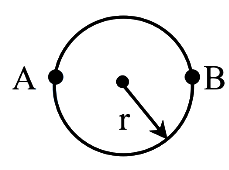
- (A) \(2 \mathrm{r}, 3 \pi \mathrm{r}\)
- (B) \(3 \pi r, \pi r\)
- (C) \(\pi r, 3 r\)
- (D) \(3 \pi r, 2 r\)
Show answer and solution
Correct Answer: (D)
Explanation:
Let us analyze the motion of the sportsman step-by-step along the circular track:
1. Understanding the Path Structure:
From the given diagram, points A and B are diametrically opposite to each other. The sequence of motion is given as \( ABAB \), meaning the sportsman starts at initial position A and moves continuously as follows:
- From A to B: Covers a semi-circle path length = \( \pi r \)
- From B to A: Covers the next semi-circle path length = \( \pi r \)
- From A to B: Covers another semi-circle path length = \( \pi r \)
2. Calculating Distance Travelled:
Distance is defined as the actual total length of the path covered by the moving body:
\( \text{Total Distance} = \pi r + \pi r + \pi r = 3\pi r \)
3. Calculating Displacement:
Displacement is the shortest straight-line distance separating the initial position and the final position.
- Initial Position: Point A
- Final Position: Point B
Since A and B are opposite ends of the diameter, the straight-line separation between them is equal to the diameter of the track:
\( \text{Displacement} = 2r \)
Hence, Option D is the correct choice. -
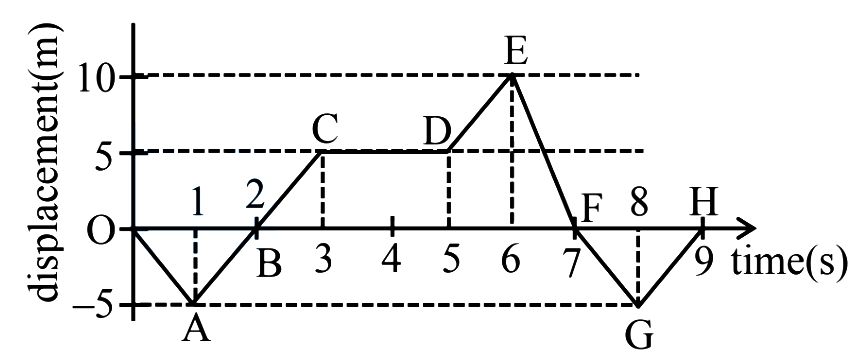
- (A) (A), (D), (E) only
- (B) (B), (C), (D) only
- (C) (B), (D), (E) only
- (D) (B), (C), (E) only
Show answer and solution
Correct Answer: (D)
\(\begin{aligned}
& \langle\overrightarrow{\mathrm{v}}\rangle=\frac{\Delta \overrightarrow{\mathrm{s}}}{\Delta \mathrm{t}}=\frac{\mathrm{S}_{\mathrm{f}}-\mathrm{S}_{\mathrm{i}}}{\mathrm{t}_{\mathrm{f}}-\mathrm{t}_{\mathrm{i}}} \\
& \overrightarrow{\mathrm{v}}=\frac{\mathrm{ds}}{\mathrm{dt}}=\text { slope }
\end{aligned}\)
(A) 0 to \(3 \mathrm{sec} ;\langle\overrightarrow{\mathrm{v}}\rangle=\frac{5-0}{3}=5 / 3 \mathrm{~m} / \mathrm{s}\)
(B) 0 to \(5 \mathrm{sec} ;\langle\vec{v}\rangle=\frac{5-5}{2}=0\)
(C) \(\mathrm{t}=2 ;\) slope \(=\vec{v}=5 \mathrm{~m} / \mathrm{s}\)
(D) \(\mathfrak{t}=5\) to \(7 \mathrm{sec} ;\langle\overrightarrow{\mathrm{v}}\rangle=\frac{0-5}{2}=-2.5 \mathrm{~m} / \mathrm{s}\)
At \(t=6.5 \mathrm{sec} ; \vec{v}=10\)
(E) \(\mathrm{t}=0\) to \(\mathrm{t}=9 ;\langle\overrightarrow{\mathrm{v}}\rangle=0\) -
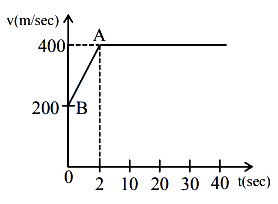
- (A) \(12\)
- (B) \(3\)
- (C) \(6\)
- (D) \(9\)
Show answer and solution
Correct Answer: (A)
Distance = area under the graph
\(\begin{aligned}
d & =300 \times 2+400 \times 28.5 \\
& =600+114000 \\
& =12000 \mathrm{~m}
\end{aligned}\) -
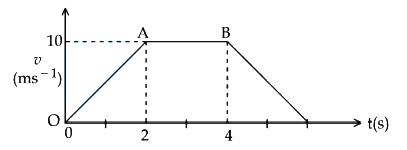
- (A) \(30\mathrm{~m}\)
- (B) \(11\mathrm{~m}\)
- (C) \(10\mathrm{~m}\)
- (D) \(13\mathrm{~m}\)
Show answer and solution
Correct Answer: (A)
Distance travelled = displacement when direction of velocity remains constant
\(\begin{aligned} \Rightarrow \text { Distance } & =\text { Area } \\ & =\frac{1}{2}(2 \mathrm{~s}+4 \mathrm{~s})(10 \mathrm{~m} / \mathrm{s}) \\ & =30 \mathrm{~m}\end{aligned}\) -
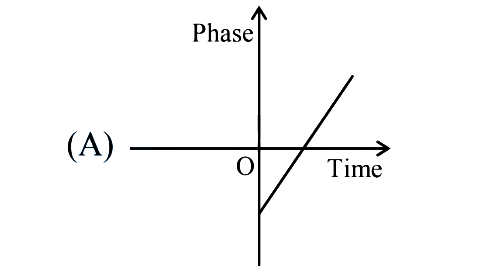
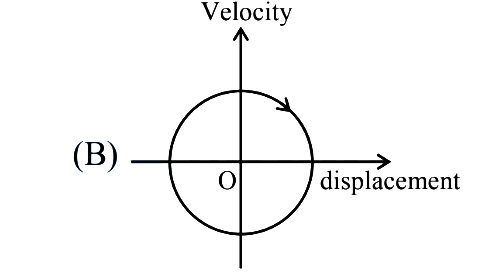
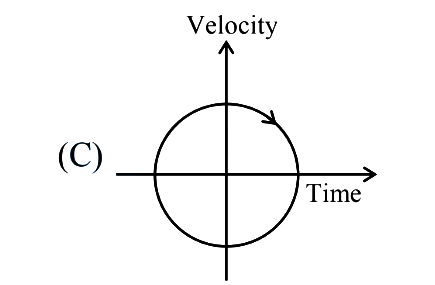
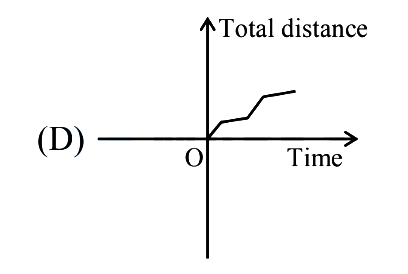
- (A) A, B and D only
- (B) A, B and C only
- (C) A and B only
- (D) A, C and D only
Show answer and solution
Correct Answer: (A)
For option (A)
\(\phi=\mathrm{kt}+\mathrm{C}\) it can be 1D motion
\(\mathrm{eg} \rightarrow \mathrm{x}=\mathrm{A} \sin \phi(\mathrm{SHM})\)
For option (B)
\(\mathrm{v}^2+\mathrm{x}^2=\) constant yes 1D
For option (C)
time can't be negative Not possible
For option (D)
Possible
A, B \& D only
No questions on this page match these filters.