


Questions
28 questionsShowing 1–28 of 28 questions
-
- (A) \(q_1=10 \mu \mathrm{C}, \mathrm{q}_2=20 \mu \mathrm{C}\)
- (B) \(\mathrm{q}_1=30 \mu \mathrm{C}, \mathrm{q}_2=15 \mu \mathrm{C}\)
- (C) \(\mathrm{q}_1=20 \mu \mathrm{C}, \mathrm{q}_2=10 \mu \mathrm{C}\)
- (D) \(\mathrm{q}_1=15 \mu \mathrm{C}, \mathrm{q}_2=30 \mu \mathrm{C}\)
Show answer and solution
Correct Answer: (A)
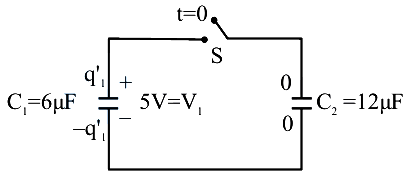
\(\mathrm{q}_1^{\prime}=6 \times 5=30 \mu \mathrm{C}\)
Finally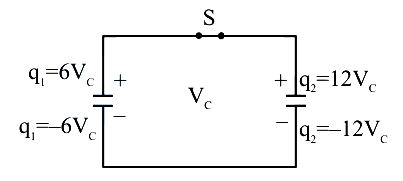
\(\begin{aligned} & 6 \mathrm{~V}_{\mathrm{C}}+12 \mathrm{~V}_{\mathrm{c}}=30+0 \\ & 18 \mathrm{~V}_{\mathrm{C}}=30 \\ & \mathrm{~V}_{\mathrm{C}}=\frac{30}{18}=\frac{5}{3} \mathrm{Volt} \\ & \Rightarrow \mathrm{q}_1=\frac{6 \times 5}{3}=10 \mu \mathrm{C} \\ & \Rightarrow \mathrm{q}_2=\frac{12 \times 5}{3}=20 \mu \mathrm{C}\end{aligned}\) -
- (A) 43.8 kJ
- (B) 48.7 kJ
- (C) 87.7 kJ
- (D) 24.4 kJ
Show answer and solution
Correct Answer: (C)
Given \(\mathrm{V}=4.2\) volt
\(\therefore\) Energy supplied by battery
\(=\mathrm{vq}=4.2 \times 5800 \times 3600 \times 10^{-3} \mathrm{~J}=87.696 \mathrm{~kJ}\)
\(\therefore\) Energy stored in the battery when fully charged
\(=87.696 \mathrm{~kJ} \approx 87.7 \mathrm{~kJ}\) -
- (A) 10
- (B) 15
- (C) 5
- (D) 20
Show answer and solution
Correct Answer: (C)
\(\begin{aligned} & \mathrm{Q}_{\mathrm{in}}=\mathrm{Q}\left(1-\frac{1}{\mathrm{~K}}\right) \\ & 4 \times 10^{-6}=5 \times 10^{-6}\left(1-\frac{1}{\mathrm{~K}}\right) \\ & 1-\frac{1}{\mathrm{~K}}=\frac{4}{5} \\ & \mathrm{~K}=5\end{aligned}\) -
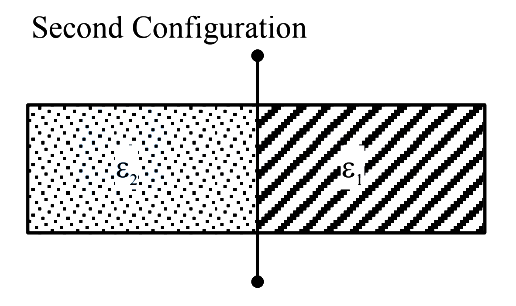
- (A) \(\frac{\varepsilon_1 \varepsilon_2^2}{\left(\varepsilon_1+\varepsilon_2\right)^2}\)
- (B) \(\frac{4 \varepsilon_1 \varepsilon_2}{\left(\varepsilon_1+\varepsilon_2\right)^2}\)
- (C) \(\frac{\varepsilon_1 \varepsilon_2}{\varepsilon_1+\varepsilon_2}\)
- (D) \(\frac{\varepsilon_0\left(\varepsilon_1+\varepsilon_2\right)}{2}\)
Show answer and solution
Correct Answer: (B)
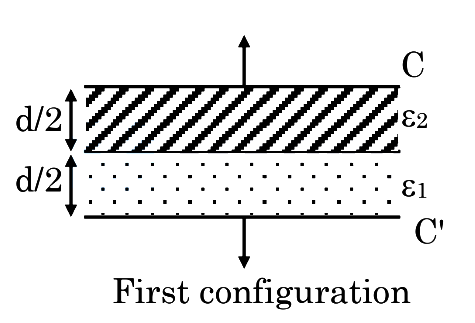
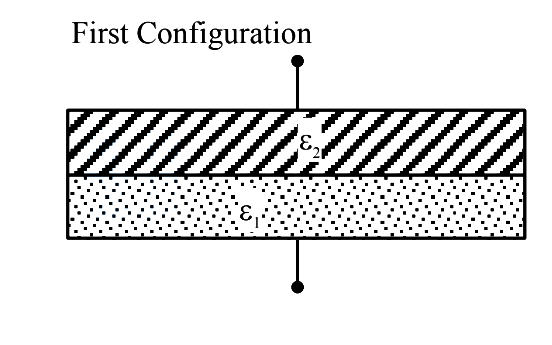
Area of plate is \(A\). then
\(\begin{aligned}
& \mathrm{C}=\frac{\varepsilon_2 \varepsilon_0 \mathrm{~A}}{\mathrm{~d} / 2}=\frac{2 \varepsilon_2 \varepsilon_0 \mathrm{~A}}{\mathrm{~d}} \\
& \mathrm{C}^{\prime}=\frac{\varepsilon_1 \varepsilon_0 \mathrm{~A}}{\mathrm{~d} / 2}=\frac{2 \varepsilon_1 \varepsilon_0 \mathrm{~A}}{\mathrm{~d}}
\end{aligned}\)
Let \(\mathrm{C}_0=\frac{\varepsilon_0 \mathrm{~A}}{\mathrm{~d}}\)
\(\begin{aligned}
& \mathrm{C}=2 \varepsilon_2 \mathrm{C}_0 \\
& \mathrm{C}^{\prime}=2 \varepsilon_1 \mathrm{C}_0
\end{aligned}\)
\(\mathrm{C} \& \mathrm{C}^{\prime}\) are in series
\(\mathrm{C}_1=\frac{\mathrm{CC}^{\prime}}{\mathrm{C}+\mathrm{C}^{\prime}}=\frac{4 \varepsilon_2 \varepsilon_1 \mathrm{C}_0^2}{2 \mathrm{C}_0\left(\varepsilon_2+\varepsilon_1\right)}\)
\(=\frac{2 \varepsilon_2 \varepsilon_1 \mathrm{C}_0}{\left(\varepsilon_2+\varepsilon_1\right)}\)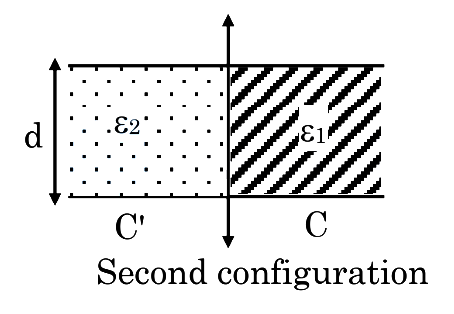
Here \(\mathrm{C}=\frac{\varepsilon_1 \varepsilon_0 \mathrm{~A}}{2 \mathrm{~d}}=\frac{\varepsilon_1 \mathrm{C}_0}{2}\)
\(\mathrm{C}^{\prime}=\frac{\varepsilon_2 \mathrm{C}_0}{2}\)
\(\mathrm{C} \& \mathrm{C}^{\prime}\) are inparallel
\(\mathrm{C}_2=\mathrm{C}^{\prime}+\mathrm{C}=\left(\varepsilon_1+\varepsilon_2\right) \frac{\mathrm{C}_0}{2}\)
Thus \(\frac{\mathrm{C}_1}{\mathrm{C}_2}=\frac{2 \varepsilon_2 \varepsilon_1 \mathrm{C}_0}{\left(\varepsilon_2+\varepsilon_1\right)} \times \frac{2}{\left(\varepsilon_1+\varepsilon_2\right) \mathrm{C}_0}\)
\(=\frac{4 \varepsilon_2 \varepsilon_1}{\left(\varepsilon_2+\varepsilon_1\right)^2}\) -
- (A) \(2 \times 10^{-4} \mathrm{~J} / \mathrm{m}^3\)
- (B) \(1.8 \times 10^5 \mathrm{~J} / \mathrm{m}^3\)
- (C) \(1.8 \times 10^3 \mathrm{~J} / \mathrm{m}^3\)
- (D) \(2 \times 10^2 \mathrm{~J} / \mathrm{m}^3\)
Show answer and solution
Correct Answer: (C)
\(\begin{aligned} \text { Energy density } & =\frac{1}{2} \varepsilon_0 E^2 \\ & =\frac{1}{2} \varepsilon_0\left(\frac{V}{d}\right)^2 \\ & =\frac{1}{2}\left(8.85 \times 10^{-12}\right)\left(\frac{20}{10^{-6}}\right)^2 \mathrm{~J} / \mathrm{m}^3 \\ & \simeq 1.8 \times 10^3 \mathrm{~J} / \mathrm{m}^3\end{aligned}\) -
- (A) 4 mC and 0.2 J
- (B) 8 mC and 2.0 J
- (C) 2 mC and 0.4 J
- (D) 2 mC and 0.2 J
Show answer and solution
Correct Answer: (A)
\(\begin{aligned} & \Delta \mathrm{q}=(\mathrm{KC}-\mathrm{C}) \mathrm{V} \\ & =40 \times 10^{-6} \times 100 \\ & =4000 \times 10^{-3}=4 \mathrm{mC} \\ & \Delta \mathrm{U}=\frac{1}{2} \mathrm{C}^{\prime} \mathrm{V}^2-\frac{1}{2} \mathrm{CV}^2=\frac{1}{2}(\mathrm{~K}-1) \mathrm{CV}^2 \\ & =\frac{1}{2} \mathrm{CV}^2(2-1) \\ & =\frac{1}{2} \mathrm{CV}^2=\frac{1}{2} \times 40 \times 10^{-6} \times 10000 \\ & =0.2 \mathrm{~J}\end{aligned}\) -
- (A) A only
- (B) C only
- (C) B and D only
- (D) \(C\) and \(E\) only
Show answer and solution
Correct Answer: (D)
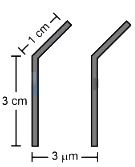
We know \(C=\frac{A \varepsilon_0}{d}\)
\(=\frac{b \ell \varepsilon_0}{d}\)
So to increase the capacitance by 10 factor \(\left(\frac{A}{d}\right)\) has to increase by 10 fator.
For option (A) \(\quad C^{\prime}=\frac{(30 \ell) b \varepsilon_0}{\left(\frac{d}{3}\right)}=30 \mathrm{C}\)
For option (B) \(\quad C^{\prime}=\frac{\ell b \varepsilon_0}{10 d}=\frac{C}{10}\)
For option (C) \(\quad C^{\prime}=\frac{(2 \ell) 5 b \varepsilon_0}{d}=10 \mathrm{C}\)
For option (D) \(\quad C^{\prime}=\frac{\left(\frac{\ell}{3}\right) b \varepsilon_0}{\left(\frac{10 d}{3}\right)}=\frac{C}{10}\)
For option (E) \(\quad C^{\prime}=\frac{\left(\frac{\ell}{3}\right) 5(2 b) \varepsilon_0}{\left(\frac{d}{3}\right)}=10 C\)
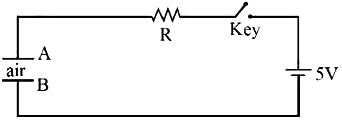
Clearly (C) and (E) are the situation for 10 C - 8. At steady state the charge on the capacitor, as shown in the circuit below, is _________ \(\mu \mathrm{C}\).
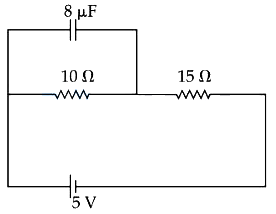
2025 Medium- (A) 6
- (B) 16
- (C) 26
- (D) 36
Show answer and solution
Correct Answer: (B)
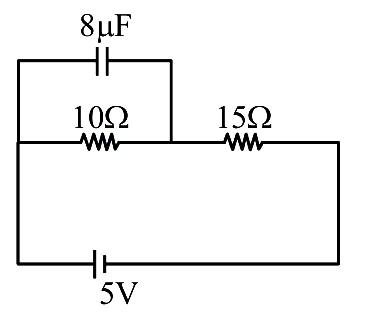
\(\begin{aligned} & \mathrm{i}=\left(\frac{5}{25}\right) \\ & \mathrm{Q}=\mathrm{CV} \\ & \mathrm{Q}=\left(8 \times 10^{-6}\right)\left(\frac{5}{25} \times 10\right) \\ & \mathrm{Q}=\left(\frac{8 \times 5 \times 10^{-2}}{25}\right)=16 \mu \mathrm{C}\end{aligned}\) -
- (A) \(\varepsilon_0 \mathrm{E}^2 \mathrm{Ad}\)
- (B) \(\frac{1}{2} \varepsilon_0 \mathrm{E}^2 \mathrm{Ad}\)
- (C) \(\frac{1}{4} \varepsilon_0 \mathrm{E}^2 \mathrm{Ad}\)
- (D) \(\frac{3}{4} \varepsilon_0 \mathrm{E}^2 \mathrm{Ad}\)
Show answer and solution
Correct Answer: (B)
We know energy density
\(\rho_{\mathrm{av}}=\frac{1}{2} \varepsilon_0 E^2\)
So potential energy \(=\rho_{a v} \times\) Volume
\(\Rightarrow \text { P.E. }=\frac{1}{2} \varepsilon_0 E^2 A d\) -
- (A) A, B and C Only
- (B) A and C Only
- (C) D and E Only
- (D) B and C Only
Show answer and solution
Correct Answer: (A)
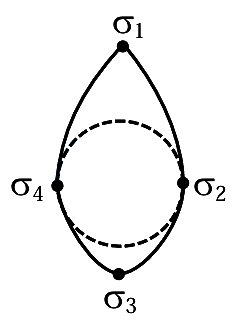
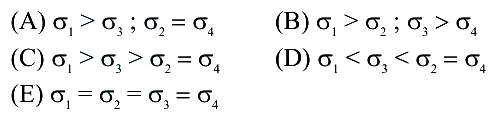
\(\begin{aligned} & \sigma \propto \frac{1}{\mathrm{ROC}} \\ & (\mathrm{ROC})_1 \lt (\mathrm{ROC})_3 \lt (\mathrm{ROC})_2=(\mathrm{ROC})_4 \\ & \sigma_1 \gt \sigma_3 \gt \sigma_2=\sigma_4\end{aligned}\) -
- (A) \(V_0\) and \(\frac{E_0}{4}\)
- (B) zero and \(\frac{E_0}{16}\)
- (C) zero and \(\frac{E_0}{8}\)
- (D) \(\frac{\mathrm{V}_0}{2}\) and \(\frac{\mathrm{E}_0}{16}\)
Show answer and solution
Correct Answer: (B)
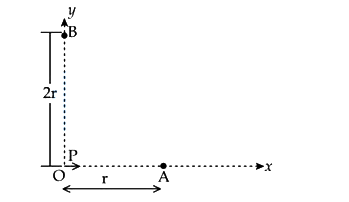
At point \(A\) (axial)
\(\left|E_0\right|=\frac{2 k_p}{r^3}, V_0=\frac{k_p}{r^2}\)
At point \(B\) (equatorial)
\(\begin{aligned}
& |E|=\frac{k_p}{(2 r)^3}=\frac{E_0}{16} \\
& V=0
\end{aligned}\) -
- (A) 60
- (B) 64
- (C) 70
- (D) 75
Show answer and solution
Correct Answer: (B)
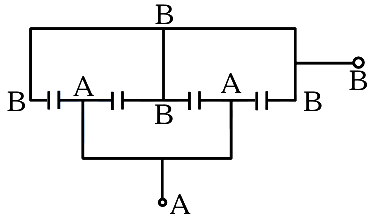
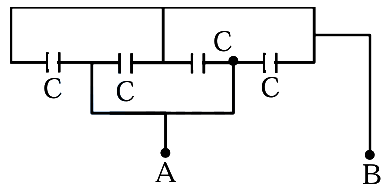
Redrawing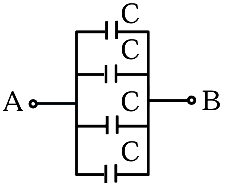
\(\mathrm{C}_{\mathrm{eq}}=4 \mathrm{C}=64\) -
- (A) \(\mathrm{A}\) is true but \(\mathrm{R}\) is false
- (B) Both \(\mathrm{A}\) and \(\mathrm{R}\) are true and \(\mathrm{R}\) is the correct explanation of \(\mathrm{A}\)
- (C) \(\mathrm{A}\) is false but \(\mathrm{R}\) is true
- (D) Both \(\mathrm{A}\) and \(\mathrm{R}\) are true but \(\mathrm{R}\) is NOT the correct explanation of \(\mathrm{A}\)
Show answer and solution
Correct Answer: (B)
For a uniformly charged spherical shell:
- The electric field inside the shell is zero everywhere (from Gauss's law)
* When the electric field is zero, no work is done in moving a charge
- Since work - force \(\times\) displacement, and force - q̧E (where E - 0), work - 0
- The potential inside is constant and equal to the value at the surface
Assertion A is correct: Since the electric field is zero everywhere inside the shell, no work is done moving a charge between any two points, regardless of path.
Reason R is correct: The potential inside a uniformly charged spherical shell is indeed constant and equal to the value at the surface.
Does R explain \(A\) ? Yes, because:
- Constant potential means zero electric field (since \(\mathrm{E}=-\mathrm{FW}\))
- Zero electric field means no force on a test charge
- No force means no work done in moving the charge
Therefore, opxion (2) is correct: Both A and R are true and R is the correct explanation of A. -
- (A) Both \((\mathrm{A})\) and \((\mathrm{R})\) are correct and \((\mathrm{R})\) is the correct explanation of \((\mathrm{A})\)
- (B) \((\mathrm{A})\) is correct but \((\mathrm{R})\) is not correct
- (C) Both \((\mathrm{A})\) and \((\mathrm{R})\) are correct but \((\mathrm{R})\) is not correct explanation of (A)
- (D) (A) is not correct but \((\mathrm{R})\) is correct
Show answer and solution
Correct Answer: (A)
Electric field of outside charge is zero inside conductor -
- (A) A, C Only
- (B) A, B, D Only
- (C) C, D Only
- (D) B, C, D Only
Show answer and solution
Correct Answer: (D)
Capacitor behaves like closed circuit at \(t=0\) and charge is zero.
\(\mathrm{A} X, \mathrm{~B} \checkmark, \mathrm{C} \checkmark, \mathrm{D} \checkmark\) -
- (A) \(\frac{K q_0^2}{\mathrm{a}}(4-2 \sqrt{2})\)
- (B) \(\frac{K q_0^2}{\mathrm{a}}(3-\sqrt{2})\)
- (C) \(\frac{\mathrm{Kq}_0^2}{\mathrm{a}}(4 \sqrt{2}-2)\)
- (D) \(\frac{\mathrm{Kq}_0^2}{\mathrm{a}}(3 \sqrt{2}-2)\)
Show answer and solution
Correct Answer: (D)
\(\begin{aligned}
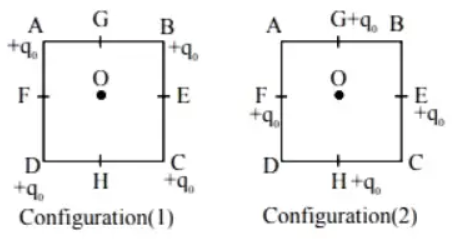
& u_{\oplus}=\left(2 \frac{K q_0}{a}+\frac{K q_0}{\sqrt{2} a}\right) q_0 \times 2 \\
& u_0=\left(2 \frac{K q_0 \sqrt{2}}{a}+\frac{K q_0}{a}\right) q_0 \times 2
\end{aligned}\)
\(\begin{aligned}
& \text { So, } \quad \Delta u=u_2-u_1=2 q_0 \frac{k q_0}{a}\left[2 \sqrt{2}+1-2-\frac{1}{\sqrt{2}}\right] \\
& \Rightarrow \quad \Delta u=\frac{2 q_0^2}{4 \pi \varepsilon_0 a}\left[\frac{4-\sqrt{2}-1}{\sqrt{2}}\right]=\frac{2 q_0^2}{4 \pi \varepsilon_0 a} \frac{(3-\sqrt{2})}{\sqrt{2}} \\
& \Rightarrow \quad \Delta u=\frac{2 k q_0^2}{a}\left[\frac{3-\sqrt{2}}{\sqrt{2}}\right]=\frac{k q_0^2}{a}(3 \sqrt{2}-2)
\end{aligned}\) -
- (A) 20
- (B) 25
- (C) 15
- (D) 10
Show answer and solution
Correct Answer: (C)
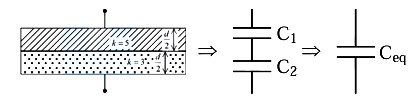
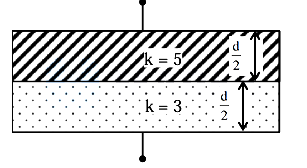
\(\begin{aligned} & \mathrm{C}_1=\frac{5 \times 4 \times 10^{-4} \times 8.85 \times 10^{-12}}{\frac{1.77}{2} \times 10^{-3}}=20 \mathrm{pF} \\ & \mathrm{C}_2=\frac{3 \times 4 \times 10^{-4} \times 8.85 \times 10^{-12}}{\frac{1.77}{2} \times 10^{-3}}=12 \mathrm{pF} \\ & \mathrm{C}_{\mathrm{eq}}=\frac{\mathrm{C}_1 \mathrm{C}_2}{\mathrm{C}_1+\mathrm{C}_2}=\frac{12 \times 20}{12+20}=7.5 \mathrm{pF}\end{aligned}\)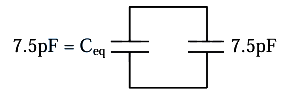
Finally equivalent capacitance
\(\left(\mathrm{C}_{\mathrm{eq}}\right)_{\text {final }}=7.5+7.5=15 \mathrm{pF}\) -
- (A) \(120 \mathrm{~V}, 120 \mathrm{~V}, 80 \mathrm{~V}\)
- (B) \(40 \mathrm{~V}, 40 \mathrm{~V}, 80 \mathrm{~V}\)
- (C) \(0 \mathrm{~V}, 0 \mathrm{~V}, 80 \mathrm{~V}\)
- (D) \(0 \mathrm{~V}, 120 \mathrm{~V}, 40 \mathrm{~V}\)
Show answer and solution
Correct Answer: (A)
Potential inside shell is equal to potential on surface
\(\mathrm{V}_{\mathrm{in}}=\mathrm{V}_{\text {surface }}=\frac{\mathrm{kQ}}{\mathrm{R}}=120 \mathrm{~V}\)
at \(\mathrm{r}=15 \mathrm{~cm}\)
\(\mathrm{V}=\frac{\mathrm{kQ}}{\mathrm{r}}=\frac{120 \times 10}{15}=80 \mathrm{~V}\) -
- (A) 2
- (B) 1
- (C) 3
- (D) 4
Show answer and solution
Correct Answer: (B)
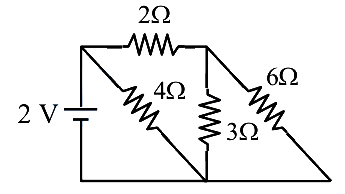
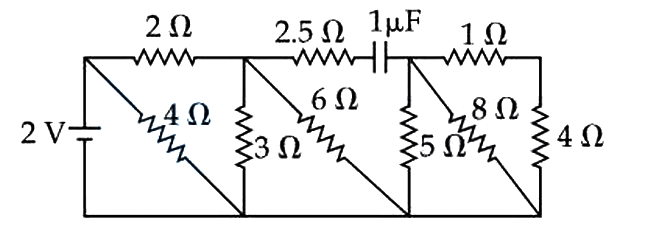
\(\begin{aligned} & \mathrm{R}_{\mathrm{eq}}=2 \Omega \\ & \mathrm{I}=\frac{2}{2}=1 \mathrm{~A}\end{aligned}\) -
- (A) \(x y z=\) constant
- (B) \(x y+y z+z x=\) constant
- (C) \(\left(x^2+y^2\right)\left(y^2+z^2\right)\left(z^2+x^2\right)=\) constant
- (D) \((x+y)(y+z)(z+x)=\) constant
Show answer and solution
Correct Answer: (C)
Potential due to an infinite wire is \(V=2 k \lambda \ln r\), where \(r\) is the distance from the wire.
Taking the point in space \(P(x, y, z)\)
Distance from wire along \(x\)-axis is \(r_x=\sqrt{y^2+z^2}\)
Distance from wire along \(y\)-axis is \(r_y=\sqrt{x^2+z^2}\)
Distance from wire along \(z\)-axis is \(r_z=\sqrt{x^2+y^2}\)
\(\Rightarrow\) Potential at \(P\) due to wire along \(x\)-axis is
\(V_x=2 k \lambda \ln r_x\)
Potential at \(P\) due to wire along \(y\)-axis is
\(V_y=2 k \lambda \ln r_y\)
Potential at \(P\) due to wire along \(z\)-axis is
\(V_z=2 k \lambda \ln r_z\)
\(\Rightarrow\) Not potential at \(P=V=V_x+V_y+V_z\)
or \(\quad V=2 k \lambda \ln r_x+2 k \lambda \ln r_y+2 k \lambda \ln r_z\)
i.e. \(V=2 k \lambda \ln \left(r_x r_y r_z\right)\)
or
\(\begin{aligned}
& V=2 k \lambda \ln \left(\sqrt{y^2+z^2} \sqrt{z^2+x^2} \sqrt{x^2+y^2}\right) \\
& =k \lambda \ln \left(y^2+z^2\right)\left(z^2+x^2\right)\left(x^2+y^2\right)
\end{aligned}\)
\(\Rightarrow\) For equipotential surface
\(\left(x^2+y^2\right)\left(y^2+z^2\right)\left(z^2+x^2\right)=\text { constant }\) -
- (A) \(22.5 \mu \mathrm{~F}\)
- (B) \(7.5 \mu \mathrm{~F}\)
- (C) \(9 \mu \mathrm{~F}\)
- (D) \(30 \mu \mathrm{~F}\)
Show answer and solution
Correct Answer: (C)
After dielectric
\(\begin{aligned}
& \mathrm{C}_1=4 \mathrm{C} \\
& \mathrm{C}_1=4 \times 5=20 \mu \mathrm{~F} \\
& \mathrm{C}_2=\mathrm{C}_3=5 \mu \mathrm{~F}
\end{aligned}\)
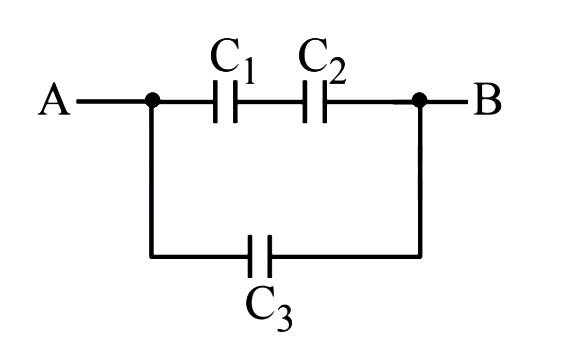
\(\mathrm{C}_1 \& \mathrm{C}_2\) are in series which is parallel to \(\mathrm{C}_3\) So
\(\begin{aligned}
& C_{c q}=\frac{C_1 C_2}{C_1+C_2}+C_3 \Rightarrow \frac{20 \times 5}{20+5}+5 \\
& =4+5=9 \mu \mathrm{~F}
\end{aligned}\)
Correct Option (3) -
- (A) \(\mathrm{C}_2\gt\mathrm{C}_1, \mathrm{U}_2 \lt \mathrm{U}_1\)
- (B) \(\mathrm{C}_1\gt\mathrm{C}_2, \mathrm{U}_1\gt\mathrm{U}_2\)
- (C) \(\mathrm{C}_1\gt\mathrm{C}_2, \mathrm{U}_1 \lt \mathrm{U}_2\)
- (D) \(\mathrm{C}_2\gt\mathrm{C}_1, \mathrm{U}_2\gt\mathrm{U}_1\)
Show answer and solution
Correct Answer: (D)
For a capacitor at steady state
\(q=C V \text { and } U=\frac{1}{2} C V^2\)
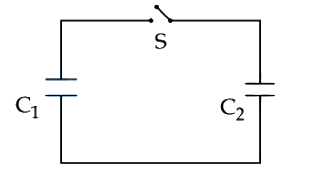
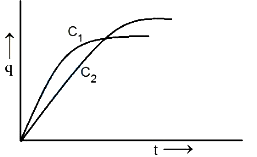
Since \(C_1\) and \(C_2\) are connected in parallel, \(V_1=V_2\).
Also from graph \(q_1 < q_2\)
\(\begin{aligned}
& \Rightarrow \quad C_1 V_1 < C_2 V_2 \\
& \text { i.e. } C_1 < C_2 \text { or } C_2>C_1 \\
& \qquad \frac{U_1}{U_2}=\frac{C_1 V_1^2}{C_2 V_2^2}=\frac{C_1}{C_2} < 1
\end{aligned}\)
or \(U_1 < U_2\) or \(U_2>U_1\) -
- (A) -1.8 J
- (B) -2.0 J
- (C) -1.5 J
- (D) -1.2 J
Show answer and solution
Correct Answer: (A)
P.E. of two charges
\(\begin{aligned}
& \mathrm{u}=\frac{1}{4 \pi \varepsilon_0} \frac{\mathrm{q}_1 \mathrm{q}_2}{\mathrm{r}} \\
& \mathrm{r}=\sqrt{\left(\mathrm{x}_2-\mathrm{x}_1\right)^2+\left(\mathrm{y}_2-\mathrm{y}_1\right)^2+\left(\mathrm{z}_2-\mathrm{z}_1\right)^2} \\
& =14 \mathrm{~cm} \\
& \therefore \mathrm{u}=\frac{9 \times 10^9 \times 7 \times 10^{-6} \times(-4) \times 10^{-6}}{14 \times 10^{-2}} \\
& =-1.8 \mathrm{~J}
\end{aligned}\) -
- (A) \(8 \mathrm{q}_2\)
- (B) \(6 \mathrm{q}_2\)
- (C) \(8 q_1\)
- (D) \(6 \mathrm{q}_1\)
Show answer and solution
Correct Answer: (A)
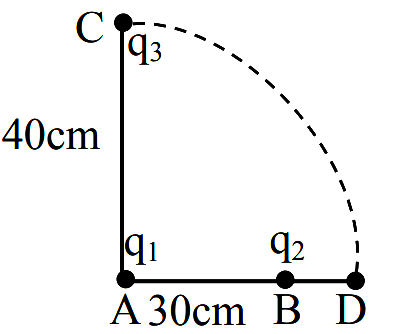
Potential at C
\(\mathrm{V}_{\mathrm{C}}=\frac{\mathrm{kq}_1}{0.4}+\frac{\mathrm{kq}_2}{0.5}\)
Potential at D
\(\mathrm{V}_{\mathrm{D}}=\frac{\mathrm{kq}_1}{0.4}+\frac{\mathrm{kq}_2}{0.1}\)
\(\Delta \mathrm{U}=\left(\mathrm{V}_{\mathrm{D}}-\mathrm{V}_{\mathrm{c}}\right)\left(\mathrm{q}_3\right)=\left(\frac{\mathrm{kq}_2}{0.1}-\frac{\mathrm{kq}_2}{0.5}\right)\left(\mathrm{q}_3\right)\)
\(\Delta \mathrm{U}=8 \mathrm{kq}_2 \mathrm{q}_3=\frac{8 \mathrm{q}_2 \mathrm{q}_3}{4 \pi \varepsilon_0}\) -
- (A) \(\frac{1}{4} \mathrm{~V}\)
- (B) \(\frac{2}{5} \mathrm{~V}\)
- (C) \(\frac{3}{4} \mathrm{~V}\)
- (D) 1 V
Show answer and solution
Correct Answer: (B)
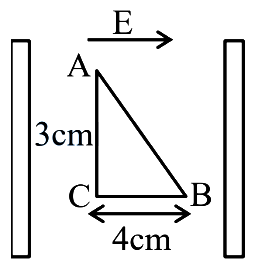
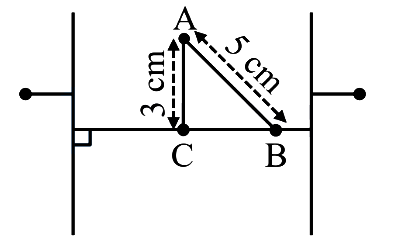
\(\begin{aligned} & \text { Using } \Delta V=E(\Delta d) \\ & V=E(10) \\ & V_{A B}=E \cdot 4=\frac{V}{10} \times 4=\frac{2 V}{5}\end{aligned}\) -
- (A) \(\frac{1}{9}\)
- (B) 9
- (C) \(\frac{1}{3}\)
- (D) 3
Show answer and solution
Correct Answer: (D)
For conducting sphere, \(\mathrm{V}=\frac{\sigma \mathrm{r}}{\varepsilon_0}\)
After contact, \(\mathrm{V}_1=\mathrm{V}_2\)
\(\begin{aligned}
& \sigma_1 r_1=\sigma_2 r_2 \\
& \frac{\sigma_1}{\sigma_2}=\frac{r_2}{\mathrm{r}_1} \\
& \frac{\sigma_1}{\sigma_2}=3
\end{aligned}\) -
- (A) 18.4 mJ
- (B) 14.4 mJ
- (C) 12.4 mJ
- (D) 16.4 mJ
Show answer and solution
Correct Answer: (B)
\(\begin{aligned} & \mathrm{U}=-\mathrm{PE} \cos \theta \\ & \mathrm{w}_{\mathrm{ext}}=\Delta \mathrm{U}=\mathrm{U}_{\mathrm{f}}-\mathrm{U}_{\mathrm{i}}=-\mathrm{PE} \cos 180^{\circ}+\mathrm{PE} \cos 0^{\circ} \\ & \mathrm{w}_{\mathrm{ext}}=2 \mathrm{PE} \\ & =2 \times\left(4 \times 10^{-6}\right)(18) \times 10^4 \\ & =144 \times 10^{-2} \\ & =14.4 \mathrm{~mJ}\end{aligned}\) -
- (A) \(600\)
- (B) \(200\)
- (C) \(400\)
- (D) \(100\)
Show answer and solution
Correct Answer: (B)
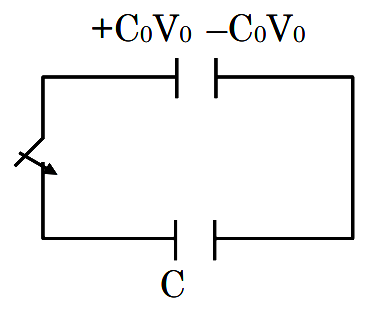
New potential \(=\frac{\mathrm{C}_0 \mathrm{~V}_0}{\mathrm{C}_0+\mathrm{C}}=\frac{\mathrm{V}_0}{3}\)
\(\begin{aligned} & 3 \mathrm{C}_0 \mathrm{~V}_0=\mathrm{C}_0 \mathrm{~V}_0+\mathrm{CV}_0 \\ & 2 \mathrm{C}_0 \mathrm{~V}_0=\mathrm{CV}_0 \\ & \mathrm{C} \Rightarrow 2 \mathrm{C}_0\end{aligned}\)
No questions on this page match these filters.