


All JEE Mains 2025 Physics questions
32 chaptersShowing 251–300 of 454 questions
-
- (A) \(\frac{\varepsilon_1 \varepsilon_2^2}{\left(\varepsilon_1+\varepsilon_2\right)^2}\)
- (B) \(\frac{4 \varepsilon_1 \varepsilon_2}{\left(\varepsilon_1+\varepsilon_2\right)^2}\)
- (C) \(\frac{\varepsilon_1 \varepsilon_2}{\varepsilon_1+\varepsilon_2}\)
- (D) \(\frac{\varepsilon_0\left(\varepsilon_1+\varepsilon_2\right)}{2}\)
Show answer and solution
Correct Answer: (B)
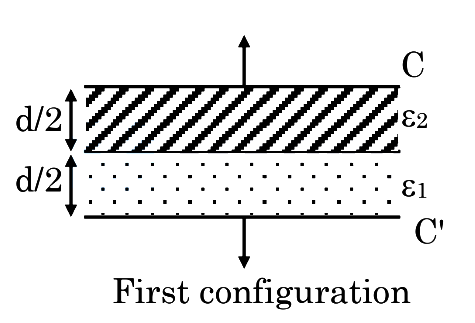
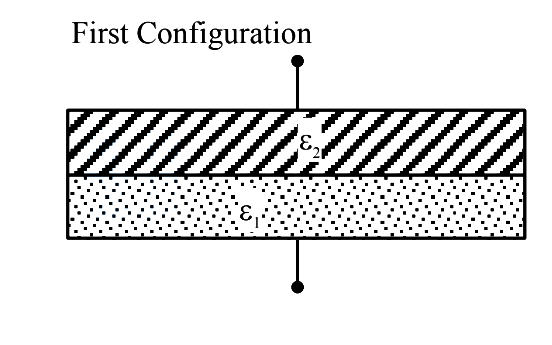
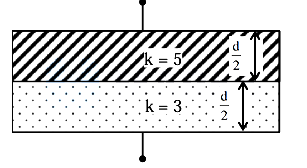
Area of plate is \(A\). then
\(\begin{aligned}
& \mathrm{C}=\frac{\varepsilon_2 \varepsilon_0 \mathrm{~A}}{\mathrm{~d} / 2}=\frac{2 \varepsilon_2 \varepsilon_0 \mathrm{~A}}{\mathrm{~d}} \\
& \mathrm{C}^{\prime}=\frac{\varepsilon_1 \varepsilon_0 \mathrm{~A}}{\mathrm{~d} / 2}=\frac{2 \varepsilon_1 \varepsilon_0 \mathrm{~A}}{\mathrm{~d}}
\end{aligned}\)
Let \(\mathrm{C}_0=\frac{\varepsilon_0 \mathrm{~A}}{\mathrm{~d}}\)
\(\begin{aligned}
& \mathrm{C}=2 \varepsilon_2 \mathrm{C}_0 \\
& \mathrm{C}^{\prime}=2 \varepsilon_1 \mathrm{C}_0
\end{aligned}\)
\(\mathrm{C} \& \mathrm{C}^{\prime}\) are in series
\(\mathrm{C}_1=\frac{\mathrm{CC}^{\prime}}{\mathrm{C}+\mathrm{C}^{\prime}}=\frac{4 \varepsilon_2 \varepsilon_1 \mathrm{C}_0^2}{2 \mathrm{C}_0\left(\varepsilon_2+\varepsilon_1\right)}\)
\(=\frac{2 \varepsilon_2 \varepsilon_1 \mathrm{C}_0}{\left(\varepsilon_2+\varepsilon_1\right)}\)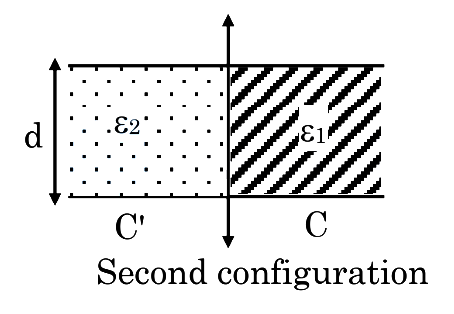
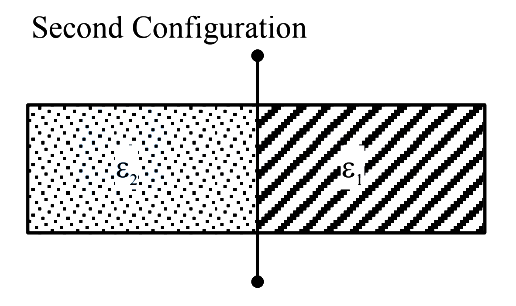
Here \(\mathrm{C}=\frac{\varepsilon_1 \varepsilon_0 \mathrm{~A}}{2 \mathrm{~d}}=\frac{\varepsilon_1 \mathrm{C}_0}{2}\)
\(\mathrm{C}^{\prime}=\frac{\varepsilon_2 \mathrm{C}_0}{2}\)
\(\mathrm{C} \& \mathrm{C}^{\prime}\) are inparallel
\(\mathrm{C}_2=\mathrm{C}^{\prime}+\mathrm{C}=\left(\varepsilon_1+\varepsilon_2\right) \frac{\mathrm{C}_0}{2}\)
Thus \(\frac{\mathrm{C}_1}{\mathrm{C}_2}=\frac{2 \varepsilon_2 \varepsilon_1 \mathrm{C}_0}{\left(\varepsilon_2+\varepsilon_1\right)} \times \frac{2}{\left(\varepsilon_1+\varepsilon_2\right) \mathrm{C}_0}\)
\(=\frac{4 \varepsilon_2 \varepsilon_1}{\left(\varepsilon_2+\varepsilon_1\right)^2}\) -
- (A) \(2 \times 10^{-4} \mathrm{~J} / \mathrm{m}^3\)
- (B) \(1.8 \times 10^5 \mathrm{~J} / \mathrm{m}^3\)
- (C) \(1.8 \times 10^3 \mathrm{~J} / \mathrm{m}^3\)
- (D) \(2 \times 10^2 \mathrm{~J} / \mathrm{m}^3\)
Show answer and solution
Correct Answer: (C)
\(\begin{aligned} \text { Energy density } & =\frac{1}{2} \varepsilon_0 E^2 \\ & =\frac{1}{2} \varepsilon_0\left(\frac{V}{d}\right)^2 \\ & =\frac{1}{2}\left(8.85 \times 10^{-12}\right)\left(\frac{20}{10^{-6}}\right)^2 \mathrm{~J} / \mathrm{m}^3 \\ & \simeq 1.8 \times 10^3 \mathrm{~J} / \mathrm{m}^3\end{aligned}\) -
- (A) 4 mC and 0.2 J
- (B) 8 mC and 2.0 J
- (C) 2 mC and 0.4 J
- (D) 2 mC and 0.2 J
Show answer and solution
Correct Answer: (A)
\(\begin{aligned} & \Delta \mathrm{q}=(\mathrm{KC}-\mathrm{C}) \mathrm{V} \\ & =40 \times 10^{-6} \times 100 \\ & =4000 \times 10^{-3}=4 \mathrm{mC} \\ & \Delta \mathrm{U}=\frac{1}{2} \mathrm{C}^{\prime} \mathrm{V}^2-\frac{1}{2} \mathrm{CV}^2=\frac{1}{2}(\mathrm{~K}-1) \mathrm{CV}^2 \\ & =\frac{1}{2} \mathrm{CV}^2(2-1) \\ & =\frac{1}{2} \mathrm{CV}^2=\frac{1}{2} \times 40 \times 10^{-6} \times 10000 \\ & =0.2 \mathrm{~J}\end{aligned}\) -
- (A) A only
- (B) C only
- (C) B and D only
- (D) \(C\) and \(E\) only
Show answer and solution
Correct Answer: (D)
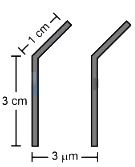
We know \(C=\frac{A \varepsilon_0}{d}\)
\(=\frac{b \ell \varepsilon_0}{d}\)
So to increase the capacitance by 10 factor \(\left(\frac{A}{d}\right)\) has to increase by 10 fator.
For option (A) \(\quad C^{\prime}=\frac{(30 \ell) b \varepsilon_0}{\left(\frac{d}{3}\right)}=30 \mathrm{C}\)
For option (B) \(\quad C^{\prime}=\frac{\ell b \varepsilon_0}{10 d}=\frac{C}{10}\)
For option (C) \(\quad C^{\prime}=\frac{(2 \ell) 5 b \varepsilon_0}{d}=10 \mathrm{C}\)
For option (D) \(\quad C^{\prime}=\frac{\left(\frac{\ell}{3}\right) b \varepsilon_0}{\left(\frac{10 d}{3}\right)}=\frac{C}{10}\)
For option (E) \(\quad C^{\prime}=\frac{\left(\frac{\ell}{3}\right) 5(2 b) \varepsilon_0}{\left(\frac{d}{3}\right)}=10 C\)
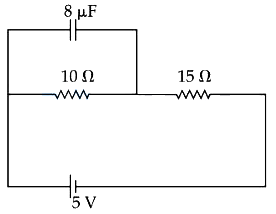
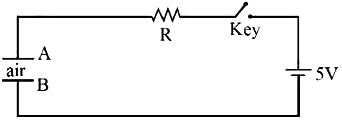
Clearly (C) and (E) are the situation for 10 C - 255. At steady state the charge on the capacitor, as shown in the circuit below, is _________ \(\mu \mathrm{C}\).
2025 Medium- (A) 6
- (B) 16
- (C) 26
- (D) 36
Show answer and solution
Correct Answer: (B)
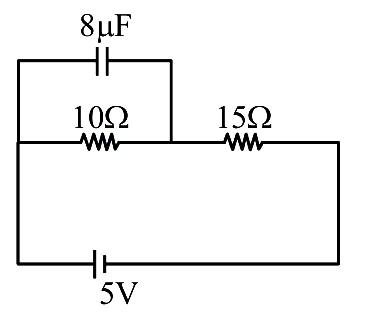
\(\begin{aligned} & \mathrm{i}=\left(\frac{5}{25}\right) \\ & \mathrm{Q}=\mathrm{CV} \\ & \mathrm{Q}=\left(8 \times 10^{-6}\right)\left(\frac{5}{25} \times 10\right) \\ & \mathrm{Q}=\left(\frac{8 \times 5 \times 10^{-2}}{25}\right)=16 \mu \mathrm{C}\end{aligned}\) -
- (A) \(\varepsilon_0 \mathrm{E}^2 \mathrm{Ad}\)
- (B) \(\frac{1}{2} \varepsilon_0 \mathrm{E}^2 \mathrm{Ad}\)
- (C) \(\frac{1}{4} \varepsilon_0 \mathrm{E}^2 \mathrm{Ad}\)
- (D) \(\frac{3}{4} \varepsilon_0 \mathrm{E}^2 \mathrm{Ad}\)
Show answer and solution
Correct Answer: (B)
We know energy density
\(\rho_{\mathrm{av}}=\frac{1}{2} \varepsilon_0 E^2\)
So potential energy \(=\rho_{a v} \times\) Volume
\(\Rightarrow \text { P.E. }=\frac{1}{2} \varepsilon_0 E^2 A d\) -
- (A) A, B and C Only
- (B) A and C Only
- (C) D and E Only
- (D) B and C Only
Show answer and solution
Correct Answer: (A)
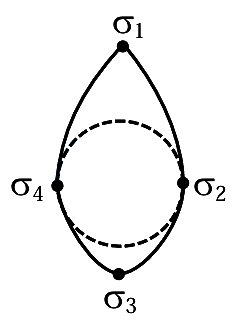
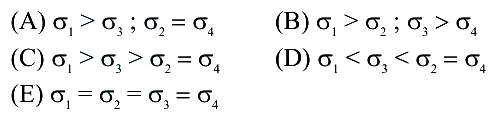
\(\begin{aligned} & \sigma \propto \frac{1}{\mathrm{ROC}} \\ & (\mathrm{ROC})_1 \lt (\mathrm{ROC})_3 \lt (\mathrm{ROC})_2=(\mathrm{ROC})_4 \\ & \sigma_1 \gt \sigma_3 \gt \sigma_2=\sigma_4\end{aligned}\) -
- (A) \(V_0\) and \(\frac{E_0}{4}\)
- (B) zero and \(\frac{E_0}{16}\)
- (C) zero and \(\frac{E_0}{8}\)
- (D) \(\frac{\mathrm{V}_0}{2}\) and \(\frac{\mathrm{E}_0}{16}\)
Show answer and solution
Correct Answer: (B)
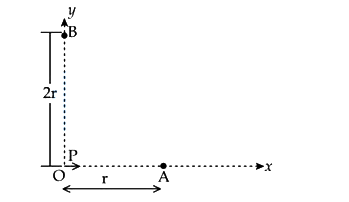
At point \(A\) (axial)
\(\left|E_0\right|=\frac{2 k_p}{r^3}, V_0=\frac{k_p}{r^2}\)
At point \(B\) (equatorial)
\(\begin{aligned}
& |E|=\frac{k_p}{(2 r)^3}=\frac{E_0}{16} \\
& V=0
\end{aligned}\) -
- (A) 60
- (B) 64
- (C) 70
- (D) 75
Show answer and solution
Correct Answer: (B)
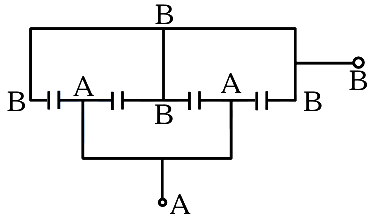
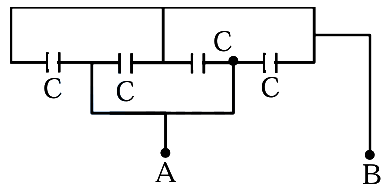
Redrawing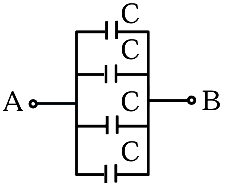
\(\mathrm{C}_{\mathrm{eq}}=4 \mathrm{C}=64\) -
- (A) \(\mathrm{A}\) is true but \(\mathrm{R}\) is false
- (B) Both \(\mathrm{A}\) and \(\mathrm{R}\) are true and \(\mathrm{R}\) is the correct explanation of \(\mathrm{A}\)
- (C) \(\mathrm{A}\) is false but \(\mathrm{R}\) is true
- (D) Both \(\mathrm{A}\) and \(\mathrm{R}\) are true but \(\mathrm{R}\) is NOT the correct explanation of \(\mathrm{A}\)
Show answer and solution
Correct Answer: (B)
For a uniformly charged spherical shell:
- The electric field inside the shell is zero everywhere (from Gauss's law)
* When the electric field is zero, no work is done in moving a charge
- Since work - force \(\times\) displacement, and force - q̧E (where E - 0), work - 0
- The potential inside is constant and equal to the value at the surface
Assertion A is correct: Since the electric field is zero everywhere inside the shell, no work is done moving a charge between any two points, regardless of path.
Reason R is correct: The potential inside a uniformly charged spherical shell is indeed constant and equal to the value at the surface.
Does R explain \(A\) ? Yes, because:
- Constant potential means zero electric field (since \(\mathrm{E}=-\mathrm{FW}\))
- Zero electric field means no force on a test charge
- No force means no work done in moving the charge
Therefore, opxion (2) is correct: Both A and R are true and R is the correct explanation of A. -
- (A) Both \((\mathrm{A})\) and \((\mathrm{R})\) are correct and \((\mathrm{R})\) is the correct explanation of \((\mathrm{A})\)
- (B) \((\mathrm{A})\) is correct but \((\mathrm{R})\) is not correct
- (C) Both \((\mathrm{A})\) and \((\mathrm{R})\) are correct but \((\mathrm{R})\) is not correct explanation of (A)
- (D) (A) is not correct but \((\mathrm{R})\) is correct
Show answer and solution
Correct Answer: (A)
Electric field of outside charge is zero inside conductor -
- (A) A, C Only
- (B) A, B, D Only
- (C) C, D Only
- (D) B, C, D Only
Show answer and solution
Correct Answer: (D)
Capacitor behaves like closed circuit at \(t=0\) and charge is zero.
\(\mathrm{A} X, \mathrm{~B} \checkmark, \mathrm{C} \checkmark, \mathrm{D} \checkmark\) -
- (A) \(\frac{K q_0^2}{\mathrm{a}}(4-2 \sqrt{2})\)
- (B) \(\frac{K q_0^2}{\mathrm{a}}(3-\sqrt{2})\)
- (C) \(\frac{\mathrm{Kq}_0^2}{\mathrm{a}}(4 \sqrt{2}-2)\)
- (D) \(\frac{\mathrm{Kq}_0^2}{\mathrm{a}}(3 \sqrt{2}-2)\)
Show answer and solution
Correct Answer: (D)
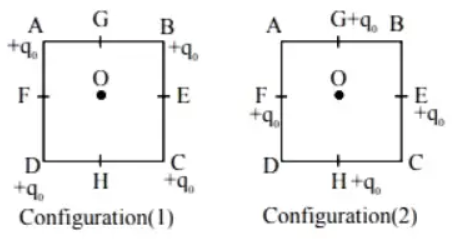
\(\begin{aligned}
& u_{\oplus}=\left(2 \frac{K q_0}{a}+\frac{K q_0}{\sqrt{2} a}\right) q_0 \times 2 \\
& u_0=\left(2 \frac{K q_0 \sqrt{2}}{a}+\frac{K q_0}{a}\right) q_0 \times 2
\end{aligned}\)
\(\begin{aligned}
& \text { So, } \quad \Delta u=u_2-u_1=2 q_0 \frac{k q_0}{a}\left[2 \sqrt{2}+1-2-\frac{1}{\sqrt{2}}\right] \\
& \Rightarrow \quad \Delta u=\frac{2 q_0^2}{4 \pi \varepsilon_0 a}\left[\frac{4-\sqrt{2}-1}{\sqrt{2}}\right]=\frac{2 q_0^2}{4 \pi \varepsilon_0 a} \frac{(3-\sqrt{2})}{\sqrt{2}} \\
& \Rightarrow \quad \Delta u=\frac{2 k q_0^2}{a}\left[\frac{3-\sqrt{2}}{\sqrt{2}}\right]=\frac{k q_0^2}{a}(3 \sqrt{2}-2)
\end{aligned}\) -
- (A) 20
- (B) 25
- (C) 15
- (D) 10
Show answer and solution
Correct Answer: (C)
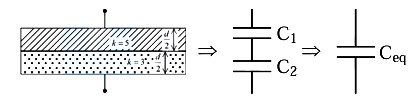
\(\begin{aligned} & \mathrm{C}_1=\frac{5 \times 4 \times 10^{-4} \times 8.85 \times 10^{-12}}{\frac{1.77}{2} \times 10^{-3}}=20 \mathrm{pF} \\ & \mathrm{C}_2=\frac{3 \times 4 \times 10^{-4} \times 8.85 \times 10^{-12}}{\frac{1.77}{2} \times 10^{-3}}=12 \mathrm{pF} \\ & \mathrm{C}_{\mathrm{eq}}=\frac{\mathrm{C}_1 \mathrm{C}_2}{\mathrm{C}_1+\mathrm{C}_2}=\frac{12 \times 20}{12+20}=7.5 \mathrm{pF}\end{aligned}\)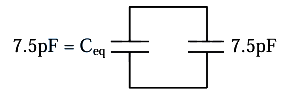
Finally equivalent capacitance
\(\left(\mathrm{C}_{\mathrm{eq}}\right)_{\text {final }}=7.5+7.5=15 \mathrm{pF}\) -
- (A) \(120 \mathrm{~V}, 120 \mathrm{~V}, 80 \mathrm{~V}\)
- (B) \(40 \mathrm{~V}, 40 \mathrm{~V}, 80 \mathrm{~V}\)
- (C) \(0 \mathrm{~V}, 0 \mathrm{~V}, 80 \mathrm{~V}\)
- (D) \(0 \mathrm{~V}, 120 \mathrm{~V}, 40 \mathrm{~V}\)
Show answer and solution
Correct Answer: (A)
Potential inside shell is equal to potential on surface
\(\mathrm{V}_{\mathrm{in}}=\mathrm{V}_{\text {surface }}=\frac{\mathrm{kQ}}{\mathrm{R}}=120 \mathrm{~V}\)
at \(\mathrm{r}=15 \mathrm{~cm}\)
\(\mathrm{V}=\frac{\mathrm{kQ}}{\mathrm{r}}=\frac{120 \times 10}{15}=80 \mathrm{~V}\) -
- (A) 2
- (B) 1
- (C) 3
- (D) 4
Show answer and solution
Correct Answer: (B)
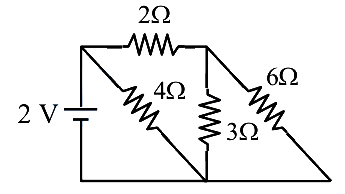
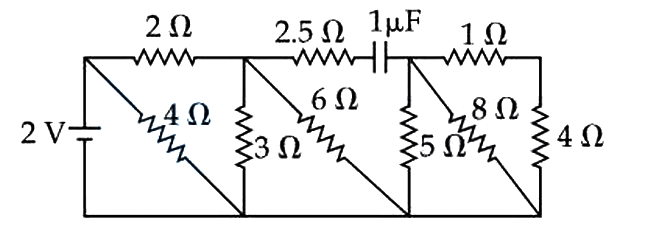
\(\begin{aligned} & \mathrm{R}_{\mathrm{eq}}=2 \Omega \\ & \mathrm{I}=\frac{2}{2}=1 \mathrm{~A}\end{aligned}\) -
- (A) \(x y z=\) constant
- (B) \(x y+y z+z x=\) constant
- (C) \(\left(x^2+y^2\right)\left(y^2+z^2\right)\left(z^2+x^2\right)=\) constant
- (D) \((x+y)(y+z)(z+x)=\) constant
Show answer and solution
Correct Answer: (C)
Potential due to an infinite wire is \(V=2 k \lambda \ln r\), where \(r\) is the distance from the wire.
Taking the point in space \(P(x, y, z)\)
Distance from wire along \(x\)-axis is \(r_x=\sqrt{y^2+z^2}\)
Distance from wire along \(y\)-axis is \(r_y=\sqrt{x^2+z^2}\)
Distance from wire along \(z\)-axis is \(r_z=\sqrt{x^2+y^2}\)
\(\Rightarrow\) Potential at \(P\) due to wire along \(x\)-axis is
\(V_x=2 k \lambda \ln r_x\)
Potential at \(P\) due to wire along \(y\)-axis is
\(V_y=2 k \lambda \ln r_y\)
Potential at \(P\) due to wire along \(z\)-axis is
\(V_z=2 k \lambda \ln r_z\)
\(\Rightarrow\) Not potential at \(P=V=V_x+V_y+V_z\)
or \(\quad V=2 k \lambda \ln r_x+2 k \lambda \ln r_y+2 k \lambda \ln r_z\)
i.e. \(V=2 k \lambda \ln \left(r_x r_y r_z\right)\)
or
\(\begin{aligned}
& V=2 k \lambda \ln \left(\sqrt{y^2+z^2} \sqrt{z^2+x^2} \sqrt{x^2+y^2}\right) \\
& =k \lambda \ln \left(y^2+z^2\right)\left(z^2+x^2\right)\left(x^2+y^2\right)
\end{aligned}\)
\(\Rightarrow\) For equipotential surface
\(\left(x^2+y^2\right)\left(y^2+z^2\right)\left(z^2+x^2\right)=\text { constant }\) -
- (A) \(22.5 \mu \mathrm{~F}\)
- (B) \(7.5 \mu \mathrm{~F}\)
- (C) \(9 \mu \mathrm{~F}\)
- (D) \(30 \mu \mathrm{~F}\)
Show answer and solution
Correct Answer: (C)
After dielectric
\(\begin{aligned}
& \mathrm{C}_1=4 \mathrm{C} \\
& \mathrm{C}_1=4 \times 5=20 \mu \mathrm{~F} \\
& \mathrm{C}_2=\mathrm{C}_3=5 \mu \mathrm{~F}
\end{aligned}\)
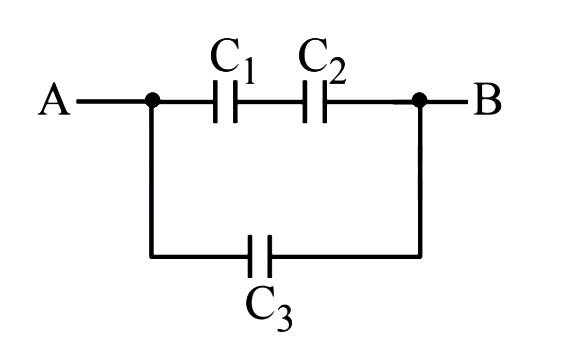
\(\mathrm{C}_1 \& \mathrm{C}_2\) are in series which is parallel to \(\mathrm{C}_3\) So
\(\begin{aligned}
& C_{c q}=\frac{C_1 C_2}{C_1+C_2}+C_3 \Rightarrow \frac{20 \times 5}{20+5}+5 \\
& =4+5=9 \mu \mathrm{~F}
\end{aligned}\)
Correct Option (3) -
- (A) \(\mathrm{C}_2\gt\mathrm{C}_1, \mathrm{U}_2 \lt \mathrm{U}_1\)
- (B) \(\mathrm{C}_1\gt\mathrm{C}_2, \mathrm{U}_1\gt\mathrm{U}_2\)
- (C) \(\mathrm{C}_1\gt\mathrm{C}_2, \mathrm{U}_1 \lt \mathrm{U}_2\)
- (D) \(\mathrm{C}_2\gt\mathrm{C}_1, \mathrm{U}_2\gt\mathrm{U}_1\)
Show answer and solution
Correct Answer: (D)
For a capacitor at steady state
\(q=C V \text { and } U=\frac{1}{2} C V^2\)
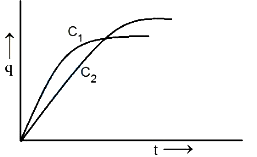
Since \(C_1\) and \(C_2\) are connected in parallel, \(V_1=V_2\).
Also from graph \(q_1 < q_2\)
\(\begin{aligned}
& \Rightarrow \quad C_1 V_1 < C_2 V_2 \\
& \text { i.e. } C_1 < C_2 \text { or } C_2>C_1 \\
& \qquad \frac{U_1}{U_2}=\frac{C_1 V_1^2}{C_2 V_2^2}=\frac{C_1}{C_2} < 1
\end{aligned}\)
or \(U_1 < U_2\) or \(U_2>U_1\) -
- (A) -1.8 J
- (B) -2.0 J
- (C) -1.5 J
- (D) -1.2 J
Show answer and solution
Correct Answer: (A)
P.E. of two charges
\(\begin{aligned}
& \mathrm{u}=\frac{1}{4 \pi \varepsilon_0} \frac{\mathrm{q}_1 \mathrm{q}_2}{\mathrm{r}} \\
& \mathrm{r}=\sqrt{\left(\mathrm{x}_2-\mathrm{x}_1\right)^2+\left(\mathrm{y}_2-\mathrm{y}_1\right)^2+\left(\mathrm{z}_2-\mathrm{z}_1\right)^2} \\
& =14 \mathrm{~cm} \\
& \therefore \mathrm{u}=\frac{9 \times 10^9 \times 7 \times 10^{-6} \times(-4) \times 10^{-6}}{14 \times 10^{-2}} \\
& =-1.8 \mathrm{~J}
\end{aligned}\) -
- (A) \(8 \mathrm{q}_2\)
- (B) \(6 \mathrm{q}_2\)
- (C) \(8 q_1\)
- (D) \(6 \mathrm{q}_1\)
Show answer and solution
Correct Answer: (A)
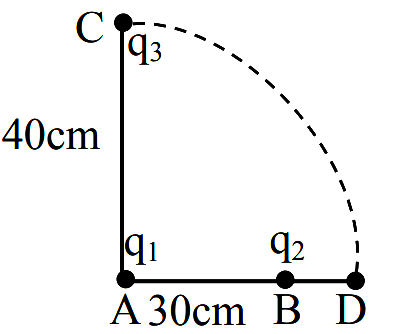
Potential at C
\(\mathrm{V}_{\mathrm{C}}=\frac{\mathrm{kq}_1}{0.4}+\frac{\mathrm{kq}_2}{0.5}\)
Potential at D
\(\mathrm{V}_{\mathrm{D}}=\frac{\mathrm{kq}_1}{0.4}+\frac{\mathrm{kq}_2}{0.1}\)
\(\Delta \mathrm{U}=\left(\mathrm{V}_{\mathrm{D}}-\mathrm{V}_{\mathrm{c}}\right)\left(\mathrm{q}_3\right)=\left(\frac{\mathrm{kq}_2}{0.1}-\frac{\mathrm{kq}_2}{0.5}\right)\left(\mathrm{q}_3\right)\)
\(\Delta \mathrm{U}=8 \mathrm{kq}_2 \mathrm{q}_3=\frac{8 \mathrm{q}_2 \mathrm{q}_3}{4 \pi \varepsilon_0}\) -
- (A) \(\frac{1}{4} \mathrm{~V}\)
- (B) \(\frac{2}{5} \mathrm{~V}\)
- (C) \(\frac{3}{4} \mathrm{~V}\)
- (D) 1 V
Show answer and solution
Correct Answer: (B)
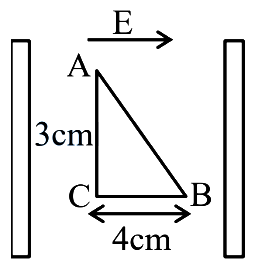
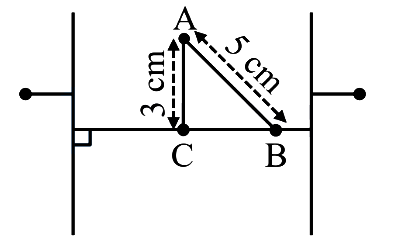
\(\begin{aligned} & \text { Using } \Delta V=E(\Delta d) \\ & V=E(10) \\ & V_{A B}=E \cdot 4=\frac{V}{10} \times 4=\frac{2 V}{5}\end{aligned}\) -
- (A) \(\frac{1}{9}\)
- (B) 9
- (C) \(\frac{1}{3}\)
- (D) 3
Show answer and solution
Correct Answer: (D)
For conducting sphere, \(\mathrm{V}=\frac{\sigma \mathrm{r}}{\varepsilon_0}\)
After contact, \(\mathrm{V}_1=\mathrm{V}_2\)
\(\begin{aligned}
& \sigma_1 r_1=\sigma_2 r_2 \\
& \frac{\sigma_1}{\sigma_2}=\frac{r_2}{\mathrm{r}_1} \\
& \frac{\sigma_1}{\sigma_2}=3
\end{aligned}\) -
- (A) 18.4 mJ
- (B) 14.4 mJ
- (C) 12.4 mJ
- (D) 16.4 mJ
Show answer and solution
Correct Answer: (B)
\(\begin{aligned} & \mathrm{U}=-\mathrm{PE} \cos \theta \\ & \mathrm{w}_{\mathrm{ext}}=\Delta \mathrm{U}=\mathrm{U}_{\mathrm{f}}-\mathrm{U}_{\mathrm{i}}=-\mathrm{PE} \cos 180^{\circ}+\mathrm{PE} \cos 0^{\circ} \\ & \mathrm{w}_{\mathrm{ext}}=2 \mathrm{PE} \\ & =2 \times\left(4 \times 10^{-6}\right)(18) \times 10^4 \\ & =144 \times 10^{-2} \\ & =14.4 \mathrm{~mJ}\end{aligned}\) -
- (A) \(600\)
- (B) \(200\)
- (C) \(400\)
- (D) \(100\)
Show answer and solution
Correct Answer: (B)
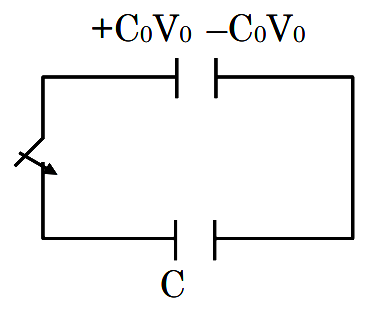
New potential \(=\frac{\mathrm{C}_0 \mathrm{~V}_0}{\mathrm{C}_0+\mathrm{C}}=\frac{\mathrm{V}_0}{3}\)
\(\begin{aligned} & 3 \mathrm{C}_0 \mathrm{~V}_0=\mathrm{C}_0 \mathrm{~V}_0+\mathrm{CV}_0 \\ & 2 \mathrm{C}_0 \mathrm{~V}_0=\mathrm{CV}_0 \\ & \mathrm{C} \Rightarrow 2 \mathrm{C}_0\end{aligned}\) -
- (A) \(5 \times 10^{-9} \mathrm{Nm}\)
- (B) \(5 \times 10^{-3} \mathrm{Nm}\)
- (C) \(2.5 \times 10^{-12} \mathrm{Nm}\)
- (D) \(2.5 \times 10^{-9} \mathrm{Nm}\)
Show answer and solution
Correct Answer: (A)
\(\begin{aligned}
& \mathrm{E}=\frac{\mathrm{v}}{\mathrm{~d}}=\frac{5}{5 \times 10^{-4}}=10^4 \mathrm{~V} / \mathrm{m} \\
& \tau=\mathrm{PE} \sin \theta
\end{aligned}\)
Where \(\mathrm{P}=\mathrm{qa}=2 \times 10^{-6} \times 5 \times 10^{-7}\)
\(=1 \times 10^{-12} \mathrm{C}-\mathrm{m}\)
\(\tau=1 \times 10^{-12} \times 10^4 \times \frac{1}{2}=5 \times 10^{-9} \mathrm{~N}-\mathrm{m}\) -
- (A) \(\frac{\lambda \mathrm{a}}{2 \epsilon_0}\)
- (B) \(\frac{\lambda \mathrm{a}}{4 \epsilon_0}\)
- (C) \(\frac{\lambda \mathrm{a}}{16 \epsilon_0}\)
- (D) \(\frac{\lambda \mathrm{a}}{8 \epsilon_0}\)
Show answer and solution
Correct Answer: (D)
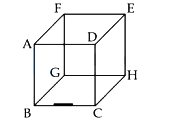
\(\begin{aligned} & \text { Charge of the line charge }=\frac{a \lambda}{2} \\ & \text { Portion of wire inside cube }=\frac{1}{4} \\ & \therefore \quad q_{e n}=\frac{1}{4}\left(\frac{a \lambda}{2}\right)=\frac{a \lambda}{8} \\ & \qquad \phi=\frac{q_{e n}}{\varepsilon_0}=\frac{a \lambda}{8 \varepsilon_0}\end{aligned}\) -
- (A) 2 E
- (B) \(\sqrt{2} \mathrm{E}\)
- (C) \(\mathrm{E} / 2\)
- (D) Zero
Show answer and solution
Correct Answer: (B)
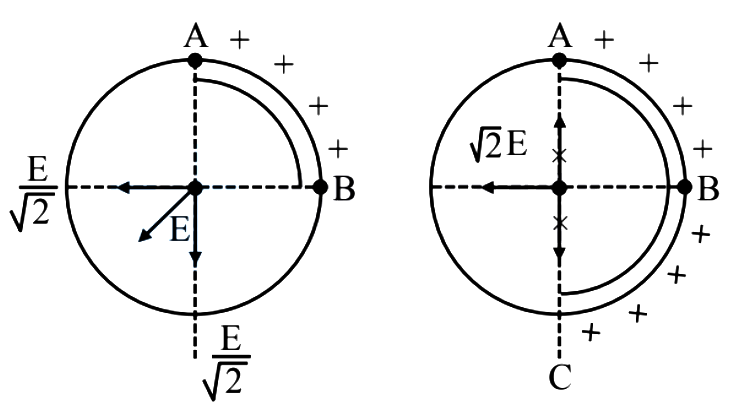
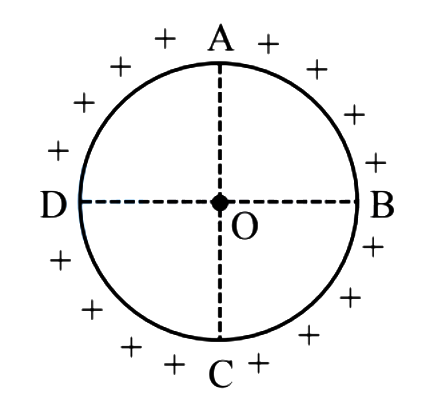
Let the metallic ring be divided into four identical quadrants: arc AB, arc BC, arc CD, and arc DA.
Since the charge distribution is uniform, the magnitude of the electric field at the center 'O' due to each individual quadrant is equal. We are given that the electric field due to arc AB has a magnitude of \( E \).
The electric field vector for any uniformly charged arc points along its angle bisector, away from the positive charge. - Let the electric field due to arc AB be \( \vec{E}_{AB} \) (magnitude = \( E \)). - Let the electric field due to arc BC be \( \vec{E}_{BC} \) (magnitude = \( E \)).
Because AC and BD are mutually perpendicular diameters, the quadrants AB and BC sit 90° apart. Consequently, their respective electric field vectors, \( \vec{E}_{AB} \) and \( \vec{E}_{BC} \), are also perpendicular to each other.
The total electric field at 'O' due to the combined arc ABC is the vector sum of the fields from arc AB and arc BC. Since the two vectors are perpendicular, we calculate the resultant magnitude using the Pythagorean theorem:
\( E_{ABC} = \sqrt{|\vec{E}_{AB}|^2 + |\vec{E}_{BC}|^2} \)
\( E_{ABC} = \sqrt{E^2 + E^2} \)
\( E_{ABC} = \sqrt{2E^2} = \sqrt{2}E \) -
- (A) \(\sqrt{\frac{\mathrm{qE} l}{2 \mathrm{~m}}}\)
- (B) \(\sqrt{\frac{\mathrm{qE} l}{\mathrm{~m}}}\)
- (C) \(\sqrt{\frac{\mathrm{qE} l}{4 \mathrm{~m}}}\)
- (D) \(\sqrt{\frac{2 q \mathrm{El}}{\mathrm{m}}}\)
Show answer and solution
Correct Answer: (B)
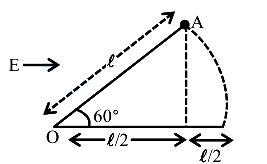
\(\begin{aligned} & \mathrm{W}_{\mathrm{all}}=\Delta \mathrm{k} \\ & \mathrm{W}_{\mathrm{e}}=\mathrm{k}_{\mathrm{f}}-\mathrm{k}_{\mathrm{i}} \\ & \mathrm{qE} \frac{\ell}{2}=\frac{1}{2} \mathrm{mv}^2-0 \\ & \mathrm{v}=\sqrt{\frac{\mathrm{qE} \ell}{\mathrm{m}}}\end{aligned}\) -
- (A) \(15.7 \times 10^{-8} \mathrm{C}\)
- (B) \(17.7 \times 10^{-8} \mathrm{C}\)
- (C) \(-15.7 \times 10^{-8} \mathrm{C}\)
- (D) \(-17.7 \times 10^{-8} \mathrm{C}\)
Show answer and solution
Correct Answer: (D)
\(\begin{aligned} & \text { Flux }(\phi)=\frac{\theta_{\text {inc }}}{\epsilon_0} \\ & \begin{aligned} \theta_{\text {inc }} & =\epsilon_0 \phi \\ \quad= & -17.7 \times 10^{-8} \mathrm{C}\end{aligned}\end{aligned}\) -
- (A) \((4 \mathrm{~d} / 3,0,0)\)
- (B) \((\mathrm{d} / 4,0,0)\)
- (C) \((3 \mathrm{~d} / 4,0,0)\)
- (D) \((\mathrm{d} / 3,0,0)\)
Show answer and solution
Correct Answer: (B)
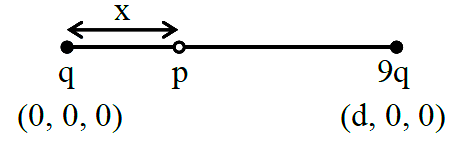
Let \(\mathrm{E}_{\mathrm{p}}=0\)
\(\begin{aligned}
& \therefore \frac{\mathrm{kq}}{\mathrm{x}^2}=\frac{\mathrm{k} 9 \mathrm{q}}{(\mathrm{~d}-\mathrm{x})^2} \\
& \Rightarrow \frac{\mathrm{~d}-\mathrm{x}}{\mathrm{x}}=3 \Rightarrow \mathrm{x}=\frac{\mathrm{d}}{4}
\end{aligned}\)
\(\therefore\) co-ordinate of P is \(\left(\frac{\mathrm{d}}{4}, 0,0\right)\) -
- (A) \(\frac{a}{r} \sim 10\)
- (B) \(\frac{a}{r} \sim 20\)
- (C) \(\frac{a}{r} \sim 0.5\)
- (D) \(\frac{a}{r} \sim 3\)
Show answer and solution
Correct Answer: (D)
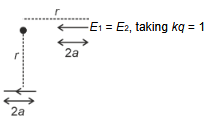
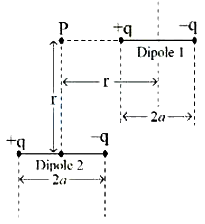
\(\begin{aligned}
& \Rightarrow \frac{1}{(r-a)^2}-\frac{1}{(r+a)^2}=\frac{2 a}{\left(a^2+r^2\right)^{3 / 2}} \\
& \frac{4 a r}{\left(r^2-a^2\right)^2}=\frac{2 a}{\left(a^2+r^2\right)^{3 / 2}} \\
& \left(r^2-a^2\right)^2=2 r\left(a^2+r^2\right)^{3 / 2} \\
& \left(1-\frac{a^2}{r^2}\right)^2=2\left(1+\frac{a^2}{r^2}\right)^{3 / 2} \\
& \left(1-x^2\right)^2=2\left(1+x^2\right)^{3 / 2}\left(x=\frac{a}{r}\right) \\
& \frac{\left(1-x^2\right)^2}{\left(1+x^2\right)^{3 / 2}}=2
\end{aligned}\)
Now for \(\mathrm{X}=3\)
We get \(\frac{64}{10 \sqrt{10}} \approx 2 \Rightarrow \frac{a}{r} \approx 3\)
[But for \(a > r\) point charge will between the dipole where \(\vec{E} \neq 0\)] -
- (A) 5
- (B) 10
- (C) 15
- (D) 20
Show answer and solution
Correct Answer: (A)
Explanation:
Let us calculate the ratio of forces step-by-step using Coulomb's Law and Newton's Law of Gravitation from the Physics curriculum, applying direct numerical cancellation:
Step 1: Write the formula for the ratio of forces
The electrostatic force (\(F_e\)) and gravitational force (\(F_g\)) between two sharing bodies separated by distance \(r\) are given by:
\(F_e = \frac{k \cdot |q_A| \cdot |q_B|}{r^2}\) and \(F_g = \frac{G \cdot m_A \cdot m_B}{r^2}\)
Taking the ratio eliminates the distance parameter (\(r^2\)) completely:
\(\frac{F_e}{F_g} = \frac{k \cdot |q_A| \cdot |q_B|}{G \cdot m_A \cdot m_B}\)
Step 2: Substitute the values and apply the smart cancellation trick
Substitute the given values into the equation:
\(\frac{F_e}{F_g} = \frac{(9 \times 10^9) \times (6.67 \times 10^{-19}) \times (9.6 \times 10^{-10})}{(6.67 \times 10^{-11}) \times (19.2 \times 10^{-27}) \times (9 \times 10^{-27})}\)
Separating the constant coefficients from the powers of 10:
\(\frac{F_e}{F_g} = \left[ \frac{9 \times 6.67 \times 9.6}{6.67 \times 19.2 \times 9} \right] \times \left[ \frac{10^9 \times 10^{-19} \times 10^{-10}}{10^{-11} \times 10^{-27} \times 10^{-27}} \right]\)
Now, cancel out the identical numbers directly without multiplying them:
- The \(9\) in the numerator cancels out with the \(9\) in the denominator.
- The \(6.67\) in the numerator cancels out with the \(6.67\) in the denominator.
- We are left with \(\frac{9.6}{19.2}\). Since \(19.2 = 2 \times 9.6\), this reduces beautifully to \(\frac{1}{2} = 0.5\).
Step 3: Simplify the powers of 10
- Numerator power = \(9 - 19 - 10 = -20\)
- Denominator power = \(-11 - 27 - 27 = -65\)
- Net power = \(-20 - (-65) = 45\)
Combining the components gives:
\(\frac{F_e}{F_g} = 0.5 \times 10^{45}\)
Step 4: Find the final value of \(10P\)
Comparing our result with the expression given in the question (\(P \times 10^{45}\)):
\(P = 0.5\)
Therefore:
\(10P = 10 \times 0.5 = 5\)
Hence, Option A is the correct choice. -
- (A) \(0.885 \mathrm{nC} / \mathrm{m}^2\)
- (B) \(17.7 \mathrm{nC} / \mathrm{m}^2\)
- (C) \(885 \mathrm{nC} / \mathrm{m}^2\)
- (D) \(1.77 \mathrm{nC} / \mathrm{m}^2\)
Show answer and solution
Correct Answer: (D)
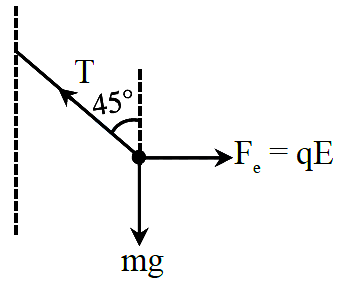
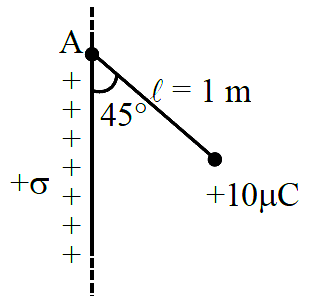
\(\begin{aligned} & \mathrm{qE}=\mathrm{mg} \\ & \mathrm{q}\left[\frac{\sigma}{2 \varepsilon_0}\right]=\mathrm{mg} \\ & \sigma=\frac{2 \varepsilon_0 \mathrm{mg}}{\mathrm{q}} \\ & \sigma=\frac{2 \times 8.85 \times 10^{-12} \times 100 \times 10^{-6} \times 10}{10 \times 10^{-6}} \\ & \sigma=17.7 \times 10^{-10} \mathrm{C} / \mathrm{m}^2 \\ & \sigma=1.77 \mathrm{nC} / \mathrm{m}^2\end{aligned}\) -
- (A) 3 cm
- (B) 2 cm
- (C) 4 cm
- (D) 1 cm
Show answer and solution
Correct Answer: (B)
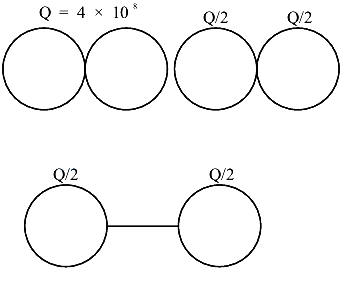
\(\begin{aligned} & \mathrm{F}=\frac{\mathrm{k}\left(\frac{\theta}{2}\right)\left(\frac{\theta}{2}\right)}{\mathrm{r}^2} \\ & 9 \times 10^{-3}=\frac{9 \times 10^9 \times\left(4 \times 10^{-8}\right) \times 4 \times 10^{-8}}{4 \times \mathrm{r}^2} \\ & \mathrm{r}^2=\frac{9 \times 10^9 \times 16 \times 10^{-16}}{4 \times 9 \times 10^{-3}}=4 \times 10^{-4} \\ & \mathrm{r}=2 \times 10^{-2} \mathrm{~m} \Rightarrow 2 \mathrm{~cm}\end{aligned}\) -
- (A) 48
- (B) 50
- (C) 52
- (D) 54
Show answer and solution
Correct Answer: (A)
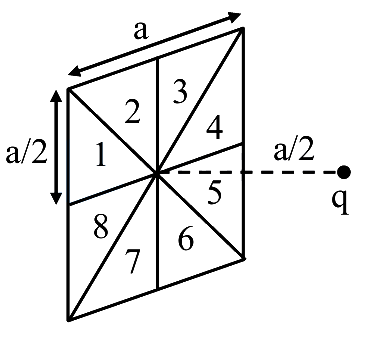
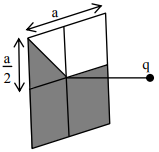
Total flux through square \(=\frac{\mathrm{q}}{\epsilon_0}\left(\frac{1}{6}\right)\)
Lets divide square is 8 equal parts.
Flux is same for each part.
\(\therefore\) Flux through shaded portion is \(\frac{5}{8}\) (Total flux)
\(=\frac{5}{8} \times \frac{\mathrm{q}}{\epsilon_0} \frac{1}{6}=\frac{5}{48} \frac{1}{\epsilon_0}\)
\(\therefore\) required Ans. is 48 -
- (A) Potential energy and torque both are maximum.
- (B) Torque on dipole is zero and net force is directed away from the sheet.
- (C) Torque on dipole is zero and net force acts towards the sheet.
- (D) Potential energy of dipole is minimum and torque is zero.
Show answer and solution
Correct Answer: (D)
Electric field due to sheet \(E=\frac{\sigma}{2 \varepsilon_0}\)
and torque on dipole \(\vec{\tau}=\vec{P} \times \vec{E}\)
here \(\vec{\tau}=0\)
and \(U=-\vec{P} \cdot \vec{E} \rightarrow\) should be minimum -
- (A) 14
- (B) 12
- (C) 16
- (D) 18
Show answer and solution
Correct Answer: (B)
Work done in rotating a dipole \(=\Delta U\)
\(\text { or } \begin{aligned}
W & =\left(-P E \cos \theta_f\right)-\left(-P E \cos \theta_i\right) \\
& =2 P E \quad\left(\because \theta_f=180^{\circ} \text { and } \theta_i=0^{\circ}\right) \\
& =\left(2 \times 6 \times 10^{-6} \times 10^6\right) \mathrm{J}=12 \mathrm{~J}
\end{aligned}\) -
- (A) \(\frac{1}{2 \pi} \sqrt{\frac{m l}{2 q E_0}}\)
- (B) \(2 \pi \sqrt{\frac{\mathrm{~m} l}{\mathrm{qE}_0}}\)
- (C) \(\frac{1}{2 \pi} \sqrt{\frac{2 \mathrm{~m} l}{\mathrm{qE}_0}}\)
- (D) \(2 \pi \sqrt{\frac{\mathrm{~m} l}{2 \mathrm{qE}_0}}\)
Show answer and solution
Correct Answer: (D)

\(\tau=P E_0 \sin \theta\)
If \(\theta\) is small
\(\begin{aligned}
\tau & =-\left(P E_0\right) \theta \\
I & =m\left(\frac{l}{2}\right)^2 \cdot 2=\frac{m l^2}{2} \\
T & =2 \pi \sqrt{\frac{m l^2}{2 \cdot P E_0}}=2 \pi \sqrt{\frac{m l^2}{2 \cdot q / E_0}} \\
T & =2 \pi \sqrt{\frac{m l}{2 q E_0}}
\end{aligned}\) -
- (A) 0
- (B) \(1 \times 10^6 \mathrm{~m} / \mathrm{s}\)
- (C) \(16 \times 10^6 \mathrm{~m} / \mathrm{s}\)
- (D) \(16 \times 10^4 \mathrm{~m} / \mathrm{s}\)
Show answer and solution
Correct Answer: (C)
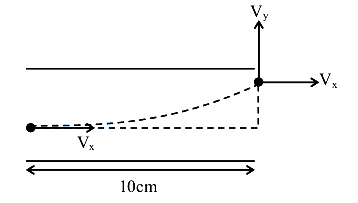
\(\begin{aligned} & \Rightarrow \mathrm{t}=\frac{\ell}{\mathrm{V}_{\mathrm{x}}}=\frac{10 \times 10^{-2}}{10^6}=10^{-7} \\ & \Rightarrow \mathrm{~V}_{\mathrm{y}}=\mathrm{u}_{\mathrm{y}}+\mathrm{a}_{\mathrm{y}} \mathrm{t} \\ & \Rightarrow \mathrm{V}_{\mathrm{y}}=0+\frac{\mathrm{eE}}{\mathrm{m}} \times 10^{-7} \\ & \Rightarrow \mathrm{~V}_{\mathrm{y}}=\frac{1.6 \times 10^{-19}}{9.1 \times 10^{-31}} \times 9.1 \times 10^{-2} \times 10^{-7} \\ & \Rightarrow \mathrm{~V}_{\mathrm{y}}=16 \times 10^6\end{aligned}\) -
- (A) \(0.72 \pi\)
- (B) \(1.44 \pi\)
- (C) \(6.48 \pi\)
- (D) \(2.16 \pi\)
Show answer and solution
Correct Answer: (D)
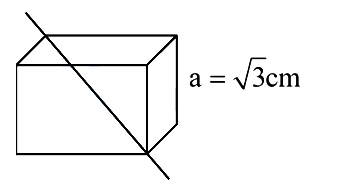
\(\begin{aligned} & \phi=\frac{\mathrm{q}_{\mathrm{enc}}}{\varepsilon_0}=\frac{\lambda \cdot \sqrt{3} \mathrm{a}}{\varepsilon_0} \\ & =2 \times 10^{-9} \times \sqrt{3} \times \sqrt{3} \times 10^{-2} \times 36 \pi \times 10^9 \mathrm{Nm}^2 \mathrm{C}^{-1} \\ & =2.16 \pi \mathrm{Nm}^2 \mathrm{C}^{-1}\end{aligned}\) -
- (A) \(\frac{a}{\sqrt{2}}\)
- (B) \(\frac{a}{2}\)
- (C) a
- (D) 0
Show answer and solution
Correct Answer: (C)
\(\begin{aligned} & \mathrm{E}=\frac{\mathrm{KQr}}{\left(\mathrm{x}^2+\mathrm{R}^2\right)^{3 / 2}} \\ & \frac{\mathrm{dE}}{\mathrm{dx}}=0 \\ & \therefore \mathrm{x}=\frac{\mathrm{R}}{\sqrt{2}}=\frac{\sqrt{2} \mathrm{a}}{\sqrt{2}}=\mathrm{a}\end{aligned}\) -
- (A) \(\frac{\sigma q}{4 \epsilon_0}\)
- (B) \(\frac{3 \sigma q}{2 \epsilon_0}\)
- (C) \(\frac{3 \sigma q}{4 \in_0}\)
- (D) \(\frac{\sigma q}{2 \epsilon_0}\)
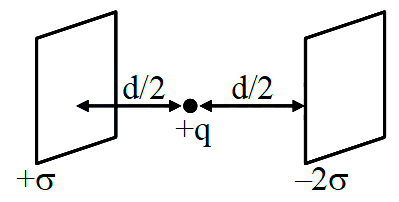
Show answer and solution
Correct Answer: (B)
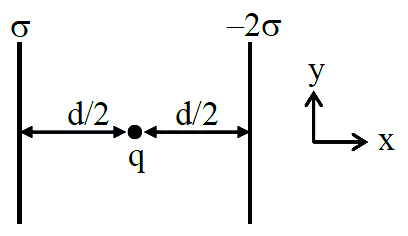
Final charge distribution will be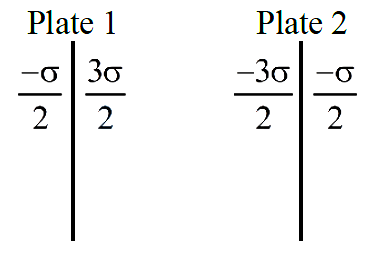
\(\therefore \mathrm{F}_{\mathrm{net}}=\frac{3 \sigma}{2 \epsilon_0} \mathrm{q}\) -
- (A) (A) is correct but \((\mathrm{R})\) is not correct
- (B) Both \((\mathrm{A})\) and \((\mathrm{R})\) are correct but \((\mathrm{R})\) is not the correct explanation of (A)
- (C) Both (A) and (R) are correct and (R) is the correct explanation of (A)
- (D) (A) is not correct but \((\mathrm{R})\) is correct
Show answer and solution
Correct Answer: (D)
A : Since polar dielectrics are randomly oriental \(\overrightarrow{\mathrm{P}}_{\mathrm{net}}=\overrightarrow{0}\).
R : If \(\overrightarrow{\mathrm{E}}\) is absent, polar dielectric remain polar & are randomly oriented. -
- (A) (A)-(III), (B)-(II), (C)-(IV), (D)-(I)
- (B) (A)-(IV), (B)-(II), (C)-(III), (D)-(I)
- (C) (A)-(II), (B)-(I), (C)-(IV), (D)-(III)
- (D) (A)-(IV), (B)-(I), (C)-(III), (D)-(II)
Show answer and solution
Correct Answer: (A)
Inside uniformly charged spherical shell, \(E=0\)
\(\therefore \mathrm{A} \rightarrow \mathrm{III}\)
For uniformly charged infinite plate
\(E=\frac{\sigma}{2 \varepsilon_0}\)
\(\therefore \mathrm{B} \rightarrow \mathrm{II}\)
Outside of spherical shell
\(E=\frac{Q}{4 \pi \varepsilon_0 r_2}=\frac{\sigma R^2}{\varepsilon_0 r^2}\)
\(\therefore \mathrm{C} \rightarrow \mathrm{IV}\)
Between two plates \(E=\frac{\sigma}{\varepsilon_0}\)
\(\therefore \mathrm{D} \rightarrow \mathrm{I}\) -
- (A) 20
- (B) 25
- (C) 15
- (D) 10
Show answer and solution
Correct Answer: (C)
\(\begin{aligned} & \phi=\overrightarrow{\mathrm{E}} \cdot \overrightarrow{\mathrm{A}}=(2 \hat{\mathrm{i}}+4 \hat{\mathrm{j}}+6 \hat{\mathrm{k}}) \times 10^3 \cdot \mathrm{~A} \hat{\mathrm{j}} \\ & 6=4 \times 10^3 \mathrm{~A} \\ & \mathrm{~A}=1.5 \times 10^{-3} \mathrm{~m}^2 \\ & =15 \mathrm{~cm}^2\end{aligned}\) -
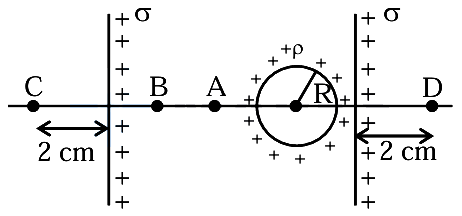
- (A) \(\overrightarrow{\mathrm{E}}_{\mathrm{A}}=\overrightarrow{\mathrm{E}}_{\mathrm{B}} ; \overrightarrow{\mathrm{E}}_{\mathrm{C}}=\overrightarrow{\mathrm{E}}_{\mathrm{D}}\)
- (B) \(\overrightarrow{\mathrm{E}}_{\mathrm{A}} \gt \overrightarrow{\mathrm{E}}_{\mathrm{B}} ; \overrightarrow{\mathrm{E}}_{\mathrm{C}}=\overrightarrow{\mathrm{E}}_{\mathrm{D}}\)
- (C) \(\overrightarrow{\mathrm{E}}_{\mathrm{C}} \neq \overrightarrow{\mathrm{E}}_{\mathrm{D}} ; \overrightarrow{\mathrm{E}}_{\mathrm{A}} \gt \overrightarrow{\mathrm{E}}_{\mathrm{B}}\)
- (D) \(\left|\overrightarrow{\mathrm{E}}_{\mathrm{A}}\right|=\left|\overrightarrow{\mathrm{E}}_{\mathrm{B}}\right| ; \overrightarrow{\mathrm{E}}_{\mathrm{C}} \gt \overrightarrow{\mathrm{E}}_{\mathrm{D}}\)
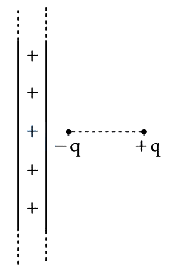
Show answer and solution
Correct Answer: (C)
Conceptual
\(\begin{aligned}
& \mathrm{E}_{\mathrm{C}} \neq \mathrm{E}_{\mathrm{D}} \\
& \mathrm{E}_{\mathrm{A}} \gt \mathrm{E}_{\mathrm{B}}
\end{aligned}\) -
- (A) 112 Nm
- (B) 1.12 Nm
- (C) 2.24 Nm
- (D) 11.2 Nm
Show answer and solution
Correct Answer: (B)
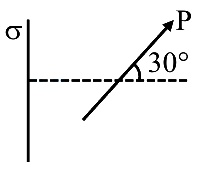
\(\begin{aligned} \mathrm{E} & =\frac{\sigma}{2 \varepsilon_0} \\ \tau & =\mathrm{PE} \sin \theta\end{aligned}\)
\(\begin{aligned} & =\left[\left(2 \times 10^{-6}\right)\left(\frac{2}{10}\right)\right]\left[\frac{100 \times 10^{-6}}{2 \times 8.85 \times 10^{-12}}\right]\left(\frac{1}{2}\right) \\ & =\frac{10}{8.85}=1.12 \mathrm{Nm}\end{aligned}\) -
- (A) \(\frac{15}{7} \mathrm{~cm}\)
- (B) \(\frac{20}{7} \mathrm{~cm}\)
- (C) \(\frac{15}{9} \mathrm{~cm}\)
- (D) \(\frac{20}{9} \mathrm{~cm}\)
Show answer and solution
Correct Answer: (D)
\(\begin{aligned} & 9^{\text {th }} \text { harmonic of closed pipe }=\frac{9 \mathrm{~V}_1}{4 \ell_1} \\ & 4^{\text {th }} \text { harmonic of open pipe }=\frac{2 \mathrm{~V}_2}{\ell_2} \\ & \therefore \frac{9 \mathrm{~V}_1}{4 \ell_1}=\frac{2 \mathrm{~V}_2}{\ell_2} \\ & \therefore \frac{9}{4 \ell_1} \sqrt{\frac{\mathrm{~B}}{\rho_1}}=\frac{2}{\ell_2} \sqrt{\frac{\mathrm{~B}}{\rho_2}} \Rightarrow \frac{\ell_2}{\ell_1}=\frac{8}{9} \sqrt{\frac{\rho_1}{\rho_2}} \\ & \ell_2=\ell_1 \times \frac{8}{9} \times \frac{1}{4}=\frac{20}{9} \mathrm{~cm}\end{aligned}\) -
- (A) \(y=2 \cos (0.83 x-3.35 t) \mathrm{cm}\)
- (B) \(y=2 \sin (0.83 x-3.5 t) \mathrm{cm}\)
- (C) \(y=2 \cos (3.35 x-0.83 t) \mathrm{cm}\)
- (D) \(y=2 \cos (0.13 x-0.5 t) \mathrm{cm}\)
Show answer and solution
Correct Answer: (A)
\(\begin{aligned}
& \mathrm{v}=\frac{\text { distance }}{\text { time }} \\
& \mathrm{v}=\frac{12}{0.3}=4 \mathrm{~cm} / \mathrm{s} \\
& \mathrm{k}=\frac{2 \pi}{\lambda}=\frac{2 \pi}{7.5}=\frac{4 \pi}{15}=0.83 \\
& \mathrm{v}=\frac{\omega}{\mathrm{k}} \Rightarrow \omega=\mathrm{vk}=4 \times \frac{4 \pi}{15}=3.35
\end{aligned}\)
So \(y=A \cos (k x-\omega t)\)
No questions on this page match these filters.