


Questions
8 questionsShowing 1–8 of 8 questions
-
- (A) \(1 / 8\)
- (B) \(8\)
- (C) \(4\)
- (D) \(1 / 4\)
Show answer and solution
Correct Answer: (D)
\(\begin{aligned} & \mathrm{N}_2=\mathrm{N}_0 \mathrm{e}^{-3 \lambda t} \\ & \mathrm{~N}_1=\mathrm{N}_0 \mathrm{e}^{-\lambda \mathrm{t}} \\ & \frac{\mathrm{N}_2}{\mathrm{~N}_1}=\mathrm{e}^{-2 \lambda \mathrm{t}} \\ & \mathrm{t}_{\text {half lifeofN }} \mathrm{t} \\ & \mathrm{t}=\frac{\ln 2}{\lambda}{ }_{\mathrm{n}} 1 \\ & \frac{\mathrm{~N}_0}{2}=\mathrm{N}_0 \mathrm{e}^{-\lambda \mathrm{t}}\end{aligned}\)
\(\begin{aligned} & \lambda \mathrm{t}=\ln 2 \\ & \mathrm{t}=\frac{\ln 2}{\lambda} \\ & =\mathrm{e}^{-2 \lambda \frac{\ln 2}{\lambda}} \\ & \frac{\mathrm{~N}_2}{\mathrm{~N}_1}=\frac{1}{4}\end{aligned}\) -
- (A) \(\mathrm{n} \rightarrow \mathrm{p}+\mathrm{e}^{+}+\bar{v}\)
- (B) \(\mathrm{n} \rightarrow \mathrm{p}+\mathrm{e}^{+}+\boldsymbol{v}\)
- (C) \(\mathrm{n} \rightarrow \mathrm{p}+\mathrm{e}^{-}+\boldsymbol{v}\)
- (D) \(\mathrm{n} \rightarrow \mathrm{p}+\mathrm{e}^{-}+\bar{v}\)
Show answer and solution
Correct Answer: (D)
For all nuclear processes, charge must be conserved. Also, when a release of an electron ( \(e^{-}\)) is always accompanied by a release of an antineutrino ( \(\bar{v}\) )
Hence, \(n \rightarrow p+\mathrm{e}^{-}+\overline{\mathrm{v}}\) is the correct answer. -
- (A) 8.1 MeV
- (B) 5.9 MeV
- (C) 23.6 MeV
- (D) 26.8 MeV
Show answer and solution
Correct Answer: (C)
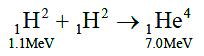
\(\begin{aligned} & E_B=\mathrm{BE}_{\text {reactant }}-\mathrm{BE}_{\text {product }} \\ & =1.1 \times 2+1.1 \times 2-7 \times 4=-23.6 \mathrm{MeV} \\ & =\mathrm{Q}=23.6 \mathrm{MeV}\end{aligned}\) - 4. For a nucleus of mass number \(A\) and radius \(R\), the mass density of nucleus can be represented as how? 2025 Easy
- (A) \(\mathrm{A}^3\)
- (B) \(\mathrm{A}^{\frac{1}{3}}\)
- (C) \(\mathrm{A}^{\frac{2}{3}}\)
- (D) Independent of A
Show answer and solution
Correct Answer: (D)
The mass density ( \(\rho\)) of a nucleus is defined as the ratio of its mass to its volume:
\(\rho=\) Mass of nucleus / Volume of nucleus
For a spherical nucleus with radius R , the volume is:
\(\text { Volume }=(4 / 3) \pi R^3\)
The mass of the nucleus is related to the mass number A :
\(\text { Mass }-\mathrm{A} \times \mathrm{m} \text {u}\)
(where m_u is the atomic mass unit, approximately \(1.66 \times 10^{-27} \mathrm{~kg}\))
Therefore:
\(\rho=\left(\mathrm{A} \times \mathrm{m} \_\mathrm{u}\right) /\left[(4 / 3) \pi \mathrm{R}^3\right]\)
Now, there's an important relationship between the mass number A and nuclear radius R. Empirically, it has been found that:
\(\mathrm{R}=\mathrm{Ro} * \mathrm{~A}^{\wedge}(1 / 3)\)
Where Ro is a constant approximately equal to \(1.2 \times 10^{-15} \mathrm{~m}(1.2\) fermi).
Substituting this into the density equation:
\(\begin{aligned}
& \rho=\left(\mathrm{A} \times \mathrm{m} \ \mathrm{u}\right) /\left[(4 / 3) \pi\left(\mathrm{Ro} \times \mathrm{A}^{\wedge}(1 / 3)\right)^3\right] \\
& \rho=(\mathrm{A} \times \mathrm{m} \text { u }) /\left[(4 / 3) \pi \mathrm{Ro}^3 \times \mathrm{A}\right] \\
& \rho=\mathrm{m} \_\mathrm{u} /\left[(4 / 3) \pi \mathrm{Ro}^3\right]
\end{aligned}\)
This shows that the nuclear density is approximately constant for all nuclei, regardless of their mass number. This is a fundamental property of nuclear matter known as nuclear saturation density.
The numerical value is:
\(\rho=2.3 \times 10^{17} \mathrm{~kg} / \mathrm{m}^3\) -
- (A) \((\mathrm{A})\) is correct but \((\mathrm{R})\) is not correct
- (B) \((\mathrm{A})\) is not correct but \((\mathrm{R})\) is correct
- (C) Both \((\mathrm{A})\) and \((\mathrm{R})\) are correct and \((\mathrm{R})\) is the correct explanation of (A)
- (D) Both (A) and (R) are correct but (R) is not the correct explanation of (A)
Show answer and solution
Correct Answer: (B)
\(\rho=\frac{\mathrm{M}}{\mathrm{~V}}=\frac{\mathrm{m}_{\mathrm{n}} \times \mathrm{A}}{\frac{4}{3} \pi \mathrm{R}^3}=\frac{\mathrm{m}_{\mathrm{n}} \times \mathrm{A}}{\frac{4}{3} \pi \mathrm{AR}_0^3}\)
So \(\rho\) is almost is constant
\(\begin{aligned}
& \mathrm{R}=\mathrm{R}_0 \mathrm{~A}^{1 / 3} \\
& \mathrm{R} \propto \mathrm{~A}^{1 / 3}
\end{aligned}\) -
- (A) \((A)\) is true but (R) is false
- (B) (A) is false but (R) is true
- (C) Both \((\mathbf{A})\) and \((\mathbf{R})\) are true and \((\mathbf{R})\) is the correct explanation of \((\mathbf{A})\)
- (D) Both (A) and (R) are true but (R) is NOT the correct explanation of (A)
Show answer and solution
Correct Answer: (A)
From graph between B.E/N & A we can see BE/N is almost constant \(\Rightarrow\) correct
Reason \(\Rightarrow\) incorrect as nuclear forces are short range forces. -
- (A) A-II, B-I, C-III, D-IV
- (B) A-III, B-I, C-II, D-IV
- (C) A-II, B-I, C-IV, D-III
- (D) A-III, B-I, C-IV, D-II
Show answer and solution
Correct Answer: (B)
Conceptual -
- (A) \(\mathrm{E}^2=\mathrm{pc}^2+\mathrm{m}^2 \mathrm{c}^2\)
- (B) \(\mathrm{E}^2=\mathrm{p}^2 \mathrm{c}^2+\mathrm{m}^2 \mathrm{c}^2\)
- (C) \(\mathrm{E}^2=\mathrm{pc}^2+\mathrm{m}^2 \mathrm{c}^4\)
- (D) \(\mathrm{E}^2=\mathrm{p}^2 \mathrm{c}^2+\mathrm{m}^2 \mathrm{c}^4\)
Show answer and solution
Correct Answer: (D)
We need to check the dimensions only.
With momentum the dimension
\(E^2=p^2 C^2\)
And with mass \(E^2=m^2 c^4\)
So \(E^2=p^2 C^2+m^2 c^4\) (dimensionally)
No questions on this page match these filters.