


All JEE Mains 2025 Physics questions
32 chaptersShowing 351–400 of 454 questions
-
- (A) \(\mathrm{m} \ln \left(\frac{\mathrm{T}_2}{\mathrm{~T}_1}\right)\)
- (B) zero
- (C) \(\mathrm{m} \ln \left(\frac{\mathrm{T}_1}{\mathrm{~T}_2}\right)\)
- (D) \(\mathrm{m}\left(\mathrm{T}_2-\mathrm{T}_1\right)\)
Show answer and solution
Correct Answer: (A)
\(\begin{aligned} & d \mathrm{Q}=\mathrm{msdT} \\ & \mathrm{dS}=\frac{\mathrm{dQ}}{\mathrm{T}}=\frac{\mathrm{msdT}}{\mathrm{T}} \\ & \Delta \mathrm{S}=\int \frac{\mathrm{msdT}}{\mathrm{T}}=\mathrm{ms} \ln \frac{\mathrm{T}_{\mathrm{f}}}{\mathrm{T}_{\mathrm{i}}} \\ & \Delta \mathrm{S}=\mathrm{m} \ln \frac{\mathrm{T}_2}{\mathrm{~T}_1}\end{aligned}\) -
- (A) \(10\)
- (B) \(20\)
- (C) \(5\)
- (D) \(15\)
Show answer and solution
Correct Answer: (A)
\(\begin{aligned} & 625=\mathrm{ms} \Delta \mathrm{T}+\mathrm{mL} \\ & 625=\mathrm{m}\left[125 \times 300+2.5 \times 10^4\right] \\ & 625=\mathrm{m}[37500+25000] \\ & 625=\mathrm{m}[62500] \\ & \mathrm{m}=\frac{1}{100} \mathrm{~kg} \\ & \mathrm{M}=10 \text { grams }\end{aligned}\) -
- (A) 3043 J
- (B) 3024 J
- (C) 3003 J
- (D) 3022 J
Show answer and solution
Correct Answer: (A)

\(\begin{aligned} & \Delta \mathrm{Q}_1=\mathrm{m} \times \mathrm{S}_1 \times \Delta \mathrm{T}=10^{-3} \times 2100 \times 10=21 \mathrm{~J} \\ & \Delta \mathrm{Q}_2=\mathrm{m} \times \mathrm{L}_{\mathrm{f}}=10^{-3} \times 3.35 \times 10^5=335 \mathrm{~J} \\ & \Delta \mathrm{Q}_3=\mathrm{m} \times \mathrm{S}_{\mathrm{w}} \times \Delta \mathrm{T}=10^{-3} \times 4180 \times 100=418 \mathrm{~J} \\ & \Delta \mathrm{Q}_4=\mathrm{m} \times \mathrm{L}_{\mathrm{v}}=10^{-3} \times 2.25 \times 10^6=2250 \mathrm{~J} \\ & \Delta \mathrm{Q}_5=\mathrm{m} \times \mathrm{S}_{\mathrm{v}} \times \Delta \mathrm{T}=10^{-3} \times 1920 \times 10=19.2 \mathrm{~J} \\ & \Delta \mathrm{Q}_{\mathrm{net}}=3043.2 \mathrm{~J}\end{aligned}\) -
- (A) \(2.0 \times 10^{-6} \mathrm{~m}^2\)
- (B) \(3.0 \times 10^{-7} \mathrm{~m}^2\)
- (C) \(6.0 \times 10^{-7} \mathrm{~m}^2\)
- (D) \(4.0 \times 10^{-7} \mathrm{~m}^2\)
Show answer and solution
Correct Answer: (A)
\(\begin{aligned} & \Delta \mathrm{Q}=\mathrm{ms} \Delta \mathrm{T} \\ & 8.1 \times 10^2=0.1 \times 900 \times \Delta \mathrm{T} \\ & \Delta \mathrm{A}=\mathrm{A}_0 2 \alpha \Delta \mathrm{~T}=2.0 \times 10^{-6} \mathrm{~m}^2\end{aligned}\) -
- (A) 0.23 K
- (B) 0.36 K
- (C) 0.14 K
- (D) 0.48 K
Show answer and solution
Correct Answer: (D)
\(\begin{aligned} & \mathrm{mgh}=\mathrm{ms} \Delta \mathrm{T} \\ & \Delta \mathrm{T}=\frac{\mathrm{gh}}{\mathrm{s}}=\frac{10 \times 200}{4200} \mathrm{~K}=\frac{10}{21} \mathrm{~K}\end{aligned}\) -
- (A) 5
- (B) 10
- (C) 25
- (D) 2.5
Show answer and solution
Correct Answer: (A)
\(\begin{aligned} & \frac{50 \mathrm{~g}}{\pi \mathrm{r}^2}=\mathrm{y} \cdot \frac{\Delta \ell}{\ell} \\ & \frac{50 \times 3 \pi}{\pi \times\left(3 \times 10^{-3}\right)^2}=\mathrm{P} \times 10^{11} \times \frac{0.1 \times 10^{-3}}{3} \\ & \Rightarrow \mathrm{P}=\frac{50 \times 3 \times 3}{3^2 \times 10^{-6} \times 10^{11} \times 0.1 \times 10^{-3}} \\ & \mathrm{P}=5\end{aligned}\) -
- (A) \(1 / 160 \pi\)
- (B) \(1 / 4 \pi\)
- (C) \(1 / 40 \pi\)
- (D) \(1 / 2 \pi\)
Show answer and solution
Correct Answer: (A)
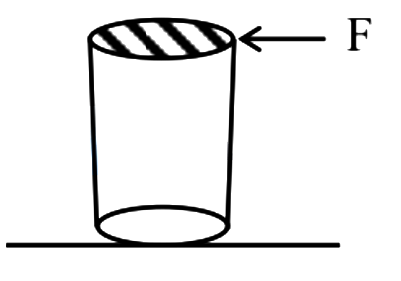
\(\begin{aligned} & \text { Shear moduli }=\frac{\sigma_{\text {shear }}}{\theta} \\ & 10^{10}=\frac{10^5}{\pi \times 16 \times 10^{-4}} \times \frac{1}{\theta} \\ & \theta=\frac{1}{160 \pi} \text { Radian }\end{aligned}\) -
- (A) 8
- (B) 9
- (C) 4
- (D) 3
Show answer and solution
Correct Answer: (C)
Given, Initial pressure of liquid \(\left(P_i\right)=1 \mathrm{~atm}\)
Final pressure of liquid \(\left(\mathrm{P}_{\mathrm{f}}\right)=5 \mathrm{~atm}\)
Change in pressure \((\mathrm{dP})=\mathrm{P}_{\mathrm{f}}-\mathrm{P}_{\mathrm{i}}=4 \mathrm{~atm}\)
\(=4 \times 10^5 \mathrm{~Pa}\)
Change in volume \((\mathrm{dV})=-0.8 \mathrm{~cm}^3\)
Bulk modulus \((B)=2 \times 10^9 \mathrm{~Pa}\)
Now, \(B=\frac{-d P}{(d V / V)} \Rightarrow V=-B\left(\frac{d V}{d P}\right)\)
\(\begin{aligned}
\Rightarrow & V=-2 \times 10^9 \times \frac{\left(-0.8 \times 10^{-6}\right)}{4 \times 10^5} \\
& =4 \times 10^{-3} \mathrm{~m}^3=4 \text { litre }
\end{aligned}\) -
- (A) 30
- (B) 25
- (C) 35
- (D) 20
Show answer and solution
Correct Answer: (B)
\(\begin{aligned} & \ell=2 \mathrm{~m} ; \mathrm{Y}=2 \times 10^{11} \frac{\mathrm{~N}}{\mathrm{~m}^2} \\ & \begin{aligned} \mu=-\frac{\left(\frac{\Delta \mathrm{r}}{\mathrm{r}}\right)}{\left(\frac{\Delta \ell}{\ell}\right)} \Rightarrow \frac{\Delta \ell}{\ell} & =\frac{1}{\mu} \times\left(\frac{\Delta \mathrm{r}}{\mathrm{r}}\right) \\ & =\frac{1}{0.2} \times\left(10^{-3}\right)\end{aligned}\end{aligned}\)
\(\begin{aligned} & \Rightarrow \frac{\Delta \ell}{\ell}=5 \times 10^{-3} \\ & \begin{aligned} \mathrm{u}=\frac{1}{2} \mathrm{y} \varepsilon_{\ell}^2 & =\frac{1}{2} \times 2 \times 10^{11} \times\left[5 \times 10^{-3}\right]^2 \\ & =25\end{aligned}\end{aligned}\) -
- (A) 1.25
- (B) 1
- (C) 1.75
- (D) 1.5
Show answer and solution
Correct Answer: (A)
\(\begin{aligned} & \mathrm{B}=\frac{\rho \mathrm{gh}}{\left(\frac{\Delta \mathrm{v}}{\mathrm{v}}\right)} \\ & \frac{\Delta \mathrm{v}}{\mathrm{v}} \times 100=\frac{\rho \mathrm{gh}}{\mathrm{B}} \times 100 \\ & \frac{1000 \times 10 \times 2.5 \times 10^3}{2 \times 10^9} \times 100 \% \\ & =1.25 \%\end{aligned}\) -
- (A) 41
- (B) 42
- (C) 43
- (D) 44
Show answer and solution
Correct Answer: (C)
Since bulk modulus is given as
\(\begin{aligned}
& \mathrm{B}=\frac{-\Delta \mathrm{P}}{\left(\frac{\Delta \mathrm{~V}}{\mathrm{~V}}\right)} \\
& 2.15 \times 10^9=\frac{-\Delta \mathrm{P}}{-\left(\frac{0.2}{100}\right)} \\
& \Delta \mathrm{P}=2.15 \times 10^9 \times 2 \times 10^{-3} \\
& =4.3 \times 10^6=43 \times 10^5 \mathrm{~N} / \mathrm{m}^2
\end{aligned}\) -
- (A) 5
- (B) 4
- (C) 3
- (D) 1
Show answer and solution
Correct Answer: (D)
\(\begin{aligned} & \mathrm{T}=\mathrm{K}\left(\ell-\ell_0\right) \\ & \Rightarrow 5=\mathrm{K}\left(1.4-\ell_0\right) \\ & \Rightarrow 7=\mathrm{K}\left(1.56-\ell_0\right) \\ & \Rightarrow \frac{5}{1.4-\ell_0}=\frac{7}{1.56-\ell_0} \\ & \therefore \ell_0=1 \mathrm{~m}\end{aligned}\) -
- (A) 10
- (B) 20
- (C) 30
- (D) 50
Show answer and solution
Correct Answer: (D)
\(\begin{aligned} & \mathrm{B}=\frac{\Delta \mathrm{P}}{\frac{\Delta \mathrm{V}}{\mathrm{V}}} \\ & \Delta \mathrm{V}=\frac{7 \times 10^6}{1.4 \times 10^{11}} \times\left(10 \times 10^{-2}\right)^3 \\ & \Delta \mathrm{~V}=50 \mathrm{~mm}^3\end{aligned}\) -
- (A) 1
- (B) 2
- (C) 5
- (D) 4
Show answer and solution
Correct Answer: (A)
Deformation angle
\(\begin{aligned}
& 2 \theta_1=\theta_2 \\
& \Rightarrow 2 \frac{\sigma_1}{\eta_1}=\frac{\sigma_2}{\eta_2}
\end{aligned}\)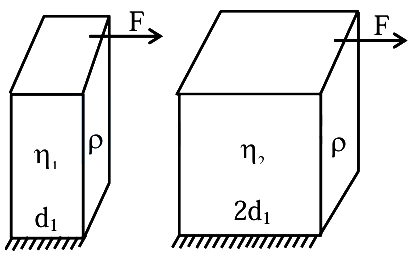
\(\begin{aligned} & \Rightarrow 2\left(\frac{\mathrm{~F}}{\ell \mathrm{~d}_1 \eta_1}\right)=\frac{\mathrm{F}}{\ell \mathrm{d}_2 \eta_2} \\ & \Rightarrow \eta_2=\frac{\eta_1}{4}=1 \times 10^9 \Rightarrow x=1\end{aligned}\) -
- (A) \(1: 6\)
- (B) \(1: 12\)
- (C) \(3: 4\)
- (D) \(1: 3\)
Show answer and solution
Correct Answer: (B)
\(\frac{\mathrm{L}_{\mathrm{A}}}{\mathrm{L}_{\mathrm{B}}}=\frac{1}{3}\) and \(\frac{\mathrm{d}_{\mathrm{A}}}{\mathrm{d}_{\mathrm{B}}}=2\)
\(\Delta \mathrm{L}_{\mathrm{A}}=\frac{\mathrm{F}_{\mathrm{A}} \mathrm{L}_{\mathrm{A}}}{\mathrm{A}_{\mathrm{A}} \mathrm{Y}_{\mathrm{A}}}\) and \(\Delta \mathrm{L}_{\mathrm{B}}=\frac{\mathrm{F}_{\mathrm{B}} \mathrm{L}_{\mathrm{B}}}{\mathrm{A}_{\mathrm{B}} \mathrm{Y}_{\mathrm{B}}}\)
Given, \(F_A=F_B\) and \(Y_A=Y_B\)
\(\frac{\Delta \mathrm{L}_{\mathrm{A}}}{\Delta \mathrm{L}_{\mathrm{B}}}=\frac{\frac{\mathrm{F}_{\mathrm{A}} \mathrm{L}_{\mathrm{A}}}{\mathrm{A}_{\mathrm{A}} \mathrm{Y}_{\mathrm{A}}}}{\frac{\mathrm{F}_{\mathrm{B}} \mathrm{L}_{\mathrm{B}}}{\mathrm{A}_{\mathrm{B}} \mathrm{Y}_{\mathrm{B}}}}=\left(\frac{\mathrm{L}_{\mathrm{A}}}{\mathrm{L}_{\mathrm{B}}}\right)\left(\frac{\mathrm{A}_{\mathrm{B}}}{\mathrm{A}_{\mathrm{A}}}\right)\)
\(\frac{\Delta \mathrm{L}_{\mathrm{A}}}{\Delta \mathrm{L}_{\mathrm{B}}}=\left(\frac{\mathrm{L}_{\mathrm{A}}}{\mathrm{L}_{\mathrm{B}}}\right)\left(\frac{\frac{\pi}{4} \mathrm{~d}_{\mathrm{B}}^2}{\frac{\pi}{4} \mathrm{~d}_{\mathrm{A}}^2}\right)=\left(\frac{\mathrm{L}_{\mathrm{A}}}{\mathrm{L}_{\mathrm{B}}}\right)\left(\frac{\mathrm{d}_{\mathrm{B}}}{\mathrm{d}_{\mathrm{A}}}\right)^2\)
\(\frac{\Delta \mathrm{L}_{\mathrm{A}}}{\Delta \mathrm{L}_{\mathrm{B}}}=\left(\frac{1}{3}\right)\left(\frac{1}{2}\right)^2=\frac{1}{12}\) -
- (A) \(\frac{82}{5}\)
- (B) \(\frac{57}{2}\)
- (C) \(\frac{71}{5}\)
- (D) \(\frac{68}{5}\)
Show answer and solution
Correct Answer: (A)
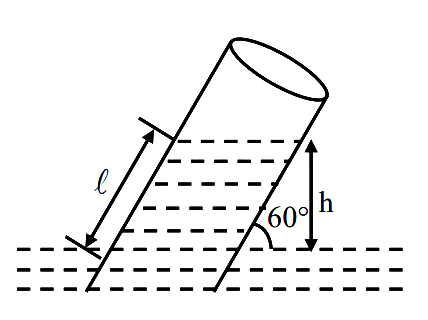
\(\begin{aligned} & \mathrm{h}=\frac{2 \mathrm{~T} \cos \theta}{\rho \mathrm{gr}}=\frac{2 \times 70 \times 1}{1 \times 980 \times 10^{-2}} \\ & \mathrm{~h}=\frac{100}{7} \mathrm{~cm} \\ & \sin 60^{\circ}=\frac{\mathrm{h}}{\ell} \\ & \ell=\frac{\mathrm{h} \times 2}{\sqrt{3}} \\ & \ell=\frac{100}{7} \times \frac{2}{\sqrt{3}} \\ & =\frac{200}{7 \times \sqrt{3}} \\ & =16.49 \mathrm{~cm}\end{aligned}\) -
- (A) \(0.1\)
- (B) \(0.05\)
- (C) \(0.02\)
- (D) \(0.25\)
Show answer and solution
Correct Answer: (B)
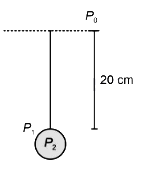
\(\begin{aligned}
& P_1=P_0+\rho g h=P_0+1000 \times 10 \times \frac{20}{100} \\
& \Rightarrow P_1=P_0+2000
\end{aligned}\)
So, \(P_2-P_1=\frac{2 S}{R}=\left(\frac{2 S}{1 \times 10^{-3}}\right)\)
\(\Rightarrow P_2=P_0+2100\)
(given)
\(\begin{aligned}
& \text { So, } P_0+2100-P_0-2000=2 S \times 10^3 \\
& \Rightarrow 100=2 S \times 10^3 \\
& \Rightarrow s=\left(\frac{1}{20}\right)=0.05
\end{aligned}\) -
- (A) 2190
- (B) 2000
- (C) 1540
- (D) 1325
Show answer and solution
Correct Answer: (A)
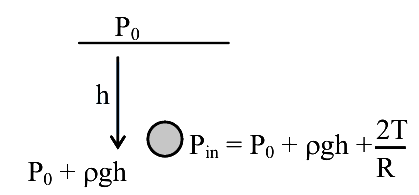
\(\Delta \mathrm{P}=\mathrm{P}_{\mathrm{in}}-\mathrm{P}_0\)
\(\begin{aligned} & =\rho \mathrm{gh}+\frac{2 \mathrm{~T}}{\mathrm{R}}=\frac{1000 \times 10 \times 20}{100}+\frac{2 \times 0.095}{10^{-3}} \\ & =2000+190 \\ & =2190\end{aligned}\) -
- (A) Statement I is true but Statement II is false
- (B) Statement I is false but Statement II is true
- (C) Both Statement I and Statement II are false
- (D) Both Statement I and Statement II are true
Show answer and solution
Correct Answer: (A)
Hot water is less viscous then cold water.
Surfactant reduces surface tension. -
- (A) 15 J
- (B) 5 J
- (C) 20 J
- (D) 10 J
Show answer and solution
Correct Answer: (A)
\(\begin{aligned}
& W_1=s 4 \pi\left(\frac{R}{3}\right)^2 \times 27-4 \pi R^2 \cdot s \\
& \Rightarrow W_1=4 \pi R^2 \cdot s(2)=10 \text { Joule }
\end{aligned}\)
Now, \(W_2=s 4 \pi R^2(4-1)=4 \pi R^2 s \times 3\)
\(\Rightarrow \quad W_2=3 \times \frac{10}{2}=15 \text { Joule }\) -
- (A) 10
- (B) 8
- (C) 6
- (D) 7
Show answer and solution
Correct Answer: (B)
\(\begin{aligned} & \Delta \mathrm{P}=\frac{4 \mathrm{~T}}{\mathrm{R}} \\ & \frac{\mathrm{R}_{\mathrm{A}}}{\mathrm{R}_{\mathrm{B}}}=\frac{\Delta \mathrm{P}_{\mathrm{B}}}{\Delta \mathrm{P}_{\mathrm{A}}}=2 \\ & \frac{\mathrm{~V}_{\mathrm{A}}}{\mathrm{V}_{\mathrm{B}}}=\left(\frac{\mathrm{R}_{\mathrm{A}}}{\mathrm{R}_{\mathrm{B}}}\right)^3=8\end{aligned}\) -
- (A) \(K\) is negative, then liquid \(A\) and liquid \(B\) have convex meniscus.
- (B) \(K\) is negative, then liquid \(A\) and liquid \(B\) have concave meniscus.
- (C) K is negative, then liquid A has concave meniscus and liquid \(B\) has convex meniscus
- (D) K is zero, then liquid A has convex meniscus and liquid B has concave meniscus.
Show answer and solution
Correct Answer: (C)
\(\mathrm{k}=\frac{\cos \theta_{\mathrm{A}}}{\cos \theta_{\mathrm{B}}}\)
It is negative when \(\cos \theta_A \& \cos \theta_B\) are of opposite sign. so option (3) -
- (A) 10
- (B) 8
- (C) 4
- (D) 6
Show answer and solution
Correct Answer: (C)
\(R=\frac{R_2 R_1}{R_2-R_1}=\frac{4 \times 2}{2}=4 \mathrm{~cm}\) -
- (A) \(4 \pi \mathrm{r}^2 \mathrm{~T}\left[2-2^{\frac{2}{3}}\right]\)
- (B) \(4 \pi r^2 \mathrm{~T}\left[2-2^{\frac{1}{3}}\right]\)
- (C) \(4 \pi r^2 \mathrm{~T}[1+\sqrt{2}]\)
- (D) \(4 \pi r^2 T[\sqrt{2}-1]\)
Show answer and solution
Correct Answer: (A)
\(\begin{aligned} & 2 \times \frac{4}{3} \pi \mathrm{R}^3=\frac{4}{3} \pi \mathrm{r}^3 \Rightarrow \mathrm{r}=2^{1 / 3} \mathrm{R} \\ & \mathrm{U}_{\mathrm{i}}=2 \times 4 \pi \mathrm{R}^2 \mathrm{~T} \\ & \mathrm{U}_{\mathrm{f}}=4 \pi \mathrm{r}^2 \mathrm{~T}=4 \pi \mathrm{R}^2 \mathrm{~T} 2^{2 / 3} \\ & \therefore \text { Heat lost }=\mathrm{u}_{\mathrm{i}}-\mathrm{u}_{\mathrm{f}}=4 \pi \mathrm{R}^2 \mathrm{~T}\left[2-2^{2 / 3}\right]\end{aligned}\) -
- (A) \(1400 \mathrm{~cm}^3\)
- (B) \(600 \mathrm{~cm}^3\)
- (C) \(4000 \mathrm{~cm}^3\)
- (D) \(400 \mathrm{~cm}^3\)
Show answer and solution
Correct Answer: (B)
Volume of cube inside water
\(\begin{aligned}
& =\left(\frac{\text { Denslty of cube }}{\text { Denslty of water }}\right) \times \text { Volume of cube } \\
& =\frac{\text { Mass of cube }}{\text { Denslty of water }} \\
& =\frac{400 \mathrm{gm}}{1 \mathrm{gm} / \mathrm{cm}^3} \\
& =400 \mathrm{~cm}^3
\end{aligned}\)
Volume of cube outside water
\(\begin{aligned}
& =\text { Volume of cube }- \text { Volume of cube inside water } \\
& =1000 \mathrm{~cm}^3-400 \mathrm{~cm}^3 \\
& =600 \mathrm{~cm}^3
\end{aligned}\) -
- (A) 4
- (B) 5
- (C) 3
- (D) 2
Show answer and solution
Correct Answer: (C)
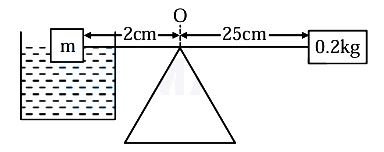
Given, volume of block \(=\left(10 \times 10^{-2}\right)^3=10^{-3} \mathrm{~m}^3\)
Let density of block \(=\rho \mathrm{kg} / \mathrm{m}^3\)
mass of block \(=\rho \times 10^{-3} \mathrm{~kg}\)
Buoyant Force \(\left(\mathrm{F}_{\mathrm{B}}\right)=1000 \times \frac{10^{-3}}{2} \times 10=5 \mathrm{~N}\)
F.B.D. of blocks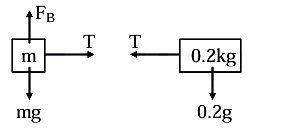
Balancing torque about point O , we get
\(\begin{aligned}
& \operatorname{mg}\left(2 \times 10^{-2}\right)-\mathrm{F}_{\mathrm{B}}\left(2 \times 10^{-2}\right)=0.2 \mathrm{~g}\left(25 \times 10^{-2}\right) \\
& \rho \times 10^{-3} \times 10 \times 2-10=50 \\
& \rho=3000 \mathrm{~kg} / \mathrm{m}^3
\end{aligned}\)
Hence, mass of block \(=\rho \times 10^{-3}\)
\(=3000 \times 10^{-3}=3 \mathrm{~kg}\) -
- (A) 2 Mg
- (B) Mg
- (C) \(\frac{3}{2} \mathrm{Mg}\)
- (D) \(\frac{\mathrm{Mg}}{2}\)
Show answer and solution
Correct Answer: (D)
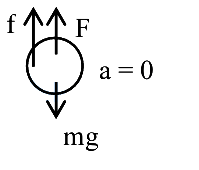
\(\begin{aligned} & \mathrm{mg}-\mathrm{F}_{\mathrm{B}}-\mathrm{f}=0 \\ & \Rightarrow \mathrm{mg}-\frac{\mathrm{mg}}{2}-\mathrm{f}=0 \\ & \therefore \mathrm{f}=\frac{\mathrm{mg}}{2}\end{aligned}\) -
- (A) \(2.18\)
- (B) \(2.38\)
- (C) \(1.68\)
- (D) \(1.99\)
Show answer and solution
Correct Answer: (D)
\(\mathrm{v}_{\mathrm{T}} \Rightarrow \frac{2}{9} \frac{\left(\rho_0-\rho_{\ell}\right) \mathrm{r}^2 \mathrm{~g}}{\eta}\)
\(\begin{aligned} & \eta=\frac{2}{9}\left(\frac{7825-925}{2.45 \times 10^{-2}}\right) \times(1.8)^2 \times 10^{-6} \times 9.8 \\ & \eta \approx 1.99\end{aligned}\) -
- (A) \(4 \mathrm{~m} / \mathrm{s}\)
- (B) \(2 \mathrm{~m} / \mathrm{s}\)
- (C) \(6 \mathrm{~m} / \mathrm{s}\)
- (D) \(8 \mathrm{~m} / \mathrm{s}\)
Show answer and solution
Correct Answer: (D)
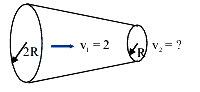
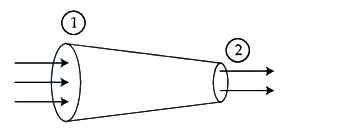
\(\begin{aligned} & \mathrm{A}_1 \mathrm{~V}_1=\mathrm{A}_2 \mathrm{~V}_2 \Rightarrow 2 \pi(2 \mathrm{R})^2=\mathrm{V}_2 \pi \mathrm{R}^2 \\ & \therefore \mathrm{~V}_2=8 \mathrm{~m} / \mathrm{s}\end{aligned}\) -
- (A) 100
- (B) 200
- (C) 150
- (D) 250
Show answer and solution
Correct Answer: (C)
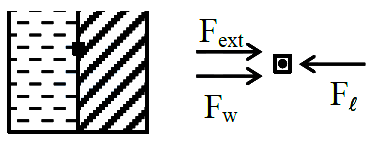
in equilibrium
\(\begin{aligned} & \mathrm{F}_{\text {ext }}+\mathrm{F}_{\mathrm{w}}=\mathrm{F}_{\ell} \\ & \Rightarrow \mathrm{F}_{\text {ext }}=\mathrm{F}_{\ell}-\mathrm{F}_{\mathrm{w}} \\ & =\left(\mathrm{P}_0+\rho_{\ell} \mathrm{gh}\right) \mathrm{A}-\left(\mathrm{P}_0+\rho_{\mathrm{w}} \mathrm{gh}\right) \mathrm{A} \\ & =\left(\rho_{\ell}-\rho_{\mathrm{w}}\right) \mathrm{ghA} \\ & =(1500-1000) \times 10 \times 3 \times\left(100 \times 10^{-4}\right) \\ & =150 \mathrm{~m}\end{aligned}\) -
- (A) \(3 \mathrm{~m} / \mathrm{s}\)
- (B) \(5 \mathrm{~m} / \mathrm{s}\)
- (C) \(2 \mathrm{~m} / \mathrm{s}\)
- (D) \(4 \mathrm{~m} / \mathrm{s}\)
Show answer and solution
Correct Answer: (D)
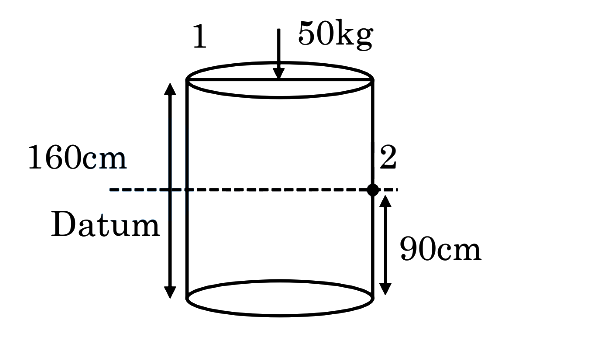
Apply Bernouli equation between points \(1 \& 2\)
\(\begin{aligned}
& P_1+\frac{1}{2} \rho v_1^2+\rho g h=P_2+\frac{1}{2} \rho v_2^2+0 \\
& P_0+\frac{\mathrm{mg}}{\mathrm{~A}}+\rho g \frac{70}{100}=P_0+\frac{1}{2} \rho v_2^2 \\
& \frac{5000}{0.5}+10^3 \times 10 \frac{70}{100}=\frac{1}{2} \times 10^3 v_2^2
\end{aligned}\)
\(\begin{aligned}
& 10^3+10^3 \times 7=\frac{10^3}{2} \mathrm{v}_2^2 \\
& \mathrm{v}_2^2=16 \\
& \mathrm{v}_2=4 \mathrm{~m} / \mathrm{s}
\end{aligned}\)
As the tank area is large \(\mathrm{v}_1\) is negligible compared to \(\mathrm{v}_2\) -
- (A) C, D, E Only
- (B) A, D, E Only
- (C) B, C, D Only
- (D) A, B, C Only
Show answer and solution
Correct Answer: (A)
Surface tension arises due to extra energy of the molecules at the molecules at the surface as compared at the interior of a liquid. The coefficient of viscosity for a liquid decreases with rise in temperature where as it increases for gases with increase in temperature. The flow is turbulent for a Reynold's number greater than 2000. Stream lines never intersect in a steady flow. -
- (A) 5
- (B) 10
- (C) 15
- (D) 20
Show answer and solution
Correct Answer: (A)
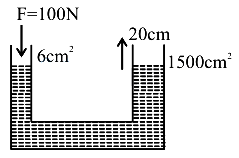
\(\begin{aligned} & \frac{\mathrm{F}_1}{\mathrm{~A}_1}=\frac{\mathrm{F}_2}{\mathrm{~A}_2}, \frac{100}{6}=\frac{\mathrm{F}}{1500}, \mathrm{~F}=\frac{50}{3} \times 1500 \\ & \mathrm{~F}=50 \times 500=25 \times 10^3 \mathrm{~N} \\ & \omega=\overrightarrow{\mathrm{F}} . \overrightarrow{\mathrm{S}}=25 \times 10^3 \times \frac{20}{100} \\ & =5 \times 10^3=5 \mathrm{~kJ}\end{aligned}\) -
- (A) \(\mathrm{A}, \mathrm{B}\) and E Only
- (B) B, D and E Only
- (C) A, C and D Only
- (D) C, D and E Only
Show answer and solution
Correct Answer: (C)
The terminal velocity of ball of radius \(R\) inside a liquid of viscosity \(\eta\) can be written as \(V_T=\frac{2 R^2 g}{n}(\sigma-\rho)\), where \(\sigma\) is the density of ball and \(\delta\) is the density of the liquid.
Hence,
\(A\) is correct since \(V_T \propto R^2\) gives a parabola on a graph
\(C\) is correct since \(V_T \alpha \frac{1}{\eta}\) and \(\eta\) varies with temperature
\(D\) is correct since \(V_T \alpha(\sigma-\rho)\) i.e., varies with density of liquid. -
- (A) \(1 \times 10^5 \mathrm{~J}\)
- (B) \(4 \times 10^4 \mathrm{~J}\)
- (C) \(6 \times 10^4 \mathrm{~J}\)
- (D) \(8 \times 10^4 \mathrm{~J}\)
Show answer and solution
Correct Answer: (D)
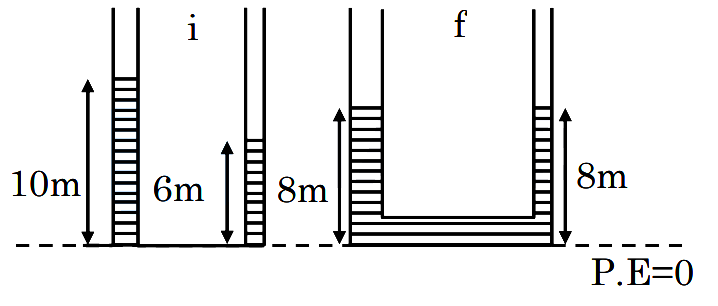
\(\begin{aligned} & \mathrm{U}_1=(\rho \mathrm{A} \times 10) \mathrm{g} \times 5+(\rho \mathrm{A} 6) \mathrm{g} \times 3 \\ & \mathrm{U}_{\mathrm{i}}=\rho \mathrm{Ag}(50+18) \\ & \mathrm{U}_{\mathrm{i}}=68 \rho \mathrm{Ag}\end{aligned}\)
\(\begin{aligned} & U_f=(\rho A \times 16) g \times 4 \\ & =(\rho A g) \times 64\end{aligned}\)
\(\begin{aligned} & \omega=\Delta U=4 \times \rho A g \\ & =4 \times 1000 \times 2 \times 10=8 \times 10^4 \mathrm{~J}\end{aligned}\) -
- (A) \(P_1-P_2\)
- (B) \(\left(P_1-P_2\right)^4\)
- (C) \(\left(\mathrm{P}_1-\mathrm{P}_2\right)^2\)
- (D) \(\sqrt{\mathrm{P}_1-\mathrm{P}_2}\)
Show answer and solution
Correct Answer: (D)
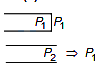
Using Bernoulli's theorem
\(\begin{aligned}
& P_1-P_2=\frac{1}{2} \rho v^2 \\
& v \propto \sqrt{P_1-P_2}
\end{aligned}\) -
- (A) \(\frac{2 \mathrm{Ma}}{3 \mathrm{a}+\mathrm{g}}\)
- (B) \(\frac{3 \mathrm{Ma}}{2 \mathrm{a}-\mathrm{g}}\)
- (C) \(\frac{3 \mathrm{Ma}}{2 \mathrm{a}+\mathrm{g}}\)
- (D) \(\frac{2 \mathrm{Ma}}{3 \mathrm{a}-\mathrm{g}}\)
Show answer and solution
Correct Answer: (A)
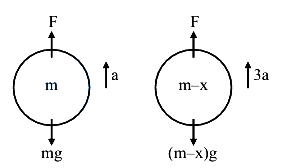
\(\begin{aligned}
& F-m g=m a \\
& F=m a+m g \\
& F-(m-x) g=(m-x) 3 a
\end{aligned}\)
Put F
\(\begin{aligned}
& \mathrm{Ma}+\mathrm{mg}-\mathrm{mg}+\mathrm{xg}=3 \mathrm{ma}-3 \mathrm{xa} \\
& \mathrm{x}=\frac{2 \mathrm{ma}}{\mathrm{~g}+3 \mathrm{a}}
\end{aligned}\) -
- (A) \(10 \mathrm{~m} / \mathrm{s}\)
- (B) \(4 \mathrm{~m} / \mathrm{s}\)
- (C) \(6 \mathrm{~m} / \mathrm{s}\)
- (D) \(8 \mathrm{~m} / \mathrm{s}\)
Show answer and solution
Correct Answer: (D)
\(\begin{aligned} & a=\frac{F}{m}=-10 x \\ & v \frac{d v}{d x}=-10 x\end{aligned}\)
\(\int_{10}^{\mathrm{v}} \mathrm{vdv}=-10 \int_{0.1}^{1.9} \mathrm{xdx}\)
\(\begin{aligned} & \frac{v^2-100}{2}=-10\left(\frac{1.9^2-0.1}{2}\right)^2 \\ & v=8 \mathrm{~m} / \mathrm{s}\end{aligned}\) -
- (A) \(5,5 \sqrt{3}\)
- (B) \(5 \sqrt{3}, 5\)
- (C) \(5 \sqrt{3}, 5 \sqrt{3}\)
- (D) 5,5
Show answer and solution
Correct Answer: (B)
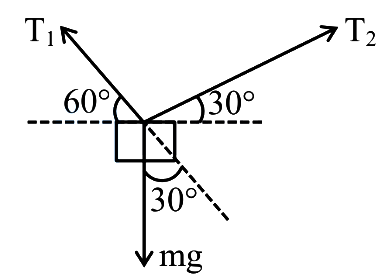
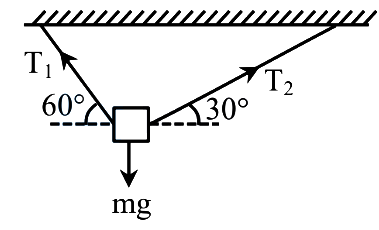
\(\begin{aligned} & \mathrm{T}_1=\mathrm{mg} \cos 30^{\circ} \\ & \mathrm{T}_2=\mathrm{mg} \sin 30^{\circ}\end{aligned}\) -
- (A) \(4 \hat{\mathrm{i}}+3 \hat{\mathrm{j}}+5 \hat{\mathrm{k}}\)
- (B) \(3 \hat{\mathrm{i}}+4 \hat{\mathrm{j}}+5 \hat{\mathrm{k}}\)
- (C) \(3 \hat{i}+4 \hat{j}-5 \hat{k}\)
- (D) \(3 \hat{\mathrm{i}}+4 \hat{\mathrm{j}}+\sqrt{5} \hat{\mathrm{k}}\)
Show answer and solution
Correct Answer: (B)
\(\begin{aligned} & \overrightarrow{\mathrm{a}}=\frac{\mathrm{B}}{2} \hat{\mathrm{k}}=3 \hat{\mathrm{k}}, \mathrm{t}=\frac{5}{3} \mathrm{~s} \\ & \overrightarrow{\mathrm{u}}=3 \hat{\mathrm{i}}+4 \hat{\mathrm{j}} \\ & \overrightarrow{\mathrm{v}}=\overrightarrow{\mathrm{u}}+\overrightarrow{\mathrm{a}} \mathrm{t}=3 \hat{\mathrm{i}}+4 \hat{\mathrm{j}}+5 \hat{\mathrm{k}}\end{aligned}\) -
- (A) \(\theta_1=30^{\circ} \theta_2=60^{\circ}\) with \(\mathrm{T}_2=\frac{3 \mathrm{mg}}{4}\)
- (B) \(\theta_1=60^{\circ} \theta_2=30^{\circ}\) with \(\mathrm{T}_2=\frac{\mathrm{mg}}{2}\)
- (C) \(\theta_1=45^{\circ} \theta_2=45^{\circ}\) with \(\mathrm{T}_2=\frac{3 \mathrm{mg}}{4}\)
- (D) \(\theta_1=30^{\circ} \theta_2=60^{\circ}\) with \(\mathrm{T}_2=\frac{4 \mathrm{mg}}{5}\)
Show answer and solution
Correct Answer: (B)
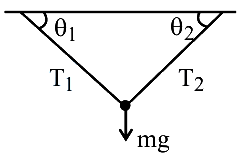
\(\begin{aligned} & \mathrm{T}_1 \sin \theta_1+\mathrm{T}_2 \sin \theta_2=\mathrm{mg} \& \mathrm{~T}_1=\sqrt{3} \mathrm{~T}_2 \\ & \Rightarrow \mathrm{~T}_2\left[\sqrt{3} \sin \theta_1+\sin \theta_2\right]=\mathrm{mg} \\ & \text { for } \theta_1=60^{\circ} \& \theta_2=30^{\circ} \\ & \mathrm{T}_2=\frac{\mathrm{mg}}{2}\end{aligned}\) -
- (A) 39 N
- (B) 15 N
- (C) 11 N
- (D) 20 N
Show answer and solution
Correct Answer: (C)
\(\begin{aligned} & \mathrm{kx}_1=5 \mathrm{~N} \\ & \mathrm{kx}_2=7 \mathrm{~N} \\ & \mathrm{k}\left(5 \mathrm{x}_1-2 \mathrm{x}_2\right)=5 \mathrm{kx}_1-2 \mathrm{kx}_2 \\ & =5 \times 5-2 \times 7=11 \mathrm{~N}\end{aligned}\) - 394. An object with mass 500 g moves along x -axis with speed \(v=4 \sqrt{x} \mathrm{~m} / \mathrm{s}\). The force acting on the object is : 2025 Easy
- (A) 8 N
- (B) 5 N
- (C) 6 N
- (D) 4 N
Show answer and solution
Correct Answer: (D)
\(\begin{aligned} & F=M \times a \\ & v=4 \sqrt{x} \\ & v^2=16 x \\ & 2 v \frac{d v}{d x}=16 \\ & \frac{v d v}{d x}=\frac{16}{2}=8 \\ & F=0.5 \times 8=4 N\end{aligned}\) -
- (A) \(9 \%\)
- (B) \(3 \%\)
- (C) \(4.5 \%\)
- (D) \(2.5 \%\)
Show answer and solution
Correct Answer: (C)
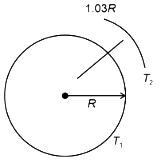
\(T_1 \propto(R)^{3 / 2}\)
and \(T_2 \propto(1.03 R)^{3 / 2}\)
\(\Rightarrow \quad T_2=(1.03 R)^{3 / 2} \cdot T_1 \approx 1.045 T_1\)
So \(T_2\) will larger by \(4.5 \%\) w.r.t. \(T_1\). -
- (A) 5
- (B) 4
- (C) 3
- (D) 2
Show answer and solution
Correct Answer: (C)
Explanation:
Let us calculate the kinetic energy of the satellite step-by-step using gravitational principles:
1. Identify the given parameters:
Mass of the satellite \( (m) = 1000\text{ kg} = 10^3\text{ kg} \)
Mass of the Earth \( (M_e) = 6 \times 10^{24}\text{ kg} \)
Radius of the Earth \( (R_E) = 6.4 \times 10^6\text{ m} \)
Height of the orbit \( (h) = 270\text{ km} = 2.7 \times 10^5\text{ m} \)
2. Calculate the orbital radius \( (r) \):
The total distance of the satellite from the center of the Earth is:
\( r = R_E + h = 6.4 \times 10^6\text{ m} + 0.27 \times 10^6\text{ m} = 6.67 \times 10^6\text{ m} \)
3. Apply the Kinetic Energy formula:
The kinetic energy of a satellite revolving in a stable circular orbit is given by:
\( \text{KE} = \frac{G M_e m}{2r} = \frac{G M_e m}{2(R_E + h)} \)
Substituting the correct values into the expression:
\( \text{KE} = \frac{6.67 \times 10^{-11} \times 6 \times 10^{24} \times 10^3}{2 \times 6.67 \times 10^6} \)
Canceling out the common term \( 6.67 \) from both the numerator and denominator simplifies the math:
\( \text{KE} = \frac{6 \times 10^{16}}{2 \times 10^6} \)
\( \text{KE} = 3 \times 10^{10}\text{ J} \)
Hence, Option C is the correct choice. -
- (A) 7
- (B) 8
- (C) 9
- (D) 3
Show answer and solution
Correct Answer: (D)
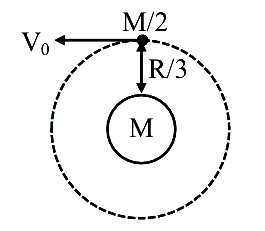
\(\begin{aligned} & \text { orbital velocity } v_0=\sqrt{\frac{\mathrm{GM}}{4 \mathrm{R} / 3}}=\sqrt{\frac{3 \mathrm{GM}}{4 \mathrm{R}}} \\ & \text { Angular momentum of satellite }=\frac{\mathrm{M}}{2} \mathrm{v}_0 \frac{4 R}{3} \\ & =\frac{M}{2} \cdot \sqrt{\frac{3 \mathrm{GM}}{4 \mathrm{R}}} \cdot \frac{4 \mathrm{R}}{3} \\ & =M \sqrt{\frac{\mathrm{GMR}}{3}} \\ & x=3\end{aligned}\)
(ii) Since mass of satellite is comparable to the mass of earth.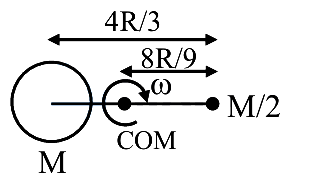
\(\begin{aligned} & \frac{\text { G.M. } \frac{\mathrm{M}}{2}}{\left(\frac{4 \mathrm{R}}{3}\right)^2}=\frac{\mathrm{M}}{2} \omega^2 \cdot \frac{8 \mathrm{R}}{9} \\ & \omega=\sqrt{\frac{81 \mathrm{GM}}{128 \mathrm{R}^3}}\end{aligned}\)
Angular momentum of satellite about common centre of mass,
\(\begin{aligned}
& L=\frac{M}{2} \cdot\left(\frac{8 R}{9}\right)^2 \cdot \omega \\
& L=M \sqrt{\operatorname{GMR}\left(\frac{8}{81}\right)} \\
& x=\frac{81}{8} \simeq 10
\end{aligned}\) -
- (A) \(12: 11\)
- (B) \(11: 10\)
- (C) \(12: 9\)
- (D) \(16: 9\)
Show answer and solution
Correct Answer: (A)
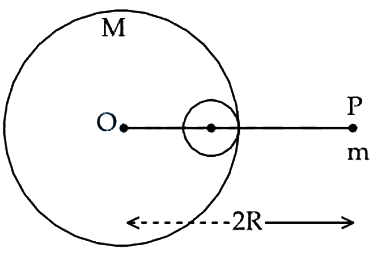
\(\begin{aligned}
& \mathrm{F}_1=\frac{\mathrm{GMm}}{(2 \mathrm{R})^2} .....(1)\\
& \mathrm{~F}_2=\frac{\mathrm{GMm}}{(2 \mathrm{R})^2}-\left(\frac{\mathrm{G}\left(\frac{\mathrm{M}}{27}\right) \mathrm{m}}{\left(\frac{4 \mathrm{R}}{3}\right)^2}\right) \\
& \mathrm{F}_2=\frac{11}{48} \frac{\mathrm{GMm}}{\mathrm{R}^2} ....(2)\\
& \mathrm{~F}_1: \mathrm{F}_2=12: 11
\end{aligned}\) -
- (A) 11
- (B) 7
- (C) 9
- (D) 13
Show answer and solution
Correct Answer: (C)
\(\because\) acceleration due to gravity on surface is given by
\(\mathrm{g}=\frac{\mathrm{GM}}{\mathrm{R}_{\mathrm{e}}^2}\)
Now since diameter is reduced to \(1 / 3^{\text {rd }}\), radius also reduces to \(1 / 3^{\text {rd }}\), keeping mass constant
New value of acceleration due to gravity on Earth's surface is
\(\mathrm{g}^{\prime}=\frac{\mathrm{GM}}{\left(\frac{\mathrm{R}_{\mathrm{e}}}{3}\right)^2}=9 \frac{\mathrm{GMe}}{\mathrm{R}_{\mathrm{e}}^2}=9 \mathrm{~g}\) -
- (A) \(\sqrt{\frac{\mathrm{GM}}{2 \mathrm{R}}}\)
- (B) \(\sqrt{\frac{\mathrm{GM}}{\mathrm{R}}}\)
- (C) \(\sqrt{\frac{3 \mathrm{GM}}{\mathrm{R}}}\)
- (D) \(\sqrt{\frac{2 \mathrm{GM}}{\mathrm{R}}}\)
Show answer and solution
Correct Answer: (A)
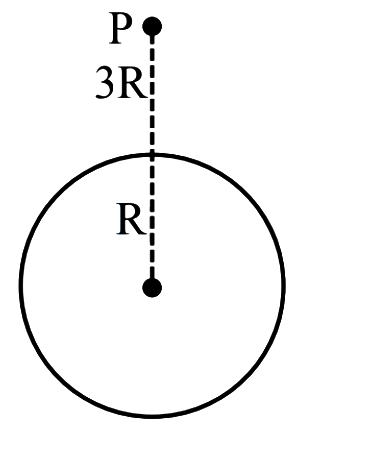
\(\begin{aligned}
& \mathrm{P}_{\mathrm{P}}+\mathrm{k}_{\mathrm{P}}=\mathrm{P}_{\mathrm{o}}+\mathrm{k}_0 \\
& -\frac{\mathrm{GMm}}{4 \mathrm{R}}+\frac{1}{2} \mathrm{mV}_{\mathrm{P}}^2=0 \\
& \mathrm{~V}_{\mathrm{P}}=\sqrt{\frac{\mathrm{GM}}{2 \mathrm{R}}}
\end{aligned}\)
Choice 1
No questions on this page match these filters.