


Questions
12 questionsShowing 1–12 of 12 questions
-
- (A) \(1400 \mathrm{~cm}^3\)
- (B) \(600 \mathrm{~cm}^3\)
- (C) \(4000 \mathrm{~cm}^3\)
- (D) \(400 \mathrm{~cm}^3\)
Show answer and solution
Correct Answer: (B)
Volume of cube inside water
\(\begin{aligned}
& =\left(\frac{\text { Denslty of cube }}{\text { Denslty of water }}\right) \times \text { Volume of cube } \\
& =\frac{\text { Mass of cube }}{\text { Denslty of water }} \\
& =\frac{400 \mathrm{gm}}{1 \mathrm{gm} / \mathrm{cm}^3} \\
& =400 \mathrm{~cm}^3
\end{aligned}\)
Volume of cube outside water
\(\begin{aligned}
& =\text { Volume of cube }- \text { Volume of cube inside water } \\
& =1000 \mathrm{~cm}^3-400 \mathrm{~cm}^3 \\
& =600 \mathrm{~cm}^3
\end{aligned}\) -
- (A) 4
- (B) 5
- (C) 3
- (D) 2
Show answer and solution
Correct Answer: (C)
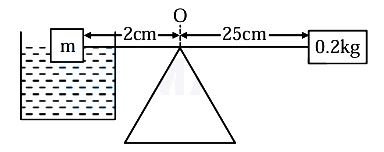
Given, volume of block \(=\left(10 \times 10^{-2}\right)^3=10^{-3} \mathrm{~m}^3\)
Let density of block \(=\rho \mathrm{kg} / \mathrm{m}^3\)
mass of block \(=\rho \times 10^{-3} \mathrm{~kg}\)
Buoyant Force \(\left(\mathrm{F}_{\mathrm{B}}\right)=1000 \times \frac{10^{-3}}{2} \times 10=5 \mathrm{~N}\)
F.B.D. of blocks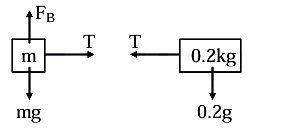
Balancing torque about point O , we get
\(\begin{aligned}
& \operatorname{mg}\left(2 \times 10^{-2}\right)-\mathrm{F}_{\mathrm{B}}\left(2 \times 10^{-2}\right)=0.2 \mathrm{~g}\left(25 \times 10^{-2}\right) \\
& \rho \times 10^{-3} \times 10 \times 2-10=50 \\
& \rho=3000 \mathrm{~kg} / \mathrm{m}^3
\end{aligned}\)
Hence, mass of block \(=\rho \times 10^{-3}\)
\(=3000 \times 10^{-3}=3 \mathrm{~kg}\) -
- (A) 2 Mg
- (B) Mg
- (C) \(\frac{3}{2} \mathrm{Mg}\)
- (D) \(\frac{\mathrm{Mg}}{2}\)
Show answer and solution
Correct Answer: (D)
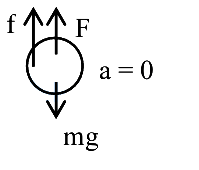
\(\begin{aligned} & \mathrm{mg}-\mathrm{F}_{\mathrm{B}}-\mathrm{f}=0 \\ & \Rightarrow \mathrm{mg}-\frac{\mathrm{mg}}{2}-\mathrm{f}=0 \\ & \therefore \mathrm{f}=\frac{\mathrm{mg}}{2}\end{aligned}\) -
- (A) \(2.18\)
- (B) \(2.38\)
- (C) \(1.68\)
- (D) \(1.99\)
Show answer and solution
Correct Answer: (D)
\(\mathrm{v}_{\mathrm{T}} \Rightarrow \frac{2}{9} \frac{\left(\rho_0-\rho_{\ell}\right) \mathrm{r}^2 \mathrm{~g}}{\eta}\)
\(\begin{aligned} & \eta=\frac{2}{9}\left(\frac{7825-925}{2.45 \times 10^{-2}}\right) \times(1.8)^2 \times 10^{-6} \times 9.8 \\ & \eta \approx 1.99\end{aligned}\) -
- (A) \(4 \mathrm{~m} / \mathrm{s}\)
- (B) \(2 \mathrm{~m} / \mathrm{s}\)
- (C) \(6 \mathrm{~m} / \mathrm{s}\)
- (D) \(8 \mathrm{~m} / \mathrm{s}\)
Show answer and solution
Correct Answer: (D)
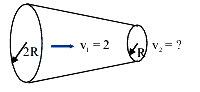
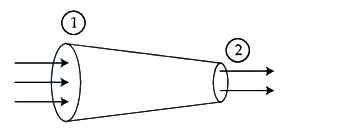
\(\begin{aligned} & \mathrm{A}_1 \mathrm{~V}_1=\mathrm{A}_2 \mathrm{~V}_2 \Rightarrow 2 \pi(2 \mathrm{R})^2=\mathrm{V}_2 \pi \mathrm{R}^2 \\ & \therefore \mathrm{~V}_2=8 \mathrm{~m} / \mathrm{s}\end{aligned}\) -
- (A) 100
- (B) 200
- (C) 150
- (D) 250
Show answer and solution
Correct Answer: (C)
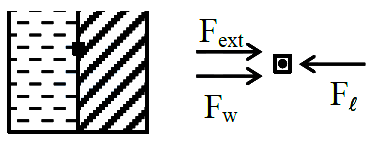
in equilibrium
\(\begin{aligned} & \mathrm{F}_{\text {ext }}+\mathrm{F}_{\mathrm{w}}=\mathrm{F}_{\ell} \\ & \Rightarrow \mathrm{F}_{\text {ext }}=\mathrm{F}_{\ell}-\mathrm{F}_{\mathrm{w}} \\ & =\left(\mathrm{P}_0+\rho_{\ell} \mathrm{gh}\right) \mathrm{A}-\left(\mathrm{P}_0+\rho_{\mathrm{w}} \mathrm{gh}\right) \mathrm{A} \\ & =\left(\rho_{\ell}-\rho_{\mathrm{w}}\right) \mathrm{ghA} \\ & =(1500-1000) \times 10 \times 3 \times\left(100 \times 10^{-4}\right) \\ & =150 \mathrm{~m}\end{aligned}\) -
- (A) \(3 \mathrm{~m} / \mathrm{s}\)
- (B) \(5 \mathrm{~m} / \mathrm{s}\)
- (C) \(2 \mathrm{~m} / \mathrm{s}\)
- (D) \(4 \mathrm{~m} / \mathrm{s}\)
Show answer and solution
Correct Answer: (D)
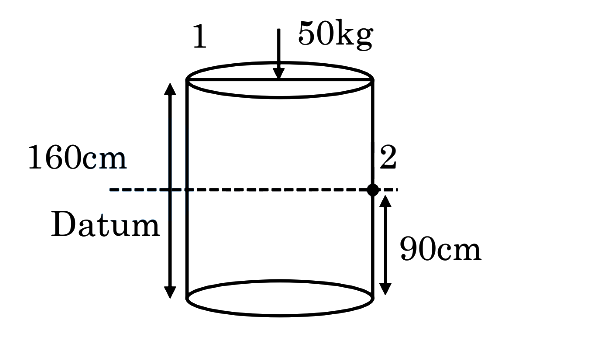
Apply Bernouli equation between points \(1 \& 2\)
\(\begin{aligned}
& P_1+\frac{1}{2} \rho v_1^2+\rho g h=P_2+\frac{1}{2} \rho v_2^2+0 \\
& P_0+\frac{\mathrm{mg}}{\mathrm{~A}}+\rho g \frac{70}{100}=P_0+\frac{1}{2} \rho v_2^2 \\
& \frac{5000}{0.5}+10^3 \times 10 \frac{70}{100}=\frac{1}{2} \times 10^3 v_2^2
\end{aligned}\)
\(\begin{aligned}
& 10^3+10^3 \times 7=\frac{10^3}{2} \mathrm{v}_2^2 \\
& \mathrm{v}_2^2=16 \\
& \mathrm{v}_2=4 \mathrm{~m} / \mathrm{s}
\end{aligned}\)
As the tank area is large \(\mathrm{v}_1\) is negligible compared to \(\mathrm{v}_2\) -
- (A) C, D, E Only
- (B) A, D, E Only
- (C) B, C, D Only
- (D) A, B, C Only
Show answer and solution
Correct Answer: (A)
Surface tension arises due to extra energy of the molecules at the molecules at the surface as compared at the interior of a liquid. The coefficient of viscosity for a liquid decreases with rise in temperature where as it increases for gases with increase in temperature. The flow is turbulent for a Reynold's number greater than 2000. Stream lines never intersect in a steady flow. -
- (A) 5
- (B) 10
- (C) 15
- (D) 20
Show answer and solution
Correct Answer: (A)
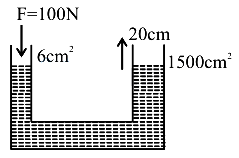
\(\begin{aligned} & \frac{\mathrm{F}_1}{\mathrm{~A}_1}=\frac{\mathrm{F}_2}{\mathrm{~A}_2}, \frac{100}{6}=\frac{\mathrm{F}}{1500}, \mathrm{~F}=\frac{50}{3} \times 1500 \\ & \mathrm{~F}=50 \times 500=25 \times 10^3 \mathrm{~N} \\ & \omega=\overrightarrow{\mathrm{F}} . \overrightarrow{\mathrm{S}}=25 \times 10^3 \times \frac{20}{100} \\ & =5 \times 10^3=5 \mathrm{~kJ}\end{aligned}\) -
- (A) \(\mathrm{A}, \mathrm{B}\) and E Only
- (B) B, D and E Only
- (C) A, C and D Only
- (D) C, D and E Only
Show answer and solution
Correct Answer: (C)
The terminal velocity of ball of radius \(R\) inside a liquid of viscosity \(\eta\) can be written as \(V_T=\frac{2 R^2 g}{n}(\sigma-\rho)\), where \(\sigma\) is the density of ball and \(\delta\) is the density of the liquid.
Hence,
\(A\) is correct since \(V_T \propto R^2\) gives a parabola on a graph
\(C\) is correct since \(V_T \alpha \frac{1}{\eta}\) and \(\eta\) varies with temperature
\(D\) is correct since \(V_T \alpha(\sigma-\rho)\) i.e., varies with density of liquid. -
- (A) \(1 \times 10^5 \mathrm{~J}\)
- (B) \(4 \times 10^4 \mathrm{~J}\)
- (C) \(6 \times 10^4 \mathrm{~J}\)
- (D) \(8 \times 10^4 \mathrm{~J}\)
Show answer and solution
Correct Answer: (D)
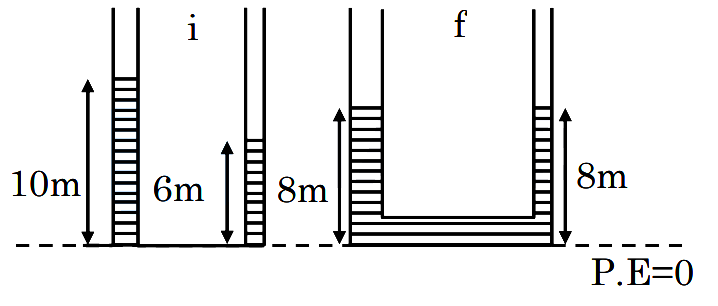
\(\begin{aligned} & \mathrm{U}_1=(\rho \mathrm{A} \times 10) \mathrm{g} \times 5+(\rho \mathrm{A} 6) \mathrm{g} \times 3 \\ & \mathrm{U}_{\mathrm{i}}=\rho \mathrm{Ag}(50+18) \\ & \mathrm{U}_{\mathrm{i}}=68 \rho \mathrm{Ag}\end{aligned}\)
\(\begin{aligned} & U_f=(\rho A \times 16) g \times 4 \\ & =(\rho A g) \times 64\end{aligned}\)
\(\begin{aligned} & \omega=\Delta U=4 \times \rho A g \\ & =4 \times 1000 \times 2 \times 10=8 \times 10^4 \mathrm{~J}\end{aligned}\) -
- (A) \(P_1-P_2\)
- (B) \(\left(P_1-P_2\right)^4\)
- (C) \(\left(\mathrm{P}_1-\mathrm{P}_2\right)^2\)
- (D) \(\sqrt{\mathrm{P}_1-\mathrm{P}_2}\)
Show answer and solution
Correct Answer: (D)
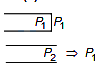
Using Bernoulli's theorem
\(\begin{aligned}
& P_1-P_2=\frac{1}{2} \rho v^2 \\
& v \propto \sqrt{P_1-P_2}
\end{aligned}\)
No questions on this page match these filters.