


Questions
7 questionsShowing 1–7 of 7 questions
-
- (A) \(6\)
- (B) \(2\)
- (C) \(4\)
- (D) \(1\)
Show answer and solution
Correct Answer: (B)
Additional buoyant force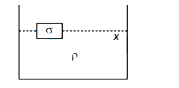
\(\begin{aligned}
& g \rho a^2 x=\sigma a^3 A \\
& A=\frac{\rho}{\sigma} \frac{g}{a} x \\
& T=2 \pi \sqrt{\frac{\sigma a}{\rho g}}
\end{aligned}\)
Now, \(\sigma=\frac{10 \times 10^{-3}}{10^{-3}}=10\)
\(\begin{aligned} \Rightarrow \quad T & =2 \pi \sqrt{\frac{10 \times 0.1}{10^3 \times 10}} \\ & =2 \pi \times 10^{-2}\end{aligned}\) -
- (A) \(\frac{16}{5}\)
- (B) \(10\)
- (C) \(\frac{15}{4}\)
- (D) \(25\)
Show answer and solution
Correct Answer: (D)
A = 1 cm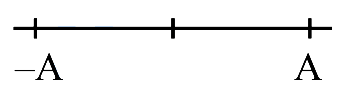
\(\begin{aligned} & \mathrm{n}=\frac{12.5}{2}=6.25 \text { cycles } \\ & \therefore \mathrm{D}=4 \times 6+1=25 \\ & \mathrm{~d}=1 \\ & \frac{D}{d}=25\end{aligned}\) -
- (A) \(175\)
- (B) \(25 \sqrt{7}\)
- (C) \(5 \sqrt{7}\)
- (D) \(125\)
Show answer and solution
Correct Answer: (A)
\(\begin{aligned} & \mathrm{x}_1=\sqrt{7} \sin 5 \mathrm{t} \\ & \mathrm{x}_2=2 \sqrt{7} \sin \left(5 \mathrm{t}+\frac{\pi}{3}\right)\end{aligned}\)
From phasor,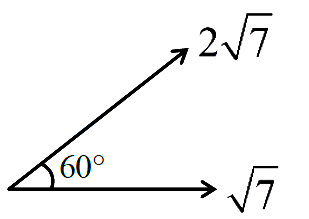
\(\therefore\) Amplitude of resultant \(\mathrm{SHM}=7\)
\(\begin{aligned} & \phi=\tan ^{-1} \frac{2 \sqrt{7} \times \sqrt{3} / 2}{\sqrt{7}+2 \sqrt{7} \times \frac{1}{2}}=\tan ^{-1} \frac{\sqrt{21}}{2 \sqrt{7}}=\tan ^{-1} \frac{\sqrt{3}}{2} \\ & \therefore \quad \mathrm{X}_{\mathrm{R}}=7 \sin (5 \mathrm{t}+\phi) \\ & \quad \mathrm{a}_{\mathrm{R}}=-7 \times 25 \sin (5 \mathrm{t}+\phi) \\ & \therefore \mathrm{a}_{\max }=175 \mathrm{~cm} / \mathrm{sec}=175 \times 10^{-2} \mathrm{~m} / \mathrm{sec}\end{aligned}\) -
- (A) (A) is false but (R) is true
- (B) (A) is true but (R) is false
- (C) Both (A) and (R) are true but (R) is NOT the correct explanation of (A)
- (D) Both \((\mathbf{A})\) and \((\mathbf{R})\) are true and \((\mathbf{R})\) is the correct explanation of \((\mathbf{A})\)
Show answer and solution
Correct Answer: (D)
\(\begin{aligned} & \text { If we express position } x(t)=A \sin (\omega t+\phi) \\ & \text { then } x_0=A \sin \phi \\ & v_0=A \omega \cos \phi \\ & \Rightarrow \tan \phi=\frac{\omega x_0}{v_0} \\ & A=\sqrt{x_0^2+\frac{v_0^2}{\omega^2}}\end{aligned}\)
Hence both position and linear momentum of a particle can be expressed as a function of time if we know initial momentum and position -
- (A) A, B, D Only
- (B) B, C, D Only
- (C) C, D, E Only
- (D) A, B, C Only
Show answer and solution
Correct Answer: (A)
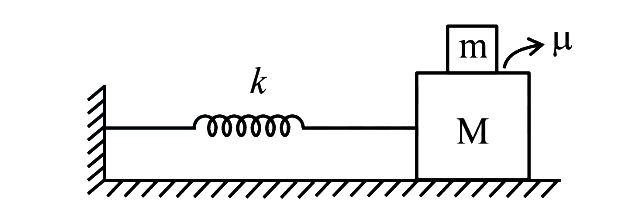
(A) As both blocks moving together so Time period \(=2 \pi \sqrt{\frac{\mathrm{~m}}{\mathrm{~K}}} ;\) where \(\mathrm{m}=\mathrm{M}+\mathrm{m}\)
\(\mathrm{T}=2 \pi \sqrt{\frac{\mathrm{M}+\mathrm{m}}{\mathrm{~K}}}\)
(B) Let block is displaced by x in \((+\mathrm{ve})\) direction so force on block will be in(-ve) direction
\(\begin{aligned}
& \mathrm{F}=-\mathrm{Kx} \\
& (\mathrm{M}+\mathrm{m}) \mathrm{a}=-\mathrm{Kx} \\
& \mathrm{a}=-\frac{\mathrm{Kx}}{(\mathrm{M}+\mathrm{m})}
\end{aligned}\)
(C) As upper block is moving due to friction thus
\(\mathrm{f}=\mathrm{ma}=\frac{\mathrm{mKx}}{(\mathrm{M}+\mathrm{m})}\)
(D) This option is like two block problem in friction for maximum amplitude, force on block is also maximum, for which both blocks are moving together.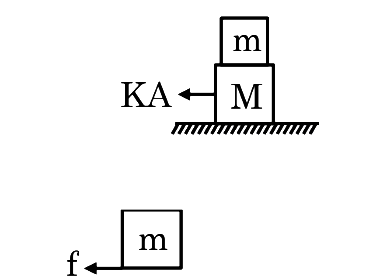
\(\begin{aligned}
& K A=(M+m) a \\
& a=\frac{K A}{(M+m)} \\
& f=m a=\frac{m K A}{(M+m)} \\
& f_{\max }=f_L=\mu \mathrm{mg} \\
& f=\mu m g \\
& \frac{m K A}{(M+m)}=\mu m g \\
& A=\frac{\mu(M+m) g}{K}
\end{aligned}\)
(E) Maximum friction can be \(\mu \mathrm{mg}\) as force is acting between blocks & normal force here is mg. -
- (A) \(\frac{\mathrm{k}_1}{\mathrm{k}_2}\)
- (B) \(\sqrt{\frac{\mathrm{k}_1}{\mathrm{k}_2}}\)
- (C) \(\sqrt{\frac{\mathrm{k}_2}{\mathrm{k}_1}}\)
- (D) \(\frac{\mathrm{k}_2}{\mathrm{k}_1}\)
Show answer and solution
Correct Answer: (B)
\(\begin{aligned} & \mathrm{V}_1=\mathrm{A}_1 \omega_1 \\ & \mathrm{~V}_2=\mathrm{A}_2 \omega_2 \\ & \mathrm{~A}_1=\mathrm{A}_2 \\ & \frac{\mathrm{~V}_1}{\mathrm{~V}_2}=\frac{\omega_1}{\omega_2}=\frac{\sqrt{\frac{\mathrm{K}_1}{\mathrm{~m}}}}{\sqrt{\frac{\mathrm{~K}_2}{\mathrm{~m}}}} \\ & \frac{\mathrm{~V}_1}{\mathrm{~V}_2}=\sqrt{\frac{\mathrm{K}_1}{\mathrm{~K}_2}}\end{aligned}\) -
- (A) \(\theta_1 l_2^2=\theta_2 l_1^2\)
- (B) \(\theta_1 l_1=\theta_2 l_2\)
- (C) \(\theta_1 l_1^2=\theta_2 l_2^2\)
- (D) \(\theta_1 l_2=\theta_2 l_1\)
Show answer and solution
Correct Answer: (D)
\(\begin{aligned} & \omega=\sqrt{\frac{\mathrm{g}}{\ell}} \\ & \alpha=-\omega^2 \theta \\ & \therefore \frac{\mathrm{~g}}{\ell_1} \theta_1=\frac{\mathrm{g}}{\ell_2} \theta_2 \\ & \Rightarrow \theta_1 \ell_2=\theta_2 \ell_2\end{aligned}\)
No questions on this page match these filters.