


All JEE Mains 2024 Physics questions
31 chaptersShowing 101–150 of 593 questions
-
- (A) Both \(A\) and \(R\) are correct and \(R\) is \(NOT\) the correct explanation of \(A\).
- (B) \(A\) is correct but \(R\) is not correct.
- (C) Both \(A\) and \(R\) are correct and \(R\) is the correct explanation of \(A\).
- (D) A is not correct but \(R\) is correct.
Show answer and solution
Correct Answer: (D)
Intensity of light \(\mathrm{I}=\frac{\mathrm{nh} \nu}{\mathrm{A}}\)Here \(\mathrm{n}\) is no. of photons per unit time.
\(\mathrm{n}=\frac{\mathrm{IA}}{\mathrm{h} v}\) so on increasing frequency \(v, \mathrm{n}\) decreases taking intensity constant.
\(\mathrm{k}_{\max }=\mathrm{h} v-\phi\)
So on increasing \(v\), kinetic energy increases.
-
- (A) Statement-\(I\) is correct and Statement-\(II\) is incorrect.
- (B) Statement-\(I\) is incorrect but Statement-\(II\) is correct.
- (C) Both Statement-\(I\) and Statement-\(II\) are incorrect.
- (D) Both Statement-\(I\) and Statement-\(II\) are correct.
Show answer and solution
Correct Answer: (A)
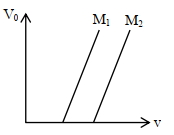
\(\mathrm{eV}_0=\mathrm{hv}-\phi\)\(\mathrm{V}_0=\frac{\mathrm{h}}{\mathrm{e}} \mathrm{v}-\frac{\phi}{\mathrm{e}}\)
\(\mathrm{M}_2\) material has higher work function, so statement-\((II)\) is incorrect.
Option \((1)\) is correct.
-
- (A) \(2.46 \times 10^{-3} \mathrm{~kg} \mathrm{~m} / \mathrm{s}\)
- (B) \(2.16 \times 10^{-3} \mathrm{~kg} \mathrm{~m} / \mathrm{s}\)
- (C) \(1.58 \times 10^{-3} \mathrm{~kg} \mathrm{~m} / \mathrm{s}\)
- (D) \(4.32 \times 10^{-3} \mathrm{~kg} \mathrm{~m} / \mathrm{s}\)
Show answer and solution
Correct Answer: (B)
\(\mathrm{p}=\frac{\mathrm{E}}{\mathrm{C}}=\frac{6.48 \times 10^5}{3 \times 10^8}=2.16 \times 10^{-3}\) -
- (A) Doubled
- (B) Quadrupled
- (C) Zero
- (D) Halved
Show answer and solution
Correct Answer: (C)
Since \(\frac{\mathrm{f}}{2}<\mathrm{f}_0\)i.e. the incident frequency is less than threshold frequency. Hence there will be no emission of photoelectrons.
\(\Rightarrow\) current \(=0\)
-
- (A) \(122\)
- (B) \(125\)
- (C) \(130\)
- (D) \(135\)
Show answer and solution
Correct Answer: (A)
\(10.2 \mathrm{eV}=\frac{\mathrm{hc}}{\lambda}\)\(\lambda=\frac{1245 \mathrm{eV}-\mathrm{nm}}{10.2 \mathrm{eV}}=122.06 \mathrm{~nm}\)
-
- (A) \(0.5 \mathrm{eV}\)
- (B) \(1.68 \mathrm{eV}\)
- (C) \(2.48 \mathrm{eV}\)
- (D) \(1.98 \mathrm{eV}\)
Show answer and solution
Correct Answer: (D)
\(\mathrm{eV}=\mathrm{hv}-\phi\)\(0.5 \mathrm{~V}=2.48-\phi\)
\(\text { work function }(\phi)=2.48 \mathrm{~V}-0.5 \mathrm{~V}=1.98 \mathrm{~V}\)
-
- (A) \(9 \times 10^{18}\)
- (B) \(6 \times 10^{15}\)
- (C) \(5 \times 10^{15}\)
- (D) \(7 \times 10^{16}\)
Show answer and solution
Correct Answer: (C)
\(\mathrm{P}=\mathrm{nh \nu}\)\(\mathrm{n}=\frac{\mathrm{P}}{\mathrm{h} \nu}=\frac{2 \times 10^{-3}}{6.63 \times 10^{-34} \times 6 \times 10^{14}}\)
\(=5 \times 10^{15}\)
-
- (A) \(\frac{1}{1}\)
- (B) \(\frac{1}{8}\)
- (C) \(\frac{8}{1}\)
- (D) \(\frac{1}{4}\)
Show answer and solution
Correct Answer: (B)
For photon\(\mathrm{E}_{\mathrm{p}}=\frac{\mathrm{hc}}{\lambda_{\mathrm{p}}} \Rightarrow \lambda_{\mathrm{p}}=\frac{\mathrm{hc}}{\mathrm{E}_{\mathrm{p}}}\)
For electron
\( \lambda_{\mathrm{e}}=\frac{\mathrm{h}}{\mathrm{m}_{\mathrm{e}} \mathrm{v}_{\mathrm{e}}}=\frac{\mathrm{hv}_{\mathrm{e}}}{2 \mathrm{~K}_{\mathrm{e}}} \)
\( \text { Given } \mathrm{v}_{\mathrm{e}}=0.25 \mathrm{c} \)
\( \lambda_{\mathrm{e}}=\frac{\mathrm{h} \times 0.25 \mathrm{c}}{2 \mathrm{~K}_{\mathrm{e}}}=\frac{\mathrm{hc}}{8 \mathrm{~K}_{\mathrm{e}}}\)
Also \(\lambda_{\mathrm{p}}=\lambda_{\mathrm{e}}\)
\( \frac{\mathrm{hc}}{\mathrm{E}_{\mathrm{p}}}=\frac{\mathrm{hc}}{8 \mathrm{~K}_{\mathrm{e}}} \)
\( \frac{\mathrm{K}_{\mathrm{e}}}{\mathrm{E}_{\mathrm{p}}}=\frac{1}{8}\)
-
- (A) \(1: 8\)
- (B) \(1: 2\)
- (C) \(4: 1\)
- (D) \(8: 1\)
Show answer and solution
Correct Answer: (D)
\(\lambda= \frac{\mathrm{h}}{\mathrm{p}}=\frac{\mathrm{h}}{\mathrm{mv}} \Rightarrow \mathrm{v}=\frac{\mathrm{h}}{\mathrm{m} \lambda}\)\(\frac{\mathrm{v}_{\mathrm{p}}}{\mathrm{v}_\alpha}=\frac{\mathrm{m}_\alpha}{\mathrm{m}_{\mathrm{p}}} \times \frac{\lambda_\alpha}{\lambda_{\mathrm{p}}}\)
\(=4 \times 2=8\)
-
- (A) \(16 \times 10^{1 \mathrm{~s}} \mathrm{~Hz}\)
- (B) \(16 \times 10^{12} \mathrm{~Hz}\)
- (C) \(1.6 \times 10^{12} \mathrm{~Hz}\)
- (D) \(1.6 \times 10^{15} \mathrm{~Hz}\)
Show answer and solution
Correct Answer: (D)
\( \phi_0=h v_0 \)\( 6.63 \times 1.6 \times 10^{-19}=6.63 \times 10^{-34} v_0 \)
\( v_0=\frac{1.6 \times 10^{-19}}{10^{-34}} \)
\( v_0=1.6 \times 10^{15} \mathrm{~Hz}\)
-
- (A) \(215 \mathrm{~nm}\)
- (B) \(414 \mathrm{~nm}\)
- (C) \(400 \mathrm{~nm}\)
- (D) \(200 \mathrm{~nm}\)
Show answer and solution
Correct Answer: (B)
For \(P.E.E.\) : \(\lambda \leq \frac{h c}{W_e}\)\(\lambda \leq \frac{1240 \mathrm{~nm}-\mathrm{eV}}{3 \mathrm{eV}}\)
\(\lambda \leq 413.33 \mathrm{~nm}\)
\(\lambda_{\max } \approx 414 \mathrm{~nm}\) for \(P.E.E.\)
-
- (A) \(1: 5\)
- (B) \(1: 3\)
- (C) \(5: 3\)
- (D) \(3: 5\)
Show answer and solution
Correct Answer: (D)
\( \mathrm{n}_1 \times \frac{\mathrm{hc}}{\lambda_1}=200 \)\( \mathrm{n}_2 \times \frac{\mathrm{hc}}{\lambda_2}=200 \)
\( \frac{\mathrm{n}_{\mathrm{l}}}{\mathrm{n}_2}=\frac{\lambda_1}{\lambda_2}=\frac{300}{500} \)
\( \frac{\mathrm{n}_1}{\mathrm{n}_2}=\frac{3}{5}\)
-
- (A) \(4.13 \mathrm{eV}\)
- (B) \(1 \mathrm{eV}\)
- (C) \(3.13 \mathrm{eV}\)
- (D) \(7.26 \mathrm{eV}\)
Show answer and solution
Correct Answer: (B)
\(\mathrm{E}_{\text {photon }}=\text { (work function) }+\mathrm{K} \cdot \mathrm{E}_{\max }\)\(\therefore 4.13=3.13+\mathrm{K} \cdot \mathrm{E}_{\max }\)
\(\therefore \mathrm{K} \cdot \mathrm{E}_{\max }=1 \mathrm{eV}\)
-
- (A) \(5 \lambda\)
- (B) \(3 \lambda\)
- (C) \(9 \lambda\)
- (D) \(4.5 \lambda\)
Show answer and solution
Correct Answer: (C)
\(\mathrm{E}=\phi+\mathrm{K}_{\max }\)
\(\phi=\frac{\mathrm{hc}}{\lambda_0}\)
\(\mathrm{K}_{\max }=\mathrm{eV}_0\)
\(8 \mathrm{e}=\frac{\mathrm{hc}}{\lambda}-\frac{\mathrm{hc}}{\lambda_0} \ldots . . \text { (i) }\)
\(2 \mathrm{e}=\frac{\mathrm{hc}}{3 \lambda}-\frac{\mathrm{hc}}{\lambda_0} \ldots . . . \text { (ii) }\)
\(\text {on solving (i) (ii) }\)
\(\lambda_0=9 \lambda\) -
- (A) \(4 \mathrm{~V}\)
- (B) \(4.1 \mathrm{~V}\)
- (C) \(2 \mathrm{~V}\)
- (D) \(1.5 \mathrm{~V}\)
Show answer and solution
Correct Answer: (C)
\(\frac{\mathrm{hc}}{\lambda}-\phi=\mathrm{eV}\)\(\Rightarrow \frac{1240}{300} \mathrm{eV}-2.13 \mathrm{eV}=\mathrm{eVs}\)
\(\Rightarrow 4.13 \mathrm{eV}-2.13 \mathrm{eV}=\mathrm{eVs}\)
\(\Rightarrow \text { So, } \quad \mathrm{V}_5=2 \mathrm{volt}\)
-
- (A) \(E\) only
- (B) \(C\) only
- (C) \(B, D\) only
- (D) \(A, C\) only
Show answer and solution
Correct Answer: (B)
(Theory)Photoelectric effect prove particle nature of light.
- 117. Which of the following statement is not true about stopping potential \(\left(\mathrm{V}_0\right)\)? 2024 Hard
- (A) \(I\)t depends on the nature of emitter material.
- (B) \(I\)t depends upon frequency of the incident light.
- (C) \(I\)t increases with increase in intensity of the incident light.
- (D) \(I\)t is \(1 / \mathrm{e}\) times the maximum kinetic energy of electrons emitted.
Show answer and solution
Correct Answer: (C)
\(\mathrm{KE}_{\max }=\mathrm{h} v-\phi_0=\mathrm{eV}\) -
- (A) \(3.2 \times 10^{-8} \ \hat{\mathrm{k}} \mathrm{T}\)
- (B) \(3.2 \times 10^{-8}\ \hat{\mathrm{i}}\)
- (C) \(9.6 \ \hat{\mathrm{j}} \mathrm{T}\)
- (D) \(9.6 \times 10^{-8}\ \hat{\mathrm{kT}}\)
Show answer and solution
Correct Answer: (A)
\( \frac{E}{B}=C \)\( \frac{E}{B}=3 \times 10^8\)
\(B =\frac{E}{3 \times 10^8}=\frac{9.6}{3 \times 10^8} \)
\(B =3.2 \times 10^{-8} \mathrm{~T} \)
\(\hat{B} =\hat{v} \times \hat{E} \)
\( =\hat{i} \times \hat{j}=\hat{k}\)
So,
\(\overrightarrow{\mathrm{B}}=3.2 \times 10^{-8} \hat{\mathrm{k}} \mathrm{T}\)
-
- (A) \(35.4 \ \mathrm{Wm}^{-2}\)
- (B) \(53.1 \ \mathrm{Wm}^{-2}\)
- (C) \(26.6 \ \mathrm{Wm}^{-2}\)
- (D) \(106.2 \ \mathrm{Wm}^{-2}\)
Show answer and solution
Correct Answer: (B)
\( \mathrm{I}=\frac{1}{2} \varepsilon_0 \mathrm{E}_0^2 \times \mathrm{c} \)\( \mathrm{I}=\frac{1}{2} \times 8.85 \times 10^{-12} \times 4 \times 10^4 \times 3 \times 10^8 \)
\( \mathrm{I}=53.1 \mathrm{~W} / \mathrm{m}^2\)
-
- (A) \(\mathrm{B}_z=60 \sin \left[\frac{\pi}{2}\left(\mathrm{x}-3 \times 10^8 \mathrm{t}\right)\right] \hat{\mathrm{kT}}\)
- (B) \(\mathrm{B}_z=2 \times 10^{-7} \sin \left[\frac{\pi}{2} \times 10^3\left(\mathrm{x}-3 \times 10^8 \mathrm{t}\right)\right] \hat{\mathrm{kT}}\)
- (C) \(\mathrm{B}_{\mathrm{x}}=60 \sin \left[\frac{\pi}{2}\left(\mathrm{x}-3 \times 10^8 \mathrm{t}\right)\right]\) i \(\mathrm{i} \mathrm{T}\)
- (D) \(\mathrm{B}_z=2 \times 10^{-7} \sin \left[\frac{\pi}{2}\left(\mathrm{x}-3 \times 10^8 \mathrm{t}\right)\right] \hat{\mathrm{k} T}\)
Show answer and solution
Correct Answer: (B)
\(\mathrm{E}=\mathrm{BC} \Rightarrow 60=\mathrm{B} \times 3 \times 10^8\)\(\Rightarrow \mathrm{B}=2 \times 10^{-7}\)
\(\text { Also } \mathrm{C}=\mathrm{f} \lambda\)
\(\Rightarrow 3 \times 10^8=\mathrm{f} \times 4 \times 10^{-3}\)
\(\Rightarrow \mathrm{f}=\frac{3}{4} \times 10^{11}\)
\(\Rightarrow \omega=2 \pi \mathrm{f}=\frac{3}{4} \times 2 \pi \times 10^{11}\)
\(\Rightarrow \omega=\frac{\pi}{2} \times 10^3 \mathrm{C}\)
\(\Rightarrow \quad \text { Electric field } \Rightarrow \mathrm{y} \text { direction }\)
\(\text { Propagation } \Rightarrow \mathrm{x} \text { direction }\)
\(\text { Magnetic field } \Rightarrow z \text {-direction }\)
-
- (A) \(13 \mathrm{~A}\)
- (B) \(8 \mathrm{~A}\)
- (C) \(10 \mathrm{~A}\)
- (D) \(12 \mathrm{~A}\)
Show answer and solution
Correct Answer: (D)
Displacement current is same as conduction current in capacitor.\(\mathrm{x}_{\mathrm{C}}=\frac{1}{\omega \mathrm{C}}=\frac{1}{2 \pi \mathrm{fC}}\)
\(=\frac{1}{2 \pi \times 4 \times 10^3 \times 12 \times 10^{-6}}=3.317 \Omega\)
\(I=\frac{V}{X_C}=\frac{40}{3.317}=12 \mathrm{~A}\)
-
- (A) \(\lambda_4<\lambda_3<\lambda_1<\lambda_2\)
- (B) \(\lambda_4<\lambda_3<\lambda_2<\lambda_1\)
- (C) \(\lambda_1<\lambda_2<\lambda_3<\lambda_4\)
- (D) \(\lambda_2<\lambda_1<\lambda_4<\lambda_3\)
Show answer and solution
Correct Answer: (C)
\(\lambda_1<\lambda_2<\lambda_3<\lambda_4\) -
- (A) \(5\)
- (B) \(1\)
- (C) \(4\)
- (D) \(2\)
Show answer and solution
Correct Answer: (D)
\(\frac{\varepsilon_{\mathrm{II}} \times \mu_{\mathrm{mL}}}{\varepsilon_0 \times \mu_0}=\frac{\frac{1}{\mathrm{v}^2}}{\frac{1}{\mathrm{c}^2}}\)\(\varepsilon_{\mathrm{r}} \times \mu_{\mathrm{r}}=\frac{\mathrm{c}^2}{\mathrm{v}^2}\)
\(\varepsilon_{\mathrm{r}} \times 2=\frac{\left(3 \times 10^8\right)^2}{\left(1.5 \times 10^8\right)^2}\)
\(\varepsilon_{\mathrm{r}} \times 2=4\)
\(\varepsilon_{\mathrm{r}}=2\)
-
- (A) Statement \(I\) is incorrect but Statement \(II\) is correct
- (B) Both Statement \(I\) and Statement \(II\) are correct.
- (C) Both Statement \(I\) and Statement \(II\) are incorrect.
- (D) Statement \(I\) is correct but Statement \(II\) is incorrect.
Show answer and solution
Correct Answer: (B)
\(\frac{1}{2} \varepsilon_0 \mathrm{E}^2=\frac{\mathrm{B}^2}{2 \mu_0}\)
\(\because \mathrm{E}=\mathrm{CB} \text { and } \mathrm{C}=\frac{1}{\mu_0 \varepsilon_0}\) -
- (A) \(2.5\)
- (B) \(10\)
- (C) \(5\)
- (D) \(2\)
Show answer and solution
Correct Answer: (C)
\(\lambda=\frac{\mathrm{c}}{\mathrm{f}}=\frac{3 \times 10^8}{60 \times 10^6}=5 \mathrm{~m}\) -
- (A) \(1.106 \times 10^{-8} \mathrm{Jm}^{-3}\)
- (B) \(4.425 \times 10^{-8} \mathrm{Jm}^{-3}\)
- (C) \(2.212 \times 10^{-8} \mathrm{Jm}^{-3}\)
- (D) \(2.212 \times 10^{-10} \mathrm{Jm}^{-3}\)
Show answer and solution
Correct Answer: (A)
\(\mathrm{U}_{\mathrm{E}}=\frac{1}{2} \epsilon_0 \mathrm{E}^2\)\(\mathrm{U}_{\mathrm{E}}=\frac{1}{2} \times 8.85 \times 10^{-12} \times(50)^2\)
\(=1.106 \times 10^{-8} \mathrm{~J} / \mathrm{m}^3\)
-
- (A) \(486\)
- (B) \(243\)
- (C) \(729\)
- (D) \(972\)
Show answer and solution
Correct Answer: (A)
\(Intensity =\frac{1}{2} \varepsilon_0 \mathrm{E}_0^2 \mathrm{c}\)\(=\frac{1}{2} \times 9 \times 10^{-12} \times(600)^2 \times 3 \times 10^8\)
\(=\frac{9}{2} \times 36 \times 3=486 \mathrm{w} / \mathrm{m}^2\)
-
- (A) \( A-IV, B-I, C-III, D-II\)
- (B) \( A-II, B-III, C-I, D-IV\)
- (C) \( A-IV, B-III, C-I, D-II\)
- (D) \(A-I, B-II, C-III, D-IV\)
Show answer and solution
Correct Answer: (C)
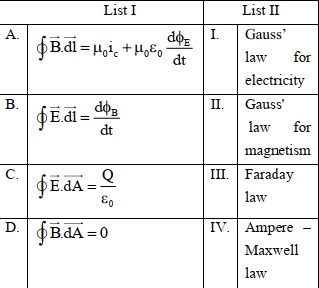
Ampere - Maxwell law\(\rightarrow \oint \overrightarrow{\mathrm{B}} \cdot \overrightarrow{\mathrm{dl}}=\mu_0 i_c+\mu_0 \varepsilon_0 \frac{\mathrm{d} \phi_{\mathrm{E}}}{\mathrm{dt}}\)
Faraday law \(\rightarrow \oint \overrightarrow{\mathrm{E}} \cdot \overrightarrow{\mathrm{dl}}=\frac{\mathrm{d} \phi_{\mathrm{B}}}{\mathrm{dt}}\)
Gauss' law for electricity \(\rightarrow \oint \vec{E} \cdot \overrightarrow{d A}=\frac{Q}{\varepsilon_0}\)
Gauss ' law for magnetism \(\rightarrow \oint \vec{B} \cdot \overrightarrow{d A}=0\)
-
- (A) \((A)-(II), (B)-(I), (C)-(IV), (D)-(III)\)
- (B) \((A)-(III), (B)-(II), (C)-(IV), (D)-(I)\)
- (C) \((A)-(IV), (B)-(III), (C)-(II), (D)-(I)\)
- (D) \((A)-(I), (B)-(III), (C)-(II), (D)-(IV)\)
Show answer and solution
Correct Answer: (B)
Infrared is the least energetic thus having biggest wavelength \((\lambda)\) and gamma rays are most energetic thus having smallest wavelength. -
- (A) \(A-IV, B-I, C-II, D-III\)
- (B) \(A-I, B-II, C-III, D-IV\)
- (C) \(A-III, B-IV, C-I, D-II\)
- (D) \(A-II, B-III, C-IV, D-I\)
Show answer and solution
Correct Answer: (A)
Gauss's Law of electrostatic\(\phi=\oint \overrightarrow{ E } \cdot d \overrightarrow{ s }=\frac{ q }{\epsilon_0}\)
Faraday's law \(\oint \vec{E} \cdot d \vec{l}=\frac{-d \phi_B}{d t}\)
Gauss's law of magnetism \(\oint \overrightarrow{ B } \cdot d \overrightarrow{ A }=0\)
Ampere's Maxwell law
\(\oint \vec{B} . d \vec{l}=\mu_0 i_C+\mu_0 \in_0 \frac{d \phi_E}{d t}\)
Where, \(i_{ C }\) : Conduction current \(\epsilon_0 \frac{ d \phi_{ E }}{ dt }\) : Displacement current
-
- (A) \(\overrightarrow{\mathrm{B}}=\hat{\mathrm{i}} \frac{40}{\mathrm{c}} \cos \omega\left(\mathrm{t}-\frac{\mathrm{z}}{\mathrm{c}}\right)\)
- (B) \(\vec{B}=\hat{j} 40 \cos \omega\left(t-\frac{z}{c}\right)\)
- (C) \(\overrightarrow{\mathrm{B}}=\hat{\mathrm{k}} \frac{40}{\mathrm{c}} \cos \omega\left(\mathrm{t}-\frac{\mathrm{z}}{\mathrm{c}}\right)\)
- (D) \(\vec{B}=\hat{j} \frac{40}{c} \cos \omega\left(t-\frac{z}{c}\right)\)
Show answer and solution
Correct Answer: (D)
\(\overrightarrow{\mathrm{E}}=\hat{\mathrm{i}} 40 \cos \omega\left(\mathrm{t}-\frac{\mathrm{z}}{\mathrm{c}}\right)\)\(\overrightarrow{\mathrm{E}}\) is along \(+\mathrm{x}\) direction
\(\overrightarrow{\mathrm{v}}\) is along \(+\mathrm{z}\) direction
So direction of \(\vec{B}\) will be along +y and magnitude of \(B\) will be \(\frac{E}{C}\)
So answer is \(\frac{40}{c} \cos \omega\left(t-\frac{z}{c}\right) \hat{j}\)
-
- (A) \(\vec{B}=E_0 C \cos (\omega t-k z) \hat{j}\)
- (B) \(\vec{B}=\frac{E_0}{C} \cos (\omega t-k z) \hat{j}\)
- (C) \(\vec{B}=E_0 \operatorname{Cos}(\omega t+k z) \hat{j}\)
- (D) \(\vec{B}=\frac{E_0}{C} \cos (\omega t+k z) \hat{j}\)
Show answer and solution
Correct Answer: (B)
Given \(\vec{E}=E_0 \cos (\omega t-k z) \hat{i}\)\( \vec{B}=\frac{E_0}{C} \cos (\omega t-k z) \hat{j} \)
\( \hat{C}=\hat{E} \times \hat{B}\)
-
- (A) \(\mathrm{E}_{\mathrm{y}}=1.17 \sin \left(1.5 \times 10^3 \mathrm{x}+0.5 \times 10^{11} \mathrm{t}\right) \mathrm{Vm}^1\)
- (B) \(\mathrm{E}_{\mathrm{z}}=105 \sin \left(1.5 \times 10^3 \mathrm{x}+0.5 \times 10^{11} \mathrm{t}\right) \mathrm{Vm}^{-1}\)
- (C) \(\mathrm{E}_z=1.17 \sin \left(1.5 \times 10^5 \mathrm{x}+0.5 \times 10^{11} \mathrm{t}\right) \mathrm{Vm}^{-1}\)
- (D) \(\mathrm{E}_{\mathrm{y}}=10.5 \sin \left(1.5 \times 10^3 \mathrm{x}+0.5 \times 10^{11} \mathrm{t}\right) \mathrm{Vm}^{-1}\)
Show answer and solution
Correct Answer: (B)
\(\mathrm{E}_0=\mathrm{B}_0 \mathrm{C}\)\(\mathrm{E}_0=3 \times 10^8 \times\left(3.5 \times 10^{-7}\right) \sin \left(1.5 \times 10^3 \mathrm{x}+0.5 \times 10^{11} \mathrm{t}\right)\)
\(\mathrm{E}_0=105 \sin \left(1.5 \times 10^3 \mathrm{x}+0.5 \times 10^{11} \mathrm{t}\right) \mathrm{Vm}^{-1}\)
-
- (A) \(\;\frac{{I_o}}{8}\)
- (B) \(\;I_o\)
- (C) \(\;\frac{{I_o}}{2}\)
- (D) \(\;\frac{{I_o}}{4}\)
Show answer and solution
Correct Answer: (D)
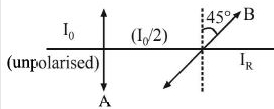
Relation between intensities\(I_{r}=\left(\frac{I_{0}}{2}\right) \cos ^{2}\left(45^{\circ}\right)=\frac{I_{0}}{2} \times \frac{1}{2}=\frac{I_{0}}{4}\)
-
- (A) \(30^{\circ}\)
- (B) \(15^{\circ}\)
- (C) \(60^{\circ}\)
- (D) \(45^{\circ}\)
Show answer and solution
Correct Answer: (C)
For first minima a \(\sin \theta=\lambda\)\(\sin \theta=\frac{\lambda}{\mathrm{a}}=\frac{1}{2}\)
\(\theta=30^{\circ}\)
Angular spread \(=60^{\circ}\)
-
- (A) \(60 \mathrm{~mm}\)
- (B) \(24 \mathrm{~mm}\)
- (C) \(120 \mathrm{~mm}\)
- (D) \(12 \mathrm{~mm}\)
Show answer and solution
Correct Answer: (B)
Linear width\(\mathrm{W} =\frac{2 \lambda \mathrm{d}}{\mathrm{a}}=\frac{2 \times 6 \times 10^{-7} \times 0.2}{1 \times 10^{-5}}\)
\(=2.4 \times 10^{-2}=24 \mathrm{~mm}\)
-
- (A) \(40\)
- (B) \(20\)
- (C) \(30\)
- (D) \(10\)
Show answer and solution
Correct Answer: (C)
For first minima\(\text { a } \sin \theta=\lambda\)
\( \Rightarrow \sin \theta=\frac{\lambda}{a}=\frac{5000 \times 10^{-10}}{1 \times 10^{-6}}=\frac{1}{2} \)
\( \Rightarrow \theta=30^{\circ}\)
-
- (A) \(6\)
- (B) \(8\)
- (C) \(5\)
- (D) \(9\)
Show answer and solution
Correct Answer: (A)
\(\sin \theta=\theta=\frac{2 \lambda}{b}\)\(=\frac{2 \times 600 \times 10^{-9}}{4 \times 10^{-4}}=3 \times 10^{-3} \mathrm{rad}\)
\(\text { Total divergence }=(3+3) \times 10^{-3}=6 \times 10^{-3} \mathrm{rad}\)
-
- (A) \(I_0 / 4\)
- (B) \(I_0\)
- (C) \(I_0 / 2\)
- (D) \(I_0 / 8\)
Show answer and solution
Correct Answer: (A)
Intensity of emergent light\(=\frac{I_0}{2} \cos ^2 45^{\circ}=\frac{I_0}{4}\) -
- (A) \(0.26\)
- (B) \(0.20\)
- (C) \(0.54\)
- (D) \(45\)
Show answer and solution
Correct Answer: (B)
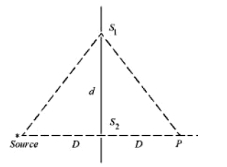
Path difference for minima at \(\mathrm{P}\)\( 2 \sqrt{\mathrm{D}^2+\mathrm{d}^2}-2 \mathrm{D}=\frac{\lambda}{2} \)
\( \therefore \sqrt{\mathrm{D}^2+\mathrm{d}^2}-\mathrm{D}=\frac{\lambda}{4} \)
\( \therefore \sqrt{\mathrm{D}^2+\mathrm{d}^2}=\frac{\lambda}{4}+\mathrm{D} \)
\( \Rightarrow \mathrm{D}^2+\mathrm{d}^2=\mathrm{D}^2+\frac{\lambda^2}{16}+\frac{\mathrm{D} \lambda}{2} \)
\( \Rightarrow \mathrm{d}^2=\frac{\mathrm{D} \lambda}{2}+\frac{\lambda^2}{16}\)
\( \Rightarrow \mathrm{d}^2=\frac{0.2 \times 400 \times 10^{-9}}{2}+\frac{4 \times 10^{-14}}{4} \)
\( \Rightarrow \mathrm{d}^2 \approx 400 \times 10^{-10} \)
\( \therefore \mathrm{d}=20 \times 10^{-5} \)
\( \Rightarrow \mathrm{d}=0.20 \mathrm{~mm}\)
-
- (A) \(5\)
- (B) \(8\)
- (C) \(2\)
- (D) \(16\)
Show answer and solution
Correct Answer: (C)
\( \text {For } n^{\text {th }} \text { minima } \)
\( b \sin \theta=n \lambda \)
\( (\lambda \text { is } \operatorname{small} \text { so } \sin \theta \text { is small, hence } \sin \theta \simeq \tan \theta) \)
\( b \tan \theta=n \lambda \)
\( b \frac{y}{D}=n \lambda \)
\( \Rightarrow y_n=\frac{n \lambda D}{b} \text { (Position of } n^{\text {th }} \text { minima) }\)
\( \mathrm{B} \rightarrow 1^{\mathrm{st}} \text { minima, } \mathrm{A} \rightarrow 3^{\mathrm{rc}} \text { minima } \)
\( \mathrm{y}_3=\frac{3 \lambda \mathrm{D}}{\mathrm{b}}, \mathrm{y}_1=\frac{\lambda \mathrm{D}}{\mathrm{b}} \)
\( \Delta \mathrm{y}=\mathrm{y}_3-\mathrm{y}_1=\frac{2 \lambda \mathrm{D}}{\mathrm{b}} \)
\( 3 \times 10^{-3}=\frac{2 \times 6000 \times 10^{-10} \times 0.5}{\mathrm{~b}} \)
\( \mathrm{~b}=\frac{2 \times 6000 \times 10^{-10} \times 0.5}{3 \times 10^{-3}} \)
\( \mathrm{~b}=2 \times 10^{-4} \mathrm{~m} \)
\( x=2\)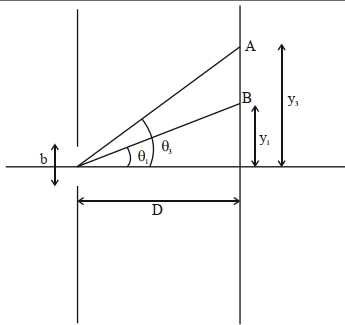
-
- (A) \(272\)
- (B) \(274\)
- (C) \(275\)
- (D) \(277\)
Show answer and solution
Correct Answer: (C)
\(\mathrm{y}=\frac{\lambda \mathrm{D}}{\mathrm{d}}=\frac{550 \times 10^{-9} \times 100 \times 10^{-2}}{0.2 \times 10^{-3}}=275\)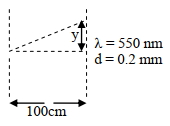
-
- (A) \(197\)
- (B) \(198\)
- (C) \(199\)
- (D) \(200\)
Show answer and solution
Correct Answer: (D)
\(\mathrm{I}=\mathrm{I}_0 \cos ^2\left(\frac{\Delta \phi}{2}\right)\)\(\frac{\mathrm{I}_0}{4}=\cos ^2\left(\frac{\Delta \phi}{2}\right)\)
\(\Delta \phi=\frac{2 \pi}{3}\)
\(\frac{2 \pi}{\lambda}\left(\frac{\mathrm{yd}}{\mathrm{D}}\right)=\frac{2 \pi}{3}\)
\(\mathrm{y}=\frac{\lambda \mathrm{D}}{3 \mathrm{~d}}=\frac{600 \times 10^{-9} \times 1}{3 \times 10^{-3}}=2 \times 10^{-4} \mathrm{~m}\)
-
- (A) \(10\)
- (B) \(15\)
- (C) \(20\)
- (D) \(25\)
Show answer and solution
Correct Answer: (A)
\(\beta=\frac{\lambda \mathrm{D}}{\mathrm{d}}=\frac{5 \times 10^{-7} \times 2}{3 \times 10^{-4}}=\frac{10 \times 10^{-3}}{3} \mathrm{~m}\)For \(3^{\text {rd }}\) maxima \(y_3=3 \beta=10 \times 10^{-3} \mathrm{~m}=10 \mathrm{~mm}\)
-
- (A) \(1 / 2\)
- (B) \(3 / 4\)
- (C) \(1 / 3\)
- (D) \(1 / 4\)
Show answer and solution
Correct Answer: (A)
\( \Delta \mathrm{x}=\frac{7 \lambda}{4} \)\( \phi=\frac{2 \pi}{\lambda} \Delta \mathrm{x}=\frac{2 \pi}{\lambda} \times \frac{7 \lambda}{4}=\frac{7 \pi}{2} \)
\( \mathrm{I}=\mathrm{I}_{\max } \cos ^2\left(\frac{\phi}{2}\right) \)
\( \frac{\mathrm{I}}{\mathrm{I}_{\max }}=\cos ^2\left(\frac{\phi}{2}\right)=\cos ^2\left(\frac{7 \pi}{2 \times 2}\right)=\cos ^2\left(\frac{7 \pi}{4}\right) \)
\(=\cos ^2\left(2 \pi-\frac{\pi}{4}\right) \)
\(=\cos ^2 \frac{\pi}{4} \)
\(=\frac{1}{2}\)
-
- (A) \(121\)
- (B) \(122\)
- (C) \(124\)
- (D) \(125\)
Show answer and solution
Correct Answer: (D)
Let intensity of light on screen due to each slit is \(\mathrm{I}_0\)So internity at centre of screen is \(4 \mathrm{I}_0\)
Intensity at distance y from centre-
\(\mathrm{I}=\mathrm{I}_0+\mathrm{I}_0+2 \sqrt{\mathrm{I}_0 \mathrm{I}_0} \cos \phi\)
\(\mathrm{I}_{\max }=4 \mathrm{I}_0\)
\(\frac{\mathrm{I}_{\max }}{2}=2 \mathrm{I}_0=2 \mathrm{I}_0+2 \mathrm{I}_0 \cos \phi\)
\(\cos \phi=0\)
\(\phi=\frac{\pi}{2}\)
\(\mathrm{~K} \Delta \mathrm{x}=\frac{\pi}{2}\)
\(\frac{2 \pi}{\lambda} \mathrm{d} \sin \theta=\frac{\pi}{2}\)
\(\frac{2}{\lambda} \mathrm{d} \times \frac{\mathrm{y}}{\mathrm{D}}=\frac{1}{2}\)
\(\mathrm{y}=\frac{\lambda \mathrm{D}}{4 \mathrm{~d}}=\frac{5 \times 10^{-7} \times 1}{4 \times 10^{-3}}\)
\(=125 \times 10^{-6}\)
\(=125\)
- 147. Light emerges out of a convex lens when a source of light kept at its focus. The shape of wavefront of the light is _______. 2024 Hard
- (A) Both spherical and cylindrical
- (B) Cylindrical
- (C) Spherical
- (D) Plane
Show answer and solution
Correct Answer: (D)
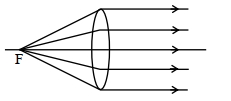
Light emerges parallel\(\therefore\) planor wavefront
-
- (A) \(1\)
- (B) \(2\)
- (C) \(3\)
- (D) \(4\)
Show answer and solution
Correct Answer: (D)
\((\mu-1) \mathrm{t}=\mathrm{n} \lambda\)\((1.5-1) \mathrm{t}=4 \times 500 \times 10^{-9} \mathrm{~m}\)
\(\mathrm{t}=4000 \times 10^{-9} \mathrm{~m}\)
\(\mathrm{t}=4 \mu \mathrm{m}\)
-
- (A) \(2 \mathrm{~mm}\)
- (B) \(2 \mathrm{~cm}\)
- (C) \(0.02 \mathrm{~mm}\)
- (D) \(0.2 \mathrm{~mm}\)
Show answer and solution
Correct Answer: (A)
Width of \(1^{\text {st }}\) secondary maxima \(=\frac{\lambda}{a} \cdot D\)Here
\( a=0.2 \times 10^{-3} \mathrm{~m} \)
\( \lambda=400 \times 10^{-9} \mathrm{~m} \)
\( D=100 \times 10^{-2}\)
Width of \(1^{\text {st }}\) secondary maxima
\( =\frac{400 \times 10^{-9}}{0.2 \times 10^{-3}} \times 100 \times 10^{-2} \)
\( =2 \mathrm{~mm}\)
-
- (A) \(9: 1\)
- (B) \(16: 1\)
- (C) \(1: 1\)
- (D) \(4: 1\)
Show answer and solution
Correct Answer: (A)
Since, Intensity \(\propto\) width of slit \((\omega)\)\(\text { so, } I_1=I, I_2=4 \mathrm{I}\)
\(I_{\min }=\left(\sqrt{I_1}-\sqrt{I_2}\right)^2=I\)
\(I_{\max }=\left(\sqrt{I_1}+\sqrt{I_2}\right)^2=9 \mathrm{I}\)
\(\frac{I_{\max }}{I_{\min }}=\frac{9 \mathrm{I}}{\mathrm{I}}=\frac{9}{1}\)
No questions on this page match these filters.