


Questions
21 questionsShowing 1–21 of 21 questions
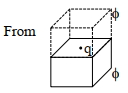
- 1. A charge \(q\) is placed at the center of one of the surface of a cube. The flux linked with the cube is _______. 2024 Hard
- (A) \(\frac{q}{4 \epsilon_0}\)
- (B) \(\frac{q}{2 \epsilon_0}\)
- (C) \(\frac{q}{8 \epsilon_0}\)
- (D) Zero
Show answer and solution
Correct Answer: (B)
\(2 \phi=\frac{q}{\epsilon_0}\)\(\phi=\frac{q}{2 \epsilon_0}\)
-
- (A) \(\mathrm{T}^2=\frac{4 \pi^2 \mathrm{~m}}{2 \mathrm{k} \lambda \mathrm{q}} \mathrm{r}^3\)
- (B) \(T=2 \pi r \sqrt{\frac{m}{2 k \lambda q}}\)
- (C) \(\mathrm{T}=\frac{1}{2 \pi \mathrm{r}} \sqrt{\frac{\mathrm{m}}{2 \mathrm{k} \lambda \mathrm{q}}}\)
- (D) \(\mathrm{T}=\frac{1}{2 \pi} \sqrt{\frac{2 \mathrm{k} \lambda \mathrm{q}}{\mathrm{m}}}\)
Show answer and solution
Correct Answer: (B)
\(\frac{2 \mathrm{k} \lambda \mathrm{q}}{\mathrm{r}}=\mathrm{m} \omega^2 \mathrm{r}\)\(\omega^2=\frac{2 \mathrm{k} \lambda \mathrm{q}}{\mathrm{mr}^2}\)
\(\left(\frac{2 \pi}{\mathrm{T}}\right)^2=\frac{2 \mathrm{k} \lambda \mathrm{q}}{\mathrm{mr}^2}\)
\(\mathrm{~T}=2 \pi \mathrm{r} \sqrt{\frac{\mathrm{m}}{2 \mathrm{k} \lambda \mathrm{q}}}\)
-
- (A) \(7\)
- (B) \(3\)
- (C) \(5\)
- (D) \(6\)
Show answer and solution
Correct Answer: (B)
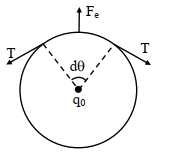
\( 2 \mathrm{~T} \sin \frac{\mathrm{d} \theta}{2}=\frac{\mathrm{kq}_0}{\mathrm{R}^2} \cdot \lambda \mathrm{Rd} \theta \)\( {\left[\lambda=\frac{\mathrm{Q}}{2 \pi \mathrm{R}}\right]}\)
\( \Rightarrow \mathrm{T}=\frac{\mathrm{Kq} \mathrm{q}_0 \mathrm{Q}}{\left(\mathrm{R}^2\right) \times 2 \pi} \)
\( =\frac{\left(9 \times 10^9\right)\left(2 \pi \times 30 \times 10^{-12}\right)}{(0.30)^2 \times 2 \pi} \)
\( =\frac{9 \times 10^{-3} \times 30}{9 \times 10^{-2}}=3 \mathrm{~N}\)
-
- (A) \(12\)
- (B) \(13\)
- (C) \(15\)
- (D) \(16\)
Show answer and solution
Correct Answer: (A)
\(\phi =\overrightarrow{\mathrm{E}} \cdot \overrightarrow{\mathrm{A}}\)\(=\left(\frac{2 \hat{\mathrm{i}}+6 \hat{\mathrm{j}}+8 \hat{\mathrm{k}}}{\sqrt{6}}\right) \cdot 4\left(\frac{2 \hat{\mathrm{i}}+\hat{\mathrm{j}}+\hat{\mathrm{k}}}{\sqrt{6}}\right)\)
\(=\frac{4}{6} \times(4+6+8)=12 \mathrm{Vm}\)
-
- (A) \(13\)
- (B) \(14\)
- (C) \(15\)
- (D) \(16\)
Show answer and solution
Correct Answer: (D)
\(\overrightarrow{\mathrm{E}}=2 x \hat{\mathrm{i}}\)
\(\phi=\overrightarrow{\mathrm{E}} \cdot \overrightarrow{\mathrm{A}}\)
\(\phi_{\text {in }}=-4 \times 4=-16 \mathrm{Nm}^2 / \mathrm{c}\)
\(\phi_{\text {out }}=8 \times 4=32 \mathrm{Nm}^2 / \mathrm{c}\)
\(d_{\text {net }}=\phi_{\text {in }} \phi_{\text {out }}=-16+32=16 \mathrm{Nm}^2\)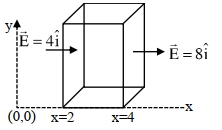
-
- (A) \(90\)
- (B) \(150\)
- (C) \(180\)
- (D) \(60\)
Show answer and solution
Correct Answer: (C)
\( \overrightarrow{\mathrm{E}}=6 \hat{\mathrm{i}}+5 \hat{\mathrm{j}}+3 \hat{\mathrm{k}}\)\( \overrightarrow{\mathrm{A}}=30 \hat{\mathrm{i}} \)
\( \phi=\overrightarrow{\mathrm{E}} \cdot \overrightarrow{\mathrm{A}} \)
\( \phi=(6 \hat{\mathrm{i}}+5 \hat{\mathrm{j}}+3 \hat{\mathrm{k}}) \cdot(30 \hat{\mathrm{i}}) \)
\( \phi=6 \times 30=180\)
-
- (A) 2
- (B) 4
- (C) 6
- (D) 8
Show answer and solution
Correct Answer: (D)
\(u=1 m / s ; a=-\frac{\sigma e}{2 \epsilon_0 m}\)
\(t=1 s\)
\(S=-1 m\)
Using \(S=u t+\frac{1}{2} a t^2\)
\(-1=1 \times 1-\frac{1}{2} \times \frac{\sigma e}{2 \epsilon_0 m} \times(1)^2\)
\(\therefore \sigma=8 \frac{\epsilon_e m}{e}\)
\(\therefore \alpha=8\) -
- (A) \(16\)
- (B) \(20\)
- (C) \(23\)
- (D) \(30\)
Show answer and solution
Correct Answer: (A)
Explanation:
Let us calculate the ratio of the electric fields step-by-step based on the Electric Charges and Fields chapter of the NCERT Class 12 Physics textbook:
Step 1: Electric field due to an infinite plane sheet of charge (\(E_s\))
The magnitude of the electric field produced by an infinite plane sheet of charge with uniform surface charge density \(\sigma_s\) at any given point is independent of its distance from the sheet and is expressed as:
\(E_s = \frac{\sigma_s}{2\varepsilon_0}\)
Step 2: Electric field due to an infinitely long straight line charge (\(E_l\))
The magnitude of the electric field produced by an infinitely long line charge with uniform linear charge density \(\lambda_e\) at a perpendicular distance \(r\) from the line is given by:
\(E_l = \frac{\lambda_e}{2\pi\varepsilon_0 r}\)
Step 3: Determine the perpendicular distance (\(r\)) from the line charge to the point
- The infinite sheet lies on the flat \(x-y\) plane where \(z = 0\).
- The line charge is parallel to the \(y\)-axis on the \(z = 4\text{ m}\) plane, meaning it effectively passes through the cross-section coordinates \(x = 0, z = 4\text{ m}\).
- The target test point is located at \((0,0,2)\), where \(z = 2\text{ m}\).
Thus, the absolute perpendicular distance \(r\) from the line charge to the test point is:
\(r = |4 - 2| = 2\text{ m}\)
Step 4: Calculate the ratio of the magnitudes of the electric fields
Taking the ratio of the sheet's field strength (\(E_s\)) to the line's field strength (\(E_l\)):
\(\frac{E_s}{E_l} = \frac{\left(\frac{\sigma_s}{2\varepsilon_0}\right)}{\left(\frac{\lambda_e}{2\pi\varepsilon_0 r}\right)} = \frac{\sigma_s \cdot \pi r}{\lambda_e}\)
Substituting the given relationship \(|\sigma_s| = 2|\lambda_e|\) and the calculated distance \(r = 2\text{ m}\) into the equation:
\(\frac{E_s}{E_l} = \frac{(2\lambda_e) \cdot \pi \cdot 2}{\lambda_e} = 4\pi = \frac{4\pi}{1}\)
Step 5: Compute the final value of \(n\)
We are given that this field magnitude ratio is equal to \(\pi\sqrt{n} : 1\):
\(\pi\sqrt{n} = 4\pi\)
\(\sqrt{n} = 4\)
Squaring both sides of the relation yields:
\(n = 16\)
Hence, Option A is the correct choice.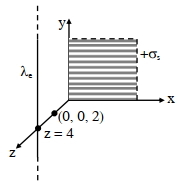
-
- (A) \(2: 5\)
- (B) \(5: 2\)
- (C) \(2: 3\)
- (D) \(3: 2\)
Show answer and solution
Correct Answer: (A)
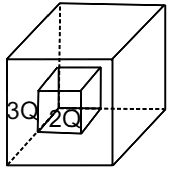
Flux through \(C_1, \phi_1=\frac{q_{\text {in }}}{\varepsilon_0}=\frac{2 Q}{\varepsilon_0}\)
Flux through \(C_2, \phi_2=\frac{q_{\text {in }}}{\varepsilon_0}=\frac{2 Q+3 Q}{\varepsilon_0}=\frac{5 Q}{\varepsilon_0}\)
\(\frac{C_1}{C_2}=\frac{\phi_1}{\phi_2}=\frac{2 Q / \varepsilon_0}{5 Q / \varepsilon_0}=\frac{2}{5}\) -
- (A) \(\frac{5 q}{\epsilon_0}\)
- (B) \(\frac{4 q}{\epsilon_0}\)
- (C) \(\frac{3 q}{\epsilon_0}\)
- (D) \(\frac{q}{\epsilon_0}\)
Show answer and solution
Correct Answer: (B)
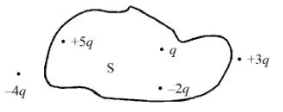
As per gauss theorem,\(\phi=\frac{q_{\text {in }}}{\epsilon_0}=\frac{q+(-2 q)+5 q}{\epsilon_0}\)
\(\frac{4 \mathrm{q}}{\epsilon_0}\)
-
- (A) \(F / 25\)
- (B) \(5 \mathrm{~F}\)
- (C) \(F / 5\)
- (D) \(25 \mathrm{~F}\)
Show answer and solution
Correct Answer: (B)
In air \(F=\frac{1}{4 \pi \epsilon_0} \frac{q_1 q_2}{r_2}\)In medium
\(F^{\prime}=\frac{1}{4 \pi\left(K \epsilon_0\right)} \frac{q_1 q_2}{\left(r^{\prime}\right)^2}=\frac{25}{4 \pi\left(5 \epsilon_0\right)} \frac{q_1 q_2}{(r)^2}=5 F\)
-
- (A) \(2\)
- (B) \(3\)
- (C) \(5\)
- (D) \(6\)
Show answer and solution
Correct Answer: (C)
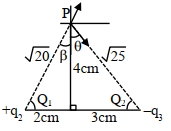
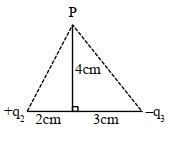
\(\frac{\mathrm{Kq}_2}{20} \cos \beta=\frac{\mathrm{Kq}_3}{25} \cos \theta\)\(\frac{\mathrm{Kq}_2}{20} \frac{4}{\sqrt{20}}=\frac{\mathrm{Kq}_3}{25} \frac{4}{\sqrt{25}}\)
\(\frac{\mathrm{q}_2}{\mathrm{q}_3}=\frac{20}{25} \sqrt{\frac{20}{25}}=\frac{8}{5 \sqrt{\mathrm{x}}}\)
\(\Rightarrow \sqrt{\mathrm{x}}=\frac{8 \times 25 \sqrt{25}}{5 \times 20 \sqrt{20}}\)
\(\mathrm{x}=5\)
-
- (A) \(10^{39}\)
- (B) \(10^{19}\)
- (C) \(10^{29}\)
- (D) \(10^{36}\)
Show answer and solution
Correct Answer: (A)
\(\mathrm{F}_{\mathrm{e}}=\frac{\mathrm{kQ}_1 \mathrm{Q}_2}{\mathrm{r}^2}=\frac{9 \times 10^9 \times 1.6 \times 10^{-19} \times 1.6 \times 10^{-19}}{\mathrm{r}^2}\)\(\frac{\mathrm{Gm}_1 \mathrm{~m}_2}{\mathrm{r}^2}=\frac{6.67 \times 10^{-11} \times 9.1 \times 10^{-51} \times 1.6 \times 10^{-2 /}}{\mathrm{r}^2}\)
\(\frac{\mathrm{F}_{\mathrm{e}}}{\mathrm{F}_{\mathrm{g}}} \cong 0.23 \times 10^{40} \cong 2.3 \times 10^{39}\)
Option \((1)\)
-
- (A) \(\sigma / \epsilon_0 R\)
- (B) \(\sigma / 2 \in_0\)
- (C) \(\sigma / \epsilon_0\)
- (D) \(\sigma / 4 \in_0\)
Show answer and solution
Correct Answer: (C)
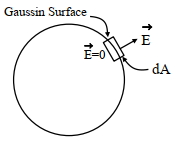
By Gauss law \(\int \vec{E} \cdot d \vec{A}=\frac{q_{\text {in }}}{\varepsilon_0}\)\(\mathrm{EdA}=\frac{\sigma \times \mathrm{dA}}{\varepsilon_0}\)
\(\mathrm{E}=\frac{\sigma}{\varepsilon_0}\)
-
- (A) \(2\)
- (B) \(3\)
- (C) \(4\)
- (D) \(5\)
Show answer and solution
Correct Answer: (B)
\(\sin \theta=\frac{10}{20}=\frac{1}{2}\)\(\theta=30^{\circ}\)
\(\tan \theta=\frac{\mathrm{qE}}{\mathrm{mg}}\)
\(\tan 30^{\circ}=\frac{\mathrm{q} \times 2 \times 10^4}{1 \times 10^{-3} \times 10}\)
\(\frac{1}{\sqrt{3}}=\mathrm{q} \times 10^6\)
\(\mathrm{q}=\frac{1}{\sqrt{3}} \times 10^{-6} \mathrm{C}\)
\(x=3\)
-
- (A) 8
- (B) 10
- (C) 12
- (D) 14
Show answer and solution
Correct Answer: (A)
Potential \(=\frac{k Q}{R}=\frac{k \cdot Z e}{R}\)
\(=\frac{9 \times 10^9 \times 50 \times 1.6 \times 10^{-19}}{9 \times 10^{-13} \times 10^{-2}}\)
\(=8 \times 10^6 V\) -
- (A) \(1\)
- (B) \(2\)
- (C) \(5\)
- (D) \(6\)
Show answer and solution
Correct Answer: (B)
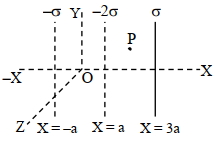
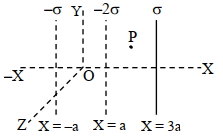
\(\overrightarrow{\mathrm{E}}_{\mathrm{p}}=\left(\frac{\sigma}{2 \varepsilon_0}+\frac{2 \sigma}{2 \varepsilon_0}+\frac{\sigma}{2 \varepsilon_0}\right)(-\hat{\mathrm{i}})\)\(=-\frac{2 \sigma}{\varepsilon_0} \hat{\mathrm{i}}\)
-
- (A) \(7\)
- (B) \(2\)
- (C) \(11\)
- (D) \(14\)
Show answer and solution
Correct Answer: (B)
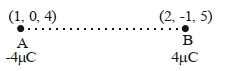
\( \vec{\tau}=\vec{p} \times \vec{E} \)\( \vec{p}=q \vec{\ell} \)
\( \vec{E}=0.2 \frac{V}{\mathrm{~cm}}=20 \frac{\mathrm{V}}{\mathrm{m}} \)
\( \vec{p}=4 \times(\hat{i}-\hat{j}+\hat{k}) \)
\( =(4 \hat{i}-4 \hat{j}+4 \hat{k}) \mu \mathrm{C}-\mathrm{m} \)
\( \vec{\tau}=(4 \hat{i}-4 \hat{j}+4 \hat{k}) \times(20 \hat{i}) \times 10^{-6} \mathrm{Nm} \)
\( =(8 \hat{\mathrm{k}}+8 \hat{\mathrm{j}}) \times 10^{-5}=8 \sqrt{2} \times 10^{-5} \)
\( \alpha=2\)
-
- (A) \(\frac{2 Q}{\varepsilon_0}\)
- (B) \(\frac{5 \mathrm{Q}}{\varepsilon_0}\)
- (C) \(\frac{7 Q}{\varepsilon_0}\)
- (D) \(\frac{3 Q}{\varepsilon_0}\)
Show answer and solution
Correct Answer: (B)
\(5 \mathrm{Q}\) charge is inside the spherical region flux through sphere \(=\frac{5 \mathrm{Q}}{\varepsilon_0}\)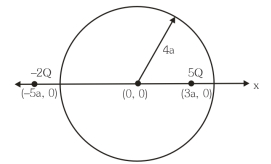
-
- (A) \(\frac{(1+\sqrt{3})}{r}\)
- (B) \(\frac{\mathrm{r}}{3(1+\sqrt{3})}\)
- (C) \(\frac{r}{(1+\sqrt{3})}\)
- (D) \(r(1+\sqrt{3})\)
Show answer and solution
Correct Answer: (C)
\(\left(\vec{E}_{\text {net }}\right)_p=0\)\(\frac{\mathrm{kq}}{\mathrm{x}^2}=\frac{\mathrm{k} \cdot 3 \mathrm{q}}{(\mathrm{r}-\mathrm{x})^2}\)
\((\mathrm{r}-\mathrm{x})^2=3 \mathrm{x}^2\)
\(\mathrm{r}-\mathrm{x}=\sqrt{3} \mathrm{x}\)
\(\mathrm{x}=\frac{\mathrm{r}}{\sqrt{3}+1}\)

-
- (A) \(4 \mathrm{~N}\)
- (B) \(6 \mathrm{~N}\)
- (C) \(1 \mathrm{~N}\)
- (D) \(12 \mathrm{~N}\)
Show answer and solution
Correct Answer: (B)
\(F_{P S} \propto Q^2\)
\(F_{P S}=16 N\)
Now If \(\mathrm{P} \& \mathrm{R}\) are brought in contact then
Now If \(\mathrm{S} \& \mathrm{R}\) are brought in contact then
New force between \(P \& S\) is :
\(\mathrm{F}_{\mathrm{PS}} \propto \frac{\mathrm{Q}}{2} \times \frac{3 \mathrm{Q}}{4}\)
\(\mathrm{~F}_{\mathrm{PS}} \propto \frac{3 \mathrm{Q}^2}{8}=\frac{3}{8} \times 16=6\)
No questions on this page match these filters.