


Questions
20 questionsShowing 1–20 of 20 questions
-
- (A) \(\sqrt{6} \mathrm{~m}\)
- (B) \(2 \mathrm{~m}\)
- (C) \(1 \mathrm{~m}\)
- (D) \(\sqrt{5} \mathrm{~m}\)
Show answer and solution
Correct Answer: (B)
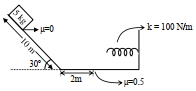
\(\mathrm{w}_{\mathrm{g}}+\mathrm{w}_{\mathrm{FT}}+\mathrm{w}_{\mathrm{s}}=\Delta \mathrm{KE}\)\(5 \times 10 \times 5-0.5 \times 5 \times 10 \times \mathrm{x}-\frac{1}{2} \mathrm{Kx}^2=0-0\)
\(250=25 \mathrm{x}+50 \mathrm{x}^2\)
\(2 \mathrm{x}^2+\mathrm{x}-10=0\)
\(\mathrm{x}=2\)
-
- (A) \(5 \sqrt{3} \mathrm{~J}\)
- (B) \(5 \mathrm{~J}\)
- (C) \(5 \times 10^3 \mathrm{~J}\)
- (D) \(10 \mathrm{~J}\)
Show answer and solution
Correct Answer: (B)
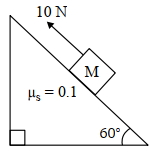
Work done against frictional force
\(=\mu \mathrm{N} \times 10\)
\(=0.1 \times 5 \times 10=5 \mathrm{~J}\) -
- (A) \(4200\)
- (B) \(3900\)
- (C) \(4000\)
- (D) \(4500\)
Show answer and solution
Correct Answer: (C)
Given \(\mathrm{m}=100 \mathrm{~kg}\)\( \mathrm{s}=10 \mathrm{~m} \)
\( \mu=0.4\)
As \(\mathrm{f}=\mu \mathrm{mg}=0.4 \times 100 \times 10=400 \mathrm{~N}\)
Now \(W=f . s=400 \times 10=4000 \mathrm{~J}\)
-
- (A) \(3:2\)
- (B) \(5:1\)
- (C) \(2:5\)
- (D) \(1:5\)
Show answer and solution
Correct Answer: (B)
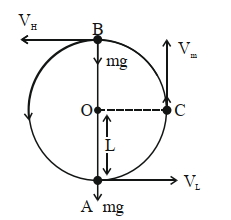
Apply energy conservation between \(A\) & \(B\)\( \frac{1}{2} \mathrm{mV}_{\mathrm{L}}^2=\frac{1}{2} \mathrm{mV}_{\mathrm{H}}^2+\mathrm{mg}(2 \mathrm{~L}) \)
\( \because \mathrm{V}_{\mathrm{L}}=\sqrt{5 \mathrm{gL}}\)
So, \(\mathrm{V}_{\mathrm{H}}=\sqrt{\mathrm{gL}}\)
\(\frac{(\mathrm{K} . \mathrm{E})_{\mathrm{A}}}{(\mathrm{K} . \mathrm{E})_{\mathrm{B}}}=\frac{\frac{1}{2} \mathrm{~m}(\sqrt{5 \mathrm{gL}})^2}{\frac{1}{2} \mathrm{~m}(\sqrt{\mathrm{gL}})^2}=\frac{5}{1}\)
-
- (A) \(t^2\)
- (B) \(\mathrm{t}^{2 / 3}\)
- (C) \(t^{3 / 2}\)
- (D) \(\mathrm{t}\)
Show answer and solution
Correct Answer: (C)
\(\mathrm{P}=\text { costant } \Rightarrow \mathrm{FV}=\text { constant }\)\(\Rightarrow \mathrm{m} \frac{\mathrm{dV}}{\mathrm{dt}} \mathrm{V}=\text { constant }\)
\(\int_0^{\mathrm{V}} \mathrm{VdV}=(\mathrm{C}) \int_0^{\mathrm{t}} \mathrm{dt}\)
\(\left(\frac{\mathrm{V}^2}{2}\right)=\mathrm{Ct}\)
\(\mathrm{V} \propto \mathrm{t}^{1 / 2}\)
\(\frac{\mathrm{ds}}{\mathrm{dt}} \propto \mathrm{t}^{1 / 2}\)
\(\int_0^{\mathrm{s}} \mathrm{ds}=\mathrm{K} \int_0^{\mathrm{t}} \mathrm{t}^{1 / 2} \mathrm{dt}\)
\(\mathrm{S}=\mathrm{K} \times \frac{2}{3} \mathrm{t}^{3 / 2}\)
\(\mathrm{~S} \propto \mathrm{t}^{3 / 2}\)
\(\therefore \text { displacement is proportional to }(\mathrm{t})^{3 / 2}\)
-
- (A) \(19.8 \mathrm{~m} / \mathrm{s}\)
- (B) \(21.9 \mathrm{~m} / \mathrm{s}\)
- (C) \(16.7 \mathrm{~m} / \mathrm{s}\)
- (D) \(10.6 \mathrm{~m} / \mathrm{s}\)
Show answer and solution
Correct Answer: (B)
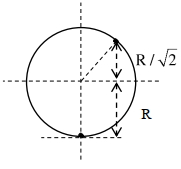
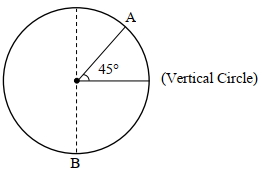
Apply \(W.E.T.\) from \(A\) to \(B\)\(\Rightarrow \mathrm{W}_{\mathrm{mg}}=\mathrm{K}_{\mathrm{B}}-\mathrm{K}_{\mathrm{A}}\)
\(\Rightarrow \mathrm{mg} \times\left(\frac{\mathrm{R}}{\sqrt{2}}+\mathrm{R}\right)=\frac{1}{2} \mathrm{mv}_{\mathrm{B}}^2-0\left\{\mathrm{v}_{\mathrm{A}}=0 \text { rest }\right\}\)
\(\Rightarrow \mathrm{mgR} \frac{(\sqrt{2}+1)}{\sqrt{2}}=\frac{1}{2} \mathrm{mv}_{\mathrm{B}}^2\)
\(\Rightarrow \sqrt{\mathrm{gR} \frac{2(\sqrt{2}+1)}{\sqrt{2}}}=\mathrm{v}_{\mathrm{B}}\)
\(\Rightarrow \sqrt{\frac{10 \times 14 \times 2(2.4)}{1.4}}=\mathrm{v}_{\mathrm{B}}\)
\(\Rightarrow 21.9=\mathrm{v}_{\mathrm{B}}\)
Hence option \((2)\) is correct
-
- (A) \(\left(6 t^4+9 t^5\right)\ \mathrm{W}\)
- (B) \(\left(3 t^3+6 t^5\right)\ W\)
- (C) \(\left(9 t^5+6 t^3\right)\ \mathrm{W}\)
- (D) \(\left(9 t^3+6 t^5\right)\ W\)
Show answer and solution
Correct Answer: (D)
\(\overrightarrow{\mathrm{F}}=\left(6 \mathrm{t} \hat{\mathrm{i}}+6 \mathrm{t}^2 \hat{\mathrm{j}}\right) \mathrm{N}\)\(\overrightarrow{\mathrm{F}}=\mathrm{ma}=\left(6 \mathrm{t}+6 \mathrm{t}^2 \hat{\mathrm{j}}\right)\)
\(\overrightarrow{\mathrm{a}}=\frac{\overrightarrow{\mathrm{F}}}{\mathrm{m}}=\left(3 \mathrm{t}+3 \mathrm{t}^2 \hat{\mathrm{j}}\right)\)
\(\overrightarrow{\mathrm{v}}=\int_0^{\mathrm{t}} \overrightarrow{\mathrm{a}} d \mathrm{~d}=\frac{3 \mathrm{t}^2}{2} \hat{\mathrm{i}}+\mathrm{t}^3 \hat{\mathrm{j}}\)
\(\mathrm{P}=\overrightarrow{\mathrm{F}} \cdot \overrightarrow{\mathrm{v}}=\left(9 \mathrm{t}^3+6 \mathrm{t}^5\right) \mathrm{W}\)
-
- (A) \(1: 1\)
- (B) \(2: 1\)
- (C) \(\sqrt{3}: 2\)
- (D) \(1: 2\)
Show answer and solution
Correct Answer: (A)
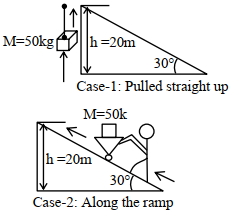
Work done by gravity is independent of path. It depends only on vertical displacement so work done in both cases will be same.Option \((1)\) is correct
-
- (A) \(2\)
- (B) \(3\)
- (C) \(4\)
- (D) \(5\)
Show answer and solution
Correct Answer: (A)
Total time of flight \(=\mathrm{T}\)
\(T=\sqrt{\frac{2 h}{g}}+\sqrt{\frac{2(H-h)}{g}}\)
For \(\max\) time \(=\frac{d T}{d h}=0\)
\(\sqrt{\frac{2}{g}}\left(\frac{-1}{2 \sqrt{\mathrm{H}-\mathrm{h}}}+\frac{1}{2 \sqrt{\mathrm{h}}}\right)=0\)
\(\sqrt{\mathrm{H}-\mathrm{h}}=\sqrt{\mathrm{h}}\)
\(\mathrm{h}=\frac{\mathrm{H}}{2} \Rightarrow \frac{\mathrm{H}}{\mathrm{h}}=2\)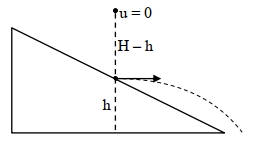
-
- (A) \(32 \%\)
- (B) \(44 \%\)
- (C) \(16 \%\)
- (D) \(84 \%\)
Show answer and solution
Correct Answer: (D)
\(\mathrm{K}_{\mathrm{i}} =\frac{1}{2} \mathrm{~m}(100)^2\)\(\mathrm{~K}_{\mathrm{f}} =\frac{1}{2} \mathrm{~m}(40)^2\)
\(\% \text { loss }=\frac{\left|\mathrm{K}_{\mathrm{f}}-\mathrm{K}_{\mathrm{i}}\right|}{\mathrm{K}_{\mathrm{i}}} \times 100\)
\(=\frac{\left|\frac{1}{2} \mathrm{~m}(40)^2-\frac{1}{2} \mathrm{~m}(100)^2\right|}{\frac{1}{2} \mathrm{~m}(100)^2} \times 100\)
\(=\frac{|1600-100 \times 100|}{100}=84 \%\)
-
- (A) \(58\)
- (B) \(59\)
- (C) \(60\)
- (D) \(61\)
Show answer and solution
Correct Answer: (A)
\(\mathrm{W}=\int_{\mathrm{x}_1}^{\mathrm{x}_2} \mathrm{Fdx}\)\(\mathrm{W}=\int_2^4\left(3 \mathrm{x}^2+2 \mathrm{x}-5\right) \mathrm{dx}\)
\(\mathrm{W}=\left[\mathrm{x}^3+\mathrm{x}^2-5 \mathrm{x}\right]_2^4\)
\(\mathrm{~W}=[60-2] \mathrm{J}=58 \mathrm{~J}\)
-
- (A) \(20 \mathrm{~m} / \mathrm{s}\)
- (B) \(\sqrt{10} \mathrm{~m} / \mathrm{s}\)
- (C) \(2 \sqrt{10} \mathrm{~m} / \mathrm{s}\)
- (D) \(10 \mathrm{~m} / \mathrm{s}\)
Show answer and solution
Correct Answer: (B)
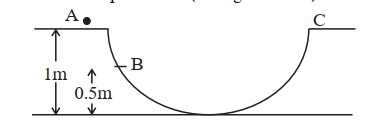
By COME
\( \mathrm{KE}_{\mathrm{A}}+\mathrm{U}_{\mathrm{A}}=\mathrm{KE}_{\mathrm{B}}+\mathrm{U}_{\mathrm{B}} \)
\( 0+\mathrm{mg}(1)=\frac{1}{2} \mathrm{mv}^2+\mathrm{mg} \times 0.5 \)
\( v=\sqrt{g}=\sqrt{10} \mathrm{~m} / \mathrm{s}\) -
- (A) \(\frac{\mathrm{m}}{2 \alpha^2 \mathrm{~d}}\)
- (B) \(\frac{\mathrm{md}}{2 \alpha^2}\)
- (C) \(\frac{m \alpha^2 d}{2}\)
- (D) \(2 m \alpha^2 d\)
Show answer and solution
Correct Answer: (C)
\(\mathrm{v}=\alpha \sqrt{\mathrm{x}}\)\(\text { at } \mathrm{x}=0: \mathrm{v}=0\)
\(\&\text { at } \mathrm{x}=\mathrm{d} ; \mathrm{v}=\alpha \sqrt{\mathrm{d}}\)
\(\text { W.D }=\mathrm{K}_1-\mathrm{K}_{\mathrm{i}}\)
\(\text { W.D }=\frac{1}{2} \mathrm{~m}(\alpha \sqrt{\mathrm{d}})^2-\frac{1}{2} \mathrm{~m}(0)^2\)
\(\Rightarrow \text { W.D }=\frac{\mathrm{m} \alpha^2 \mathrm{~d}}{2}\)
-
- (A) \(v_B: v_A\)
- (B) \(m_B: m_A\)
- (C) \(m_B v_B: m_A v_A\)
- (D) \(1: 1\)
Show answer and solution
Correct Answer: (A)
Initial momentum is zero.\(\text { Hence }\left|P_A\right|=\left|P_B\right|\)
\(\Rightarrow m_A v_B=m_B v_B\)
\(\frac{(\mathrm{KE})_A}{(\mathrm{KE})_B}=\frac{\frac{1}{2} m_A v_A^2}{\frac{1}{2} m_B v_B^2}=\frac{v_A}{v_B}\)
\(\frac{(\mathrm{KE})_B}{(\mathrm{KE})_A}=\frac{v_B}{v_A}\)
-
- (A) \(3\)
- (B) \(8\)
- (C) \(4\)
- (D) \(5\)
Show answer and solution
Correct Answer: (D)
\(3=K(a-\ell)\)\(2=K(b-\ell)\)
\(T=K(3 a-2 b-\ell)\)
\(T=K(3(a-\ell)-2(b-\ell)\)
\(=K\left[3\left(\frac{3}{K}\right)-2\left(\frac{2}{K}\right)\right]\)
\(=9-4\)
\(=5 \mathrm{~N}\)
-
- (A) \(\mathrm{D}\)
- (B) \(\mathrm{C}\)
- (C) \(\mathrm{A}\)
- (D) \(B\)
Show answer and solution
Correct Answer: (C)
\(\mathrm{KE}=\frac{\mathrm{p}^2}{2 \mathrm{~m}}\)Same momentum, so less mass means more \(\mathrm{KE}\).
So \(\frac{\mathrm{m}}{2}\) will have \(\max\). \(\mathrm{KE}\).
-
- (A) \(50 \%, \sqrt{\frac{\mathrm{gh}}{2}}\)
- (B) \(50 \%, \sqrt{\mathrm{gh}}\)
- (C) \(40 \%, \sqrt{2 \mathrm{gh}}\)
- (D) \(50 \%, \sqrt{2 \mathrm{gh}}\)
Show answer and solution
Correct Answer: (D)
\(\text { Velocity just before collision }=\sqrt{2 \mathrm{gh}}\)\(\text { Velocity just after collision }=\sqrt{2 \mathrm{~g}\left(\frac{\mathrm{h}}{2}\right)}\)
\(\therefore \Delta \mathrm{KE}=\frac{1}{2} \mathrm{~m}(2 \mathrm{gh})-\frac{1}{2} \mathrm{mgh}\)
\(=\frac{1}{2} \mathrm{mgh}\)
\(\therefore \% \text { loss in energy }\)
\(=\frac{\Delta \mathrm{KE}}{\mathrm{KE}_{\mathrm{i}}} \times 100=\frac{\frac{1}{2} \mathrm{mgh}}{\frac{1}{2} \mathrm{mg} 2 \mathrm{~h}} \times 100=50 \%\)
Hence option \((4)\)
-
- (A) \(2\)
- (B) \(6\)
- (C) \(4\)
- (D) \(8\)
Show answer and solution
Correct Answer: (C)
Given \(\mathrm{U}=2 \mathrm{x}^2+3 \mathrm{y}^3+2 \mathrm{z}\)\(\mathrm{F}_{\mathrm{x}}=-\frac{\partial \mathrm{U}}{\partial \mathrm{x}}=-4 \mathrm{x}\)
At \(x=1\) magnitude of \(F_x\) is \(4 \mathrm{~N}\)
-
- (A) \(1: \sqrt{3}: 2\)
- (B) \(1: \sqrt{3}: \sqrt{2}\)
- (C) \(\sqrt{2}: \sqrt{3}: 1\)
- (D) \(\sqrt{3}: \sqrt{2}: 1\)
Show answer and solution
Correct Answer: (A)
\(\mathrm{KE}=\frac{\mathrm{P}^2}{2 \mathrm{~m}}\)\(\mathrm{P} \propto \sqrt{\mathrm{m}}\)
\(\text { Hence, } \mathrm{P}_{\mathrm{A}}: \mathrm{P}_{\mathrm{B}}: \mathrm{P}_{\mathrm{C}}\)
\(=\sqrt{400}: \sqrt{1200}: \sqrt{1600}=1: \sqrt{3}: 2\)
-
- (A) \(500 \%\)
- (B) \(600 \%\)
- (C) \(6 \%\)
- (D) \(60 \%\)
Show answer and solution
Correct Answer: (A)
\(\text { Kinetic energy }(\mathrm{K})=\frac{\mathrm{P}^2}{2 \mathrm{~m}}\)\(\Rightarrow \mathrm{P}=\sqrt{2 \mathrm{mK}}\)
\(\text { If } \mathrm{K}_{\mathrm{f}}=36 \mathrm{~K}_{\mathrm{i}}\)
\(\text { So, } \mathrm{P}_{\mathrm{f}}=6 \mathrm{P}_{\mathrm{i}}\)
\(\% \text { increase in momentum }=\frac{P_f-P_i}{P_i} \times 100 \%\)
\(=\frac{6 \mathrm{P}_{\mathrm{i}}-\mathrm{P}_{\mathrm{i}}}{\mathrm{P}_{\mathrm{i}}} \times 100 \%\)
\(=500 \%\)
No questions on this page match these filters.